Location of R&D activities by vertical multinationals over asymmetric
countries
Carlos Eduardo Lobo e Silva and José Pedro Pontes
REM Working Paper 012-2017
November 2017
REM – Research in Economics and Mathematics
Rua Miguel Lúpi 20,
1249-078 Lisboa,
Portugal
ISSN 2184-108X
Any opinions expressed are those of the authors and not those of REM. Short, up to two paragraphs can be cited provided that full credit is given to the authors.
Location of R&D activities by vertical
multinationals over asymmetric
countries
Authors: Carlos Eduardo Lobo e Silva1 and José Pedro Pontes2
Date: 06/11/2017
Abstract: This paper deals with the location of R&D by vertical multinational firms. By taking the colocation of laboratories and productive plants as a benchmark, we can see that the spatial separation of both emerges under two conditions – high intensity of R&D spillovers and strong size asymmetry between countries. The latter condition is effective since it is related with a rising international inequality of wages. If the spatial separation of R&D and
manufacturing takes place, headquarters services (namely R&D units) will be likely located in the smaller country. The converse pattern, where laboratories are place in the larger country, may arise if production is high-tech and the localized externalities of research activity are strong. Hence, this article confirms the main results of the literature on this topic but in the context of a different framework which allows us to tackle two usually disregarded topics: the transfer cost of technology; and the direct engagement of industrial workers in R&D spillovers. These aspects are dealt with by presupposing that, in addition to a “technological” externality among researchers, there is an “educational” externality exerted by researchers upon
neighbouring industrial workers. When a country loses its laboratories, the inhabitants become intellectually “impoverished” and their labour starts to have a lesser efficiency. J.E.L. Classification: F23; O32; R12.
Keywords: Location of R&D; Vertical Multinationals; Spillovers; Nash Equilibria in a Large Group of Agents.
Acnowledgements: The authors wish to thank Miguel St. Aubyn for helpful comments. The usual disclaimer applies. This article had the support of UECE (Research Unit on Complexity and
Economics) which is financially supported by FCT (Fundação para a Ciência e a Tecnologia),
Portugal. This article is part of the Strategic Project (UID/ECO/00436/2013).
1 Pontifícia Universidade Católica do Rio Grande do Sul, Porto Alegre, Brasil.
2 ISEG – School of Economics and Management, Universidade de Lisboa and REM – Research in
Economics and Mathematics, UECE - Research Unit on Complexity and Economics (UECE). Correspondent Author: [email protected].
1.
Introduction
The location of R&D units is a subject which is scarcely dealt with. The dominant perception in this field is that research laboratories tend to be collocated with productive plants, in
particular when the productive activity is basically high-tech.
However, multinational firms often set up high-tech production and R&D in different
countries. Two examples of this kind of spatial separation are Sweden (which has a lot of R&D activity and comparatively few high-tech production) and Ireland (where the opposite relation holds).
The location of R&D activities is a part of the overall spatial strategy of multinational firms. In particular, it is closely connected with the location of the so called vertical multinationals (as in HELPMAN, 1984), a situation with zero trade costs in spite of the fact that there are economies of scale in the productive activity. In this case, R&D activities (and other headquarters services) may show either of two spatial patterns. 3
They may either collocate with the plant if trade alone equalizes the prices of productive factors across countries. Or they may separate spatially from manufacturing through locating in a different country. The latter possibility arises if the relative factor endowments of the two countries are so opposed that trade is per se unable to equalize the factor costs across
countries. In this situation, the firm locates each stage (R&D, manufacturing) in the country which is relatively abundant in the kind of input that this stage uses more intensively. The forecasts of the vertical multinational firm are rather limited. All in all it amounts to say that R&D tends to locate in the country where human capital is available in larger quantities, the distribution of this input across countries being presupposed rather than explained by the model. Models where growth is led by the production of “blueprints” of differentiated consumer goods, such as MARTIN and OTTAVIANO (1999), are based on a given and fixed initial distribution of researchers across countries, although the manufacturing of each brand is not necessarily tied to the country where the product “idea” was initially conceived.
By assuming that trade costs are positive (although not “prohibitive”), the literature on the so called horizontal FDI (MARKUSEN and VENABLES, 2000; MARKUSEN, 2002) provides a likely forecast for the location of R&D units (and other headquarters services, in general), in the particular case where the two countries have approximate relative factor endowments, but very different absolute endowments or market sizes. In this case, the productive activity is driven by the interplay of positive trade costs and scale economies (the so called Home Market
effect, as in KRUGMAN, 1980) and it concentrates in the country with the larger number of
consumers. The agglomeration of plants in in the larger market raises factor costs there and it “crowds out” R&D activities to the smaller country which thus becomes the home for the headquarters of most multinational firms.
3 DEFEVER (2006) remarks that, while R&D units are spatially driven towards high-tech production, the
Although some small countries, such as Sweden, the Netherlands and Switzerland, contain a disproportionately high share of multinational firm headquarters, there exist many instances of international corporation R&D services which are in large countries. In order to account for this possibility, the theory should include the positive technological externalities which each researcher exerts on his fellows who live and work close by (see SIEDSCHLAG et Al, 2013). Hence, we can check empirically that the location of an R&D unit is driven by the knowledge base of the region where it is to be sited, as expressed by the intensity of patents. Evidence also clearly shows us that the proximity to centres of excellence in research is a very important factor when the firm chooses where to locate its new research facility abroad. Consequently,
R&D units are placed where they can obtain technology from local sources.
By presupposing that R&D spillovers are strong enough, EKHOLM and HAKKALA (2007) account for the possibility that headquarters/labs within the multinational firm are placed in the larger country. Nevertheless their analysis suffers from two kinds of limitations. Firstly, there is no cost of technology transfer, i.e., the spatial separation of labs and factories does not entail any specific kind of expense. Secondly, technological externalities engage only labs thus leaving aside plants and the productive activity.
In this article, we confirm the main findings of the literature on R&D activity location and we deal with the two mentioned limits of previous analyses.
2.
An overview of the economy
We presuppose an economy with two vertically related industries. The upstream industry is made up by a set of laboratories. Like in ROMER (1990), each laboratory produces a piece of non-rival technological capital, i.e., a differentiated “design” or “blueprint” of a producing process. The downstream industry is composed by manufacturing firms which combine these differentiated “blueprints” with labor so as to produce a consumer composite good.
As a preliminary approach, we presuppose a closed country, where
N
individuals live. Within the set ofN
persons, a numberX are “researchers” who work in laboratories (labshenceforth) and Z are industrial workers operating in factories which produce a final composite good. Hence, we have
N
=
X
+
Z
(2.1)
As it was stated before, the economy is formed by two vertically linked industries:
1) An upstream industry is made by a set of identical labs. Each lab uses a physical unit of labor (an individual who is a “researcher”) as a private input. However, following here the endogenous growth literature (FRANKEL, 1962; ROMER, 1986, 1990), the labor productivity of each “researcher” is determined, as a collective input, by the number X of labs/researchers which operate in the economy. This collective input is a source of externalities at two different levels:
• At the generation of “blueprints” of producing methods, i. e., at the production of the technological capital itself as expressed byK.
• As a local educative externality, similar to those present in LUCAS (1988) and BENABOU (1993). The proportion of researchers in total population enhances the average amount of human capital possessed by each individual working in the economy, including both researchers in labs and workers in factories. Hence, if we presuppose that the physical unit of labor is the unit (one employed person), the amount of labor in efficiency units that each individual supplies to production is labeled as
l ≥
1
.We may summarize the description above by saying that the production function of a
lab is given by,
K
=
Xl
(2.2)
From (2.2), we see that the output of a lab is positively influenced by the collective input of research work in the overall economy and by the labor efficiency of the researcher who works for that lab.
In turn, the labor efficiency of workers (both researchers and industrial workers) is an increasing function of the proportion of researchers in the country’s labor force. Not only a researcher produces technological knowledge, but in addition he disseminates knowledge in the labor force, thus increasing the labor productivity in the overall economy. We model this educational externality as,
min 1 X ,1 l N
α
= + + (2.3)In (2.3), as it will be seen ahead,
α
stands for the elasticity of technological capital in the overall production function, or, what is equivalent, it represents the share of this kind of capital in total production costs. This informal education function is plotted in Figure 1.The degree of knowledge and skills of agents varies directly with the proportion of researchers in total population and with the relative importance,
α
, of technological capital as an input to production of the consumer composite good.2) A manufacturing firm which combines technological capital (a “blueprint” of a productive process) with labor in order to produce a consumer composite good. Since both upstream labs and downstream manufacturing firms form perfectly competitive firms, we may assume that the prices of both a “blueprint” and the final composite good are given to the individual firms and equal to 1 without loss of generality.
Consequently, this economy may also be regarded as being made by competitive, vertically integrated firms. Each vertically integrated firm uses one researcher and z industrial workers according to the production firm
( )
(1 )y=Kα zl −α (2.4)
Or, by substituting (2.2) in (2.4), we have
(
) ( )
(1 )y= Xl α z l −α (2.5)
where y stands for the output of composite good generated by a vertically integrated firm and
α
∈
(
0,1
)
is a distribution parameter.Parameter
α
∈
(
0,1
)
has a triple economic meaning:1. According to (2.4), it gives the technological intensity of the industry. A high
α
expresses the fact that the industry is a high-tech one.2. Bearing in mind that, (2.5) can be written as
(1 )
y= X zα −α l (2.6)
α
can be seen to express the intensity of spillovers across researchers or labs.3. By taking function (2.3) in Figure 1 into consideration,
α
can be regarded as bounding from above the positive external influence that research activities in a country exert upon the efficiency of their workers, thus upon the overall educational level in that country.We begin to determine the profit-maximizing number of workers hired by the representative firm, thus determining its size.
We assume that the vertically integrated competitive firms behave as a “large group” of symmetric agents (as in CHAMBERLIN, 1948), where each one presupposes that, when it varies the amount of labor engaged, the other firms keep their volumes of industrial employment unchanged. Consequently, each firm takes as given the total number Z of industrial workers and the associated variables, namely
X
=
N
−
Z
, the number of researchers andmin 1 X ,1
l
N
α
= + +
, the efficiency of each agent (either worker or researcher) in the
economy.
Like in ROMER (1990), technological capital works as joint, non-rival input to many industrial firms. Consequently, each vertically integrated firm faces the expenditure with the
technological capital that it uses as a fixed cost,F, so that the aggregate profit function of the consumer good industry becomes from (2.5)
( )
( ) ( )
(1 )z
Xl
αzl
αwz
F
π
=
−
−
−
(2.7)The representative firm maximizes its profit in relation to the amount of labor used, z. An interior maximum is reached by solving the first order condition, as
( ) ( ) (
)
( ) (1 )1 0
z Xl α z α l α w
π
α
− −′ = − − = (2.8)
Or, solving for the wage
(
)
( )ˆ 1
The profit maximizing level of hired labor fulfills the condition (2.8) that in a competitive industry the wage should equal the value of the marginal product of labor.4
Substituting
w
ˆ
from (2.9) into the profit function (2.7) and equating this function to zero, since the vertically integrated firm is perfectly competitive, we obtain the condition,(
) ( )
(1 )(
)
1
0
XL
αzl
αX
αz l z
αF
π
−
α
−
=
−
−
−
=
(2.10)By solving (2.10), we obtain the equilibrium reward of technological capital, F%
(1 )
F
α
X z
α −αl
=
%
(2.11)We presuppose now that the set of individuals in the economy play a symmetric static game, where each person decides to become either a “researcher” or an “industrial worker”, taking as given the aggregate numbers of “industrial workers” and “researchers”,
Z
and
X
=
N
−
Z
, respectively, in the economy.
A symmetric game usually has a symmetric Nash equilibrium, which is defined as an equilibrium where each player uses the same strategy (either pure or mixed). Henceforth, following the steps of CHAMBERLIN (1948), we will concentrate on symmetric equilibria only. In this case, if all participants select the same pure strategy, each one choosing to become either an “industrial” worker or a “researcher”, a Nash equilibrium does not exist, since the production of the final good entails the combination of both stages, R&D and manufacturing, within the same vertically integrated firm.
Clearly, the unique symmetric Nash equilibrium of this large group game is the one where each player selects a completely mixed strategy, which, for given aggregate values of industrial workers and researchers, implies that both pure strategies give the same payoff. The following condition must be satisfied for a symmetric Nash equilibrium to exist.
ˆ
F% =w (2.12)
Plugging (2.9) and (2.11) into (2.12) and solving for the number of industrial workers in each firm, we get 1 z
α
α
− = % (2.13)The equilibrium value of z decreases with the degree of the technological intensity of the production of the final composite good, as shown by the parameter
α
.3.
The case of two asymmetrically sized countries
We now presuppose an economy made by two asymmetric countries, namely North, with population
N
and South, with N* consumers/workers. North is the larger country so that the inequality N >N* always holds. Henceforth, it will be assumed that the asterisk * labels magnitudes concerned with the smaller country South.Labor is immobile across countries, but the technological capital produced in a country may be used by a plant in the other country in the context of a vertical multinational firm.
We can prove the following proposition.
Proposition 1: If, in both countries, all firms are “national”, in the sense that each firm employs locally a researcher and a set of zindustrial workers, then the rewards of both technological capital and labor will be higher in the larger country North.
Proof: Indeed, from (2.11), the ratio between equilibrium values of the reward of technological capital F% in North and South is
( )
( ) ( )
( ) 1 * * * 1 * F X z l F X z l α α α αα
α
− − = % % (3.1) From (2.13), we have z z* 1α
α
− = = and, consequently,(
1)
Z Xz Xα
α
− = =Since we have
Z
=
N
−
X
, the equation follows(
1)
N X Xα
α
− − = (3.2) whose solution isX
=
α
N
(3.3)Similarly, for South, we have
* *
Moreover, from (2.3) and Figure 1, we have that
*
1
l=l = +
α
(3.5)By inserting (3.3), (3.4) and (3.5) into (3.1), the latter expression becomes
* 1 F N F N α = > % (3.6)
From (2.9), the ratio of equilibrium wages in North and South can be written as
(
)
( )
(
)
( )
* * * * 1 ˆ ˆ 1 X z l w w X z l α α α αα
α
− − − = − (3.7)Applying the same reasoning as before, we can conclude that, when all firms are national, equilibrium wages are higher in the larger country, i.e. it can be easily shown that
* * ˆ 1 ˆ w N w N α = > (3.8) QED
Similar in some way to models with positive transport costs and production under increasing returns (such as MARKUSEN and VENABLES, 1998 and 2000), where a Home Market arises in the location of productive units (as in KRUGMAN, 1980), factor prices also rise here in the larger country. However, as now the economy is perfectly competitive and it works under zero trade costs, the rise in factor prices in the northern country is exclusively due to externalities in R&D which are enhanced by country population size.
3.1.
Equilibrium spatial distribution of production
We now deal with the location of the productive activities in this economy. As it was seen before, these are R&D and the manufacturing of a final consumer good across the two asymmetric countries.
As before, since the location decisions are taken simultaneously by a large group of symmetric firms, we will restrict our analysis to two symmetric Nash equilibria, namely
• The pattern where all firms are “national”, research and manufacturing being performed in the same proportion within each country. We will name this pattern as the “national pattern”.
• The pattern where all firms are “multinational” and country specialization is complete. All firms perform research in a country and combine the technological capital thus created with labor to manufacture a final consumer good in the other country.5
In what follows, we derive the necessary and sufficient conditions so that each type of locational symmetric Nash equilibrium holds.
3.2. Equilibrium without country specialization: the “national pattern”
We consider now situations where each firm is “national”, in the sense that it performs both research and manufacturing in a single country. We have seen before that the symmetric Nash equilibrium of a large group of individuals entails the adoption of a completely mixed strategy whose support is the set of pure strategies (to become an industrial worker, to become a researcher). Given the aggregate numbers of both professions,
Z
and
X
=
N
−
Z
, the completely mixed equilibrium strategy is defined by the indifference condition (2.13), which we can write here considering now two asymmetric countries as* 1
z z
α
α
−
= = (3.9)
Let us consider the parameter space
*
,
N
N
α
, where(
)
(
)
* 0,1 ,N 0,1 Nα
∈ ∈ stand for theshare of technological capital in total production costs and the coefficient of symmetry in size between countries South and North. Two remarks on this type of symmetric Nash equilibrium are suitable to say now.
Firstly, conditions (3.9) hold in any point of the above mentioned parameter space. Hence, a situation where production is undertaken by national, single plant firms is always feasible. Secondly, since this Nash equilibrium entails a completely mixed strategy for each player it is non-strict, in the sense that each player has two pure best replies to any aggregate numbers
of “workers” and “researchers”. Consequently, an arbitrarily small shift of parameter
α
can shift the economy to an out of equilibrium situation (see among others WEIBULL, 1997, p. 15). Hence, this kind of equilibrium will be treated differently according to the specific position in parameter space *,
N
N
α
. Where it is the unique Nash equilibrium, it will be taken as the solution of the game. Otherwise, whenever another strict Nash equilibrium, possibly involving a multinational organization of production, is present, the latter will be selected as the outcome of the game.3.3. Equilibrium with full country specialization: the “multinational” pattern
We assume now that a symmetric arrangement holds where all firms are vertical
multinationals. Hence, they perform research in a single country and use the technological capital thereby generated in order to manufacture a consumer good employing the individuals living in the other country. For simplicity, we presuppose that country specialization is full. A country only does R&D while only manufacturing takes place in the other country.
3.3.1. Multinationals have headquarters in the larger country
We start with the assumptions that all firms do research in the North, manufacturing being performed exclusively by industrial workers in South. Only laboratories locate in the North whose inhabitants are all researchers.
This pattern is an equilibrium if and only if the following two conditions are both satisfied: • No researcher in the North finds profitable to become an industrial worker, i.e.
ˆ
m m
F% ≥w (3.10)
where the subscript
m
indicates that we are dealing with a situation where firms are multinationals.• No industrial worker in the South has an incentive to become a researcher. This is equivalent to assume that
* *
ˆ
m m
F% ≤w (3.11)
Proposition 2: The condition F%m* ≤wˆm* in (3.11) is trivially fulfilled.
Proof: The complete specialization of each country in a stage (North in R&D, South in manufacturing) determines the following equalities.
{
}
{
}
* * * * * * * * *and
0
0 and Z
min 1
,1
min 2,1
1
min 1
,1
min 1,1
1
X
N
X
Z
N
Z
N
z
X
N
X
l
N
X
l
N
α
α
α
α
α
=
=
=
=
=
=
=
+
+
=
+
= +
=
+
+
=
+
=
(3.12)According to (2.9), the equilibrium wage paid by the multinational firm headed in North to the industrial workers in South, in the right hand side of inequality (3.10) is
( ) (
)
*( ) (* 1 )*
ˆm 1
w = Xl α −
α
z −α l −α (3.13)It follows from (3.12) that the wage wˆ*m in (3.13)simplifies to
(2 ) *( )
(
) (
)
*
ˆm 1 1
w N α N −α
α
αα
= + − (3.14)
If an industrial worker in South switches to become a researcher, then he would set up a single-plant “national” plant. Consequently, his reward, F%m*, could be expressed as the
difference between the total revenues of a “national” firm located in South and total industrial labor costs at the wage rate which is paid in South by multinational firm subsidiaries, i.e.
(
) (
)
(1 )(
)
* * * * * * * ˆ m m F = X l α z l −α − z w % (3.15)* * * * * * * * * *
1
1
1 for
large
1
for
large
X
X
l
N
N
Z
N
N
z
N
N
N
N
=
= +
≈
−
=
=
≈
(3.16)By inserting (3.16) and (3.14) into (3.15), the researcher’s reward in South can be simplified as
( )
(
) (
)
1 * *1
1
1
mN
F
N
N
α α αα
α
−
=
−
+
−
%
(3.17)Taking into account (3.14) and (3.17), inequality F%m*≤wˆ*m becomes
( )
(
) (
)
( ) ( )(
) (
)
1 * 2 *1
1
1
1
1
N
N
N
N
N
α α α α α αα
α
α
α
− −
−
+
−
≤
+
−
(3.18)It is direct to show that inequality (3.18) simplifies as
(
)
(
) (
)
* 1 where 1 1 N K K K N N α αα
α
− ≤ ≡ + − (3.19)It is clear that inequality is fulfilled for any values of N N, * and
α
, because the values ofand
K
N
can be set to any desired value through the choice of adequate of units of measure of total population in a country. It is also self-evident that this choice does not change the ratio* N
N . Specifically, if we set the units of population such that K <1, then inequality (3.19) becomes * * N K N+N ≤ (3.20)
Since N*<N implies that
* *
1 2
N
N+N < , inequality (3.20) can be written as * * 1 2 N K N+N < ≤ (3.21) Then, if we set 1 1
Hence, the organization of industrial production within a vertical multinational where all researchers live in the large country North and all manufacturing workers have residences in the small country arises if and only if condition (3.10) is met, namely
ˆ
m m
F% ≥w
The reward paid by the multinational to its researcher in North is the difference between total revenues and total expenditure in wages paid to the workers living in South, i.e.
( )
(
* *)
(1 )(
* *)
ˆ m m F = Xl α z l −α − z w % (3.22)By plugging terms from (3.12) and (3.14) into (3.22), the fixed cost of technological capital for the multinational can be simplified as
(
)
(2 1) * 1( )1
m
F% =
α
+α
αN α− N −α (3.23)
By substituting (3.14) and (3.23) in (3.10), the condition of non-deviation by a researcher in
North can be shown to mean that
* 1 N N
α
α
− ≥ (3.24) As * 1 1 N Nα
α
−> ≥ , a necessary condition for inequality (3.24) to hold is that
1 2
α
> (3.25)This means that multinationals with headquarters in North can arise only if technological capital is important to raw labor as an input to the production of consumer goods, i.e., if the productive activity is a high-tech one.
3.3.2. Multinationals have headquarters in the smaller country
Since the two countries are symmetric in all aspects but in what concerns population size, the equilibrium condition of a pattern where firms are multinationals with headquarters in South, can be obtained from (3.24) by interchanging parametersN and N*.
* * 1 1 N N N N
α
α
α
α
− ≥ ↔ ≤ − (3.26)We can also easily seen that the equivalent of Proposition 2 for South-based multinationals always holds. Let us assume that a multinational with headquarters in the smaller country pays wage wˆm to its workers in the plant located in North. If one of this workers unilaterally
becomes a researcher, then he would get F%m as reward for his research output. By symmetry with Proposition 2, we are able to write inequality F%m ≤wˆm, whose two sides can be easily written by interchanging parameters N and N* in (3.14) and (3.17).
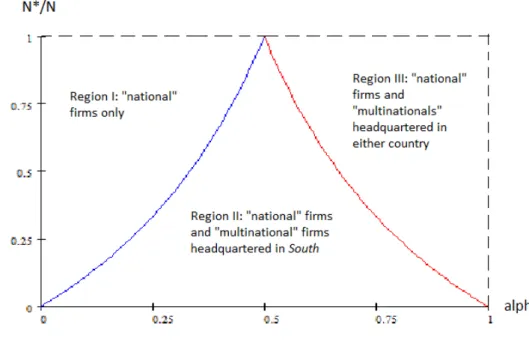
We should remember that a non-strict Nash equilibrium with only national firms exists for any parameter values. In Figure 1, we plot the
*
,
N
N
α
parameter space the conditions (3.24) and (3.26) that bound the regions where both types of multinational firms (either based in North, or in South) are in equilibrium.4.
Vertical multinational firms in the context of size asymmetry
across countries – plot and discussion
Figure 1 shows the spatial pattern of production for different regions of the parameter space
* ,N N
α
. Since multiple equilibria do emerge in some regions, we should provide some
qualifications on equilibrium selection.
As it was said clearly before, the equilibrium with “national firms only” is a non-strict Nash equilibrium where each player uses the same completely mixed strategy with support in the two pure strategies “to become a researcher” and “to become an industrial worker”. By contrast, the Nash equilibria where only multinational firms exist, either based in North or in
South, are strict Nash equilibria, since now each player adopts the same pure strategy within
each country. Consequently, we will consider that an equilibrium with “national firms only”, holds in the situation where it is the unique Nash equilibrium (that is to say, in region I in Figure 1) and in no other one.
Having settled this aspect, it remains to select one kind of multinational firm (either North or
South based) in region III of Figure. We can easily prove a proposition which may help us for
Proposition 3: The comparison of factor rewards by multinational firms with headquarters in different countries leads to the following results:
a) The northern based multinational pays higher wages to its manufacturing workers than the southern based one because it provides relatively more technological capital to its manufacturing plants.
b) When both types of multinational firms are feasible, the reward of technological capital by the southern based multinational will be higher (lower) than the one prevailing under the northern based counterpart if and only if 1 2
2<
α
<3 2 1 3α
< < , respectively.Proof: a) The wage paid by a northern based multinational to its workers living in South is, from (3.14)
(2 ) *( )
(
) (
)
*
ˆm 1 1
w =N α N −α +
α
α −α
By interchanging parameters N and N*, the wage paid by a southern based multinational to its workers with residence in North is
( ) ( )
(
) (
)
2 * ˆm 1 1 w =N α N −α +α
α −α
Taking the ratio of the two wages and simplifying, we obtain(3 ) * *
ˆ
1
ˆ
m mw
N
w
N
α
=
>
(4.1)b) The reward of technological capital by a multinational based in North is, from (3.23)
(
)
(2 1) * 1( )1
m
F% =
α
+α
α N α− N −αBy symmetry, the reward of technological capital by a southern based multinational is
(
)
(2 1) (1 ) * * 1 m Fα
α
α N α− N −α = + %Taking the ratio of the two rewards and further simplifying, we obtain,
(3 2) * * m m
F
N
F
N
α−
=
%
%
(4.2)Consequently, we have the following inequalities, * * 2 If , then 3 2 If 1, then 3 m m m m F F F F
α
α
< > < < < % % % % (4.3) QED.Bearing in mind the conditions of Nash equilibrium selection, several comments on Figure 1 are in order.
Firstly, vertical multinational firms – irrespective of where they are headquartered - tend to arise for a moderate to high
α
value. The spatial separation of R&D units and productive plants is more likely to emerge in high-tech industries and whenever localized spillovers are important. This is the case of industries pharmaceuticals and telecommunications where this kind of spatial separation happens more usually.Secondly, vertical multinationals and the split of R&D and manufacturing tend to emerge if the two countries are very asymmetric in size. This happens because size asymmetry enhances the inequality of factor prices across countries (see above Proposition 1), the larger country exhibiting higher prices for both technological capital and labor. As in HELPMAN (1984) and MARKUSEN and VENABLES (2000), this creates an incentive for separating R&D and
manufacturing across countries.
Thirdly, the model shows a strong bias for the empirical fact that many multinationals set up headquarters and research labs in small countries. In this article, multinationals tend to locate headquarters in the smaller country if the asymmetry between South and North is high and if the relative importance of technology in production is medium sized. The latter condition is intuitive. If
α
is very low, there is no incentive to split headquarters and manufacturing plant and the firm works as a “national” firm. Ifα
is very high, the sheer importance of R&D in overall production leads the firm to specialize the population of the larger country North in its performance.The former condition is still more interesting since it confirms the literature on multinational firm location. As MARKUSEN and VENABLES say:
This may help us to understand the importance of smaller countries such as Sweden, Switzerland and the Netherlands as home countries for multinationals. Essentially, production is drawn into the larger country, leaving the smaller country with a comparative advantage in headquarter
service production. (MARKUSEN and VENABLES, 2000: 228)
Although there is no Home Market effect in this paper, since trade costs on the final output are zero and the economy operates under perfect competition, R&D tends to concentrate in the smaller country because this pattern leads to lower labor costs.
The opposing case where R&D concentrates in the larger country drives here from the same determinants as in EKHOLM and HAKKALA (2007), namely from a high value for parameter
α
. If production is very high-tech and spillovers across labs are crucial, then for the firms it pays off to collaborate with a large R&D sector. This can be achieved by specializing the inhabitants of North in R&D.Our analysis integrates two aspects which were formally ignored beforehand and whose inclusion makes the approach more realistic. Departing from a situation where R&D and production take place in both countries in “national firms”, the formation of multinational firms leads to a negative “educational” externality in the country which specializes in manufacturing. The fact that this country loses the labs which used to operate aside plants causes an “educational impoverishment” which shows itself in a fall of labor efficiency of workers.
By adding this “educational” externality we are able to tackle two different aspects of the analysis which were previously ignored. The spatial separation of R&D and plant brings about a cost in labor efficiency which is borne by the country which loses its research capacity.
Furthermore, R&D spillovers are not confined to researchers but they also engage plants and industrial workers.
5.
Concluding remarks
By taking the colocation of R&D units and plants within national firms as the benchmark, we were able to see that a spatial separation by multinationals arises under two conditions. Firstly, the intensity of production in R&D and its geographically localized spillovers should be high enough to make a country specialization in laboratory activity profitable. Secondly, the two countries should be sufficiently asymmetric in size so that an international difference in factor costs emerges, thereby creating an incentive to separate activities in space and assign each stage to the country where the most used input is available in relatively larger quantity. It is likely that the newly formed vertical multinational firms will place R&D units (alongside with other headquarters services) in the smaller country, where factor costs are lower. The opposite location strategy, labs being located in the larger country, will more likely prevail if the production is very intensive in R&D and the technological externalities brought about by researchers in their neighborhood are high enough.
This analysis takes in consideration two aspects which were previously neglected. The spatial separation of labs and factories yields a positive technology transfer cost. Moreover, R&D spillovers do not engage only researchers but also affect the productive activity. Both aspects are tackled in this article by presupposing that when a country loses its R&D units by
specializing in manufacturing, the average efficiency of its labor force is diminished in the context of a negative “educational” externality.
REFERENCES
BENABOU, ROLAND (1993),“WORKINGS OF A CITY: LOCATION, EDUCATION AND PRODUCTION”,108,
QUARTERLY JOURNAL OF ECONOMICS,AUGUST, PP.619-652.
CHAMBERLIN,EDWARD (1948),THE THEORY OF MONOPOLISTIC COMPETITION – A RE-ORIENTATION OF THE THEORY OF VALUE,6TH
EDITION,LONDON,OXFORD UNIVERSITY PRESS (1ST
EDITION IN 1933).
EKHOLM,KAROLINA AND KATARINA HAKKALA(2007),“LOCATION OF R&D AND HIGH-TECH PRODUCTION BY VERTICALLY INTEGRATED MULTINATIONALS”,ECONOMIC JOURNAL,117(MARCH), PP.512-543.
DEFEVER, FABRICE (2006),“FUNCTIONAL FRAGMENTATION AND THE LOCATION OF MULTINATIONAL FIRMS IN THE ENLARGED EUROPE”,REGIONAL SCIENCE AND URBAN ECONOMICS,36, PP.658-677.
FRANKEL,MARVIN (1962),“THE PRODUCTION FUNCTION IN ALLOCATION AND GROWTH”,AMERICAN
ECONOMIC REVIEW,52(5), PP.995-1022.
HELPMAN,ELHANAN (1984),“A SIMPLE THEORY OF INTERNATIONAL TRADE WITH MULTINATIONAL CORPORATIONS”,JOURNAL OF POLITICAL ECONOMY,92(3), PP.451-471.
KRUGMAN,PAUL (1980),“SCALE ECONOMIES, PRODUCT DIFFERENTIATION AND THE PATTERN OF TRADE”,
AMERICAN ECONOMIC REVIEW,70, PP.950-959.
LUCAS,ROBERT (1988),“ON THE MECHANICS OF ECONOMIC DEVELOPMENT”,JOURNAL OF MONETARY
ECONOMICS,22, PP.3-42.
MARKUSEN,JAMES (2002),MULTINATIONAL FIRMS AND THE THEORY OF INTERNATIONAL TRADE, CAMBRIDGE AND LONDON,MITPRESS.
MARKUSEN,JAMES AND ANTHONY VENABLES(1998),“MULTINATIONAL FIRMS AND THE NEW TRADE THEORY”,JOURNAL OF INTERNATIONAL ECONOMICS,46, PP.183-2013.
MARKUSEN,JAMES AND ANTHONY VENABLES(2000),“THE THEORY OF ENDOWMENT, INTRA-INDUSTRY AND MULTINATIONAL TRADE”,JOURNAL OF INTERNATIONAL ECONOMICS,52, PP.209-234.
MARTIN,PHILLIPE AND GIANMARCO OTTAVIANO(1999),“GROWING LOCATIONS: INDUSTRY LOCATION IN A MODEL OF ENDOGENOUS GROWTH”,EUROPEAN ECONOMIC REVIEW,43(2), PP.281-302.
ROMER,PAUL (1986),“INCREASING RETURNS AND LONG-RUN GROWTH”,JOURNAL OF POLITICAL ECONOMY, 94(5), PP.1002-1037.
ROMER,PAUL (1990),“ENDOGENOUS TECHNOLOGICAL CHANGE”,JOURNAL OF POLITICAL ECONOMY,98(5),
PP.S71-S102.
SIEDSCHLAG,IULIA,DONAL SMITH,CAMELIA TURCU AND XIAOHENG ZHANG(2013),“WHAT
DETERMINES THE LOCATION OF R&D ACTIVITIES BY MULTINATIONAL FIRMS?”,RESEARCH POLICY,42, PP. 1420-1430.
WEIBULL,JORGEN (1997),EVOLUTIONARY GAME THEORY, CAMBRIDGE/MASS. AND LONDON/ENGLAND,THE