MASTER in
FINANCE
MASTER’S FINAL WORK
DISSERTATION
Robust Mean Variance
João Nuno Martins Cardoso
MASTER in
FINANCE
MASTER’S FINAL WORK
DISSERTATION
ROBUST MEAN VARIANCE
João Nuno Martins Cardoso
Supervisor:
Raquel Medeiros Gaspar
Abstract
This empirical study’s objective is to evaluate the impact of robust estimation on mean variance portfolios. This was accomplished by doing a simulation on the behavior of 15
SP500 stocks. This simulation includes two scenarios: One with normally distributed
samples and another with contaminated non-normal samples. Each scenario includes
200 resamples. The performance of maximum likelihood (classical) estimated
portfolios and robustly estimated portfolios are compared, resulting in some
conclusions: On normally distributed samples, robust portfolios are marginally less
efficient than classical portfolios. However, on non-normal samples, robust portfolios
present a much higher performance than classical portfolios. This increase in
performance is positively correlated with the level of contamination present on the
sample. In summary, assuming that financial returns do not present a normal
distribution, we can state that robust estimators result in more stable mean variance
Resumo
Este estudo empírico tem como objectivo avaliar o impacto da estimação robusta nos
portefólios de média variância. Isto foi conseguido fazendo uma simulação do
comportamento de 15 acções do SP500. Esta simulação inclui dois cenários: um com
amostras que seguem uma distribuição normal e outro com amostras contaminadas
não normais. Cada cenário inclui 200 reamostragens. O performance dos portefólios
estimados usando a máxima verosimilhança (clássicos) e dos portefólios estimados de
forma robusta são comparados, resultando em algumas conclusões: Em amostras
normais, portefólios robustos são marginalmente menos eficientes que os portefólios
clássicos. Contudo, em amostras não normais, os portefólios robustos apresentam um
performance muito superior que os portefólios clássicos. Este acréscimo de
performance está positivamente correlacionado com o nível de contaminação da
amostra. Em suma, assumindo que os retornos financeiros têm uma distribuição não
normal, podemos afirmar que os estimadores robustos resultam em portefólios de
Table of Contents
Table of Contents...iv
List of Tables ... v
List of Figures ... v
1. Introduction ... 1
2. Literature Review ... 3
2.1 MVT Applications & Shortcomings ... 3
2.2 Estimation Risk ... 4
2.3 Mean Variance Theory extensions ... 5
2.4 Robust Statistics ... 7
3. Methodology ... 10
3.1 Data ... 11
3.2 Monte Carlo Simulation ... 13
3.2.1 Control scenario ... 13
3.2.2 Contamination scenario ... 15
3.3 Robust estimator ... 16
3.4 Portfolio creation process ... 17
4. Results ... 19
4.1 Control scenario ... 19
4.1.1 Tangent Portfolios ... 21
4.1.2 Average and naive portfolio ... 25
4.2 Contamination Scenario ... 27
4.2.1 Tangent portfolios ... 28
4.2.2 Average and naive portfolio ... 31
5. Conclusion ... 34
List of Tables
Table I - Stock description………...………...………...……..11
Table II - Control Scenario descriptive statistics………...………...………....……..14
Table III - Contamination Scenario descriptive statistics……….16
Table IV - Sharpe Ratio of tangent portfolios on the true efficient frontier……..………30
Table V - Sharpe Ratio of average portfolios………..33
List of Figures
Figure 1 - True efficient frontierand 200 estimated efficient frontiers……….…………..…………20Figure 2 - Tangent portfolios ………...……….………21
Figure 3 - Classical risk/return scatter ……….23
Figure 4 - Robust risk/return scatter ………..……….23 Figure 5 - Sharpe Ratio distribution……….……….….……..24
Figure 6 - Dispersion of tangent portfolios’ allocation……….……….………..25/26 Figure 7 - Average and Naive Portfolios.………..………...….26
Figure 8 - Dispersion of estimated tangent portfolios (5% contamination 2.5 magnitude)………28
Figure 9 - Dispersion of estimated tangent portfolios (5% contamination 5 magnitude)……...28
Figure 10 - Dispersion of estimated tangent portfolios (5% contamination 10 magnitude)…....29
1. Introduction
The purpose of this paper is to study the effect of estimation risk on the stability of
portfolios resulting from Mean Variance Theory (MVT), developed by the work of
Markowitz (1952, 1959). It is focused on problems on practical applications of MVT,
contrasting with the fact that in theory it produces optimal results and is the backbone
of modern portfolio theory. Nonetheless, its translation into real life is not perfect, as
the composition of the optimal portfolio1 is unstable over time and too sensitive to ill
estimations of parameters, resulting in it being unconsidered by many portfolio
managers, topic that was explored by Michaud (1989). How can a model like this be
considered the answer for portfolio allocation problems and then result in less than
efficient portfolios on its practical applications? See Jobson and Korkie (1981).
To answer this question, first we should start by looking in to MVT and understand
how it works. This theory takes a basket of n securities and allocates them in order to
maximize expected returns for each possible risk level, on a certain investment period.
Resulting in a curve in risk/expected return plan, representing the set of efficient
portfolios, called efficient frontier. One of the advantages of MVT is its simplicity, mainly because it relies on two inputs:, a vector composed with n securities’
expected returns and , a n n* variance-covariance matrix of the respective expected returns. In MVT the optimization problem is treated as a deterministic
problem, i.e. it is assumed that both and which are be applied to the investment period are known with certainty. In real life, of course, these two inputs have to be
estimated, and so they are subject to estimation error. The assumption that one knows for sure the future expected returns and future variance-covariance of expected
returns of the different assets is difficult to stand. In practice, investors have to
forecast those inputs, which inevitably results in estimation error. Estimation risk is
therefore the main source of risk in MVT. As Fabozzi et al (2014) defended, the
irrational relation between inputs and outputs and the great sensitivity of the portfolio
On this study, several questions have to be answered. First, why does MVT produce
sub-optimal portfolios in practice? How can robust estimators improve the stability of
the resulting portfolios? How robust estimators perform in comparison with classical
Maximum Likelihood estimators under different scenarios? And finally, how different
degrees of parameter deviation affect the stability of the final output of MVT?
We start by positioning this study with respect to what has already been done on this
subject on chapter 2, showing several studies about MVT risk mitigation, optimization
of the estimation process and portfolio optimization procedures. Additionally, in this
chapter we demonstrate how this work differs from those past studies. Then on
chapters 3 we present the methodology used. On chapter 4 a simulation study of 15
Standard and Poor’s stocks is presented, where the performance of classical Maximum Likelihood estimators and robust estimators is compared. On chapter 5 some
2. Literature Review
Mean Variance Theory developed by Markowitz (1952, 1959) has been the basis of
modern portfolio theory. Before him, the focus of investment selection was on
evaluating securities individually in order to decide which securities yielded the higher
returns. Not taking in account the risk associated with those securities. After
Markowitz the focus changed to diversification and the impact of each security on a
portfolio’s total risk-return.
This literature review starts by taking a look at the main breakthroughs that MVT
allowed, as well as the limitations of this theory on section 2.1. Subsequently, on
section 2.2, are presented the major developments related with estimation risk, which
is a very important topic through this paper. On the next section (2.3), are presented
some important improvements and alternatives to classical MVT. To conclude, section
2.4 presents a review on robust statistics.
2.1 MVT Applications & Shortcomings
Since its creation MVT has been widely used by researchers and practitioners. In the
academia it laid the ground for several equilibrium models, like CAPM, produced
through the work of Lintner (1965), Mossin (1966) and Sharpe (1966). It was also
important in defining and understanding the difference between systematic and
diversifiable risk. For practitioners it is important in many portfolio management
applications. However, despite the simplicity of the model created by Markowitz, the
powerful optimization theory supporting it and the existence of software able to easily
solve the optimization problem, it is still disregarded in practice due to its poor ability
to adapt to estimated inputs and due to the sensibility of optimal portfolios to small
changes in inputs, see Michaud (1989). If we divide MVT in two parts, first we have the
process of computing the inputs and secondly the optimization of those same inputs in
results, whereas on the second part, the process is flawless. Though, the second part
only results in solid portfolio allocations if the first part produced exact inputs, which
most of the times is not possible.
MVT is based on the assumption that the vector of expected returns
and variance-covariance matrix
are sufficient to create the set of efficient portfolios. However this preposition does not consider an important factor. It implies that and are known, when in practice these parameters have to be estimated with base onhistorical prices of those same securities. Therefore, the actual inputs of MVT are ˆ
and ˆ , which have some associated estimation error. This is a shortcoming of MVT,
which does not take in account the fact that inputs were estimated, and include
estimation error, treating them as the unbiased parameters. This is commonly referred
to as “certainty equivalence”, as those estimated parameters are considered equivalent to the known parameters through the whole optimization process.
2.2 Estimation Risk
Estimation risk is a fundamental factor for the inefficiency of Mean Variance efficient
portfolios. Merton (1980) has shown that expected returns are extremely sensitive to
estimation error, variance is slightly sensitive and covariance is the less sensitive of the
three. We also know that even small changes in input parameters may result in large
changes in the optimal portfolio composition, Chopra (1993). Additionally, Chopra and
Ziemba (1993) concluded that “errors in means are approximately 10 times as important as errors in variances and covariances considered together”. So, considering that investors have limited resources, they should focus their resources on finding the
best possible estimates of expected returns, as this parameter is the one which most
influences the quality of the estimated tangent portfolio.
Jobson and Korkie (1981) made a simulation study where they estimated the expected
return and risk of 20 securities from a simulated dataset of 60 monthly returns. The
estimated tangent portfolio had a Sharpe ratio of 0.08, compared with the Sharpe ratio
weighted portfolio of those same 20 securities, concluding that MV efficient portfolios
can even be dominated by naive portfolios of the same assets due to the effect of
estimation error.
Taking a different perspective, Michaud (1989) introduced the concept of “estimation
error maximizers”, defending that MVT behaves as a maximizer of estimation risk. Securities that have its expected return overestimated (underestimated), its standard
deviation underestimated (overestimated) or its covariance underestimated
(overestimated) will be overweighted (underweighted) on the resulting portfolio. This
acts as proof of the ill effect of estimation risk on the output of the optimal portfolio composition.
Best and Grauer (1991) made a computational simulation on the behavior of portfolios
of different sizes and reached the conclusion that when changing the expected return
of one asset, the composition, expected return and risk of the optimal portfolio
changed drastically. Although when a non-negativity constraint was present the
portfolio composition was still very sensitive to changes in one security expected
return, but the expected return and risk of the portfolio tended to remain almost
constant.
What all of those studies show is that estimation risk has a big impact on portfolio
allocation problems. More than changing the portfolio composition, it may also affect
deeply the portfolio’s expected return and risk. Hence, estimation risk has to be
mitigated as much as possible, something that researchers have been doing but is still
a work in progress, like we can see on the next section.
2.3 Mean Variance Theory extensions
The inability of MVT to cope with estimated parameters and the fact that it did not
acknowledge the existence of estimation error on its inputs has been criticized by
several authors like Barry (1974), Bawa and Klein (1979), Brown (1976).
According to Stein (1956) for an estimator to be admissible it must dominate all other
inadmissibility of sample means as estimators of expected returns. Based on this
development Jobson et al(1979) proposed a James-Stein estimator to improve the
efficiency of MVT, this estimator was put to the test on Jobson and Korkie (1981) and
consists on a Bayesian estimator which shrinks the individual means of each security to
a global mean, in a way that, the greater the volatility of each security, the greater the
shrinkage, Jorion (1986) proposed a similar estimator, but shrinking the expected
return estimates towards the minimum variance portfolio.
Black Litterman (1991) introduced a market based shrinkage approach which combines
equilibrium expected returns based on the weighted average market return from
CAPM with investor’s views on each asset or group of assets and with the investor’s
degree of confidence on each forecast. An important assumption of this model is that
the expected return of a security should be consistent with the market equilibrium
unless the investor has a particular view on that security. Therefore, an investor
without any views (unconstrained) should hold the market portfolio. Another possible
way to correct the ill effect of estimation error is to increase the risk aversion
parameter. That is exactly what Horst, Roon and Werker (2002) did, developing a risk
aversion correction to take estimation risk into account when estimating mean
variance tangent portfolios, this new risk aversion is higher than the standard one and
the increase depends on the sample size, number of securities on the portfolio and on
the curvature of the mean variance frontier. This way, considering that the estimated
efficient frontier is an overestimation of the true efficient frontier due to the error maximization effect, increasing the risk aversion parameter nullifies some of that
overestimation.
On 1998 Michaud presented a resampling methodology to mitigate estimation risk on
a mean variance framework. Through statistical resampling, several risk/return
estimates are created, from those estimates, tangent portfolios are created and by
averaging the weights of those tangent portfolios an investor can reach a solid
estimate of an optimal portfolio.
On the late 90’s, a method that considers estimation error as part of the optimization
introduced by El Ghaoui and Lebret (1997) and Ben-Tal and Nemirovski (1998). It
consists on finding a solution that is satisfactory to most possible realizations of the
uncertain parameters
,
. From this point, uncertainty sets are created, containing all or at least most of the possible realizations of the uncertain parameters, the greaterthe set, the more uncertain is the parameter (higher chance of estimation error) and
more robust is the solution. The problem is then solved by finding the portfolio that
maximizes utility on the worst-case scenario, from the possible values of the
uncertainty set. See for instance: Lobo and Boyd (2000) and Goldfarb and Iyengar
(2003). Even using any of these enhancements of MVT, and due to the stochastic
behavior of the asset return process, estimation error will always exist, even if it is
lower than the vanilla MVT.
2.4 Robust Statistics
What would be preferred by an investor: (i) make a solid estimation of expected
returns and covariances of a set of securities or (ii) make an estimation that considers
the infinitesimal probability of a sudden market crisis but isn’t as reliable as the first
one on a non-crisis scenario? Should investors give the same importance to extreme
returns as they do to more common returns? This results in a problem of statistical
robustness. Robust statistics, developed by Huber (1964) and Hampel (1968), consists
on procedures to deal with situations where the underlying distribution deviates
slightly from the assumed model, see Huber and Ronchetti (1981). On MVT, extreme
observations with a very few chance of happening have a great effect on the estimated
input parameters.
It is then important to clarify two concepts: efficiency and breakdown of estimators.
Efficiency is the capability of an estimator to yield close to optimal estimates, therefore
to minimize estimation errors. Breakdown is the amount of outlying observations that
an estimator can withstand before it produces unstable results, see Huber and
Ronchetti (1981). Usually, the more efficient an estimator is, the lower is its
breakdown point, and vice versa. For example, if we compare the classical mean and
as it tends to produce closer to optimal estimates. However, if we multiply the highest
observation on a given sample by one million, the mean of that sample would be
heavily biased by it, whereas its median would remain the same. Consequently robust
estimators, the ones with a considerable higher breakdown point have an implied loss
of efficiency associated with gains in stability, Huber and Ronchetti (1981).
An estimator is considered robust if it can withstand extreme observations and still
yield stable estimations. Classical estimators are known to result in dire results on the
presence of those observations as its breakdown point is or is close to zero. One way
to assess if an estimator is robust is to study its Influence Function. This function
resulted from the work of Hampel (1968, 1974) as it “allows us to assess the relative
influence of individual observations towards the value of an estimate or test statistic” and therefore “allows an immediate and simple heuristic assessment of the asymptotic
properties of an estimate” Huber and Ronchetti (1981). Furthermore, Hampel (1986) has stated that the only necessary condition for an estimator to be robust is for it to
have a bounded influence function, consequently the only condition necessary for
MVT to be robust is to have its parameters estimated through robust estimators with
bounded influence functions.
On this study we see how estimation error and the inclusion of “noise” on the sample, affect the quality of the estimated parameters. Studying the effect of different
magnitudes and frequencies of sample contamination and how robust estimators
perform in comparison to classical estimators on all those different scenarios. To do
this, we use a resampling method similar to the one developed by Michaud (1998).
Though, on our case, two different estimates are applied to each sample, one classical
and one robust and different kind of samples are used. In addition, we are able to see
3. Methodology
In order to compare the performance of tangent portfolios resulting from classically
and robustly estimated efficient frontiers, we simulate the returns of a set of stocks
through a resampling process. This is repeated to several different scenarios. On each
scenario, both types of estimations are applied to all samples, resulting in a number of
different estimated parameters. From there, MVT is applied on each different
scenario, for both estimation types and for all resamples, resulting in several estimated
tangent portfolios which are the main tools to study the advantages and disadvantages
of each estimator.
On this chapter this methodology is explained in detail. On section 3.1 we start by
presenting the data which served as base for this empirical study. Section 3.2 is where
the simulation methodology is presented, being then divided in subsection 3.2.1 and
3.2.2. On subsection 3.2.1 the control scenario, the one which does not contain any
contamination, is explained. In opposition, subsection 3.2.2 describes the different
contamination scenarios, and how the contamination process occurred. Section 3.3
shows in more detail the robust estimator which is used on this study. And finally
3.1 Data
A set of 15 Standard & Poor’s stocks are the objects of the simulation, all of them having been in the index for more than 20 years. This set of stocks encompasses
companies from different industries and sizes.
Table I – Stock description
Number Name Industry
Market
Capitalization
1 AT&T, Inc. Telecommunications 196.89B
2 The Boeing Company Aircraft 92.62B
3 Colgate-Palmolive Co. Consumer goods 56.2B
4 Duke Energy Corporation Energy 48.78B
5 Ford Motor Co. Automaker 52.24B
6 DR Horton Inc. Construction 10.78B
7 Intel Corporation Technology 137.9B
8 Johnson & Johnson Pharmaceutical 261.4B
9 Oracle Corporation Technology 153.14B
10
The Procter & Gamble
Company Consumer goods 195.02B
11
Verizon Communications
Inc. Telecommunications 178.57B
12 Coca-Cola Enterprises Inc. Beverages 10.7B
13 The Gap, Inc. Clothing 12.33B
14 The Hershey Company
Chocolate
manufacturing 20.12B
15 Mattel, Inc. Toy manufacturing 7.35B
Since we want to mitigate idiosyncratic risk as much as possible, 15 stocks should be
enough to generate diversified portfolios. See, for instance, the comments about a
diversified portfolio of Reilly (1985): “In terms of overdiversification, several studies have shown that it is possible to derive most of the benefits of diversification with a portfolio consisting of from 12 to 18 stocks. To be adequately diversified does not
require 200 stocks in a portfolio” pp.(213).
Monthly observations from April 1995 to March 2015 were extracted for each stock.
To minimize estimation error as much as possible, a sample of 240 monthly returns
was used for each stock, given that according to Jobson and Korkie (1981) 60 to 100
monthly returns are not enough to eliminate estimation error. The authors also note
that a sample of at least 200 monthly returns would be needed in order to minimize
estimation error to a point that it would not bias our estimated tangent portfolio.
Through classical maximum likelihood estimation of those monthly returns, the
expected returns and variance-covariance matrix of each security was extracted.
From this point onwards, we focus our study only on the expected returns and
variance-covariance matrix estimated from the initial data. Creating a vector
composed with the annual return of each of the 15 stocks and a matrix composed with the covariances between those same returns. These values are going
to be the inputs of the simulation process. Additionally, we assume and to be next year’s realized return and variance-covariance for each stock. It is important to understand that and are related to next year as the investment horizon of the developed portfolios will be equally of one year.
This data serves as benchmark through the whole study, being more than once
compared with the simulated data. Having this in to account, these parameters are
referred to as true expected returns
and true covariance
. Anything else referred to as true is assumed to be related with these same parameters. Below we can see the true parameters:
2.15 9.94 10.62 4.11 2.90 14.16 8.97 9.44 14.40 7.96 3.65 9.05 11.04 10.40 1.36
0.0581 0.0013 0.0007 0.0017 0.0030 0.0025 0.0016 0.0012 0.0015 0.0007 0.0033 0.0008 0.0018 0.0009 0.0018 0.0013 0.0731 0.0012 0.0006 0.0068 0.0047 0.0029 0.0012 0.0021 0.0009 0.0014 0.0037 0.0035 0.0009 0.0031 0.0007 0.0012 0.0400
0.0013 0.0021 0.0014 0.0008 0.0015 0.0007 0.0021 0.0009 0.0027 0.0015 0.0008 0.0020 0.0017 0.0006 0.0013 0.0555 0.0021 0.0018 0.0008 0.0017 0.0006 0.0015 0.0014 0.0016 0.0008 0.0013 0.0010 0.0030 0.0068 0.0021 0.0021 0.2344 0.0089 0.0052 0.0019 0.0034 0.0020 0.0031 0.0064 0.0073 0.0012 0.0045 0.0025 0.0047 0.0014 0.0018 0.0089 0.2208 0.0046 0.0016 0.0034 0.0010 0.0021 0.0054 0.0058 0.0019 0.0043 0.0016 0.0029 0.0008 0.0008 0.0052 0.0046 0.1418 0.0011 0.0067 0.0001 0.0013 0.0021 0.0048 0.0005 0.0025 0.0012 0.0012 0.0015 0.0017 0.0019 0.0016 0.0011 0.0339 0.0007 0.0016 0.0012 0.0019 0.0017 0.0010 0.0017 0.0015 0.0021 0.0007 0.0006 0.0034 0.0034 0.0067 0.0007 0.1751 0.0007 0.0022 0.0004 0.0037 0.0003 0.0014 0.0007 0.0009 0.0021 0.0015 0.0020 0.0010 0.0001 0.0016 0.0007 0.0512 0.0006 0.0026 0.0012 0.0005 0.0017 0.0033 0.0014 0.0009 0.0014 0.0031 0.0021 0.0013 0.0012 0.0022 0.0006 0.0489 0.0013 0.0017 0.0006 0.0017 0.0
008 0.0037 0.0027 0.0016 0.0064 0.0054 0.0021 0.0019 0.0004 0.0026 0.0013 0.1334 0.0043 0.0015 0.0034 0.0018 0.0035 0.0015 0.0008 0.0073 0.0058 0.0048 0.0017 0.0037 0.0012 0.0017 0.0043 0.1566 0.0007 0.0038 0.0009 0.0009 0.0008 0.0013 0.0012 0.0019 0.0005 0.0010 0.0003 0.0005 0.0006 0.0015 0.0007 0.0417 0.0014 0.0018 0.0031 0.0020 0.0010 0.0045 0.0043 0.0025 0.0017 0.0014 0.0017 0.0017 0.0034 0.0038 0.0014 0.1058
(2)
3.2 Monte Carlo Simulation
We use Monte Carlo simulation to set 200 resamples of 10 years of daily correlated
returns for the 15 securities. This process is repeated on all different scenarios. This
simulation method consists on a series of repeated random sampling developed by
Metropolis (1949). We assume each stock’s returns to follow a geometric Brownian
motion, and therefore, this method results in samples from a multivariate normal
distribution
,
. Those samples follow a trend and are influenced by the multivariate effect of . In our case this repeated sampling creates several datasets of hypothetical historical returns. Each resample is used to estimate its own ˆi and ˆifor i1, , 200.
3.2.1 Control scenario
The first scenario is treated as the control scenario. In this case all samples were based
on a geometric Brownian motion which follows a multivariate normal distribution. This
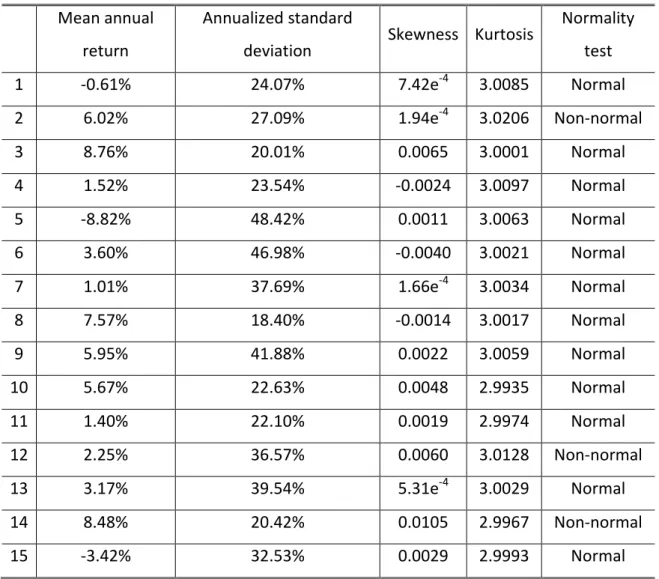
results in samples of normally distributed returns on all 15 securities. On Table II we
Table II – Control Scenario descriptive statistics
Mean annual
return
Annualized standard
deviation
Skewness Kurtosis Normality test
1 -0.61% 24.07% 7.42e-4 3.0085 Normal
2 6.02% 27.09% 1.94e-4 3.0206 Non-normal
3 8.76% 20.01% 0.0065 3.0001 Normal
4 1.52% 23.54% -0.0024 3.0097 Normal
5 -8.82% 48.42% 0.0011 3.0063 Normal
6 3.60% 46.98% -0.0040 3.0021 Normal
7 1.01% 37.69% 1.66e-4 3.0034 Normal
8 7.57% 18.40% -0.0014 3.0017 Normal
9 5.95% 41.88% 0.0022 3.0059 Normal
10 5.67% 22.63% 0.0048 2.9935 Normal
11 1.40% 22.10% 0.0019 2.9974 Normal
12 2.25% 36.57% 0.0060 3.0128 Non-normal
13 3.17% 39.54% 5.31e-4 3.0029 Normal
14 8.48% 20.42% 0.0105 2.9967 Non-normal
15 -3.42% 32.53% 0.0029 2.9993 Normal
As we can observe the majority of the stocks follow a normal distribution. Even the
ones which fail the normality test have skewness very close to 0 and kurtosis close to 3
which demonstrates that they behave in many ways like a normally distributed sample.
Consequently, this first simulation does not contain many outlier observations.
Therefore the main cause of estimation error are the sample size and the high
standard deviation of stock returns, which by themselves can be enough to cause
portfolio allocation inefficiencies. This control scenario allows, in particular, to see if
without extreme observations to bias the inputs of MVT, robust estimators are less
efficient than classical estimators, and if so, how significantly. It is also important to
realized risk/return of all securities on the following year, the true parameters and
.
3.2.2 Contamination scenario
On the contamination scenario, various sets of 200 resamples are produced. However,
in this case the Monte Carlo simulation does not follow a geometric Brownian motion.
It includes a multiplicative contamination, which consists in randomly multiplying a
certain percentage of the standard normally distributed matrix that is on the base of
the geometric Brownian motion by a certain value, as proposed by Perret-Gentil and
Victoria-Feser (2005). Through this method, it is possible to test the stability of the
Mean Variance portfolios against outlier observations and small parameter
fluctuations. It artificially creates extreme observations typical of financial returns and
adding “noise” to the sample in order for the estimated parameters to fluctuate. This way, we are able to test if a small degree of deviation on the estimated parameters
seriously affects the composition and performance of the tangent portfolios, as well as
testing how both types of estimators behave on the presence of extreme observations.
Nine different contamination scenarios are used on this study, varying in percentage of
sample contamination and in magnitude of contamination. The percentages of
contamination are 2.5%, 5% and 10% and the magnitude of contamination, that is, the
value by which each contaminated return is multiplied, is 2.5, 5 and 10. Each
percentage of contamination is tested with each magnitude, allowing for nine different
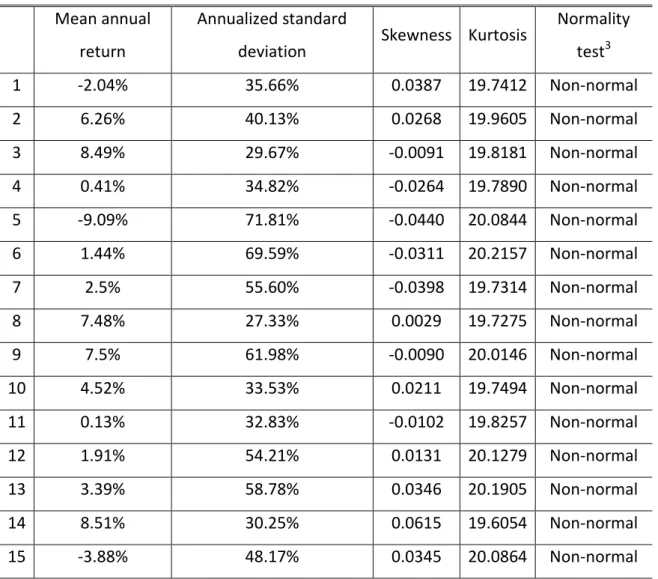
contamination degrees. On Table III we present the descriptive statistics for the
Table III – Contamination Scenario descriptive statistics
Mean annual
return
Annualized standard
deviation
Skewness Kurtosis Normality test3
1 -2.04% 35.66% 0.0387 19.7412 Non-normal
2 6.26% 40.13% 0.0268 19.9605 Non-normal
3 8.49% 29.67% -0.0091 19.8181 Non-normal
4 0.41% 34.82% -0.0264 19.7890 Non-normal
5 -9.09% 71.81% -0.0440 20.0844 Non-normal
6 1.44% 69.59% -0.0311 20.2157 Non-normal
7 2.5% 55.60% -0.0398 19.7314 Non-normal
8 7.48% 27.33% 0.0029 19.7275 Non-normal
9 7.5% 61.98% -0.0090 20.0146 Non-normal
10 4.52% 33.53% 0.0211 19.7494 Non-normal
11 0.13% 32.83% -0.0102 19.8257 Non-normal
12 1.91% 54.21% 0.0131 20.1279 Non-normal
13 3.39% 58.78% 0.0346 20.1905 Non-normal
14 8.51% 30.25% 0.0615 19.6054 Non-normal
15 -3.88% 48.17% 0.0345 20.0864 Non-normal
On opposition with the control scenario, this scenario is composed by 15 non-normally
distributed securities. All stocks present fat tails, as we can see by the high kurtosis.
That means that in this scenario there are many more outlier observations which may
have a great impact on the estimated parameters.
3.3 Robust estimator
On all scenarios, after creating the 200 resamples, there is a need to estimate the
inputs of MVT
,
. As already explained, two estimations are applied on each sample. A classical estimation based on Maximum Likelihood estimators and a robustmultivariate M-estimator which looks into the
2
n h
observations (out of ) whose
classical covariance matrix has the lowest possible determinant, see Rousseeuw
(1984). The location estimate is then computed by taking the average of those h
points and the scatter estimate is the covariance matrix of those h points. These
estimates can resist
n h
outliers and so, we can assess the robustness of the estimator by looking into hn
. In extreme cases, in order to achieve the highest
resistance against outliers an of 0.5 could be used. However, in less extreme
scenarios, should be set higher than 0.5 in order to improve finite-sample efficiency.
In our case, was set to 0.75 on all estimations. That means that the estimations
produce stable results if the sample contains up to 25% outliers. Moreover, we have
finite samples and so, in order to achieve a good enough efficiency, an higher than
0.5 would be needed.
3.4 Portfolio creation process
On this study we work with three different types of portfolios: Tangent portfolios,
average portfolios and, in a lesser extent, naive portfolios. All those portfolios are used
to compare the performance of both estimation styles.
First and foremost, it is important to mention that on each scenario, we have two sets
of portfolios, a set of classically and another of robustly estimated portfolios. After
computing ˆi and ˆi for n1, , 200 for each estimation type, MVT results in two groups of 200 efficient frontiers. An efficient frontier is a set of efficient portfolios
resulting from MVT. However, we need to find the tangent portfolio for each efficient
frontier. That portfolio is the most efficient portfolio of a given efficient frontier on the
presence of a risk free rate. Having a defined efficient frontier and risk free rate are the
necessary tools to reach the tangent portfolio. The risk-free rate used on this study is
the 12-month Euribor rate at the date of 25/2/15, 0.24%. Euribor is the rate that is
assumed risk-free, following the assumption that the European Central Bank has no
risk of default. The maturity of 12-months is also the one that makes more sense since
as we know the parameters and for the next year and the investment horizon of this simulation is one year. Other assumption of this study was the non-inclusion of
short selling on the portfolio creation process. This is consistent with many other
studies on MVT, with the majority of portfolios on the market and it makes the study
simpler and easier to understand. See for example, Chopra and Ziemba (1993) and
Goldfarb and Iyengar (2003).
The second portfolio type is the “average portfolio”. That portfolio is born from the
average weights of all resamples, following the process developed by Michaud (98),
like mentioned on section 2.3. This portfolio will then be compared with the so called
naive portfolio, the portfolio which allocates equal weights for all possible assets.
All those portfolios may differ greatly in risk and return. That is why we need a
performance measure to compare any of them with one another. The instrument used
is the Sharpe Ratio. Developed by William Sharpe, it is a measure of excess return per
unit of risk. It is commonly used in finance and in this study is the major instrument for
4. Results
This chapter starts by presenting a broad view in to the control scenario on section 4.1. Subsequently, it presents the results for the different types of portfolios tested on that scenario, on subsection 4.1.1 we study the behavior of tangent portfolios and on subsection 4.1.2 average and naive portfolios. On section 4.2 the focus is on the contaminated scenario, with a major focus on the 5% contamination. Again, on subsection 4.2.1 we take a look at how tangent portfolios perform on contaminated samples and on subsection 4.2.2 we test how average and naive portfolios perform.
4.1 Control scenario
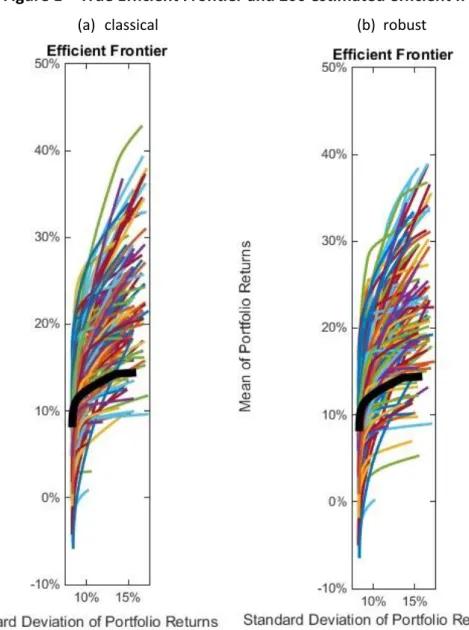
We build 200 classically estimated efficient frontiers and 200 robustly estimated
efficient frontiers. The resulting efficient frontiers can be observed below, with the
Figure 1 – True Efficient Frontier and 200 estimated efficient frontiers
Figure 1 shows the great variety of estimated efficient frontiers that MVT created,
both by classical and robust estimation. As we could observe on Table II of chapter 3,
the resample process created a huge dispersion of returns on all securities. This, of
course, led to a great dispersion of efficient frontiers. We can also notice that a great
part of the frontiers are above the true efficient frontier, which may be an evidence of the “estimation error maximizer” effect. By overweighing securities with overestimated returns, there is a much greater chance to create efficient frontiers
Visual representation of estimated efficient frontiers and True efficient frontier, represented by the thicker black curve. On (a) 200 classically estimated efficient frontiers and on (b) 200 robustly estimated efficient frontiers
Figure 2 – Tangent Portfolios
4.1.1 Tangent Portfolios
The next step is to look at the composition of the classically estimated and robustly
estimated tangent portfolios on each different sample. On Figure 2 we can see the
distribution of the estimated tangent portfolios’ risk and return, the red line represents the median, the point with the exact number of higher and lower
observations, the edges of the box represent the
25% and 75% percentiles and the upper and lower black lines represent the highest
and lowest observations, respectively. The red crosses represent observations
considered outliers. Additionally, the true tangent risk and return are represented by blue circles. As we can see, classical and robust portfolios present roughly the same
dispersion of observations, both on risk and return. Moreover, approximately 75% of
estimated tangent returns are above the true tangent return of 10.71% and range from around 2% to almost 25%. The estimated tangent risk level is higher than the true risk
level of 14.2% on around 90% of the observations, though it has a much smaller range
of observations, going from 13% to 22%. The great dispersion of tangent returns is
Dispersion of estimated tangent portfolios’ return and risk, both for classical estimation and robust estimation. True optimal return and risk represented by the blue circles.
associated with the already discussed sampling variability associated with the high
standard deviations of the 15 securities. The fact that estimated tangent returns
happen to be much higher than the true tangent return is a reflection of the
“estimation error maximizer” effect of MVT which causes MVT to allocate a greater part of the budget on assets with returns positively affected by estimation error and
less on assets negatively affected with estimation error. Therefore, these assets with
higher estimation error have a higher weight on the estimated portfolio than on the
true tangent portfolio. This results in estimated tangent portfolios with higher return and slightly higher risk than the true tangent portfolio’s risk and return. Concluding, as estimation error on returns has a higher effect on tangent portfolio composition, those
securities with overestimated returns will have more weight on the tangent portfolio
and consequently its tangent return will be overestimated and to a lesser extent its risk
will also be overestimated.
Up to this point, we have been looking at the behavior of the tangent portfolios on
their own simulated samples. Now we study their performance in “reality”. On this
empirical study “reality” is represented by the parameters as in equations (1)
and (2). By collecting the weights of the estimated tangent portfolios and applying
Figure 3 – Classical risk/return scatter
Figure 4 - Robust risk/return scatter
Figures 3 and 4 show the true position of all tangent portfolios with respect to the
efficient frontier, using both classical and robust estimation. On both cases the true tangent portfolio is represented by an orange circle on the efficient frontier. Looking at
Scatter of the risk/return of 200 classically estimated tangent portfolios, on the true efficient frontier plus the true tangent
portfolio, represented by an orange circle.
Scatter of the risk/return of 200 robustly estimated tangent portfolios, on the true efficient frontier plus the true tangent portfolio,
the scatter we can notice that all estimated tangent portfolios result in less than
optimal portfolios on practice. This happens due to the fact that the estimated
parameters (ˆi ˆi j j
),i(classical robust, ), j(1, , 200)) which served has base for its computation had an associated estimation error. Combining this with the
“estimation error maximizer” effect of MVT referred to on section 2.2, lead to tangent portfolios which overweighted securities with overestimated returns and
underestimated standard deviations, and vice versa. As estimation error is positively
correlated with standard deviation and in this study all 15 securities present high
standard deviations is easy to understand the cause of the large range of risk/returns
and consequent inefficiency presented by these estimated portfolios.
Even if Figure 3 and 4 give us an idea about how estimated tangent portfolios behave
on the following year, visual inspection is not enough to reach solid conclusions.
Therefore, there is a need to measure the performance of each portfolio through the
Sharpe ratio. The true tangent portfolio has a Sharpe Ratio of 0.7373. That portfolio is the point of the efficient frontier that maximizes the Sharpe Ratio for the defined risk
free rate. All the estimated portfolios are under that same efficient frontier. Thus, it
can be instantly affirmed that all estimated portfolios have a lower Sharpe Ratio than
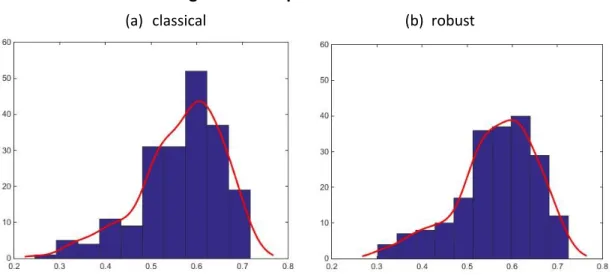
the true tangent portfolio. This statement was then confirmed by computing each portfolio Sharpe Ratio, see Figure 5. In order to compare both estimation methods
with each other and with the true tangent portfolio an average of each of the 200 portfolios Sharpe Ratio was taken.
Figure 5 – Sharpe Ratio distribution
The results show that on average a classically estimated tangent portfolio has a
Sharpe of 0.5654 and a robustly estimated tangent portfolio has a Sharpe of 0.5643.
The classical estimation leads to a marginally higher performance measure. This
confirms the theory of robust statistics, which defines robust estimators as less
efficient estimators on a well distributed sample, that is, a sample without outlying
observations as is the case on this first scenario, see Table II. Additionally, classically
estimated portfolios have a standard deviation of its Sharpe ratio of 0.0852 against
0.0929 of robustly estimated portfolios. This adds to the point that robustly estimated
portfolios are less efficient than classically estimated ones. What can be concluded
from these results is that when building a portfolio through MVT, on a sample without
any outlying observations, classical estimation is marginally more efficient than robust
estimation.
4.1.2 Average and naive portfolio
On this study we have the opportunity of creating portfolios through the resampling
method developed in Michaud (1998). Doing an average of the weight each security
has on the 200 tangent portfolios, both for the classical and robust case, results in two
average weighted portfolios, one for the classical estimation and another for the
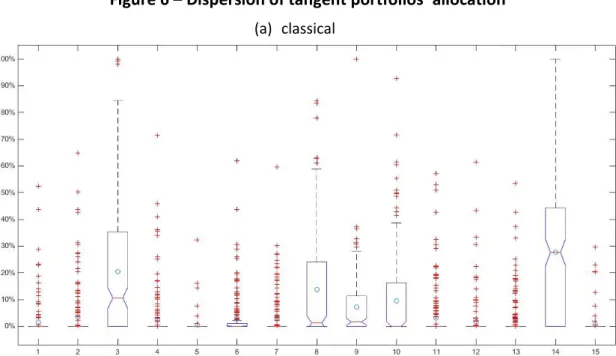
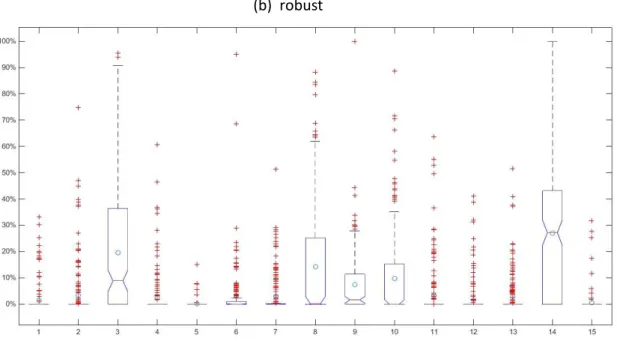
robust estimation, see Figure 6.
Figure 6 –Dispersion of tangent portfolios’ allocation
If we apply those two portfolios to the true efficient frontier we can see how those average weighted portfolios behave on practice and compare it with the behavior of a
naively created portfolio. That behavior can be observed below on Figure 7:
Figure 7 – Average and Naive Portfolios
Average weighted, naive and true tangent portfolios on the true efficient frontier. The green circle represents the true tangent portfolio. The red cross represents the average robust portfolio. The orange Dispersion of the tangent portfolio weights of each asset on the 200 resamples, both for classical estimation (a) and robust
The orange diamond represents the average weighted classical portfolio and the red
cross inside it represents the average weighted robust portfolio. Additionally, the
green circle on top of the true efficient frontier is the true tangent portfolio and the blue dot on the bottom is the naive portfolio, with an equally weighted allocation
between the 15 securities. As we can see, both classical and robust portfolios are
below the efficient frontier, though having a higher return and lower risk than the
naive portfolio. Also, they present roughly the same risk and return, which shows that
robust estimators are as good as classical estimators in an environment where they
were expected to be less efficient. Looking at each portfolio’s Sharpe ratio, we can confirm that both estimators result in equally efficient portfolios as they have exactly
the same Sharpe ratio of 0.6848, not too far from the Sharpe ratio of the true tangent portfolio of 0.7373. Another fact worth considering is that a Sharpe ratio of 0.6848 is way higher than the average Sharpe calculated beforehand for the 200 classically
estimated portfolios (0.5403) and 200 robustly estimated portfolios (0.5354). This
happens because by doing the average of the weights of the 200 portfolios, we are
mitigating the error maximization effect caused by estimation error. If in some
portfolios certain assets’ weights were overestimated, on other portfolios the same
assets’ weights might have been underestimated, assuming that there is the same chance of happening positive and negative estimation errors. So, by doing the average
of those weights we are nullifying the overestimations with the underestimations and
reaching closer to the true tangent portfolio performance.
4.2 Contamination Scenario
On a second stage, the resampling process was repeated for the contamination
scenario. Again, two methods of evaluating the performance of both estimators are
developed. Firstly we put each of the 400 estimated tangent portfolios (200 classical
portfolios, apply those portfolios on the true efficient frontier and then look at its Sharpe ratio. In this part the focus is on the contaminations of 5% of observations by
the three magnitudes of contamination of 2.5, 5 and 10. On annex the same results for
the 2.5% and 10% contaminations can be observed.
4.2.1 Tangent portfolios
Let’s start by looking at the distribution of risk/return of both classical and robust estimated tangent portfolios for the three magnitudes of contamination on Figures 8,
9 and 10:
Figure 8 - Dispersion of estimated tangent portfolios (5% contamination 2.5 magnitude)
Figure 9 - Dispersion of estimated tangent portfolios (5% contamination 5 magnitude)
Dispersion of tangent portfolios’ return (a) and risk (b) on the 5% contamination, 2.5 magnitude scenario. The blue circles represent the true tangent portfolio return and risk, respectively
(a) return (b) risk
Figure 10 - Dispersion of estimated tangent portfolios (5% contamination 10
magnitude)
The red line represents the median, which is the observation that has the same
number of higher and lower observations, the top and bottom blue lines represent the
75% and 25% percentiles, respectively. The black line on top represents the higher
observation and the bottom black line the lower observation. Additionally the red
crosses are observations treated as outliers and the blue circle represents the
expected return and risk of the true tangent portfolio. Identically to the base scenario the estimated expected returns of the three contaminations are around 75% to 80% of
the times higher than the true expected return and the risk almost always higher than the true risk. On the 2.5 magnitude contamination there are no noticeable differences between the classical and the robust estimator, which tells us that a magnitude of 2.5
is not enough to produce extreme enough observations on these samples. However, as
the magnitude of contamination increases we can identify a pattern of growth and
dispersion of the classically estimated portfolios, both on expected return and risk. In
opposition robustly estimated portfolios maintain roughly the same distribution of
risk/return on all magnitudes. This is a proof of the ability of robust estimators to
produce stable results even in situations where the sample is not a good source of
information for the parameters needed due to the presence of outlying observations
or in situations when some securities parameters fluctuate.
(a) return (b) risk
Dispersion of tangent portfolios’ return (a) and risk (b) on the 5% contamination, 10 magnitude scenario.
Now it is important to apply the weights of each portfolio to the true efficient frontier
in order to observe how they will perform on the next year. On the following table we
can see the average of the Sharpe ratios of the classically and robustly estimated
portfolios with 2.5%, 5% and 10% contamination under the three different
magnitudes.
Table IV – Sharpe Ratio of tangent portfolios on the true efficient frontier
Sharpe Ratio
–
2.5% contamination
Magnitude
Classical Robust
Mean Standard
deviation
Mean Standard
deviation
2.5 0.5566 0.0963 0.5499 0.1058
5 0.5342 0.0919 0.5494 0.0851
10 0.5055 0.1055 0.5338 0.0966
Sharpe Ratio
–
5% contamination
Magnitude
Classical Robust
Mean
Standard
deviation Mean
Standard
deviation
2.5 0.5587 0.0881 0.5525 0.0864
5 0.5217 0.1152 0.5370 0.1047
10 0.4823 0.1061 0.5262 0.1078
Sharpe Ratio
–
10% contamination
Magnitude
Classical Robust
Mean Standard
deviation
Mean Standard
deviation
2.5 0.5395 0.0965 0.5337 0.1025
5 0.4958 0.1025 0.5034 0.1042
10 0.4520 0.1058 0.4823 0.1068
To start, is important to note that again all the estimated portfolios are below the true efficient frontier and so, none of them presents a Sharpe ratio equal or higher than the ratio of the true tangent portfolio (0.7373). Looking at Table IV, we can see that for the lower magnitude classically estimated portfolios present a higher Sharpe ratio than
robustly estimated portfolios. That difference is marginal and confirms that this lower
magnitude is not enough to create extreme enough observations in order for robust
estimators to perform better than classical estimators. However, as the magnitude
increases we can see that the average Sharpe ratio of classically estimated portfolios
decreases much more than the Sharpe of robustly estimated portfolios which proves
that on the 5 and 10 magnitudes of contamination robust estimation is a much more
viable tool to create mean variance portfolios on an environment without a well
distributed sample. On the 2.5% contamination the pattern of decline of Sharpe ratio
as the magnitude increases is common with the 5% contamination. Again, on the 2.5
magnitude classically estimated portfolios present a slightly higher Sharpe ratio but on
the two higher magnitudes robustly estimated portfolios have a higher Sharpe ratio,
which remains stable as the magnitude increases. On the 10% contamination we can
observe that once more on the 2.5 magnitude classically estimated portfolios have a
marginally higher Sharpe ratio but on the other two magnitudes robustly estimated
portfolios have a higher Sharpe. However, on this higher percentage of contamination
we can see that the robustly estimated portfolios’ average Sharpe ratio is not stable. As the magnitude of contamination increases, the average Sharpe ratio decreases
considerably, perhaps due to the inability of the robust estimator to deal with the total
amount of outlying observations present on that extreme scenario of contamination.
4.2.2 Average and naive portfolio
Repeating the same process of averaging the weights of the various estimated
portfolios on the 5% contaminated samples and for all three magnitudes, we produce
one average weighted classical portfolio and one average weighted robust portfolio for
each magnitude. Once more, on Figure 11 we have the true efficient frontier, the true tangent portfolio represented by a green circle, the average weighted classical portfolio represented by an orange diamond, the average weighted robust portfolio
Figure 11 - Average and Naive Portfolios
(a)
(b)
(c)
On the 2.5 magnitude the two average weighted portfolios seem to have roughtly the
same risk/return, though the classically estimated portfolio has a Sharpe ratio of 0.673
compared with a Sharpe ratio of 0.6693 of the robustly estimated portfolio. This fact is
consistent with the previous considerations taken, namely that a magnitude of 2.5 is
not enough to create significant outlying observations which would create “noise” on the sample. On the opposite side, the 5 and 10 magnitudes displays a decrease in
performance by the average weighted classical portfolio. As the magnitude increases
the classical portfolio’s Sharpe ratio decreases considerably, as can be observed on Table V:
Table V – Sharpe Ratio of average portfolios
Sharpe Ratio
Magnitude
2.5% contamination 5% contamination 10% contamination
Classical Robust Classical Robust Classical Robust
2.5 0.679 0.6726 0.673 0.6693 0.6585 0.6533
5 0.6499 0.6743 0.6329 0.6475 0.5995 0.6061
10 0.6017 0.6483 0.5713 0.6553 0.5382 0.5728
Once again, averaging the weights of the different estimated portfolios provides
portfolios with a much higher performance than the average Sharpe of each estimated
portfolio. Additionally the average weighted robust portfolio remains stable with an
increase in magnitude, as opposed to the average weighted classical portfolio. Another
proof of the stability of robust methods of estimation to outlying observations and
distancing of the sample from the realized risk/return. On the 2.5% and 10%
contaminations the pattern remains. On the 2.5% contamination, average weighted
classical portfolios decrease as the magnitude increases, when average weighted
robust portfolios remain stable. On 10% contamination both classes of portfolios
decrease as the magnitude increases, though the decline on average weighted classical
portfolios Sharpe ratio is higher than the decline on average weighted robust
portfolios.
5. Conclusion
Mean Variance Theory is based on the assumption that expected returns and
covariances between securities are the only necessary inputs in to create efficient
portfolios. These inputs are not known, have to be estimated and are therefore subject
to estimation error. This puts a great importance on the estimation process. This study tests the ability that two possible estimators (classical maximum likelihood estimators
and robust estimators) have to withstand outlying observations which may have a
higher than desired effect on the parameter estimation, and to withstand small
parameter deviations and still remain stable. With the meaning of stable being: to
produce close to efficient portfolios on majority of the possible scenarios. It can be
stated that on scenarios of uncertainty, where the sample may not be a perfect source
of information for the estimation of the parameters needed for MVT, robust
estimators produce closer to optimal results than classical estimators. Only on the
scenarios where the sample is a close to perfect reflection of the true parameters do classical estimators produce better results than robust estimators. However, the
results that classical estimators produce on these situations are only marginally
superior, whereas on the extreme contamination scenarios, where the sample doesn’t exactly represent the true parameters and contains many outlying observations, robust estimators have a much higher performance. Which makes robust estimation a
good tool of risk mitigation, as it produces close to efficient results even on the worst
case scenario. In comparison, classical estimation produces slightly more efficient
results but only on the best case scenario. Future research might study the
performance of different types of robust estimators against on another, try to study
which contamination percentage and magnitude would be a better reflection of the
uncertainty observable on financial data. Other possible developments would be to
repeat the simulation process with another distribution or apply a different weight to
References
Barry, C. B. (1974). Portfolio analysis under uncertain means, variances, and covariances. The
Journal of Finance, 29(2), 515-522.
Bawa, V. S., Brown, S. J., & Klein, R. W. (1979). Estimation risk and optimal portfolio
choice. NORTH-HOLLAND PUBL. CO., N. Y., 190 pp.
Ben-Tal, A., & Nemirovski, A. (1998). Robust convex optimization.Mathematics of Operations
Research, 23(4), 769-805.
Best, M. J., & Grauer, R. R. (1991). On the sensitivity of mean-variance-efficient portfolios to
changes in asset means: some analytical and computational results. Review of Financial
Studies, 4(2), 315-342.
Black, F., & Litterman, R. B. (1991). Asset allocation: combining investor views with market
equilibrium. The Journal of Fixed Income, 1(2), 7-18.
Brown, S. J. (1976). Optimal portfolio choice under uncertainty: A Bayesian approach (Doctoral
dissertation, University of Chicago, Graduate School of Business).
Chopra, V. K. (1993). Improving optimization. The Journal of Investing, 2(3), 51-59.
Chopra, V. K., & Ziemba, W. T. (1993). The effect of errors in means, variances, and
covariances on optimal portfolio choice.
El Ghaoui, L., & Lebret, H. (1997). Robust solutions to least-squares problems with uncertain
data. SIAM Journal on Matrix Analysis and Applications, 18(4), 1035-1064.
Goldfarb, D., & Iyengar, G. (2003). Robust portfolio selection problems.Mathematics of
Operations Research, 28(1), 1-38.
Hampel, F. R. (1968). Contributions to the theory of robust estimation. University of California.
Hampel, F. R. (1974). The influence curve and its role in robust estimation.Journal of the
American Statistical Association, 69(346), 383-393.
Hampel, F. R. (1986). Ronchetti, EM, Rousseeuw, PJ, and Stahel.
Huber, P. J. (1964). Robust estimation of a location parameter. The Annals of Mathematical
Statistics, 35(1), 73-101.
Huber, P. J., & Ronchetti, E. M. (1981). Robust StatisticsWiley. New York.
Jobson, J. D., Korkie, B., & Ratti, V. (1979). Improved estimation for Markowitz portfolios using
and Economics Statistics Section(Vol. 41, pp. 279-284). American Statistical Association
Washington DC.
Jobson, J. D., & Korkie, R. M. (1981). Putting Markowitz theory to work. The Journal of Portfolio
Management, 7(4), 70-74.
Jorion, P. (1986). Bayes-Stein estimation for portfolio analysis. Journal of Financial and
Quantitative Analysis, 21(03), 279-292.
Kolm, P. N., Tütüncü, R., & Fabozzi, F. J. (2014). 60 Years of portfolio optimization: Practical
challenges and current trends. European Journal of Operational Research, 234(2), 356-371.
Lobo, M. S., & Boyd, S. (2000). The worst-case risk of a portfolio. Unpublished manuscript.
Available from http://faculty. fuqua. duke. edu/% 7Emlobo/bio/researchfiles/rsk-bnd. pdf.
Lintner, J. (1965). The valuation of risk assets and the selection of risky investments in stock
portfolios and capital budgets. The review of economics and statistics, 13-37.
Markowitz, H. (1952). Portfolio selection*. The journal of finance, 7(1), 77-91.
Markowitz, H. (1959). Portfolio selection: efficient diversification of investments. Cowies Foundation Monograph, (16).
Merton, R. C. (1980). On estimating the expected return on the market: An exploratory
investigation. Journal of Financial Economics, 8(4), 323-361.
Metropolis, N., & Ulam, S. (1949). The monte carlo method. Journal of the American statistical
association, 44(247), 335-341.
Michaud, R. O. (1989). The Markowitz optimization enigma: is' optimized'optimal?. Financial
Analysts Journal, 45(1), 31-42.
Michaud, R. O., & Michaud, R. (1998). Efficient asset management. Harvard Business School
Press, Boston.
Mossin, J. (1966). Equilibrium in a capital asset market. Econometrica: Journal of the
econometric society, 768-783.
Perret-Gentil, C., & Victoria-Feser, M. P. (2005). Robust mean-variance portfolio
selection. Available at SSRN 721509.
Reilly, F. K. (1985). Investments Analysis and Portfolio Management. Dryden Press, San
Francisco.
Rousseeuw, P. J. (1984). Least median of squares regression. Journal of the American
Sharpe, W. F. (1966). Mutual fund performance. Journal of business, 119-138.
Stein, C. (1956). Inadmissibility of the usual estimator for the mean of a multivariate normal
distribution. In Proceedings of the Third Berkeley symposium on mathematical statistics and
probability (Vol. 1, No. 399, pp. 197-206).
Ter Horst, J., De Roon, F., & Werker, B. J. (2002). Incorporating estimation risk in portfolio