Manuela Guerreiro1 Patrícia Pinto2 Júlio Mendes3 AbstrAct
The Algarve is a mature destination in the south of Portugal and is mainly well-known for its offerings of sun and sea. In addition to strong seasonal changes, the region also faces strong competition from other nearby destinations, which has affected its ability to better attract tourists. Regional stakeholders have recognized the need to diversify the tourist experience, and a strong effort has been dedicated to the development of complementary tourist products, with special attention to eco-tourism. The present study uses data from a survey of tourists who visited the Algarve in December 2010 (low season) to determine the extent to which tourists visiting the region would actively search for nature-related activities, and the profile of these individuals. In particular, the study aims to understand whether these tourists share environmentally friendly values or, instead, have chosen the Algarve based on its attributes of traditional appealing climatic conditions and beaches. Depending on whether nature-based tourism in the Algarve is a fact or a myth, strategies for repositioning the destination can be adapted, new tourist products can be proposed and communication campaigns may need to be rethought.
Keywords: Tourism Destination, Nature-Based Tourism, Environmentally Friendly Values. JEL Classification: L83.
1. IntroductIon
In recent decades, seaside destinations that have conventionally offered a sun and beach product have felt the need to become more competitive, as they face strong seasonality problems, and need to adapt their offerings to the new motivational tendencies of tourists (Valle, Guerreiro, Mendes & Silva, 2011). Tourists nowadays are more proactive and search for more authentic and diversified experiences, which forces destinations to rethink and restructure what they have to offer (Gale, 2005; Sedmak & Mihalic, 2008). Nature-based tourism has recently received attention in mass tourism destinations as a complementary product to sun and beach, especially during the low season (Agapito, Valle & Mendes, 2014).
These issues apply to the Algarve, which is the most important tourist region in Portugal, and is usually seen as a seaside destination. Like other coastal destinations, and due to its climate conditions, sun and beach is its most important tourist product (Valle, Pintassilgo, Matias & André, 2012). The Algarve suffers from competition with destinations that have
1 Manuela Guerreiro, University of Algarve, Faculty of Economics, Research Centre for Spatial and Organizational Dynamics, Faro, Portugal. ([email protected])
2 Patrícia Pinto, University of Algarve, Faculty of Economics, Research Centre for Spatial and Organizational Dynamics, Faro, Portugal. ([email protected])
similar characteristics, however, such as Spain, Tunisia and Greece, and there has thus been a growing consensus among regional stakeholders that a more wide-ranging set of tourist products is necessary, especially products that take advantage of the inland region. In addition to its beaches, the Algarve actually has a vast interior area that could provide exciting and rich experiences for tourists (Agapito et al., 2015). Individuals who want to explore natural resources or undertake nature-based activities, can go horseback riding, fishing, on safari, on nature walks and enjoy agricultural experiences. Local tourism authorities believe that there is a section of tourists who are more environmentally aware and who want to visit the inland areas, searching for nature-based experiences.
Using data from a survey conducted during the low season of 2010 in the Algarve, this study aims to determine the extent to which this premise is a reality or, instead, whether it is a myth. It also endeavored to provide a better understanding of the relevance of nature-based activities to the tourist experience in the region. Within this scope, four specific objectives are pursued. Firstly, the study intended to investigate whether tourists traveling to the Algarve visit the inland areas and, if that were the case, whether they were interested in alternative experiences to those associated with sun and beach. Secondly, the types of nature-based activities that strongly interest these tourists will be identified. The third specific objective is to assess whether a visit to the inland areas is associated with more satisfaction and willingness to revisit the area, as well as recommendations of the Algarve region. Finally, the study aims to understand the extent to which nature and the countryside are important motivators for visiting the Algarve in comparison to other possible regions, especially among tourists who visit the inland areas.
The fact that the main motivator to visit destinations has for decades been identified as a
sun and beach, in the case of the Algarve) does not mean that tourists restrict their activities to a single area and only engage with what is offered in that area. If, on the contrary, the needs and expectations of “new” tourists are really changing and becoming more comprehensive, tourist destination planners should be aware of this new reality when they promote and manage their destination.
2. LItErAturE rEVIEW 2.1 nature-based tourism
According to Williams and Buswell (2003), tourism involves three components: travel, accommodation and participation in activities at the destination. Activities such as hiking, nature photography, safaris or fishing are tourist activities that take place in a natural environment.
The erosion caused by traditional mass tourism has contributed to the growth of specific forms of tourism, most of which are more environmentally friendly (Eadington & Smith, 1992). The lack of innovation in traditional mass tourism destinations has also resulted in less attractive tourist products that have not adapted to the new requirements/desires of contemporary tourists. According to Akama and Kieti (2003: 73), “postmodern social and
economic changes, especially in the developed countries in the north, have enhanced the value of natural areas and the promotion of nature-based tourism and recreational activities.” In this context, nature-based tourism activities have registered growth rates ranging from 10% to 12% per year (Higgins, 1996; McKercher, 1996; Neto, 2003; Ties, 2007). Auesriwong, Nilnoppakun and Parawech (2015: 778) note that “community-based ecotourism is also recognized as one of the
alternative tourism forms that has been introduced to gain stakeholders’ participation, especially local’s participation, in sustainable tourism development.”
There has been no clear and consensual definition of nature-based tourism in the literature (Khan & Su, 2003; Cobbinah, 2015; Lenao & Basupi, 2016). Initially defined as travel to undisturbed areas that required respectful consideration of nature (Boo, 1990), nowadays it includes other areas that can be affected by these kinds of activities, including the environment, society, economy (Swarbrooke, 1999) and culture (Figgis, 1993) of the region. According to Wilson (1992: 23), nature-based tourism is a “temporary migration of
people to what they understand to be a different and usually more ‘pure’ environment.” As Tangeland and Aas (2011: 822) have pointed out, these include “tourism products that are based upon
activities that take place in a natural environment.” Many of the activities connected with nature-based tourism can be enjoyed free of charge and include tourism products like trekking, hiking, rafting, climbing, nature photography, wildlife safaris and camping. Tangeland et al. (2013: 364), in turn, considered nature-based tourism a “specific type of rural tourism.” Other researchers have used synonymous terms, such as ecological, sustainable, green, alternative, responsible or mountain tourism. From a different perspective, Deng and Li (2015) try to depart from this debate around the concept and propose that “tourists’ own self-interpretations
of ecotourism and self-identification of ecotourists may be a more meaningful and practical way forward”
(Deng & Li, 2015: 255).
Independently of the adapted definition, ecotourism is increasingly perceived as a way to achieve sustainable development, promote local livelihoods, environmental and cultural conservation (Dimitrov, 2013; Tran & Walter, 2014). The increasing number of visitors who have been interested in this form of tourism, however, has contributed to diversifying the forms of nature-based activities (Urry, 1990; Poon, 1993). This phenomenon has led to increasing concern about the negative impacts of tourism on some especially fragile environments (Buckley, 2007). As Lindberg and Hawkins (1993) note, it is vital to achieve a balanced use of natural resources in order to ensure their conservation and, at the same time, the well-being of local residents. Filion, Foley and Jacquemot (1994) emphasized that this kind of tourism requires responsible behaviour from visitors, who must be environmentally conscious.
2.2 General environmental awareness
The problems raised by modern society about our natural environment are well known, with ozone depletion, acid rain and deforestation being only a few examples. More widespread concern about environmental issues has developed as the breadth of general ecological problems has been increasingly brought to the public’s attention. Diverse measurement instruments have been proposed to evaluate general environmental awareness (Maloney & Ward, 1973; Maloney, Ward & Braucht, 1975; Weigel & Weigel, 1978). As Stern et al. (1995) noted, the New Environmental Paradigm (NEP) Scale (Dunlap & Van Liere, 1978) is the most extensively used scale. The NEP Scale “measures a constellation of attitudes that
represent the respondents’ adherence to a worldview of the relationship between humanity and the environment” (Vining & Ebreo, 1992: 1582). The NEP arose in opposition to the Dominant Social Paradigm (DSP) (Dunlap & Van Liere, 1978), which highlighted progress and growth instead. The NEP scale was first proposed as a unidimensional measure with 12 items, but additional research has shown that it is a multidimensional concept (Noe & Snow, 1990; Shetzer, Stackman & Moore, 1991; Albrecht, 1997). Consequently, subsets of NEP items were considered in some studies as measures of three different dimensions: balance of nature, limits of growth and humanity over nature (Vining & Ebreo, 1992; Albrecht, 1997; Valle, Reis, Menezes & Rebelo, 2004; Valle, Rebelo, Reis & Menezes, 2005). Other studies obtain different dimensions. Lundmark (2007), for example, found five central dimensions: human domination over nature; human exemptionalism; balance of nature; the risk of an eco-crisis
and, finally, limits to growth. In a recent study that applied the NEP scale to surf tourists in the Algarve, Frank, Pintassilgo and Pinto (2015) obtained a bi-dimensional solution, the ecological view versus the anthropocentric view, and showed that, globally, this segment of tourists reported a very strong ecological view (albeit with some anthropocentric elements.
In the tourism literature, Dolnicar, Crouch and Long (2008) have provided a good review of the characteristics of environmentally friendly tourists and concluded that most studies in this field are focused on the ecotourism sector, and have ignored the results of environmental behaviour from other research areas, such as psychology. In a more recent study, Dolnicar (2010) suggested that both socio-demographic and psychological factors are predictors of pro-environmental behaviour. In particular, this study showed that income and moral obligation affect the environmentally friendly behaviour of tourists on vacation. In another recent study, Mehmetoglu (2010) showed that, in a holiday setting, environmentally friendly behaviour was associated with the following characteristics: gender (female), household income, political orientation (liberal), environmental concern and personal environmental norms. Conversely, fun and excitement values negatively affected pro-environmental behaviour. The studies that we reviewed regarding the environmental awareness of tourists did not reveal the extent to which these and other factors affected their search for nature-based tourism activities.
3. MEthods 3.1 setting
Located in the south of Portugal, the Algarve is the most important Portuguese destination for tourists, and is well known for its sunny climate and sea. As a result, this region’s economy has become strongly dependent on the tourism industry. Although the climate conditions and beaches are the main reasons for visiting the region, the Algarve also offers interesting attributes that appeal to tourists: historical, cultural and architectural heritage; gastronomic attractions and natural and rural landscapes (Valle, Silva, Mendes & Guerreiro, 2006; Valle, Guerreiro & Mendes, 2010; Mendes et al., 2011; Agapito et al., 2015).
The Algarve has recently started to invest in a diversified set of products that is seen as strategically important for reducing problems of seasonality, and enabling accommodation units to maintain a reasonable occupancy rate throughout the year. Complementary products include golf, nautical tourism (which would take advantage of the marinas and port facilities), international conferences, culture-oriented tourism, health tourism and nature-based tourism (PENT, 2013). Authorities believe that this strategic diversification could potentially attract more tourists and/or encourage an increase in the average length of stay and daily expenditure (PENT, 2013). These issues bring challenges for destination management organizations (DMO) that need to understand tourist receptiveness to new products and offer. While previous studies have provided some insights into the importance of cultural offerings in this type of destination (Valle et al., 2011), the remaining possible products, including nature-based tourism, have rarely been studied. This study is thus a first attempt to comprehend the extent to which the type of tourist who visits the inland of the region really has a specific profile (motivations to visit the region, preferences regarding tourism experiences and degree of environment awareness), different from the typical “seaside” tourist.
3.2 Questionnaire and data
The data for this study came from 384 questionnaires that were given to foreign tourists who visited the Algarve region during the winter months in 2010. The sample size was determined based on the most conservative estimate of the sample proportion (p = 0.5), a 95% level of confidence and a maximum sampling error of 5% (Vicente & Reis, 1996). Two interviewers used the questionnaire with tourists leaving the region at Faro International Airport, as they were waiting to depart. The interviewers were suitably identified and the study’s purposes were explained to the respondents. Data was collected using a systematic sampling procedure.
The questionnaire included four sections of interest for this study. Section I aimed to identify the motivations of tourists in visiting the Algarve; Section II sought to understand their environmental awareness using the NEP, which is composed of 15 items (Dunlap &Van Liere, 1978); Section III investigated the activities in which the tourists took part during their stay, and Section IV included questions about their socio-demographic characteristics (gender, age, nationality, marital status, educational qualifications and employment situation).
3.3 data analysis methods
Data analysis included a preliminary descriptive analysis of the questions that were relevant to the specific objectives of this study, in particular those that outlined the profile of the respondents and described their visit to the Algarve. An exploratory factorial analysis (EFA) was applied to the items that measured their environmental awareness, to reduce the dimensionality of the original dataset (15 items). To assess the reliability of the identified factors, Cronbach’s alpha coefficients were calculated.
4. rEsuLts And dIscussIon 4.1 overall sample profile
The sample comprised the following socio-demographic characteristics: 54% were women and 46% were men. Ages ranged from 16 to 82 years, with the majority of respondents (61%) from 45 to 60 years old or older. The average age was 48 years, with a standard deviation of 17. The median age was 50 years and the mode was 65 years. Seventy percent of the 384 tourists who were interviewed were from the UK, and 9% were from Germany, which was the second most represented country. In terms of professional status, 49% were still working, and 21% were retired. The marital status data showed that 66% were married, 26% were single and 7% were divorced. Most participants had a higher education degree (57%) and 40% had a secondary education degree.
Results about their tourist experience in the Algarve showed that 77% of the respondents had visited the region previously and only 23% was visiting the Algarve for the first time. The types of accommodation that they chose consisted of apartments (38%), hotels (21%) and their own properties (19%). Rural tourism was the least popular reason for the trip (selected by only 1% of respondents). The internet (41%) and travel agencies (17%) were the most common accommodation booking methods. Most respondents stayed at the destination for a week (54%), with an average stay of 12 days (standard deviation: 8 days). The median and mode were 7 days. In terms of the transportation methods used within the region, 31% of respondents rented a car, 20% preferred to use the bus and 20% had their own car. The train was used by only 7% of respondents.
4.2 Visit to the Algarve
Most tourists stayed in coastal municipalities (63%), with Albufeira, Loulé and Portimão together hosting 40% of respondents. All respondents had visited the coastal area of the Algarve, and 68% had visited the inland region, with the most visited places located in the municipalities of Monchique, Silves and Loulé (Figure 1).
Figure 1. Areas Visited in the Inland of the region
Source: Own elaboration
Among the tourists who had visited the region for the first time (38.8%), only 13.1% travelled inland. This implies that, among the tourists who had visited the region one year ago (76.8%), 86.9% searched for experiences other than the Algarve’s sun and beach product. Table 1 shows the activities in which the tourists who visited the inland of the region (referred to as “inland tourists”) and those in which the tourists who only visited seaside areas (referred to as “seaside tourists”) participated. The most common activities were “nature walks” and “gastronomic experiences,” with these activities characterizing “inland tourists” more than “seaside tourists.” These two groups of tourists also engaged in “walking tours,” “fishing” and “bike riding.” Such results conform with previous research which has shown that activities and resources that could potentially become tourism products in the Algarve inland should also be considered as complementary tourism products in coastal areas since “seaside tourists” also search for a more diversified experience (Valle et al., 2011).
table 1. Participation in Activities in the Algarve region (Inland tourists versus seaside tourists)
Activities Inland tourists seaside tourists
Horseback riding 1.9% 2.5% Fishing 11.9% 5.0% Safaris 2.7% 0.8% Hunting 2.3% 3.3% Nature walks 46.4% 36.7% Golf 18.4% 17.5% Gastronomic experiences 45.2% 22.5% Agricultural activities 3.1% 1.7% Walking tours 15.3% 10.8% Bike riding 10.0% 8.3% Other 18.4% 10.0%
While there were no statistically significant relationships between overall satisfaction with the tourism experience and visits to specific locations within the Algarve inland (independence tests: p > 0.05), recommendations to visit the region and repeated visits had statistically significant relationships with visiting the inland region (independence tests: p = 0.003 and p = 0.000, respectively). The greatest intentions to recommend visits to the region were expressed by visitors to inland Algarve (88.8%). The percentage was slightly lower among tourists who were in coastal areas (76.7%). A large proportion (86.4%) of tourists who visited the inland were favorable to the idea of repeating their visit. This intention was not equally present among those who stayed in coastal areas (70%).
4.3 Motivations
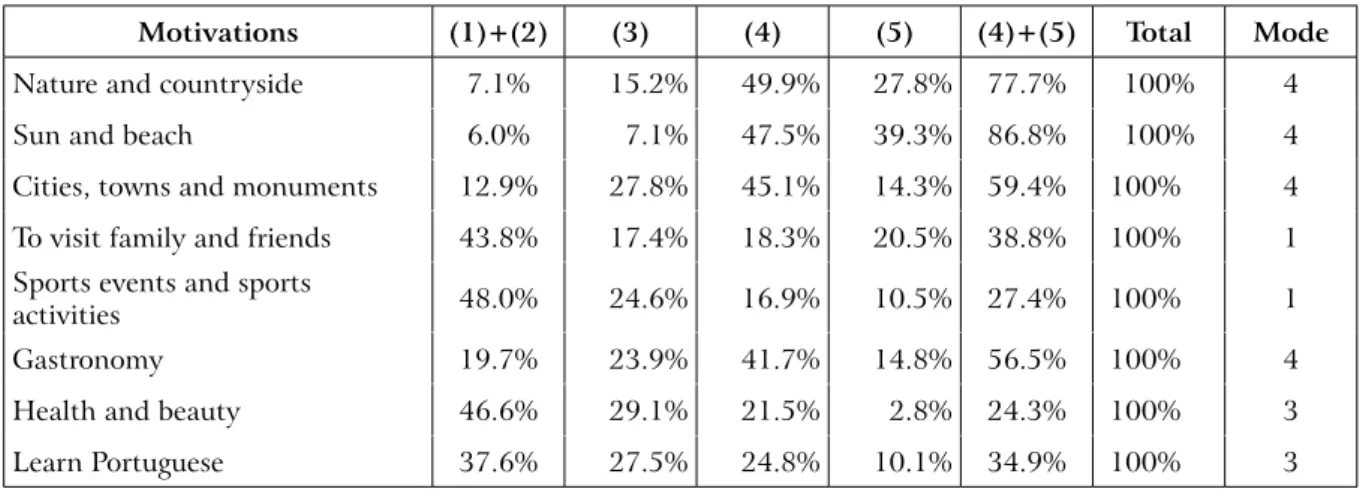
Overall, eight motivations for tourists to visit the Algarve region were assessed using a 5-point Likert scale: 1 – Not at all important, 2 – Not very important, 3 – Indifferent, 4 – Important and 5 – Very important. The results showed that the most important reasons for selecting the Algarve as a tourism destination were sun and beach, nature and rural landscape (Table 2). These reasons scored the highest in the categories important and very important (86.8% and 77.7%, respectively). Other important motives for visiting the region were to visit towns and monuments (59.4%) and to have gastronomic experiences (56.5%). Sports events and activities, as well as health and beauty related activities, were the least considered motivations (27.4% and 24.3%, respectively).
table 2. Motivations to Visit the Algarve (distribution by responses on the Likert scale)
Motivations (1)+(2) (3) (4) (5) (4)+(5) total Mode Nature and countryside 7.1% 15.2% 49.9% 27.8% 77.7% 100% 4
Sun and beach 6.0% 7.1% 47.5% 39.3% 86.8% 100% 4
Cities, towns and monuments 12.9% 27.8% 45.1% 14.3% 59.4% 100% 4 To visit family and friends 43.8% 17.4% 18.3% 20.5% 38.8% 100% 1 Sports events and sports
activities 48.0% 24.6% 16.9% 10.5% 27.4% 100% 1
Gastronomy 19.7% 23.9% 41.7% 14.8% 56.5% 100% 4
Health and beauty 46.6% 29.1% 21.5% 2.8% 24.3% 100% 3 Learn Portuguese 37.6% 27.5% 24.8% 10.1% 34.9% 100% 3 (1) = Not at all important; (2) = Not very important; (3) = Indifferent; (4) = Important; (5) = Very important
Source: Own elaboration
Table 3 further compares the motivations of tourists who visited inland Algarve with those who only visited the seaside. The table presents responses using the sum of Categories 4 (important) and 5 (very important). The findings clearly show that “inland tourists” valued nature and countryside more than “seaside tourists” (88.8% versus 82.6%), however, with the exception of “health and beauty,” the former group rated all motives strongly.
table 3. Motivations to Visit the Algarve (Inland tourists versus seaside tourists)
Motivations overall sample Inland tourists seaside tourists
Nature and countryside 77.7% 84.0% 63.3%
Sun and beach 86.8% 88.8% 82.6%
Cities, towns and monuments 59.4% 64.8% 48.1% To visit family and friends 38.8% 41.4% 32.7% Sport events and sport activities 27.4% 27.9% 26.5%
Gastronomy 56.5% 62.7% 41.6%
Health and beauty 24.3% 23.3% 27.0%
Learn Portuguese 34.9% 42.0% 18.8%
Source: Own elaboration 4.4 Environmental awareness
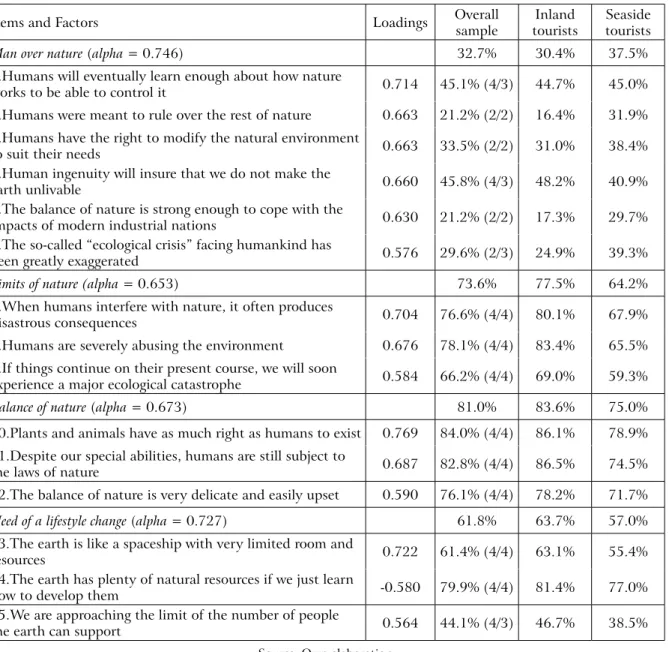
The following five-point Likert scale was used to measure environmental awareness: 1 – strongly disagree, 2 – disagree, 3 – indifferent, 4 – agree and 5 – strongly agree. For the purposes of data reduction, EFA was applied to the 15 items used to measure general environmental awareness. The use of this method provided four new dimensions (factors) that best represented the initial item, together accounting for 56% of the total variance. Both the Kaiser–Meyer–Olkin (KMO) measure of sampling adequacy and Bartlett’s test of sphericity indicated that the data was suitable for an EFA (KMO = 0.778; Bartlett test: p = 0.000). All items loaded reasonably strongly on one factor and the Cronbach’s alphas reported acceptable values, as summarized in Table 4. Taking into account the meaning of the corresponding items with higher loadings, factors were labelled Human over Nature,
Limits of Nature, Balance of Nature and Need for a Lifestyle Change. These results are somewhat consistent with previous findings on general environmental awareness. Table 4 shows the results from the EFA and some descriptive statistics, including the percentage of responses in the response categories “agree” plus “strongly agree” (within the overall sample, among “inland tourists” only and among “seaside tourists” only), the mode and the median for each item (the numbers in parentheses).
Factor 1 was labelled Human over Nature because it included items related to the legitimacy of human dominion over nature. High values for this factor would suggest that tourists expressed beliefs that humankind has the right to modify the natural environment and to rule over the rest of nature. Overall, agreement with the items included in this factor was low, ranging from 21.2% (in items 2 and 5) to 45.8% (in item 4). The last two columns of Table 3 show that “inland tourists” reported lower levels of agreement with this factor than “seaside tourists” (30.4% versus 37.5%), meaning the former group possessed a more environmentally friendly attitude regarding this dimension.
Factor 2, Limits of Nature, included items expressing the idea that the exploration of environmental resources has limits that, once surpassed, can produce catastrophic consequences. Overall, tourists demonstrated high levels of agreement with the items included in this factor, ranging from 66.2% (in item 9) to 78.1% (in item 8). “Inland tourists” expressed higher levels of agreement with this factor than “seaside tourists” (77.5% versus 64.2%), which implies that the former had a more positive environmental attitude concerning this dimension.
Factor 3 was the Balance of Nature, and included items that indicated the fragility of the balance of nature. This factor had the highest consistency among responses; the overall
sample reported high levels of agreement with all items, ranging from 76.1% (in item 12) to 84.0% (in item 10). As in the previous factor, “inland tourists” expressed higher levels of agreement on this factor than “seaside tourists” (83.6% versus 75.0%), which suggests that the former had a more environmentally friendly attitude based on this dimension.
Finally, Factor 4 was Need for a Lifestyle Change because it included items that reflected the importance of considering the capacity of the planet in terms of available space and resources. In this factor, items 13 and 15 had lower levels of agreement than those included in factors 2 and 3 but still indicated an environmentally friendly attitude, which was reinforced by the high level of agreement in item 14. As in factors 2 and 3, “inland tourists” exhibited higher levels of agreement with this factor than “seaside tourists” (63.7% versus 57.0%), which shows that the former were more environmentally aware in this dimension.
table 4. Environmental Awareness Items, Loadings from EFA and descriptive statistics Items and Factors Loadings Overall sample touristsInland Seaside tourists
Man over nature (alpha = 0.746) 32.7% 30.4% 37.5%
1.Humans will eventually learn enough about how nature
works to be able to control it 0.714 45.1% (4/3) 44.7% 45.0% 2.Humans were meant to rule over the rest of nature 0.663 21.2% (2/2) 16.4% 31.9% 3.Humans have the right to modify the natural environment
to suit their needs 0.663 33.5% (2/2) 31.0% 38.4%
4.Human ingenuity will insure that we do not make the
earth unlivable 0.660 45.8% (4/3) 48.2% 40.9%
5.The balance of nature is strong enough to cope with the
impacts of modern industrial nations 0.630 21.2% (2/2) 17.3% 29.7% 6.The so-called “ecological crisis” facing humankind has
been greatly exaggerated 0.576 29.6% (2/3) 24.9% 39.3%
Limits of nature (alpha = 0.653) 73.6% 77.5% 64.2%
7.When humans interfere with nature, it often produces
disastrous consequences 0.704 76.6% (4/4) 80.1% 67.9% 8.Humans are severely abusing the environment 0.676 78.1% (4/4) 83.4% 65.5% 9.If things continue on their present course, we will soon
experience a major ecological catastrophe 0.584 66.2% (4/4) 69.0% 59.3%
Balance of nature (alpha = 0.673) 81.0% 83.6% 75.0%
10.Plants and animals have as much right as humans to exist 0.769 84.0% (4/4) 86.1% 78.9% 11.Despite our special abilities, humans are still subject to
the laws of nature 0.687 82.8% (4/4) 86.5% 74.5%
12.The balance of nature is very delicate and easily upset 0.590 76.1% (4/4) 78.2% 71.7%
Need of a lifestyle change (alpha = 0.727) 61.8% 63.7% 57.0%
13.The earth is like a spaceship with very limited room and
resources 0.722 61.4% (4/4) 63.1% 55.4%
14.The earth has plenty of natural resources if we just learn
how to develop them -0.580 79.9% (4/4) 81.4% 77.0% 15.We are approaching the limit of the number of people
the earth can support 0.564 44.1% (4/3) 46.7% 38.5% Source: Own elaboration
5. concLusIon And rEsEArch IMPLIcAtIons
In contrast to the belief that the sun and beach product is the main motivator for tourists to visit the Algarve, the present study showed that natural and rural landscapes, gastronomy, cities,
towns and monuments are also important attractions (78%, 57% and 60%, respectively). The results also showed a stronger valorization of nature and countryside among “inland tourists” compared to “seaside tourists.” Another relevant point was that nature-based walks and gastronomy-related experiences were considered favorite activities for tourists visiting inland Algarve. Also of note was that intentions to recommend the region to others and to revisit the region had a statistically significant positive relationship with visiting the inland. These results support a new reality that must be acknowledged in order to meet the needs of new market segments that have not, so far, been considered in the DMO’s communication strategies. A concluding remark on the promotion of this destination is thus warranted. In particular, this study has implications in terms of the design, development and promotion of new products to the region of Algarve. In effect, the study’s findings suggest that it would not be sustainable to promote the destination exclusively with a focus on the sun and beach product. More than ever, it is necessary that the DMOs endorse an integrated management of new products with existing ones, in order to effectively meet the expectations of new tourists. It is thus necessary to reposition the strategy for the Algarve by differentiating it from the competition based on an integrated offer of sun and beach, nature, culture and gastronomy. As in many other times and circumstances, substantive decisions on this issue are necessary, taking advantage of all the opportunities offered by the market, and intending to plan the future of the Algarve as a destination with vision, wisdom and good sense.
Another important finding from this study was that tourists visiting the Algarve reported a strong environmental awareness, as demonstrated by their recognition of the balance and limits of nature and the importance of considering these environmental limits. Tourists recognized that there are limits to the supremacy of humans over nature. Another important finding was that the sense of responsibility to the environment was stronger among “inland tourists” than “seaside tourists.” In other words, tourists who sought the interior of this region adhered more strongly to the values and beliefs represented on the NEP scale. It could be assumed that these tourists were also more aware of the problems of nature and the need for its conservation, or even the need to practice more environmentally and culturally sustainable forms of tourism. This is an important finding since it shows that nature-based tourism in the Algarve is not a myth, but is, instead, a type of tourism that should receive more attention from the individuals who are responsible for managing and promoting the destination. This information is particularly important when providing the necessary input for the development of strategies to reposition the destination, either in terms of new product proposals, or of more effective communication with target audiences (current and potential).
Finally, some future research topics emerge from this study’s findings. Firstly, it is important to understand the functioning and the dynamics of regional and local partnerships. This would facilitate the design and implementation of programs and strategies in tourist destinations, allowing the promotion of new tourist products, integrated with the more traditional ones. The issue of positioning and repositioning the anchor tourist products in destinations also deserves more research attention. Finally, a deeper understanding of nature-based tourists is required, including their demand patterns, competing destinations, source markets, socio-economic characteristics and motivations to choose this type of destination. ACKNOWLEDGEMENTS
This paper was financed by National Funds provided by FCT- the Foundation for Science and Technology - through project UID/SOC/04020/2013.
REFERENCES
Agapito, D., Valle, P. and J. Mendes (2014). The sensory dimension of tourist experiences: Capturing meaningful sensory-based themes in Southwest Portugal. Tourism Management, 42(22), 224-237.
Akama, J. and Kieti, D. (2003). Measuring tourist satisfaction with Kenya’s wildlife safari: A case study of Tsavo West National Park. Tourism Management. 24(1): 73-81.
Albrecht, T. L. (1997). Defining social marketing: 25 years later. Social Marketing Quarterly,
Special Issue. 3(3-4): 21-23.
Auesriwong, A., Nilnoppakun, A. and Parawech, W. (2015). Integrative participatory community-based ecotourism at Sangkhom District, Nong Khai Province, Thailand.
Procedia Economics and Finance, 23: 778-782.
Boo, E. (1990). Ecotourism: the potentials and pitfalls. Vol. 1, World Wildlife Fund. Michigan. Buckley, R. (2007). Adventure tourism products: Price, duration, size, skill, remoteness.
Tourism Management. 28(6): 1428-1433.
Cobbinah, P. (2015). Contextualising the meaning of ecotourism. Tourism Management
Perspectives, 16(October): 179-189.
Deng, J. and Li, J. (2015). Self-identification of ecotourists. Journal of Sustainable Tourism, 23(2): 255-279.
Dimitrov, P. (2013). Long-run forecasting of the number of the ecotourism arrivals in the municipality of Stambolovo, Bulgaria. Tourism and Management Studies, 9(1): 41-47. Dolnicar, S. (2010). Identifying tourists with smaller environmental footprints. Journal of
Sustainable Tourism. 18(6): 717-734.
Dolnicar, S., Crouch, G. and Long, P. (2008). Environment-friendly tourists: What do we really know about them? Journal of Sustainable Tourism. 16(2): 197-210.
Dunlap, R. E. and Van Liere, K. D. (1984). Commitment to the dominant social paradigm and concern for environmental quality. Social Science Quarterly. 65(4): 1013-1032.
Dunlap, R. E. and Van Liere, K. D. (1978). The new environmental paradigm. Journal of
Environmental Education. 9(4): 10-19.
Eadington, W. E. and Smith, V. L. (1992). The emergence of alternative forms of tourism. In V.L. Smith and W.R. Eadington (eds). Tourism alternatives: Potentials and problems in the
development of tourism. John Wiley and Sons. Eadington, Chicester (pp. 1-12).
Figgis, P. (1993). Eco-tourism: Special interest or major direction? Habitat Australia. 21 (February): 8-12.
Filion, F. L., Foley, J.P., Jacquemot, A. J. and Munasinghe, M. (1994). The economics of global ecotourism. In M. Munasinghe (ed). Protected area economics and policy: Linking conservation
and sustainable development. The World Bank. Washington (pp. 235-252).
Frank, F., Pintassilgo, P. and P. Pinto (2015). Environmental awareness of surf tourists: a case study in the Algarve. Journal of Spatial and Organizational Dynamics, III(2), 102-113. Gale, T. (2005). Modernism, post-modernism and the decline of British seaside resorts as
long holiday destinations: A case study of Rhyl, North Wales. Tourism Geographies. 7(1): 86-112.
Higgins, B. R. (1996). The global structure of the nature tourism industry: Ecotourists, tour operators, and local businesses. Journal of Travel Research. 35(2): 11-18.
Khan, M.M. and Su, K.D. (2003). Service quality expectations of travelers visiting Cheju Island in Korea. Journal of Ecotourism. 2(2): 114-125.
Lenao, M. and Basupi, B. (2016). Ecotourism development and female empowerment in Botswana: A review. Tourism Management Perspectives, 18(April): 51-58
Lindberg, K. and Hawkins, D. E. (1993). Ecotourism: A guide for planners and managers. The Ecotourism Society. Vermont.
Lundmark C. (2007). The new ecological paradigm revisited: Anchoring the NEP scale in environmental ethics. Environmental Education Research. 13(3): 329-347
Maloney, M. P. and Ward, M. P. (1973). Ecology: Let’s hear from the people. An objective scale for the measurement of ecological attitudes and knowledge. American Psychologist. 28 (July): 583-586.
Maloney, M. P., M. P. Ward and Braucht, G. N. (1975). A revised scale for the measurement of ecological attitudes and knowledge. American Psychologist. 30: 787-790.
McKercher, B. (1996). Differences between tourism and recreation in parks. Annals of Tourism
Research. 23(3): 563-575.
Mehmetoglu, M. (2010). Factors influencing the willingness to behave environmental friendly at home and holiday settings. Scandinavian Journal of Hospitality and Tourism. 10(4): 430-447.
Mendes, J., Valle, P. and Guerreiro, M. (2011). Destination image and events: A structural model for the Algarve case. Journal of Hospitality Marketing and Management. 19(3/4): 366-384.
Neto, F. (2003). A new approach to sustainable tourism development: moving beyond environmental protection. Natural Resources Forum. 27(3): 212-222.
Noe, F.P. and Snow, R. (1990). The new environmental paradigm and further scale analysis.
Journal of Environmental Education. 21(4): 20-26.
PENT (2013). Plano Estratégico Nacional de Turismo, Ministério da Economia e da Inovação. Accessed in: 17 January 2013, on the website of: www.turismodeportugal.pt.
Poon, A. (1993). Tourism, technology and competitive strategies. CAB International. Wallingford. Sedmak, G. and Mihalic, T. (2008). Authenticity in mature seaside resorts. Annals of Tourism
Research. 35(4): 1007-1031.
Shetzer, L., Stackman, R.W. and Moore, L.F. (1991). Business environmental attitudes and the new environmental paradigm. Journal of Environmental Education. 22(4): 14-21.
Stern, P. C., T. Dietz and Guagnano, G. A. (1995). The new ecological paradigm in social-psychology context. Environment and Behavior. 26(6): 723-743.
Swarbrooke, J. (1999). Sustainable Tourism Management. CABI International. Wallingford. Tangeland, T. and Aas, Ø. (2011). Household composition and the importance of experience
attributes of nature based tourism activity products - A Norwegian case study of outdoor recreationists. Tourism Management. 32(4): 822-832.
Tangeland, T., Vennesland, B. and Nybakk, E. (2013). Second-home owners’ intention to purchase nature-based tourism activity products: A Norwegian case study. Tourism
Management. 36(June): 364-376.
Ties (2007). Fact sheet: Global ecotourism. The international ecotourism society. Accessed on: 4 February 2013, on the website of: http://www.box.net/shared/static/eaukonjc0a.pdf.
Tran, L. and Walter, P. (2014). Ecotourism, gender and development in northern
Vietnam. Annals of Tourism Research, 44(January): 116-130.
Urry, J. (1990). The tourist gaze. Leisure and travel in contemporary societies. Sage. London. Valle, P., Guerreiro, M and Mendes, J. (2010). Sustainable cultural events based on marketing
segmentation: The case of Faro capital of culture. PASOS Journal of Tourism and Cultural
Heritage. 8(3): 91-104.
Valle, P., Guerreiro, M., Mendes, J. and Silva, J. (2011). The cultural offer as a tourist product in coastal destinations: The case of the Algarve, Portugal. Tourism and Hospitality
Research. 11(4): 233-247.
Valle, P., Pintassilgo, P., Matias, A. and André, F. (2012). Tourist attitudes towards an accommodation tax earmarked for environmental protection: A survey in the Algarve.
Tourism Management. 33(6): 1408-1416.
Valle, P., Rebelo, E., Reis, E. and Menezes, J. (2005). Combining behavioral theories to predict recycling participation. Environment and Behavior. 37(3): 364-396.
Valle, P., Reis, E., Menezes, J. and Rebelo, E. (2004). Behavioral determinants of household recycling participation: The Portuguese case. Environment and Behavior. 36(4): 505-540.
Valle, P., Silva, J. A., Mendes, J. and Guerreiro, M. (2006). Tourist satisfaction and
destination loyalty intention: A structural and categorical analysis. International
Journal of Business Science and Applied Management
.
1(1): 25-44.
Vining, J. and Ebreo, A. (1992). Predicting recycling behavior from global and specific environmental attitudes and changes in recycling opportunities. Journal of Applied Social
Psychology. 22(2): 1580-1607.
Weigel, R. and Weigel, J. (1978). Environmental concern: The development of a measure.
Environment and Behavior. 10(1): 3-15.
Williams, C and Buswell, J. (2003). Service quality in leisure and tourism. CABI, Oxford. Wilson, A. (1992). Culture of nature. Blackwell. Oxford.