Vol. 52, n. 1 : pp. 187-195, January-February 2009
ISSN 1516-8913 Printed in Brazil BRAZILIAN ARCHIVES OF BIOLOGY AND TECHNOLOGY
A N I N T E R N A T I O N A L J O U R N A L
Impact of the Construction of the Harbor at Pecém (Ceará,
Brazil) upon Reef Fish Communities in Tide Pools
Marcelo Carneiro de Freitas
1,4*Regine Helena Silva dos Fernandes Vieira
2and Maria
Elisabeth de Araújo
3,41Departamento de Engenharia de Pesca; Universidade Federal do Ceará; Av. Mister Hull s/n; 60455-970;
Fortaleza - CE - Brasil. 2Laboratório de Microbiologia; Instituto de Ciências do Mar; Universidade Federal do
Ceará; Av. Abolição, 3207; 60165-081; Fortaleza - CE - Brasil. 3Departamento de Oceanografia; Universidade
Federal de Pernambuco; Av. da Arquitetura, s/n; Recife - PE - Brasil. 4Grupo de Ictiologia Marinha Tropical;
Recife - PE - Brasil
ABSTRACT
This study aimed to assess the impact of harbor construction at Pecém (Brazil) upon the reef fish communities in tide pools. The monitoring was carried out through a visual census and sea water quality was evaluated by microbiological analyses. From March to December 2001, 1,425 individuals of 17 families and 25 species were registered. The most frequent species were Haemulon parra, Acanthurus chirurgus, Abudefduf saxatilis and
Sparisoma axillare.The average species diversity for the whole period was 1.77 bits.ind -1. There was evidence that
the tide pools gradually silted up, resulting in a reduction in species diversity and richness. The microbiological analyses indicated the presence of faecal coliforms in the water though not at significant levels. The present study could be useful as an early reference for future projects, using the fish communities as indicators for the impact upon the environment of the harbor construction and other human activities.
Key words: marine fishes, environmental changes, sand dredging
*
Author for correspondence: [email protected]
INTRODUCTION
In spite of their acknowledged ecological importance, reef structures around the world are still being directly or indirectly damaged by the human activity. They are being degraded by the large-scale environmental changes caused by variations in temperature, sediments originated
from deforestation, pollution, waste,
agrochemicals and other forms of discharge. The environmental impact suffered by these habitats is
often potentialized by predatory fishing,
overexploitation, coastal pollution, anchorage and so forth (White et al., 1994).
Poorly regulated real estate developments along the Brazilian coast have seriously changed the life of the communities relying on the coastal environment for their survival. This is particularly true for the larger building projects such as harbors. The building of a harbor brings with it a range of sedimentological and geomorphological
problems (e.g. Morais, 1972; Neumann-Leitão,
sometimes affecting biological communities as
well (e.g. Sheppard, 1980; Neumann-Leitão and
Matsumura-Tundisi, 1998; Neumann-Leitão et al.,
1999; Koening et al., 2003).
Very few studies have been published dealing with the impact of harbor construction upon reef fish
communities (e.g. Adjeroud et al., 2000). The
construction of the harbor at Pecém, as part of a larger industrial development zone, has caused considerable changes in the natural environment (Silva, 1997). The analysis of the oils and greases, solids in suspension, parameters physicist-chemistries and faecal coliforms can be used as
parameters to evaluate the environmental
degradation on port regions (Silva et al., 2000). It is therefore of a great public health concern that these areas are periodically evaluated in regard to their level of microbial contamination (Vieira et al., 2001). The sea pollution results in an increased risk in the recreational use of the beaches since it represents a threat for swimmers, surfers and for the people who depend on ocean resources (Vieira et al., 1998). Local wave patterns have changed leading to extensive sedimentation on the lee side of the harbor structure, as well as to changes in the coastline, erosion and the silting up of adjacent areas (Ceará, 1996).
The objective of the present study was to assess the impact of the construction of the harbor at Pecém (Ceará, Brazil) upon the reef fish
communities in local tide pools.
MATERIAL AND METHODS
The area of study, Praia de Pecém, is a stretch of coastline 65km west of Fortaleza (Ceará, Brazil) under the jurisdiction of the municipality of São Gonçalo do Amarante. The coastline features predominantly quartzitic rock outcroppings of unknown geological age. The rocks, which are rich in iron oxides (ilmenite and hematite) are distinctly layered and display some cross-lamination and stratification (Smith and Morais, 1984). The study included three tide pools 1 km west of the Pecém harbor structure. The three pools, which were at an equal distance from the surf zone, were completely cut off from the sea during the low tide. At the beginning of the experiment, the tide pools had a surface area of
156.0 m2 (pool 1), 48.0 m2 (pool 2) and 120.0 m2
(pool 3); the depth ranges of the pools were 0.2-1.2 m, 0.3-1.0 m and 0.2-0.5 m, respectively.
Pools 1 and 2 were physically similar with large, mostly rocky surfaces covered by algae, while pool 3 was already partly silted up, with few remaining rocky crevices and algae.
The fish were counted by underwater visual censuses using intense search, by which a diver determined a fixed itinerary covering the entire area of the study during a pre-established period of time (approximately 30 min in this study). The species identification was always performed in daylight since tide pools in this area allowed for observing the night-active species during daytime as well (Carvalho, 2000). The divers used plastic writing boards for taking down the information on the place and date of sampling, tides, species identification, number of individuals observed and other relevant data. The species were identified visually, but the individuals of uncertain identity were excluded from the data analysis.
From March to December 2001, a total of 17 visual censuses were carried out: one for each tide pool in August, November and December, and two for each pool in the remaining months as the tides were more favorable. The censuses were scheduled for the spring tides up to 0.4 m in order to maintain the pools isolation from the sea. The data analysis used average census values in order to minimize the potential errors derived from the differences in the sampling frequency. In January 2002, the location was visited and there was no tide pools, since they were completely silted up. The ecological indicators were developed using the indices of diversity (H´) (Shannon and Winner, 1949), richness (R) (Margalef) and eveness (J´) (Pielou, 1969). The calculations were done using the software Basic Spdivers. Bas.
categories were employed in the present study: very common (>90%), common (51-90%), occasional (21-50%) and sporadic (<21%).
For the microbiological analysis, 500 mL tide pool water samples were collected in amber-colored, sterilized vials and brought immediately to the Microbiology Laboratory of the Marine Sciences Institute (LABOMAR/UFC). The multiple tube technique was used with the protocol described by Mehlman et al. (1984). The most probable number (MPN) of the total and faecal coliforms was estimated following the guidelines of the Bacteriological Analytical Manual (FDA, 2001).
The amount of sediments in the pools was
estimated in centimeters by measuring the
reductions in maximum depth with a
measuring tape.
RESULTS
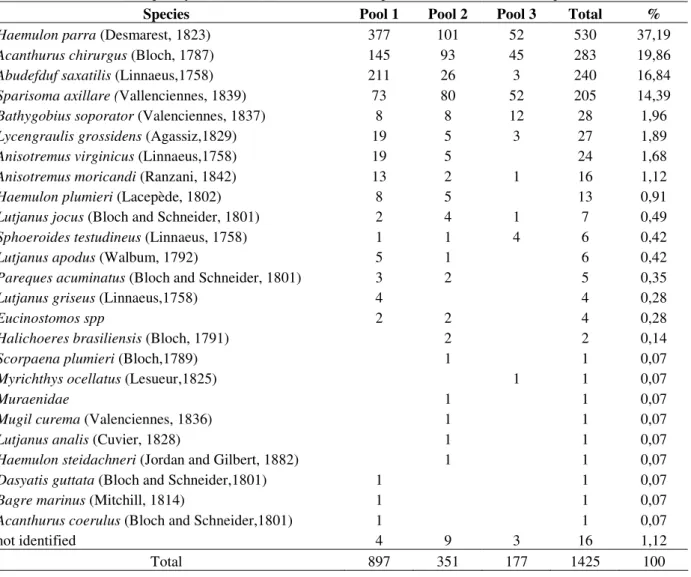
Between March and December 2001, the divers counted 1,425 fish belonging to 25 species and 17 families in the three pools (Table 1). Pools 1 and 2 characterized by the large, rocky surfaces covered with the algae accounted for 897 and 351 individuals, respectively, while pool 3 which was mostly silted up accounted for only 177. The most numerous family was Haemulidae with 42% of the total number of the individuals registered, followed by Acanthuridae (20%), Pomacentridae (17%), Scaridae (15 %) and other families (6 %) (Fig. 1). The most frequently occurring species
were Haemulon parra (37.19%), Acanthurus
chirurgus (19.86%), Abudefduf saxatilis (16.84%)
and Sparisoma axillare (14.39 %) (Table1).
Table 1 - Numbers and frequency (absolute and relative) of fish species observed in each tide pool (Pecém, Ceará).
Species Pool 1 Pool 2 Pool 3 Total %
Haemulon parra (Desmarest, 1823) 377 101 52 530 37,19
Acanthurus chirurgus (Bloch, 1787) 145 93 45 283 19,86
Abudefduf saxatilis (Linnaeus,1758) 211 26 3 240 16,84
Sparisoma axillare (Vallenciennes, 1839) 73 80 52 205 14,39
Bathygobius soporator (Valenciennes, 1837) 8 8 12 28 1,96
Lycengraulis grossidens (Agassiz,1829) 19 5 3 27 1,89
Anisotremus virginicus (Linnaeus,1758) 19 5 24 1,68
Anisotremus moricandi (Ranzani, 1842) 13 2 1 16 1,12
Haemulon plumieri (Lacepède, 1802) 8 5 13 0,91
Lutjanus jocus (Bloch and Schneider, 1801) 2 4 1 7 0,49
Sphoeroides testudineus (Linnaeus, 1758) 1 1 4 6 0,42
Lutjanus apodus (Walbum, 1792) 5 1 6 0,42
Pareques acuminatus (Bloch and Schneider, 1801) 3 2 5 0,35
Lutjanus griseus (Linnaeus,1758) 4 4 0,28
Eucinostomos spp 2 2 4 0,28
Halichoeres brasiliensis (Bloch, 1791) 2 2 0,14
Scorpaena plumieri (Bloch,1789) 1 1 0,07
Myrichthys ocellatus (Lesueur,1825) 1 1 0,07
Muraenidae 1 1 0,07
Mugil curema (Valenciennes, 1836) 1 1 0,07
Lutjanus analis (Cuvier, 1828) 1 1 0,07
Haemulon steidachneri (Jordan and Gilbert, 1882) 1 1 0,07
Dasyatis guttata (Bloch and Schneider,1801) 1 1 0,07
Bagre marinus (Mitchill, 1814) 1 1 0,07
Acanthurus coerulus (Bloch and Schneider,1801) 1 1 0,07
not identified 4 9 3 16 1,12
Acanthuridae 20% Haemulidae 42% Scaridae 15% Others 6% Pomacentridae 17%
Figure 1 - Relative abundance of the fish families in tide pools (Pecém, Ceará) from March and December, 2001.
These findings showed that the category of rare species accounted for as much as 44% of the total number of species, followed by the occasionally occurring species (28%), very common species (16%) and common species (12%) (Fig. 2).
Nine of the species could be classified as
occasional (Bathygobius soporator, Lycengraulis
grossidens, Lutjanus jocu, Sphoeroides
testudineus, Pareques acuminatus, Eucinostomus
spp, Lutjanus analis, Mugil curema, Bagre
marinus), eight were secondary residents
(Haemulon parra, Acanthurus chirurgus,
Abudefduf saxatilis, Sparisoma axillare,
Anisotremus virginicus, Anisotremus moricandi,
Haemulon plumieri, Lutjanus jocu), while eight
were sporadic (Lutjanus griseus, Halichoeres
brasiliensis, Acanthurus coerulus, Dasyatis
guttata, Haemulon steidachneri, Muraenidae,
Myrichthys ocellatus, Scorpaena plumieri).
The diversity, richness and eveness indices decreased in the last two months of the census, probably as a result of the silting up of the tide pools (Fig. 3). The average diversity, richness and eveness for the whole period in the three pools were H’ = 1.77, R = 3.31 and J’ = 0.55.
Figure 2 - Species frequency patterns in censuses carried out in tide pools (Pecém, Ceará) between March and December, 2001.
0 10 20 30 40 50 60 70 80 90 100 Acan thur
us c hiru
rgus
Abu defd
uf s axat
ilis
Hae mul
on p arra
Spar isom
a ax illare Anis otre mus virg inic us Bath ygob ius sopa rato r Lutja nus apod us Anis otre mus mor ican di Hae mul
on p lum ieri Lutja nus jocu Spho eroi des test udin eus Lyce ngra ulis gro ssid ens Par eque
s ac um inat us Euc inos tom us s
p
Hae mul
on s teid achn eri Hal icho eres bra silie nsis Lutja nus gris eus Aca nthu rus coer ulus Bag re m
arin us
Das iaty
s gu ttata Lutja nus anal is Mug il cu
rem a Mur aeni dae Myr icht hys ocel latu s Sco rpae
0 0,4 0,8 1,2 1,6 2
Mar Apr May Jun Jul Aug
Sept Oct Nov Dec
Months
D
iv
e
rs
it
y
(
b
it
s
.i
n
d
-¹
)
0 0,2 0,4 0,6 0,8 1
E
v
e
n
e
s
s
Diversity Evenness
Figure 3 - Monthly ecological indices of tide pools in Pecém (Ceará) in 2001.
The microbiological analyses of the tide pool water were performed between March and November 2001, drawing three monthly samples per pool per month (total: 27 samples). All the samples yielded low levels of total coliforms (TC). The pool 1 presented the highest values, especially in the months of March and September (MPN: 230 TC/100 mL), followed by the months of May, July and October (MPN: 90 TC/100 mL). In pool 2, the highest values were observed in March and August (MPN: 150 and 90 TC/100 mL, respectively). For pool 3, the samples drawn in May and September
yielded 90 and 230 TC/100 mL, respectively. With regard to the MPN of the faecal coliforms (FC), the highest value observed came from the samples drawn in March from pool 1 (MPN: 230 FC/100 mL). In September, lower values (MPN: 90 FC/100 mL) were registered for pools 1 and 3, and later, in October, for pool 1 (Fig. 4). During the period covered by the study the tide pools at Pecém were gradually silting up. The maximum average depth was reduced from 93.0 cm in March to 35.0 cm in October, and by January 2002 the pools were completely filled up with sediments.
0 50 100 150 200 250
Mar Apr May Jun Jul Aug
Sept Oct Nov
Months
M
N
P
F
C
/1
0
0
m
L
0 50 100 150 200 250 300 350
R
a
in
fa
ll
(
m
m
)
pool 1 pool 2 pool 3 Rainfall
Figure 4 - Total monthly rainfall and most probable number (MPN) of faecal coliforms (FC) per
DISCUSSION
The fish fauna composition depends on a number of factors, including reef location. Studies involving tide pools in Paraíba (Rosa et al., 1997; Silva, 2002) found the families
Gobiidae, Blenniidae, Pomacentridae and
Labrisomidae to be the most abundant in the region. In the present study, as well as in Carvalho (2000), Cunha at al. (2007) and Cunha et al. (2008), Haemulidae and Lutjanidae were the most abundantly represented families in the tide pools at Pecém and Iparana (Ceará). At the latter location, Gerreidae and Pomacentridae were also relatively abundant (Cunha, 2000).
The species most frequently observed in the
present study (H. parra, A. chirurgus, A.
saxatilis and S. axillare) matched with the
findings of Carvalho (2000), Cunha (2000), Cunha et al. (2007) and Cunha et al. (in press), the latter suggested the addition of L. apodus
and Eucinostomus species. These seemed to be
the most representative intertidal fish species west of Fortaleza, Ceará.
Species distribution is tied up with the reef
environment affinity and ecological
classification. Classifications basically include the resident, marine-dependent and visiting species and have been supplied with further
subcategories by many authors (e.g. Crabtree
and Dean, 1982; Rosa et al., 1997; Vasconcelos-Filho and Oliveira, 2000). Primary residents in
tide pools included P. acuminatus and A.
saxatilis, which were found as both the juveniles
and adults, although not throughout the year. The fact that P. acuminatus is a wary species
while A. saxatilis swims freely and
non-territorially (Humann, 1999) might have masked their relative abundance in the tide pools at Pecém.
Tide pools are known to serve as nursing grounds for several fish species (Crabtree and Dean 1982). In fact, the presence of the juveniles in the tide pools at Pecém suggested some of the species observed would remain in this habitat during part of or possibly their entire life cycle. These findings showed that the species initially classified as very common became rare towards the end of the study period. The classification by the frequency (ranging from very common to rare) was location-dependent. This has been shown by Feitoza
(2001), who found S. axillare to be common and
A. saxatilis and H. parra to be occasional residents
at the underwater reefs off Risca do Zumbi (Rio Grande do Norte). At Pecém, all the three species were classified as very common. The species diversity index indicates the degree of structural complexity of the community and is considered to be a function of richness and eveness (Omori and Ikeda, 1984). Continuous sedimentation of the environment reduced the availability of shelter and food in the studied tide pools thereby forcing the pool dwellers to move to other areas and leading to reduced ecological indices. The indices reported for Pecém by Carvalho (2000) were somewhat higher (H’= 2.22, R= 4.48 and J’= 0.60), possibly because that study was carried out before the harbor construction with no changed local sedimentological patterns. The diversity index may reflect environmental impacts in several ways. For instance, it may decrease as a result of one or few species dominating the community, or because the individuals of the rare species are replaced by the individuals of more common ones, or because certain species are reproducing more intensely than usual (Omori and Ikeda, 1984). The present findings indicated that the reductions in the fish diversity during the period of the study were caused by the silting up of the environment. The activities of the construction of the harbor in the region led to a loss of the microhabitats capable of offering food and shelter, especially for herbivorous species such as the errant,
algae-foraging A. chirurgus and S. axillare (Moura, 1998).
As the pools silted up, the only species observed to increase in the numbers, up to two months before the pools became completely covered by the sediments, were H. parra and A. saxatilis.
predators. After the implantation of the Suape Industrial Port Complex in Pernambuco State (Brazil), there was a strong decrease in the phytoplankton density due to high amount of suspended matter (Koening et al., 2003). Modifications of this basin also changed the species composition and trophic structure (Silva et al., 2004). The present study did not observe the presence of microbiological seawater contamination associated with the harbor construction at Pecém. During the monitoring of the tide pools, the level of faecal coliforms did not exceed the limits established by the CONAMA enactment #274 (CONAMA, 2000). According to this law, the seawater is unsuitable for human activities if it contains over 1,000 faecal (thermotolerants) coliforms or over 800 Escherichia coli or over 100 enterococci per 100 mL in more than 20% of samples collected in a five week period in the same place. Likewise, the values of 2,500 faecal (thermotolerants) coliforms or 2,000 Escherichia coli or 400 enterococci per 100 mL observed in the fifth and last sample also make it unsuitable for human activities.The highest levels of the total and faecal coliforms observed in this study came from the water samples from pool 1 during March. Although inserted within the rainy season (January to June in 2001), no other month yielded significant values for the coliform bacilli, suggesting that the rainfalls were not
significantly associated with the faecal
contamination in the tide pools studied. This observation was similar to that Vieira et al. (1999) in their study of tide pools at Barra do Ceará (an estuary located within the urban zone of Fortaleza). The faecal coliforms in present samples were more likely associated with the presence in the area of fishermen, construction workers and a sewer connected to the harbor construction site. In an earlier analysis, the water samples drawn from the shores of Pecém yielded MPN values in the range 230-430 FC/100 mL (Ceará, 1996). Thus, in the absence of pollution by sewage and waste from the seaside bars and restaurants, the area could be considered suitable for primary human contact, such as bathing. Silva et al. (2000) found no significant signs of pollution by coliforms at Pecém and adjacent areas caused by the harbor construction.
The intense silting up of the area in this study appeared to be the largest the direct impact of
the harbor construction upon local tide pool fauna. The phenomenon is commonly observed in the vicinity of artificial harbors and is due to the reflection and refraction of the waves, favoring the rip currents and littoral drift, of the sand dredging and dumping the unwanted sand in the nearby areas (Morais, 1972). At Pecém, the silting was triggered by the building of a temporary terminal required for the unloading of large rocks for the off-shore breakwaters and building material for piers and other structures (Ceará, 1996). As a result of this, the natural transport of the coastal sediments was barred, accumulating east of the pier, while the western coastline was gouged by the erosive forces. A similar pattern was observed when a breakwater (called ‘Hawkshaw’s Seawall’) was built closed to Fortaleza where a new harbor had been projected. The wavebreaker caused the coastline to silt up and the intertidal zone to widen considerably, making impossible to proceed with the harbor construction. However, even when the harbor building project was transferred a couple of miles east to Mucuripe, the silting and erosion continued leading to extensive land losses at Praia de Iracema (Morais, 1981). According to Ceará (1996), the sedimentological changes observed in association with the harbor construction at Pecém could be expected to revert to
the original configuration. However, the
observations “in loco” two years later showed no signs of reversion. The environmental impact study carried out prior to the construction of the harbor at Pecém provided a list of the fish species occurring in the coastal waters off State of Ceará. This list did not contain any quantitative data or references to the ecosystems.
the environmental impact studies. The Tropical Marine Ichthyology Research Group (IMAT) will continue to monitor the area in order to analyze the complete ecological cycle and ascertain whether the tide pools observed in the present study reverted to their original state, including the reestablishment of the fish stocks, as mentioned by the engineers working at the harbor construction site.
ACKNOWLEDGEMENTS
We extend our thanks to the Foundation for Supporting the Technological and Scientific Development of Ceará (FUNCAP) for the logistical support and for making the project possible. We also thank our collegues from the IMAT and the Microbiology Laboratory at the Marine Sciences Institute (LABOMAR) of the Federal University of Ceará for helping in the laboratory analyses.
RESUMO
O objetivo principal desta pesquisa foi estudar os possíveis impactos sobre as comunidades de peixes que vivem em poças de maré na praia de Pecém-CE. O método de censo visual foi utilizado para o registro dos peixes, e a análise microbiológica para verificar a qualidade das águas. No período de março a dezembro de 2001 foram observados 1.425 indivíduos pertencentes a 17 famílias e 25 espécies em três poças estudadas. As espécies mais freqüentes foram
Haemulon parra, Acanthurus chirurgus,
Abudefduf saxatilis e o Sparisoma axillare. A
diversidade média de espécies no período foi de
1,77 bits.ind-1. Durante a pesquisa foi observado
um processo crescente de assoreamento na área de estudo, em decorrência da construção do porto de Pecém. No que concerne à balneabilidade das águas dessa praia, a avaliação não mostrou sinais significativos de poluição microbiológica, embora tenha sido detectada a presença de coliformes fecais. Os resultados desta pesquisa poderão servir como referência pioneira para futuros projetos de monitoramento para áreas que venham a sofrer com atividades de construção portuária.
REFERENCES
Adjeroud, M., Planes, S. and Delesalle, B. (2000), Coral and fish communities in a disturbed environment: Papeete Harbor, Tahiti. Atoll Research Bulletin 84: 1 – 6.
Carvalho-Filho, A. (1999), Peixes: Costa Brasileira. Editora Melro, 320p., 3ed.
Carvalho, R. A. A. (2000), Ictiofauna recifal da região entre-marés da praia do Pecém, Ceará, Brasil. Monografia de Graduação, Departamento de Engenharia de Pesca, Universidade Federal do Ceará, Fortaleza. 38 pp.
Ceará. (1996), Secretaria dos Transportes, Energia, Comunicação e Obras – SETECO. Estudo de Impacto Ambiental – EIA: obras off-shore do Porto de Pecém. Fortaleza: SETECO, 3 (A e B).
CONAMA. (2000), Resoluções CONAMA. Ministério da Habitação, Urbanismo e Meio Ambiente, Brasília. Crabtree, R. E. and Dean, J. M. (1982), The structure of
two South Carolina estuarine tidal pool fish assemblages. Estuaries 5 (1): 2 – 9.
Cunha, F. E. A. (2000), Estrutura da Comunidade de Peixes em Poças de Maré na Praia de Iparana, Ceará, Brasil. Dissertação de Mestrado, Departamento de Engenharia de Pesca, Universidade Federal do Ceará, Fortaleza. 70 pp.
Cunha, F. E. A., Monteiro-Neto, C. and Nottinghan, M. C. (2007), Temporal and spatial variations in tidepool fish assemblages of the northeast coast of Brazil. Biota Neotropica 7 (1): 95 – 102.
Cunha, F. E. A., Carvalho, R. A. A., Monteiro-Neto, C., Moraes, L. E. S. and Araujo, M. E. (2008), Comparative analysis of tidepool fish species composition on tropical coastal rocky reefs at state of Ceará, Brazil. Iheringia, Série Zoologia 93: 1 - 2, 2008.
Food and Drug Administration – FDA. (2001), Bacteriological analytical on line. FDA / Center for Food Safety and Applied Nutrition – CFSAN. Available from Internet URL http:// www. CFSAN. FDA. gov/ inEDAN/BAN-TOC.html
Feitoza, B. M. (2001), Composição e estrutura da comunidade de peixes recifais da Risca do Zumbi, Rio Grande do Norte. Dissertação de Mestrado, Departamento de Zoologia, Universidade Federal da Paraíba, João Pessoa. 156 pp.
Hobson, E. S. and Chess, J. R. (1986), Relationships among fishes and their prey in a nearshore sand community off Southern California. Environmental Biology Fishery 17 (3): 201 – 226.
Humann, P. (1999), Reef fish identification: Florida, Caribbean, Bahamas. New World Publications, Jacksonville.
Mehlman, I. J., Andrews, W. H. and Wentz, B. A. (1984), Coliform bacteria, in Bacteriological Analytical Manual, Association of Official Analytical Chemists, Arlington. 6th ed., p. 5.01 - 5.07.
Morais, J. O. (1972), Processos de assoreamento do porto do Mucuripe. Arquivos de Ciências do Mar 12 (2): 139–149.
Morais, J. O. (1981), Evolução sedimentológica da Enseada do Mucuripe (Fortaleza-Ceará-Brasil). Arquivos de Ciências do Mar 21 (1/2), 19 – 46. Moura, R. L. (1998), Atividade, distribuição e táticas
alimentares de uma comunidade de peixes do Atol das Rocas. Dissertação de Mestrado, Departamento de Zoologia do Instituto de Biociências, Universidade de São Paulo, São Paulo. 108 pp. Neumann-Leitão, S., Koening, M. L., Macedo, S. J.,
Medeiros, C., Muniz, K. and Feitosa, F. A. N. (1999), Plankton disturbance at Suape estuarine área Pernambuco-Brazil after a Port Complex implantation. pp. 47-56. Second International Conference on Ecosystems and Sustainable Development. Greece.
Neumann-Leitão, S. and Matsumura-Tundisi, T. (1998), Dynamics of a perturbed estuarine zooplanktonic community: Port of Suape, PE, Brazil. Verh. Internat. Verein. Limnol. 26: 1981 – 1988.
Neumann, V. H., Medeiros, C., Parente, L., Neumann-Leitão, S. and Koening, M. L. (1998), Hydrodynamism, sedimentology, geomorphology and plankton changes at Suape area (Pernambuco-Brazil) after a Port Complex Implantation. Anais Academia Brasileira de Ciências 2: 313 – 323. Neumann-Leitão, S. (1994), Impactos antrópicos na
comunidade zooplanctônica estuarina. Porto de Suape-PE-Brasil. São Carlos. Tese de Doutorado em Ciências da Engenharia Ambiental, Departamento de Hidráulica, Escola de Engenharia de São Carlos da Universidade de São Paulo. 273 pp.
Omori, M. and Ikeda, T. (1984), Methods in marine zooplankton ecology. Winley Interscience Publication, New York. 331 pp.
Pielou, E. C. (1969), An introduction mathematical ecology. Wiley Interscience, New York. 385 pp. Randall, J. E. (1967), Food habits of reef fihes of the
West Indies. Studies in Tropical Oceanography 5: 665 – 847.
Rosa, R. S. and Moura, R. L. (1997), Visual assessment of reef fish community structure in the Atol das Rocas Biological Reserve of Northeastern Brazil, Proceedings of the 8th International Coral Reef Symposium, Panamá. 1, 983 – 986.
Rosa, R. S., Rosa, I. L. and Rocha, L. A. (1997), Diversidade da ictiofauna de poças de marés da praia do Cabo Branco, João Pessoa, Paraíba, Brasil. Revista Brasileira de Zoologia 14 (1), 201 – 212.
Sale, P. F. (1991), The ecology of fishes on coral reefs. Academic Press, San Diego, CA, 754 pp.
Shannon, C. E. and Winner, W. (1949), A mathematical theory of communication. Urban, Illinois: University of Illinois Press, 1949.
Sheppard, C. R. C. (1980), Coral fauna of Diego Garcia lagoon, following harbor construction. Marine Pollution Bulletin 11: 227 – 230.
Silva, J. O. C., Morais, J. O. and Meireles, A. J. A. (1997), Aspectos geoambientais da planície costeira do Pecém. Anais do XVII Simpósio de Geologia do Nordeste, resumos expandidos, Sociedade Brasileira de Geologia– Núcleo Nordeste, p. 520 –524.
Silva, P. R. F. G., Platonov, A. K. and Vieira, R. H. S. F. (2000), Monitoramento das águas da área de construção do Porto do Pecém e sua zona de influência direta (Estado do ceará, Brasil). Arquivos de Ciências do Mar 33: 165 –171.
Silva, G. R. (2002), Estrutura da assembléia de peixes de poças de maré em Barra de Mamanguape, Rio Tinto, Paraíba, Brasil. Dissertação de Mestrado, Departamento de Zoologia, Universidade Federal da Paraíba, João Pessoa. 79 pp.
Silva, A. P., Neumann-Leitão, S., Schwamborn, R, Oliveira, L.M. (2004), Mesozooplankton of an impacted Bay in North Eastern Brazil. Brazilian Arquives of Biology and Technology 47 (3): 485 – 493.
Smith, A. J. and Morais, J. O. (1984), Estudos preliminares sobre a geologia ambiental costeira do Estado do Ceará, Nordeste do Brasil. Arquivos de Ciências do Mar 23: 85 - 96.
Vasconcelos Filho, A. L. and Oliveira, A. M. (2000), Ictiofauna. In:Barros,H.Met al. (Eds.).Gerenciamento participativo de estuários e manguezais. Recife, Ed. Universitária, UFPE.
Vieira, R. H. S. F., Rodrigues, D. P., Evangelista, N. S. S., Theophilo, G. N. D. and Reis, E. M. F. (1998), Colimetry of marine waters off Fortaleza (Ceará State, Brazil) and detection of enteropathogenic Escherichia coli strains. Internatl. Microbiol. 1: 221-224.
Vieira, R. H. S. F, Rodrigues, D. P., Menezes, Evangelista, N. S. S, Reis, E. M. F., Barreto, L. M. and Gonçalves, F. A. (2001), Microbial contamination of sand from major beaches in Fortaleza, Ceará State, Brazil. Brazilian Journal of Microbiology 32: 77-80. Vieira, R. H. S. F., Silva, P. R. F. G., Lehugeur, L. G. and
Sousa, O. V. (1999), Colimetria da água da praia da Barra do Ceará-Fortaleza-Ceará. Arquivos de Ciências do Mar 32: 119 –122.
White, A. T., Hale, A. T., Renard, Y. and Cortesi, L. (1994), Collaborative and community-based management of coral reefs: lessons from experience. Kumarian Press: West Hart Ford, 130 pp.