Repositório ISCTE-IUL
Deposited in Repositório ISCTE-IUL:
2018-07-20Deposited version:
Post-printPeer-review status of attached file:
Peer-reviewedCitation for published item:
Pereira, L., Teixeira, C. & Salgado, A. (2017). Pereira diamond: projects' economic and social impacts. In 23rd International Conference on Engineering, Technology and Innovation, ICE/ITMC 2017. (pp. 6-14). Funchal: IEEE.
Further information on publisher's website:
10.1109/ICE.2017.8279862Publisher's copyright statement:
This is the peer reviewed version of the following article: Pereira, L., Teixeira, C. & Salgado, A. (2017). Pereira diamond: projects' economic and social impacts. In 23rd International Conference on Engineering, Technology and Innovation, ICE/ITMC 2017. (pp. 6-14). Funchal: IEEE., which has been published in final form at https://dx.doi.org/10.1109/ICE.2017.8279862. This article may be used for non-commercial purposes in accordance with the Publisher's Terms and Conditions for self-archiving.
Use policy
Creative Commons CC BY 4.0
The full-text may be used and/or reproduced, and given to third parties in any format or medium, without prior permission or charge, for personal research or study, educational, or not-for-profit purposes provided that:
• a full bibliographic reference is made to the original source • a link is made to the metadata record in the Repository • the full-text is not changed in any way
The full-text must not be sold in any format or medium without the formal permission of the copyright holders.
Serviços de Informação e Documentação, Instituto Universitário de Lisboa (ISCTE-IUL) Av. das Forças Armadas, Edifício II, 1649-026 Lisboa Portugal
Phone: +(351) 217 903 024 | e-mail: [email protected] https://repositorio.iscte-iul.pt
Pereira Diamond: Projects’ Economic and Social
Impacts
Leandro Pereira, PhD, Claudia Teixeira, André Salgado
Business Research Unit – BRU-IULISCTE - Instituto Universitário de Lisboa Lisbon, Portugal
[email protected] [email protected] [email protected]
Abstract— This research paper presents a model to assist business managers and decision-makers to make better decision of investment projects. This model provides a methodology and principles to assist organizations estimating and evaluating their projects benefits to apply in a Business Case, namely for projects with economic and social impacts. This model may be applied by any organizations (private sector, public sector or NGO) which may aim to leverage business value or generate more social value.
Keywords— Benefits; Project; Business Case; Investment; Strategy; Social Responsibility; Decision-making; Introduction
I. INTRODUCTION
A. What is a scientific business case?
According to the BCBOK® Guide [1], a Business Case consists on a decision-making tool to determine whether an investment will create value. Typically, it consists on a well-structured document where it states the investment purpose followed by the business impacts estimation (benefits) and costs in order to determine whether the decision under analysis will be profitable. This guide also mentions that a Business Case should be free of non-validated assumptions, based on a rational and impartial process supported on business research methods to validate cause-effect relations between phenomenon’s. [1]
The author Mcvey [2] also states that “a business case is part of the due diligence the business case represents, measuring benefits, costs, and risks associated with the investment. The business case assesses and evaluates the available options to solve the business issue. The business case provides an opportunity for the business to determine if a project is needed and if the solution options are beneficial to the organization”. The author also says this may be accomplished through both qualitative and quantitative analysis techniques, by describing if the solution is feasible and financially viable while meeting business goals”.
B. Business case: State-of-the art
When talking about project investment [3], project success measurement is a subject which still requires a few
improvements since the process efficiency, namely in time, budget and scope is still dominant instead of effectiveness through organizational benefits generation. In other words, this means most project definitions and methodologies still ignore a relevant dimension which is benefits realization during the project management cycle [4]. The project management professionals and literature available is still much focused on project deliveries (project management) which ends up neglecting the projects’ intended benefits [5]. A study conducted in September 2014 by APM Benefits Management SIG (Specific Interest Group) undertook a questionnaire survey to find out how benefits management is perceived in the organisations that its members work for. Most respondents were based in UK and worked in a wide spread of industrial sectors. One of the questions was: “By widening the focus to the whole organization, to what extent is benefits thinking integral to the wider approach to management, from strategy to operations?” to which 40,5% answered it is “weak benefits focus” plus 23,8% as a “very weak benefits focus”. The survey report also states that “there is a need for guidance and best practice examples on how benefits management might fit within the overall approach to organisational change and project/programme/portfolio management These authors also noted that benefits practices cannot be a “one size fits all” approach, but instead needs to be tailored to different contexts, especially when considering different nature of businesses (different types of organisations and industrial sectors).
The founder of ROI Institute, Phillips expresses the increasing need on key executives becoming aware of their projects’ ROI:
“The use of the ROI Methodology has intensified during this global recession, as organizations of all types have used this methodology to decide which programs to eliminate, which to keep and which to fund in the future. (…) As more organizations come out of the recession, key executives are demanding ROI up front, before a project is implemented. Because there is a need to avoid wasteful spending and unnecessary expenses to keep the organization lean, executives are asking for a forecast of ROI in advance” [6].
These statistics shows there is a recognition on the need of benefits management and that there are still little actions to actively pursue and implement a benefits management culture within the investment decision-making and monitoring.
C. Economic ROI
Regarding economic ROI evaluation there are a few methodologies developed to date such as the Gateway Review Process (GRP) which have been assisting in the successful delivery of projects, programs and policy in the Australian public sector [7]; the Guide to Cost Benefit Analysis of Investment Projects published by the European Union [8] and The Green Book, published by the UK Government [9] and the ROI Methodology ™ [10] which is a North American-type methodology, whose mission is to help managers to assess the contribution of each decision to create wealth, value and corporate sustainability, by applying the main business techniques in the evaluation of investment projects. The purpose of each model:
The Gateway Review Process (GRP) is composed by 6 critical stages which aims to provide timely advice to the Senior Responsible Owner (SRO) (the person in charge for a project or program). This methodology provides the SRO with an independent view on the current progress of the project or program and evaluate whether it can proceed successfully to the next stage[7].
Regarding the Guide to Cost Benefit Analysis of Investment Projects [8] it aims to support managing authorities, public administrators and their advisors in the Member States, when they analyse project ideas or pre-feasibility studies at an early stage of the project cycle. It consists on 6 main steps.
The Green Book [9] published by the UK Government is a guiding document created to assist public sector bodies, departments and executive agencies in the appraisal and evaluation of public investment through several techniques and issues that should be considered when carrying out public project assessments. It aims to make the appraisal process throughout government to be more consistent and transparent.
The ROI Methodology ™ [10] is a North American-type methodology, whose mission is to help managers assessing the contribution of each decision to create wealth, value and corporate sustainability, by applying the main business techniques in the evaluation of investment projects.
All of the referred methodologies have been developed and tested in several contexts and suffered improvements throughout the last few years. They have proven to guidance documents mainly oriented for projects from the public sector and supported several decision makers on investment appraisals.
However, there is a lack information about how to formulate the initiatives benefits in a more detailed and guided way which is critical to assure the correct benefits quantification leveraged by the future project.
Therefore, this paper aims to provide a deeper comprehension and guidance in regards to the benefits modelling process to support any business case professional to be successful.
D. Social ROI
What is social value and the purpose of SROI?
According to Social Value UK [11], social value consists on the value experienced by stakeholders through the changes in their lives, where some of those benefits are not captured based in market prices. Social Value UK, also states how important it is to measure and manage social value from the perspective of those affected by an organisation's work.
Social Return on Investment aims to measure social value (value that stakeholders experience through changes in their lives). Organisations which have social objectives will want to know if they are achieving these objectives. SROI is a method that can help organisations design systems that ensure they have the information they need.
This information can help in developing strategies to increase the social and environmental value you create, manage activities by comparing performance against forecasts and help communicate with funders and beneficiaries [12].
According to the Guide to Social Return on Investment and Social Return on Investment Position [13], there are seven principles of SROI:
1. Involve stakeholders – whoever is a beneficiary or is involved in the initiative should be involved in the benefits planning (in what gets measured and how).
2. Understand what changes for those stakeholders – identify and explain the rational of change as well as gather evidence of positive and negative change.
3. Value what matters (also known as the 'monetisation principle') – Need to recognize the values of stakeholders, in which value refers to the relative importance of different outcomes and it is informed by stakeholders' preferences.
4. Only include what is material – in order to measure SROI, determine what information and evidence must be included in the accounts to give a true and fair picture, in order to define the conclusions about the impact generated by the initiative.
5. Do not over-claim – make sure the results (value) presented reflect the values from the activities responsible for creating them, and no more.
6. Be transparent – when making benefits estimation (ex-antes) and measurement (ex-post) demonstrate the basis and rationale used for the analysis, to support an accurate and reliable process.
7. Verify the result – in order to avoid biased data or subjectivity, ensure an impartial team/individual checking the results to bring independent assurance.
According to the Guide to Social Return on Investment, when making investments, the manager may need to prove its value to others. This may be regarding a social enterprise, a public authority, a business and investor or even a charity.
Typically, the majority of public, private and third sector organizations do care and control closely the costs they do, such as through annual accounts, management accounts, budget reports and a whole accountancy profession to make it sure it happens. Although some organizations are somehow proficient on counting what they do with these resources, just a few can explain in a clear way, why all matters and the real value
delivered. Social Return on Investment aims to redress the balance by looking at value and not just cost [12]. According to this guide, it is critical to measure and value the things that matters. That requires the clear and accurate identification of the metrics who better represents the outcome under analysis.
Also in order to be capable of calculating the ROI, we would need to know the actual numbers of the indicator under analysis before and after the intervention [1]. In regards to data collection this may be through existing sources (internal or external) or through new data collection (ex. Primary data collection: interviews, focus groups, workshops and seminars, surveys).
Another principle when counting SROI is not to double count outcomes, otherwise it is not reflecting a trustworthy result of the reality. Furthermore, when estimating future benefits, it is important to establish how long the outcomes last. The timescale used is generally the number of years that is expected the benefit to endure after the intervention, in other words, it means the duration of the outcome or the benefit period. In order to define this timeframe, it is important to have a longitudinal data to support the outcome duration. The longer is the duration, the more likely it is that the outcome will be affected by other factors and consequently less credible.
It is important to note that sometimes the department/entity investing is not necessarily the one that makes the final saving. For instance, the central government may benefit from costs savings which resulted from a local government initiative (eg. Prison savings from reduction in crime) and vice versa. Therefore, it is important to separate out the stakeholders impacted by the initiative to avoid any confusion and help on the communication.
Having all the information collected, the goal is to calculate the financial value of the investment and the financial value of the social costs and benefits. Some economic indicators recommended are: ROI% (return on investment), NPV (Net present value) and Payback period. When making a business case to estimate future benefits in order to support a decision making today, there should also be conducted a sensitivity and risk analysis where it is possible to test which assumptions have the greatest effect on your model and the probability of each economic metric occurrence [1].
Although, nowadays SROI is a measure gaining more relevance across organizations when making investment decisions, it is important to be aware about its limitations:
1. Some benefits important to stakeholders, cannot be monetized, hence considered intangible. An SROI analysis should be seen as a framework for exploring an organisation’s social impact, in which monetisation plays an important but not an exclusive role [13];
2. Focus on monetisation: Although quantifying in economic terms the social impact, it is crucial to follow the rest of the process [14]. Furthermore, an organization must know about its mission and values to understand how it may make an impact, or in other words, how to change the world “what it does and what difference it makes”, otherwise it risks choosing inappropriate indicators, including SROI calculation.
3. Needs considerable capacity: SROI analysis requires time and resources. [15] & [16]
4. It is most easily used when an organisation is already measuring the direct and longer-term results of its work with people, groups, or the environment.
5. Some outcomes not easily associated with monetary value such as, increased self-esteem, improved family relationships, cannot be directly associated with a monetary value. In order to incorporate these benefits into the SROI ratio proxies for these values would be required. SROI analysis is still a developing area [14].
II. CONCEPTUAL MODEL
A. Pereira Diamond Model
The following model “Pereira Diamond Model” relies on the scientific management principle. In other words, in order to follow a rational, objective and impartial process, the Business Case should have the end goal of getting two different people reaching the same or very similar results’ estimation, when analysing under the same circumstances / conditions.
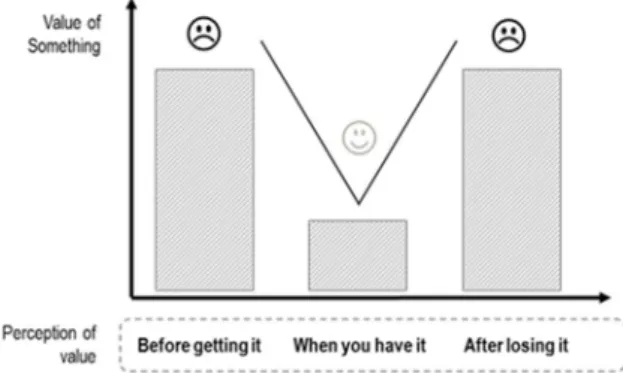
A project’s origin within an organization, is bounded by four possible dimensions presented in fig. 2. Pereira Diamond Model presents these four dimensions as the primary causes for a project “birth”. But firstly, in order to identify the future benefits to be estimated (and measure in the future ex-post) it is important to bear in mind the principle of the value of something, which is measured by the impact of having something or not having or losing it. Fig. 1 shows of how the perception of value changes according to having or not having something:
Fig. 1. The Value of Somethings (by the authors)
When conducting a business case to evaluate a project viability, the estimation should be based on the economic value generated and not on a financial perspective (eg. Liquidity level; Repayment schedule of external financing over the years, depreciations; etc.…).
In order to instantiate and organize the initiative’s benefits under consideration, each of these dimensions can consider different scenarios depending on the problem that will resolve or mitigate. The following image (Fig. 2) illustrates the levels of benefits within each dimension which are the main possible ways to achieve each dimension:
Fig. 2. Pereira Diamond - 1st and 2nd levels (by the authors, 2015)
Business Increase - When talking about increasing business (business sales) and consequently company’s revenue, then the project is connected to the “outside” (market). The project may contribute to it through one or more of the following: Increase market share; Increase cross-selling; Increase up-selling; Increase customer loyalty.
Costs Reduction - In the costs reduction dimension, the main initiative’s goal is to obtain an effective decrease in the expenses (costs) account of the company.
Efficiency Increase - In the opposite side of costs reduction, the projects within the efficiency dimension do not have an economic or financial implications, or in other words, a direct impact on the company expenses (costs) account. They do instead, have an impact on human abilities by optimizing processes which release time.
Legal Compliance - Projects under the legal compliance dimension are those projects which aim organizations to comply with the regulators entities and/or policy group instructions. B. Pareto Law
According to Pareto principle, known for the 80/20, the estimated return on investment should consider 20% of the main benefits generated (ideally up to 3 benefits), since they represent 80% of the value generated. Therefore, the remaining benefits should be classified as intangible for its residual weight and for its small contribution taken in the final decision upon deciding whether to go ahead or not with the initiative implementation.
Pareto’s theory became known as the “80/20” rule, which states that 20% of the known variables will account 80% of the results [17], which was the result of the observations and writings of Joseph M. Juran, a "pioneer in the development of principles and methods for managing quality control programs" [18].
Fig. 3. Example Pareto Histogram (by the authors, 2015)
C. S-Pereira ROI Model
The proposed SROI Model relies on a scientific management approach where it is aimed to assure a cause-effect relationship in the value proposition under analysis.
This model aims to provide the main sequential steps when pursuing the SROI calculation, namely, the benefits model where presents the four dimensions of benefit impacts that a project may leverage. This framework also considers a clear diagnosis previously to benefits identification to assure that the business case specialist undertaking this analysis, clearly states the problem to be addressed.
How can I know what the best solutions are if I am not aware about the problem? It is critical to understand the overall problem we seek to solve, the impacts (social and economic) this problem is generating and most importantly, understand why it is happening. This problem-solving exercise assists on identifying the “how”, or in other words, identifying one or more alternative solutions to solve a specific need/problem or opportunity.
Problem-solving exercise: There is a hypothetic problem that is intended to be solved. The problem impacts should be identified, both social and economic, by measuring the according KPI’s. After this, the main root-causes should be identified. Several techniques could be used to know more about root-causes, for example, interviews observation, surveys, historical records, among others. The solution appears by fitting the identified causes. The benefit should be the opposite of the problem impacts identified. Based on Pareto Law principle, it should be identified up to 3 main benefits.
Which type of benefits can be leveraged? An organization (namely a non-profit oriented) may intend to implement a project which may have internal impacts (to its own organization) or external impact.
In regards to internal impact, as presented in fig. 4, may have cost reductions, efficiency increase or legal compliance. When identifying a solution benefits with external impact, there are 4
types of social impact benefits that may be leveraged (see fig. 4):
Fig. 4. SROI Diamond Model (by the authors, 2016)
Health (eg: avoid or reduce the number of human losses or diseases) - Drug prevention; Disease prevention; Mental health Education - Increase population culture; Development in science; Increase scholar level; Increase employment level Security - Food security; Crime prevention; Accidents prevention: car, fluvial, trails and air; Economic Security Human Rights - Humanitarian Aid; Homeless support; Gender human rights (labour wise)
Social benefits are not possible to quantify economically by itself, for instance, how much is worth saving 100 lives? Although we cannot value how much a human live is worth, it is possible to identify which costs the Government may save according to each life saved.
Therefore, the next step is to identify which are the economic impacts generated with that solution. Fig. 2, presents the 4 main dimensions for economic benefits: business growth, reduce costs, increase efficiency or legal compliance. Typically, projects with social impacts, generate economic impacts in terms of costs and time reduction or reducing current costs and increasing efficiency.
For example: by avoiding an average of 100 human lives losses, which economic impacts may the Government get? Avoiding costs with human losses (ex. Courts, morgue, health centre). Having this metrics collected (such as average cost per death) it will be possible to take the next step: calculating SROI by identifying Social KPIs (non-economic indicators) plus Economic KPIs (economic indicators linked to the social KPS’s).
D. S-Pereira ROI Model Application
These will be presented under the problem-solving model. Issue under analysis: Criminality in neighbourhoods. Impacts (three main impacts identified): First, High level of the nº of human lives losses; Second, High costs associated to human losses (voluntary and involuntary) and third, High custodial/penitentiary costs.
Causes (three root-causes associated to this specific problem): First, massive house construction causes a higher population concentration which are socially homogeneous;
Second, lack of policing efforts and as third, social inequalities exclusion and poverty.
Solution (to counter the root-causes identified): Support Program and Family prevention living in Social Neighbourhoods (more policing efforts, more monitoring, more funds for family support and more society integration).
Benefits (to counter the impacts of the actual problem): First, reduce nº of human lives KPI= After project – Before project; Second, costs reduction associated to human losses (courts, morgue, health care) and third, costs reduction by the decrease of nº of prisoners linked to this type of crime.
Data collection:
The assignment of values to each metric comes from the data collection according to the Benefits Planning where we identified the source and collection technique. The values must depend on the process and not on who runs it, to ensure the most impartiality and accuracy to the study.
Benefit 1 (Social KPI): Nº human deaths (before project) - Nº human deaths (after project) = Nº of avoided human deaths
Benefit 2 (Economic KPIs): Nº of avoided human deaths; Average cost per criminal case in court (with resources costs); Average cost linked with human deaths (morgue and related services); Average cost associated with health centres / hospitals (overnight hospital costs and / or medication)
Benefit 3 (Economic KPIs): Average cost per detention; Average cost per prisoner; Number of avoided prisoners
For each metric, it is essential to identify the data sources (who provides: Ex Funeral Home, Hospitals, criminal record) and the technique (under three types of methods: historical methods, interrogative methods or experimental methods) to estimate the future results.
Costs Estimation:
In this step, there should be identified the components and tasks required for the solution development and implementation.
The costs should include: Initial Investment (one-shot investments); New operational costs (new costs per year due to the new project)
Sensitivity and Risk analysis:
In order to make a decision about whether or not to invest in an initiative, the economics benefits identified should pursue a sensitivity and risk analysis.
According Guide to Cost Benefit Analysis of Investment Projects [8] the recommended method is the Monte Carlo Simulation. Also, according to the European Commission [8], sensitivity analysis “allows the determination of the critical variables or parameters of the model, which variations (either positive or negative), will have the greatest impact on a project’s financial and economic performance”. That analysis is carried out by varying one element at a time and determining the effect of that change on IRR or NPV or other economic indicators. The method consists of the repeated random extraction of a set of values for the critical variables, taken within the respective defined intervals, and then calculating the performance indices
for the project (FRR or NPV) resulting from each set of extracted values. The most helpful way of presenting the result of Monte Carlo analysis is to express it in terms of the probability distribution or cumulated probability of the FRR (Financial Rate of Return of the Investment) or the NPV (Net Present Value) in the resulting interval of values [8].
What happens if these assumptions (variables) change? Which assumptions are most important in controlling results? Which variables have less impact in the results?
In order to complement the sensitive analysis information, the risk analysis allows to measure the probabilities of different results to occur.
The risk analysis allows to answer the questions [19]: How likely is “most likely”?; How likely are the other financial results?; Could anything happen that would cause very different results?
Fig. 5 and 6 provide graphical examples of probability and cumulative distribution for NPV.
Fig. 5. Probability Distribution for NPV (illustrative) by the authors
Fig. 6. Cumulative probability distribution for NPV GCBAIP (2008)
The same exercise should be pursued for the remaining economic indicators, namely:
ROI (%)
Net Present Value Payback
If the goal is to measure the benefits obtained from a past project, then the same problem-solving formulation should be
applied in order to identify the metrics for measurement. In order to be possible to collect the ROI of the initiative this will require to have had collected the data (or get historical methods) to collect the scenario before the Project and collect the according results during project exploitation period.
III. RESEARCH METHODOLOGY
Below are presented the main guideline of the research questions:
৹ How to estimate a project economic benefits dimension?
৹ What the main social value dimensions? How to estimate the social value leveraged by a future project?
Taking into account the growing need for organizations to justify their investments the application of one model that allows to structure the type of investment and that enables the organization to list the benefits of it becomes crucial nowadays. Meanwhile, when it refers to a social return this exercise figures even more sensitive since the immateriality return is more tangible.
Following this logic, in this study it was intended to validate the Pereira Diamond models (S-Pereira ROI and E-Pereira Diamond), in order to provide organizations with a tool that drives the investment regardless its nature and purpose.
To test S-Pereira ROI model 50 organizations have been contacted in random order, to obtain a sample, grouping public, private and non-profit organizations. As a result of this first contact, 27 organizations have accepted to apply the S-Pereira ROI model to one of its business case projects. One organization after estimating the SROI for its business case project gave up the initiative and also the present study. The study application period was 12 to 18 months and the variation is explained by the implicit differences in each project and its close relationship with the benefits return. For the comprehension of the results was used a comparative method at two points in time. One initial estimation, before implementation, and one second measurement in order to ascertain the actual value of the return.
To try out E-Pereira Diamond model 40 organizations were contacted, in order to apply the model to one of its business case projects. For this challenge 20 organizations agreed to participate. A company operating in the banking sector after estimating the ROI decided not to proceed with the project initiative and this study. The application period varied between 10 and 12 months. The measurement of the results was made similarly to that described above. One moment of initial estimation and a second measurement for determining the actual value of the return.
IV. MODEL APPLICATION AND DATA RESULTS
The application of the model began with the identification of the projects that were proposed for the present study. It started with a telephone contact, followed by the meeting schedule ending with a formal agreement and a kick-off meeting.
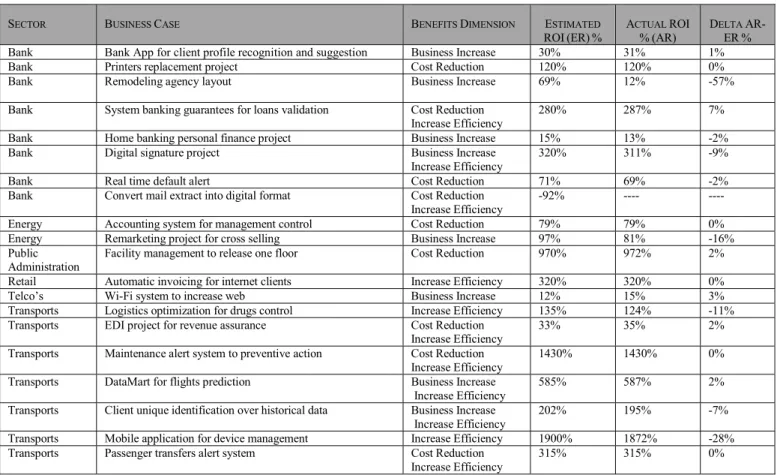
In a second phase, the problem-solving step initiated in which the issue for analysis was identified with a mapping not only of its impacts and trends but also of the causes. Finally, the project team identified the solution, framing it in the model dimension, with the identification of the according benefits for analysis. In the data collection phase, it was identified the KPI’s for the benefits measurement and the identification of the costs associated with the new intervention. Finally, a sensitivity analysis was applied in order to provide organizations with more robust information for decision-making. Before implementing the solution, a pre-intervention measurement of the KPIs was pursued, allowing to compare the estimated and real results obtained (ROI measurement). The results obtained for each model is explained in a data table that elucidate the impact of models to achieve a successful ROI. Table I refers to S-Pereira ROI model results and table II to Pereira Diamond model results. The tables, with a very similar structure are organized by columns that show: Organization type, for the S-Pereira ROI model, and the market sector organizations in the Pereira Diamond’s case; the name of the business case in analysis; the type of benefit (whether external or internal, according to the description of the model) only for S-Pereira ROI Model; the dimension of the type previously identified benefits; an estimated ROI in percent; The actual ROI in percentage and the estimated ROI deviation over the measured.
TABLE I. TABLEI. S-PEREIRAROIMODELRESULTS(NGO–NONGOVERNMENTALORGANIZATION,IPSS–PRIVATEINSTITUTIONOF
SOCIALSOLIDARITY)
According to the PMBOK® Guide [20], costs from projects should be reviewed during the course of the project and the accuracy of a project estimate will increase as the project progresses through the project life cycle. For instance, with a project within the initiation phase (business case should be done) may have a rough order of magnitude -25% to 75%. However, later in the project once we have more information, definitive estimates should narrow the range of accuracy to -5% to +10%.
ORGANIZATION TYPE BUSINESS CASE BENEFITS
(INTERNAL EXTERNAL)
BENEFITS DIMENSION ESTIMAT ED ROI (ER)% ACTUAL ROI % (AR) DELTA AR-ER%
Enterprise (Social area) Volunteering hours Bank Social Dimension Education 17% 16% -1%
Enterprise (Social area) Cultural Cycle Promotion Social Dimension Education 24% 12% -12%
Enterprise (Social area) Health: at work, at home Social Dimension Health 14% 16% 2%
Enterprise (Social area) Road Security Social Dimension Security 134% 129% -5%
Enterprise (Social area) Gender Policy implementation Social Dimension Human Rights 23% 25% 2%
Enterprise (Social area) Yoga in the Office Social Dimension Health 19% 18% -1%
Enterprise (Social area) Training for me (out of work scope) Social Dimension Education 88% 96% 8%
Public Database implementation Increase Efficiency Increase Efficiency 25% 25% 0%
Public Mobile App for Costumer Service Cost Reduction Increase Efficiency
Increase Efficiency Cost Reduction
320% 328% 8%
Public Culture patrimonial Impact Social Dimension Education 801% 820% 19%
Public Natural Park (Extension) Social Dimension Health 722% 700% -22%
Public Archaeological supervision to a work construction
Social Dimension Education 79% 80% 1%
Public Cycling Path connection Social Dimension Health 342% 338% -4%
Public Electrification with LED technology Cost Reduction Cost Reduction 68% 68% 0%
Public Sign Language News Social Dimension Education 16% 12% -4%
Public Syringes distribution to addicts Social Dimension Health 272% 286% 14%
NGO Financial Tax Compliance Compliance Compliance 106% 106% 0%
NGO Hosting Political Refugees Social Dimension Human Rights 3% 8% 5%
NGO Scholar support Center based in
volunteering work Social Dimension Education 1180% 1180% 0%
NGO Gender Equality Promotion Social Dimension Human Rights 172% 148% -24%
NGO Campaign against alcohol consumption Social Dimension Health 262% 294% 32%
NGO STD and HIV/SIDA prevention Campaign Social Dimension Health 12% 11% -1%
NGO Cost managing software implementation Increase Efficiency Increase Efficiency -20% --- ---
NGO Neighborhood Safety promotion Social Dimension Security 1% 1% 0%
IPSS Class opening in a growing school Social Dimension Education 15% 11% -4%
IPSS Inclusion of mental illness patients Social Dimension Human Rights 10% 3% -7%
Table I presents the results which express the effectiveness of the model. The overall average deviation between the estimated ROI and the actual ROI was 7%. For the companies that chose to apply the model as part of its social responsibility policy had a deviation of 4%. Even if the size of the projects was lower in comparison to other types of organizations presented in the study, the recurrent use of management methodologies actively contributes to the value of the deviation.
In the public sector projects also had an estimated deviation to the actual 8%. Also, the use of management methodologies contributed positively to this result. Although three projects have submitted deviations above 10% two projects obtain exactly the expected ROI estimation.
The third sector, made up of NGOs, had a deviance value of 9% with two projects with 0% of deviance from the estimated ROI. On the other hand, and with a smaller sample, the IPSS demonstrated a 7% of deviance to the estimated ROI.
TABLE 2–PEREIRA DIAMOND MODEL RESULTS
SECTOR BUSINESS CASE BENEFITS DIMENSION ESTIMATED
ROI(ER)% ACTUAL %(AR) ROI DELTA ER% AR-Bank Bank App for client profile recognition and suggestion Business Increase 30% 31% 1%
Bank Printers replacement project Cost Reduction 120% 120% 0%
Bank Remodeling agency layout Business Increase 69% 12% -57%
Bank System banking guarantees for loans validation Cost Reduction Increase Efficiency
280% 287% 7%
Bank Home banking personal finance project Business Increase 15% 13% -2%
Bank Digital signature project Business Increase
Increase Efficiency
320% 311% -9%
Bank Real time default alert Cost Reduction 71% 69% -2%
Bank Convert mail extract into digital format Cost Reduction Increase Efficiency
-92% ---- ----
Energy Accounting system for management control Cost Reduction 79% 79% 0%
Energy Remarketing project for cross selling Business Increase 97% 81% -16%
Public
Administration Facility management to release one floor Cost Reduction 970% 972% 2%
Retail Automatic invoicing for internet clients Increase Efficiency 320% 320% 0%
Telco’s Wi-Fi system to increase web Business Increase 12% 15% 3%
Transports Logistics optimization for drugs control Increase Efficiency 135% 124% -11%
Transports EDI project for revenue assurance Cost Reduction
Increase Efficiency 33% 35% 2%
Transports Maintenance alert system to preventive action Cost Reduction Increase Efficiency
1430% 1430% 0% Transports DataMart for flights prediction Business Increase
Increase Efficiency
585% 587% 2% Transports Client unique identification over historical data Business Increase
Increase Efficiency
202% 195% -7% Transports Mobile application for device management Increase Efficiency 1900% 1872% -28% Transports Passenger transfers alert system Cost Reduction
Increase Efficiency 315% 315% 0%
Doing the same exercise, but now concerning to Pereira Diamond model, the results shown a great efficiency of the model and its predictive power. An overall view, reveal 8% deviance between the estimated and the actual ROI.
In banking sector the deviation presented stands at 11%. To this value contributed the layout agency remodelling project that had a deviation of 57%. If eventually the project had been excluded from the study deviation would fell to 4%. The transport sector presents a 7%deviance from the estimated ROI. The remaining sectors shown a grouped 4%deviation.
The main difficulties inherent to this process occurred at two levels. The first one regarding the willingness of the organizations to participate in the study (only 54% and 50% for the application of the S-Pereira model and the E-Pereira model accordingly). The second one, was related to the metrics identification that best reflect the projects, especially, the access to the information collection regarding each project under analysis. Organizations had very different levels of data collection maturity.
V. CONCLUSIONS AND FUTURE CONTRIBUTIONS
The model allows to ensure that the causes of the real problems that affect the organizations are quickly identified so that solutions can be more effective by mitigating the negative impacts and thus able to provide benefits to all the stakeholders that are in interaction with organization.
It is believed that this model stands out from the other models because it presents a dynamic and predictive characteristic, with a low-cost data collection and without leaving space for subjectivity since it has been tested and it is understood in a quantitative way.
This study has some limitations that may be seen as future opportunities for model’s optimization. Thus, this study did not take into account the assessment of other indicators that could disclose the divergence reasons between the estimated and actual ROI for both S-Pereira ROI and E-Pereira models. As a future contribution, it is suggested to apply the root cause analysis methodology to identify the deviation causes and, thus, contribute to greater accuracy of both models.
At the same time, the original intention of the study was to include a 50 organizations sample for S-Pereira ROI model and 40 enterprises sample for E-Pereira Diamond model. The final samples for this study were composed of 27 and 20 organizations respectively. It is recommended, in order to be more representative in a possible new study, to use bigger random samples that allows confirm with more accuracy the obtained results.
The study application period can be another limitation because it would be possible to add more tracking moments to confirm the results accuracy and conclusions. Thus, in order to optimize the estimation techniques that both models advocate, it is proposed to future researches extend the application period of the study by developing additional tracking moments and combine with, above already cited, root cause analysis methodology.
Finally, after the elaboration of this study it was understood that the S-Pereira ROI model could undergo an optimization at the social dimension, which may be developed in future researches. This vertex could be divided in two: increase the social dimension to which the initiative is proposed (already presented in this model) and increase revenue / grants. In this way, from the point of view of the systematization of the model, we obtain a more focused and oriented vision for the
organizations that look for internal sustainability to execute non-profit actions.
REFERENCES
[1] BCBOK® (2015). A Guide to the Business Case Body of Knowledge of Knowledge. BCI (Business Case Institute):
http://www.businesscaseinstitute.org/bcbok-standards/what-is-a-business-case
[2] Mcvey, M. 2014. Head of Learning and Development. BABOK Guide. http://www.iiba.org/ba-connect/2013/march/how-to-define-business-case-babok-guide.aspx. Consulted on May 2015.
[3] Zwikael, O & Smyrk, J. (2012). A General Framework for Gauging the Performance of Initiatives to Enhance Organizational Value. British Journal of Management, Vol. 23, S6–S22.
[4] Müller, R. & Turner, R., 2007. The influence of project managers on project success criteria and project success by type of project. European Management Journal, 25, pp. 298–309.
[5] Ashurst, C., Doherty N. F. & Peppard, J., 2008. Improving the impact of IT development projects: the benefits realization capability model’, . European Journal of Information Systems,, 17, pp. 352–370.
[6] Phillips, J. 2011. Questions about ROI in today's climate. Magazine HR Poland: ROI Institute publications and articles.
[7] Australian Government (2009). Gateway Review Process – Department of Treasury and Finance: State Government: Victoria – Australia. [8] European Commission. (2008). Guide to Cost Benefit Analysis of
Investment Projects: DG Regional Policy. Brussels: European Commission.
[9] National Audit Office. (2003). The Green Book: Appraisal and Evaluation in Central. HM Treasury Department: London, Government of UK.
Retrieved from https://www.gov.uk/government/uploads/system/uploads/attachment_dat
a/file/220541/green_book_complete.pdf
[10] ROI Institute (2008). Return on Investment Methodology. ROI Institute, Inc.
[11] Social Value UK (2016): http://socialvalueuk.org/what-is-sroi [12] A Guide to Social Return on Investment, 2009. Society Media [13] Social Return on Investment Position. (2010). 2.
[14] Arvidson et al. (2010). The Ambitions and Challenges of SRO. TSRC Working Paper, pp. 49, pp. 9-10.
[15] Millar & Hall, 2012. Social Return on Investment (SROI) and Performance Measurement. Public Management Review, p. DOI:10.1080/14719037.2012.698857 p.12.
[16] Gair, C. 2009. SROI Act II: A Call to Action for Next Generation SROI. pp. REDF pp. 6-7.
[17] Basile, F. (1996). Great management ideas can work for you . Indianapolis Business Journal, pp. Vol.16, 53-54.
[18] Juran, J. (2001). The non-Pareto principle; mea culpa. Retrieved from The Juran Institute: www.juran.com/research/articles/ sp7515.html
[19] Schmidt, M. J., 2009. Business Case Essentials: A Guide to Structure and Content. Boston: Solution Matrix ltd.
[20] PMBoK® (2013), A Guide to the Project Management Body of Knowledge. Project