397
Abstract
The grinding process is defined as an abrasive cutting action of a tool known as grinding wheel, which is submitted to high rotations, promoting excellent finishing and accuracy in dimensions, respecting the parameters established in each project. Dur-ing the machinDur-ing, the cuttDur-ing edges of the abrasive grains undergo wearDur-ing and this increases the contact surface of the tool with the workpiece, increasing the machining temperature and creating possibilities of damaging it. Therefore, it is necessary to use a cutting fluid, responsible for lubricating and cooling the cutting zone, removing the chips from the cutting region between the workpiece and the wheel, and even having an anticorrosive action. However, its composition causes contamination to the environ-ment and to the operator. In face of the increasingly strict environenviron-mental laws, it has become necessary to search for new methods of cooling that are at least as effective as conventional one and economically practicable. Thus, the Minimum Quantity of Lubrication was developed as a mist of air and oil applied at high pressure, reducing drastically the use of contaminants. In this work, two oil flows were used for the MQL technique, 30 ml/h and 120 ml/h. The wheel used was a CBN (Boron Cubic Nitride) one, composed of synthetic grains and the workpiece, in a ring format, were produced in AISI 4340 steel quenched and tempered. It was observed from results that MQL can be applied in the industrial processes without losing piece quality.
keywords: cylindrical plunge grinding, minimum quantity of lubrication, cubic boron nitride grinding wheel, AISI 4340 steel.
Rafael Polato Francelin
Universidade Estadual Paulista Julio de Mesquita Filho Departamento de Engenharia Mecânica
Bauru – São Paulo - Brasil [email protected]
Wangner Barbosa da Costa
Universidade Estadual Paulista Júlio de Mesquita Filho Departamento de Engenharia Mecânica
Bauru – São Paulo - Brasil [email protected]
José Claudio Lopes
Universidade Estadual Paulista Júlio de Mesquita Filho Departamento de Engenharia Mecânica
São Paulo – São Paulo - Brasil [email protected]
Alan Polato Francelin
Universidade Estadual Paulista Júlio de Mesquita Filho Departamento de Engenharia Mecânica
Bauru – São Paulo - Brasil [email protected]
Hamilton Jose de Mello
Universidade Estadual Paulista Júlio de Mesquita Filho Departamento de Engenharia Mecânica
Bauru – São Paulo - Brasil [email protected]
Paulo Roberdo de Aguiar
Universidade Estadual Paulista Júlio de Mesquita Filho Departamento de Engenharia Mecânica
Bauru – São Paulo - Brasil [email protected]
Eduardo Carlos Bianchi http://orcid.org/0000-0003-2675-4276
Universidade Estadual Paulista Júlio de Mesquita Filho Departamento de Engenharia Mecânica
Bauru – São Paulo - Brasil [email protected]
Evaluation of the oil flow
using the MQL technique
applied in the cylindrical
plunge grinding of AISI 4340
steel with cbn grinding wheel
Mechanic and Energy
Mecânica e Energia
1. Introduction
The use of abrasives to reach the object’s final shape and dimensions comes from over 2000 years ago. Abrasive com-pounds were used to make knives, tools and weapons. Abrasives may also have been used to cut and shape rocks, such as pyramids, as well as polishing gemstones. Nowa-days, abrasives are being used in many applications and many of the modern technologies depend on the industry to exist. Grinding fits into the abrasive processes, as it contains in its tool, the grind-ing wheel, abrasive grains responsible for removing material from the machined part. For Pereira et al. (2009), grinding is a
manu-facturing process of significant importance, mainly where there is need of precision in the dimensions and low surface roughness. The grinding process is usually the last surface machining process, and therefore has a high added value. Finally, it is one of the most complex machining processes, due to the substantial number of variables pres-ent, with many pa-rameters that influence each other (Chen et al., 2002), influencing
directly and indirectly in the re-sult.Mainly, due to the elevated temperatures gener-ated by the friction of the grinding wheel and the workpiece, it is necessary to use a cutting fluid. On the other hand, this fluid is responsible for heat transfers with the workpiece (cooling), and is responsible for removing chip and other impuri-ties found or in the workpiece’s surface or in the tool, reducing friction and minimizing wheel’s wear by acting as a lubricant (Pawlak et al., 2004). However, its composition makes
it clear that its use is extremely harmful to the environment and to people who work in uninterrupted contact with this harmful atmosphere. Proper disposal is required, which involves prohibitive costs and com-plex chemical processes for separating the oil from the water and all the treatments that, from the eco-nomic point of view, makes the conventional method of cooling lubrication many times higher than the cost of the wheel, when considering the total ex-penses with fluid acquisition, maintenance, fil-tration and disposal (Nguyen and Zhang,
2003). With stricter laws, apparent envi-ronmental and health damage, in addition to the prohibitive costs, research into new methods of refrigeration has been made necessary. The search for a better superficial quality (roughness) and the increase of the useful life of the wheel should also be under-stood as objectives that are completed to the other ne-cessities, like tolerances and surface finishes, for example. The MQL (minimum quantity of lubri-cant), also called "Near-dry machining", works by injecting a mist of air and oil at high pressures towards the machining surface (Pusavec et al., 2014).
In accordance with such preroga-tives, it is necessary to study and develop new techniques that minimize the use of conventional cooling methods. Therefore, the objective of this work is to eval-uate the MQL technique, varying the oil flow in the cylindrical grinding process of AISI 4340 steel, as well as the results of surface roughness, circularity deviations, grinding wheel wear, microhard-ness, acoustic emis-sion and vibration.
2. Materials and methods
All the tests were conducted in the Abrasion Machining Laboratory (LUA) from the Faculty of Engineering – UNESP – Bauru, where there was used a cylindrical plunge grinder model RUAP515H from Sul-mecânica, equipped with CNC controls from Fagor in order to access the X-axis. Two CNC programs were used; one for the machining
of the test pieces and another for the printing of the wear on the grinding wheel surface.
The workpieces used for the tests were made of AISI 4340 steel, quenched and tempered, with a hardness of approximately 58 HRc and have the following dimensions: external diameter of 58 mm, internal diam-eter of 30 mm and a thickness of 4.5 mm.
For grinding, a Boron Cubic Nitride grinding wheel (CBN) from Nikkon-Saint Gobain was used, with the specification SN-B151Q12VR2. It consists of a vitrified bond with CBN grains, with an external diameter of 350 mm and a thickness of 19 mm.
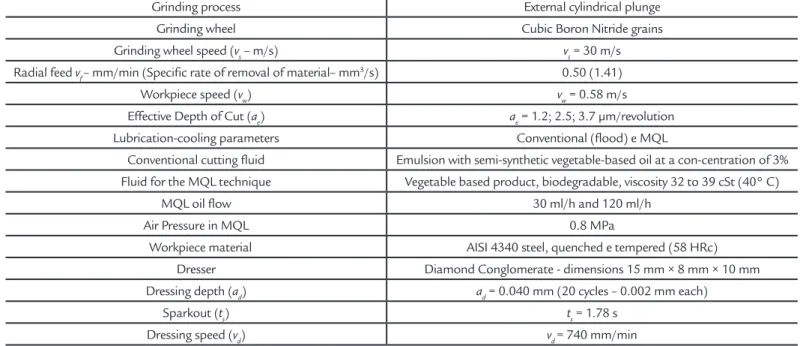
Table 1 shows the machining condi-tions adopted in this work.
Grinding process External cylindrical plunge Grinding wheel Cubic Boron Nitride grains Grinding wheel speed (vs – m/s) vs = 30 m/s Radial feed vf– mm/min (Specific rate of removal of material– mm3/s) 0.50 (1.41)
Workpiece speed (vw) vw = 0.58 m/s
Effective Depth of Cut (ae) ae = 1.2; 2.5; 3.7 µm/revolution
Lubrication-cooling parameters Conventional (flood) e MQL
Conventional cutting fluid Emulsion with semi-synthetic vegetable-based oil at a con-centration of 3% Fluid for the MQL technique Vegetable based product, biodegradable, viscosity 32 to 39 cSt (40° C)
MQL oil flow 30 ml/h and 120 ml/h Air Pressure in MQL 0.8 MPa
Workpiece material AISI 4340 steel, quenched e tempered (58 HRc) Dresser Diamond Conglomerate - dimensions 15 mm × 8 mm × 10 mm Dressing depth (ad) ad = 0.040 mm (20 cycles – 0.002 mm each)
Sparkout (ts) ts = 1.78 s Dressing speed (vd) vd= 740 mm/min
Table 1
399 For this study, two different oil flows
were evaluated by the MQL technique in comparison to the conventional (flood) technique, being three parameters ana-lyzed: conventional fluid, MQL 30 ml/h and MQL 120 ml/h. In order to find a ten-dency line in the results, the cooling system’s param-eters had two replications, which aimed to increase the statistical reliability of the process and thus the data obtained.
For the conventional flood cooling system, the semi-synthetic ME-1 cutting fluid from Qui-matic Tapmatic Ltda. was used, with an emulsion corresponding to 3%. For the MQL system, the Accu-Lube LB-1000 fluid from ITW Chemical Prod-ucts Ltda. where used.
Average arithmetic roughness (Ra) was measured with the help of a Surtronic 3+ rugosimeter from Taylor Hobson. For that, a cut-off length of 0.25 mm and a total path of measurement (ln) of 1.25 mm were adopted. In all measurements, for each test specimen, 10 measurements were per-formed in various positions. In each test body, 3 measurements were per-formed in distinct positions (120° each).
The wheel width made it possible to perform two tests at each dressing interval. In order to analyze the wear of the wheel, cylindrical workpieces made of AISI 1020
steel with a length of 120 mm and a di-ameter of 40 mm were used, where they were subjected to machining cycles with feed speed (vf) of 0.50 mm/min, with the objective to print its surface with the relief of the cutting sur-face of the wheel. After printing, with their respective markings, it is possible to study the differ-ences of altitudes between the grinded region and the region that did not perform the grind-ing. In this way, the diametrical wear of the grinding wheel can be measured using the Taylor Hobson ru-gosimeter with the Talyprofile program of the same brand for computer use. Fig. 2 exemplifies the graph for the respective measurement of the diametrical wear of the wheel.
To determine the microhardness of the sample, the equipment from Mitutoyo, model Mi-croWizhard version 1.04 was used. This machine uses the micro-hard-ness system on the Vickers scale, using a load of 300g to ease the visualization of indentations at the moment of measure-ments. For each sample, three sets of indentations were performed, each series representing 6 measure-ments of micro-hardness tested at distances, equidistant from each other and below the machined surface (indentation of the surface towards the center).
The circularity error, how the piece is not perfectly circular, was obtained by using a Taylor Hobson Tayround 31C circular flowmeter. The gauging mecha-nism is, in summary, consists of one end of the arm where there is a probe with a diamond tip, being this tip the element that makes con-tact with the part to obtain the deviation.
For the metallographic procedures for analysis of optical microscopy and microhardness, the samples were prepared following these procedures: cutting of the part and its respective inlay, using a metallographic filling machine from Taclago model EM30D. Sandpapers were subsequently used in the following sequence: 80, 120, 220, 320, 400, 500 and 600 grits, and polishing with alumina of 1 μm granulometry. After the samples were chemically attacked using a chemical compound of HNO3 and C2H6O (Nital, in which the acid concentration was 2%), with the aid of an Olympus BX51M mi-croscope belonging to the Laboratory of Anelasticity and Biomaterials of Faculty of Sciences of UNESP, Bauru, the opti-cal micrographs were performed with a magnification of 1000x, enough to detect possible changes in the microstructure of the sample.
3. Results
In this topic, the output data ob-tained in the experiment of grinding AISI 4340 steel with su-per abrasive grinding
wheel (CBN) will be presented. It is in-teresting to note that, for each cooling parameter, three tests were performed.
The values presented in this section are the mean values ob-tained by the analysis of all the workpieces.
3.1 Roughness
The application of the MQL tech-nique causes the formation of an oil and chip mixture that is retained in the machin-ing area, increasmachin-ing the errors (Alves et al.,
2009). The same occurs with cy-lindrical plunge grinding, where a paste forms and remains on the surface of the test piece,
damag-ing the quality of the grinding. The obstruction of the wheel (the pores of the grinding wheel struc-ture are filled by chips, fluid and impurities), which occurs principally in the use of the MQL tech-nique, is explained by Oliveira et al. (2012),
who state that, in addition to increasing the
grinding forces and causing a high rough-ness, it also increases circularity deviations. Fig.1 presents the results of circular-ity deviations according to the established cooling param-eters. It is possible to notice similarities between the results of different MQL’s oil flows.
According to Puerto et al. (2013),
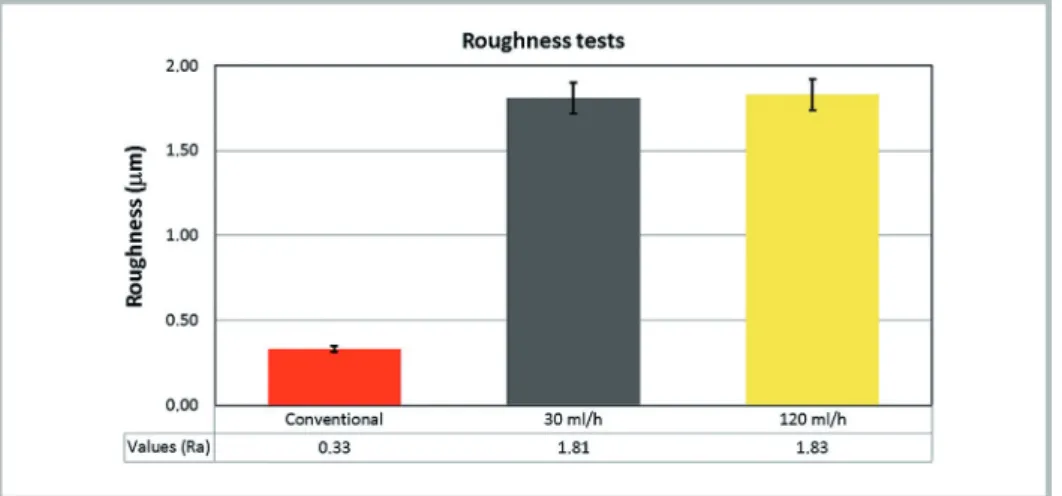
by being a process of abrasive machining, finishing grind-ing, especially for materials of high hardness, the surface roughness is very low (Ra results between 0,1μm to 2,0μm). With these results, it is possible to verify that flood (conventional) cooling is more effective when talking about final surface quality, where the mean roughness for this parame-ter is 0.32 μm, whereas for MQL, the lowest mean roughness was 1.81 μm (when the volume of oil was 30 ml / h).
The resistance of the fabricated components is significantly affected by
the surface roughness, due to the fatigue stresses generated by the work to which the pieces are subjected (Malkin & Guo, 2008). Thus, the roughness of a workpiece is directly linked to the cooling technique, the abrasive grain size of the wheel, in addition to dressing conditions, material removal rate and spark-out time.
From Fig. 4 it is possible to note that the roughness values found for the differ-ent oil flows in the MQL technique are similar, demonstrating that the amount of oil did not have a major influence on the result. However, as mentioned above, they
are higher than that found in the conven-tional art. At the lowest flow rate, the most likely reason for the high roughness was that there was not enough oil to lubricate the cutting edges that are in contact with the workpiece during machining. At the higher flow rate, the high oil flow may have accelerated the clogging process of the grinding wheel pores by generating a more abundant mixture of oil and chips, while the compressed air flow of the MQL system is sufficient only for cooling and not for cleaning the surface of the grinding wheel, damaging the results of the machining.
3.2 Roundness
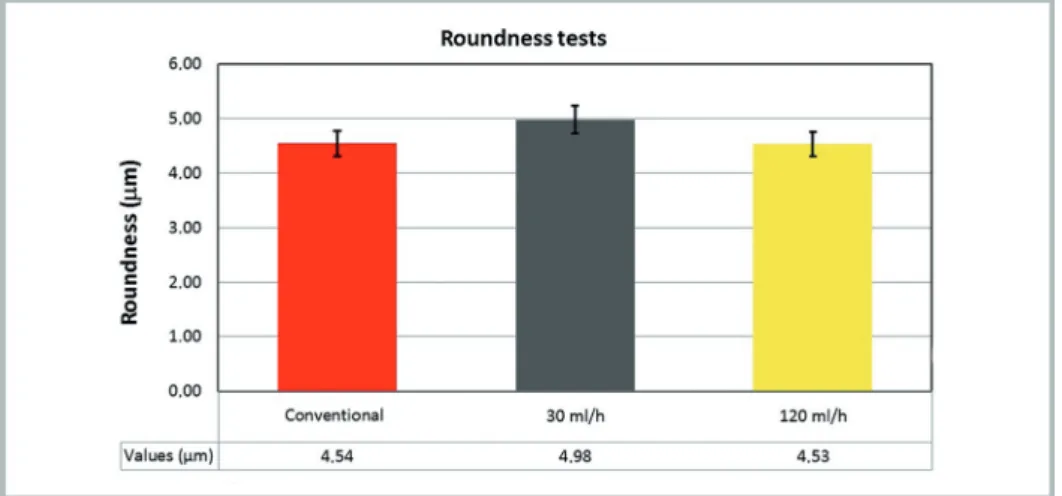
In Fig. 2, the circularity values are presented according to the cooling
parameters. It is no-ticed that flood (con-ventional) cooling presents a better result
only than that of MQL of 30 ml / h and similar to that of 120 ml / h.
Figure 2 Roundness as a
function of cooling parameters.
According to Wang (2008) the cir-cularity deviation is a value that must be within the toler-ance specifications of the project, since this parameter is significant for the grinding processes.
Some reasons may be able to justify these deviations, such as an inefficient
cooling, a misa-lignment of mandrels or a clearance between components in the machine. In addition, the obstruc-tion of the wheel (pores of the tool structure are filled with a mixture of oil, impurities and chips) caused by the MQL technique increases the grinding forces, roughness
and circularity (Oliveira et al. 2012).
A CBN wheel with higher porosity may be a solution to avoid impregnation of oil with chips in its structure, which has a good combination of abrasive grains and bond material, great chip stor-age capacity, high grinding rate and good dressing response.
3.3 Diametral tool wear
Fig.3 shows the average value of di-ametral wear for each cooling parameter. A widely used method for evaluating the
wear of a grinding wheel is through the ratio G. This relationship is shown capable of measuring the efficiency of the wheel by
the ratio between the volume of material removed and the worn wheel volume. That is, a simple division determines the
Figure 3
401 efficiency of a wheel. According to Jiang
et al. (2013), wear of the grinding wheel
is a strong indication of the use-ful life of this tool, since high wear is related to thermal damage or other unexpected failures in the machined part. It can be stated that the conventional lubrication leads to less wear of the grinding wheel
because the higher the value of the G ratio, the lower the wear. In a study by Valarelli
et al. (2002), in which it compared several
parameters resulting from grinding with CBN and Al2O3 grinding wheels, it was observed that the G ratio of a CBN grind-ing wheel is 20 times higher than that of the Al2O3 wheel.
Comparing only the values obtained with the MQL lubrication-refrigeration, the wear using a flow of 120 ml/h was the smallest one, showing to be more effec-tive in this wear problem. As in the other analyzed parameters, the tendency is that the wear increases with the decrease of the oil flow from MQL system.
3.4 Microhardness
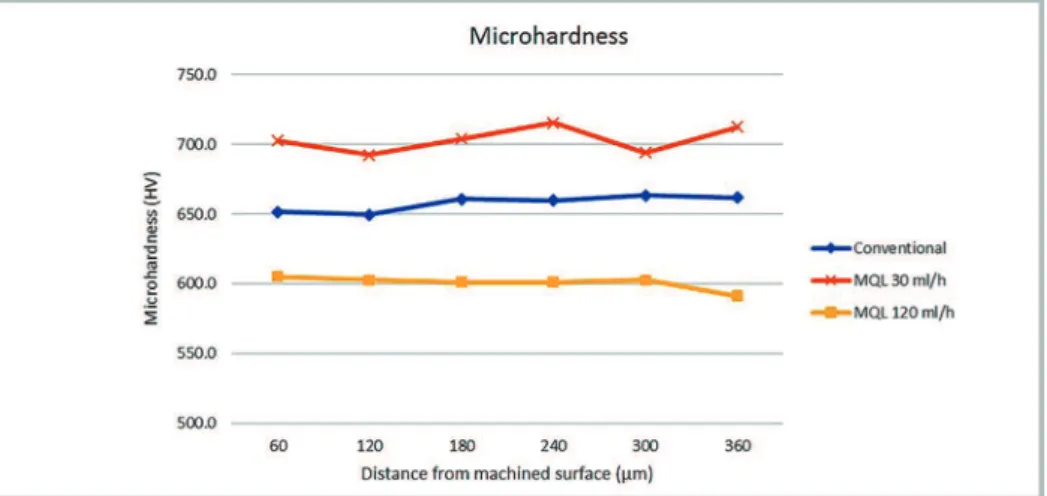
Fig. 4 shows the Vickers microhard-ness results, found by measuring six points with three replicates in different parts
of the sample, starting from the surface towards the center of the piece, and for this reason the distance to the machined
surface. The reason for this would be to determine whether there was an increase in hardness on the ground surface.
Figure 4 Microhardness as a function of the distance from machined surface.
The results obtained with the mi-crohardness are added to the results of the micrograph, bringing a more complete report and determining the occurrence or not of thermal damages. Fig. 4 shows that the microhardness was higher in the sample that was machined with MQL of
30 ml / h and that the results show a ten-dency where increasing the oil flow of the MQL, increases the hard-ness. However, the sample that was machined with conven-tional lubrication-refrigeration obtained an intermediate result, being only smaller than the result obtained with MQL at 30
ml / h. Even with these microhardness dif-ferences, it is not possible to conclude that there were thermal damages, since there are not significant changes in the hardness between the distinct levels of the samples in comparison to a not-machined piece of the same AISI 4340 steel.
4. Conclusion
From this present study, it can be concluded that:
• in the analysis of the roughness, noticed is that the conventional cooling (flood) obtained more satisfactory results for the MQL technique. The results ob-tained for different oil flows in the MQL technique indicate that with a surface cleaning, a smaller amount of oil can be used in order to obtain the same rough-ness value;
• in the study of the final geometry of the workpiece, circularity deviations were presented similar to the conventional technique as to the MQL with 120 ml/h,
while the one obtained for MQL with 30 ml/h was superior to the others. Thus, it is concluded that the MQL technique with 120 ml/h of oil can replace the con-ventional technique when the geometric precision for the limiting factor in the final quality of the part;
• the MQL technique requires a smaller wheel replacement interval due to lower wear than that obtained by the conventional technique. Thus, under these machining conditions, a lot of time is lost to perform a tool replacement, generating extra costs;
• none of the lubrication-cooling
parameters used caused thermal damage to the respective workpieces, according to microhardness profiles, even with the most severe machining condition (30 ml/h of oil). In the micrograph, it was not pos-sible to identify the microstructure, such as burn-ing or loss of carbon, and it was possible to easily identify a martensite matrix of the material;
• given the differences obtained between the results of two oil flows for MQL, it may be de-termined if there is an oil flow between 30 ml/h and 120 ml/h for the MQL technique that provides superior results. It starts with an oil flow of 60 ml/h.
Acknowledgments
The authors wish to thanks the Department of Mechanical Engineer-ing of the Faculty of En-gineerEngineer-ing of UNESP Bauru - SP, the Foundation for
Research Support of the State of São Paulo (FAPESP) for their support in granting the Scientific Initiation Scholarchip (process 2015/00754-0), to the Laboratory of
belonging to the Saint-Gobain Group, for the donation of the CBN grinding wheel,
to Quimatic Tapmatic Brasil Ltda. and ITW Chemical Products Ltda. for the
donation of cutting fluids and to all by the research opportunity.
References
ALVES, J. A. C., FERNANDES, U. de B., JÚNIOR, C. E da S., BIANCHI, E. C., AGUIAR, P. R., SILVA, E. J., Application of the minimum quantity lubrica-tion (MQL) technique in the plunge cylindrical grinding operalubrica-tion. Associação
Brasileira de Engenharia e Ciências Mecânicas. v. 31, n. 1, Janeiro-Março, 2009.
CHEN, X., ROWE, W. B., CAI, R. Precision grinding using CBN wheels.
Internatio-nal JourInternatio-nal of Machine Tools & Manufacture, 42, p.584-593, 2002.
GERDAU Aços Finos Piratini, 2003. (Manual dos Aços).
JIANG, J.I., GE, P.Q., BI, W.B., ZHANG, L., WANG, D.X., ZHANG, Y. 2D/3D ground surface topography modeling considering dressing and wear effects in grin-ding process. Int. J. Mach. Tools Manuf., 74, p.29–40, 2013.
MALKIN, S., GUO. C. Grinding technology: theory and aplications of machining
with abrasives. New York: Industrial Press, 372. 2008 p.
MOIA, D. F. G., THOMAZELLA, I. H., AGUIAR, P. R., BIANCHI, E. C., MAR-TINS, C. H. R., MARCHI, M. Tool condition monitoring of aluminum oxide grinding wheel in dressing operation using acoustic emission and neural networks,
Journal of the Brazilian So-ciety of Mechanical Sciences and Engineering, v.37,
n.2, p. 627–640, 2015. doi:10.1007/s40430-014-0191-6.
NGUYEN, T., ZHANG, L.C. An assessment of the applicability of cold air and oilmist in surface grinding. Journal of Materials Processing Technology, v.140,
n. 1-3, p.224-230, 2003.
OLIVEIRA, D.J., GUERMANDI, L.G., BIANCHI, E.C., DINIZ, A.E., AGUIAR, P.R., CANARIM, R.C. Improving minimum quantity lubrication in CBN grin-ding using compressed air wheel cleaning. Journal of Materials Processing
Technology. v.212, p. 2559-2568, 2012.
PAWLAK, Z., KLAMECKI, E. B., RAUCKYTE, T., SHPENKPV, P. G., KOKO-WSKI, A. The tribochemical and micellar aspects of cutting fluids. Tribology
In-ternational, v. 38, 2004.
PEREIRA, W. X., DINIZ, A. E., HASSUI, A. Comparing different plunge cylindrical grinding cycles based on workpiece roughness and process vibration. J. of the Braz.
Soc. of Mech. Sci. & Eng. v.31, n.2, p. 161-166, 2009.
PUERTO, P., FERNÁNDEZ, R., MADARIAGA, J., ARANA, J., GALLEGO, I. Evolution of surface roughness in grinding and its relationship with the dressing parameters and the ra-dial wear. Procedia Engineering. v. 63. p. 174-182, 2013.
PUSAVEC, F., DESHPANDE, A., YANG, S. M’SAOUBI, R., KOPAC, J., DILLON, O. W. (Jr.), JAWAHIR, I. S. Sustainable machining of high temperature Nickel alloy e Inconel 718: part 1 e predictive performance models. Journal of Cleaner
Production, 81, p.257, 2014.
VALARELLI, I. de D., BIANCHI, E. C., AGUIAR, P. R., MONICI, R. D. Estudo comparativo do desempenho de rebolos com grãos superabrasivos e convencionais submetidos a diversas condições de usinagem. In: CONGRESSO NACIONAL DE ENGENHARIA MECÂNICA, 2. João Pessoa, 2002.
WANG, J. P. Avaliação da retificação com rebolo de CBN vitrificado aplicada em
ligas de alto desemprenho. São Carlos: USP - Programa de Pós-Graduação em
Engenharia Mecânica, 2008. (Dissertação).