Dominated splittings for flows with singularities
This article has been downloaded from IOPscience. Please scroll down to see the full text article.
2013 Nonlinearity 26 2391
(http://iopscience.iop.org/0951-7715/26/8/2391)
Download details:
IP Address: 200.128.60.106
The article was downloaded on 16/09/2013 at 18:12
Please note that terms and conditions apply.
Nonlinearity26(2013) 2391–2407 doi:10.1088/0951-7715/26/8/2391
Dominated splittings for flows with singularities
Vitor Araujo1, Alexander Arbieto2and Luciana Salgado3
1Instituto de Matem´atica, Universidade Federal da Bahia, Av. Adhemar de Barros, S/N , Ondina,
40170-110-Salvador-BA-Brazil
2Universidade Federal do Rio de Janeiro, Instituto de Matem´atica, PO Box 68530, 21945-970
Rio de Janeiro, Brazil
3Instituto de Matem´atica Pura e Aplicada-Estrada Dona Castorina, 110, Jardim Botˆanico,
22460-320 Rio de Janeiro, Brazil
E-mail:[email protected],[email protected]@impa.br Received 24 October 2012, in final form 2 July 2013 Published 18 July 2013
Online atstacks.iop.org/Non/26/2391
Recommended by R de la Llave
Abstract
We obtain sufficient conditions for an invariant splitting over a compact invariant subset of aC1 flow X
t to be dominated. In particular, we reduce
the requirements to obtain sectional hyperbolicity and hyperbolicity.
Mathematics Subject Classification: 37D30, 37D25
1. Introduction
The theory of hyperbolic dynamical systems is one of the main paradigms in dynamics. Developed in the 1960s and 1970s after the work of Smale, Sinai, Ruelle, Bowen [9,10,26,27], among many others, this theory deals with compact invariant setsfor diffeomorphisms and flows of closed finite-dimensional manifolds with hyperbolic splitting of the tangent space. That is, ifXis a vector field andXt is the generated flow then we say that an invariant and
compact setis hyperbolic if there exists a continuous splitting of the tangent bundle over
,TM=Es⊕EX⊕Eu, whereEXis the direction of the vector field, the subbundles are
invariant under the derivativeDXtof the flowXt
DXt·E∗x =E
∗
Xt(x), x∈, t ∈R, ∗ =s, X, u;
Esis uniformly contracted byDXtandEuis uniformly expanded: there areK, λ >0 so that
DXt |Es
x Ke
−λt, DX
−t |Eu
x Ke
−λt, x∈, t ∈R.
(1.1)
Very strong properties can be deduced from the existence of such a structure; see for instance [13,25].
Weaker notions of hyperbolicity, such as the notions of dominated splitting, partial hyperbolicity, volume hyperbolicity and singular or sectional hyperbolicity (for singular flows),
have been proposed to try to enlarge the scope of this theory to classes of systems beyond the uniformly hyperbolic ones; see [1] and [5] for singular or sectional hyperbolicity. However, the existence of dominated splittings is the weaker one.
Many researchers have studied the relations of the existence of dominated splittings with other dynamical phenomena, mostly in the discrete time case, such as robust transitivity, homoclinic tangencies and heteroclinic cycles, and also the possible extension of this notion to endomorphisms; see for instance [5,6,15,19–21,33].
However, the notion of dominated splittings deserves attention. Several authors used this notion for linear Poincar´e flow, see [11,16,17], and this is useful in the absence of singularities, as in [12]. We remark that this flow is defined only in the set of regular points. However, in the singular case, it is a non-trivial question to obtain a dominated splitting for the derivative of the flow, and thus allowing singularities. Indeed, it is difficult to obtain it from a dominated splitting for linear Poincar´e flow. See [14], for an attempt to solve this, in the context of robustly transitive sets, using the extended linear Poincar´e flow.
Definition 1.1. Adominated splitting over a compact invariant setofX is a continuous
DXt-invariant splittingTM =E⊕F withEx = {0},Fx = {0}for everyx ∈and such
that there are positive constantsK, λsatisfying
DXt|Ex · DX−t|FXt (x)< Ke
−λt, for all x∈, and allt >0. (1.2)
The purpose of this article is to study the existence of dominated splittings for flows with singularities. On one hand, we study this question in the presence of some sectional hyperbolicity, as this theory was built to understand flows like the Lorenz attractor, which are the prototype of non-hyperbolic dynamics with singularities, but with robust dynamical properties. On the other hand, we present several examples to clarify the role of the condition on the singularities.
This article is organized as follows. In section2, we present the definitions and auxiliary results needed in the proof of theoremA, and some examples showing that the domination condition on the singularities is necessary. In section3, we present applications of our main result and more examples implying that these results are not valid for diffeomorphisms. In section4theoremBis proved assuming theoremA. In section5, we prove theoremAand theorem2.4. TheoremCand corollary2are proved in section6using the previously proved results. Finally, in section7, we present the examples stated in propositions1and2.
2. Statements of the results
Let M be a connected compact finite n-dimensional manifold, n 3, with or without a boundary. We consider a vector fieldX, such thatXis inwardly transverse to the boundary
∂M, if∂M= ∅. The flow generated byXis denoted by{Xt}.
Aninvariant setfor the flow ofX is a subset ofM which satisfiesXt() = for
allt ∈R. Themaximal invariant set of the flowisM(X):= ∩t0Xt(M), which is clearly a
compact invariant set.
Asingularityfor the vector fieldX is a pointσ ∈ M such that X(σ ) = 0. The set formed by singularities is denoted by Sing(X). We say that asingularity is hyperbolicif the eigenvalues of the derivativeDX(σ )of the vector field at the singularityσ have a non-zero real part.
A compact invariant setis said to bepartially hyperbolicif it exhibits a dominated splittingTM=E⊕Fsuch that subbundleEisuniformly contracted, i.e. there existC >0
andλ >0 such thatDXt|Ex Ce
−λfort 0. In this caseF is thecentral subbundle
We say that aDXt-invariant subbundleF ⊂TMis asectionally expandingsubbundle
if dimFx 2 is constant forx ∈and there are positive constantsC, λsuch that for every x∈and every two-dimensional linear subspaceLx ⊂Fxone has
|det(DXt|Lx)|> Ce
λt, for allt >0. (2.1)
Definition 2.1 ([18, definition 2.7]). Asectional-hyperbolic setis a partially hyperbolic set whose singularities are hyperbolic and whose central subbundle is sectionally expanding.
This is a generalization of hyperbolicity for compact invariant sets with singularities accumulated by regular orbits, since the Lorenz attractor and higher dimensional examples are sectional-hyperbolic [1,7,18,30] and because of the following result the proof of which can be found in [1,5,19].
Lemma 2.2 (Hyperbolic lemma). Every compact invariant subset of a sectional-hyperbolic set without singularities is a hyperbolic set.
The main result of this paper is the following.
Theorem A.Letbe a compact invariant set ofX such that every singularity in this set is hyperbolic. Suppose that there exists a continuousDXt-invariant splitting of the tangent bundle of,TM =E⊕F, whereEis uniformly contracted,F is sectionally expanding and for some constantsC, λ >0we have
DXt|Eσ · DX−t|Fσ< Ce −λt
for all σ ∈∩Sing(X) and t 0. (2.2)
ThenTM=E⊕F is a dominated splitting.
As a corollary, we obtain sufficient conditions to obtain hyperbolicity in the non-singular case using the hyperbolic lemma.
Corollary 1. Letbe a compact invariant set without singularities for the vector fieldX. Suppose that there exists a continuousDXt-invariant decomposition of the tangent bundle of ,TM=E⊕F, whereEcontracts andF is sectionally expanding. Thenis a hyperbolic set.
We note that in definition2.1domination is required. As a consequence of theoremA, the domination assumption is only necessary at the singularities, so that we obtain the following equivalent definition of sectional-hyperbolicity.
Definition 2.3. A compact invariant set ⊂ M is a sectional-hyperbolic set for X if all singularities in are hyperbolic, there exists a continuous DXt-invariant splitting of the
tangent bundle onTM =E⊕F with constantsC, λ >0 such that for everyx ∈ and
everyt >0 we have
(1) DXt|ExCe −λt;
(2) |detDXt|Lx|> C
−1eλt, for every two-dimensional linear subspaceL x ⊂Fx;
(3) DXt|Eσ · DX−t|Fσ< Ce
−λtfor allσ ∈∩Sing(X).
2.1. Hyperbolicity versus sectional-expansion
We present here some motivation for theoremA. We observe that, for a hyperbolic set, both splittings(Es⊕EX)⊕EuandEs⊕(EX⊕Eu)are dominated. Moreover, it is easy to see
Our next result shows that we cannot have a hyperbolic splitting without the flow direction, unless we restrict ourselves to finitely many singularities, all of them isolated on the non-wandering set.
Theorem 2.4. Letbe a compact invariant set ofX. Suppose that there exists a continuous DXt-invariant decomposition of the tangent bundleTM =E⊕F overand constants C, λ >0,such that for everyx ∈and allt >0
DXt|ExCe
−λt and DX
−t|FXt (x)Ce−λt. Thenconsists of finitely many hyperbolic singularities.
We cannot replace the assumptions on theorem2.4either by sectional-expansion or by sectional-contraction, as the following examples show.
Example 1. Consider a Lorenz-like singularityσ for aC1 flow{Xt}t∈Ron a3-manifoldM,
that is,σ is a hyperbolic singularity of saddle-type such that the eigenvalues ofDX(σ )are real and satisfyλ2 < λ3<0<−λ3< λ1andλ1+λ2>0.
LetEi be the eigenspace associated to the eigenvalueλi,i = 1,2,3, and setE =E3 andF =E1⊕E2. Then the decomposition is trivially continuous, not dominated (F admits vectors more sharply contracted than those ofE) butEuniformly contracts the lengths of the vectors andF uniformly expands the area, that is,F is sectionally expanded.
Example 2. Consider a hyperbolic saddle singularity,σ, for aC1flow{Xt}t∈Ron a4-manifold
Msuch that the eigenvalues ofDX(σ )are real and satisfy
λ2< λ3<0< λ4 < λ1, λ1+λ3>0 and λ2+λ4 <0.
LetEibe the eigenspace associated to the eigenvalueλi,i=1,2,3,4, and setF =E2⊕E4 andE=E1⊕E3. Then the decomposition is trivially continuous, not dominated as before, Eis uniformly area contracting, sinceDX−t |Eexpands area fort >0; andF is uniformly area expanding. In other words,F is sectionally expanded andEis sectionally contracted.
In both examples above we have sectional-expansion and sectional-contraction along the subbundles of a continuous splitting but the splitting is not dominated. These examples involve a trivial invariant set: an equilibrium point. But there are examples with compact invariant sets having singularities accumulated by regular orbits and also with a dense regular orbit; see section7.
This suggests that theorem 2.4might be generalized if we assume domination at the singularities oftogether with sectional-expansion alongF and uniform contraction along
Eover regular orbits. This is precisely the content of theoremA.
3. Applications and other examples
To present the next result characterizing sectional-hyperbolic sets through sectional Lyapunov exponents, we first have to present more definitions.
We say that a probability measure µ is X-invariant if µ(Xt(U )) = µ(U ), for every
measurable subsetU ⊂Mand everyt ∈R. Given a compactX-invariant setwe say that a subsetY ⊂Mis atotal probability subsetofifµ(Y )=1 for everyX-invariant measure
µsupported in . We note that each singularityσ ofbelongs to Y sinceµ = δσ is a X-invariant probability measure.
LetA:E×R→Ebe a Borel measurable map given by a collection of linear bijections
whereMis the base space (we assume it is a manifold) of the finite-dimensional vector bundle
E, satisfying the cocycle property
A0(x)=I d, At+s(x)=At(Xs(x))◦As(x), x∈M, t, s∈R,
with{Xt}t∈Ra smooth flow overM. We note that for each fixedt >0 the mapAt :E → E, vx ∈Ex →At(x)·vx∈EXt(x)is an automorphism of the vector bundleE.
The natural example of a linear multiplicative cocycle over a smooth flowXton a manifold
is the derivative cocycleAt(x)=DXt(x)on the tangent bundleT M of a finite-dimensional
compact manifoldM.
A concrete instance of this structure we will use is the derivative cocycleAt(x)=DXt | Exrestricted to a continuousDXt-invariant subbundleEof the tangent bundleT M.
According to the multiplicative ergodic theorem of Oseledets [3,4], since in this setting we have that sup−1t1logAt(x)is a bounded function ofx ∈, there exists a subsetR
ofwith total probability such that for everyx ∈Rthere exists a splitting
Ex =E1(x)⊕ · · · ⊕Es(x)(x) (3.1)
which isDXt-invariant and the following limits, known as theLyapunov exponents atx, exist
λi(x)= lim
t→±∞
1
t logDXt(x)·v,
for everyv∈Ei(x)\{0}, i=1, . . . , s(x). We order these numbers asλ1(x) < . . . < λs(x)(x).
One of these subbundles is given by the flow direction (at non-singular points of the flow) and the corresponding Lyapunov exponent is zero for almost every point.
The functionssandλiare measurable and invariant under the flow, i.e.,s(Xt(x))=s(x)
andλi(Xt(x))=λi(x)for allx ∈Randt ∈R. The splitting (3.1) also depends measurably
on the base pointx ∈ R. IfF is a measurable subbundle of the tangent bundle then by ‘the Lyapunov exponents ofE’ we mean the Lyapunov exponents of the non-zero vectors inF.
Given a vector spaceE, we denote by∧2Ethe second exterior power ofE, defined as
follows. For a basisv1, . . . , vn of E, then ∧2E is generated by{vi ∧vj}i=j. Any linear
transformationA:E→F induces a transformation∧2A:∧2E→ ∧2F. Moreover,v i∧vj
can be viewed as the 2-plane generated byvi andvj ifi =j; see for instance [3] for more
information.
In [2], a notion of sectional Lyapunov exponents was defined and a characterization of sectional-hyperbolicity was obtained based on this notion.
Definition 3.1 ([2, definition 2.2]). Given a compact invariant subsetof X with aDXt
-invariant splittingTM = E⊕F, thesectional Lyapunov exponentsofx alongF are the
limits
lim
t→+∞ 1
t log ∧ 2DX
t(x)·v
whenever they exists, wherev∈ ∧2F x− {0}.
As explained in [2], if{λi(x)} s(x)
i=1are the Lyapunov exponents, then the sectional Lyapunov
exponents at a pointx ∈ R are{λi(x)+λj(x)}1i<js(x)and they represent the asymptotic
sectional-expansion in theF direction.
As an application of theoremA, we have the following result, which is an extension of the main result in [2] assuming continuity of the splitting, instead of a dominated splitting.
If the Lyapunov exponents in theEdirection are negative and the sectional Lyapunov exponents in the F direction are positive on a set of total probability within , then the splitting is dominated andis a sectional-hyperbolic set.
We now apply the main result to the setting of weakly dissipative three-dimensional flows. We recall that an open subsetUis atrapping regionifXt(U )⊂U, t >0 and a compact
invariant subsetisattractingif it is the maximal invariant subset(U )= ∩t0Xt(U )inside
the trapping regionU. We say that a compact invariant subsetfor the flow of the vector field
Xisweakly dissipativeif div(X)(x)0 for allx ∈, that is, the flow nearinfinitesimally does not expand in volume.
We also say that a hyperbolic singularity σ of X is C1-linearizable if there exists a
diffeomorphismh:Vσ →Bfrom an open neighbourhood ofσ ∈Mto an open neighbourhood Bof the origin inR3such thath(Xt(x))=et A·h(x), Xs(x)∈Vσfor|s|tandA=DX(σ ).
For this it is enough that the spectrum ofDX(σ )satisfies a finite number of non-resonance conditions; see e.g. [28]. Hence this is aCr-generic condition for all sufficiently larger1.
Theorem C. Let X be a C1 vector field on a three-dimensional manifold M admitting a trapping regionU whose singularities (if any) are hyperbolic andC1 linearizable. Let us assume that the compact invariant subset=(U )is weakly dissipative and endowed with a one-dimensional continuous fieldF of asymptotically backward contracting directions, that is,x∈→Fxis continuous and for eachx∈,Fxis a one-dimensional subspace ofTxM, and also
lim inf
t→+∞ 1
t logDX−t |Fx<0 for allx∈. (3.2) If at each singularityσ ∈ Uthere exists a complementaryDXt-invariant directionEσ such thatEσ⊕Fσ =TσMis a dominated splitting, thenis a hyperbolic set (in particular,has no singularities).
Since we use the attracting and dominated splitting assumption only to prove the non-existence of singularities in, as a consequence of the proof we obtain the following.
Corollary 2. LetXbe aC1vector field on a three-dimensional manifoldMadmitting compact invariant subset, without singularities, which is weakly dissipative and endowed with a one-dimensional continuous fieldF of asymptotically backward contracting directions.
Thenis a hyperbolic set.
These results are extremely weak versions of the following conjecture of Viana, presented in [31].
Conjecture 1. If an attracting set(U )of smooth map/flow has a non-zero Lyapunov exponent at Lebesgue almost every point of its isolating neighbourhoodU, that is
lim sup
t→+∞ 1
t logDXt>0 for Lebesgue almost everyx ∈U, (3.3)
then(U )has a physical measure: there exists an invariant probability measureµsupported in(U )such that for all continuous functionsϕ:U →R
lim
t→+∞ 1
t
t
0
ϕ(Xt(x))dt =
ϕdµ for Lebesgue almost every x ∈U.
Indeed, ifUis a trapping region and=(U )satisfies the assumptions of theoremC, then
We now provide several examples which clarify the role of the assumption of domination at the singularities in theorem A and the relations between dominated splittings for diffeomorphisms and flows.
Proposition 1.There exist the following examples of vector fields and flows.
(1) A vector field with an invariant and compact set containing singularities accumulated by regular orbits inside the set, with a non-dominated and continuous splitting of the tangent space, but satisfying uniform contraction and sectional-expansion.
(2) A vector field with an invariant and compact set with a continuous and invariant splitting E⊕F such thatEis uniformly contracted,F is area expanding but it is not dominated. (3) A suspension flow whose base map has a dominated splitting but the flow does not admit
any dominated splitting.
Item (3) above is based on a diffeomorphism described in [8] and similar to another suggested by Pujals in [5, example B.12].
An important remark is that our results are not valid for diffeomorphisms, as the following result shows.
Proposition 2.There exists a transitive hyperbolic set for a diffeomorphism with a non-dominated splitting which is sectionally-expanding and sectionally contracting.
4. Proof of theoremB
We follows the lines of [2]. The following proposition, whose proof can be found in [2], is the main auxiliary result in the proof.
We fix a compactXt-invariant subset. We say that a family of functions{ft :→R}t∈R is subadditive if for everyx ∈ M andt, s ∈ Rwe have thatft+s(x) fs(x)+ft(Xs(x)).
The subadittive ergodic theorem (see e.g. [32]) shows that the functionf (x)=lim inf
t→+∞
ft(x)
t
coincides withf (x) = lim
t→+∞
1
tft(x)in a set of total probability in.
Proposition 3.Let {t → ft : → R}t∈Rbe a continuous family of continuous function
which is subadditive and suppose that f (x) < 0 in a set of total probability. Then there exist constants C > 0 and λ < 0 such that for everyx ∈ and every t > 0 we have
exp(ft(x))Cexp(λt /2).
Proof.See [2, proposition 3.4].
Remark 1. In [2] only =M(X)was considered to conclude that{Xt}t∈Ris a sectional-Anosov flow. However all statements are valid for a compact invariant subset ofM.
Proof of theoremB.Define the following families of continuous functions on φt(x)=logDXt|Ex and ψt(x)=log ∧
2DX
−t|FXt (x), (x, t )∈×R.
Both familiesφt, ψt :→Rare easily seen to be subadditive. From proposition3applied
toφt(x)and the hypothesis on the Lyapunov exponents, there are constantsC >0 andγ <0
such that exp(φt(x))= DXt|ExCexp(γ t )for allt >0 showing thatEis a contractive subbundle.
Analogously, the hypothesis on the sectional Lyapunov exponents and proposition 3
applied to the function ψt(x) provides constants D > 0 and η < 0 for which ∧2 DX−t|FXt (x)Deηt, soF is a sectionally expanding subbundle. Now theoremAensures that
5. Proof of theoremAand theorem2.4
We need an auxiliary lemma for which the following definition is necessary. Given a pair of subspacesEx, Fx ofTxMsuch thatEx∩Fx = {0}, the angle (Ex, Fx)between the two
subspaces is defined by
sin (Ex, Fx):= 1
π(Ex)
, x∈,
whereπ(Ex):Ex⊕Fx →Ex is the projection ontoEx parallel toFx defined in the vector
spaceEx⊕Fx.
We say that an invariant splittingE⊕F =TMof the tangent bundle over a invariant
subsethas angle uniformly bounded away from zeroif the dimensions of the fibersEx,Fx
are constant for allxinand there existsθ0>0 such that sin (Ex, Fx)θ0for eachxin.
The next lemma specifies the subbundle which contains the flow direction.
Lemma 5.1. Letbe a compact invariant set forX. Given an invariant splittingE⊕F of TMwith the angle bounded away from zero over, such thatE is uniformly contracted, then the flow direction is contained in theF subbundle, for allx ∈.
Proof. We denote byπ(Ex): TxM →Ex the projection onEx parallel toFx atTxM, and
likewiseπ(Fx):TxM→Fxis the projection onFxparallel toEx. We note that forx ∈
X(x)=π(Ex)·X(x)+π(Fx)·X(x)
and fort ∈R, by linearity ofDXtandDXt-invariance of the splittingE⊕F
DXt·X(x)=DXt·π(Ex)·X(x)+DXt·π(Fx)·X(x)
=π(EXt(x))·DXt·X(x)+π(FXt(x))·DXt·X(x)
Let z be a limit point of the negative orbit of x. That is, we assume without loss of generality sinceis compact, that there is a strictly increasing sequence tn → +∞such
that lim
n→+∞xn:=n→lim+∞X−tn(x)=z. Thenz∈and, ifπ(Ex)·X(x)is not the zero vector, we get
lim
n→+∞DX−tn·X(x)=n→lim
+∞X(xn)=X(z), but also lim
n→+∞DX−tn·π(Ex)·X(x)n→lim
+∞c
−1eλtnπ(E
x)·X(x) =+∞. (5.1)
This is possible only if the angle betweenExn andFxntends to zero whenn→+∞.
Indeed, using the Riemannian metric onTyM, the angleα(y)=α(Ey, Fy)betweenEy
andFyis related to the norm ofπ(Ey)as follows:π(Ey) =1/sin(α(y)). Therefore
DX−tn·π(Ex)·X(x) = π(Exn)·DX−tn·X(x)
1
sin(α(xn))
· DX−tn·X(x)
= 1
sin(α(xn))
· X(xn)
for alln1. Hence, if the sequenceDX−tn·π(Ex)·X(x)in the left hand side of (5.1) is unbounded, then lim
n→+∞α(X−tn(x))=0.
However, since the splittingE⊕Fhas an angle bounded away from zero over the compact
, we have obtained a contradiction. This contradiction shows thatπ(Ex)·X(x)is always
The proof of theorem2.4follows from lemma5.1.
Proof of theorem 2.4. We assume, arguing by contradiction, that there exists a point
x ∈ \Sing(X), that is, x is a regular point: X(x) = 0. Hence lemma 5.1ensures that
X(x)∈Fx. But the same lemma5.1applied to the reversed flowX−t generated by the field −Xon the same invariant setshows thatX(x)∈ Ex. ThusX(x)∈Ex∩Fx = {0}. This
contradiction ensures that⊂Sing(X). But our assumptions on the splitting show that each
σ ∈is a hyperbolic singularity: the eigenvalues ofDX|Eσ are negative and the eigenvalues ofDX |Fσ are positive. It is well known that hyperbolic singularitiesσ are isolated in the ambient manifoldM; see e.g. [22]. We conclude that the compactis a finite set of hyperbolic
singularities.
Before proving theoremAwe need some extra notions and definitions.
We recall that, for a invertible continuous linear operatorL, the minimal norm (or co-norm) is equal tom(L) := L−1−1. Hence condition (1.2) in definition1.1is equivalent
to
DXt|Ex< Ke
−λt·m(DX
t|Fx) for all x∈and for allt >0. (5.2)
The multiplicative ergodic theorem of oseledets [3,4] provides the following properties of Lyapunov exponents and Lyapunov subspaces, in addition to the existence of Lyapunov exponents on the total probability subsetR of, as presented in section3. For any pair of disjoint subsetsI, J ⊂ {1, . . . , s(x)}, the angle between the bundlesEI(x)=i∈IEi(x)and EJ(x)=j∈JEj(x)decreases at most subexponentially along the orbit ofx, that is
lim
t→±∞ 1
t log sin
(EI(Xt(x)), EJ(Xt(x)))=0, x ∈R;
which implies, in particular, that for any pair i, j ∈ {1, . . . , s(x)} withi = j and vi ∈ Ei(x)\ {0}, vj ∈Ej(x)\ {0}
lim
t→±∞ 1
t log|det(DXt |span{vi, vj})| =λi(x)+λj(x).
Proof of theorem A. Let x ∈ R ⊂ be a regular point of the flow of X. From lemma5.1we know thatX(x) ∈ Fx. SinceF is aDXt-invariant subbundle, considering
the linear multiplicative cocycleAt(z)=DXt |Fzforz∈, t ∈R, there exists a splitting Fx =s(x)j=1Fj(x)ofFxinto a direct sum of Lyapunov subspaces. One of these subspaces is
EXgenerated byX(x)= 0, which we renameF
1(x)=ExXin what follows. We also have the
corresponding Lyapunov exponentsλFj(x), j =1, . . . , s(x).
Fixing i = 2, . . . , s(x) andv ∈ Fi(x)\ {0}, we consider span{X(x), v}. From the
assumption of sectional expansion of area together with the subexponential control on angles at regular points we obtain
0< λlim inf
t→+∞ 1
t log|det(DXt|span{X(x), v})| =λ F 1(x)+λ
F i (x)=λ
F i(x).
HenceλF
i (x)λ >0 for alli=2, . . . , s(x), x∈RandX(x)= 0.
If we consider the cocycleBt(z)=DXt | Ez, x ∈ , t ∈R, then we find the splitting Ex = r(x)i=1Ej(x)into Lyapunov subspaces and the corresponding Lyapunov exponents λE
i (x), i=1, . . . , r(x). It is easy to see that the assumption of uniform contraction alongE
implies thatλE
Thenφt(x)=log
DXt|Ex
m(DXt|Fx) is a subadditive family of continuous functions satisfying
φ(x)=lim inf
t→+∞
φt(x)
t lim infn→+∞ 1
t logDXt|Ex −lim supn→+∞ 1
t logm(DXt|Fx)
=max{λEi (x),1ir(x)} −min{λFi (x),1is(x)}−λ−0= −λ
for allx∈Rsuch thatX(x)= 0.
Forx =σ for some singularityσ ∈ we haveφ(σ )−λas a direct consequence of the assumption of domination at the singularities.
We have shown thatφ(x) <0 for allx ∈ R. Applying proposition3we see that there existsC > 0 such that expφt(x) Ce−λt /2 for allx ∈ andt > 0, which gives us the
condition (5.2). This concludes the proof of theoremA.
The proof of corollary1follows from theoremAand the hyperbolic lemma2.2.
6. Proof of theoremCand corollary2
We start by showing that the one-dimensional asymptotically backward contracting subbundle
Foveris in fact a uniformly expanding subbundle. Indeed, we note thatft(x)=logDX−t | Fx is a subadditive family of continuous functions satisfying f (x) < 0 for all x ∈ .
In particular, f (x) < 0 in a set of total probability. Hence by proposition3 we obtain
ft(x) Ce−t λ/2 for all t > 0 and some constants λ, C > 0. (This trivially implies
DXt | FXt(x) e
t λ/2/C, x ∈ , t 0 and soDX
T | Fx > 2 for allx ∈ and T 2 log(2C)/λ.)
Now we use the assumption thatis an attracting set whose possible singularitiesσ are hyperbolic,C1linearizable and admit a complementaryDXt-invariant directionEσsuch that Eσ⊕Fσ =TσMis a dominated splitting.
Lemma 6.1. The attracting setdoes not contain singularities.
Proof. By theC1-linearization assumption and the stable/unstable manifold theorems, there exists a correspondingXt-invariant (weak- or strong-)unstable one-dimensional manifoldWσu
contained in (sinceis attracting) such that Fσ = TσWσu andX−t(z) −→
t→+∞σ for each
z∈Wu σ.
Claim 1. For allz∈Wu
σ we haveX(z)∈Fz.
We note that this is trivially true for z = σ. Let us assume, by contradiction, that
X(z) /∈Fzfor somez∈Wσu\ {σ}(and thus for all suchzbyDXt-invariance). By assumption
there exists a diffeomorphismh:Vσ→Bfrom an open neighbourhood ofσ ∈Mto an open
neighbourhoodBof the origin inR3such thath(Xt(x))=et A·h(x), Xs(x)∈Vσfor|s|t
andA=DX(σ ). By a linear change of coordinates we can assume without loss of generality thatDh(σ )·Fσ =R×02andDh(σ )·Eσ =0×R2. Letv : Vσ ∩→ R3 denote the
continuous unitary vector field such that span(vx)=Dh(x)·Fx, x∈Vσ∩.
We are assuming thatvz has a non-zero component along theEσ ≈ 0×R2 direction
for z ∈ Wσu\ {σ}. SinceX−t(z) →
t→+∞σ the domination of the splittingEσ ⊕Fσ ensures that (et A·v
z, Eσ) −→
t→−∞0. However the invariance ofF ensures thatFX−t(z)t→−∞−→ Fσ and sincehis aC1conjugation we also have (et A·v
z, Fσ) −→
Using the claim together with the previous estimate on expansion alongF, we have that
∞>sup
x∈
X(x)X(XkT(z)) = DXkT ·X(z)2kX(z), k1
which is a contradiction and completes the proof of the lemma.
From now we use only the assumptions of corollary2, that is, thatis a weakly dissipative compact invariant subset without singularities having a continuous field of asymptotically backward contracting directions.
In this setting, the linear Poincar´e flow is well defined over . If we denote by
Ox :TxM→Nxthe orthogonal projection fromTxMtoNx = {v∈TxM:< v, X(x) >=0}
the orthogonal complement of the field direction atx ∈ , then thelinear Poincar´e flowis given byPt
x =OXt(x)◦DXt :TxM→NXt(x), x∈, t ∈R.
We note that since the flow direction is invariant, from the splittingTxM = ExX⊕NX
we can writeDXt = X(X
−t(x)) X(x) ⋆
0 P−t
and since|detDX−t|1 by the weak dissipative
assumption, we get|det(P−t)|m0=minz∈(X(x)/X(X−t(x))) >0.
Claim 2. The subbundleF˜of the normal bundle given by{ ˜Fx =Ox(Fx)}x∈isPt-invariant and uniformly backward contracting.
Indeed, the continuity of the subbundleFensures that (Fx, X(x))is bounded away from zero, and so there existsκ > 0 such that for everyv ∈ ˜Fx we have|β| κvsuch that βX(x)+v=u∈Fx. This ensures that
Px−t·v = OX−t(x)(DX−t·(u−βX(x)))OX−t(x)(DX−t·u−βX(X−t(x)))
DX−t·uCe−t λ/2v+βX(x)Ce−t λ/2(v+κvX(x))
C
1 +κsup
z∈
X(z)
e−t λ/2v = ˜Ce−t λ/2v.
This proves claim2.
This is enough to guarantee the existence of a complementaryP−t-invariant and expanding subbundle through a graph transform technique. To this end, let us consider the one-dimensional subbundleGxofNx orthogonal toF˜x. We can then writeNx = ˜Fx⊕Gxand so,
sinceF˜ isPt-invariant, we getPx−t =
at(x) bt(x)
0 ct(x)
, whereat(x):F˜x → ˜FX−t(x), ct(x):
Gx → GX−t(x) andbt(x) : Gx → FX−t(x). We know that |at(x)| C˜e
−t λ/2 and since
0< m0|det(P−t)| = |at(x)| · |ct(x)|we obtain|ct(x)|m0et λ/2/C, x˜ ∈, t >0. We
fixT >0 such thatm0eT λ/2/C˜ 2.
Let us now consider the family of continuous one-dimensional complementary subspaces ofF˜xinsideNxgiven by the graph of a linear mapL:Gx → ˜Fx, i.e., we consider the vector
spaceGof allL= {Lx :Gx → ˜Fx :x ∈}with the normL1−L2 =supx∈L1x−L2x.
We have thatGwith this norm is a Banach space.
It is easy to see that the map P−t transforms the graph of L
x into the graph of ˆ
LX−t(x) = (P −t
x ·Lx +πX−t(x)·P
−t)◦[(I −π
X−t(x))·P
−t]−1, where π
z : Nz → ˜Fz is
the orthogonal projection fromNzintoF˜zatz∈. In this way we get a mapP−T :G→G
which we claim is a contraction with respect to the norm given above. Indeed, for any pair
Li = {Li
x}x∈, i=1,2 we get ˆL1X−
T(x)− ˆL
2
X−T(x) = P −t
x ·(L1x−L2x)◦[(I−πX−t(x))·P −t]−1
|aT(x)| · L1x−L 2
x/|ct(x)|
1 2L
1
x−L
s
W
E
F
Figure 1.A double homoclinic saddle connection expanding area.
for eachx ∈ . We thus have aP−T fixed pointL0 defining aP−T-invariant subbundle ˜
E= { ˜Ex= {(u, L0x(u)):u∈Gx}x∈of the normal bundle. SinceP−T commutes with each
Psfor alls∈R, we see thatE˜ isPs-invariant for alls∈R.
Claim 3. The subbundleE= ˜E⊕EXisDX
t-invariant.
Indeed, for anyv=u+βX(x)withu∈ ˜Ex, β∈R, we haveDXt·v=DXt·u+βX(Xt(x))
andDXt·u=Pxt·u+γ X(Xt(x))for someγ ∈R, thusDXt·v=Pxt·u+(β+γ )X(Xt(x))
withPt
x·u∈ ˜EXt(x, henceDXt·v∈EXt(x)and the claim is proved.
At this point we have a continuous splitting TxM = Ex ⊕Fx, x ∈ . Using this
invariant splitting we can writeDX−t =
At(x) 0
0 Bt(x)
and the continuity of the splitting
ensures that (Ex, Fx)is bounded away from zero. This ensures that 1 |detDX−t| =
|detAt(x)| · |Bt(x)| ·sin (Ex, Fx)and sinceBt(x)=DX−t|Fxwe have|Bt(x)|Ce−t λ/2,
hence|detAt(x)|grows exponentially fast.
This shows thathas a continuous invariant splittingE⊕F withFuniformly contracting andEarea expanding for the backward flow. In a three-dimensional manifold this shows that
Eis sectionally expanding for−X. From corollary1we have thatis a hyperbolic set for
−X, henceis a hyperbolic set and the proof of theoremCand corollary2is complete.
7. Examples
This section is devoted to presenting some examples.
7.1. Proof of proposition1
Here we present examples stated in proposition1.
Item (1). Consider a vector field on the planeR2with a double saddle homoclinic connection
which expands volume and multiply this vector field by a contraction along the vertical direction; see figure1. For the construction of the planar vector field, see e.g. [23, chapter 4, section 9].
λ2+ λ2−
W 1
W 4
s 3
−1 1
s s
4 s 4
s
1
2
W
W 2
3
S1
λ+1 λ
1 −
Figure 2.A sketch of Bowen’s example flow.
Indeed, since we assume that the singularitysexpands area, i.e.,|detDXt(x)|Lx|
ceλtfor allt >0 and all 2-planeL
x ⊂Fx, for some fixed constantsc, λ >0, we can
fix a neighbourhoodUofssuch that
|detDXt(x)|Lx|ce
λt, ∀
0t 1, ∀x ∈U
and consequently
|detDXt(x)|Lx|ce
λt, ∀t >0
whenever the positive orbit ofxis contained inU. Now we observe that there exists
T >0 such that for allx∈W\Uwe haveXt(x)∈Ufor allt∈Rsatisfying|t|> T.
Hence we can choosek=inf{c−1e−λt|detDX
t(x)|Lx|:x ∈W\U,0t T}>0 and write|detDXt(x)|Lx|k·ce
λtfor 0tT;and fort > T |detDXt(x)|Lx| = |detDXt−T(XT(x))|LXT (x)| · |detDXT(x)|Lx|ce
λ(t−T )· k·ceλT
=kc2eλt.
So we can find a constantκ >0 so that|detDXt(x)|Lx| κe
λt for allx ∈W and
everyt 0.
To obtain anon-dominatedsplitting, just choose the contraction rate alongEto be weaker than the contraction rate of the singularitys.
Example 3. Considering, in the previous item(1),as the union of the saddleswith only one homoclinic connection, we haveTM =E⊕F a non-dominated continuous splitting over a compact invariant and isolated set containing a singularity of the flow. Moreover,is theα-limit set of all points of the planeR2× {0}in the region bounded by the curveexcept the sink; see [23, chapter 4, section 9].
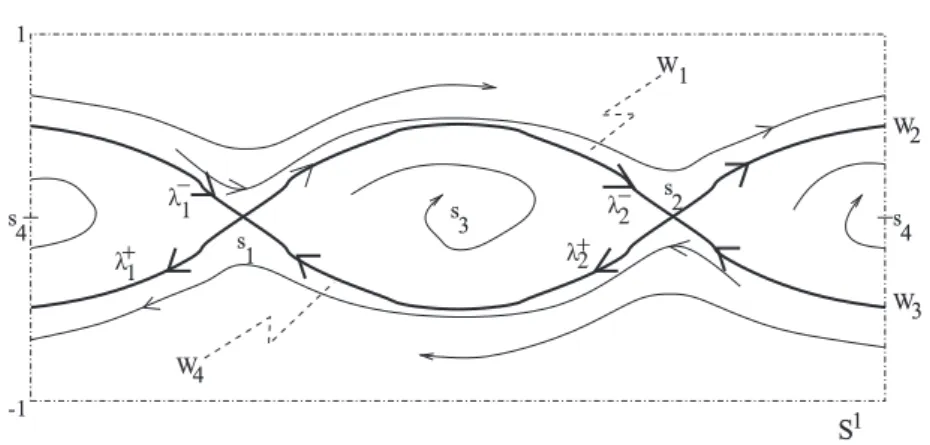
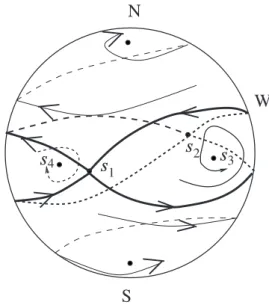
Item (2). Consider the flow known as the ‘Bowen example’; see e.g. [29] and figure2. We have chosen to reverse time with respect to the flow studied in [29] so that the heteroclinic connectionW = {s1, s2} ∪W1∪W2 ∪W3∪W4 is now a repeller. The past orbit
under this flowφt of every pointz∈ S1×[−1,1] =Mnot inW accumulates on
either side of the heteroclinic connection, as suggested in the figure, if we impose the conditionλ−1λ−2 < λ1+λ+2 on the eigenvalues of the saddle fixed pointss1 ands2
W
N
S
s
1
s
2
s
3s
4Figure 3.The Bowen flow embedded in a sphere.
We can now embed this system in the 2-sphere putting two sinks at the ‘north and south poles’ ofS2; see figure3. Let us denote the corresponding vector field onS2
byX.
Let Y be a vector field in S1 corresponding to the ‘north-south’ system: the
corresponding flow has only two fixed pointsN andS,N is a source andSa sink. We can choose the absolute value of the eigenvalues ofY atN, Sto be between the absolute value of the eigenvalues ofs1, s2.
In this way, for the flow{Zt}t∈Rassociated to the vector fieldX×Y onS2×S1, the singularities{si×S}i=1,2of the invariant set:=W× {S}are hyperbolic saddles,
and the splittingT(S2×S1)=E⊕F given by
E(p,S)= {0} ×TSS1 and F(p,S)=TpS2× {0} forp∈W,
is continuous,DZt-invariant,Eis uniformly contracted andF is area expanding (by
an argument similar to the previous example), but it is not dominated.
Example3and items(1)and(2)of proposition1show that theoremAis false without the dominating condition on the splittingE⊕F at the set of singularities within.
Item (3). Now we present a suspension flow whose base map has a dominated splitting but the flow does not admit any dominated splitting.
Letf : T4 ×T4 be the diffeomorphism described in [8] which admits a continuous
dominated splittingEcs⊕EcuonT4, but does not admit any hyperbolic (uniformly contracting
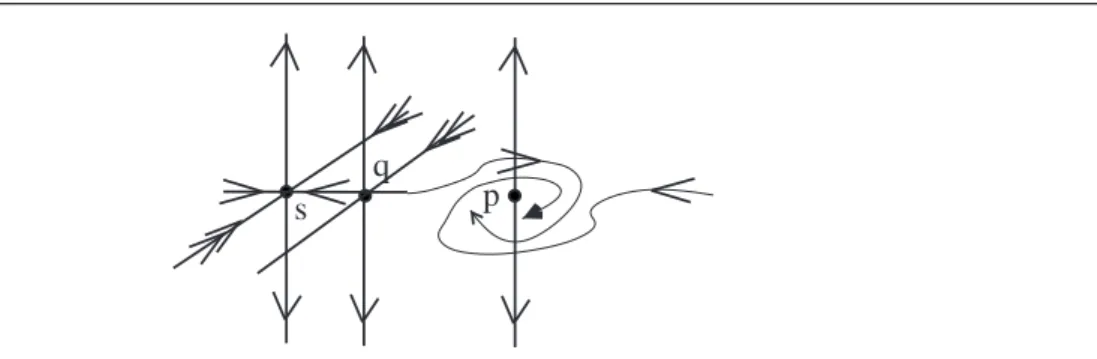
or expanding) subbundle. There are hyperbolic fixed points off satisfying (see figure4):
• dimEu(p)=2=dimEs(p)and there exists no invariant one-dimensional subbundle of Eu(p);
• dimEu(p)=2=dimEs(p) and there exists no invariant one-dimensional subbundle of Es(p);
• dimEs(q)=3 and dimEu(q)=3.
s
q
p
Figure 4.Saddles with real and complex eigenvalues.
splitting overT4×[0,1] with bundles of least dimension, and is not dominated since at the
pointpthe flow directionEX(p)dominates theEcs(p)=Es(p)direction, but at the pointq
this domination is impossible.
This completes the proof of proposition1.
7.2. Proof of proposition2
We present first some auxiliary notions.
Letf :M→Mbe aC1-diffeomorphism andŴ⊂Ma compactf-invariant set, that is, f (Ŵ)=Ŵ. We say thatŴistransitiveif there existsx ∈Ŵwith dense orbit: the closure of
{fn(x):n1}equalsŴ. The invariant setŴistopologically mixingif, for each pairU, V
of non-empty open sets ofŴ, there existsN =N (U, V )∈ Z+such thatU∩fn(V )= ∅for
alln > N.
We say thatŴis an attracting set if there exists a neighbourhoodUofŴinMsuch that
∩n0fn(U )=Ŵ; in this case we say thatUis an isolating neighbourhood forŴ. Anattractor
is a transitive attracting set and arepelleris an attractor for the inverse diffeomorphismf−1. It is well known that hyperbolic attractors or repellers can be decomposed into finitely many compact subsets which are permuted and each of these pieces is topologically mixing for a power of the original map; see e.g. [25].
Now, we present the example stated in proposition2. Consider a hyperbolic attractor (a Plykin attractor, see [24]) Ŵ, with an isolating neighbourhood U, defined on the two-dimensional sphereS2 for a diffeomorphismf :S2 → S2, with a splittingT
ŴS2 =E⊕F
satisfyingDf |Eλs andDf |F λuwhere 0< λs<1< λuandλs·λu<1.
Now we consider the following diffeomorphism
g=f1×f2:M→M, withM=S2×S2,
wheref1 := f2 andf2 := f−1. We note thatŴ1 := ∩n0f1n(U )is a hyperbolic attractor
with respect to f1 whose contraction and expansion rates along its hyperbolic splitting TŴ1S
2 = E
1⊕F1 are λ2s, λ2u, respectively. Likewise Ŵ2 := ∩n0f2n(U ) is a hyperbolic
repeller with respect tof2whose contraction and expansion rates along its hyperbolic splitting TŴ2S
2 = E
2⊕F2 areλu−1, λ−s1, respectively. This implies in particular thatDf1 contracts
area nearŴ1, that is,λ2s ·λ2u<1 and thatDf2expands area nearŴ2, that is,(λs·λu)−1>1.
Moreover, the set
Ŵ:=Ŵ1×Ŵ2
is a hyperbolic set forg, whose hyperbolic splitting is given by(E1×E2)⊕(F1×F2).
the contraction rate alongE1, butEis uniformly contracted andF is uniformly
sectionally-expanded, since the Lyapunov exponents 2 logλu,−logλu,−logλs are such that each pair
has positive sum.
On the other hand, the decompositionTŴM=TŴ1S
2×T Ŵ2S
2=E⊕FwhereE=E 1⊕F1
andF =E2⊕F2 is continuous, since each subbundle is continuous; is alsoDg-invariant;
but it is not a dominated decomposition. In fact, we have the contraction/expansion rates 0 < λ2s < 1 < λ2u associated toE and the corresponding rates λ−u1, λ−s1 associated to F, satisfying the relationλ2s < λ−u1<1< λ−s1< λ2u(since 0< λs·λu<1 and 0< λs <1< λu
imply thatλ2s < λ−u1 andλs−1 < λ2u). Therefore the splittingE⊕F cannot be dominated. In addition, as noted above, bothDg−1 |EandDg |F expand area, so thatEis sectionally
contracted andF is sectionally expanded.
Finally, since bothf1 |Ŵ1andf2 |Ŵ2are topologically mixing, theng|Ŵis transitive; see e.g. [32].
This example shows that there are transitive hyperbolic sets with a non-dominated, although continuous, splitting satisfying the sectional-expansion and uniform contraction or sectional-contraction conditions. This completes the proof of proposition2.
Acknowledgments
This is a part of the PhD thesis of LS at Instituto de Matem´atica-Universidade Federal do Rio de Janeiro under a CNPq (Brazil) scholarship and she is now supported by an INCTMat-CAPES post-doctoral scholarship at IMPA.
The authors thank C Morales and L D´ıaz for many observations that helped improve the statements of the results.
Authors were partially supported by CNPq, PRONEX-Dyn.Syst., FAPERJ and FAPESB.
References
[1] Ara´ujo V and Pacifico M J 2010Three-dimensional Flows (Results in Mathematics and Related Areas, 3rd Series, A Series of Modern Surveys in Mathematics)(Heidelberg: Springer)
[2] Arbieto A 2010 Sectional lyapunov exponentsProc. Am. Math. Soc.1383171–8 [3] Arnold L 1998Random Dynamical Systems(Berlin: Springer)
[4] Barreira L and Pesin Y 2007 Dynamics of systems with nonzero Lyapunov exponentsNonuniform Hyperbolicity
(Encyclopedia of Mathematics and its Applicationsvol 115) (Cambridge: Cambridge University Press) [5] Bonatti C, D´ıaz L J and Viana M 2005 A global geometric and probabilistic perspective, mathematical physics,
IIIDynamics Beyond Uniform Hyperbolicity(Encyclopaedia of Mathematical Sciencesvol 102) (Berlin: Springer)
[6] Bonatti C, Gourmelon N and Vivier T 2006 Perturbations of the derivative along periodic orbitsErgod. Theory Dyn. Syst.261307–37
[7] Bonatti C, Pumari˜no A and Viana M 1997 Lorenz attractors with arbitrary expanding dimensionC. R. Acad. Sci. Paris S´er. I Math.325883–8
[8] Bonatti C and Viana M 2000 SRB measures for partially hyperbolic systems whose central direction is mostly contractingIsrael J. Math.115157–93
[9] Bowen R 1975Equilibrium States and the Ergodic Theory of Anosov Diffeomorphisms(Lecture Notes in Mathematicsvol 470) (Berlin: Springer)
[10] Bowen R and Ruelle D 1975 The ergodic theory of Axiom A flowsInvent. Math.29181–202
[11] Doering C I 1987 Persistently transitive vector fields on three-dimensional manifoldsDynamical Systems and Bifurcation Theory(Pitman Research Notes in Mathematicsvol 160) ed M I Camacho, M J Pacifico and F Takens (London: Longman) pp 59–89
[12] Gan S and Wen L 2006 Nonsingular star flows satisfy axiom A and the no-cycle conditionInvent. Math. 164279–315
[14] Li M, Gan S and Wen L 2005 Robustly transitive singular sets via approach of an extended linear Poincar´e flow
Discrete Contin. Dyn. Syst.13239–69
[15] Liang C and Liu G 2008 Dominated splitting versus small anglesActa Math. Sin. (Engl. Ser.)241163–74 [16] Liao S T 1980 On the stability conjectureChin. Ann. Math.19–30
[17] Ma˜n´e R 1982 An ergodic closing lemmaAnn. Math.116503–40
[18] Metzger R and Morales C 2008 Sectional-hyperbolic systemsErgod. Theory Dyn. Syst.281587–97
[19] Morales C A, Pacifico M J and Pujals E R 2004 Robust transitive singular sets for 3-flows are partially hyperbolic attractors or repellersAnn. Math. (2)160375–432
[20] Moryiasu K 1991 The extension of dominated splittings forC1-regular mapsTokyo J. Math.14425–37 [21] Newhouse S 2004 Cone-fields, domination, and hyperbolicityModern Dynamical Systems and Applications
(Cambridge: Cambridge University Press) pp 419–32
[22] Palis J and de Melo W 1982Geometric Theory of Dynamical Systems(Berlin: Springer)
[23] Perko L 2001Differential Equations and Dynamical Systems(Texts in Applied Mathematicsvol 7) 3rd edn (New York: Springer)
[24] Plykin R V 1974 Sources and currents of A-diffeomorphisms of surfacesMath. USSR Sbr.94243–64 [25] Robinson C 2004An Introduction to Dynamical Systems: Continuous and Discrete(Upper Saddle River, NJ:
Pearson/Prentice Hall)
[26] Sinai Y 1968 Markov partitions and C-diffeomorphismsFunc. Anal. Appl.264–89 [27] Smale S 1967 Differentiable dynamical systemsBull. Am. Math. Soc.73747–817
[28] Sternberg E 1958 On the structure of local homeomorphisms of euclideann-space: IIAm. J. Math.80623–31 [29] Takens F 1995 Heteroclinic attractors: time averages and moduli of topological conjugacyBull. Braz. Math.
Soc.25107–20
[30] Tucker W 1999 The Lorenz attractor existsC. R. Acad. Sci. Paris328(S´erie I) 1197–202
[31] Viana M 1998 Dynamics: a probabilistic and geometric perspectiveProc. Int. Congress of Mathematicians (Berlin, Germany, 1998)vol 1, pp 557–78
[32] Walters P 1982An Introduction to Ergodic Theory(Berlin: Springer)