ISSN 0001-3765 www.scielo.br/aabc
On the Patterns of Principal Curvature Lines around a Curve of Umbilic Points
RONALDO GARCIA1 and JORGE SOTOMAYOR2 1Instituto de Matemática e Estatística, Universidade Federal de Goiás
Caixa Postal 131 – 74001-970 Goiânia, GO, Brasil 2Instituto de Matemática e Estatística, Universidade de São Paulo Rua do Matão 1010, Cidade Universitária, 05508-090 São Paulo, SP, Brasil
Manuscript received on June 15, 2004; accepted for publication on October 10, 2004; contributed byJorge Sotomayor*
ABSTRACT
In this paper is studied the behavior of principal curvature lines near a curve of umbilic points of a smooth surface.
Key words:Umbilic point, principal curvature lines, principal cycles.
1 INTRODUCTION
The study of umbilic points on surfaces and the patterns of principal curvature lines around them has attracted the attention of generation of mathematicians among whom can be named Monge, Darboux and Carathéodory. One aspect – concerning isolated umbilics – of the contributions of these authors, departing from Darboux (Darboux 1896), has been elaborated and extended in several directions by Garcia, Sotomayor and Gutierrez, among others. See (Gutierrez and Sotomayor, 1982, 1991, 1998), (Garcia and Sotomayor, 1997, 2000) and (Garcia et al. 2000, 2004) where additional references can be found.
In (Carathéodory 1935) Carathéodory mentioned the interest of non isolated umbilics in generic surfaces pertinent to Geometric Optics. In a remarkably concise study he established that any local analytic regular arc of curve inR3 is a curve of umbilic points of a piece of analytic surface. In some cases he also determined the patterns of behavior of principal curvature lines near the curve of umbilic points.
In the present paper will be performed an analytic, explicit and constructive study of umbilic curves and of the simplest patterns for their neighboring principal curvature lines, that holds also
*Member Academia Brasileira de Ciências
for smooth curves and surfaces. A comparison of results of this work with those of Carathéodory (Carathéodory 1935) is attempted in section 6.
2 PRELIMINARIES
Letc: [0, l] →R3be a regular curve parametrized by arc lengthucontained in a regular smooth surfaceM, which is oriented by the once for all given positive unit normal vector fieldN.
LetT◦c=c′. According to (Spivak 1980), the Darboux frame{T , N∧T , N}alongcsatisfies the following system of differential equations:
T′=kgN ∧T +knN
(N ∧T )′= −kgT +τgN
N′= −knT −τg(N ∧T )
(1)
whereknis thenormal curvature,kgis thegeodesic curvatureandτgis thegeodesic torsionof the curvec.
Proposition1. Letc: [0, l] →Mbe a regular arc length parametrization of a curve of umbilic
points, such that{T , N∧T , N}is a positive frame ofR3. Then the expression
α(u, v)=c(u)+v(N∧T )(u)+
1
2k(u)v
2 +1
6a(u)v
3 + 1
24b(u)v
4
+h.o.t
N (u), (2)
wherek(u) = kn(c(u), T ) =kn(c(u), N ∧T )is the normal curvature ofMin the directionsT andN∧T, defines a localC∞chart in a small tubular neighborhood ofc. Moreoverτ
g(u)=0.
Proof.This parametrization, in the case wherecis a principal curvature line, was first introduced by
Gutierrez and Sotomayor in (Gutierrez and Sotomayor 1982). In the present case,cbeing a regular curve of umbilic points, by the Implicit Function Theorem it follows that the principal curvatures
k1≤ k2restricted tocare alsoC∞. Also, it follows thatkn(c(u), T (u)) =kn(c(u), (N ∧T )(u)) and in consequenceτg(c(u), v)=0 for anyv∈Tc(u)M.
3 FIRST AND SECOND FUNDAMENTAL FORMS
In the chartαin the equation (2) the positive unit normal vector vector field is given by
N = αu∧αv
|αu∧αv|
.
So it follows that,
N (u, v)= − [1
2k
′v2 +1
6(a
′+3k′k
g)v3+0(v4)]T (u)
− [kv+1
2a(u)v
2 +1
6(b(u)−3k
3)v3
+0(v4)](N ∧T )(u)
+ [1−1 2k
2v2
The coefficients of the first and second fundamental forms in the chart α are given by:
E=< αu, αu >, F =< αu, αv>, G=< αv, αv>, e=< αuu, N >, f =< αuv, N >and
g=< αvv, N > .Therefore,
E(u, v)=1−2kgv+(kg2−k
2
)v2+1
6(6kgk 2
−2ka(u))v3+O(v4)
F (u, v)=1
2k
′kv3
+O(v4)
G(u, v)=1+k2v2+ka(u)v3+O(v4)
e(u, v)=k−2kgkv+
1 2(2kk
2
g−kga(u)−2k3+k′′)v2
+16[a′′+kg(9k3−b(u))+(3k2g−k
2)a(u)
+3k′(kg′ +k2)]v3+O(v4)
f (u, v)=k′v+1
2(kgk
′
+a′)v2+1
6(kga
′
+3k′kg2+b′)v 3
+O(v4)
g(u, v)=k+a(u)v+1
2(b(u)−k
3
)v2−1
2k 2
(a(u)−k′)v3+O(v4)
(3)
TheMeanandGausscurvatures in the chartαare given by:
H=k+1
2a(u)v+
1
4(b(u)+k
′′−3k3
−kga(u))v2+O(v3)
K=k2+ka(u)v+ 1
2(−kgka(u)−3k
4
+kk′′+kb(u)−2k′′)v2+O(v3)
(4)
According to (Spivak 1980) the differential equation of curvature lines in the chartαis given by
(F g−Gf )dv2+(Eg−Ge)dudv+(Ef −F e)du2=
=Ldv2+Mdvdu+N du2=0; where
L= − [k′v+1
2(kgk
′+a′)v2 +1
6(kga
′+3k′k2
g+b′+3k 2k′)v3
+O(v4)]
M = a(u)v+ 1
2[b(u)−3k 3
−k′′−3kga(u)]v2
+16[15k3kg−3k′gk′+(3k 2 g−16k
2
)a(u)−a′′−5kgb(u)]v3+O(v4)
N =k′v+1
2(a
′
−3kgk′)v2+ 1 6(3k
′k2 g−9k
2
k′−5kga′+b′)v3+O(v4)
(5)
4 PRINCIPAL CONFIGURATIONS NEAR AN UMBILIC CURVE
Proposition2. Suppose that∇H(u,0)=(k′, a(u)/2)is not zero at a pointu0. Then the principal
foliations near the pointc(u0))of the curve are as follows.
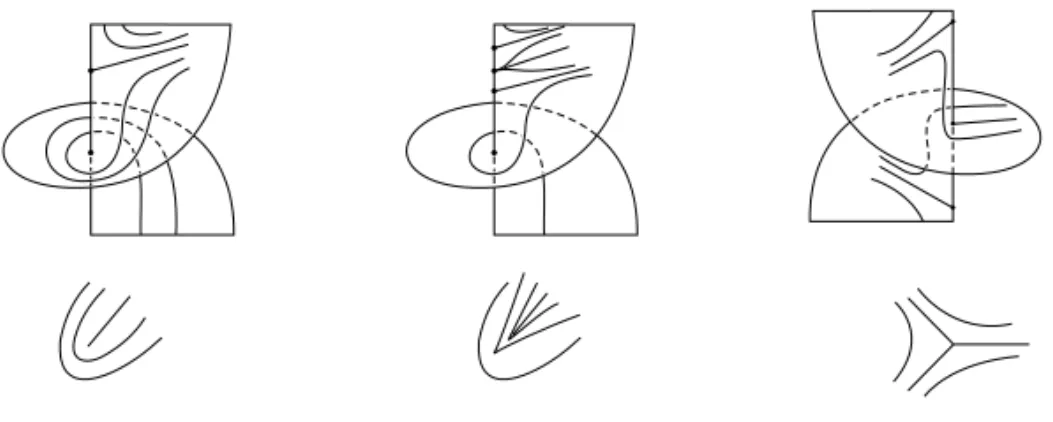
ii) Ifk′(u0)=0,k′′(u0) =0anda(u0) =0, then one principal foliation is transversal tocand the other foliation has quadratic contact with the curvecat the pointc(u0). See Fig. 1, center and right.
Fig. 1 – Principal curvature lines near an umbilic curve: transversal case, left, and tangential case, center and right.
Proof.After division byv, the implicit differential equation of curvature lines is given by:
F(u, v,[du:dv])= −[k′+1
2(kgk
′
+a′)v+O(v2)]dv2
+[a(u)+1
2(b(u)−3k
3
−k′′−3kga(u))v+O(v2)]dudv
+[k′+1
2(a
′
−3kgk′)v+O(v2)]du2=0,
(6)
Consider the Lie-Cartan line fieldX =(Fp, pFp,−(Fu+pFv))whereF=Lp2
+Mp+N =
0, p=dv/du. It follows thatF(u,0, p)=k′(1−p2)
+a(u)pand so whenk′ =0,F(u, v, p)=0
is a regular surface nearv=0 and has two connected components containing the points(u,0, p±), wherep±= [a(u)±a2+4(k′)2]/(2k′) =0. Clearly the Lie-Cartan line field fieldXis regular
at(0,0, p±)and so the configuration of principal lines is as shown in Fig. 1, left.
Suppose for simplicity that atu = 0 it holds thatk′(0) = 0. By hypothesis, we have that
a(0) = a0 = 0. Then, after division by v, it follows that the implicit differential equation of principal curvature lines is given by:
F= − [k′′(0)u+1 2a
′(0)v+ · · · ]dv2
+ [a0+a′(0)u+(b(0)−3k(0)3−k′′−3kg(0)a0)v+ · · · ]dvdu
+ [k′′(0)u+1
2a
′(0)v
+ · · · ]du2=0
Therefore the directions defined by F(u, v,[du : dv]) = 0 arep = 0 andq = 0 where
p = dv/duandq =du/dv. Therefore one direction is tangent to cand the other is orthogonal
toc.
In fact,Fp(0,0,0)=a0 =0 and it follows that the integral curve of the Lie-Cartan line field
X =(Fp, pFp,−(Fu+pFv))passing through(0,0,0)is given by:
u(t )=a0t+ · · ·
v(t )= − 1
2k
′′(0)a
0t2+ · · ·
p(t )= −k′′(0)t+. . .
The curve(u(t ), v(t )) has quadratic contact with the line v = 0, provided k′′(0)a
0 = 0. Eliminatingt it follows thatv= −2ka′′
0u
2 + · · ·.
To describe the other principal foliation near(0,0,0)it is convenient to consider the Lie-Cartan line fieldY = (qFq,Fq,−(qFu+Fv))withq =du/dv. It is clear that this principal foliation is transversal tocin a neighborhood ofc(0). Therefore the principal configuration is as shown in
Fig. 1, center and right. This ends the proof.
Proposition 3. Suppose thatk′(0) = a(0) = 0,a′(0)k′′(0) = 0, at the pointc(0)of a regular
curvecof umbilic points. LetA:= −2k′′(0)/a′(0) =0andB := [b(0)−3k(0)3−k′′(0)]/a′(0). Letandδbe defined by
= −4A4+12BA3−(36+12B2)A2+(4B3+72B)A−9B2−108; δ=2−AB.
Then the principal foliations at this point are as follows.
i) Ifδ < 0and < 0then0is topologically equivalent to a Darbouxian umbilic of typeD1,
through which the umbilic curve is adjoined transversally to the separatrices. See Fig. 2 left.
ii) If δ < 0 and > 0 then 0 is topologically equivalent to a Darbouxian umbilic of type
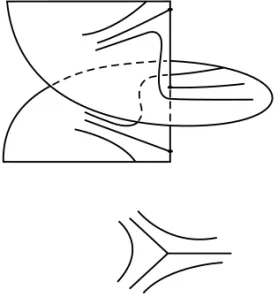
D2, through which the umbilic curve is adjoined, on the interior of the parabolic sectors, transversally to the separatrices and to the nodal central line. See Fig. 2 center.
iii) Ifδ >0then0is topologically a Darbouxian umbilic of typeD3, through which the umbilic
curve is adjoined transversally to the separatrices. See Fig. 2 right.
Proof. After division by v, the first order terms of differential equation of curvature lines, see
equation (6), is given by:
F(u, v,[du:dv])= −(Au+v+O1(2))dv2+(2u+Bv+O2(2))dudv
+(Au+v+O3(2))du2.
Consider the Lie-Cartan line fieldX = (Fp, pFp,−(Fu+pFv)), wherep =dv/du. The singular points ofX along the projective line – represented by thep axis – are defined by the cubic equationR(p) = p3
+(A−B)p2
−3p−A = 0. The condition = 0 means that R
has no multiple roots and consequently the singularities ofX restricted to the projective line are hyperbolic. The linear part ofXalong the axispis given by:
DX(0,0, p)=
⎛
⎜ ⎝
2−2Ap B−2p 0
(2−2Ap)p (B−2p)p 0
0 0 3p2+2(A−B)p−3 ⎞
⎟ ⎠
The non vanishing eigenvalues ofDX(0,0, p)are
λ1=2+(B−2A)p−2p2, λ2=3p2+2(A−B)p−3.
The resultant betweenR andλ2 =R′ is exactly = 0, while the resultant betweenR andλ1is
(2−AB)(16+(2a−b)2)=δ(16+(2a−b)2) =0.
Therefore in the hypothesis considered all the singular points ofXare hyperbolic. In the chart
(u, v, q =du/dv)the Lie-Cartan line fieldZ=(qFq,Fq,−(qFu+Fv))is regular at 0.
Now consider the vector fieldY =(Au+v+O1(2),−u−B2v−O2(2)). By properties of the index of umbilic points, see (Gutierrez and Sotomayor 1998), (Hopf 1979) and (Spivak 1980), it follows thatI nd(Y,0)= −2I nd(Fi,0), whereFi,(i =1,2)denotes the principal foliations.
Asdet (DY (0)) = (2−AB)/2 = δ/2, it follows that I nd(Y,0) = 1 provided δ > 0, and that
I nd(Y,0)= −1 whenδ <0. Therefore,I nd(Fi,0)= ±1/2.
In the hypothesis of item i), < 0 andδ < 0, the fieldX has only one hyperbolic saddle point and the index of the principal foliations is 1/2 and so they define topologically a Darbouxian umbilicD1, with one separatrix approaching the umbilic point and one hyperbolic sector for each principal foliation.
In the hypothesis of item ii), >0 andδ <0, the fieldXhas two hyperbolic saddle points and one hyperbolic node. In this case the index of the principal foliations is 1/2 and so is topologically a Darbouxian umbilicD2, with two separatrices approaching the umbilic point, one hyperbolic sector and one parabolic sector for each principal foliation.
In the hypothesis of item iii), >0 andδ >0, the fieldXhas three hyperbolic saddle points and the index of the principal foliations is−1/2 and they define topologically a Darbouxian umbilic
Figure 3 shows the behavior ofXnear the projective line and the blowing down of the integral curves.
Clearly whenA = 0 the umbilic separatrices are transversal to the curve of umbilic points which is parametrized byv=0.
Fig. 3 – Behavior ofXin a neighborhood of the projective line and projection of the integral curves.
5 SPHERICAL AND PLANAR UMBILIC CURVES
In the previous sections have been studied a sample of the most generic situations, under the restriction on the surface of having an umbilic curve. Below will be considered the case wherek
is a constant which implies the additional constrain that the umbilic curve be spherical or planar, a case also partially considered in (Carathéodory 1935). Under this double imposition the simplest patterns of principal curvature lines are analyzed in what follows.
Proposition4. Letcbe a regular closed spherical or planar curve. Suppose thatcis a regular
curve of umbilic points on a smooth surface. Then the principal foliations near the curve are as follows.
i) If Hv(u,0) = a(u)/2 = 0 and a(u) > 0 for definiteness, then one principal foliation is
transversal to the curvecof umbilic points.
The other foliation defines a first return map (holonomy)π along the oriented umbilic curve
c, with first derivativeπ′ =1and second derivative given by a positive multiple of
l
0
kg(u)
a′(u)
a(u)32
du.
When the above integral is non zero the principal lines spiral towards or away fromc, depending on their side relative toc.
Fig. 4 – Curvature lines near a spherical umbilic curve.
Proof. Whencis a spherical or planar curve it follows thatk(u)= k. In the planar casek = 0
andkgis the curvature of plane curves. In this case the differential equation of principal curvature lines, see equation (6), after division byvis given by:
−1 2a
′(u)v+1
6(kga
′+b′)v2
+O(v3)
dv2
+a(u)+1
2(b(u)−3k
3
−3kga(u))v
+1 6(15k
3k
g+(3kg2−16k
2)a(u)
−a′′−5kgb(u))v2+O(v4)
dudv
+1 2a
′(u)v+1
6(b
′−5k
ga′)v2+O(v3)
du2=0
(7)
The curvev=0 is a solution of equation (7). Asa(u) =0 by hypothesis it follows thatv=0 is a periodic orbit of (7). The Poincaré map is defined byπ(v0)= v(l, v0)wherev(u, v0)is the solution of (7) with initial conditionv(0, v0)=v0.
By the standard method of differentiation of solutions of differential equations with respect to initial conditions to obtain the Taylor expansion ofπ, it follows thatdv/dv0(u)=
a0
a(u), where
a0=a(0) >0 for definiteness. Thereforeπ′(0)=1.
Differentiation shows thatq(u)= d
2v
dv20(u,0)satisfies the following linear differential equation:
−12a0a ′b(u)
a(u)2 +
3 2
a0a′k3
a(u)2 −
1 6
a0a′kg
a(u) +
1 3
a0b′
a(u) +a(u)q
′
+ 12a′q(u)=0.
Integration of the equation above leads to
q(u)= a0
6 1 √ a(u) u 0 a′
a5/2(3b(u)−9k 3
)+ 1
a3/2(a
′k
g−2b′)
du
To obtain the second derivative ofπ, integration by parts gives:
π′′(0)=q(l)= 1
6 √ a0 l 0 kg a′
a3/2du.
To proceed consider the case wherea(u)has a transversal zero say atu = 0. Therefore the differential equation of curvature lines, equation (7), near(0,0)can be written as:
F(u, v,[du:dv] = [−v+h.o.t]dv2+ [2u+a1v+h.o.t] + [v+h.o.t]du2=0,
wherea1=(b(0)−3k3)/a′(0). Consider the Lie-Cartan line fieldX=(Fp, pFp,−(Fu+pFv)), wherep =dv/du. The fieldX has three real singular points along the projective line - axisp -and its are defined by the polynomial equationp(p2
−a1p−3) =0. The linear part ofX along the axispis given by:
DX(0,0, p)=
⎛
⎜ ⎝
2 a1−2p 0
2p (a1−2p)p 0
0 0 3p2
−2a1p−3 ⎞
⎟ ⎠
The eigenvalues ofDX(0,0, p)areλ1=2−2p2+a1pandλ2=3p2−2a1p−3.
Atp =0 it follows thatλ1λ2 = −6 < 0 and so(0,0,0)is a hyperbolic saddle point ofX. Evaluatingλ1andλ2at the other singular points(0,0, pi)ofXit is obtained thatλ1= −(1+p2i) andλ2=3+p2i. Therefore these two singular points ofXare also hyperbolic saddle points. Near the projective line the phase portrait ofXis as illustrated in Fig. 5. Blowing down the phase portrait ofXit follows that the singular point is equivalent to a Darbouxian umbilic point of typeD3.
Fig. 5 – Resolution ofXnear the projective line.
Remark1. By properly choosing functionskganda(u)=2Hvit is possible to construct explicit
examples of the spiraling behavior in item i) of Proposition 4.
Proposition5. A closed regular curvec: [0, l] →R3parametrized by arc lengthuis a curve of
Proof. The Frenet frame ofcis given by{t, n, b}and the following equations holds:
t′=kn
n′= −kt+τ b
b′= −τ n
For any regular surface containingc the Darboux frame{t, N ∧t, N}and the Frenet frame
{t, n, b}are related by:
N =cosθ (u)n+sinθ (u)b
N∧t = −sinθ (u)n+cosθ (u)b.
Direct calculation shows that kn(u) = k(u)cosθ (u), kg(u) = −k(u)sinθ (u) and τg(u) =
−(θ′(u)+τ (u)).
Supposing thatcis a curve of umbilic points it follows, see Proposition 1, thatτg = 0 and
kn(c(u), T )=kn(c(u), N ∧T )=k(u)cosθ (u).
Therefore in order to obtain a regular surface containing c (closed curve) it is necessary that l
0τ (u)du be an integer multiple of 2π. Clearly, from equation (2) this condition is also
sufficient.
The following corollary is the first case discussed in (Carathéodory 1935).
Corollary1.Any regular spherical closed curvecis a curve of umbilic points of a regular surface
which containsc.
Proof. For any closed spherical curve it follows that τg = 0 and therefore
l
0τ (u)du =
−l
0θ′(u)du=0.
6 CONCLUDING REMARKS
The interest on the structure of principal lines in a neighborhood of a continuum of umbilic points, forming a curve, in an analytic surface goes back to the work of Carathéodory (Carathéodory 1935). For previous results related to this subject, Carathéodory refers in his paper to the books of Monge (Monge 1850) and Dupin (Dupin 1813), reliquae not found by the authors.
In the present work has been carried out an independent, explicit, self sufficient and constructive study of umbilic curves on smooth surfaces, that holds also for regular closed curves. Here only the simplest, least degenerate cases, have been considered. A partial comparison of the results of this paper with those of (Carathéodory 1935) is attempted below.
In some cases Carathéodory also determined the behavior of principal lines near the curve of umbilic points. The transversal case in Proposition 2 can be found in his paper. The tangential case is not there.
The cases studied in Proposition 3 are not treated in (Carathéodory 1935).
Concerning Proposition 4, casei), which gives an explicit criterion for quadratic spiraling approach to the umbilic closed curve, it seems that Carathéodory was aware of the possibility of spiraling, but gave no criterion or example for this situation. Case ii)in Proposition 4 was not treated in his paper.
In (Carathéodory 1935) the focal surfaces – caustics – received great attention. In fact Ca-rathéodory starts his analysis with the focal surfaces from which he obtains the surface with an umbilic curve. In the present direct approach, the focal surfaces can be obtained from their standard expression
α+riN,
whereri = (ki)−1, i = 1,2 are the curvature radii defined in terms of the principal curvatures
k2,1 = H±
√ H2
−K, expressed in function of the Mean and Gaussian curvatures given in equation (4).
Additional analysis – complemented with some plotting – must be done to fully grasp the diversity of focal surfaces possible for surfaces with an umbilic curve exhibiting the several points studied here. In (Carathéodory 1935) only the first cases in Propositions 2 and 4 seem to have been considered.
ACKNOWLEDGMENTS
The authors are fellows of Conselho Nacional de Desenvolvimento Científico e Tecnológico (CNPq). This work was done under the project CNPq/Programa de Apoio ao Desenvolvimento Científico e Tecnológico/PADCT 620029/2004-8. The second author acknowledges the help of P. Tonelli and E. Harle in translating (Carathéodory 1935).
RESUMO
Neste trabalho estuda-se o comportamento das linhas de curvatura principal próximas a uma curva de pontos umbílicos, numa superfície suave.
Palavras-chave: ponto umbílico, linhas de curvatura principal, ciclos principais.
REFERENCES
Carathéodory C.1935. Einfach Bemrkungen uber Nabelpunktscurven. Lecture at Breslau, Complete Works 5: 26–30.
Dupin CH.1813. Développements de Géometrie, Paris, Courcier.
Garcia R and Sotomayor J.1997. Structural stability of parabolic points and periodic asymptotic lines, Matemática Contemporânea 12: 83–102.
Garcia R and Sotomayor J.2000. Lines of Axial Curvature on Surfaces Immersed inR4, Differential Geometry and its Applications 12: 253–269.
Garcia R, Gutierrez C and Sotomayor J.2000. Lines of Principal Curvature around Umbilics and Whitney Umbrellas, Tohoku Math J 52: 163–172.
Garcia R, Gutierrez C and Sotomayor J.2004. Bifurcations of Umbilic Points and related Principal Cycles. J Dyn Differ Equ 15 (in press).
Gutierrez C and Sotomayor J.1982. Structural Stable Configurations of Lines of Principal Curvature, Asterisque 98-99: 185–215.
Gutierrez C and Sotomayor J.1991. Lines of Curvature and Umbilic Points on Surfaces, Brazilian 18th Math. Coll., IMPA, Reprinted as Structurally Configurations of Lines of Curvature and Umbilic Points on Surfaces, Monografias del IMCA.
Gutierrez C and Sotomayor J.1998. Lines of Curvature, Umbilical Points and Carathéodory Conjecture, Resenhas IME-USP 03: 291–322.
Hopf E.1979. Differential Geometry in the Large, Lect. Notes in Math. 1000, Springer Verlag.
Monge G.1850. Application de l’Analyse à la Géométrie, Bachalier, Paris, Reimpression by University Microfilms International, Ann Arbor, MI.