A detailed comparative study between chemical and bioactive
properties of
Ganoderma lucidum
from different origins
DEJAN S. STOJKOVIĆ,a LILLIAN BARROS,b RICARDO C. CALHELHA,b,c JASMINA
GLAMOČLIJA,a ANA ĆIRIĆ,a LEO J.L.D. VAN GRIENSVEN,d MARINA SOKOVIĆ,a,* ISABEL
C.F.R. FERREIRAb,*
a
University of Belgrade, Department of Plant Physiology, Institute for Biological Research “Siniša Stanković”, Bulevar Despota Stefana 142, 11000 Belgrade, Serbia.
b
CIMO-ESA, Polytechnic Institute of Bragança, Campus de Santa Apolónia, Ap. 1172, 5301-855 Bragança, Portugal.
c
Centro de Química, Universidade do Minho, Campus de Gualtar 4710-057 Braga, Portugal.
d
Plant Research International, Wageningen University and Research, P.O. Box 16, 6700 AA Wageningen, The Netherlands.
Abstract
A detailed comparative study on chemical and bioactive properties of wild and cultivated Ganoderma lucidum from Serbia (GS) and China (GCN) was performed. This species was chosen because of their worldwide use as medicinal mushroom. Higher amounts of sugars were found in GS, while higher amounts of organic acids were recorded in GCN. Unsaturated fatty acids predominated over saturated fatty acids. GCN revealed higher antioxidant activity, while GS exhibited inhibitory potential against human breast and cervical carcinoma cell lines. No cytotoxicity in non-tumour liver primary cell culture was observed for the different samples. Both samples possessed antibacterial and antifungal activities, in some cases even better than the standard antimicrobial drugs. This is the first study reporting a comparative of chemical compounds and bioactivity of G. lucidum samples from different origins.
Introduction
Ganoderma lucidum (Curtis) P. Karst is a mushroom that has been widely used as a tonic for promoting longevity in Traditional Chinese Medicine and also in other Asian countries as healthy food, for more than 2000 years (Paterson, 2006). This medicinal mushroom is commonly used in the treatment of bronchitis, asthma, hypercholesterolemia, hepatopathy, hypertension, arthritis, neurasthenia, hypertension, immunological diseases, gastric ulcers, chronic hepatitis, nephritis, and insomnia (Zhong and Tang, 2004; Liu and Zhang, 2005; Xie et al. 2006; Huang and Ning, 2010; Teng et al. 2011). Currently, G. lucidum is among the most sought medicinal
mushrooms in the world market. Various products are being prepared from its cultivated
fruiting bodies and have been commercialized as dietary supplements worldwide (Lai et
al. 2004).
The beneficial health effects of Ganoderma species are attributed to different bioactive molecules such as phenolics, polysaccharides, triterpenes, sterols, lectins and proteins (Ferreira et al. 2010; Heleno et al. 2012). Some studies with wild mushrooms report the growth habitat as a very important factor influencing the profile and amounts of biomolecules with active principles (Heleno et al. 2013). According to Karthikeyan et al. (2007) the differences in the chemical composition of G. lucidum, were attributed to different sites of collection.
It was previously demonstrated that free radical scavenging properties, reducing power and lipid peroxidation inhibition of G. lucidum was correlated with phenolic compounds, but also with polysaccharides (Heleno et al. 2012; Kozarski et al. 2012; Wang et al. 2013) and peptides (Girjal et al. 2012). The contemporary view of cancer is
suppressor genes, leading to uncontrolled proliferation of the progeny cells (Ajith and Janardhanan, 2011). There are clinical evidences of complete regression of gastric large
B-cell lymphoma with G. lucidum spore powder treatment (60 capsules daily for 5 days, which is 3 times the dose recommended by the manufacturer) (Cheuk et al. 2007). Some recent studies described ethanol and polysaccharide extracts of G. lucidum, as in vitro inhibitors of various cancer cell lines: melanoma, gastric carcinoma and inflammatory breast cancer (Martinez-Montemayor et al. 2011; Jang et al. 2011; Zheng et al. 2012; Sun et al. 2012). Nevertheless, the mechanism of antitumour action of G. lucidum requires more detailed study. Although huge diversity of antibacterial drugs is currently described, bacterial resistance to first choice antibiotics has rapidly and drastically grown. The discovery and development of new antibiotics is a central strategy in combating bacterial drug resistance (Moir et al. 2012). Antimicrobial activity of different G. lucidum extracts (acetone and methanol) was also reported, indicating differences between the kind of extracts and the sample used (Alves et al. 2012).
In the present work, G. lucidum samples from Serbia (GS) and China (GCN) were submitted to a detailed comparative study regarding: nutritional value, hydrophilic compounds (free sugars, organic acids and phenolic compounds), lipophilic compounds (fatty acids, tocopherols and ergosterol), bioactive properties (antioxidant, cytotoxic, and antimicrobial activities) and hepatotoxicity.
Materials and methods
Samples
at the Fungal Collection Unit of the Mycological Laboratory, Department for Plant Physiology, Institute for Biological Research “Siniša Stanković”, Belgrade, Serbia, under number Gl-009-2012. A batch of cultivated G. lucidum was obtained from China, identified by dr LJLD van Griensven and stored dry for later use.
Both specimens were lyophilised (LH Leybold, Lyovac GT2, Frenkendorf, Switzerland), reduced to a fine dried powder (20 mesh), mixed to obtain a homogeneous sample and kept at -20 ºC until further analysis.
Standards and Reagents
Germany) was used as a solvent. Water was treated in a Milli-Q water purification system (TGI Pure Water Systems, USA).
Chemical composition
Nutritional value. The samples were analysed for chemical composition (moisture, proteins, fat, carbohydrates and ash) using the AOAC procedures (AOAC, 1995). The crude protein content (N×4.38) of the samples was estimated by the macro-Kjeldahl method; the crude fat was determined by extracting a known weight of powdered sample with petroleum ether, using a Soxhlet apparatus; the ash content was determined by incineration at 600±15 ºC. Total carbohydrates were calculated by difference. Energy was calculated according to the following equation: Energy (kcal) = 4 × (g protein + g carbohydrate) + 9 × (g fat).
Hydrophilic compounds. Free sugars were determined by high performance liquid chromatography coupled to a refraction index detector (HPLC-RI), after extraction and analysis procedures previously described by the authors (Heleno et al. 2009) using melezitoze as internal standard (IS). The compounds were identified by chromatographic comparisons with authentic standards. Quantification was performed using the internal standard method and sugar contents were further expressed in g per 100 g of dry weight (dw).
commercial standards of each compound. The results were expressed in g per 100 g of dry weight (dw).
Phenolic compounds were determined by the same methodology using 280 nm and 370 nm as preferred wavelengths, according to a procedure previously described by the authors (Reis et al. 2012). The phenolic compounds were characterized according to their UV and retention times, and comparison with authentic standards. For quantitative analysis, calibration curves were prepared from different standard compounds. The results were expressed in mg per 100 g of dry weight (dw).
Lipophilic compounds. Fatty acids were determined by gas–liquid chromatography with flame ionization detection (GC-FID)/capillary column as described previously by the authors (Heleno et al. 2009). The results were expressed in relative percentage of each fatty acid.
Tocopherols were determined following a procedure previously described by the authors (Heleno et al. 2010) using HPLC-fluorescence. Quantification was based on the fluorescence signal response of each standard, using the IS (tocol) method and by using calibration curves obtained from commercial standards of each compound. The results were expressed in µg per 100 g of dry weight (dw).
Ergosterol was determined following a procedure previously described by the authors (Barreira et al. 2013) using HPLC-UV and cholecalciferol as internal standard. The results were expressed in mg per 100 g of dry weight (dw).
Evaluation of bioactive properties
paper. The residue was then extracted with 25 mL of methanol (25 ºC at 150 rpm) for 1 h. The combined methanolic extracts were evaporated at 40 ºC (rotary evaporator Büchi R-210) to dryness. The extracts were redissolved in i) methanol (final concentration 20 mg/mL) for antioxidant activity evaluation, or ii) water for antitumour cell (final concentration 8 mg/mL) and antimicrobial (final concentration 1.5 mg/mL) activity evaluation. The final solutions were further diluted to different concentrations to be submitted to distinct bioactivity evaluation in vitro assays. The results were expressed in i) EC50 values (sample concentration providing 50% of antioxidant activity or 0.5 of absorbance in the reducing power assay) for antioxidant activity; ii) GI50 values (sample concentration that inhibited 50% of the net cell growth) for cytotoxicity activity in human tumour cell lines and non-tumour liver primary cell culture, and MIC (Minimum inhibitory concentration); and iii) MBC/MFC (Minimum bactericidal concentration/Minimum fungicidal concentration) values for antimicrobial activity. Trolox and ellipticine were used as positive controls in antioxidant and cytotoxic activity evaluation assays, respectively. Streptomycin and ampicillin were used as standards in the antibacterial assay. Bifonazole and ketokonazole were used as standards in the antifungal susceptibility test.
β-carotene/linoleate assay; the neutralization of linoleate free radicals avoids β-carotene bleaching, which is measured by the formula: β-carotene absorbance after 2h of assay/initial absorbance) × 100. Lipid peroxidation inhibition in porcine (Sus scrofa) brain homogenates was evaluated by the decreasing in thiobarbituric acid reactive substances (TBARS); the colour intensity of the malondialdehyde-thiobarbituric acid (MDA-TBA) was measured by its absorbance at 532 nm; the inhibition ratio (%) was calculated using the following formula: [(A - B)/A] × 100%, where A and B were the absorbance of the control and the sample solution, respectively (Heleno et al. 2010).
Cytotoxicity in human tumour cell lines and in liver primary cell culture. Five human tumour cell lines were used: MCF-7 (breast adenocarcinoma), NCI-H460 (non-small cell lung cancer), HCT-15 (colon carcinoma), HeLa (cervical carcinoma) and HepG2 (hepatocellular carcinoma). Cells were routinely maintained as adherent cell cultures in RPMI-1640 medium containing 10% heat-inactivated FBS and 2 mM glutamine (MCF-7, NCI-H460 and HCT-15) or in DMEM supplemented with 10% FBS, 2 mM glutamine, 100 U/mL penicillin and 100 mg/mL streptomycin (HeLa and HepG2 cells), at 37 ºC, in a humidified air incubator containing 5% CO2. Each cell line was plated at an appropriate density (7.5 × 10³ cells/well for MCF-7, NCI-H460 and HCT-15 or 1.0 × 10⁴ cells/well for HeLa and HepG2) in 96-well plates. Sulforhodamine B assay was performed according to a procedure previously described by the authors (Guimarães et al. 2013).
contrast microscope. Before confluence was reached, cells were subcultured and plated in 96-well plates at a density of 1.0×10⁴ cells/well, and cultivated in DMEM medium with 10% FBS, 100 U/mL penicillin and 100 µg/mL streptomycin.
Test on antimicrobial activity. The following Gram-negative bacteria were used: Escherichia coli (ATCC 35210), Pseudomonas aeruginosa (ATCC 27853), Salmonella typhimurium (ATCC 13311), Enterobacter cloacae (ATCC 35030) and the following Gram-positive bacteria: Staphylococcus aureus (ATCC 6538), Bacillus cereus (clinical isolate), Micrococcus flavus (ATCC 10240), and Listeria monocytogenes (NCTC 7973). For the antifungal bioassays, microfungi were used: Aspergillus fumigatus (1022), Aspergillus ochraceus (ATCC 12066), Aspergillus versicolor (ATCC 11730), Aspergillus niger (ATCC 6275), Penicillium funiculosum (ATCC 36839), Penicillium ochrochloron (ATCC 9112), Trichoderma viride (IAM 5061), and Penicillium aurantiogriseum (food isolate). The organisms were obtained from the Mycological Laboratory, Department of Plant Physiology, Institute for Biological Research “Siniša Stanković´”, Belgrade, Serbia.
Minimum inhibitory concentration (MIC) determinations were performed by a serial dilution technique using 96-well microtiter plates. The extracts investigated were dissolved in 5% DMSO and added in broth medium (bacteria)/broth malt medium (fungi) with inocula. The microplates were incubated for 48 h at 37 °C for bacteria or 72 h at 28 °C for fungi. The following day, 30 µl of 0.2 mg/ml solution of INT (p -iodonitrotetrazolium violet) was added, and the plates were returned to the incubator for at least one-half hour to ensure adequate color reaction. Inhibition of growth was indicated by a clear solution or a definite decrease in color reaction. The lowest concentrations without visible growth (at the binocular microscope) were defined as MICs. The minimum bactericidal concentrations (MBCs) and minimum fungicidal concentrations (MFCs) were determined by serial subcultivation of a 2 µL sample into microtiter plates containing 100 µL of broth per well and further incubation for 48 h at 37 °C or 72 h at 28 °C. The lowest concentration with no visible growth was defined as MBC/MFC, respectively, indicating 99.5% killing of the original inoculum. 5% DMSO was used as a negative control.
Statistical analysis
For each one of the species three samples were used and all the assays were carried out in triplicate. The results are expressed as mean values and standard deviation (SD). The results were analyzed using one-way analysis of variance (ANOVA) followed by Tukey’s HSD Test with α = 0.05. This treatment was carried out using SPSS v. 18.0 program.
Chemical and nutrition composition
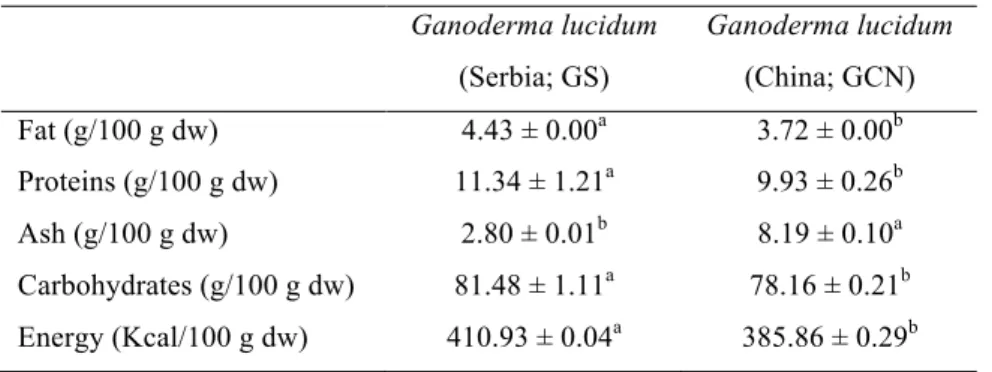
The results of the nutritional value, hydrophilic and lipophilic compounds of G. lucidum samples from Serbia (GS) and China (GCN) are presented in Tables 1-3. Carbohydrates were the most abundant macronutrients, followed by fat or ash, depending on the sample. Carbohydrate, fat and protein contents were higher in GS, giving to this sample a higher energetic contribution (Table 1). Macronutrients content found in the studied samples was comparable to the one reported by Mau et al. (2001) for cultivated G. lucidum from China.
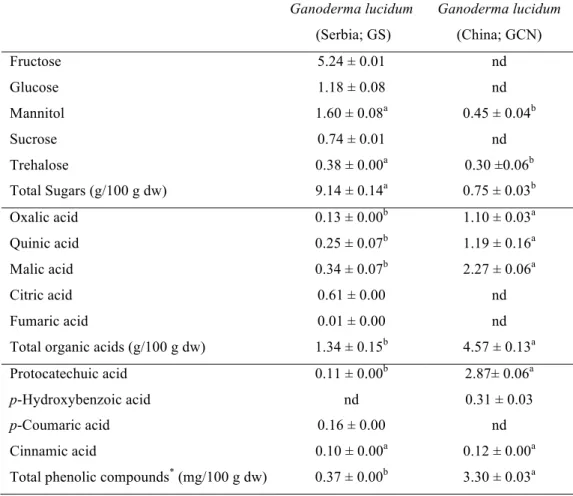
Fructose was the most abundant sugar in GS, while mannitol was the predominant one in GCN. Interestingly, five free sugars (fructose, glucose, mannitol, sucrose and trehalose) were reported in GS, while only two sugars, namely mannitol and trehalose were reported in GCN. Accordingly, high levels of these two sugars have been reported in other cultivated mushrooms (Wannet et al. 1999). Total free sugars content was notably higher in GS (Table 2). A similar sugars profile (with the same five sugars) and total amount (10.29 g/100 g dw) was obtained in a sample of G. lucidum from Portugal previously studied by some of us (Heleno et al. 2012).
sample of G. lucidum from Korea (16.2 mg/100 g dw; Kim et al. 2008).
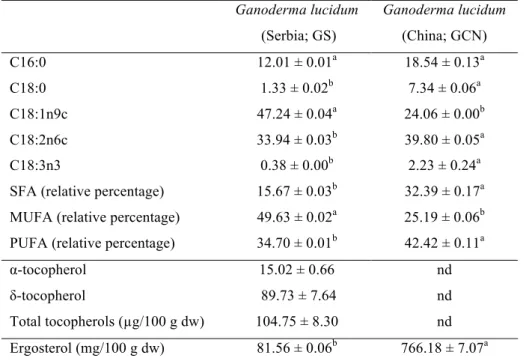
Unsaturated fatty acids (UFA) predominated over saturated fatty acids (SFA). Monounsaturated fatty acids (MUFA) were dominant in GS, while polyunsaturated fatty acids predominated in GCN. The most abundant fatty acids in both GS and GCN were linoleic (C18:2n6c), oleic (C18:1n9) and palmitic (C16:0) acids (Table 3). The same characteristic was described by other authors for G. lucidum from China (Lv et al. 2012). α- and δ-Tocopherols were found in GS, while no tocopherols could be recorded
in GCN; this difference can be due to degradation processes during the growth or conservation periods of the latter sample (commercial) since tocopherols are very sensitive to light and temperature. Ergosterol content was almost ten times higher in GCN than in GS (Table 3). A high variability in ergosterol content among nineteen samples from different locations in China (189.1 to 1453.3 µg/g dw), was also reported by Lv et al. (2012). Furthermore, Barreira et al. (2013) also reported the same in thirteen mushroom species from Portugal.
Bioactive properties
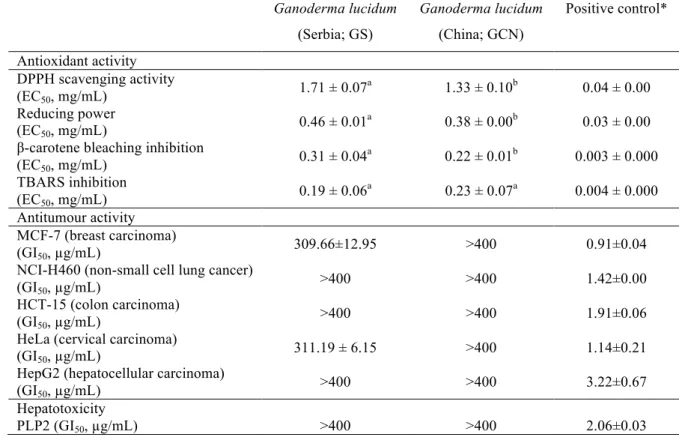
Antioxidant activity was tested by four different methods that measured free radicals scavenging activity, reducing power and lipid peroxidation inhibition (Table 4).
Both samples revealed antioxidant properties. Nevertheless, GS gave slightly higher reducing power, higher DPPH radical scavenging activity and higher β-carotene bleaching inhibition (lower EC50 values). GCN gave slightly better results for lipid peroxidation inhibition evaluated by TBARS assay.
than samples from Korea (~74% at 10 mg/mL; Kim et al. 2008). In general, G. lucidum from Portugal, previously studied by some of us (Heleno et al. 2012), showed higher antioxidant properties, measured by the same in vitro assays.
The effects of GS and GCN on the growth of five human tumour cell lines (MCF-7, NCI-H460, HCT-15, HeLa and HepG2) are presented in Table 4. GS revealed activity against MCF-7 (GI50 309.66 µg/mL) and HeLa (GI50 311.19 µg/mL) cell lines, while no effect was noted in NCI-H460, HCT-15 and HepG2 cell lines at maximum dose of 400 µg/mL. GCN had no cytotoxic effects towards any of the tested cell lines at the maximum concentration used. It should be highlighted that none of the samples showed toxicity in a non-tumour liver primary cell culture.
Despite some reports on antitumour activity of G. lucidum (mainly against breast cancer), it should be noticed that the bioactivity was related to polysaccharides (β-1,3-glucans) and triterpenes (ganoderic acids and others) (Ferreira et al. 2010; Martinez-Montemayor et al. 2011). In the present study, the bioactivity of extracts rich in
phenolic compounds and other hydrophilic molecules was assessed, revealing that GS had some cytotoxic effect on breast and cervical cell lines.
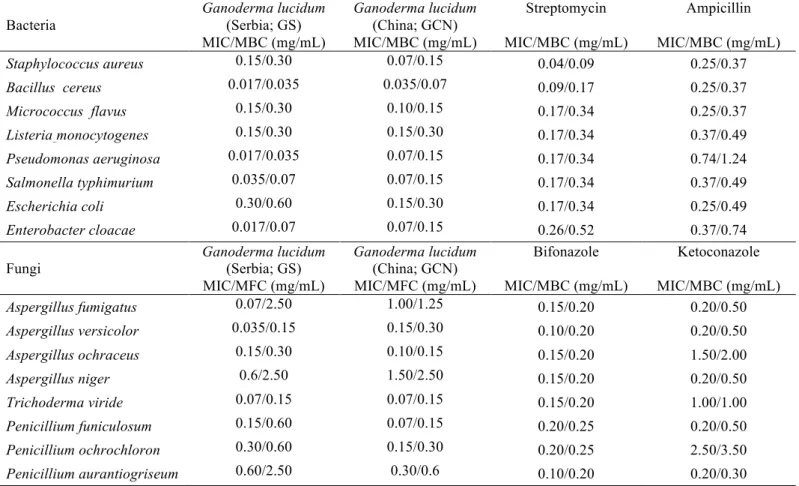
antibiotics streptomycin and ampicillin, it is noticeable that both samples exhibited stronger antimicrobial potential for most of the tested bacteria. The obtained results were better than those published by other authors (MIC and MBC of G. lucidum extract at 1 mg/mL) (Sheena et al. 2003; Quereshi et al. 2010).
Both samples also revealed good antifungal activity. A. versicolor was the most susceptible species to GS, while T. viride and P. funiculosum were the most sensitive to GCN. A. niger and P. aurantiogriseum were the most resistant fungi species to GS, while A. niger was the most resistant to GCN. The antifungal activity of GS decreased in order: A. versicolor > A. fumigatus = T. viride > A. ochraceus = P. funiculosum > P. ochrochloron > A. niger = P. aurantiogriseum. Antifungal activity of GCN decreased in order: T. viride = P. funiculosum > A. ochraceus >A. versicolor = P. ochrochloron > P. aurantiogriseum > A. fumigatus > A. niger. Comparing the results of antimycotic standards and extracts, it seems clear that in most cases both GS and GCN expressed higher antimicrobial potential than ketoconazole and bifonazole.
Overall, the chemical and bioactive properties of G. lucidum proved to be highly dependent on the origin of the samples, i.e. Serbia and China. G. lucidum revealed important bioactive molecules such as reducing sugars, organic acids, phenolic compounds, unsaturated fatty acids, tocopherols and ergosterol. Furthermore, the methanolic extract gave promising antioxidant, cytotoxic (for human tumour cell lines) and antimicrobial activities, without hepatotoxicity.
Acknowledgements
Serbian Ministry of Education and Science for financial support (grant number 173032). L. Barros and R.C. Calhelha also thank to FCT, POPH-QREN and FSE for their grants (SFRH/BPD/4609/2008 and SFRH/BPD/68344/2010, respectively). We are kindly grateful to Ana Zupanc and Zoran Stevanović for providing us fresh material of G. lucidum mushroom.
Declaration of interest: The authors report no conflicts of interest. The authors alone
are responsible for the content and writing of the paper.
References
Ajith TA, Janardhanan KK. (2011). Antimutagenic effect of Phellinus rimosus (Berk) Pilat against chemical induced mutations of histidine dependent Salmonella typhimurium strains. Food Chem. Toxicol. 49:2676-2680
Alves MJ, Ferreira ICFR, Dias J, Teixeira V, Martins A, Pintado M. (2012). A review on antimicrobial activity of mushroom (Basidiomycetes) extracts and isolated compounds. Planta Med.78:1707-1718
AOAC. (1995). Official methods of analysis (16th Ed.). Arlington, VA, USA: Association of Official Analytical Chemists
Barreira, JCM, Oliveira MBPP, Ferreira ICFR. (2013). Optimized chromatographic analysis of ergosterol in the most appreciated wild and cultivated edible mushrooms. Food Anal. Method. In press
Cheuk W, Chan JK, Nuovo G, Chan MK, Fok M. (2007). Regression of gastric large B-Cell lymphoma accompanied by a florid lymphoma-like T-cell reaction: immunomodulatory effect of Ganoderma lucidum (Lingzhi). Int. J. Surg. Pathol. 15:180-186
Ferreira ICR, Vaz JA, Vasconcelos MH, Martins A. (2010). Compounds from wild mushrooms with antitumor potential. Anti-cancer Ag. Med. Chem. 10:424-436 Girjal VU, Neelagund S, Krishnappa M. (2012). Antioxidant properties of the peptides
isolated from Ganoderma lucidum fruiting body. Int. J. Pep. Res. Therap. 18:319-325
Guimarães R, Barros L, Dueñas M, Calhelha RC, Carvalho AM, Santos-Buelga C, Queiroz MJRP, Ferreira ICFR. (2013). Nutrients, phytochemicals and bioactivity of wild Roman chamomile: a comparison between the herb and its preparations. Food Chem. 136:718-725
Hanel H, Raether W. (1998). A more sophisticated method of determining the fungicidal effect of water-insoluble preparations with a cell harvester, using miconazole as an example. Mycoses 31:148-154
Heleno SA, Barros L, Martins A, Queiroz MJRP, Santos-Buelga C, Ferreira ICFR. (2012). Fruiting body, spores and in vitro produced mycelium of Ganoderma lucidum from Northeast Portugal: A comparative study of the antioxidant potential of phenolic and polysaccharidic extracts. Food Res. Int. 46:135-140 Heleno SA, Barros L, Sousa MJ, Martins A, Ferreira ICFR. (2009). Study and
Heleno SA, Barros L, Sousa MJ, Martins A, Ferreira ICFR. (2010). Tocopherols composition of Portuguese wild mushrooms with antioxidant capacity. Food Chem. 119:1443-1450
Heleno SA, Stojković D, Barros L, Glamočlija J, Soković M, Martins A, Queiroz MJRP, Ferreira ICFR. (2013). A comparative study of chemical composition, antioxidant and antimicrobial properties of Morchella esculenta (L.) Pers. from Portugal and Serbia. Food Res. Int. 51:236-243
Huang SQ, Ning ZX. (2010). Extraction of polysaccharide from Ganoderma lucidum and its immune enhancement activity. Int. J. Biol. Macromol. 47: 336-341.
Jang KJ, Son IS, Shin DY, Yoon H.M., Choi, Y.H. (2011). Anti-invasive activity of ethanol extracts of Ganoderma lucidum through tightening of tight junctions and inhibition of matrix metalloproteinase activities in human gastric carcinoma cells. J. Acupunct. Merid. Stud. J. Acupunct. Merid. Stud. 4:225-235
Karthikeyan M, Radhika K, Bhaskaran R, Mathiyazhagan S, Velazhahan R. (2009). Rapid detection of Ganoderma lucidum and assessment of inhibition effect of various control measures by immunoassay and PCR. Afr. J. Biotechnol. 8:2202-2208
Kim M-Y, Seguin P, Ahn J-K, Kim J-J, Chun S-C, Kim E-H, Seo S-Y, Kang E-Y, Kim S-L, Park Y-J, Ro H-M, Chung I-M. (2008). Phenolic compound concentration and antioxidant activities of edible and medicinal mushrooms from Korea. J. Agric. Food Chem. 56:7265-7270
applanatum, Ganoderma lucidum, Lentinus edodes and Trametes versicolor. J. Food Compos. Anal. 26:114-153
Lai T, Gao Y, Zhou SF. (2004). Global marketing of medicinal Ling Zhi mushroom Ganoderma lucidum (W.Curt.:Fr.) Lloyd (Aphyllophoromycetideae) products and safety concerns. Int. J. Med. Mush. 6:189-194
Liu G-Q, Zhang K-C. (2005). Mechanisms of the Anticancer Action of Ganoderma lucidum (Leyss. ex Fr.) Karst.: A New Understanding. J. Integrative Plant Biol. 47:129-135
Lv G-P, Zhao J, Duan J-A, Tang Y-P, Li S-P. (2012). Comparison of sterols and fatty acids in two species of Ganoderma. Chem. Centr. J. 6:1-10
Martínez-Montemayor MM, Acevedo RR, Otero-Franqui E, Cubano LA, Dharmawardhane SF. (2011). Ganoderma lucidum (Reishi) inhibits cancer cell growth and expression of key molecules in inflammatory breast cancer. Nutr. Cancer 63:1085-1094
Mau JL, Lin HC, Chen CC. (2001). Non-volatile components of several medicinal mushrooms. Food Res. Int. 34:521-526.
Mau JL, Lin HC, Chen CC. (2002). Antioxidant properties of several medicinal mushrooms. J. Agric. Food Chem. 50:6072-6077
Moir DT, Opperman TJ, Butler MM, Bowlin TL. (2012). New classes of antibiotics. Curr Opin Pharmacol 12:535-544
Paterson RRM. (2006). Ganoderma - A therapeutic fungal biofactory. Phytochem. 67:1985-2001.
Reis FS, Martins A, Barros L, Ferreira ICFR. (2012). Antioxidant properties and phenolic profile of the most widely appreciated cultivated mushrooms: a comparative study between in vivo and in vitro samples. Food Chem. Toxicol. 50:1201-1207
Sheena N, Ajith TA, Mathew AT, Janardhanan KK. (2003). Antibacterial activity of three microfungi, Ganoderma lucidum, Navesporus floccosa and Phellinus rimosus occuring in South India. Pharmaceut. Biol. 41:564-567
Sun LX, Lin ZB, Duan XS, Lu J, Ge ZH, Li XF, Li XJ, Li M, Xing EH, Song YX, Jia J, Li WD. (2012). Enhanced MHC class I and costimulatory molecules on B16F10 cells by Ganoderma lucidum polysaccharides. J. Drug Targ. 20:582-592
Teng BS, Wang CD, Yang HJ, Wu JS, Zhang D, Zheng M, Fan ZH, Pan D, Zhou P. (2011). A protein tyrosine phosphatase 1B Activity inhibitor from the fruiting bodies of Ganoderma lucidum (Fr.) Karst and its hypoglycemic potency of streptozotocin-induced type 2 diabetic mice. J. Agric. Food Chem. 59:6492-6500 Wang J, Wang Y, Liu X, Yuan Y, Yue T. (2013). Free radical scavenging and
immunomodulatory activities of Ganoderma lucidum polysaccharides derivatives. Carbohydrate Polym. 91:33-38
Wannet WJB, Aben EMJ, van der Drift C, van Griensven LJLD, Vogels G, Op den Camp HJM. (1999). Trehalose phosphorylase activity and carbohydrate levels during axenic fruiting in three Agaricus bisporus strains. Curr. Microbiol. 39:205-210
Zheng S, Jia Y, Zhao J, Wei Q, Liu Y. (2012). Ganoderma lucidum polysaccharides eradicates the blocking effect of fibrinogen on NK cytotoxicity against melanoma cells. Oncol. Lett. 3:613-616
Table 1. Nutritional value (mean ± SD; n=3).
In each row different letters mean significant differences (p<0.05). Ganoderma lucidum
(Serbia; GS)
Ganoderma lucidum
Table 2. Hydrophilic compounds (mean ± SD; n=3).
*
Including the related compound cinnamic acid. dw- dry weight; nd- not detected. In each row different letters mean significant differences (p<0.05).
Ganoderma lucidum
(Serbia; GS)
Ganoderma lucidum
(China; GCN)
Fructose 5.24 ± 0.01 nd
Glucose 1.18 ± 0.08 nd
Mannitol 1.60 ± 0.08a 0.45 ± 0.04b
Sucrose 0.74 ± 0.01 nd
Trehalose 0.38 ± 0.00a 0.30 ±0.06b
Total Sugars (g/100 g dw) 9.14 ± 0.14a 0.75 ± 0.03b
Oxalic acid 0.13 ± 0.00b 1.10 ± 0.03a
Quinic acid 0.25 ± 0.07b 1.19 ± 0.16a
Malic acid 0.34 ± 0.07b 2.27 ± 0.06a
Citric acid 0.61 ± 0.00 nd
Fumaric acid 0.01 ± 0.00 nd
Total organic acids (g/100 g dw) 1.34 ± 0.15b 4.57 ± 0.13a Protocatechuic acid 0.11 ± 0.00b 2.87± 0.06a
p-Hydroxybenzoic acid nd 0.31 ± 0.03
p-Coumaric acid 0.16 ± 0.00 nd
Cinnamic acid 0.10 ± 0.00a 0.12 ± 0.00a
Table 3. Lipophilic compounds (mean ± SD; n=3).
SFA- Saturated fatty acids; MUFA- Monounsaturated fatty acids; PUFA- Polyunsaturated fatty acids. dw- dry weight; nd- not detected. In each row different letters mean significant differences (p<0.05).
Ganoderma lucidum
(Serbia; GS)
Ganoderma lucidum
(China; GCN)
C16:0 12.01 ± 0.01a 18.54 ± 0.13a
C18:0 1.33 ± 0.02b 7.34 ± 0.06a
C18:1n9c 47.24 ± 0.04a 24.06 ± 0.00b
C18:2n6c 33.94 ± 0.03b 39.80 ± 0.05a
C18:3n3 0.38 ± 0.00b 2.23 ± 0.24a
SFA (relative percentage) 15.67 ± 0.03b 32.39 ± 0.17a MUFA (relative percentage) 49.63 ± 0.02a 25.19 ± 0.06b PUFA (relative percentage) 34.70 ± 0.01b 42.42 ± 0.11a
α-tocopherol 15.02 ± 0.66 nd
δ-tocopherol 89.73 ± 7.64 nd
Table 4. Antioxidant and cytotoxic activities (mean ± SD; n=3). Ganoderma lucidum (Serbia; GS) Ganoderma lucidum (China; GCN) Positive control* Antioxidant activity DPPH scavenging activity (EC50, mg/mL)
1.71 ± 0.07a 1.33 ± 0.10b 0.04 ± 0.00 Reducing power
(EC50, mg/mL)
0.46 ± 0.01a 0.38 ± 0.00b 0.03 ± 0.00
β-carotene bleaching inhibition (EC50, mg/mL)
0.31 ± 0.04a 0.22 ± 0.01b 0.003 ± 0.000 TBARS inhibition
(EC50, mg/mL)
0.19 ± 0.06a 0.23 ± 0.07a 0.004 ± 0.000 Antitumour activity
MCF-7 (breast carcinoma)
(GI50, µg/mL) 309.66±12.95 >400 0.91±0.04
NCI-H460 (non-small cell lung cancer) (GI50, µg/mL)
>400 >400 1.42±0.00
HCT-15 (colon carcinoma)
(GI50, µg/mL) >400 >400 1.91±0.06
HeLa (cervical carcinoma) (GI50, µg/mL)
311.19 ± 6.15 >400 1.14±0.21 HepG2 (hepatocellular carcinoma)
(GI50, µg/mL) >400 >400 3.22±0.67
Hepatotoxicity
PLP2 (GI50, µg/mL) >400 >400 2.06±0.03
Table 5. Antibacterial and antifungal activities.
MIC- Minimal inhibitory concentration; MBC- Minimal bactericide concentration; MFC- Minimal fungicide concentration.
Bacteria Ganoderma lucidum (Serbia; GS) MIC/MBC (mg/mL) Ganoderma lucidum (China; GCN) MIC/MBC (mg/mL) Streptomycin MIC/MBC (mg/mL) Ampicillin MIC/MBC (mg/mL)
Staphylococcus aureus 0.15/0.30 0.07/0.15 0.04/0.09 0.25/0.37
Bacillus cereus 0.017/0.035 0.035/0.07 0.09/0.17 0.25/0.37
Micrococcus flavus 0.15/0.30 0.10/0.15 0.17/0.34 0.25/0.37
Listeria monocytogenes 0.15/0.30 0.15/0.30 0.17/0.34 0.37/0.49
Pseudomonas aeruginosa 0.017/0.035 0.07/0.15 0.17/0.34 0.74/1.24
Salmonella typhimurium 0.035/0.07 0.07/0.15 0.17/0.34 0.37/0.49
Escherichia coli 0.30/0.60 0.15/0.30 0.17/0.34 0.25/0.49
Enterobacter cloacae 0.017/0.07 0.07/0.15 0.26/0.52 0.37/0.74
Fungi Ganoderma lucidum (Serbia; GS) MIC/MFC (mg/mL) Ganoderma lucidum (China; GCN) MIC/MFC (mg/mL) Bifonazole MIC/MBC (mg/mL) Ketoconazole MIC/MBC (mg/mL)
Aspergillus fumigatus 0.07/2.50 1.00/1.25 0.15/0.20 0.20/0.50
Aspergillus versicolor 0.035/0.15 0.15/0.30 0.10/0.20 0.20/0.50
Aspergillus ochraceus 0.15/0.30 0.10/0.15 0.15/0.20 1.50/2.00
Aspergillus niger 0.6/2.50 1.50/2.50 0.15/0.20 0.20/0.50
Trichoderma viride 0.07/0.15 0.07/0.15 0.15/0.20 1.00/1.00
Penicillium funiculosum 0.15/0.60 0.07/0.15 0.20/0.25 0.20/0.50
Penicillium ochrochloron 0.30/0.60 0.15/0.30 0.20/0.25 2.50/3.50