Rev. Caatinga, Mossoró, v. 31, n. 1, p. 126 – 134, jan. – mar., 2018
SILICON FERTILIZATION AND SEED MICROBIOLIZATION ON DISEASE
SEVERITY AND AGRONOMIC PERFORMANCE OF UPLAND RICE
1IVANEIDE DE OLIVEIRA NASCIMENTO2*, ANTÔNIA ALICE COSTA RODRIGUES3, HEDER BRAUN3, CEALIA
CRISTINE SANTOS3, ARICLÉIA DE MORAES CATARINO4
ABSTRACT- Rice is one of the world’s most consumed cereals, however, its production is affected by fungal
diseases. Thus, the objective of this work was to evaluate the severity of diseases and grain yield potential of
upland rice with silicon fertilization combined with seed microbiolization with Bacillus methylotrophicus
isolates. Two experiments were conducted, one in Igarapé do Meio, Maranhão (MA), Brazil, with rice seeds of the variety Palha-Murcha and one in São Bento MA with rice seeds of the variety BRS-Primavera. A randomized block experimental design in a split-plot arrangement with five replications were used in both
experiments, with agro-silicon rates (0.0, 1.0, 2.0, 4.0 and 6.0 Mg ha-1) in the plots and microbiolized and non
-microbiolized rice seeds with B. Methylotrophicus at concentration of 108 CFU ml-1 in the subplots. The
seedling emergence, grain yield, number of panicles, plant height, plant dry weight and severity of brown leafspot, leaf scald and grain spot were evaluated. Soil fertilization with agro-silicon affected positively the
plant height of the variety Palha-Murcha and the number of panicles, plant dry weight and grain yield of the
variety BRS-Primavera, and negatively the germination of the variety BRS-Primavera. Leaf scald severity in
the variety BRS-Primavera reduced with microbiolized seeds with B. methylotropicus. Microbiolization with B.
methylotropicus had no effect on severity of brown leafspot and grain spot in the varieties evaluated.
Keywords: Bacillus methylotrophicus.Agrosilicon. Biological control. Diseases. Rice production.
EFEITO DA FERTILIZAÇÃO DE SILÍCIO E MICROBIOLIZAÇÃO DE SEMENTES SOBRE A SEVERIDADE DE DOENÇAS E DESEMPENHO AGRONÔMICO DE ARROZ DE SEQUEIRO
RESUMO - O arroz é um dos cereais mais consumidos em todo o mundo e sua produção é afetada por doenças
fúngicas. Neste sentido objetivou-se avaliar a severidade de doenças e o potencial produtivo do arroz de terras
altas em função da aplicação de silício e sementes microbiolizadas com isolados de Bacillus methylotrophicus.
Foram realizados dois experimentos, em dois munícipios do estado do Maranhão, Brasil: um em Igarapé do Meio, com sementes de arroz da variedade Palha Murcha e outro em São Bento, com a variedade Primavera. Os experimentos foram instalados no delineamento em blocos casualizados, com cinco repetições, em parcelas
subdivididas. As parcelas foram constituídas por cinco doses de agrosilício (0,0; 1,0; 2,0; 4,0 e 6,0 t ha-1) e as
subparcelas foram constituídas por sementes de arroz microbiolizadas e não microbiolizadas com B.
methylotrophicus,na concentração de 108 UFC ml-1. Os parâmetros avaliados foram emergência de plântulas,
produtividade de grãos, número de panícula, altura de planta, massa de planta seca e severidade de mancha parda, escaldadura e mancha de grãos. As doses de agrosilício aplicadas no solo afetaram positivamente a altura de plantas, para a variedade Palha Murcha. Na variedade Primavera, as doses de agrosilício influenciaram de forma positiva o número de panículas, massa de planta seca e a produtividade de grãos e de forma negativa a germinação. Para esta variedade, a severidade da escaldadura foi reduzida quando as sementes
foram microbiolizadas com B. methylotropicus. A microbiolização com B. methylotropicus não influenciou a
severidade da mancha parda e a severidade da mancha de grãos, para as duas variedades de arroz.
Palavras-chave: Bacillus methylotrophicus. Agrosilício. Controle biológico. Doenças. Produção de arroz.
____________________ *Corresponding author
1Received for publication in 08/25/2016; accepted in 04/10/2017. Paper extracted from the doctoral thesis of the first author.
2Center of Exact, Natural and Technology Sciences, Universidade Estadual da Região Tocantina do Maranhão, Imperatriz, MA, Brazil; [email protected].
Rev. Caatinga, Mossoró, v. 31, n. 1, p. 126 – 134, jan. – mar., 2018
INTRODUCTION
Genetically improved rice varieties have grain yield potential of 10 Mg ha-1, however, their world
average grain yield is 5 Mg ha-1, which denotes the
need for reduce this difference in grain yield observed in the field. This difference is due mainly to biotic and abiotic stresses that affect rice crops (KHUSH; JENA, 2008). Fungal diseases are among this biotic factors, affecting the rice grain quality and yield.
Various fungal diseases affect upland rice, such as the leaf blast (Pyricularia oryzae Cav.), leaf
scald (Monographella albescens Thume), brown
leafspot (Helminthosporium oryzae Breda de Haan),
grain spot (Phoma spp., Drechslera oryzae Breda de
Haan, Curvularia lunata (Wakker) Boedijn,
Nigrospora oryzae (Berk. & Broome), Alternaria
spp. and Fusarium spp.) and narrow brown leafspot
(Cercospora oryzae Miyake) (UTUMI, 2008). Leaf scald symptoms begin in the apical parts or blade edges of the leaves, with olive-green coloration.
Brown leafspot symptoms occur in leaves, grains, coleoptile, panicle branches and sheath, showing reddish-brown oval spots, with gray center. Grain
spot symptoms are variable, depending on the pathogen, infection stage and climatic conditions. These diseases are affected by environmental conditions, plant density, dew (SANTOS; SANTIAGO, 2014) and plant nutritional imbalance (SANTOS et al., 2010). The diseases leaf scald, brown leafspot and grain spot, evaluated in the present work, occur in crops in the State of Maranhão, Brazil.
Silicon fertilization as phytosanitary control of diseases are of interest to researchers and society, since it reduces applications of fungicides, improves growth, development and architecture and strengthens cell wall of plants (GOMES et al., 2011). Moreover, it reduces cuticular transpiration, increases photosynthetic efficiency, resistance to pest and pathogens and tolerance to drought of plants and promotes formation of compounds such as phenols (MENDONÇA et al., 2013). It also potentiates activities of enzymes such as peroxidases, polyphenoloxidases and quintinases
(GOMES et al., 2008), increases the action of anti
-oxidative defenses, reduces -oxidative damage of functional molecules in membranes and increases stomatal resistance (GUNES et al., 2007; CRUSCIOL et al., 2009).
Silicon fertilization may affect rice grain yield, control or reduce diseases such as brown leafspot (SANTOS et al., 2011) and reduce leaf blast severity in leaves and panicles (FILIPPI et al., 2012). The reduction of disease severity is due to the absorbed silicon deposited below the cuticle, which
forms a double layer silica-cuticle (SANGSTER;
HODSON; TUBB, 2001).
Bacillus methylotrophicus is a gram-positive
bacterium that interacts well with plants, has high guanine and low cytokinins contents, excellent effect for disease biological control, plant growth promotion and bioremediation, and produces bacteriocins, which makes its use as a plant protection agent a potential alternative for disease control (TUMBARSKI; PETKOV; DENKOVA, 2015).
Rice seeds microbiolization with
Pseudomonas fluorescens (Flugge) Migula, Bacillus subtilis (Cohn), Bacillus spp. and Stenotrophomonas malthophilia (Swings) is considered an efficient
treatment to control Rhizoctonia solani Kuhn, due to
the ability of these fungi to control this pathogen and the possibility of make them more efficient by combining them with compounds to stimulate their activity (LUDWIG; MOURA, 2007).
The hypothesis considered in this work is that silicon fertilization combined with the seed
microbiolization with B. methylotrophicus reduces
the difference between the grain yield potential and observed in the field, by reducing the plant susceptibility to pathogens in rice crops.
Thus, the objective of this work was to evaluate the severity of diseases and grain yield potential of upland rice with silicon fertilization
combined with seed microbiolization with B.
methylotrophicus isolates.
MATERIAL AND METHODS
Two experiments were conducted in rice fields with history of leaf blast, leaf scald, brown leafspot and grain spot; one in the rural settlement Diamante Negro, Jutaí, Igarapé do Meio, State of Maranhão, Brazil (03º35'9"N, 45º09'50.6"W and 9 m
of altitude) in the 2013-2014 crop season, and one in
the School Farm of the Maranhão State University, São Bento, State of Maranhão, Brazil (2º42'15,6"N, 44º51'19,6"W and 2 m of altitude) in the 2014-2015
crop season.
The rice variety Palha-Murcha (Creole) was
planted in Igarapé do Meio and the variety
BRS-Primavera (improved) in São Bento. The
variety BRS-Primavera is indicated for areas of low
to moderate fertility, due to its tendency to lodging in areas of high fertility, reaching grain yields of up to 3,550 kg ha-1, and is considered moderately resistant
to the diseases brown leafspot and grain spot (EMBRAPA, 2014). The average temperature of the two experimental areas was 31.7 °C and their mean precipitation was 218 mm (Meteorology Laboratory
of the Geo-Environmental Center of the Maranhão
State University).
The soils of the experimental areas were collected to evaluate their silicon content and
determine their chemical and physical
Rev. Caatinga, Mossoró, v. 31, n. 1, p. 126 – 134, jan. – mar., 2018
sandy loam and loamy sand texture, 27 and
10 g dm-3 of organic matter, pH based on CaCl2 of
4.3 and 4.3, 4.3 and 4.0 mg dm-3 of P, 3.7 and
3.5 mmolc dm-3 of K+, 37 and 12 mmolc dm-3 of Ca2+,
22 and 10 mmolc dm-3 of Mg2+ , 42 and
23 mmolc dm-3 of H++Al3+, 69.4 and
25.5 mmolc dm-3 of sum of bases, 111.4 and
48.5 mmolc dm-3 of cation exchange capacity, 62.5%
and 53% of base saturation and 5.9 and 1.5 mg dm-3
of silicon.
Silicon fertilization with agro-silicon (25%
Ca, 6% Mg and 10.5% Si) and liming with dolomitic limestone (32% CaO, 15% MgO, total neutralizing power of 90%) were performed 60 days before the rice planting. The agro-silicon applied (6.0 Mg ha-1)
contained 1,500 kg ha-1 of Ca and 360 kg ha-1 of Mg,
according to its Ca, Mg and Si contents. Dolomitic limestone was applied to balance Ca and Mg contents of the experimental units, thus isolating the effect of the silicon released by the agro-silicon,
since both the limestone and agro-silicon are used as
sources of Ca and Mg.
A randomized block experimental design in a split-plot arrangement with five replications were
used in both experiments, with agro-silicon rates
(0.0, 1.0, 2.0, 4.0 and 6.0 Mg ha-1) applied 60 days
before planting in the plots and microbiolized and
non-microbiolized rice seeds with Bacillus
Methylotrophicus (isolates B12 and B41) in the subplots.
The plots had area of 6.0 m x 4.5 m and the subplot had area of 6.0 m x 2.25 m. The two rice varieties were grown in the upland rice system, with
spacing of 0.45 m between rows, and 360,000 plants ha-1. The evaluation area of the
subplots was 2.7 m2, discarding the two lateral rows
and the borders (2.0 m of each end of the central rows).
The isolates of B. methylotrophicus (B12 and
B41) used for the rice seed microbiolization with molecular identification are part of the biological collection of the Phytopathology Laboratory of the
Maranhão State University, registered as MGSS-214
and MGSS-215, respectively, which have proved
antimicrobial activity in other pathological systems. These isolates were evaluated in vitro and
inhibited mycelial growth of Magnaporthe oryzae
(NASCIMENTO et al., 2016).
These B. methylotrophicus isolates were
multiplied in culture medium (PDA) and maintained in a BOD chamber for growth for 48 hours at 28 °C
and 12-hour photoperiod. Then, bacterial
suspensions were prepared with these isolates, adjusting their concentrations to 108 UFC ml-1 in a
spectrophotometer (wavelength of 540 nm and absorbance of 0.5). The two isolates were mixed, using 1000 mL of the B12 and B41 inocula. Seeds of the two rice varieties were immersed for 24 hours under constant stirring at 50 rpm in this mix.
Manual and mechanical weeding were
performed in the experimental area of Igarapé do Meio before planting, and manual weeding were performed throughout the experimental periods.
Soil fertilization at planting consisted of 200 kg ha-1 of 5
-30-10 (N-P-K) (Iguarapé do Meio)
and 200 kg ha-1 of 5
-30-15 (N-P-K) (São Bento),
based on the soil chemical analysis and commercial formulations locally available. Rice plants of the variety BRS-Primavera (São Bento) were fertilized with 91 kg ha-1 of urea (45% of N) 40 days after
emergence due to nitrogen deficiency symptoms in
the plants. Rice plants of the variety Palha-Murcha
(Igarapé do Meio) showed no symptoms of nitrogen deficiency.
The number of emergent seedlings was manually counted at the 5th, 10th and 15th day after planting. Ten plants per subplot of the variety
BRS-Primavera were collected in these same three days, to measure their height (mm) from the sheath to the insertion of the last fully expanded leaf. Plant
height (variety Palha-Murcha) and dry weight (both
varieties) were evaluated after 130 (Palha-Murcha) and 110 (BRS-Primavera) days of planting, using 10 plants per subplot. The collected plants were packed in paper bags, dried in a forced air circulation oven at 70 °C and weighed to obtain the plant dry weight (kg ha-1). The number of panicles in the
evaluation area of the subplot (2.7 m2) was counted
(units m-2) at the end of the crop cycle and its grains
were removed manually, stored in paper bags and weighed in a precision scale (kg ha-1) with water
content corrected to 13%.
Leaf scald and brown leafspot severity were evaluated in Igarapé do Meio at the last stage of the plant cycle (110 days after emergence); these diseases have high occurrence at this stage. Leaf scald was evaluated in São Bento at the floral differentiation stage and brown leafspot at the last stage of the plant cycle (103 days after planting).
Ten leaves were randomly collected in each subplot to evaluate these two diseases, using the scale of grades of the Centro Internacional de Agricultura Tropical – CIAT (1983) considering the leaf area affected by the diseases (0 = absence of diseases, 1 = below 1%, 3 = 1 to 5%, 5 = 6 to 25%, 7 = 26 to 50%, 9 = above 50%). Leaf scald severity was evaluated considering the lesion length in relation to the total area in each leaf. Grain spot severity was evaluated on 400 grains removed from eight panicles collected from each subplot, using a scale of grades considering the stained surface of the grain (0 = none, 1 = 1 to 25%, 2 = 26 to 50%,
4 = 51 to 75%) (SILVA-LOBO et al., 2011).
The rice varieties were analyzed separately. Data were subjected to analysis of variance and regression. The models were chosen based on the biological phenomenon, significance of the regression coefficients (using probability levels of up to 10%), t-test and coefficient of determination
Rev. Caatinga, Mossoró, v. 31, n. 1, p. 126 – 134, jan. – mar., 2018
variables of the microbiolized and non-microbiolized
seeds were compared by the F test at 5% of probability level. The Statistical Analysis were performed using the program SAEG 9.1 (SAEG, 2007).
RESULTS AND DISCUSSION
The interaction between seed
microbiolization and agro-silicon rates had no
significant effect on the seedling emergence (SE,
p=0.6426 and p=0.2829), grain yield (GY, Kg ha-1,
p=0.4390 and p=0.4150), plant height (PH, p=0.1161
and p=0.1160), plant dry weight (PDW, p=0.1062
and p=0.9999), severity of brown leafspot (BL,
p=0.8469 and p=0.9999) leaf scald (LS, p=0.9508 and p=0.2218) and grains spot (GS, p=0.3595 and
p=0.9999) in the varieties Palha-Murcha and
BRS-Primavera, and on the number of panicle (NP,
p=0.8120) of the variety Palha-Murcha. Therefore, the effect of agro-silicon and seed microbiolization
was assessed separately.
The interaction between seed
microbiolization and agro-silicon rates had
significant effect on the NP (p=0.0316) of the variety
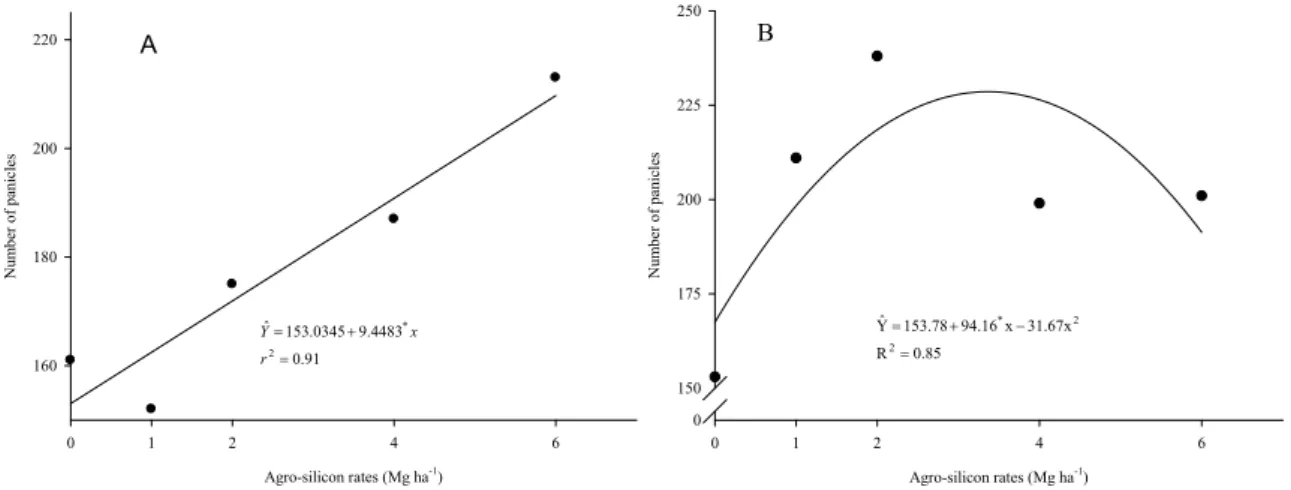
BRS-Primavera, increasing linearly with increasing agro-silicon rates with microbiolized seeds (Figure
1A) and showed a quadratic effect with
non-microbiolized seeds (Figure 1B). The NP
(F1;20=6.49; p=0.0192) was affected by the seed
microbiolization with Bacillus methylotrophicus.
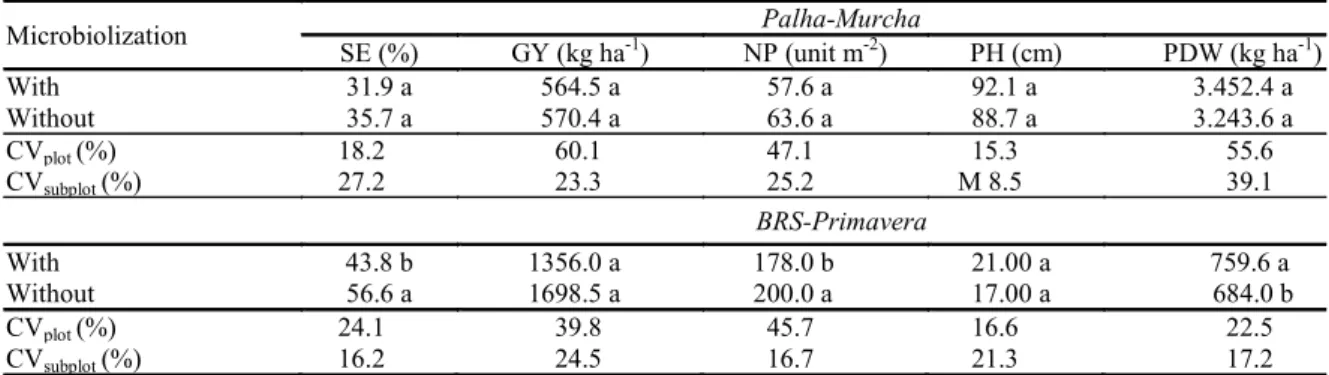
The highest NP was found in plants of non-microbiolized seeds (Table 1). This result may
be related to permanence for 24 hours of the
microbiolized seeds in the B. methylotrophicus
solution, which reduced the emergence of seedlings. Similar results were found by Filippi et al. (2012), with all silicon rates reducing leaf blast severity in
leaves (area under the disease progress
curve - AUDPC) and panicles, and increasing the
weight of one thousand grains. These authors also found a reduction of 76 and 50% of AACPD, respectively with and without microbiolized seeds, denoting the positive interaction between silicon fertilization and rhizobacteria.
Agro-silicon rates (Mg ha-1)
0 1 2 4 6
Nu
m
b
er
o
f
p
an
icl
es
160 180 200
220 A
91 . 0
4483 . 9 0345 . 153
ˆ
2
*
r
x Y
Agro-silicon rates (Mg ha-1)
0 1 2 4 6
Nu
m
b
er
o
f p
an
icles
0 150 175 200 225 250
B
0.85 R
31.67x x 94.16 153.78 Yˆ
2
2 *
Figure 1. Number of panicles as a function of agro-silicon rates (Mg ha-1) on microbiolized (A) and non-microbiolized (B)
seeds of the rice variety BRS-Primavera with Bacillus methylotrophicus, in the 2014-2015 crop season.
The height of plants (PH) of the variety
Palha-Murcha increased linearly with increasing
agro-silicon rates (Figure 2), increasing 1.99 cm for
each Mg of agro-silicon applied. The PH of the
variety BRS-Primavera was not affected by the agro-silicon rates, showing mean PH of 18.12 cm.
The results of the improved variety (BRS-Primavera)
confirm those found by Reis et al. (2008), who evaluated silicon fertilization in two rice varieties (IAC 201 and IAC 202) with aspersion irrigation and found no effect on plant height.
The agro-silicon rates had no effect on the
SE, GY, PDW and NP of the variety Palha-Murcha,
whose averages were 19.99% (SE), 567.51 kg ha-1
(GY), 3348 kg ha-1 (PDW) and 22.4 (NP). The SE
(decreasing linear effect), PDW (increasing linear
effect) (Figure 3A) and GY (plateau effect) of
variety BRS-Primavera were affected with
increasing agro-silicon rates (Figure 3B). The model
for SE as a function of agro-silicon rates was
Ŷ=21.04 – 0.4023*x; r2 = 0.70. The GY reached the
plateau at 1,514.2 kg ha-1, with a agro
-silicon rate of
2.56 Mg ha-1. According to the decreasing
Rev. Caatinga, Mossoró, v. 31, n. 1, p. 126 – 134, jan. – mar., 2018 Agro-silicon rates (Mg ha-1)
0 1 2 4 6
Plan t h ei g h t (cm ) 0 84 86 88 90 92 94 96 98 100 0.74 r x 1.9889 85.2649 Yˆ 2 *
Figure 2. Plant height (cm) of the rice variety Palha-Murcha as a function of agro-silicon rates (Mg ha-1) in the 2013-2014
crop season.
Agro-silicon rates (Mg ha-1)
0 1 2 4 6
Gra in d ry w eig h t ( k g h a -1) 0 650 700 750 800 850 A 0.90 2 r x * 23.0526 667.0233 Yˆ
Agro-silicon rates (Mg ha-1)
Yield (Kg h a -1) 2.5624 x 1514.1370, Y 0.98 r 2.564 x x, 1211.90 117.948 Yˆ 2 * *
Figure 3. Grain dry weight (A) and yield (B) of the rice variety BRS-Primavera as a function of agro-silicon rates (Mg ha-1)
in the 2014-2015 crop season.
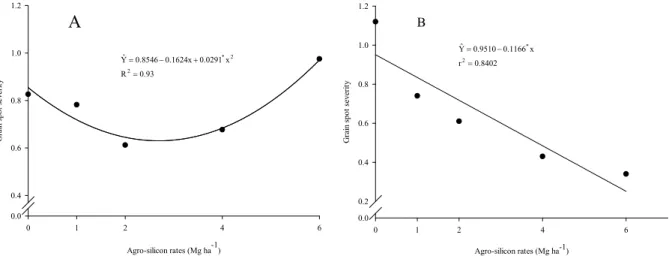
The grain spot severity (Phoma sp.,
Drechslera oryzae, Curvularia lunata, Nigrospora oryzae, Alternaria sp., Fusarium sp.) had a
decreasing quadratic effect on the variety
Palha-Murcha (Figure 4A) and decreasing linear
effect (Figure 4B) on the variety BRS-Primavera
with increasing agro-silicon rates. The agro-silicon
rates had no effect on the brown leafspot and leaf scald severities, which showed means of 1.17 and 1.84 (Palha-Murcha) and 1.48 and 1.87 (BRS-Primavera), respectively.
Agro-silicon rates (Mg ha-1)
0 1 2 4 6
G ra in s p o t se v er it y 0.0 0.4 0.6 0.8 1.0 1.2
A
0.93 R x 0.0291 0.1624x 0.8546 Yˆ 2 2 * Agro-silicon rates (Mg ha-1)
0 1 2 4 6
G ra in s p o t se v er it y 0.0 0.2 0.4 0.6 0.8 1.0 1.2 B 0.8402 r x 0.1166 0.9510 Yˆ 2 *
Figure 4. Grain spot severity in the rice variety Palha-Murcha (Igarapé do Meio, State of Maranhão, Brazil) and
BRS-Primavera (B) as a function of agro-silicon rates (Mg ha-1) in the 2013-2014 (Palha-Murcha) and 2014-2015
Rev. Caatinga, Mossoró, v. 31, n. 1, p. 126 – 134, jan. – mar., 2018
The silicon content in the soil probably affected the agronomic performance and severity of diseases of the upland rice varieties. The soil of Igarapé do Meio (Palha-Murcha) had 5.9 mg dm-3 of silicon, which may have hindered the response of the plants; and the soil of São Bento (BRS-Primavera)
had 1.5 mg dm-3 of silicon, favoring the response of
the cultivar to silicon fertilization. Marchezan et al. (2004) found no response of lowland rice to silicon fertilization using calcium silicate in a soil containing 5 to 12 mg L-1 of silicon. On the other
hand, Chagas et al. (2016) found an increase in rice grain yield with application of silicon. Mauad et al. (2013) found different plant growth for two rice cultivars fertilized with calcium silicate and dolomitic limestone; the cultivar Maravilha had higher shoot dry matter production in the anthesis and milky grain stages and the cultivar Caiapó had higher shoot dry matter production in the physiological maturation stage.
The amount of calcium applied was adequate
with agro-silicon rates of 1.0, 2.0, 4.0 and
6.0 Mg ha-1 combined with limestone, and sufficient
to increase the rice yield of the variety
Palha-Murcha. Silva and Bohnen (2003) found similar results, with no beneficial effects of silicon with adequate rates of Ca on the evaluated parameters. Thus, beneficial effects of silicon fertilization on upland rice should not be attributed to silicon alone, but to its wide action as corrective of acidity, which promotes better soil chemical conditions to plant development (BARBOSA FILHO; PRABHU, 2002).
The soil sandy texture was also an important factor in both locations. The sand fraction is constituted mainly by SiO2 quartz, which has low release of silicon to plants and greater drainage, favoring silicon losses by leaching. According to
Marchezan et al. (2004), soil chemical and physical composition and flood conditions affect silicon availability and plant responses. This information is confirmed by Camargo, Kondorfer and Côrrea (2002), who reported more availability of silicon to plants with increasing soil clay content.
On the other hand, the variety Palha-Murcha is not improved and it may not respond to silicon treatments due to its genetic characteristics, while
the variety BRS-Primavera is from a modern group,
has small plants, is indicated for planting in soils of little to moderate fertility, and is moderately resistant to brown leafspot and grain spot (EMBRAPA,
2014). The ability to absorb nutrients from the soil
and nutrient demand required vary according to several factors, including the cultivar (FARIA JÚNIOR et al., 2009).
The microbiolization had no effect on the GY
[(F1;20=0.025; p=0.8766) and (F1;20=0.78;
p=0.9999)], PH [(F1;20=2.372; p=0.1161) and
(F1;20=2.141; p=0.1586)] (Table 1), BL severity
[(F1;20=1.696; p=0.2076) and (F1;20=0.781;
p=0.9999)] and GS severity [(F1;20=1.614; p=0.2185)
and (F1;20=1.456; p=0.2417)] of the Palha-Murcha and BRS-Primavera, respectively (Table 2).
Seed microbiolization had no effect on the SE
(F1;20=2.135; p=0.1595), PDW (F1;20=0.327;
p=0.5735), NP (F1;20=1.880; p=0.1855) (Table 1) and
LS (F1;20=1.835; p=0.1907) of the variety
Palha-Murcha (Table 2). These same variables were
affected by the seed microbiolization with B.
methylotrophicus, in the variety BRS-Primavera,
with SE (F1;20=33.87; p≤0.0001), PDW (F1;20=5.42;
p=0.0305) (Table 1) and LS (F1;20=4.66; p=0.0433) (Table 2). The rice seed microbiolization with B.
methylotrophicus reduced the leaf scald severity in
the variety BRS-Primavera by 40% (Table 2).
Table 1. Mean values of agronomic variables of the rice varieties Palha-Murcha and BRS-Primavera as a function of
microbiolized and non-microbiolized seeds with B. methylotrophicus.
Microbiolization Palha-Murcha
SE (%) GY (kg ha-1) NP (unit m-2) PH (cm) PDW (kg ha-1)
With 31.9 a 564.5 a 57.6 a 92.1 a 3.452.4 a
Without 35.7 a 570.4 a 63.6 a 88.7 a 3.243.6 a
CVplot (%) 18.2 60.1 47.1 15.3 55.6
CVsubplot (%) 27.2 23.3 25.2 M 8.5 39.1
BRS-Primavera
With 43.8 b 1356.0 a 178.0 b 21.00 a 759.6 a
Without 56.6 a 1698.5 a 200.0 a 17.00 a 684.0 b
CVplot (%) 24.1 39.8 45.7 16.6 22.5
CVsubplot (%) 16.2 24.5 16.7 21.3 17.2
1
Rev. Caatinga, Mossoró, v. 31, n. 1, p. 126 – 134, jan. – mar., 2018
Table 2. Severity of the diseases leaf scald (LS) (Monographella albescens Thume), brown leafspot (BL)
(Helminthosporium oryzae Breda de Haan) and grain spot (GS) (Phoma sp., Drechslera oryzae, Curvularia lunata,
Nigrospora oryzae, Alternaria sp., Fusarium sp.) in the rice varieties Palha-Murcha and BRS-Primavera as a function of
microbiolized and non-microbiolized seeds with B. methylotrophicus.
Microbiolization Palha-Murcha BRS-Primavera
LS BL GS LS BL GS
With 1.3 a 1.1 a 0.74 a 1.7 b 1.5 a 1.3 a
Without 1.4 a 1.0 a 0.79 a 2.1 a 1.5 a 1.3 a
CVplot (%) 41.7 47.9 37.9 96.2 70.1 47.0
CVsubplot (%) 41.8 30.6 20.1 84.9 22.2 36.7
1
Means followed by same letter in the columns do not differ by the F test at 5% probability.
According to Ludwig, Moura and Gomes
(2013), Bacillus spp. did not improve the growth of
rice plants, however, Souza Júnior et al. (2010)
reported that a mixture of Bacillus spp. and
Pseudomonas synxantha increased rice shoot dry weight and root fresh weight.
Bacillussubtilis as strains related to Bacillus amyloliquefaciens and Bacillus methylotrophicus can improve plant growth by increasing hormone levels, favoring the availability of phosphate in the soil (PANE et al., 2012). The characteristics of the
varieties Palha-Murcha and BRS-Primavera were
different when treated with B. methylotrophicus.
Similar result was found by Ferreira, Knupp and
Martin-Didonet (2014), who inoculated six rice
varieties with Pseudomonas, Burkholderia and
Rhizobium and found significant differences in plant height and shoot fresh weight. According to these authors, rice cultivars respond differently to
inoculation with growth-promoting bacteria.
The results found in the present work are similar to those found by Ludwig et al. (2009), who found a decrease in leaf scald of 63.2% with the
isolate DFs416 (Bacillus sp.). Rhizobacteria
inoculation, directly or indirectly, favors the reduction of using chemical pesticides, promoting economic benefits and also ecological benefits, since such products often generate problems of environmental contamination. According to Corrêa et al. (2008), the response to biocontrol varies depending on environmental conditions, crop and pathogen population diversity, which may have several mechanisms, such as antibiosis and production of enzymes, siderophores and antibiotics,
which potentiate them as bio-controllers (GERBORE
et al., 2016; PANE et al., 2012). Therefore, the results found in the present work for the varieties of
Palha-Murcha and BRS-Primavera confirm the instability of biocontrol under different climatic
conditions, soil microbiota, cultivar and
management.
Little researches are found on soil silicon fertilization combined with seed protection with microorganisms, evaluating productive performance and severity of diseases, thus, the present work contributes with new results, since the varieties showed different responses to silicon fertilization
and seed microbiolization with Bacillus
methylotrophicus, regarding their agronomic performance and severity of diseases.
CONCLUSION
The agro-silicon rates used affected positively
the plant height of the variety Palha-Murcha,
increased the seedling emergence, number of panicles and grain dry weight and yield of the variety
BRS-Primavera, and reduce the grain spot severity in the varieties Palha-Murcha and BRS-Primavera.
The seed microbiolization with Bacillus
methylotropicusreduced the leaf scald severity in the
variety BRS-Primavera and did not affect the brown
leafspot and grain spot severity in the two rice varieties.
ACKNOWLEDGEMENTS
The authors thank the Foundation for Research and Scientific and Technological Development of Maranhão for financial support.
REFERENCES
BARBOSA FILHO, M. P.; PRABHU, A. S.
Aplicação de silicato de cálcio na cultura do arroz. Santo Antônio do Goiás: Embrapa Arroz e
Feijão, 2002, 4 p. (Documento Embrapa Arroz e Feijão, 51).
Rev. Caatinga, Mossoró, v. 31, n. 1, p. 126 – 134, jan. – mar., 2018
CENTRO INTERNACIONAL DE
AGRICULTURA TROPICAL – CIAT. Sistema de
evaluación estandar para arroz. 2. ed. Cali, 1983. 61 p.
CHAGAS, R. C. S. et al. Silicon fertilization improve yield and quality of rice and pearl millet in
cerrado soils. Bioscience Journal, Uberlândia, v. 32,
n. 4, p. 899-907, 2016.
CORRÊA, B. O. et al. Influência da microbiolização de sementes de feijão sobre a transmissão de
Colletotrichum lindemuthianum (Saac e Magn.).
Revista Brasileira de Sementes, Lavras, v. 30, n. 2, p. 156-163, 2008.
CRUSCIOL, C. A. C. et al. Effects of silicon and drought stress on tuber yield and leaf biochemical
characteristics in potato. Crop Science, Madison, v.
49, n. 3, p. 949-954, 2009.
EMPRESA BRASILEIRA DE PESQUISA
AGROPECUÁRIA - EMBRAPA. Catalógo de
cultivares de arroz. Santo Antônio de Góias, GO:
Embrapa Arroz e Feijão, 2014. 11 p.
FARIA JÚNIOR, L. A. et al. Produção de matéria seca, teor e acúmulo de silício em cultivares de arroz
sob doses de silício. Ciência e Agrotecnologia,
Lavras, v. 33, n. 4, p. 1034-1040, 2009.
FERREIRA, E. P. B.; KNUPP, A. M.; MARTIN
-DIDONET, C. C. G. Crescimento de cultivares de
arroz (Oryza sativa L.) influenciado pela inoculação
com bactérias promotoras de crescimento de plantas.
Bioscience Journal, Uberlândia, v. 30, n. 3, p. 655
-665, 2014.
FILIPPI, M. C. C. et al. Indução de resistência e promoção de crescimento em arroz por agentes biológicos. In: VI REUNIÃO BRASILEIRA SOBRE INDUÇÃO DE RESISTÊNCIA EM PLANTAS A PATÓGENOS, 2012, Viçosa.
Anais… Viçosa: Suprema Gráfica e Editora Ltda, 2012. p. 51-78.
GERBORE, J. et al. Complete Genome Sequenceof
Bacillus methylotrophicus Strain B25, a Potential
Plant Growth-Promoting Rhizobacterium. Genome
Announcements, Washington, v. 4, n. 2, p. 1-2,
2016.
GOMES, F. B. et al. Uso do silício como indutor de
resistência em batata a Myzus persicae (Sulzer)
(Hemiptera: Aphididae). Neotropical Entomology, Botucatu, v. 37, n. 2, p. 185-190, 2008.
GOMES, C. F. et al. Disponibilidade de silício para a cultura do arroz, em função de fontes, tempo de
incubação e classe de solo. Pesquisa Agropecuária
Tropical, Goiânia, v. 41, n. 4, p. 531-548, 2011.
GUNES, A. et al. Influence of silicon on antioxidant mechanisms and lilip peroxidation in chickpea (Cicer arietinum L.) cultivars under drought stress.
Journal of Plant Interactions, Londres, v. 2, n. 2, p. 105-113, 2007.
KHUSH, G. S.; JENA, K. K. Current status and future prospects for research on blast resistance in
rice (Oryza sativa L.). In: WANG, G. L.; VALENT,
B. (Eds.). Advances in genetics, genomics and
control of rice blast disease. China, 2008, 428 p.
LUDWIG, J.; MOURA, A. B. Controle biológico da queima-das-bainhas em arroz pela microbiolização
de sementes com bactérias antagonistas.
Fitopatologia Brasileira, Brasília, v. 32, n. 5, p. 381
–386, 2007.
LUDWIG, J.; MOURA, A. B.; GOMES, C. B.
(Potencial da Microbiolização de sementes de arroz
com rizobactérias para o biocontrole do nematoide das galhas. Tropical Plant Pathology, Brasília, v. 38, n. 3, p. 264–268, 2013.
LUDWIG, J. et al. Microbiolização de sementes para o controle da mancha parda e da escaldadura em arroz irrigado. Tropical Plant Pathology, Brasília, v. 34, n. 5, p. 322–328, 2009.
MARCHEZAN, F. et al. Aplicação de silício em arroz irrigado: efeito nos componentes de produção.
Bioscience Journal, Uberlândia, v. 20, n. 3, p. 125
-131, 2004.
MAUAD, M. et al. Acúmulo de silício na parte aérea de cultivares de arroz de terras altas afetado pela aplicação de silicato e carbonato no solo. Semina: Ciências Agrárias, Londrina, v. 34, n. 5, p. 2049
-2060, 2013.
MENDONÇA, A. O. et al. Acúmulo de silício e compostos fenólicos na parte aérea de plantas de
trigo após a adubação silicatada. Bioscience
Journal, Uberlândia, v. 29, n. 5, p. 1154-1162, 2013.
NASCIMENTO, I. O. et al. Isolation, identification and in vitro evaluation of Bacillus spp. In control of
Magnaporthe oryzae comparing evaluation methods.
African Journal of Agricultural Research, Lagos, v. 11, n. 19, p. 1743-1749, 2016.
REIS, M. A. et al. Aplicação de silício em arroz de
terras altas irrigado por aspersão. Acta Science
Agronomica, Maringá, v. 30, n. 1, p. 37-43, 2008.
PANE, C. et al. Novel strain of Bacillus isolated
from compost and compost-amended soils, as
Rev. Caatinga, Mossoró, v. 31, n. 1, p. 126 – 134, jan. – mar., 2018
phytopathogenic fungi. Biocontrol Science
Technology, Londres, v. 22, n. 12, p. 1373-1388,
2012.
SAEG. Sistema para análises estatísticas, versão
9.1. Viçosa: UFV, 2007.
SANGSTER, A. G.; HODSON, M. J.; TUBB, H. J. Silicon deposition in higher plants. In: DATNOFF, L. E.; SNYDER, G. H.; KORNDORFER, G. H.
(Eds.). Silicon in agriculture. Studies in plant
science, New York, v. 8, s/n., p. 85-113, 2001.
SANTOS, A. B.; SANTIAGO, C. M. Informações
técnicas para a cultura do arroz irrigado nas regiões Norte e Nordeste do Brasil. Santo Antônio
de Goiás, GO: Embrapa Arroz e Feijão, 2014. 150 p.
(Documento Embrapa Arroz e Feijão, 279).
SANTOS, D. S. et al. Eficiência de fontes de silício
para a cultura do arroz. Enciclópedia Biosfera,
Goiânia, v. 6, n. 11, p. 1-10, 2010.
SANTOS, G. R. et al. Danos causados por doenças fúngicas no arroz cultivado em várzeas no Sul do
estado do Tocantins. Bragantia, Campinas, v. 70, n.
4, p. 869-875, 2011.
SILVA-LOBO, V. L. et al. Influência da adubação
nitrogenada, época de plantio e aerosporos sobre a severidade da mancha de grãos em arroz de terras
altas. Summa Phytopathologica, Botucatu, v. 37, n.
3, p. 110-115, 2011.
SILVA, L. S.; BOHNEN, H. Produtividade e absorção de nutrientes pelo arroz cultivado em solução nutritiva com diferentes níveis de silício e cálcio. Revista Brasileira Agrociência, Pelotas, v. 9, n. 1, p. 49-52, 2003.
SOUZA JÚNIOR, I. T. et al. Biocontrole da queima
-das-bainhas e do nematoide-das-galhas e promoção
de crescimento de plantas de arroz por rizobactérias.
Pesquisa Agropecuária Brasileira, Brasília, v. 45, n. 11, p. 1259-1267, 2010.
TUMBARSKI, Y.; PETKOV, E.; DENKOVA, Z. Study on the influence of the cultural conditions and the composition of the culture medium on the
antimicrobial activity of Bacillus methylotrophicus
BM47 against some fungal phytopathogens. Journal
of Global Biosciences, Washim, v. 4, n. 8, p. 2990
-2996, 2015.
UTUMI, M. M. Sistema de produção de arroz de
terras altas. 4. ed. Porto Velho, RO: Embrapa
Rondônia, 2008. 33 p.