Pesq. agropec. bras., Brasília, v.50, n.12, p.1121-1130, dez. 2015 DOI: 10.1590/S0100-204X2015001200001
Karinna Bannach Reis(1), Marcio Vinicius de Carvalho Barros Côrtes(2),Frederico Severino Martins(3),
Marta Cristina Corsi de Filippi(2),José Realino de Paula(1) and Edemilson Cardoso da Conceição(1)
(1)Universidade Federal de Goiás, Faculdade de Farmácia, Laboratório de Pesquisas de Produtos Naturais, Caixa Postal 131, CEP 74001‑970
Goiânia, GO, Brazil. E‑mail: [email protected], [email protected], [email protected] (2)Embrapa Arroz e Feijão, Rodovia
GO‑462, Km 12, Zona Rural, Caixa Postal 179, CEP 75375‑000 Santo Antônio de Goiás, GO, Brazil. E‑mail: [email protected], [email protected] (3)Universidade de São Paulo, Faculdade de Ciências Farmacêuticas de Ribeirão Preto, CEP 14040‑903 Ribeirão
Preto, SP, Brazil. E‑mail: [email protected]
Abstract – The objective of this work was to purify and standardize the rue (Ruta graveolens) extract and evaluate its effect on Magnaporthe oryzae as an alternative to the integrated management of rice blast. The drug was characterized, the liquid extract was obtained, and the methodology for quantifying the standard markers psoralen and bergapten was validated. Rue extract and the markers, solely or in combination, were assayed in vitro, as well as in greenhouse conditions, for their ability to suppress leaf blast, by the evaluation of mycelial growth, conidial germination, and appressorium formation. Rue extract inhibited M. oryzae mycelial growth (100%), conidial germination (LD50=0.237 mg), and the appressorium formation (LD50=0.121 mg); besides, the extract reduced leaf blast severity by 80.84%. Fluorescence microscopy showed that rue extract did not damage M. oryzae cell wall and plasma membrane, indicating another mode of action. Rue extract has a great potential for controlling rice leaf blast.
Index terms: Magnaporthe oryzae, Ruta graveolens, bergapten, psoralen.
Caracterização do extrato de arruda e avaliação de seu potencial
para o controle da brusone
Resumo – O objetivo deste trabalho foi purificar e padronizar o extrato de arruda (Ruta graveolens) e avaliar o seu efeito sobre Magnaporthe oryzae como alternativa para a gestão integrada da brusone. A droga vegetal foi caracterizada, o extrato líquido obtido, e a metodologia para quantificar os marcadores padrão psoraleno e bergapteno validada. O extrato de arruda e os marcadores, isolados ou combinados, foram ensaiados in vitro, assim como em condições de casa de vegetação, para a avaliação de sua capacidade de suprimir a brusone, pela avaliação do crescimento micelial, da germinação de conídios e da formação de apressório. O extrato de arruda inibiu o crescimento micelial de M. oryzae (100%), a germinação de conídios (DL50=0,237 mg) e a formação de apressórios (DL50=0,121 mg); além disso, o extrato reduziu a severidade da brusone em 80,84%. A microscopia de fluorescência mostrou que o extrato de arruda não danificou a parede celular e a membrana plasmática de M. oryzae, o que indica outro modo de ação. O extrato de arruda apresenta grande potencial para o controle da brusone em folhas de arroz.
Termos para indexação: Magnaporthe oryzae, Ruta graveolens, bergapteno, psoraleno.
Introduction
Magnaporthe oryzae (Catt.) B.C. Couch (anamorph, Pyricularia oryzae Cav.) causes rice blast, a highly destructive disease which is spread worldwide (Ebbole, 2007). Rice blast is considered by plant pathologists as the most important disease caused by fungi (Dean et al., 2012) and result in up to 100% grain yield losses depending on weather conditions and on cultivar resistance (Prabhu et al., 2009). The
To control the rapid progress of blast, farmers appeal to indiscriminate fungicide application, which results in diverse environmental concerns (Scheuermann & Eberhardt, 2011) such as soil and water pollution, destruction of nontarget beneficial microorganisms, risks to human health, and increased production costs (Ramos, 2009). The major challenge in adopting a sustainable disease management strategy is integrating genetic resistance, cultural practices, and chemical control. The pathogen’s complex biology and rice cultivation extent in Brazil require viable alternative methods to meet social, economic, and environmental needs.
Biopesticides represent only 2% of the global market for plant protection. Despite the social and environmental benefits offered by biopesticides, challenges faced by small and medium enterprises, such as the cost of technology innovation, are enormous (Popp et al., 2013). Using plant extracts with antifungal activity represents a viable alternative for the judicious use of fungicide in farms (Paulino et al., 2011).
Ruta graveolens L. belongs to the family Rutaceae and has been the subject of research by numerous researchers, as extracts of species of the genus Ruta have shown positive effects for controlling plant pathogens. Its most notable effect was as antifungal activity against Colletotrichum gloeosporioides (Celoto et al., 2008), Alternaria solani (Domingues et al., 2009; Pedroso et al., 2009), Sclerotium rolfsii (Domingues et al., 2009), Aspergillus sp, Cercospora kikuchii, Fusarium solani, Phomopsis sp. (Venturoso et al., 2011), Colletotrichum acutatum, Sclerotinia sclerotiorum (Garcia et al., 2012), caused by secondary metabolites such as alkaloids, flavonoids, coumarins and furanocoumarins present in many species of the genus Ruta. The furanocoumarins xanthotoxin and bergapten, which are derivatives of psoralen, have shown a moderate activity against some fungi, such as Aspergillus nidulans and Colletotrichum acutatum (Menezes et al., 2014). However, no report has evaluated the effect of a standardized rue extract against M. oryzae.
The objective of this work was to purify and standardize the rue (Ruta graveolens) extract, and to evaluate its effect on M. oryzae, as an alternative to the integrated management of rice blast.
Materials and Methods
Samples of rue leaves and light powder were acquired from Santosflora Comércio de Ervas Ltda., in Goiânia, GO, Brazil. According to an analysis report issued by the company’s quality control, the gathering was made in October 2010, and the organoleptic characteristics of the plant are described as oval scattered leaves, blue‑green color (which become gray by desiccation) and long petioles, tart and bitter flavor, with a characteristic odor. The material was ground and evaluated according to established Brazilian pharmacopeia (Farmacopeia…, 2010), for verifying the absence of extraneous material and for determining volatile content, total ash, insoluble ash in acid, granulometric distribution, intumescence index, and the chromatographic profile using thin layer chromatography (TLC). The hydroalcoholic extract was obtained by percolation method (Farmacopeia…, 2010), using 1 kg plant material and 10 L hydroalcoholic solution at 80% (v/v). The percolate flowed at 1 mL min‑1, and psoralen and
bergapten contents were analysed by TLC until plant drugs were exhausted. The extract was concentrated in a rotary evaporator Rotavapor R220 (Büchi, Flawil, Switzerland) until solids above 20% (m/m) were obtained (Farmacopeia…, 2010). The liquid extract concentration was characterized by quantifying psoralen and bergapten contents, the solid contents, alcohol, pH, relative density, and viscosity, according to the Brazilian pharmacopeia (Farmacopeia…, 2010).
Samples of 20 uL were analysed in a high performance liquid chromatograph Alliance model (Waters, Milford, MA, USA) with the separation module 2695 equipped with a quaternary pump, diode array detector 2998, and data processing system using the software Enpower 3 (Waters, Milford, MA, USA). Chromatographic separations were conducted in a Luna C8 column, 5 μm, 4.6x250 mm (Phenomenex, Torrance, CA, USA). The mobile phase was the following mixture of acetonitrile: water (45:55 v/v), with a flux of 0.6 mL min‑1, under isocratic conditions
Pesq. agropec. bras., Brasília, v.50, n.12, p.1121‑1130, dez. 2015 DOI: 10.1590/S0100‑204X2015001200001 specifications of Resolution no. 899 of May 29, 2003
(Agência Nacional de Vigilância Sanitária, 2003). To assess the rue antagonism to M. oryzae, the experiment was performed in a completely randomized block design, with three replicates, and four trials composed of eight treatments (concentrations) each, as follows: trial 1, plant extract at 0, 3.38, 6.76, 13.52, 27.04, 40.56, 54.08, and 67.61 mg mL‑1; trial 2, psoralen
solution at 0, 6.09x10‑5, 12.17x10‑5, 24.35x10‑5,
48.7x10‑5, 73.04x10‑5, 97.39x10‑5, 121.73x10‑5 ug uL‑1;
trial 3, bergapten solution at 0, 9.71x10‑5, 19.43x10‑5,
38.85x10‑5, 77.71x10‑5, 116.56x10‑5, 155.41x10‑5,
194.27x10‑5 ug uL‑1; and trial 4, mixture of psoralen
and bergapten solutions at the concentrations used in trials 2 and 3, respectively. Rue extract, bergapten, and psoralen solutions at different concentrations were prepared separately. The same volumes (1.0 mL) of the test solutions, or water, were mixed with 14.0 mL of potato dextrose agar medium (Potato Dextrose Agar, HiMedia, Mumbai, India). Five‑millimetres mycelial discs of M. oryzae (Embrapa CNPAF Py 10.900) were transferred to Petri dishes and incubated at 25ºC for eight days. The colony size was measured using a digital caliper rule. Colony diameters were compared by Duncan’s test. The regression analysis was performed for all data.
The effect of rue extract and its chemical standards, psoralen, and bergapten, on M. oryzae conidia germination and appressorium formation were assessed as follows. The M. oryzae isolate was transferred to Petri dishes containing oat meal dextrose agar medium and it was then incubated under fluorescent light at 25ºC for 10 days. Conidiogenesis was induced by removing the aerial mycelium and exposing the dishes with open lids to fluorescent light at 25ºC for 48 hours. The dishes were flooded with sterilized water, and conidia were removed by gently scrapping with a brush. Later, the suspension was filtered through a Miracloth, and the concentration was determined using a Neubauer chamber and adjusted to 2x10⁵ conidia mL‑1. Four trials
more were conducted, using a randomized complete block design, with three replicates. Treatments of each trial comprised 11 different final doses, as follows: trial 1: rue extract at 0.10, 0.20, 0.30, 0.41, 0.51, 0.61, 0.71, 0.81, 0.91, and 1.01 mg; trial 2: bergapten at 0.0029, 0.0058, 0.0087, 0.0117, 0.0146, 0.0175, 0.0204, 0.0233, 0.0262, and 0.0291 µg); trial 3, psoralen at 0.0018, 0.0037, 0.0055, 0.0073, 0.0091,
0.0110, 0.0128, 0.0146, 0.0164, and 0.0183 µg; and trial 4, a mixture of psoralen and bergapten solutions, at the same concentrations as used in trials 2 and 3. The doses in trials 2 and 3 were determined based on the psoralen and bergapten contents in the extract doses used in this experiment. Different concentrations were used in this germination test because the amount required to inhibit germination was smaller than that for inhibiting mycelium growth, as observed in a preliminary and exploratory experiment . The trial was conducted on sterilized hydrophobic surfaces (clean fragments of sterilized disposable Petri dishes) placed on a microscopic slide in a Petri dish with moistened filter paper to maintain a high humidity. Drops (20 μL) composed of 10 μL of conidial suspension (resulting in a 1x10⁵ mL‑1 final concentration of M. oryzae conidia)
and 10 μL of extract or standard were mixed onto a hydrophobic surface. A spore suspension in sterile distilled water served as a control. The plates were placed in a plastic tray containing moistened filter paper and were then incubated at 25ºC for 24 hours.
Several germinated conidia with formed appressoria were examined under a microscope at 400X magnification. The images were obtained with a digital camera DXM 1200 attached to a phase contrast microscope Nikon model Eclipse 80i and the software ACT‑1C. Data were statistically analysed, and the means were compared by Duncan’s test. The values of LD50
were obtained based on probit‑log dosage curves using the software BioStat (AnalystSoft, Walnut, CA, USA).
Rue extract effects on cell wall and plasma membrane of M. oryzae were assessed as described by Côrtes et al. (2014), with rue extract at final concentrations of 3.04 and 5.07 ug uL‑1. The mixture of extract, conidia, and
calcofluor white reagent was stored in the refrigerator for 24 hours, before examination under the microscope. The principle of this method is related to the specific linkage of calcofluor white reagent with chitin from fungi cell wall. If the cell wall, or plasma membrane, is damaged, conidia or germ tube will appear brightless in comparison to control undamaged cells in microscopic analysis. The images were analysed using a DXM 1200 digital camera, attached to a Nikon model Eclipse 80i fluorescence microscope at 400X magnification and the software ACT‑1C.
approximately 3 kg of soil fertilized with NPK, 1 g zinc sulphate and 3 g ammonium sulphate, in eight rows measuring 15 cm long. Before planting, seed were sterilized with alcohol for one minute, followed by sodium hypochlorite for one minute and rinsed with sterilized water. Twenty days after sowing, a top dressing was made with 2 g of ammonium sulphate per tray. The five treatments including rue extract, psoralen, bergapten, and a mix of both markers are described in Table 1. The plant extract concentration was selected based on the results obtained in previous in vitro experiments. The concentration of markers corresponds to their contents in the extract. Rue plants were sprayed with a conidial suspension 21 days after planting, and soon after the emission of the third leaf with a DeVillbiss no. 15 connected to the compressor at 0.001 kg cm‑2 standard pressure. Later, the plants
were incubated at 100% humidity for 24 hours at 20 to 25ºC. After the incubation period, plants were transferred to greenhouse benches and maintained at 25 to 29ºC, at 80% humidity, for six days until the disease progression was evaluated.
Seven days after inoculation, the disease was assessed using two visual rating scales. The first rating scale, a nine‑grade scale varying from 0 to 82 based on the percentage of affected leaf area, was used to determine leaf blast severity, according to Notteghem (1981). The second rating scale was a five‑grade scale varying from 0 to 9 based on the lesion type, as follows: 0, absence of symptoms; 1, small hypersensitive lesions; 3, small, nonsporulation lesions; 5, isolated, typical sporulation lesions; 7, 50% coalescence of sporulation lesions; and 9, more than 50% coalescence of lesions causing death of the entire leaf. Data were transformed to (x + 0.5)0.5,
before the analysis of variance, and the means were separated by Duncan’s test, at 5% probability, using the software package for social sciences version 18.0 (SPSS Inc., Chicago, IL, EUA).
Results and Discussion
Extraneous material was not detected in the analyzed rue samples, which were composed of volatile content (7.86±0.07% m/m), total ash (5.69±0.10% m/m) and insoluble ash in acid (0.33% m/m). Powder was classified as ultrafine based on its granulometric distribution. The intumescence index was 4.6±0.1 mL g‑1, retention
factor for was 0.84 psoralen and 0.8 for bergapten as determined by TLC. The psoralen and bergapten concentrations the extract were 18.26 and 29.14 µg mL‑1,
respectively. Solid and alcoholic contents were 20.36% (m/m) and 25.96% (v/v), respectively. The relative density was 1.014 g mL‑1, pH was 5.26, and viscosity
was 28.55 mPa s.
The system suitability parameters were similar to values published by the American Pharmacopeia USP 34. The limits of detection and quantification were respectively 2.21 and 7.37 μg mL‑1 for psoralen,
and 0.27 and 0.90 μg mL‑1 for bergapten. The method
was selective, precise, linear, exact, and robust. All extract concentrations inhibited M. oryzae and showed significant differences in comparison to the control (trial 1). Additionally, differences among treatments 2, 3, and 4 were significant with a strong exponential correlation. From the fifth treatment onwards, mycelial growth was reduced by 100% (Figures 1 and 2). However, bergapten (trial 2), psoralen
Table 1. Treatments of blast disease assessment under greenhouse conditions.
Treatment Description
T1 Control (M. oryzae conidia)
T2 M. oryzae conidia + plant extract
T3 M. oryzae conidia + 18.26 µg mL‑1 psoralen
T4 M. oryzae conidia + 29.14 µg mL‑1 bergapten
T5 M. oryzae Conidia + 18.26 µg mL
‑1 of psoralen
+ 29.14 µg mL‑1 bergapten
Pesq. agropec. bras., Brasília, v.50, n.12, p.1121‑1130, dez. 2015 DOI: 10.1590/S0100‑204X2015001200001 (trial 3), and mixed markers (trial 4) did not exhibit the
same effect as that of the plant extract. There was no significant differences between colony diameter means for bergapten, psoralen, and mixed markers trials, in comparison to the control.
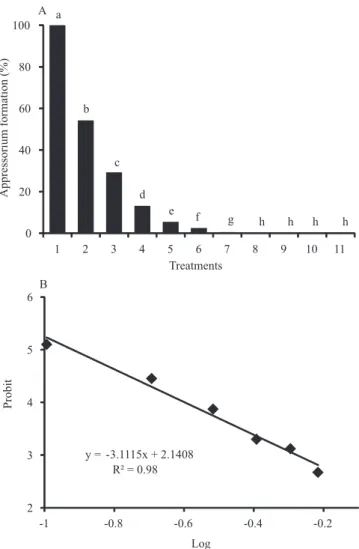
All extract concentrations inhibited germination and appressorium formation (Figures 3 and 4, trial 1). The probit‑log curve (BioStat, Method of Finney) indicated that 0.2376 mg and 0.121 mg of extract inhibited 50% of the conidia germination and appressoria, respectively. One hundred percent of germination was inhibited with a minimum of 0.71 mg extract. During germination and appressorium formation, the extract components did not damage cell wall or cell membrane of M. oryzae (Figure 5). The experiments with the standards psoralen, bergapten, and their mixture (trials 2, 3, and 4) did not inhibit conidial germination and appressorium formation. There was no significant differences among treatments.
In greenhouse experiments, leaf blast severity was significantly lower in the trial 2 treatment (3x10⁵ mL‑1
of M. oryzae conidia + plant extract), followed by the trial 3 treatment (3x10⁵ mL‑1 of M. oryzae conidia +
18.26 µg mL‑1 psoralen). The trial 4 (3x10⁵mL‑1 of
M. oryzae conidia + 29.14 µg mL‑1 bergapten), and
trial 5 treatments (3x10⁵ mL‑1 of M. oryzae conidia +
18.26 µg mL‑1 psoralen + 29.14 µg mL‑1 bergapten)
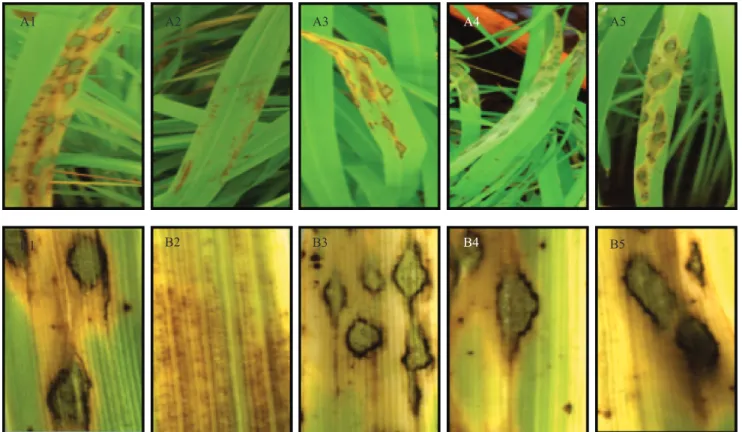
did not reduce leaf blast (Figure 6). The trial 2 treatment (3x10⁵ mL‑1 of M. oryzae conidia + plant
extract) only differed from the other treatments for the lesion type developed in response to inoculating the rice 'Primavera' with a compatible isolate. The other treatments exhibited similar lesion types as the control (Figure 7).
The described process in this study yielded a standardized rue extract. Standardization involved determining the contents of the main chemical constituents and the denominated markers, as well as assessing the pharmacotechnical characteristics which guarantee security, efficiency, and quality of the product. The markers psoralen and bergapten, previously reported as phytoalexins (Larbat et al., 2007), were identified and purified. Rue extract inhibited the mycelial growth and formation of M. oryzae appressorium whose form showed some defects. When rue extract was sprayed along with the conidial suspension of a compatible isolate on rice 'Primavera', leaf blast severity was reduced by 80%, in comparison to the control, and leaves exhibited typical hypersensitive lesions.
The inhibitory effect of rue extract on M. oryzae mycelial growth, in the present study, agrees with previously reported effects of extracts and essential oils on mycelial growth of other plant pathogens, including Alternaria solani, A. alternata, Aspergillus sp., Cercospora kikuchii, Fusarium solani, Phomopsis sp., Colletotrichum acutatum, C. gloeosporioides, Sclerotium rolfsii, Rhizoctonia solani, and Phytophthora sp. (Celoto et al., 2008; Domingues et al., 2009; Pedroso et al., 2009; Garcia et al., 2012).
According to our fluorescent microscopy results, rue extract did not affect conidial cell wall or cell membrane (Figure 5), indicating that the inhibitory activity should have been due to some other mode of action. It is unlikely that the extract interfered in the identification of the inductive surface because when rue extract was sprayed together with the conidial suspension on rice leaf surface, the disease was inhibited (Figure 6). Rice leaf is highly inducible by several known features such as hydrophobicity, cutin monomers, and leaf topography. The extract
Figure 4.Magnaporthe oryzae appressorium formation. A, concentration of standardized Ruta graveolens extract (mg): T1, 0.0; T2, 0.10; T3, 0.20; T4, 0.30; T5, 0.40; T6, 0.51; T7, 0.61; T8, 0.71; T 9, 0.81; T10, 0.91; T11, 1.01. Columns followed by equal letters did not differ significantly, according to Duncan’s test, at 5% probability. B, effects of
Ruta graveolens extract concentrations on appressorium inhibition. Probit – log dosage curve.
Pesq. agropec. bras., Brasília, v.50, n.12, p.1121‑1130, dez. 2015 DOI: 10.1590/S0100‑204X2015001200001 would be able to interfere with one, but not all leaf
inductive signals. Further studies are necessary to examine other diverse morphological alterations, such as the presence of vacuoles, disorganization of cellular content, reduction of cell wall sharpness, and reduction of hyphal turgidity, lipid, and glycogen contents and movements.
We have attributed 80% of the reduction of blast severity to the inhibitory effect of rue extract on germination, appressorium formation, or defective appressorium (Figure 6). In addition to the reduced diseased area, a change in the lesion type was observed from highly sporulated lesions (control) to hypersensitive lesions (extract). The presence of nongerminated conidia, or the absence of appressorium,
likely disrupted plant defence chain reaction, or the extract could have acted as an elicitor of systemic resistance. Data do not allow to infer that rue extract induced resistance, but this may be the subject of future researches.
In the present work, the concentration of markers in the extract were initially determined. The markers (phytoalexins) psoralen and bergapten, solely or
Figure 5. Germination and formation of appressorium.
Magnaporthe oryzae conidia mixed with 7.09 mg (A), 0.71 mg (B) and 0.10 mg (C) of Ruta graveolens extract after 48 hours of deposition on a hydrophobic surface under optical microscope. Magnaporthe oryzae conidia mixed with water (D, control) and 0.304 mg (E) of Ruta graveolens
extract after 72 hours of deposition on a hydrophobic surface, added of calcofluor white reagent. The image was obtained using a fluorescent microscope at 400X magnification.
together, did not display any inhibitory effect in vitro or in vivo. Phytoalexins were originally considered to be plant antibiotics which are synthesized after plant tissue is exposed to microbial infection (VanEtten et al., 1994). According to those studies, a phytoalexin could not be pre‑formed in the tissue, or released from pre‑existing plant constituents. Rather, it should be understood as a plant stimulus response system involving a signal, a receptor, and a responsive metabolic system (Smith, 1996). In 1994, VanEtten and collaborators proposed the term phytoanticipins and published the following definition: phytoanticipins are antimicrobial compounds of low molecular weight, which are present in plants before the challenge by microorganisms, or they are produced after infection solely from pre‑existing constituents (VanEtten et al., 1994). The difference between phytoalexins and phytoanticipins is not in their chemical structure,
but in the way they are produced, highlighting that a pre‑formed compound can be passive in its interaction with a potential pathogen. However, we have observed that treatment 3 (psoralen), when sprayed simultaneously with a conidial suspension of M. oryzae, produced sporulating lesions on a small portion of the leaf area, which suggests that psoralen has some effect on the plant defence system by reducing the disease development rate (Figure 7). The inhibitory action of plant extract vs the noneffect of the markers could be attributed to the existing of one or diverse chemical compounds contained in the extract and which were not identified. The results of the present study should be further extended to determine the molecules responsible for the antifungal action of the R. graveolens plant extract, and its use as a biological product should be validated.
Pesq. agropec. bras., Brasília, v.50, n.12, p.1121‑1130, dez. 2015 DOI: 10.1590/S0100‑204X2015001200001
Conclusions
1. Rue (Ruta graveolens) extract inhibits 100% Magnaporthe oryzae mycelial growth, and reduces 80.84% of rice leaf blast severity.
2. The LD50 values for conidial germination and
appressorium formation are 0.237 mg and 0.121 mg of rue extract, respectively.
3. Psoralen and bergapten are not the responsible chemical markers for blast control by using rue extract.
Acknowledgments
To Coordenação de Aperfeiçoamento de Pessoal de Nível Superior (Capes), and to Conselho Nacional de Desenvolvimento Científico e Tecnológico (CNPq), for funding this research.
References
AGÊNCIA NACIONAL DE VIGILÂNCIA SANITÁRIA (Brasil).
Resolução RE no. 899, de 29 de maio de 2003. Determina a publicação do “Guia para validação de métodos analíticos e
bioanalíticos”; fica revogada a Resolução RE no. 475, de 19 de
março de 2002. Diário Oficial [da] República Federativa do
Brasil, Brasília, DF, 2 jun. 2003. Seção 1, p.56.
CELOTO, M.I.B.; PAPA, M. de F.S.; SACRAMENTO, L.V.S.
do; CELOTO, F.J. Atividade antifúngica de extratos de plantas a
Colletotrichum gloeosporioides. Acta Scientiarum. Agronomy,
v.30, p.1‑5, 2008. DOI: 10.4025/actasciagron.v30i1.1104.
CÔRTES, M.V.C.B.; SILVA‑LOBO, V.L.; FILIPPI, M.C.C.; LIMA, D.C.S.; PRABHU, A.S. Potential for using crude extract
of Sarocladium oryzae for suppression of rice blast. Tropical
Plant Pathology, v.39, p.28‑34, 2014. DOI: 10.1590/
S1982‑56762014000100004.
DEAN, R.; VAN KAN, J.A.L.; PRETORIUS, Z.A.; HAMMOND‑KOSACK, K.E.; DI PIETRO, A.; SPANU, P.D.; RUDD, J.J.; DICKMAN, M.; KAHMANN, R.; ELLIS, J.;
FOSTER, G.D. The top 10 fungal pathogens in molecular plant pathology. Molecular Plant Pathology, v.13, p.414‑430, 2012. DOI: 10.1111/j.1364‑3703.2011.00783.x.
DOMINGUES, R.J.; SOUZA, J.D.F. de; TÖFOLI, J.G.;
MATHEUS, D.R. Ação “in vitro” de extratos vegetais sobre
Colletotrichum acutatum, Alternaria solani e Sclerotium rolfsii.
Arquivos do Instituto Biológico, v.76, p.643‑649, 2009.
EBBOLE, D.J. Magnaporthe as a model for understanding host‑pathogen interactions. Annual Review of Phytopathology, v.45, p.437‑456, 2007. DOI: 10.1146/annurev. phyto.45.062806.094346.
FARMACOPEIA Brasileira. 5.ed. Brasília: Agência Nacional de
Vigilância Sanitária, 2010. 2v., 1448p.
GARCIA, R.A.; JULIATTI, F.C.; BARBOSA, K.A.G.;
CASSEMIRO, T.A. Atividade antifúngica de óleo e extratos
vegetais sobre Sclerotinia sclerotiorum.Bioscience Journal, v.28, p.48‑57, 2012.
LARBAT, R.; KELLNER, S.; SPECKER, S.; HEHN, A.; GONTIER, E.; HANS, J.; BOURGAUD, F.; MATERN, U.
Molecular cloning and functional characterization of psoralen
synthase, the first committed monooxygenase of furanocoumarin
biosynthesis. Journal of Biological Chemistry, v.28, p.542‑554, 2007. DOI: 10.1074/jbc.M604762200.
MARTINS, F.S.; MORAES, C.S.S.; BARA, M.T.F.; PAULA, J.R. de; CONCEIÇÃO, E.C. da. Obtainment and characterization
of raw material of Brosimum gaudichaudii Trecul (Moraceae).
Journal of Pharmacy Research, v.4, p.3772‑3775, 2011
MENEZES, H.D. de; PEREIRA, A.C.; BRANCINI, G.T.P.; LEÃO, H.C. de; MASSOLA JÚNIOR, N.S.; BACHMANN, L.; WAINWRIGHT, M.; BASTOS, J.K.; BRAGA, G.U.L.
Furocoumarins and coumarins photoinactivate Colletotrichum
acutatum and Aspergillus nidulans fungi under solar radiation.
Journal of Photochemistry and Photobiology B:Biology, v.131,
p.74‑83, 2014. DOI: 10.1016/j.jphotobiol.2014.01.008.
NOTTEGHEM, J.L. Cooperative experiment on horizontal resistance to rice blast. In: INTERNATIONAL RICE RESEARCH
INSTITUTE (Filipinas). Blast and upland rice: report and
recommendation from the meeting for international collaboration in upland rice improvement. Los Baños, 1981. p.43‑51.
PAULINO, R. da C.; HENRIQUES, G.P. de S.A.; MOURA, O.N.S.; COELHO, M. de F.B.; AZEVEDO, R.A.B. Medicinal plants at the
Sítio do Gois, Apodi, Rio Grande do Norte state, Brazil. Revista
Brasileira de Farmacognosia, v.22, p.29‑39, 2011. DOI: 10.1590/
S0102‑695X2011005000203.
PEDROSO, D.C.; JUNGES, E.; MENEZES, V.; MULLER, J.; GIRARDI, L.B.; TUNES, L.M. de; MUNIZ, M.F.B.; DILL, A.
Crescimento micelial de Alternaria solani na presença de extratos vegetais. Revista Brasileira de Agroecologia, v.4, p.4256‑4259, 2009.
POPP, J.; PETÕ, K.; NAGY, J. Pesticide productivity and food
security: a review. Agronomy for Sustainable Development, v.33, p.243‑255, 2013. DOI: 10.1007/s13593‑012‑0105‑x.
PRABHU, A.S.; FILIPPI, M.C.C. de. (Ed.). Brusone em arroz: controle genético, progresso e perspectivas. Santo Antônio de Goiás: Embrapa Arroz e Feijão, 2006. 387p.
PRABHU, A.S.; FILIPPI, M.C.C. de.; SILVA, G.B.; SILVA‑LOBO, V.L.; MORAIS, O.P. An unprecedented outbreak of rice blast
on a newly released cultivar BRS Colosso in Brazil. In: WANG,
G.‑L.; VALENT, B. (Ed.). Advances in genetics, genomics and
control of rice blast. Dordrecht: Springer, 2009. p.257‑266. DOI:
10.1007/978‑1‑4020‑9500‑9_26.
RAMOS, L.N. Estrutura populacional e parâmetros
epidemiológicos de isolados de Magnaporthe grisea (Barr). 2009. 132p. Dissertação (Mestrado) – Universidade de Brasília, Brasília.
SCHEUERMANN, K.K.; EBERHARDT, D.S. Avaliação de
SMITH, C.J. Accumulation of phytoalexins: defence mechanism and stimulus response system. New Phytologist, v.132, p.1‑45, 1996. DOI: 10.1111/j.1469‑8137.1996.tb04506.x.
VANETTEN, H.D.; MANSFIELD, J.W.; BAILEY, J.A.;
FARMER, E.E. Two classes of plant antibiotics: phytoalexins versus phytoantecipins. Plant Cell, v.6, p.1191‑1192, 1994. DOI: 10.1105/tpc.6.9.1191.
VENTUROSO, L. dos R.; BACCHI, L.M.A.; GAVASSONI, W.L.;
CONUS, L.A.; PONTIM, B.C.A.; BERGAMIN, A.C. Atividade
antifúngica de extratos vegetais sobre o desenvolvimento de
fitopatógenos. Summa Phytopathologica, v.37, p.18‑23, 2011.
DOI: 10.1590/S0100‑54052011000100003.
WILSON, R.A.; TALBOT, N.J. Under pressure: investigating the
biology of plant infection by Magnaporthe oryzae. Nature Reviews
Microbiology, v.7, p.185‑195, 2009. DOI: 10.1038/nrmicro2032.