Nauplius
THE JOURNAL OF THE BRAZILIAN CRUSTACEAN SOCIETY
e-ISSN 2358-2936
www.scielo.br/nau www.crustacea.org.br
orcid.org/0000-0002-8497-187X
All content of the journal, except
Color patt erns of the hermit crab
Calcinus tibicen
(Herbst, 1791) fail to
indicate high genetic variation within
COI gene
Silvia Sayuri Mandai
1Raquel Corrêa Buranelli
1Fernando Luis Mantelatt o
11Laboratório de Bioecologia e Sistemática de Crustáceos (LBSC), Departamento de Biologia, Faculdade de Filosofi a, Ciências e Letras de Ribeirão Preto (FFCLRP), Universidade de São Paulo (USP). Av. Bandeirantes, 3900. 14040-901 Ribeirão Preto, São Paulo, Brazil.
SSM E-mail: [email protected] RCB E-mail: [email protected] FLM E-mail: fl [email protected]
ZOOBANK htt
p://zoobank.org/urn:lsid:zoobank.org:pub:A7CC24B7-E8BB-4925-A0C7-3929E7534EDF
ABSTRACT
Apart from traditional characters, other data have been used for taxonomy, like color patt erns. Based on the diff erent colors (green and orange) observed for some Calcinus tibicen (Herbst, 1761) specimens, we evaluated the genetic distance for cytochrome oxidase subunit I mitochondrial gene of individuals collected in Pernambuco (northern Brazil) and in São Paulo (southeast Brazil). We found low genetic variation (0.2–1.1%), and no evidence of isolation on our molecular tree based on genetic distance. We suggest high levels of gene fl ow between specimens with diff erent color patt erns, which are polymorphisms and might be related to the kind of nutrition as well diff erent ecological and evolutionary predation characteristics.
KEY WORDS
Anomura, COI gene, coloration, Diogenidae, polymorphism.
SHORT COMMUNICATION
Nauplius
OCIETY
Nauplius
OCIETY
offered by the Brazilian Crustacean Society in honor to Ludwig Buckup in recognition of his dedication and contributions to the development of Carcinology
CORRESPONDING AUTHOR Fernando Luis Mantelatto fl [email protected]
SUBMITTED 28 August 2017 ACCEPTED 22 November 2017 PUBLISHED 26 March 2018
Guest Editors
Alessandra A. de Pádua Bueno and Sandro Santos
DOI 10.1590/2358-2936e2018008
Morphological characters have been used as the main tool of identification and description of decapod crustaceans, but other information such as life history and development, habitat, mating behavior, coloration, and molecular data have become useful for species recognition (Knowlton, 1986; Malay and Paulay, 2009). With the improvement of optical photo equipment and more facilities during field collections during the last two decades, taxonomists have used more frequently color patterns of living animals or the residual patterns found in preserved specimens for species-specific recognition or identification in some decapod groups (e.g. Salmon et al., 1979; Williams and Felder, 1986; Bruce, 1978; Malay and Paulay, 2009; Negri et al., 2014; Hamasaki et al., 2017).
Among hermit crabs, color pattern differentiation is quite significant between cryptic species (e.g. Asakura and Paulay, 2003; Lemaitre and Poupin, 2003; Poupin and Malay, 2009; Negri et al., 2014), and has been considered relevant in the identification of other decapod species (see Poore et al., 2017 for review). In addition, different color patterns may have significance in the reproductive context, such as being decisive in mate choice (e.g., Detto et al., 2006), which may therefore be a barrier of reproductive isolation (Malay and Paulay, 2009). Furthermore, camouflage by coloration is considered a usual anti-predator strategy and might be related to behavioral and morphological mechanisms (e.g. Hamasaki et al., 2017).
The hermit crab genus Calcinus Dana, 1851 includes 43 species (McLaughlin et al., 2010) and is characterized by having morphologically similar species, causing misinterpretations and misidentifications (Haig and McLaughlin, 1983). Even though changes in color are known for some Calcinus species, colors might change markedly and fast during preservation (Haig and McLaughlin, 1983) and this is the main reason why color is frequently rejected in some systematic studies of decapod crustaceans (e.g. Chassard-Bouchaud, 1965; Malay and Paulay, 2009).
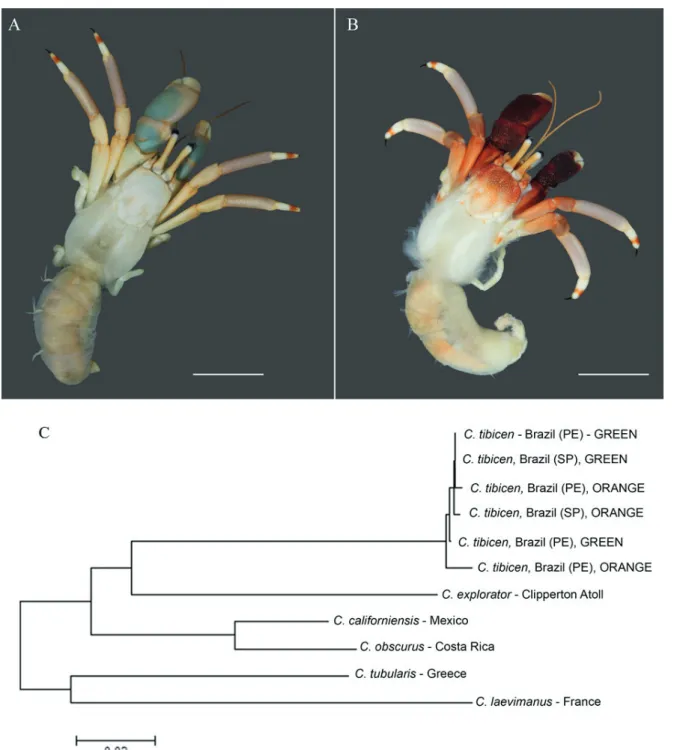
In this context, as color patterns have been considered important taxonomic characters for Calcinus species, we sought to evaluate if color differences between some specimens of Calcinus tibicen (Herbst, 1761) co-occurring in the same locality were based on high genetic differences.
We evaluated the genetic distance for the cytochrome oxidase subunit I (COI) mitochondrial gene between six differently colored individuals (orange and green) from the states of Pernambuco (PE, 08°16’15.56”S 34°56’40.34”W) and São Paulo (SP, 23°25’20.03”S
45°3’42.61”W), Brazil (Fig. 1A, B) [PE orange: CCDB
5327 – GenBank accesses KT897571, KT897572; PE green: CCDB 5328 – GenBank accesses KT897552, KT897570; SP orange: CCDB 0769 – GenBank access KT897493; SP green: CCDB 0778 – GenBank access KT897522]. The identification of the specimens was confirmed based on morphological characters (Melo, 1999). Here we report that the green pattern has changed its color after preservation in 70% ethanol.
Figure 1. Specimens of Calcinus tibicen (Herbst, 1761) from two Brazilian localities (PE: Pernambuco and SP: São Paulo), showing differences in the color patterns of the chelae in life. (A) green claw male, CCDB 5328, scale bar = 10 mm. (B): orange claw male, CCDB 5327, scale bar = 11 mm (both from Pernambuco). (C) Neighbor Joining treeof C. tibicen specimensbased on genetic distance for COI gene. Photos by R.C. Buranelli.
access: FJ620320), Calcinus laevimanus (Randall, 1840) (GenBank access: FJ620270), Calcinus obscurus Stimpson, 1859 (GenBank access: KT897589) and Calcinus tubularis (Linnaeus, 1767) (GenBank access: KT897590).
Our results showed high levels of genetic homogeneity (0.2–1.1% of variation), and the
data indicate that these patterns are polymorphisms of the species as reported for other decapods (e.g. Terossi and Mantelatto, 2010), and are probably related to ecological factors, but hardly to a reproductive barrier. Here we suggest some ecological factors, non-exclusive, probably related to the color patterns of the chelae: thermoregulation, intraspecific communication, and camouflage (Endler, 1978). The tons of the animals, in general, tend to be similar to their backgrounds (e.g. Poulton, 1890; Duarte et al., 2016), and in this case, some of the animals were collected in association and/or close to the red or green algae banks (FLM, pers. obs.). It means thatindividuals with orange or green chelae inhabit the same region, nevertheless, they can occupy different habitats with distinct background coloration, what might represent camouflage aspects, as already reported for other decapods (e.g. Bauer, 1981; Duarte et al., 2016). Morphology, coloration, and behavior can be linked to different ecological and evolutionary predation pressure under the same habitat (Hacker and Madin, 1991), related to predator color vision and predator color acuity (Endler, 1978). Natural predators of C. tibicen in this situation might be the fish Diodon hystrix Linnaeus, 1758 (Randall, 1967), and invertebrates such as Octopus vulgaris Cuvier, 1797 and Octopus briareus Robson, 1929(Gilchrist, 2003). Then, the variation in the chelae continued in C. tibicen’s populations representing adaptive significance against different predators and the color patterns can be an interesting way of camouflage against visually-hunting predators (Bauer, 1981; Hamasaki et al., 2017). Due to the relationship with the substrate, it can also be conjectured that the tons of colors are also related to the kind of nutrition of the specimens.
Therefore, although in genus Calcinus color patterns are taken to species-specific recognition or identification, in the case of C. tibicen evaluated here, this characteristic may not be used (in opposition to what was reported in Salmon et al.,1979; Bruce, 1978; Malay and Paulay, 2009; Negri et al., 2014; Hamasaki et al., 2017). Both colors of chelae occur within the same species, which was represented by the low rates of genetic variation among them and when compared with the genetic range of variation (0–9.9%) observed along the entire C. tibicen distribution in the Western Atlantic (Mandai et al., unpublished data). Some causes related to these differences in colors of the chelae, orange or
green, were inferred here; however, more studies about C. tibicen’s ecology and feeding might be taken to better understand this intriguing pattern in some regions of its distribution.
ACKNOWLEDGEMENTS
This article was part of the Bachelor’s thesis of SSM supported by scientific fellowship of Fundação de Amparo à Pesquisa do Estado de São Paulo – FAPESP (2014/10639-1). Major financial support was provided by FAPESP (2002/08178-9, Temático Biota 2010/50188-8; Coleções Científicas 2009/54931-0; APQ 2016/50376-5), Conselho Nacional de Desenvolvimento Científico e Técnológico – CNPq (Procs. 473050/2007-2, 471011/2011-8, 504322/2012-5; Research Scholarship PQ 302748/2010-5, 304968/2014-5) and Coordenação de Aperfeiçoamento de Pessoal de Nível Superior – CAPES (Ciências do Mar II 2005/2014 - 23038.004308/2014-14) to FLM. RCB thanks the Post-Doctoral fellowship by CNPQ (PROTAX 150462/2016-6). We thank anonymous reviewers for their suggestions that help to improve the quality of this paper during revision process. The authors, especially FLM, are honored to recognize the many achievements of our colleague, Ludwig Buckup, to development of carcinology in Brazil and for this reason dedicate this contribution for this commemorative edition to him.
REFERENCES
Asakura, A. and Paulay, G. 2003. Pylopaguropsis lemaitrei, a new species of hermit crab (Decapoda: Anomura: Paguridae) from French Polynesia. Crustacean Research, 32: 13–25.
Bauer, R.T. 1981. Color Patterns of the Shrimps Heptacarpus pictus and H. paludicola (Caridea: Hippolytidae). Marine Biology, 64: 141–152.
Bruce, A.J. 1978. The evolution and zoogeography of shallow-water tropical shrimps. Information Series, Department of Scientific and Industrial Research, New Zealand, 137: 337–355.
Chassard-Bouchaud, C. 1965. L’adaptation chromatique chez les
Natantia (Crustacés Décapodes). Paris, Robin & Mareuge, 104p.
Detto, T.; Backwell, P.R.; Hemmi, J.M. and Zeil, J. 2006. Visually mediated species and neighbor recognition in fiddler crabs (Uca mjoebergi and Uca capricornis). Proceedings of the Royal Society B: Biological Sciences, 273: 1661–1666.
Endler, J.A. 1978. A Predator’s View of Animal Color Patterns. p. 319–364. In: M.K. Hecht; W.C. Steere and B. Wallace (eds), Evolutionary Biology, Vol. 11. Boston, Springer.
Gilchrist, S.L. 2003. Hermit crab population ecology on a shallow coral reef (Bailey’s Cay, Roatan, Honduras): octopus predation and hermit crab shell use. Memoirs of Museum Victoria, 60: 35–44.
Hacker, S.D. and Madin, L.P. 1991. Why habitat architecture and color are important to shrimps living in pelagic Sargassum: use of camouflage and plant-part mimicry. Marine Ecology Progress Series, 70: 143–155.
Haig, J. and Mclaughlin, P.A. 1983. New Calcinus species (Decapoda: Anomura: Diogenidae) from Hawaii, with a key to the local species. Micronesica, 19: 107–121.
Hall, T.A. 1999. BioEdit: a user-friendly biological sequence alignment editor and analysis program for Windows 95/98/ NT. Nucleic Acids Symposium Series, 41: 95–98.
Hamasaki, K.; Tsuru, T.; Sanda, T.; Fujikawa, S.; Dan, S. and Kitada, S. 2017. Ontogenetic change of body color patterns in laboratory-raised juveniles of six terrestrial hermit crab species. Zootaxa, 4226: 521–545.
Kimura, N. 1980. A simple method for estimating evolutionary rates of base substitutions through comparative studies of nucleotide sequences. Journal of Molecular Evolution, 16: 111–120.
Knowlton, N. 1986. Cryptic and sibling species among the Decapod Crustacea. Journal of Crustacean Biology, 6: 356–363.
Lemaitre, R. and Poupin, J. 2003. A strikingly coloured new species of Paragiopagurus Lemaitre, 1996 (Crustacea: Decapoda: Anomura: Parapaguridae) from French Polynesia. Zootaxa, 386: 1–11.
Malay, M.C.M.D. and Paulay, G. 2009. Peripatric speciation drives diversification and distributional pattern of reef hermit crabs (Decapoda: Diogenidae: Calcinus). The Society for the Study of Evolution, 64: 634–662.
Mantelatto, F.L.; Robles, R.; Biagi, R. and Felder, D.L. 2006. Molecular analysis of the taxonomic and distributional status based for the hermit crab genera Loxopagurus Forest, 1964, and Isocheles Stimpson, 1858 (Decapoda, Anomura, Diogenidae). Zoosystema, 28: 495–506.
McLaughlin, P.A.; Komai, T.; Lemaitre, R. and Rahayu, D.L. 2010. Annotated checklist of Anomuran Decapod crustaceans of the world (exclusive of the Kiwaoidea and families Chirostylidae and Galatheidae of the Galatheoidea). Part I - Lithodoidea, Lomisoidea and Paguroidea. The Raffles Bulletin of Zoology, Supplement 23: 5–107.
Melo, G.A.S. 1999. Manual de identificação dos Crustacea Decapoda do litoral brasileiro: Anomura, Thalassinidea, Palinuridea, Astacidea. São Paulo, Plêidae, 551p.
Miller, S.A.; Dykes, D.D. and Polesky, H.F. 1988. A simple salting out procedure for extracting DNA from human nucleated cells. Nucleic Acids Research, 16: 1215.
Negri, M.; Lemaitre, R. and Mantelatto, F.L. 2014. Molecular and morphological resurrection of Clibanarius symmetricus
(Randall, 1840), a cryptic species hiding under the name for the “thinstripe” hermit crab C. vittatus (Bosc, 1802) (Decapoda: Anomura: Diogenidae). Journal of Crustacean Biology, 34: 848–861.
Poore, A.G.B.; Ahyong, S.T.; Lowry, J.K. and Sotk, E.E. 2017. Plant feeding promotes diversification in the Crustacea. PNAS, 114: 8829–8834.
Poulton, E.B. 1890. The colors of animals, their meaning and use, especially considered in the case of insects. New York, D. Appleton and Company, 365p.
Poupin, J. and Malay, M.C.M.D. 2009. Identification of a
Ciliopagurus strigatus (Herbst, 1804) species-complex, with description of a new Ciliopagurus from French Polynesia (Decapoda, Anomura, Diogenidae). Zoosystema, 31: 209–232.
Randall, J.E. 1967. Food habits of reef fishes of the West Indies.
Studies in Tropical Oceanography, 5: 665–847.
Salmon, S.D.; Ferris, D.; Johnston, G.; Hyatt, G. and Whitt, G.S. 1979. Behavioral and biochemical evidence for species distinctiveness in the fiddler crabs, Uca speciosa and U. spinicarpa. Evolution, 33: 182–191.
Sambrook, J.; Fritsch, E.F. and Maniatis, T. 1989. In vitro amplification of DNA by the Polymerase Chain Reaction, p. 2–35. In: J. Sambrook; E.F. Fritsch and T. Maniatis (eds), Molecular cloning: a laboratory manual. New York, Cold Spring Harbor Laboratory Press.
Schubart, C.D. and Huber, M.G.J. 2006. Genetic comparisons of german populations of the stone crayfish, Austropotamobius torrentium (Crustacea: Astacidae). Bulletin Francais de la Peche et de la Pisciculture, 380: 1019–1028.
Schubart, C.D.; Neigel, J.E. and Felder, D.L. 2000. Use of the mitochondrial 16S rRNA gene for phylogenetic and population studies of Crustacea. In: J.C. von Vaupel Klein and F.R. Schram (eds), The Biodiversity Crisis and Crustacea - Proceedings of the 4th International Crustacean Congress, Balkema, Rotterdam, Brookfield, The Netherlands. Crustacean Issues,12: 817–830.
Tamura, K.; Stecher, G.; Peterson, D.; Filipski, A. and Kumar, S.
2013. MEGA6: Molecular Evolutionary Genetics Analysis Version 6.0. Molecular Biology and Evolution, 30: 2725–2729.
Terossi, M. and Mantelatto, F.L. 2010. Sexual ratio, reproductive period and seasonal variation of the gonochoric shrimp
Hippolyte obliquimanus (Caridea: Hippolytidae). Marine Biology Research, 6: 213–219.
Thompson, J.D.; Higging, D.G. and Gibson, T.J. 1994.
CLUSTALW: Improving the sensitivity of progressive multiple sequence alignment through sequence weighting specific gap penalties and weight matrix choice. Nucleic Acids Research, 22: 4673–4680.
Williams, A.B. and Felder, D.L. 1986. Analysis of stone crabs:
Menippe mercenaria (Say), restricted, and a previously unrecognized species described (Decapoda: Xanthidae).