Population genetics of Chrysoperla externa
(Neuroptera: Chrysopidae) and implications for biological control
T. C. Lavagnini
a*, A. C. Morales
band S. Freitas
a,1aDepartamento de Fitossanidade, Faculdade de Ciências Agrárias e Veterinárias – FCAV, Universidade Estadual Paulista –
UNESP, Rodovia Paulo Donato Castellane, s/n, CEP 14884-900, Jaboticabal, SP, Brazil
bDepartamento de Biologia Aplicada à Agropecuária, Faculdade de Ciências Agrárias e Veterinárias – FCAV,
Universidade Estadual Paulista – UNESP, Rodovia Paulo Donato Castellane, s/n, CEP 14884-900, Jaboticabal, SP, Brazil *e-mail: [email protected]
Received: February 19, 2014 – Accepted: June 4, 2014 – Distributed: November 30, 2015
(With 3 figures)
Abstract
Green lacewings are insects with great potential to be use in the biological control of agricultural pests, but relatively few studies have attempted to understand the genetic structure of these agents, especially those of predatory insects. The purpose of this study was to characterize genetically populations of C. externa using sequences of subunit I of the cytochrome oxidase, a mitochondrial gene, and examine the population structure of this species in sampled areas in São Paulo state. The results indicate high genetic diversity but no genetic structure, detected by AMOVA analysis, and high levels of haplotype sharing in the network. These genetic patterns could be a consequence of environmental
homogeneity provided by agroecosystem (citrus orchard), allowing gene flow among populations. Probably there is a unique population in the area sampled that could be used as a population (genetic) source for mass-reared and posterior
release in these farms.
Keywords: COI gene, green lacewings, mitochondrial DNA, population structure.
Genética de populações de
Chrysoperla externa
(Neuroptera: Chrysopidae) e implicações para o controle biológico
Resumo
Crisopídeos são insetos com grande potencial para uso em controle biológico de pragas agrícolas, mas relativamente poucos estudos têm tentado compreender a estrutura genética destes agentes, especialmente no caso de insetos predadores. O objetivo deste trabalho foi caracterizar geneticamente populações de C. externa utilizando sequências da subunidade I do gene mitocondrial citocromo oxidase e avaliar a estruturação populacional desta espécie em áreas amostras no estado de São Paulo. Os resultados indicaram elevada diversidade genética e nenhuma estruturação genética, detectada pela AMOVA, além de elevado compartilhamento na rede haplotípica. Este padrão genético poderia ser uma
consequência da homogeneidade ambiental favorecida pelos agroecossistemas (citricultura), permitindo fluxo gênico
entre as populações. Provavelmente há uma única população, do ponto de vista genético, na área amostrada que poderia ser utilizada em criações massais e em liberações nas fazendas desta região.
Palavras-chave: gene COI, crisopídeos, DNA mitocondrial, estrutura populacional.
1. Introduction
The approaches involved in biological control programs are closely related with ecological concepts, especially about prey-predator population cycles (Hufbauer and Roderick, 2005) and food-web ecology (Straub et al., 2008). Some traits involved in these ecological processes could
be modified by the admixture of different genetically
structured populations, once insects should be locally adapted (Hufbauer and Roderick, 2005), these admixture could affect their genetic diversity, which can have
positive and negative results in the suppression of a prey (Straub et al., 2008).
The genetic structure and diversity of a species population can be assessed by molecular markers (Schrey et al., 2005; Smith, 2005; Ito et al., 2011; Muirhead et al., 2012), allowing
the evaluation of gene flow, migration rates, isolation among
populations, and other microevolutionary processes related with genetic differentiation (for a review see Hufbauer and Roderick, 2005). These points can elucidate approaches
for biological control releases increasing the chances of success. Even releases of native insects should have criteria; they should be mass-reared from local collected populations, so they will have adaptive traits for the local environment, due to the genetic similarity with population source (Ito et al., 2011).
Field experiments using volatile plant compounds and synthetic sex pheromone of aphids were effective in attracting native species of green lacewings. The purpose of these experiments was to attract high numbers of green lacewings to the area, thus increasing the biological control of pests (Koczor et al., 2010). This research had two
interesting aspects: 1) Chrysopa pallens and Chrysopa formosa, whose adults are also predators, were attracted in high number in the traps containing the synthetic aphids
sex pheromone and 2) adults of the carnea complex, which only the larvae are predators, were attracted in high number by volatiles plant compounds, once they feed on pollen and nectar (Koczor et al., 2010). This relationship between species and volatiles compounds plays a role in the search for prey/food, and can possibly be observed among populations of the same species that present genetic structure. The admixture of such populations could negatively affect their capability in the search for prey/food, and therefore, the biological control becomes less effective.
Chrysoperla externa (Hagen, 1861) (Neuroptera: Chrysopidae) is one of four species in the genus Chrysoperla that occur in Brazil (Freitas, 2003). These species have a wide geographical distribution, from the south of the United States to the south of South America (Adams and Penny, 1985), and can be found in different types of environments, including agroecosystems (Canard et al., 1984).
The larvae of C. externa are generalist predators, feeding on insects considered to be agricultural pests, aphids, scale insects (Monophlebidae, Pseudococcidae, Eriococcidae,
Coccidae, Diaspididae), spittlebug (Cercopidae, Cicadellidae, Membracidae, Fulgoridae), whiteflies (Aleyrodidae), psyllids (Psyllidae), thrips (Thysanoptera), eggs and larvae of Lepidoptera, mites (Tetranychidae, Eriophyidae),
beetles, Diptera and others insects of Neuroptera order (Freitas, 2002). As a result, green lacewings have been studied to be used in biological control programs and research regarding population structure, using molecular markers, could help in determining which population to be released for pest control. Genetic studies with Thanasimus dubius
(Coleoptera: Cleridae), with sequences of mitochondrial
COI gene, showed two main groups structured in north and south along its geographical distribution, with high gene
flow within groups. It is possible that prey pheromone to
attract mates also attracts the predator, due to this adaptive trait of T. dubius, the exchange of these natural enemies between the north and south region should be avoided, happening only in the region where there is genetic similarity among individuals (Schrey et al., 2005).
Some molecular studies have been carried out with C. externa populations, indicating high genetic diversity, but low genetic distances among populations due to widespread haplotype sharing, suggesting lack of genetic
structure (Morales and Freitas, 2010; Morales et al., 2013). Although, when green lacewings populations of natural
areas and agroecosystems are compared, significant
genetic structure has been observed among groups, but not within groups (Morales et al., 2013). However, few studies related to the population structure of predator insects have been conducted despite their ecological and economic importance (Schrey et al., 2005).
C. externa populations naturally occur in citrus orchards (Souza and Carvalho, 2002), allowing the use of this native species for biological control instead of an exotic species, that can cause environmental damage and extinction of non-target insects (Howarth, 1991; Ito et al., 2011).
There are many practices involving this action, 1) habitat
management to attract and maintain populations of C. externa in the area (Fiedler et al., 2008), this one maybe requires more knowledge about ecology (such as plants which can provide nectar, pollen and/or shelter for these
insects) than about genetic structure; 2) inoculative and
inundative releases, in these cases the genetic studies on population structure are essential.
The orange and its sub-products have relative influence
over the economy, Brazil produces 60% of the world’s orange juice (Brasil, 2012), and the main orange producer is São Paulo State, responsible for 73% of the national production (São Paulo, 2012).
Considering few studies regarding genetic patterns of C. externa populations and economy relevance of citrus orchards, the purpose of this study is to evaluate the genetic diversity and population structure of C. externa naturally found in citrus orchards in São Paulo State. Genetic analysis can determine if genetic structure is present in these populations or if they represent a single population. This information can help in the planning of biological control programs in this type of environment
(citrus orchard) and which population would be chosen
in case of mass-reared insects.
2. Material and Methods
Specimens were collected from citrus orchards using entomological nets at twelve locations across São Paulo State, Brazil, resulting in 114 samples of green lacewings (Table 1, Figure 1).Only the thorax was used for DNA extraction, and the head, wings and abdomen of each
specimen received a voucher identification number and
were stored in ethanol in the entomological collection of the Laboratório de Biologia Molecular do Departamento de Fitossanidade, Campus Jaboticabal-SP, FCAV-UNESP, Brazil.
2.1. Total DNA extraction, polymerase chain reaction (PCR) and sequencing
DNA was extracted from a single individual preserved
in ethanol using a Wizard™ Genomic DNA Purification Kit (Promega) supplemented with Proteinase K following
encoding the first subunit of cytochrome oxidase (COI) was amplified via PCR using the primers C1-J-2183 (5’ CAACATTTATTTTGATTTTTTGG 3’) and
TL2–N-3014 (5’ TCCATTGCACTAATCTGCCATATTA 3’)
(Simon et al., 1994). PCR was performed in volumes of 25 µL containing 2.0µL 10X buffer, 1.5mM MgCl2, 0.4µM dNTPs, 0.4µM of each primer and 1.5 units Taq polymerase
(Promega). The thermal cycling conditions were: initial denaturation at 94°C (2 min), 35 cycles at 94°C (40 sec), 55°C (50 sec) and 72°C (1 sec), and a final annealing step at 72°C (10 min). The PCR products were checked for DNA amplification on 1% agarose gels. The reaction products were purified using a Wizard SV Gel and PCR
Clean-Up System (Promega) following the manufacturer’s protocols. Purified PCR products were sequenced with
BigDye™ Terminator version 3.1 (Perkin-Elmer Applied
Biosystems) using the same conditions and primers
employed in the PCR. Subsequently, the fragments were washed several times with 75% isopropanol, followed by centrifugation. Sequences were read using an ABI Prism 3100 Genetic Analyzer.
2.2. Data analysis
The sequences were visualized with Chromas v.2.01 ©
(1998-2005) Technelysium Pty Ltd and were aligned using
BioEdit v. 7.0.9.0 (Hall, 1999).
Measures of mitochondrial DNA (mtDNA) diversity, such as the number of haplotypes (h), haplotype diversity (Hd), nucleotide diversity (π), polymorphic sites (S) and average number of pairwise nucleotide differences (k),
were calculated with DnaSP v.5 (Librado and Rozas, 2009). The genetic distances for all of the individuals and each population were estimated with MEGA v.4 (Tamura et al., 2007). The haplotype network was inferred based on the statistical parsimony approach implemented in TCS v.1.21 (Clement et al., 2000).
Inferences regarding changes in population size were made using Arlequin v. 3.5 (Excoffier and Lischer 2010).
Table 1. Samples of Chrysoperla externa populations, used for genetic analysis, collected in São Paulo State, Brazil.
LC GL Date of
collection GC N
CA Cafelândia 01-XII-2006
21°48’45”S; 49°33’45”W 10
PI Pirajuí 21-XI-2006 22°00’01”S; 49°27’07”W 10
IA Iacanga 13-XI-2006 21°53’38”S; 49°01’43”W 10
BA Bariri 12-VI-2006 22°04’28”S; 48°44’26”W 10
LU Lucianópolis 02-X-2006 22°26’10”S; 49°31’10”W 10
IT Itápolis 03-VIII-2006
21°35’46”S; 48°48’48”W 10
NE Nova
Europa 11-VI-2006
21°46’42”S; 48°33’33”W 10
BE
Boa Esperança
do Sul
11-X-2006 21°59’42”S; 48°23’30”W 10
DE Descalvado 11-X-2006 21°54’14”S; 47°37’12”W 09
SE Santa
Ernestina 04-X-2006
21°28’02”S; 48°23’20”W 10
AG Agudos 16-X-2006 22°28’09”S; 48°59’22”W 06
SC São Carlos 25-X-2006 22°00’55”S; 47°53’28”W 09 LC: Locality code; GL: Geographical localities; GC: Geographical Coordinates; N: sample size.
These included mismatch distribution analysis (Rogers and Harpending, 1992) and two neutrality tests, Tajima’s D test (Tajima, 1989) and Fu’s Fs test (Fu, 1997). All analyses proposed are appropriate for demographic inferences; however, neutrality tests provide more statistical support for detecting demographic events than mismatch distribution analysis (Ramos-Onsins and Rozas, 2002).
Arlequin v. 3.5 (Excoffier and Lischer 2010) was used
to conduct an Analysis of Molecular Variance (AMOVA)
to assess population genetic structure, and the results
were tested for statistical significance (p<0.05) with
16,000 permutations. This analysis estimates how intra- and
interspecific variability is partitioned among several hierarchical levels: Φst – covariance within populations; Φsc – covariance among populations within groups; Φct – covariance among groups. The pairwise FST among
populations was calculated with 16,000 permutations in Arlequin v. 3.5 (Excoffier and Lischer 2010), and results
were considered significant when p<0.05. The effective number of migrants per generation (Nm) was obtained
using FST values with the formula FST=1/2Nm+1.
3. Results
3.1. Molecular diversity indices and haplotype network analysis
A 649-bp fragment of the mitochondrial COI gene was used to analyze the 114 individuals (accession numbers
HQ425564 - HQ425621; HQ668468 - HQ668523). The fragments analyzed had 35 polymorphic sites (S) and a nucleotide diversity (π) of 0.0035±0.002. Thirty-six haplotypes (h) were observed with a haplotype diversity (Hd) of 0.86, implying that the haplotypes were very
different from each other. Despite this high haplotypic diversity, the average genetic distance among individuals was low, 0.004. Molecular diversity indices among each population are shown in Table 2.
The haplotype network (Figure 2) was star-like, and haplotypes were shared across different localities (Table 3). According to the parsimony criterion, two haplotypes
were considered the most ancestral, 01 and 04, because they were more interior in the network and were the most frequent among the individuals sampled. Among them, haplotype 04 is more ancestral because its outgroup weight is the highest, 0.163, this parameter corresponds to the probability of this haplotype being the root or outgroup of network (Figure 2) (Castelloe and Templeton, 1994). 3.2. Neutrality tests and demographic inferences
All tests performed allowed us to infer that the populations analyzed were subject to demographic events.
The neutrality tests were significant; Tajima’s D was –1.99553 (p=0.003) and Fu’s Fs was –27.0672 (p=0.0). Both of these negative and significant values indicate
population expansion (Tajima, 1989; Fu, 1997). Although less powerful, the unimodal curve found with the mismatch distribution provided the same inference of neutrality tests,
Table 2. Molecular diversity indices of mitochondrial COI gene for each Chrysoperla externa population.
N S h Hd π k
Cafelândia 10 07 05 0.7556 0.0027 1.733
Pirajuí 10 04 04 0.7778 0.0020 1.288
Iacanga 10 15 09 0.9778 0.0064 4.133
Bariri 10 09 06 0.7778 0.0030 1.955
Lucianópolis 10 08 05 0.8000 0.0023 1.933
Itápolis 10 08 06 0.8444 0.0039 2.577
Nova Europa 10 08 07 0.9111 0.0035 2.266
Boa Esperança do Sul 10 06 07 0.9111 0.0026 1.711
Descalvado 09 10 06 0.9167 0.0045 2.888
Santa Ernestina 10 10 08 0.9333 0.0036 2.311
Agudos 06 04 04 0.8667 0.0027 1.733
São Carlos 09 07 06 0.9167 0.0039 2.555
N: sample size; S: polymorphic sites; h: number of haplotypes; Hd: haplotype diversity; π: nucleotide diversity; k: average
number of pairwise nucleotide differences.
a population expansion (Figure 3). The star-like structure of the haplotype network also corroborated these results (Figure 2).
3.3. Population genetic structure
Global AMOVA did not indicate genetic structure among
populations (Φst=0.00114, p=0.44), and the analysis shows
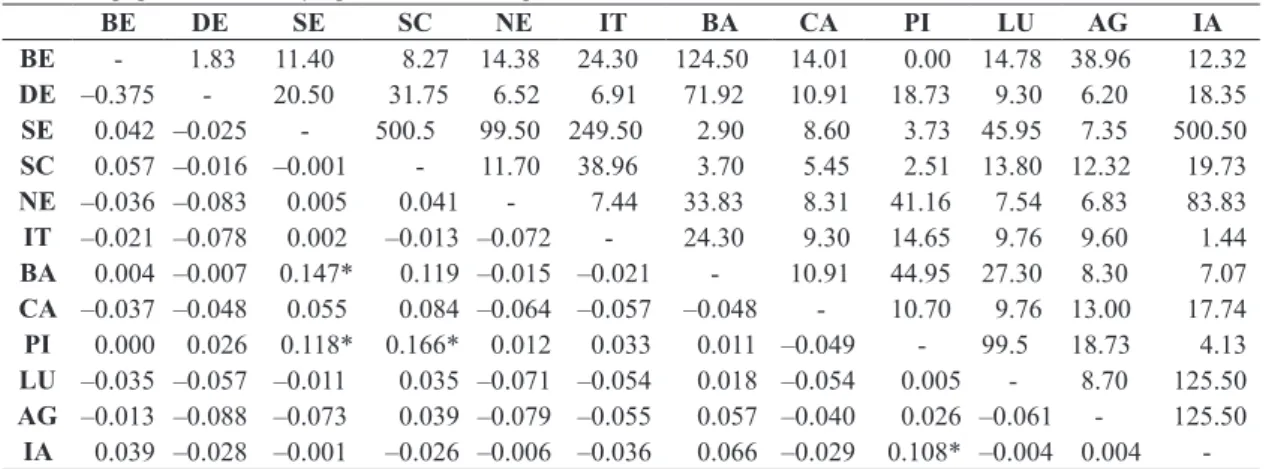
that 99.89% of the genetic variation is within populations, whereas only 0.11% is among populations. Due to this result, hierarchical AMOVA was not performed, but pairwise FSTs (Table 4) among the twelve populations sampled was calculated to detect the level of genetic
proximity. The results of the pairwise FST test indicate that some populations are very closely related genetically (Table 4), so they were considered a single population unit
due to the lower and non-significant results of this test.
The effective number of migrants per generation
(Nm) was estimated for the twelve populations (Table 4),
indicating intense gene flow, which agrees with the absence
of genetic structure found in the Global AMOVA. One of the lowest values for Nm found was between Pirajuí and São Carlos populations, Nm=2.51, which coincide with the highest value for FST, 0.166 (Table 4).
4. Discussion
The potential use of C. externa in the biological control of agricultural pests requires a genetic study on natural enemies’ populations for planning their release with the purpose of admixture only populations with some genetic
Figure 3. Graphics obtained with mismatch distribution analysis realized with sequences of mitochondrial COI gene of Chrysoperla externa.
Table 3. List of mitochondrial COI gene haplotypes shared in Chrysoperla externa populations in each geographical locality sampled.
Localities
Codes Haplotype
CA 1(05); 2(01); 3(01); 4(02); 5(01) PI 1(03);4(04); 6(01); 7(02)
IA 1(01); 4(02); 8(01); 9(01); 10(01); 11(01);
12(01); 13(01); 14(01)
BA 1(05); 11(01); 15(01); 16(01); 17(01);
18(01)
LU 1(03); 4(04); 15(01); 19(01); 20(01) IT 1(04); 4(01); 5(01); 15(02); 21(01); 22(01) NE 1(03); 4(01); 15(02); 23(01); 24(01);
25(01); 26(01)
BE 1(02); 4(03); 23(01); 27(01); 28(01);
29(01); 30(01)
DE 1(02); 4(02); 15(03); 23(01); 31(01);
32(01)
SE 1(01); 3(01); 4(03); 5(01); 33(01); 34(01) AG 1(01); 4(02); 15(02); 35(01)
SC 1(02); 4(02); 15(01); 32(01); 34(01);
36(01)
The number in parentheses refers to the frequency of the given haplotype in the sampled area. The localities codes
(LC) are the same of Table 1.
Table 4. Genetic distances (FST distances) and effective number of migrants (Nm), below and above diagonal, respectively,
for twelve populations of Chrysoperla externa sampled in São Paulo State, Brazil.
BE DE SE SC NE IT BA CA PI LU AG IA
BE - 1.83 11.40 8.27 14.38 24.30 124.50 14.01 0.00 14.78 38.96 12.32
DE –0.375 - 20.50 31.75 6.52 6.91 71.92 10.91 18.73 9.30 6.20 18.35
SE 0.042 –0.025 - 500.5 99.50 249.50 2.90 8.60 3.73 45.95 7.35 500.50
SC 0.057 –0.016 –0.001 - 11.70 38.96 3.70 5.45 2.51 13.80 12.32 19.73
NE –0.036 –0.083 0.005 0.041 - 7.44 33.83 8.31 41.16 7.54 6.83 83.83
IT –0.021 –0.078 0.002 –0.013 –0.072 - 24.30 9.30 14.65 9.76 9.60 1.44
BA 0.004 –0.007 0.147* 0.119 –0.015 –0.021 - 10.91 44.95 27.30 8.30 7.07
CA –0.037 –0.048 0.055 0.084 –0.064 –0.057 –0.048 - 10.70 9.76 13.00 17.74
PI 0.000 0.026 0.118* 0.166* 0.012 0.033 0.011 –0.049 - 99.5 18.73 4.13
LU –0.035 –0.057 –0.011 0.035 –0.071 –0.054 0.018 –0.054 0.005 - 8.70 125.50 AG –0.013 –0.088 –0.073 0.039 –0.079 –0.055 0.057 –0.040 0.026 –0.061 - 125.50
similarity. The observation of high genetic diversity and low genetic distance, evidenced by high haplotype sharing among populations, is an important issue regarding the population dynamics of C. externa, highlighting the
intense gene flow, as shown in Table 4. The different farms with citrus orchards sampled in this study form a unique habitat, allowing the dispersion of populations as being considered a suitable habitat for their survival. This is corroborated by the results from the neutrality tests and mismatch distribution, suggesting demographic events of population expansion i.e., representing colonization events of these areas over time. Agreeing with this hypothesis, data set shows high haplotype diversity among populations (Table 2), in contrast with low nucleotide diversity, which suggest a rapid demographic expansion from a small effective population size (Avise, 2000).
The global AMOVA results showed no genetic structure,
in agreement with the inference of high gene flow observed
from the Nm parameter (Table 4). These populations most likely represent subpopulations of a major genetic unit across the geographic area in the countryside of São Paulo State in which citrus is cultivated. Such inference is congruent with the genetic analysis of C. externa populations sampled in native areas and agroecosystems, and the same pattern of genetic structure has been found in the latter (Morales et al., 2013).
Possible explanations for this genetic similarity is that citrus orchards favor the establishment and maintenance of genetic variability in C. externa populations, there is abundant food and large areas of citrus orchards forming corridors used by these insects in the countryside of São Paulo State. All tests conducted to detect demographic events support the hypothesis of corridor use, and the AMOVA test and Nm values (Table 4) infer high gene flow among the sampled populations. Even the Tietê River does not seem
to act as a barrier to gene flow. In fact, some populations
occur on different sides of the river, these values are too
low and not significant to constitute genetic structure.
On the other hand, this genetic similarity could be due to a shared polymorphism among populations that was present before population expansion or any differentiation that is too recent to be detected by these analyses. However, due to intense anthropic interference and extensive citrus orchard
corridors, the hypothesis of high gene flow to explain the
lack of genetic variation across large geographic distances is the most acceptable. The observed genetic similarity shows that C. externa constitutes a single population in the sampled area and that the insects found here can be used
as a population (genetic) source for other citrus orchards with the same profile. Although there is no management of these populations (introgression of new individuals),
the molecular diversity indices and haplotype network (Figure 2) indicate that high levels of genetic variability remain, and what is essential for successful biological control of agricultural pests.
The haplotype network is in agreement with the results of the other tests. The congruent results from the statistical
analyses strengthen the inferences made regarding the population dynamics of C. externa.
Analyses with mitochondrial sequences have identified
groups/clades within species, which agrees with geographical range or ecological traits. Genetic analysis with Pilophorus typicus (Hemiptera: Miridae) populations, a predatory bug
as C. externa larvae, indicate that they are genetically structured forming two main clades (Ito et al., 2011). This is probably due to ecological or behavioral features of these insects instead of geographical conditions, once Japan archipelago presents small territorial proportions in relation to São Paulo State, promoting genetic homogeneity
among populations through gene flow. Another case of
genetically structured populations was observed between north and south populations along geographical range of Thanasimus dubius (Coleoptera: Cleridae), also a predatory bug. The genetic divergence found should be due to differences in sex pheromone of its prey and not exclusively the geographic distances (Schrey et al., 2005).
C. externa populations analyzed in this study did not show the same pattern. There are two possible reasons,
not mutually exclusive: 1) the anthropic action is so
strong that already erased genetic structure that existed
before the agroecosystems and/or 2) recent colonization
of this species in agroecosystems, so that one molecular marker, such as mitochondrial, is inappropriate to detect the recent history of this species in this environment. Probably, its evolutionary history is as recent as the history of agriculture in Brazil, so it should be used molecular markers with different modes of inheritance, as nuclear genes, for multi-locus analysis.
Considering these results, it is possible to conclude that the populations of C. externa sampled in the countryside of São Paulo State constitute a single population, with
high dispersion and gene flow, most likely favored by
the homogeneity of agroecosystems. For these farms, the mass-reared green lacewings for biological control releases could come from the same population source, which could be collected in any locality sampled in this work, due to the genetic identity among C. externa populations. Beyond biological control success, this practice avoids genetic introgression and extinction of non-target insects.
Acknowledgements
This study was supported by CNPq (Proc. n°131193/2009-0) for a Master of Science (MSc.) grant to the first author and FAPESP (Proc. n° 2006/03494-0) for financial support.
References
BRASIL. Ministério da Agricultura, Pecuária e Abastecimento, 2012 [viewed 10 September 2012]. Citrus [online]. Available from: http://www.agricultura.gov.br/vegetal/culturas/citrus.
CANARD, M., SÉMÉRIA, Y. and NEW, T.R., 1984. Biology of chrysopidae. Netherlands: Dr W. Junk Publishers, 308 p. CASTELLOE, J. and TEMPLETON, A.R., 1994. Root probabilities for intraspecific gene trees under neutral coalescent theory. Molecular Phylogenetics and Evolution, vol. 3, no. 2, pp. 102-113. http://dx.doi.org/10.1006/mpev.1994.1013. PMid:8075830. CLEMENT, M., POSADA, D. and CRANDALL, K.A., 2000. TCS: a computer program to estimate gene genealogies. Molecular Ecology, vol. 9, no. 10, pp. 1657-1659. http://dx.doi.org/10.1046/ j.1365-294x.2000.01020.x. PMid:11050560.
EXCOFFIER, L. and LISCHER, H.E.L., 2010. Arlequin suite ver 3.5: a new series of programs to perform population genetics analyses under Linux and Windows. Molecular Ecology Resources, vol. 10, no. 3, pp. 564-567. http://dx.doi.org/10.1111/j.1755-0998.2010.02847.x. PMid:21565059.
FIEDLER, A.K., LANDIS, D.A. and WRATTEN, S.D., 2008. Maximizing ecosystem services from conservation biological control: the role of habitat management. Biological Control, vol. 45, no. 2, pp. 254-271. http://dx.doi.org/10.1016/j.biocontrol.2007.12.009. FREITAS, S., 2002. O uso de crisopídeos no controle biológico de pragas. In: J.R.P. PARRA, P.S.M. BOTELHO, B.S. CORRÊA-FERREIRA and J.M.S. BENTO. Controle biológico no Brasil: parasitóides e predadores. São Paulo: Manole, pp. 209-224. FREITAS, S., 2003. Chrysoperla Steinmann, 1964 (Neuroptera,
Chrysopidae): descrição de uma nova espécie do Brasil. Revista
Brasileira de Entomologia, vol. 7, no. 3, pp. 385-387. http:// dx.doi.org/10.1590/S0085-56262003000300004.
FU, Y.X., 1997. Statistical tests of neutrality of mutations against population growth, hitchhiking and background selection. Genetics, vol. 147, no. 2, pp. 915-925. PMid:9335623.
HALL, T.A., 1999. BioEdit: a user-friendly biological sequence alignment editor and analysis program for Windows 95/98/NT. Nucleic Acids Symposium Series, vol. 41, pp. 95-98.
HOWARTH, F.G., 1991. Environmental impacts of classical biological control. Annual Review of Entomology, vol. 36, no. 1, pp. 485-509. http://dx.doi.org/10.1146/annurev.en.36.010191.002413. HUFBAUER, R.A. and RODERICK, G.K., 2005. Microevolution in biological control: mechanisms, patterns, and processes. Biological Control, vol. 35, no. 3, pp. 227-239. http://dx.doi. org/10.1016/j.biocontrol.2005.04.004.
ITO, K., NISHIKAWA, H., SHIMADA, T., OGAWA, K., MINAMIYA, Y., TOMODA, M., NAKAHIRA, K., KODAMA, R., FUKUDA, T. and ARAKAWA, R., 2011. Analysis of genetic variation and phylogeny of the predatory bug, Pilophorus typicus, in Japan using mitochondrial gene sequences. Journal of Insect Science, vol. 11, no. 18, pp. 18. http://dx.doi.org/10.1673/031.011.0118. PMid:21526929.
KOCZOR, S., SZENTKIRÁLYI, F., BIRKETT, M.A., PICKETT, J.A., VOIGT, E. and TÓTH, M., 2010. Attraction of Chrysoperla carnea complex and Chrysopa spp. Lacewings (Neuroptera:
Chrysopidae) to aphid sex pheromone components and a synthetic
blend of floral compounds in Hungary. Pest Management Science, vol. 66, no. 12, pp. 1374-1379. http://dx.doi.org/10.1002/ps.2030. PMid:20949547.
LIBRADO, P. and ROZAS, J., 2009. DnaSP v5: a software for comprehensive analysis of DNA polymorphism data. Bioinformatics (Oxford, England), vol. 25, no. 11, pp. 1451-1452. http://dx.doi. org/10.1093/bioinformatics/btp187. PMid:19346325.
MORALES, A.C. and FREITAS, S., 2010. Haplotype characterization of the COI mitochondrial gene in Chrysoperla externa (Neuroptera:
Chrysopidae) from different environments in Jaboticabal, state of
São Paulo, southeastern Brazil. Brazilian Journal of Biology = Revista Brasileira de Biologia, vol. 70, no. 4, pp. 1115-1121. http:// dx.doi.org/10.1590/S1519-69842010000500030. PMid:21180923. MORALES, A.C., LAVAGNINI, T.C. and FREITAS, S., 2013. Loss of genetic variability induced by agroecosystems: Chrysoperla externa (Hagen) (Neuroptera: Chrysopidae) as a case study.
Neotropical Entomology, vol. 42, no. 1, pp. 32-38. http://dx.doi. org/10.1007/s13744-012-0085-1. PMid:23949710.
MUIRHEAD, K.A., MURPHY, N.P., SALLAM, N., DONNELLAN, S.C. and AUSTIN, A.D., 2012. Phylogenetics and genetic diversity of the Cotesia flavipes complex of parasitoid wasps (Hymenoptera:
Braconidae), biological control agents of lepidopteran stemborers.
Molecular Phylogenetics and Evolution, vol. 63, no. 3, pp. 904-914. http://dx.doi.org/10.1016/j.ympev.2012.03.003. PMid:22450357. RAMOS-ONSINS, S.E. and ROZAS, J., 2002. Statistical properties of new neutrality tests against population growth. Molecular Biology and Evolution, vol. 19, no. 12, pp. 2092-2100. http://dx.doi. org/10.1093/oxfordjournals.molbev.a004034. PMid:12446801. ROGERS, A.R. and HARPENDING, H., 1992. Population growth makes waves in the distribution of pairwise genetic differences. Molecular Biology and Evolution, vol. 9, no. 3, pp. 552-569. PMid:1316531.
SÃO PAULO. Coordenadoria de Assistência Técnica Integral, 2012 [viewed 10 September 2012]. Anexo I – informações gerais da agropecuária do Estado de São Paulo. CATI [online]. Available from: http://www.cati.sp.gov.br/microbacias2/manualoperacional.php SCHREY, N.M., REEVE, J.D. and ANDERSON, F.E., 2005. Mitochondrial DNA analysis of the bark beetle predator Thanasimus dubius F. (Coleoptera: Cleridae) reveals regional
genetic differentiation. Molecular Ecology, vol. 14, no. 11, pp. 3317-3324. http://dx.doi.org/10.1111/j.1365-294X.2005.02684.x. PMid:16156805.
SIMON, C., FRATI, F., BECKENBACH, A., CRESPI, B., LIU, H. and FLOOK, P., 1994. Evolution, weighting, and phylogenetic utility of mitochondrial gene sequences and a compilation of conserved Polymerase Chain Reaction primers. Annals of the Entomological Society of America, vol. 87, no. 6, pp. 651-701. http://dx.doi.org/10.1093/aesa/87.6.651.
SMITH, P.T., 2005. Mitochondrial DNA variation among populations of the glassy-winged sharpshooter, Homalodisca coagulate.Journal of Insect Science, vol. 5, no. 1, pp. 41. http:// dx.doi.org/10.1093/jis/5.1.41. PMid:17119623.
SOUZA, B. and CARVALHO, C.F., 2002. Population dynamics and seasonal occurrence of adults of Chrysoperla externa (Hagen,
1861) (Neuroptera: Chrysopidae) in a citrus orchard in southern
Brazil. Acta Zoologica Academiae Scientiarum Hungaricae, vol. 48, pp. 301-310.
control compatible goals? Biological Control, vol. 45, no. 2, pp. 225-237. http://dx.doi.org/10.1016/j.biocontrol.2007.05.013. TAJIMA, F., 1989. Statistical method for testing the neutral mutation hypothesis by DNA polymorphism. Genetics, vol. 123, no. 3, pp. 585-595. PMid:2513255.
TAMURA, K., DUDLEY, J., NEI, M. and KUMAR, S., 2007.
MEGA4: Molecular Evolutionary Genetics Analysis (MEGA)