2017
UNIVERSIDADE DE LISBOA FACULDADE DE CIÊNCIAS DEPARTAMENTO DE INFORMÁTICA
Cloud Security Risk and Readiness
Luís Paulo Teixeira Ferreira
Mestrado em Segurança Informática
Dissertação orientada por:
Professora Doutora Ana Luísa do Carmo Correia Respício Mestre Sérgio Valentim Costa de Sá
i
Acknowledgments
First, I would like to thank Prof. Ana Respicio for her guidance throughout this thesis, helping me being more pragmatic in order to overcome the coexistence challenge of my academic and professional life. I must also mention the professors I encountered during the three years at FCUL. Each one contributed to the success of my academic and professional path.
I express my gratitude to Eng. Sergio Sá for his availability and willingness to be part of this work, as well as for the increased value provided. Also, I would like to appreciate the important contribution given by: Eng. Alessandra Rodrigues, Eng. Pedro Dias Rodrigues and Eng. Daniel Caçador.
To my friends from FCUL, who were also immensely supportive throughout this journey, namely Pedro Chaves, Raimundo and Sergio. I highlight Pedro Chaves, as he was my companion through long studying weekends and nights at FCUL, providing not only support but also, more importantly, the unwinding moments that made me carry on.
For all the patience, support, love and friendship demonstrated during this journey, I thank you Rita. I have no words to describe how grateful I am to have you as girlfriend.
Last but not least, I am grateful for having my parents’ unconditional support throughout this academic journey, as well as from my brother (and his wife) and sister.
iii
v
Resumo
Num mundo cada vez mais dependente da informação trocada através de meios digitais, é visível a evolução do paradigma das soluções informáticas tradicionais para o tema emergente, e cada vez mais convincente, da Computação em Nuvem. Tal facto deve-se não só às características diferenciadoras deste tipo de estrutura (e.g. on-demand self-service, ubiquidade, rápida elasticidade, flexibilidade, entre outros) e à maior eficácia na gestão e utilização de recursos de TI, mas também, de um ponto de vista empresarial, aos benefícios comerciais inerentes, como contenção de despesas (capitais e/ou operacionais), que se enquadram perfeitamente nas constantes mudanças das necessidades de negócio das organizações. Um conceito chave relativamente a esta matéria é o facto dos clientes conseguirem, de um modo geral, reduzir custos em recursos como licenciamento de software, hardware ou até outros serviços como o email, visto que conseguem usufruir de toda uma panóplia de serviços do mesmo fornecedor.
A Computação na Nuvem é um modelo de computação que permite o acesso a um conjunto partilhado de recursos computacionais configuráveis (e.g. Rede, servidores, aplicações e serviços) de uma forma ubíqua e conveniente, sendo que estes recursos podem ser rapidamente aprovisionados e desaprovisionados sem encargos de gestão relevantes assim como sem interação com o fornecedor de serviço. De forma mais ampla, o paradigma da Computação em Nuvem parte do princípio de que todos os recursos de infraestrutura de tecnologias de informação (hardware, software e gestão de dados e informação), até então tratados como ativos pelas organizações que os utilizam, passam a ser alojados numa infraestrutura dum fornecedor de tecnologia como um serviço (ou fornecedor de serviços tecnológicos) e acedidos e administrados por estas através da internet com o uso de um simples browser web. A Computação em Nuvem fornece uma camada de abstração entre os recursos de computação e a arquitetura de baixo nível que se encontra subjacente. Esta camada de abstração é um argumento muito atraente para organizações que apenas se querem focar nos recursos relevantes para o seu negócio sem necessitarem de fazer investimentos avultados em infraestrutura física e recursos humanos internos para gerir essa mesma infraestrutura. Ou seja, nos dias que correm, os clientes podem apenas fazer subscrições de serviços com fornecedores de Computação em Nuvem, o que lhes concede acesso aos mesmos recursos e infraestrutura, no entanto de uma forma mais imediata e alinhada com as condições e necessidades de negócio (em constante mutação). Este modelo de computação “as-a-service” tem alterado drasticamente a forma de atuar das organizações, tal como a forma como os departamentos de informática dessas mesmas organizações obtêm recursos computacionais e de armazenamento para garantir um elevado indice de escalabilidade. No entanto, à medida que mais organizações movem dados e infraestrutura para a Nuvem, a segurança vai-se revelando cada vez mais um tópico de especial relevância. De uma forma genérica, muitos fornecedores de Computação em Nuvem não transmitem aos seus clientes a transparência necessária relativamente aos controlos de segurança que utilizam para mitigar os eventuais riscos e ameaças de segurança inerentes a estes ambientes (em parte devido ao elevado grau de exposição dos serviços em Nuvem relativamente à Internet). Neste contexto,
vi
o modelo de Computação em Nuvem reveste-se de particularidades que o distinguem dos tradicionais modelos de computação, na medida em que os riscos são diferentes para cada modelo de serviço na Nuvem (IaaS, PaaS, SaaS) assim como para cada modelo de implementação (Privada, Pública, Comunitária, Híbrida). Por outro lado, os clientes também não estão devidamente preparados para esta realidade, de um ponto de vista de segurança e de adaptação do modelo de governo, para utilizar estes serviços. O nível global de segurança de uma organização é caracterizado pela maturidade dos controlos implementados para mitigar o risco. Estes controlos são implementados em várias camadas, desde a segurança física, segurança de redes, segurança de recursos humanos, até à segurança da informação e das aplicações (segurança aplicacional).
Nos ambientes de Computação em Nuvem as responsabilidades dos consumidores pelos vários domínios de segurança e respetivos controlos variam consoante o modelo de serviço utilizado. Se uma determinada entidade está a considerar utilizar algum tipo de serviço de Computação em Nuvem, esta deveria aferir os riscos associados ao(s) modelo(s) de serviço/implementação aplicáveis e, consequentemente, identificar casos de uso que representem um nível de risco aceitável para assim poder avançar para a adoção deste modelo computacional em Nuvem. Todavia, devido aos requisitos de imediatismo (geralmente impostos pelos executivos das organizações) relacionados com as necessidades de negócio, a análise e avaliação de riscos (assim como a sua mitigação) é, de um modo geral, negligenciada pelas equipas internas (de informática e segurança) aquando de uma migração de ativos de informação para a Nuvem. Embora este mercado esteja a crescer, apesar dos potenciais problemas de segurança adjacentes, a projeção da taxa de crescimento relativa ao consumo de serviços em Nuvem poderia ser maior se as organizações começassem a implementar processos internos mais adequados para a avaliação do seu grau de maturidade ao nível dos controlos de segurança aplicáveis em ambientes de Computação na Nuvem. Esta avaliação permitiria uma melhor gestão de risco relativamente à segurança de dados, assim como a identificação de possíveis melhorias em áreas específicas de segurança. Essas melhorias depois de implementadas traduzem-se em mais confiança e motivação das organizações para usufruir das vantagens da Computação em Nuvem. De salientar que este tipo de análise e avaliação de maturidade e riscos por parte de consumidores, tendo em conta os diferentes fornecedores de serviços em Nuvem, devem ser balanceados com uma revisão dos possíveis benefícios de escala provenientes deste modelo, especificamente em termos de segurança (e.g. Mais meios de deteção de anomalias, assim como melhor capacidade de resposta a incidentes de segurança). A Computação em Nuvem tem um potencial significante para melhorar a segurança e resiliência de organizações que não possuem um nível de maturidade de segurança satisfatório tendo em conta essas áreas.
Tendo em conta os tópicos abordados, o autor do presente trabalho acredita que existia a necessidade de criação de uma metodologia que, não só suportasse a tomada de decisão das organizações relativamente à implementação de mecanismos apropriados de gestão e mitigação de risco, mas que também permitisse aferir o nível de maturidade de segurança em Nuvem de uma forma holística, ou seja, cobrindo de um modo geral as diversas áreas de
vii
segurança mais relevantes. Esta dissertação propõe uma abordagem que, através de um modelo de avaliação de maturidade, permitirá aos clientes de serviços em Nuvem responder às necessidades já mencionadas no âmbito das diversas áreas de segurança (como conformidade ou proteção de dados). Este modelo também incorpora componentes que permitem a identificação de potenciais fatores de risco resultantes da utilização dos diferentes modelos de serviço e implementação da Computação em Nuvem. O modelo criado é traduzido da teoria para a prática através dum protótipo desenvolvido pelo autor. Além das funcionalidades de avaliação do nível de maturidade de segurança em Nuvem e identificação de possíveis fatores de risco, o protótipo também fornece dashboards que contêm informações relevantes sobre os resultados da avaliação. Os resultados obtidos devem permitir que uma organização compare diferentes fornecedores de serviços de Computação em Nuvem, ajudando desta forma a tomada de decisão por parte dos quadros superiores, assim como negoceie de uma forma mais consciente e fundamentada os acordos de nível de serviço (SLAs) com os fornecedores, obtendo desta forma algum tipo de garantias de segurança por parte dos mesmos. Uma primeira avaliação realizada por especialistas nas áreas de Computação em Nuvem e segurança revelou que o protótipo é uma contribuição importante para as avaliações de segurança em Nuvem, assim como tem aplicabilidade em ambientes organizacionais com requisitos de segurança e compliance elevados.
ix
Abstract
Within the “Information Era”, the world has become increasingly dependent on information exchanged through digital media and it is clear that the paradigm of traditional IT solutions is evolving rapidly to emerging areas (and more and more convincing) like Cloud Computing. This is due not only to the differentiating characteristics of Cloud Computing services (e.g. on-demand self-service, ubiquity, rapid elasticity, flexibility, among others) and to the greater effectiveness in the management and use of IT resources, but also, from a business point of view, it is due to the inherent commercial benefits, such as cost containment (both capital and operational costs), which fit perfectly into the constantly changing business needs of organizations. Although the advantages of using Cloud Computing services are easily identified from a business point of view, many potential consumers are reluctant to use these services to host their information assets due to the fact that, at least at the first stage, they will have to deal with the unknown (their being used to traditional computing environments), as well as due to the risks and security threats inherent to these environments resulting from the high degree of exposure to the Internet. In this context, the Cloud Computing model has particularities that distinguish it from the traditional computing models insofar as the risks are different for each service model in the Cloud (IaaS, PaaS, SaaS) as well as for each implementation model (Private, Public, Community, Hybrid). Based on that, there is a need for a methodology which, from an IT and information security perspective, not only supports the decision-making of the organizations that consume cloud services with regards to the implementation of appropriate risk management and mitigation mechanisms, but also which enables the organizations to assess its maturity level regarding the implemented controls (that will help mitigate cloud security risks) and, consequently, the forecasting of security areas that should be improved. This, in turn, helps the organizations to achieve a satisfactory mature state that enables the use of cloud services in a more proper and secure way (“security readiness”).
This dissertation proposes a holistic approach which, through a designed assessment model, will enable Cloud services customers to tackle the aforementioned needs across several different security areas (such as compliance, governance or data protection), as well as will allow the identification of potential risk factors related with the use of Cloud Computing. This theoretical model is translated into practise through a prototype tool developed by the author. Apart from the Cloud security maturity assessment and potential risk factors identification functionalities, the prototype also provides dashboards that give valuable insights about the assessment results. A first evaluation performed by experts in the cloud and security fields revealed that the prototype is an important contribution for Cloud Security assessments in organizational environments.
xi
Content
List of Figures ... xiii
List of Tables ... xv Chapter 1 Introduction ... 1 1.1 Motivation ... 1 1.2 Objectives ... 3 1.3 Contributions ... 3 1.4 Document Structure ... 4 1.5 Project Plan ... 5 Chapter 2 Context ... 7
2.1 What is Cloud Computing? ... 7
2.1.1 Cloud Service Models ... 7
2.1.2 Cloud Deployment Models ... 9
2.1.3 Cloud Computing Differentiating Features ... 10
2.1.4 Cloud Computing Adoption ... 11
2.2 Cloud Computing and Security ... 12
2.2.1 Cloud Computing - Possible Security Benefits ... 14
Chapter 3 Related Work ... 15
3.1 Security Risks in Cloud Computing ... 15
3.2 Literature Review ... 18
3.3 Review of Standards ... 19
Chapter 4 A solution to assess the readiness and potential risk on Cloud environments ... 21
4.1 Model description ... 21
4.1.1 Readiness Assessment ... 22
4.1.2 Potential risk identification ... 24
4.2 Tool description ... 26
4.2.1 Readiness Assessment ... 26
4.2.2 Potential Risk identification ... 29
xii
4.3 Process for Assessment ... 34
Chapter 5 Tool Evaluation ... 37
5.1 Method of evaluation ... 37
5.2 Participants ... 38
5.3 Analysis of Results ... 39
5.3.1 Utility ... 40
5.3.2 Usability ... 42
Chapter 6 Conclusion and Future Work ... 45
6.1 Conclusions ... 45
6.2 Future work ... 45
Glossary…. ... 47
References... ... 51
Appendix A – Utility questionnaire ... 55
Appendix B – Usability questionnaire ... 56
xiii
List of Figures
Figure 1 - Project Planning and Implementation ... 5
Figure 2 - Cloud Computing Deployment Models integration. Adapted from (Miller et al.,2009) ... 10
Figure 3 - Respondents Adopting Cloud. Extracted from (Weins, 2017) ... 12
Figure 4 - Security integration with different service models. Extracted from (ISACA, 2012) ... 13
Figure 5 - Assessment model overview - Components integration ... 21
Figure 6 - Cloud Security maturity level evaluation criteria. Adapted from ISO/IEC 21827:2008 ... 23
Figure 7 - Tool KPI Maturity Level calculation (average and worst case) example ... 26
Figure 8 - Tool domains for Cloud Security Readiness assessment ... 27
Figure 9 - Tool maturity assessment layout example ... 28
Figure 10 - Tool trend analysis results ... 28
Figure 11 - Tool Potential Risks Identification layout example ... 29
Figure 12 - Tool Potential Risks impact mapping ... 30
Figure 13 - Cloud Security Domain Maturity Gap Analysis ... 31
Figure 14 - Cloud Security Trend Gap Analysis ... 31
Figure 15 - Cloud Security maturity comparison between average and worst case ... 32
Figure 16 - Cloud Security Top 10 Potential Risk Factors ... 33
Figure 17 - Cloud Security Top 10 Higher Risk Sub-Domains ... 33
Figure 18 - Cloud Security Potential Risk for Cloud Deployment Models ... 34
Figure 19 - Cloud Security Maturity Assessment Process ... 34
xv
List of Tables
Table 1- Cloud Computing Service Models. Adapted from (Mell & Grance, 2011). ... 8
Table 2 - Cloud Computing Deployment Models. Adapted from (Goyal, 2014; Mell & Grance, 2011) ... 9
Table 3 - Cloud Computing Differentiating Features (Mell & Grance, 2011) ... 11
Table 4 - Potential Security Benefits of Cloud Computing. Extracted from (ENISA, 2009) .. 14
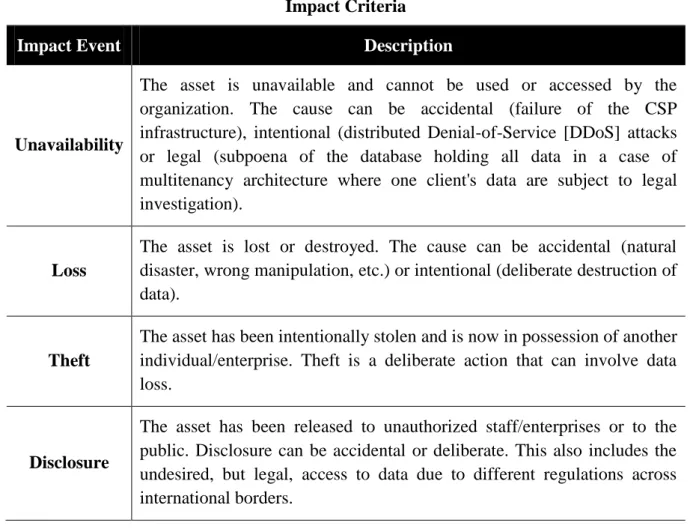
Table 5 - Impact criteria for potential risk factors. Extracted from (ISACA, 2012) ... 25
Table 6 - Cloud Security Maturity Assessment Process description ... 35
Table 7 - Results obtained from the utility questionnaire - SUS ... 41
1
Chapter 1 Introduction
Within the “Information Era”, the world has become increasingly dependent on information exchanged through digital media and it is clear that the paradigm of traditional IT solutions is evolving rapidly to emerging areas (and more and more convincing) like Cloud Computing. This is due not only to the characteristics of Cloud Computing services (e.g. on-demand self-service, ubiquity, rapid elasticity, and flexibility, among others) and to the greater effectiveness in the management and use of IT resources, but also, from a business point of view, to the inherent commercial benefits, such as cost containment (both capital and operational costs), which fit perfectly into the constantly changing business needs of organizations.
Although the advantages of using Cloud Computing services are easily identified from a business point of view (in that it facilitates business activities and increases productivity and profitability), many potential consumers are reluctant to use these services to host their information assets due to the fact that, at least at the first stage, they will have to deal with the unknown (as they are used to traditional computing environments), as well as due to the risks and security threats inherent to these environments resulting from the high degree of exposure to the Internet (making the company more vulnerable and more exposed to external attackers). In this context, organizations should have specific Cloud security controls in place to mitigate Cloud specific risks, because the Cloud Computing model has particularities which distinguish it from the traditional computing models insofar as the risks are different for each service model in the "Cloud" (IaaS, PaaS, SaaS) as well as for each implementation model (Private, Public, Community, Hybrid).
1.1 Motivation
This dissertation responds to a gap in the existence of models (e.g. computational tools) that enable the assessment of cloud security maturity level (in terms of controls implemented) of the organizations which use Cloud services or intend to migrate services to it, as well as risk evaluation regarding the use of Cloud Computing solutions. In addition to the Informatics Department of the Faculty of Sciences of the Lisbon University (FCUL), this work relies on a collaboration of EY Portugal, a company which provides information security consulting services to national and international markets. This synergy between the security business market and the academic environment is an excellent opportunity because it enables both the identification of the organization's security needs (mostly in the Portuguese security market) as well as a scientific approach to addressing those needs. In the specific context of this project, the objective was to marry the spheres of business and academia, producing an academic work with business relevance.
2
The project is directly linked to the several services provided through Cloud Computing, a paradigm which has emerged with special relevance in the IT market and which, according to experts in the field, has had a notable growth with increasing adoption by organizations from different industries worldwide. The main reason for such growth is the need for organizations' IT teams to respond to business requirements, both in terms of cost reduction and also with regards to ubiquity, efficiency, and immediacy. However, due to these requirements and needs (usually imposed by the organization's senior management), the analysis and evaluation of security-related risks and prior mitigation is often neglected by IT teams when moving information assets to the Cloud. Although this market is growing in spite of the potential security issues, the growth rate projection of Cloud services could be much higher if organizations started putting into practice appropriate security maturity evaluation and risk analysis processes to identify the security domains that need improvement and to identify and mitigate cloud security risks.
If a particular entity or organization is considering the use of any Cloud Computing service, it should:
Assess operational, privacy, governance and compliance risks;
Classify its assets and identify inappropriate use cases for the cloud computing service delivery model, based on the level of risk and currently implemented controls (maturity level);
Identify use cases that represent an acceptable level of risk for the Cloud service delivery model;
Choose and implement risk compensation controls prior to adopting Cloud Computing services;
In other words, there is a need for a method which, from an IT and information security point of view, not only supports the decision-making of the organizations that consume services regarding the aforementioned points, but also which allows the organizations to assess its maturity level regarding the implemented controls that will help mitigate cloud risks and, consequently, forecast areas that should be improved, enabling the organization to be more mature to use cloud services in a more proper and secure way (“security readiness”).
This led to an interest in the design of a maturity level and potential risk assessment model specific for Cloud Computing environments that can allow organizations to respond to some of the problems identified above and to identify what should be improved to achieve readiness levels (from an Information Security point of view) and, consequently, to use Cloud Computing services more securely. The designed maturity assessment model is intended to help an organization analyze the maturity state of its cloud security controls and to define a target state within the context of its business and security goals, and then to perform a gap analysis between its current maturity state and target readiness states.
3
In other words, after a maturity assessment is completed through the use of the developed tool, an organization should be able to evaluate its degree of cloud security maturity in several different strategic domains (in line with the industry standards) such as compliance, governance and interoperability, enabling a more precise and reasoned definition of the top priority controls that should be implemented to mitigate potential cloud risks and to improve its overall maturity level.
1.2 Objectives
Based essentially on the Information Security topic, the main goal of this work is to help potential Cloud Computing consumers to:
Through an assessment process, assess the Cloud security maturity level regarding the implementation of controls aimed at mitigating cloud security risks from different security domains and to prioritize the missing controls according the organization’s pre-defined target readiness states to be achieved for each domain.
Evaluate the potential risk factors of using Cloud computing services. For example, the consumers should be able to compare the potential risks of maintaining a classic IT architecture within the organization premises to the risks of using a (third-party) Cloud Computing environment. These potential risks can be mapped (in terms of applicability) to the different Cloud computing service and deployment models, enabling the organization to identify the potential risks according to a specific model they are using or intend to use (e.g. SaaS, Hybrid Cloud).
1.3 Contributions
With the work described in the present document, a model was designed, constituting a starting point in the security maturity assessment paradigm for Cloud Computing environments. This effort is a foundation for future work which may improve the existing model as well as the features of the solution created to that model.
In addition to the research work carried out throughout this process, the most evident result of this work is the prototype which has been built. The prototype tool developed enables organizations to assess their security maturity level regarding Cloud Computing and to identify potential risk factors specific for each Cloud service/deployment model. Furthermore, it allows organizations to define an improvements roadmap regarding Cloud Computing security controls in a more grounded way, thus enabling the organization to clearly identify what is needed to reach the target Cloud security readiness level.
4
Summing up, the author believes the developed solution prototype work is an important contribution since it enables the cloud service customer to:
Compare different providers of Cloud Computing services, based on their needs, thereby helping senior management decision-making.
Identify security requirements to achieve a readiness level regarding the use of Cloud computing services. Thus, enabling the CSC to develop a more balanced cloud strategy.
Negotiate contracts and service level agreements (SLAs) with cloud providers in a more grounded and informed manner, thus obtaining security guarantees on their side.
Identify controls that need to be implemented in order to achieve compliance with Industry standards and regulations (e.g. ISO/IEC 27017:2015).
Understand the dimensions that constitute cloud security maturity.
Identify an improvements roadmap to accomplish the changes in maturity levels for each security domain.
Develop focused investment initiatives to reach target maturity levels in relevant cloud security domains, in order to improve their overall security maturity. Steer priorities relating to secure cloud service use and adoption.
Compare different departments and entities from different industries regarding Cloud Security maturity (Benchmarking).
1.4 Document Structure
The present chapter outlines the motivation for the development of this dissertation and, consequently, the objectives which the work intends to meet.
The remainder of this document is structured as follows:
Chapter 2 – Context - The "Context" - initially presents concepts of Cloud Computing as well as its architecture layout. Then, it addresses the relationship between Cloud computing and Security followed by a presentation of the possible Cloud Computing security benefits by highlighting how the use of Cloud Computing services can also be a way of improving overall security for many organizations.
Chapter 3 – Related Work - The chapter "Related Work" succinctly presents the work that was collected and analyzed in order to enrich our knowledge regarding the project. Also, major security risks associated with Cloud Computing are presented, framing the same with the project carried out.
Chapter 4 – A solution to assess the security readiness and potential risks
5
which was chosen and the various components that make it up (modeling design decisions and the developed prototype features).
Chapter 5 – Tool evaluation - The evaluation process performed to the developed prototype is demonstrated in terms of its utility, usability, and applicability to the real world. Also, an analysis of the results obtained is presented.
Chapter 6 – Conclusions and Future Work - The work and conclusions that can be drawn from it is described, the content and the results presented are discussed and the authors give a perspective on what future work may arise from it.
1.5 Project Plan
The project described in this dissertation was developed over a period of eleven months, with sequential stages which built upon previous activities to achieve a coherent outcome.
Although there were no major changes to the project initial planning phases, generally, the different phases consumed more time than was anticipated, starting with the goal definition and finishing with the dissertation.
Figure 1 presents the various stages that made up the project development plan, from the initial research and goal definition to dissertation writing, including model design and tool implementation as well as the resulting User Validation.
7
Chapter 2 Context
This chapter introduces the Cloud Computing concepts that are essential to understanding the proposed solution as well as the decisions taken in its construction. The chapter starts by explaining what Cloud Computing is, as well as how it differentiates from traditional IT environments. Next, some statistics related with Cloud Computing adoption throughout the past years are presented. Following that, the chapter gives some context regarding the relationship between security and the different Cloud models. Finally, to support the idea that Cloud Computing has significant potential to improve the security of its consumers, potential Cloud security benefits are presented.
2.1 What is Cloud Computing?
Cloud Computing is the result of the evolution and the technical foundations gathering of areas such as server virtualization, among others. It is a flexible and efficient model for using software as well as for storing and processing data through different devices and web technologies.
More broadly, the Cloud Computing paradigm assumes that all IT infrastructure resources (hardware, software and data and information management), which until now have been treated as on-site assets by the organizations who use them, are now housed in third-party provider premises which provide technology as a service (or technological services), as well as accessed and managed by them through the Internet using a simple web browser.
Cloud computing is a computing model that allows access to a shared set of configurable computing resources (e.g. Network, servers, applications, and services) in a ubiquitous and convenient way, with the remark that these resources can be quickly provisioned and de-provisioned without relevant management (operational) effort as well as without interaction with the service provider. This model has specific characteristics which set it apart from "classic" models, three service models and four implementation models. (Mell & Grance, 2011).
It is important to highlight that, for the purpose of this dissertation, the different service and implementation models and related risks should be considered.
2.1.1 Cloud Service Models
Understanding the inter-relationships between different service models of Cloud Computing is essential to understand the underlying security risks. Infrastructure as a Service (IaaS) is the basis of all Cloud services, with Platform as a Service (PaaS) built
8
upon IaaS, and Software as a Service (SaaS) built on top of PaaS. In this manner, just as resources are inherited, so are the security risks associated with each model.
As described in Table 1, Cloud Computing environments can be composed of three different service models that define their architecture. (Mell & Grance, 2011).
Table 1- Cloud Computing Service Models. Adapted from (Mell & Grance, 2011).
Cloud Service Models
Model Description
Software as a Service (SaaS)
In this model, the consumer uses applications that run on the cloud service provider infrastructure. The applications are accessible through the internet by using several different devices and their interfaces (e.g. web browser to access online email). The consumer does not manage or control the underlying Cloud infrastructure, including network resources, servers, operating system, storage, or even application-layer specific features.
Platform as a Service (PaaS)
In this model, the consumer has the ability to implement applications in the cloud infrastructure through the use of programming languages, libraries, services and tools supported by the cloud service provider. The consumer does not manage or control the underlying Cloud infrastructure, including network resources, servers, operating system, or storage. However, it has control of the implemented applications and, possibly, of the hosting environment configurations related to the same applications. Examples can be Microsoft Azure (Microsoft, 2017), Salesforce (Salesforce, 2017) and the Google App engine (Google, 2017).
Infrastructure as a Service (IaaS)
The consumer has the capacity to provision processing, storage, networking and other key computing resources (usually through virtualized environments). The consumer can implement and run software (e.g., operating system and applications) according to his needs. The consumer does not manage or control the underlying Cloud infrastructure; however, it has control over operating systems, storage, deployed applications, and possibly limited control of certain network security components such as a host firewall.
9
2.1.2 Cloud Deployment Models
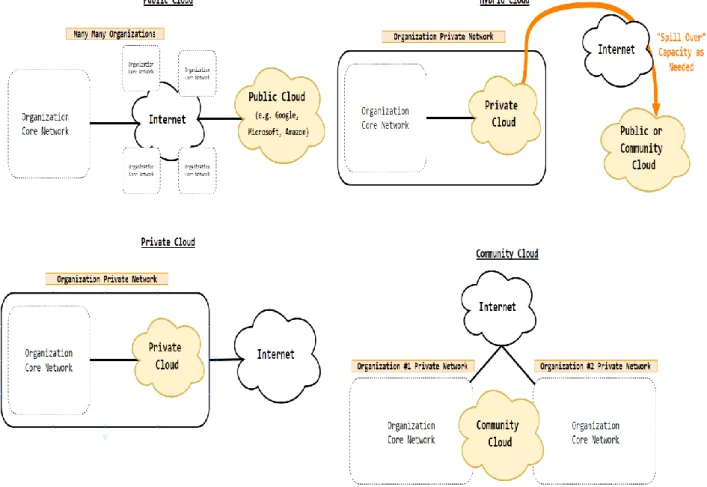
Cloud Computing offers four different deployment models. The organizations’ choice of model depends on the comparison between its requirements, whether regarding information or business processes, and the model that best meets those requirements. The deployment models and their main characteristics are presented in Table 2, as in Figure 2. (Goyal, 2014; Mell & Grance, 2011)
Table 2 - Cloud Computing Deployment Models. Adapted from (Goyal, 2014; Mell & Grance, 2011)
Cloud Deployment Models
Model Description
Community Cloud
A Community Cloud infrastructure is provisioned for the exclusive use of a specific consumer’s community, composed of organizations that have common goals (mission, security requirements and compliance). Cloud computing infrastructure can be owned, managed and operated by organizations who are part of the community, by a third party or even by a combination of the two. It can exist within the premises of the organization as well as outside it. An example of a Community Cloud may be the use of shared computing infrastructure exclusively by two or more entities within the government (or health sector), which have the same compliance, privacy, and security requirements.
Public Cloud
The Public Cloud infrastructure is provisioned for open use by the general public. The Public Cloud infrastructure can be owned, managed and operated by an organization that sells computer services, by an academic or governmental organization, or by the combination of the various parties. It exists within the premises of the organization that provides the services.
Hybrid Cloud
The Hybrid Cloud infrastructure is made up of two or more distinct cloud infrastructures (public, private or community) which remain unique entities, but are interconnected through technology (proprietary or standardized) that enables the portability of information and applications. (e.g., Relocation of backups between Clouds).
Private Cloud
The Private Cloud infrastructure is provisioned for the exclusive use of a single organization comprising multiple internal consumers (e.g. Business Units). The Private Cloud infrastructure can be owned, managed and operated by the organization itself, by a third party or by the combination of the two. It can exist both inside and outside the organization’s premises.
10
2.1.3 Cloud Computing Differentiating Features
From an architectural perspective, there is still much confusion surrounding the similarities and differences between the Cloud Computing models and the conventional computing models. It is also unclear how these similarities and differences impact organizational, operational and technological approaches to information and network security practices. Table 3 presents some characteristics that are considered differentiating with respect to the comparison between conventional computing and Cloud Computing, which were taken into account for the elaboration of this dissertation from a security-focused point of view. (Mell & Grance, 2011; CSA, 2011)
11
Table 3 - Cloud Computing Differentiating Features (Mell & Grance, 2011)
Cloud Computing Differentiating Features
On-Demand Self-Service
Consumers can unilaterally provision computing resources (e.g., Time the customer wants to use the service or Storage) as needed, automatically and without requiring human interaction with the Cloud Computing service provider.
Broad Network
Access
Cloud computing services are available through the network (via the Internet) and are accessed through standardized mechanisms that come from the use of heterogeneous client platforms (e.g. smartphones, tablets, laptops, desktops, among others).
Resource Pooling
The computing capabilities of the Cloud service provider are grouped to serve multiple consumers through a multi-tenant model, with different physical and virtual resources dynamically allocated and reallocated according to the needs of consumers. There is a perception of location independence in the sense that the consumer generally has no control or knowledge about the exact location of the resources provided to him, yet he may have the ability to specify the location at a higher abstraction level (e.g. country, data center). Examples of resources can be storage, processing, memory, and bandwidth.
Rapid Elasticity
Resources can be provisioned quickly and elastically (in many cases automatically) to scale up or scale down quickly and according to the needs of the consumer. For the consumer, the resources available for provisioning often appear to be unlimited and can be appropriated in any quantity at any time.
Measured Service
Cloud Computing service providers automatically control and optimize resources utilization by leveraging measurement capabilities at an abstraction level appropriate to the type of service provided (e.g. storage, processing, bandwidth, and active user accounts). The use of resources can be monitored, controlled and reported, thus providing transparency of the service used for both the provider and the consumer.
2.1.4 Cloud Computing Adoption
In order to better define the type of target audience for a cloud security readiness assessment model, attempts were made to understand the Cloud models’ evolution in terms of adherence. Furthermore, the author tried to be aware of which deployment models are used most to better define which KPI such a model should focus on as part of the assessment (e.g. SLAs in Public Cloud should be more detailed and strict than Private Cloud).
12
As illustrated by the graph in Figure 3, there has been an evolution in the use of cloud models ("Any Cloud"), which has motivated even more this work. The main reason for such growth is the need for organizations' IT teams to respond to business requirements, both in terms of cost reduction and also with regards to ubiquity, flexibility, efficiency, and immediacy. However, due to these requirements and needs (usually imposed by the organization's senior management), the analysis and evaluation of security-related risks and prior mitigation is often neglected by IT teams when moving information assets to the Cloud. The results presented in the graph are based on a survey which asked 1,002 IT professionals about their adoption of cloud infrastructure and related technologies. Forty-eight percent of the respondents represented enterprises with more than 1,000 employees. The margin of error is 3.07 percent. (Weins, 2017)
Figure 3 - Respondents Adopting Cloud. Extracted from (Weins, 2017)
According to Weins (2017), companies using cloud are leveraging multiple public and private clouds. That is, on average, they are running applications on 1.8 public clouds and experimenting with an additional 1.8 public clouds. They are also running applications on 2.3 private clouds and experimenting with an additional 2.1 private clouds. This may indicate that companies, in general, are experimenting with the option of putting in place a multi-cloud strategy. A multi-cloud strategy is the use of two or more cloud environments to minimize the risk of service availability failure, loss and corruption of data, loss of privacy, vender lock-in or the possibility of malicious insiders in the single cloud. Service unavailability can occur due to the breakdown of hardware, software or system infrastructure. A multi-cloud strategy can also improve overall enterprise performance by avoiding "vendor lock-in" and using different infrastructures to meet the needs of diverse partners and customers. (Pareek, 2013)
2.2 Cloud Computing and Security
In general, security controls in Cloud Computing are not very different from the security controls in any other IT environment. However, the different cloud computing
13
service/deployment models and their use can translate into additional risks for an organization.
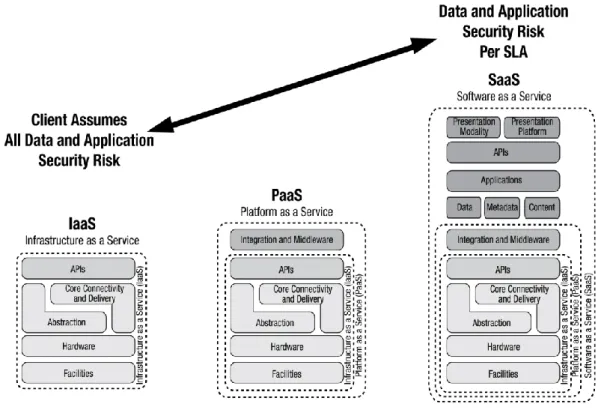
The overall security level of an organization is characterized by the maturity of the controls implemented to mitigate risk. These controls are implemented in a number of layers, from physical security, network security, human resource security, to information and application security. In cloud computing environments, the consumer’s responsibilities across the various security domains and their respective controls vary depending on the service model used. In SaaS environments, the security controls scope is negotiated in the legal contract between the consumer and service provider in terms of service level agreements (SLA), privacy and compliance. In the IaaS offering, the cloud service provider is responsible for ensuring the security of the abstraction layer and the underlying infrastructure, while the remaining components are fully supported and managed by consumers (e.g., Operating system and installed applications). Finally, in the PaaS model the platform security is the service provider’s responsibility, however, the consumer is responsible for the security of the applications developed within the platform. These differences are represented in Figure 4.
Figure 4 - Security integration with different service models. Extracted from (ISACA, 2012)
Understanding the impact of these differences between service/deployment models and how they are deployed is a key factor for organizations planning to manage security risk.
14
2.2.1 Cloud Computing - Possible Security Benefits
The economic, technological and ecological benefits of Cloud Computing have been discussed frequently, but it is worth noting that there are numerous additional potential security benefits related to the use of Cloud Computing resources. The risk assessments and analyses that are carried out by consumers with regards to cloud service providers should be balanced with a review of existing security benefits because for many organizations (e.g. SMB) the use of Cloud Computing might improve their overall security maturity level across the different security areas. Cloud Computing has significant potential to improve the security and resilience of its consumers. Table 4 shows some of the possible security benefits of using Cloud Computing (ENISA, 2009).
Table 4 - Potential Security Benefits of Cloud Computing. Extracted from (ENISA, 2009)
Potential Security Benefits of Cloud Computing
Benefits of Scale
All types of security measures have a lower cost when implemented on a large scale. That said, the same amount of security investment buys better protection. Some benefits of scale can be:
By default, most cloud service providers have the needed economic resources to replicate content in multiple locations. In this way, they increase the levels of redundancy and fault tolerance, as well as allow the elaboration of Disaster Recovery procedures.
Threat Management - Most cloud service providers have the economic ability to hire security specialists to deal with specific threats, while small and medium-sized enterprises typically only hire professionals with a more IT generic profile.
Better ability to respond to incidents such as cyber-attacks.
Security as a differentiator in the market
When organizations begin a process of analyzing Cloud services, security is one of their primary concerns. Consumers will make their decisions to purchase Cloud services based on the reputation of each provider in terms of confidentiality, integrity, and resilience, as well as the security services that are provided. This is one factor that can motivate Cloud service providers (in general) to improve their security practices.
Rapid, smart scaling of resources
A Cloud service provider has the ability to dynamically relocate resources for filtering, traffic shaping, encryption, among others, to increase support for defense measures (e.g. DDoS attack) when an attack is occurring or is imminent to happen.
Audit and evidence-gathering
Since the IaaS model is usually based on virtualization technology, it supports on-demand cloning of servers. If there are suspected security breaches, the consumer may, for example, remove an image from a machine to perform a forensic analysis in a controlled environment (without downtime).
15
Chapter 3 Related Work
This chapter presents the work that is somehow related to the topic chosen for this work. The chapter begins with a general presentation of the security risks associated with Cloud Computing and then presents some work in the areas of risk analysis for Cloud Computing and Cloud Readiness and Maturity Level.
3.1 Security Risks in Cloud Computing
This Section reviews known potential Cloud-specific risks. Since the list of potential risks associated with using Cloud Computing resources is very extensive and related to different service and implementation models, it was decided to compile some of the more relevant potential risks for the scope of this document, as we can see below.
Loss of Governance
Governance is the set of processes, technologies, laws, and policies that affect how an organization is managed and controlled. Governance also includes the relationships between the different stakeholders involved in an organization, as well as its objectives. IT governance assumes itself as a subordinate mechanism of overall corporate governance, with the mission of incorporating the intrinsic value of IT into all aspects of the organization. (Mille, 2009).
When using Cloud Computing infrastructures, the consumer has to give control (governance) of different variables to the service provider, which can affect security. At the same time, SLAs may not offer a commitment on the supplier’s part regarding security services, i.e. there is a lack of visibility on the consumer’s side regarding the technical security measures put into place in the cloud service provider’s infrastructure. (CSA, 2011; ENISA, 2009)
Lock-In
As far as we know, and according to the investigation that has been done, there are no procedures or tools that guarantee the portability and interoperability of data, applications, and services. This may make it difficult for a Cloud services consumer to migrate these same services from one provider to another or even to its on-premises infrastructure. This translates into the risk of dependence on a particular provider (CSA, 2011).
Cross-border legal requirements
Cloud computing service providers are often cross-border, and in general, different countries have different legal requirements, especially with respect to private personal information. The cloud service consumer may be violating regulations in other countries
16
by storing, processing, or transmitting data within the provider's infrastructure, that is, without taking into account the required compliance controls. In addition, government entities in the country where the Cloud infrastructure is located may require access to entity information with or without adequate notification.
It is therefore necessary that, when the Cloud service provider operates outside the consumer's territory, in countries with different legislation, the consumer identifies all legal requirements to ensure that he is not violating the laws of that country by storing and processing his data through the provider’s infrastructure (ISACA, 2012).
Isolation Failure
As noted earlier, the Multi-Tenancy feature and the resource sharing through virtualization is one of the key features of Cloud Computing. The failure of isolation mechanisms that separate components such as storage, memory, and network from different consumers (tenants) can translate into a high-level risk. In this multitenant environment, it is essential that the shared resources be totally isolated and protected so that there is no data disclosure by other tenants, for example in situations of resource relocation. In recent years, vulnerabilities of such shared technologies have been used by attackers to launch attacks on cloud infrastructures (Kazim & Zhu, 2015).
Compliance Risks
There are organizations that make considerable investments to achieve certification of compliance with certain standards (industry standards or regulatory requirements). These certifications may be called into question when migrating services to the Cloud, for example:
If your Cloud Computing service provider is unable to demonstrate evidence that complies with the same standards or
If the Cloud Computing service provider does not allow consumers to perform cloud audits to verify if the controls implemented are in accordance with their internal policies.
In some cases, the use of Public Cloud Computing services means that certain types of compliance cannot be achieved, such as PCI DSS (ENISA, 2009).
Management Interface Compromise
To manage their infrastructure, consumers of Public Cloud Computing services typically use a management interface accessible through the Internet that allows access to a broad set of resources. This translates into a high risk, especially if the interface is vulnerable to Web attacks (ENISA, 2009).
Data Protection
Cloud Computing can pose several data protection risks to Cloud Computing customers and suppliers. In some cases, it may be difficult for a consumer to effectively check
17
provider’s data manipulation practices and thereby ensure that data is processed in a legal way. This problem is aggravated in cases of multiple information transfers (e.g. between federated clouds) (ENISA, 2009).
Data Disposal
When a Cloud Computing services consumer requests the provider to delete a particular resource, such a request may not result in the complete deletion of the corresponding information. Due to the very nature of the Cloud, where storage is usually shared by multiple consumers, proper data disposal may in some cases be difficult to achieve. In this way, the provider must ensure adequate measures of information destruction after the contracts have been terminated, in order to avoid the recovery and dissemination of critical and sensitive information for the consumer (ISACA, 2012).
Malicious Insider
The damage that can be caused by malicious insiders on the Cloud provider side carries a high level of risk to the consumer. Such a risk stems from the fact that Cloud architectures require certain professionals with access privileges to the underlying systems and their data, such as system administrators (Kazim & Zhu, 2015).
Insecure Data Segregation
It is necessary to understand how the data is segregated by the provider and especially if it uses encryption for the data in transit and/or stored. The cloud provider should also provide evidence that the encryption schemes used were designed and tested by experienced experts as encryption can compromise availability. (Heiser & Nicolett, 2008)
Availability
Briefly, availability is the extent to which the full set of computing resources of an organization is accessible and usable. Availability may be affected temporarily or permanently, and a loss may be partial or complete. Denial of service attacks, equipment outages, and natural disasters are some of the threats to availability. The concern is that most of the downtime is unpredictable and can affect the organization's mission. The availability of Cloud Computing may be affected as follows (Jansen & Timothy, 2015):
Temporary Failure: Although in general the architectures of Cloud Computing environments are designed to ensure high availability and reliability in the services offered, they may also have certain periods in which service failures or performance damages occur.
Prolonged and permanent failures: There is a possibility that a cloud provider may have serious problems, such as bankruptcy or loss of premises, which affect the service for long periods or cause complete downtime.
18
3.2 Literature Review
The work (Saripalli & Walters, 2010) presents a quantitative risk and impact assessment tool called QUIRC which consists in assessing the security risks associated with six key categories related to security objectives (confidentiality, integrity, availability, multi-trust, auditability and usability) on a Cloud Computing platform. The quantitative definition of risk is proposed as a product of the likelihood of a threat event occurring and its potential impact. The overall platform security risk for a given application belonging to a given security category is the average over the cumulative sum of the threats that map to that category. In addition, it is also necessary to take into account a weight that represents the relative importance of a given category to a particular organization. By using expert-based rankings on the likelihood and consequence of threats, this framework adopts the wideband Delphi method as a scientific means to gather the information needed to assess security risks. Although this framework has advantages, the challenge and the difficulty of applying this approach is the meticulous collection of historical data for the threat events probability of occurrence calculation, which requires data entry from the entities that are being evaluated (Cloud Computing service providers).
The work (Sangroya et al., 2010) presents a risk analysis approach from a Cloud Computing services consumer perspective. This approach consists in analyzing data security risks before the consumer places their sensitive data in the Cloud. The main goals of this work are to help service providers ensure their customers data security as well as help them identify the risks associated with placing critical assets in the Cloud. There is a lack of structured approaches that can be used for risk analysis in Cloud Computing environments and the approach suggested in this paper (based on a trust matrix) is a possible step in analyzing data security risks as well as it appears to be adaptable for automating risk analysis.
Wang et al. (2012) proposes the use of attack-defense trees to perform a threat analysis in the Cloud Computing context. Attack trees are a deductive threat-modeling approach that can be used to explore the several ways in which an attacker can accomplish an attack target. Defense trees can be used to increase an attack tree so that it is possible to explore how protection measures prevent an attacker from having success. Previous work has shown how defense trees can be used to support decision making when considering the most economical protection measures to be used. The main shortcoming of such an approach in Cloud Computing environments relates to obtaining sufficient information and knowledge about the infrastructure of the various stakeholders involved in order to perform the analysis.
The OPTIMIS project, funded by the European Union (among others) carried out an investigation on the Cloud Computing risk assessment, which is largely summarized in one of its results (Jiang et al., 2012). In short, the project has developed a risk
19
assessment method that can be applied at different stages of the cloud service provisioning lifecycle - both at the time of implementation as well as when the service is in operation. The risk can be assessed from the service provider's or infrastructure provider's perspective (service providers offer economically efficient services with assessed and guaranteed environmental impact using hardware resources provided by infrastructure providers). Several functional components and a high-level architecture have been identified to support risk assessment from both parties perspective. The results of the risk assessment are used in the broader scope of the framework developed for the OPTIMIS Cloud, for example, in the context of access control (allowing the implementation of new services). One aspect of the OPTIMIS risk assessment method addresses the problems associated with the uncertainty of evaluating different infrastructure providers (during implementation or migration) caused by the lack of information provided by them. An essential part of this aspect is an approach called Dempster-Shafer Analytical Hierarchy Process (DsAHP), a technique that aims at supporting decision making using incomplete information on a number of criteria (e.g. compliance with industry standards).
Recognizing the specific challenges to implement Cloud Computing risk assessment, the concept of Risk Assessment as a Service (RAaaS), where continuous and on-demand risk assessment can be carried out, has been proposed (Kaliski Jr & Pauley, 2010). Some Cloud Computing properties are presented, aligned with the essential characteristics of NIST (Mell & Grance, 2011), which make the process of risk assessment a great challenge and, thus, motivate the need for RAaaS.
In the work (Loebbecke et al., 2011), a model to evaluate an organization’s Cloud Readiness is presented. This model uses a practical method called “magic matrices” to evaluate which services, applications and business processes are prepared to be adapted to the Cloud Computing concept. When using this method, the organization begins by comparing different service and deployment models considering various criteria such as data privacy or even cost-effectiveness. Next, the magic matrices method is applied, which, in a first phase, consists of identifying which services can be migrated to Cloud. Then, evaluation criteria (magic matrices) are defined and for each service to be evaluated its level is checked against the pre-defined criteria (e.g. bandwidth level gets better or not?). Finally, there is a categorization phase, which consists in assigning to each evaluated service a level of Cloud Readiness (e.g., Cloud Ready, not yet Cloud ready, unlikely to be assessed as cloud-ready in the next few years).
3.3 Review of Standards
The European Network and Information Security Agency (ENISA) has released a cloud
computing risk assessment report highlighting the security advantages and risks related to consuming Cloud Computing services. Through the same report, it provided some
20
viable recommendations and designed a set of criteria to assess the risk of adopting Cloud services. (Catteddu & Hogben, 2009).
CSA (2011) presents a set of best security practices, putting together guidance ranging from 14 different domains involved in governing or operating the cloud (e.g. Cloud Architecture, Governance and Enterprise Risk Management, Compliance, and Audit). This effort provides a practical, actionable roadmap to consumers wanting to adopt the cloud paradigm safely and securely. The guidance serves as a high-level primer for chief executives, consumers, and implementers wishing to adopt cloud services as an alternative or supplement to traditional infrastructure.
The international standard ISO/IEC 27017:2015 provides guidelines supporting the implementation of information security controls for both cloud service customers and cloud service providers (ISO/IEC, 2015). These guidelines for information security controls applicable to the provision and use of cloud services provide not only additional implementation guidance (having cloud security in mind) for relevant controls specified in ISO/IEC 27002 (ISO/IEC, 2013), but also additional controls with implementation guidance that specifically relate to cloud services. Proper use of the controls provided by this standard relies on the organization’s information security risk assessment and treatment.
The ISACA (2012) document provides practical guidance regarding the decision process surrounding the adoption of cloud services. First, a short theoretical description of cloud concepts is presented before identifying the most common risk areas and threats in the cloud landscape. Also, an approach to cope with these cloud-specific risk areas and threats is provided, enabling effective analysis and measurement of risk using items such as decision trees and checklists outlining the security factors to be considered when evaluating the cloud as a potential solution. This guide is meant for all current and potential cloud users who need to ensure protection of information assets. The work presented in (ODCA, 2017) addresses the maturity of an IT organization’s business and technology capabilities in specific domains and across cloud service models, such as Software as a Service (SaaS); Platform as a Service (PaaS); Infrastructure as a Service (IaaS) and others. Although is not used specifically for security, it has a well-defined process for maturity assessment and some valuable insights were taken for the present dissertation.
Throughout this state-of-art investigation, the author verified that there is a gap regarding the existence of maturity models that enable an organization to assess its maturity level specifically from a Cloud security perspective, as well as to identify the specific controls (e.g. security policies and processes, prevention mechanisms, contracts) that mitigate risk arising from the use of Cloud Computing services.
21
Chapter 4 A solution to assess the readiness and
potential risk on Cloud environments
Regarding the scope of this work, initially, the intention was to conceive more effective methods to deal with the limitations identified in the related work, as well as to adapt and improve their findings. Based on the analysis of the related work, a solution was created that is more aligned with the business management and decision-making of an organization's senior management regarding Cloud services that are being used or services that could be migrated to Cloud Computing. To this end, ideas from Cloud Readiness previously proposed in the literature were adapted to the information security reality. Concepts and guidance from well-known standards, e.g. ISO/IEC 27017:2015 (ISO/IEC, 2015) were also considered during our work. This chapter presents the conceptualized Cloud Security maturity assessment model and the corresponding developed tool that translate the model’s theory into practice.
4.1 Model description
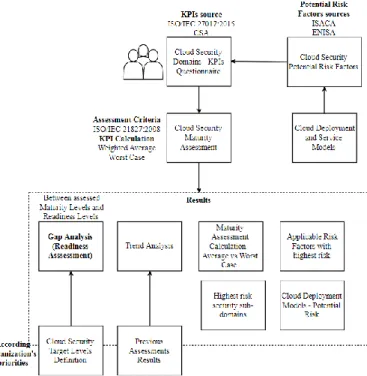
A high-level representation of the designed model and its different components’ integration is exhibited in Figure 5. The model provides an approach that, through input providing assessment of security Key Performance Indicators (KPI), materialized in a questionnaire, enables an organization to evaluate the extent to which it is sufficiently prepared to use cloud computing services, taking into account the diverse range of security areas and its potential risks.
22
After completing the maturity assessment, it will be possible for an organization to define, in a more grounded way, which areas should be considered as priorities for future investments. These future investments should not only increase cloud security maturity, but also reduce the risk of using Cloud Computing services.
In addition, the model incorporates risk concepts which can help an organization improve their security risk management processes. The author believes that, by establishing a relationship between the degree of maturity for a particular security domain and the potential cloud-specific risk factors, it is possible for an organization to assess the main potential risk factors it faces when using certain Cloud Computing services. Each potential risk factor is described as well as mapped to cloud deployment models and service models, in terms of applicability.
It is important to highlight that, as Cloud service customers are adopting a multi-cloud strategy (according Section 2.1.4), the designed model tries, as closely as possible, to be directly related to the customer's security needs in a generic way and not focused on the specific functionalities provided by different CSPs (although CSP security controls assessment is also part of it). Based on that, the customers themselves are able to compare different providers and select them based on the specific need (e.g. For SaaS would choose one specific provider and for PaaS another one).
4.1.1 Readiness Assessment
Regarding the core object of this work, the Cloud Security Maturity Assessment, it was necessary to design a model to evaluate whether specific controls (e.g. processes, technology, employee awareness, etc) are in place on the organization that is being assessed and, if so, to which extent they are aligned with the organizations target readiness level. As such, a maturity approach was implemented. Maturity approaches come from the field of quality management (Fraser et al., 2002) and were extended to the IT field in order to manage software development (Team, S. U., 2011). As time went by, those approaches were applied to organizations’ processes. Maturity is described as the state of being complete, perfect or ready (“readiness”). As a result, in order to be “ready”, an organization needs to follow an evolutionary path to reach the desired target state, starting from initial state (Lahrmann et al., 2011). Maturity models provide that path since they are composed of multiple maturity levels of a domain and can be used to assess an organization’s maturity level or for organizational development (Lahrmann et al., 2011). The inherent advantages when using this approach comes from the best practices and evolutionary paths they offer and from the fact that they can be used to assess the actual state of an organization and/or to define what and how organizations can improve their processes and capabilities in a specific field.
For the purpose of this work, this maturity approach has been adapted to the Cloud Security field. With regards to the model’s measurement scale that, for each Key