Repositório ISCTE-IUL
Deposited in Repositório ISCTE-IUL: 2020-11-18
Deposited version: Accepted Version
Peer-review status of attached file: Peer-reviewed
Citation for published item:
Pinheiro, J., Silva, G. M., Dias, Á., Lages, L. F. & Preto, M. T. (2020). Fostering knowledge creation to improve performance: the mediation role of manufacturing flexibility. Business Process Management Journal. N/A
Further information on publisher's website: 10.1108/BPMJ-10-2019-0413
Publisher's copyright statement:
This is the peer reviewed version of the following article: Pinheiro, J., Silva, G. M., Dias, Á., Lages, L. F. & Preto, M. T. (2020). Fostering knowledge creation to improve performance: the mediation role of manufacturing flexibility. Business Process Management Journal. N/A, which has been published in final form at https://dx.doi.org/10.1108/BPMJ-10-2019-0413. This article may be used for non-commercial purposes in accordance with the Publisher's Terms and Conditions for self-archiving.
Use policy
Creative Commons CC BY 4.0
The full-text may be used and/or reproduced, and given to third parties in any format or medium, without prior permission or charge, for personal research or study, educational, or not-for-profit purposes provided that:
• a full bibliographic reference is made to the original source • a link is made to the metadata record in the Repository • the full-text is not changed in any way
The full-text must not be sold in any format or medium without the formal permission of the copyright holders. Serviços de Informação e Documentação, Instituto Universitário de Lisboa (ISCTE-IUL)
1
Fostering Knowledge Creation to Improve Performance: the
Mediation Role of Manufacturing Flexibility
Abstract
PurposeThis study examines the mediating role of manufacturing flexibility in the relationship between knowledge creation, technological turbulence, and performance. In an increasingly competitive and changing environment, firms need to boost their technological and management know-how to adequately develop manufacturing flexibility.
Design/methodology/approach
The study analyzes survey data collected from 370 manufacturing firms. Validity and reliability analyses were conducted using SPSS and Amos. The research hypotheses were tested using covariance-based structural equation modeling.
Findings
The main findings show that knowledge creation positively and significantly affects business and operational performances directly, and indirectly, through manufacturing flexibility. Moreover, technological turbulence has a positive and significant effect on it. This finding contributes to understanding why some firms get better outcomes from manufacturing flexibility than others, a disputed issue in the literature.
Practical implications
This study highlights the need for manufacturing firms to foster cultures of knowledge creation, to better educate and train employees, and to develop other instruments of knowledge creation. Originality/value
This study makes several contributions to manufacturing flexibility literature: (i) establishing a link between technological turbulence and knowledge creation develop manufacturing flexibility; (ii) add empirical evidence on the relation between manufacturing flexibility and performance; (iii) contributes to consolidating the mediation role of manufacturing flexibility in the relations between knowledge creation and business performance, as studies focusing on such a role are scarce in the literature.
Keywords: knowledge creation, manufacturing flexibility, business performance, operational performance, technological turbulence
1. Introduction
This study addresses the following research questions: Does knowledge creation boost manufacturing flexibility? Does manufacturing flexibility mediate the relations between knowledge creation and business and operational performances? The external pressures exerted by market and technological environments are strong drivers of change in firms (Sharifi and Zhang, 1999). These pressures can be as diverse as environmental factors and price and cost pressures as well as the need for dynamic product mixes, the need to be proactive, and the need for constant innovation (Bootz et al., 2019; D’Aveni, 2010). Competition increases the necessity of firms to develop internal abilities (Foss and Eriksen, 1995). But they often meet resistance from managers who are faced with the need to improve core abilities despite the abilities’ rigidity (Leonard-Barton, 1992). One of these core abilities is manufacturing flexibility. Manufacturing flexibility is the firm’s ability to make the adjustments needed to cope with environmental changes without incurring negative effects (Pérez Pérez et al., 2016; Zhang et al., 2003). While it is one of the most important abilities in adaptability (Sethi and Sethi 1990), why some firms achieve higher performance than others from increased manufacturing flexibility remains unclear (Patel et al., 2012).
Developing flexibility involves the tension between change and preservation (Volberda, 1996). This tension stems from the need to change and the potential obsolescence of equipment and technology that change can render. Kara and Kayis (2004) argue that manufacturing flexibility requires considerable investments that means allocating resources to identify the appropriate type of flexibility needed and how to achieve it. While developing manufacturing flexibility can fail (Upton, 1995b), Lloréns et al. (2005) find that environmental factors as well as internal resources are important to shape it. Patel et al. (2012) recommend that future researchers consider creativity as an antecedent of manufacturing flexibility. The research linking information-processing antecedents with manufacturing flexibility is still sparse, and the role and underpinnings of such antecedents are
3
still unclear (Ojha et al., 2015). Furthermore, the link between the need for flexibility and the design of manufacturing systems is weak (Terkaj et al., 2009). Koh and Gunasekaran (2006) argue that manufacturing firms should use a combination of tacit knowledge about uncertainties and explicit knowledge from an intelligent agent to manage uncertainty. This study follows the literature and considers knowledge creation as the organizational ability to learn from sources to create new ideas and therefore as an antecedent of manufacturing flexibility. This is relevant because firm-specific knowledge creation can mitigate the risks associated with the development of manufacturing flexibility. Firm-specific knowledge creation, if well used, can better align manufacturing flexibility with the firm’s strategy to achieve higher performance.
Because manufacturing flexibility integrates technological dimensions, the present study considers technological turbulence as an additional antecedent of manufacturing flexibility. This study unifies complementary studies by arguing that technological turbulence as well as knowledge creation can positively affect manufacturing flexibility (Autry et al. 2010).
The operations management literature has not reached a consensual conclusion about the effects of manufacturing flexibility on performance (Camisón and Villar López, 2010). The research shows mixed results regarding the effects of manufacturing flexibility on performance in uncertain environments (Patel et al. 2012). Some studies claim that such effects are greater under uncertainty (Anand and Ward, 2004; Chang et al., 2003; Narasimhan and Das, 1999) while other studies claim that manufacturing flexibility is greater in firms presenting higher business performance, regardless of the levels of environmental uncertainty (Nabass and Abdallah, 2019; Pagell and Krause, 1999). Seeking further empirical consistency over the effects of manufacturing flexibility on performance seems to still be necessary (Anand and Ward, 2004; Pagell and Krause, 2004).
Mishra et al. (2014) identify some unaddressed issues in the earlier research on manufacturing flexibility: (i) the need to deepen the research on the link between manufacturing flexibility and non-operational financial forms of performance, and (ii) the need to expand the studies using more dimensions of flexibility. The current study tackles both issues by using subjective performance
measures and a recent multi-dimensional conceptualization of manufacturing flexibility (Ojha et al., 2015).
This study makes several contributions to manufacturing flexibility literature. First, it responds to a research gap, by using a form of organizational creativity (Patel et al., 2012) - knowledge creation - to further the research on the information-processing antecedents of manufacturing flexibility (Ojha et al. 2015). Second, it uses the theoretical insight of Autry et al. (2010) to join technological turbulence to knowledge creation to theoretically develop manufacturing flexibility. Third, it responds to the call of Anand and Ward (2004), Pagell and Krause (2004), and Mishra et al. (2014) for added empirical evidence on the relation between manufacturing flexibility and performance as well as the call to use a multi-dimensional concept of manufacturing flexibility in line with the latest operationalization of the construct (Jain et al., 2013). Fourth, it contributes to consolidating the mediation role of manufacturing flexibility in the relations between knowledge creation and business performance, as studies focusing on such a role are scarce in the literature (Patel et al., 2012; Wu, 2006). The managerial insights produced by this study highlight the need for manufacturing firms to foster cultures of knowledge creation, to better educate and train employees, and to develop other instruments of knowledge creation.
In the following section the hypotheses are presented as well as their theoretical foundations. An explanation of the methods used in the study and a presentation of the results follows. Next follows a discussion of the results, and then the study concludes with implications, limitations, and further research routes.
2. Theoretical Background and Hypotheses
2.1. Theoretical lenses
This study combines two theoretical lenses: the knowledge-based view (KBV) and the dynamic capabilities perspective. Grant (1996a) analyses the processes of knowledge integration to create and
5
develop capabilities and recognised the difficulty in developing dynamic and flexible responses needed by firms to adapt to hypercompetitive markets. He proposed that the firm’s fundamental role was to integrate individuals’ specialised knowledge to produce organisational ability. Nonaka (1994) advances the idea that knowledge is created at the organisational level through the interactions between tacit and explicit forms of knowledge. Nonaka and Konno (1998) introduce the concept of ‘ba’, or the shared space for emerging relations (physical, virtual, and mental) and argue that knowledge cannot be separated from its context. Therefore, both individuals and their ‘ba’ are crucial to the creation of knowledge. While knowledge creation concerns the continuous transfer, combination, and conversion of forms of knowledge (Nonaka, 1990), knowing something emerges from education, practice, collaboration, and interaction by and among knowledge users. Nonaka, Toyama, and Konno (2000) put forward the organizational perspective of firms as entities that dynamically create knowledge through a process with three main elements: first, the knowledge created through the conversion of tacit and explicit knowledges; second, the shared context in which such conversion happens; and third, knowledge inputs, outputs, and moderators of the process. The keys to such process leadership are, according to them, the role of top management in articulating the knowledge vision and the role of middle management in fostering the shared space where knowledge is created.
If the KBV of the firm (Grant, 1996b; Spender, 1996) highlights knowledge as a firm’s most strategically significant resource (Roxas and Chadee, 2016), the dynamic capabilities perspective (Teece et al., 1997) refers to the organization’s ability to change its operations in an efficient and responsive manner to the environment while striving for survival.
2.2. Conceptual model and hypotheses
2.2.1 Technological turbulence and manufacturing flexibility
The more technology changes, the more the components, processes, techniques, and methods required to produce organizational outputs will tend to change. The more intense the impacts of technological change, the higher the need for the firm to configure capabilities to change, adapt, or even entirely replace existing capabilities (Lavie 2006).
Technological change addresses the rate of change and the impact of technology, as described by Jaworski and Kohli (1993). Technological turbulence, on the other hand, concerns the volatility in technological change that raises threats and opportunities for manufacturing firms. Threats to manufacturing flexibility come in the form of rapid obsolescence of the firm’s current technologies while opportunities emerge in the form of positive incentives—new technologies—for the firm to adapt faster to develop its manufacturing flexibility. Such incentives, taken positively, can be channeled to benefit the firm’s needs and strategy.
Genchev and Willis (2014) bridge the gap between the uncertainty of the environment and the firm’s manufacturing flexibility. They refer to the latter as a firm-specific dynamic capability. Older definitions viewed flexibility as a means to improve the firm’s fast response to demand by achieving good performance through increases in product range (Upton, 1994, 1995a). But more recently, the tendency is for manufacturing flexibility to be viewed as a synergy of several dimensions (Jain et al., 2013; Zhang et al., 2003). For example, Dreyer and Grønhaug (2004) defend the multi-dimensionality of the flexibility construct
(flexibility in supply, production, and product assortment)
as a necessary condition for firms to face highly volatile environments, while other authors have equally contended that the complementary role of a wider scope of dimensions expresses manufacturing flexibility (Rogers et al., 2011). Manufacturing flexibility, in this study, is the degree to which industrial processes throughout the supply chain are able to cope with variable requirements which involve suppliers, demand volume, product portfolio, machine specialization, routing7 processes, and cross-training (Rogers et al., 2011).
The constant development of new technologies outside the firm can directly and positively impact manufacturing flexibility by pushing for the creation of new know-how and technological roadmaps into further development. Kessler and Chakrabarti (1996) argue that technological turbulence enhances the speed of innovation, as new technologies enable new products and services. A convergent perspective by Ahlström and Westbrook (1999) observes that advances in the manufacturing function could be crucial to achieve mass customization, which combines mass production with customization and requires manufacturing flexibility. Furthermore, Autry et al. (2010) find that higher technological turbulence causes the firm to perceive technology as more useful and to grow its intention to use it.
This study proposes that the higher the volatility in technological change is, the higher the levels of manufacturing flexibility should be. The rationale behind this proposal is that the firm’s perception of a technology’s usefulness and ease-of-use increases its intention to use new technology when higher technological turbulence exists (Autry et al., 2010). The broader the scope and diversity of the available technological solutions due to the degree of technological turbulence, the greater the incentives the firm has to develop manufacturing flexibility. The proposed impact of technological turbulence on manufacturing flexibility is direct via this incentive mechanism (pressure) toward the adoption of new, readily available, external know-how or technology. Therefore, the first hypothesis is:
H1a: Technological turbulence positively relates to manufacturing flexibility.
2.2.2 Knowledge creation and manufacturing flexibility
Capabilities that involve knowledge are not static (Nonaka et al., 2000). They evolve in time along with knowledge itself and competition and environmental changes and can therefore be seen as
dynamic (Brockman, 2013). For example, Camuffo and Volpato (1996), in a case study focusing on Fiat’s dynamic capabilities and operations, observe that the implementation and development of automation techniques is a path-dependent, nonlinear learning process. They argue that Fiat’s technologies resulted from learning, internal developments, external acquisitions, imitation of competitors, and the replication and selection of capabilities. Spanos and Voudouris (2009) confirm that the adaptation to new technologies is a path-dependent process that gradually accumulates technology going from the less complicated to the more articulated and complex. In order to develop manufacturing flexibility, managers may either seek readily available external technology or alternatively adapt and develop in-house, firm-specific solutions.
Nonaka (1994) states that organizational knowledge is created through the exchanges happening between tacit and explicit forms of knowledge and the conversion of both into new forms of knowledge. This conversion starts at the individual level (Brockman, 2013). Knowledge creation is defined in this study as the ability of employees to learn from sources and produce novel ideas internally (Nonaka et al., 2000). The anticipation of obsolescence in components of manufacturing flexibility requires capabilities that use knowledge. Without such capabilities, technological changes and their implications may not be detected or fully understood in a timely fashion that potentially limits firms in the development of adequate levels of flexibility. There is a strong learning component in the adaptation to technological changes and the integration of new technologies in manufacturing.
Koh and Gunasekaran (2006) argue that knowledge plays a crucial role in the integration of key manufacturing support processes and is important to the adoption of advanced technology. Reinforcing this view is the finding that the assimilation of knowledge has effects on manufacturing abilities (Tu et al., 2006). Urtasun-Alonso et al. (2014) indirectly support this view by finding a positive relation between advanced human resources (HR) management and manufacturing flexibility at the organizational level. When compared to larger firms, SMEs tend to emphasize flexible human resource practices to achieve manufacturing flexibility, whereas large firms emphasize technological capability, and sourcing practices to increase manufacturing flexibility (Mishra, 2016). Mendes and
9
Machado (2015), probe the link between employees’ skills and manufacturing flexibility and show that employees’ skills could foster manufacturing flexibility.
While these studies provide indirect evidence of a possible relation between knowledge creation and manufacturing flexibility, the current study argues that knowledge creation is essential to the firm-specific process of adapting, developing, and creating knowledge with a positive utility dimension for manufacturing flexibility. The higher the ability of the firm to learn and create new ideas, the more effective it should be in the internal generation of ideas applicable to a more effective development of manufacturing flexibility. Moreover, knowledge creation may theoretically explain how operational routines and sub-dimensions of manufacturing flexibility can be transformed and developed in more specific, consequent, and successful ways: if the internal ideation process of the firm is powerful, then decisions for transforming, adapting, and developing manufacturing flexibility should be made in a more informed manner, which makes its development more effective. The way through which firms interpret their environments affects their flexibility strategy and the performance of such strategy (De Treville et al., 2007). Since knowledge creation should confer a better ability to interpret information and use firm-specific knowledge, a positive relation between knowledge creation and manufacturing flexibility should exist. Thus, we propose the following:
H2a: Knowledge creation positively relates to manufacturing flexibility.
2.2.3. Knowledge creation and business performance
Sharkie (2003) argues that firms operate through people and that their contribution leverages the emergence of competitive advantage. Specifically, he advocates that management needs to nurture an environment of knowledge creation to develop resources to their full potential to better compete with rivals. Carlucci et al. (2004) explore the mechanisms through which knowledge can impact business performance, and designate such paths as the knowledge value chain. They discuss the strategic,
managerial and operational dimensions of knowledge management by effectively linking it not only to competences and processes, but also to business performance and value creation.
Business performance is understood in this study as the level of a stakeholder’s satisfaction with the business (Gibson and Birkinshaw, 2004). Albeit a subjective measure, it is highly correlated to financial performance indicators (return on equity (ROE), return on assets (ROA), and shareholders’ return).
The rationale is that firms with higher levels of knowledge creation and a better internal ideation process have more chances to be successful in firm-specific development processes which lead to higher stakeholders’ satisfaction. This study therefore hypothesizes that:
H2b: Knowledge creation positively relates to business performance.
2.2.4. Knowledge creation and operational performance
The KBV views knowledge as the most strategically significant key resource of the firm and as a source of competitive advantage which improves business performance (Grant, 1996b; Spender, 1996). Fugate et al. (2009) find a strong positive relation between the knowledge management process and operational performance. Carlucci et al. (2004) also finds that knowledge management affects operational dimensions.
Lloréns et al. (2005) find that environmental factors as well as internal resources affect flexibility which in turn affects performance. Knowledge creation is an organizational ability and also an internal resource with expectable effects beyond manufacturing flexibility. On this vein, Liao and Barnes (2015) found that knowledge acquisition plays an important role on innovation performance in SMEs. They also identified knowledge acquisition as an important antecedent of manufacturing flexibility.
11
Firms better able to create knowledge internally more easily combine new knowledge with existing knowledge which has positive effects on the coordination of resources and management practices involved in operational performance (time, cost, quality). This is what Carlucci et al. (2004) mean when they state that knowledge creation affects very diverse factors as it moves and transforms along the knowledge value chain of the firm. The resulting hypothesis is:
H2c: Knowledge creation positively relates to operational performance.
2.2.5. Manufacturing flexibility and business performance
Anand and Ward (2004), Nabass and Abdallah (2019) and Wei et al. (2017) provide empirical evidence for the view of manufacturing flexibility as an antecedent of performance. Raymond and St. Pierre (2005) find that advanced manufacturing systems positively affect business performance. They indicate that the more technological dimensions of manufacturing flexibility should have positive effects on performance.
Overall, however, the operations management literature has not reached a consensual conclusion over the effects of manufacturing flexibility on performance (Camisón and Villar López, 2010). For example, Anand and Ward (2004) and Chang et al. (2003) find that the relation between manufacturing flexibility and performance is stronger in more turbulent environments, while Pagell and Krause (1999) show that this influence is independent of environmental uncertainty. In other studies strategic flexibility was identified has having a direct and significant influence on firm performance while manufacturing flexibility did not (Chan et al., 2017).
Wei et al. (2017) found the relationship between manufacturing flexibility and performance is strengthened by competitive intensity but weakened by demand heterogeneity.
Therefore, firms with higher levels of manufacturing flexibility adapt better to the environment and have higher business performance as a result. The rationale for this hypothesis implicitly assumes
that manufacturing flexibility is adequate for the goals of the firms and that it leads to a stakeholder’s satisfaction from a top management perspective (business performance) because of the better alignment of the firm with its environment. Consequently, the hypothesis is:
H3a: Manufacturing flexibility positively relates to business performance.
2.2.6. Manufacturing flexibility and operational performance
Raymond and St. Pierre (2005) find that advanced manufacturing systems affect operational performance not just business performance. Theoretically, manufacturing flexibility should allow for lower inventories, reduced warehousing areas, and simpler logistics that improve quality through faster feedback loops and better products and processes (Bolwijn and Kumpe, 1990; Mishra et al., 2018). Nabass and Abdallah (2019) found manufacturing flexibility to affect positively operational performance, especially in the dimensions of quality, delivery and flexibility. The cost performance dimension was not affected by manufacturing flexibility. Swafford et al. (2008) establish flexibility in the supply chain process as antecedents to its agility. Specifically, they conclude that a firm’s supply chain agility is positively affected by the degree of flexibility in the processes of manufacturing, procurement, and distribution. In turn, this agility is required to produce innovative products which the business can deliver to customers in a timely manner. Ojha et al. (2013) investigate the effect of manufacturing flexibility on workflow and operational performance and find empirical and more direct evidence that supports manufacturing flexibility’s positive effect on performance (lower inventories and costs). They also find that manufacturing flexibility increases the speed of the flow of materials (time).
Therefore, manufacturing flexibility is positively associated with operational performance. The rationale for such a hypothesis is that by adequately developing manufacturing flexibility, firms should be able to better adapt to a changing environment with better outcomes in terms of throughput time,
13 workflow cost, and production quality. The hypothesis is:
H3b: Manufacturing flexibility positively relates to operational performance (time, cost,
quality).
2.2.7. Mediation role of manufacturing flexibility
Wu (2006) identifies manufacturing flexibility as a mediation dynamic capability in the relations between resources and performance, while Patel et al. (2012) identifies manufacturing flexibility as being able to mediate the relation between contextual ambidexterity levels (simultaneous exploitation and exploration) and business performance. These studies hint that the mediation role of manufacturing flexibility in the relation between knowledge-based capabilities and performance outcomes. Mendes and Machado (2015) find the mediation role of manufacturing flexibility in the relation between employees’ skills and business performance, which is possibly indirect evidence in support of a mediation role in the relation between knowledge creation and performance. Their findings are consistent with the mediation role of the operational capabilities in the relation between dynamic strategic planning and performance (Ojha et al., 2020).
This study argues that manufacturing flexibility is a core ability which can assimilate firm-specific knowledge created within the firm that creates an additional indirect and positive impact on business performance. This impact means that an improvement in the level of manufacturing flexibility may help deliver better business results via reduced manufacturing costs or better production quality which leads to higher sales and financial returns that satisfies stakeholders to a higher degree. The following mediation hypothesis is:
M2a: Manufacturing flexibility mediates the relation between knowledge creation and
The knowledge-transformative process through manufacturing flexibility should also improve the performance of operations indirectly through the improvement in manufacturing flexibility. The rationale is that if knowledge creation is adequately used in the development of the firm’s manufacturing flexibility, it will align it better with the firm’s needs and goals which increases the firms’ chances to achieve better operational outcomes, such as performance. Manufacturing flexibility should absorb part of the created know-how and apply it to increase its own impact on the firm’s operational performance. This results in the following mediation hypothesis:
M2b: Manufacturing flexibility mediates the relation between knowledge creation and
operational performance.
Readily available know-how and technological solutions from the marketplace can be adopted to improve manufacturing flexibility. The higher the turbulence is, the wider the available scope of solutions as well as the combinations of possibilities resulting from it. The rationale is that the adoption of readily available external technological solutions enables further developments in manufacturing flexibility. This transformative effect should produce positive impacts on operational performance as well as on business performance in a similar way to that proposed for knowledge creation. Therefore, there are two additional mediation hypotheses to consider:
M2c: Manufacturing flexibility mediates the relation between technological turbulence and
business performance.
M2d: Manufacturing flexibility mediates the relation between technological turbulence and
operational performance
15
Figure 1. Conceptual Model
3. Method
3.1. Sample and data collection
This study uses data on Portuguese manufacturing firms with 20 or more employees. The sampling frame was obtained from Kompass Database (Kompass, 2015) and consisted of 3,728 firms. The data was collected through a web-based survey. The CEOs and CFOs were identified as the key participants. Their anonymity was ensured. Of the surveys sent, 515 responses were obtained for a response rate of 14%, of which 370 were usable. Most of the respondents were CEOs (65.1%), and the remaining were CFOs.
Out of 370 firms, 45.1% (147) reported that they had between 20 and 49 employees, 45.4% had between 50 and 249 employees, and the remaining had 250 or more employees. In terms of experience, the mean age of the firms was 34 years with a standard deviation (SD) of 20 years. The mean of annual sales was 45.5 million euros. A wide variety of industries were represented in the sample as can be seen in Table 1.
Insert Table 1 here
3.2. Measures
Likert-type scales (1- strongly disagree to 7- strongly agree), with the exception of operational and business performances.
Knowledge creation was measured using four items adopted from Pavlou and El Sawy (2006) and Prieto et al. (2009). Technological turbulence was measured using five items adapted from Jaworski and Kohli (1993). Manufacturing flexibility was operationalized as a second-order factor that consists of six first-order factors: product-mix flexibility, routing flexibility, equipment flexibility (herein machine flexibility), volume flexibility, labor flexibility, and supply chain flexibility. This scale was adopted from Rogers et al. (2011). All first-order factors were measured using three items.
Operational performance was measured using three items adapted from Cua, McKone, and Schroeder (2001). This variable was measured by asking respondents to indicate how their firm compares to its main competitors over a five-year period. Business performance was measured using five items adapted from Gibson and Birkinshaw (2004) which assess stakeholder’s satisfaction from a top management perspective, over a period of five years.
3.3. Measurement scale validity and reliability
To assess the validity, reliability, and dimensionality of the constructs a confirmatory factor analysis (CFA) with the maximum likelihood (ML) estimation method was performed using AMOS 23. The CFA results showed that the model fit was satisfactory, with measures of χ2 = 829.99 (df = 419; p < 0.001); χ2 /df= 1.98; CFI = 0.94; TLI = 0.93; IFI = 0.94; RMSEA = 0.05, p-close = 0.30; SRMR = 0.06 (Hair et al., 2010; Kline, 2015).
The standardized factor loadings and corresponding t-values (See Appendix 1) as well as average variance extracted (AVE) and composite reliability (CR) estimates were examined to ensure the convergent validity and internal consistency of the constructs. As reported in Appendix 1, the standardised factor loadings for the indicators and first-order factors related to the second-order factor manufacturing flexibility were all above 0.5 and significant at p < 0.001. Table 2 presents the means, SDs, CR, Cronbach Alphas, AVE, and the correlations for all variables. All values for the CR
17
and Cronbach Alphas were greater than 0.7 (Bagozzi and Yi, 1988). The AVE for each construct was greater than 0.5 (Bagozzi and Yi, 1988) and larger than the corresponding CR value. These results support convergent validity and internal consistency.
Discriminant validity was assessed following the procedure suggested by Fornell and Larcker (1981). We tested whether the square root of the AVE of each construct (shown on the diagonal of Table 2) was higher than the correlations between all constructs. As reported in Table 2, this condition was satisfied for all constructs, which indicated discriminant validity.
Insert Table 2 here
3.4. Common method bias
To assess common method bias this study applied three approaches. First, the Harman’s single-factor test based on an exploratory factor analysis (EFA) was performed (Podsakoff et al., 2003). This test showed that the items loaded on multiple distinct factors. Taken together these factors explained 71.5% of the total variance with the first extracted factor accounting for 29.9% of the total variance, which falls well below the threshold of 50%. Second, the CFA which uses Harman’s single-factor model was performed (Podsakoff et al. 2003). The model fit indexes (χ2 = 4219.25, df = 434; p < 0.000); χ2 /df= 9.72; CFI = 0.42; TLI = 0.38; IFI = 0.43; RMSEA = 0.15, p-close = 0.00; SRMR = 0.13) showed a poor model fit. Third, we conducted the latent factor test (Podasakoff et al., 2003). The common variance obtained by squaring the unstandardized common loadings of the common latent factor was 28% which is far from approaching the 50% threshold. The fit indices of the model with the common latent factor were not significantly different from those of the model without the latent factor, and the standardized factor loadings remained significant. All these results showed that common method bias was minimal in this study.
4. Hypothesis testing and results
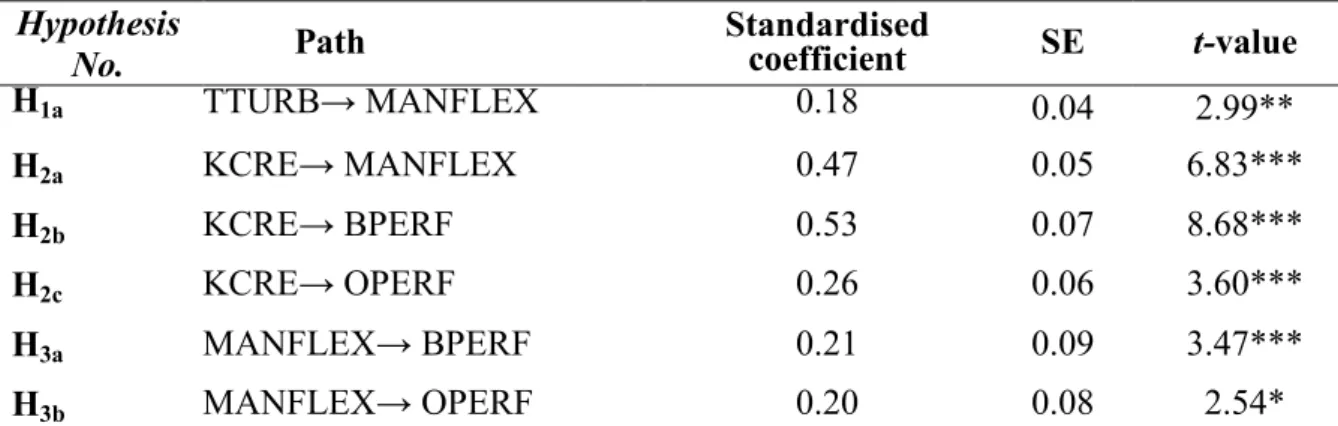
This study uses covariance-based structural equation modelling (CBSEM) to test the research model. The results indicate an acceptable fit for the structural model with χ2 = 829.17 (df = 420; p < 0.01), χ2 /df = 1.97, CFI = 0.94, TLI = 0.93, IFI = 0.94, RMSEA = 0.05, p-close = 0.32, SRMR = 0.06 (Hair et al., 2010; Kline, 2015). The structural model explains 44% of the variance in the business performance and 16% of the variance in the operational performance. Table 3 presents the test results for the main hypotheses.
Insert Table 3 here
These results confirm that technological turbulence (
β
= 0.18, p < 0.01) and knowledge creation (β
= 0.47, p < 0.001) have significantly positive relations with manufacturing flexibility. These results provide support for H1a and H1b, respectively. Hypothesis H2a and H2b postulate that knowledge creation positively relates to business and operational performances, respectively. The results support these hypotheses (β
= 0.53, p < 0.001) for business performance and (β
= 0.26, p < 0.001) for operational performance. Moreover, positive and significant effects occur for the relation between manufacturing flexibility and business performance (β
= 0.21, p < 0.001), and manufacturing flexibility and operational performance (β
= 0.20, p < 0.05). These results provide support for H3a and H3b, respectively4.1. Mediation hypotheses
A construct can be explained by indirect effects as well as by direct effects. The existence of a significant indirect effect in a chain of causation indicates that mediation is present (Zhao et al., 2010). In this sense, a hypothesized mediator is an additional link in a certain chain of causation.
19
Mediation renders hypothesis testing more consistent and precise (Malhotra et al., 2014).
To evaluate the significance of the indirect effects a bootstrapping procedure with replacement (1,000 samples, 90% confidence level) was used instead of the traditional Sobel test (Preacher and Hayes, 2008). Bootstrapping is a powerful method for evaluating mediation effects as it does not assume or require a normal data distribution.
Table 4 presents the results of the mediation analysis. These results show that all indirect effects are significant. Thus, the four mediation hypotheses have support.
Insert Table 4 here
5. Discussion
The purpose of this study is to examine knowledge creation as a key factor in explaining why some firms get higher performance from increased manufacturing flexibility than others (Nabass and Abdallah, 2019; Patel et al., 2012). The results provide support for all hypotheses. Overall, the findings show that firm-specific knowledge creation which is applicable to manufacturing flexibility is a core ability. These findings align with the previous research (e.g., Lloréns et al., 2005).
The model assumes two antecedents to manufacturing flexibility: technology turbulence and knowledge creation. In the case of technology turbulence, the results show that it has a positive relation with manufacturing flexibility, which is evidence of the dominant influence of technology on manufacturing strategy (Jiménez et al., 2011).
Knowledge creation is considered as another antecedent of manufacturing flexibility with direct and indirect influences on performance. The influence of knowledge creation on manufacturing flexibility is greater than that exerted by technology turbulence. It shows that firms which adopt a deliberate, not reactive, strategy based on knowledge and the resulting effort tend to keep up with technological developments. Furthermore, recent research shows the role of sensing capability not
only as an important component of knowledge creation but also as contributing to improved technological scanning.
Consistent with our hypotheses, knowledge creation has a positive and significant direct impact on manufacturing flexibility and performance, and the positive and significant conversion of knowledge creation also occurs as indicated by its indirect impacts on business and operations performance through manufacturing flexibility. As such, the results contribute to the ongoing discussion about the role of manufacturing flexibility on business performance, which aligns with the previous research (Camisón and Villar López, 2010; Pagell and Krause, 1999; Patel et al., 2012). On this topic, knowledge creation’s direct effect on performance is in line with Nonaka et al. (2000) and the empirical research (e.g., Fugate et al., 2009; Carlucci et al., 2004; Roxas and Chadee, 2016).
The indirect effect of knowledge creation on business and operational performances must also be underlined by showing that other factors are influenced by knowledge creation as it moves and transforms along the knowledge value chain of the firm (Carlucci et al., 2004). Additionally, it may also pinpoint a structural industry weakness in aligning manufacturing flexibility with environmental and demand requirements in the sample.
Regarding the direct effect of knowledge creation on operational and business performances, this study shows that it is significant. Our results are aligned with previous research developed in a logistics operations context which finds a positive relation between knowledge creation and both organizational and operational performances (Fugate et al., 2009).
The role of manufacturing flexibility as a mediator in the relations of knowledge creation with business and operations performances means that part of the knowledge created in the firm gets transformed by manufacturing flexibility into additional positive effects on these performances. Knowledge creation can thus explain how manufacturing flexibility can adapt, transform, and develop in more consequent and impactful ways. The ability to keep up with technological developments allows accelerating technology adoption (Autry et al., 2010) and innovation by firms (Ahlström and Westbrook, 1999; Kessler and Chakrabarti, 1996).
21
Knowledge creation's enhancing effect is in line with the dynamic capabilities proposals through the indirect effect on performance (Eisenhardt and Martin, 2000). In other words, knowledge creation presents itself as a first-order capability that allows changing other capabilities (Danneels, 2008), in this case manufacturing flexibility.
Manufacturing flexibility is also a mediator in the relation between knowledge creation and business performance. As suggested by Nonaka et al. (2000), knowledge creation endows the firm with the ability to follow environmental and technological changes. However, the main difficulty is the conversion of the newly acquired knowledge into new products (Teece, 2007), especially in manufacturing firms (Tu et al., 2006). In fact, a possible explanation for the limited explanatory power of business and operational performances provided by the model (the amount of variance it explains is 44% and 16%, respectively) could be rooted in the fact that manufacturing flexibility does not guarantee, per se, improvements in business performance if other mediation variables are unaccounted for, such as innovation (Camisón and Villar López, 2010). In this vein, according to the results, manufacturing flexibility plays an important role in quickly translating new knowledge into new products. This ability is a source of competitive advantage (Dreyer and Grønhaug, 2004; Santos-Vijande et al., 2012). The existence of organizational mechanisms to build up manufacturing flexibility has been the object of empirical research (c.f. Urtasun-Alonso et al., 2014).
Furthermore, manufacturing flexibility is also pivotal at the strategic level by fostering responsiveness (Mishra et al. 2018) and the implementation of differentiation and cost-leadership strategies (De Treville et al., 2007; Santos-Vijande et al., 2012). This strategic dimension is reflected in the planning flexibility whose effects on performance are increased by the use of operational capabilities (Ojha et al., 2020). As such, if the internal ideation process of the firm is powerful, then decisions for adapting, transforming, and developing manufacturing flexibility should be made in a more informed and context-wise manner that makes its development and impacts on performance more effective through its better alignment with competitive and environmental demands. These findings are consistent with Azan's et al., (2019) proposal regarding the modular paths of knowledge
where “the decomposability of the knowledge source and the customization of the path make it possible to better understand the transfer and to increase the knowledge output” (p. 187). Furthermore, another strategic aspect of manufacturing flexibility is the development of novelty-centred business model designs (Wei et al., 2017).
We also find that knowledge creation is more important to the development of manufacturing flexibility than technological turbulence. If the firm competes in more technologically turbulent environments, the ability to perceive the usefulness of technology is key to manufacturing flexibility (Autry et al., 2010) to avoid investing without “fully considering the firm’s precise needs” (p. 532). Furthermore, the way the firm structure knowledge corresponds to an adaptation to fast changing environments (Azan et al., 2019) and overcome technological and knowledge obsolescence (Bootz et
al., 2019). Firms that do not possess adequate levels of knowledge creation will display lower business performance as well as lower manufacturing flexibility and lower operational performance.
6. Conclusions
6.1. Theoretical implications
This study responds to the necessity to further the research on the information-processing antecedents of manufacturing flexibility (Ojha et al., 2015). It does so by adapting and empirically testing a theoretical approach in the line of Koh and Gunasekaran (2006) and by offering a further probe into the links between strategic and operational perspectives which follows the call of Ketchen and Guinipero’s (2004). Furthermore, the study expands on the insight of Autry et al. (2010) by joining knowledge creation and technological turbulence to the theoretical development of manufacturing flexibility. This study adds needed empirical evidence to the relation between manufacturing flexibility and business performance (Anand and Ward, 2004; Mishra et al., 2014; Pagell and Krause, 2004) which supports the literature stream that argues that manufacturing flexibility makes a positive difference in business performance.
23
Because our results are from a sample where SMEs predominate, this study contributes to the dearth of literature on manufacturing flexibility in such a context. Further, the results indicate that size is not that important when it comes to the need to foster a culture of knowledge creation, as the benefits it brings to business and operational performances are clear.
Moreover, to our knowledge, this study is one of the few that simultaneously uses a multi-dimensional operationalization of manufacturing flexibility (six sub-dimensions), as called for by Mishra et al. (2014) in their review of manufacturing flexibility.
Also, this study adds to those which confirm manufacturing flexibility’s mediation role in the relations between knowledge resources, technological turbulence, and business performance (Patel et al., 2012; Wu, 2006).
In summary, this study highlights the potential of knowledge creation’s theoretical explanatory power to clarify why the efforts of some firms that build up and develop manufacturing flexibility produce better performance results than others. Knowledge creation’s direct positive impact on manufacturing flexibility and its indirect impacts on business and operational performances through manufacturing flexibility indicate that it is an ability able to explain how manufacturing flexibility can be adapted, transformed, and developed to better respond to high levels of market turbulence and to generate higher positive effects on operational performance.
6.2. Managerial implications
There are several implications for managers to consider. First, managers should foster knowledge creation regardless of their firm’s size, which means supporting individual and group contributions of employees. This is a conclusion based on the fact that the majority of the firms in the sample are SMEs. As such, managers should stimulate risk taking (Upton 1995b) and overcome internal inertia (Rosenbloom and Christensen 1994), which can be realized through a culture supporting knowledge creation. This is indirectly in line with Youndt et al. (1996) and Bamberger et al., (2014): HR focused
on human capital development is highly related to multiple dimensions of operational performance. Specifically, managers should focus on concrete knowledge creation mechanisms. For example, they should foster the development of a culture conducive to innovation, the stimulation of effective cross-departmental support, or the capacity-building of employees.
Second, they should foster the ability to create knowledge to enable manufacturing flexibility to raise the levels that are adequate for coping with the firm’s market environment in rough times with less risk and through more informed decisions which are based on the employee’s specific know-how. Managers should leverage all investment in knowledge creation through the development of manufacturing responsiveness. This means that the company must act to adapt not only the industrial and logistic capacities but also the organization of work processes to respond in accordance with technological changes.
Third, this study reinforces the view that manufacturing flexibility should be seen as a multi-dimensional construct that extends from more machine and manufacturing-based sub-dimensions into the supply chain and the human factor (teams’ cross-training). As Rogers et al. (2011) underline, cross-training employees to adequately engage in different activities, different machines, and diverse teams positively reinforces manufacturing flexibility. More specifically, the commitment of managers must include the development of flexibility at the various operational levels, in particular machine, routing, product-mix, labour and supply chain management. However, the potential also derives from the capacity to do so in an integrated way, which implies an adequate articulation between organisational and marketing strategies and flexibility.
6.3. Limitations and future research
It would be enriching to perform similar studies in longitudinal contexts, as different industries may disclose different results. Cross-sectional studies such as this one have limitations in supporting the causality proposed in the hypotheses, while endogeneity issues could also affect the hypothesized
25
relations in the model. Additionally, single informant studies are more prone to common variance issues, while the exclusive use of subjective measures is subject to respondent bias and social desirability issues. Future research on the topic would benefit from data on multiple informants and secondary objective data (e.g., investments in R&D, financial and operational performance indicators) to limit the common variance issues. The assumption that CEOs and CFOs respond basically in the same way is a simplification. This study does not include control variables, such as a firm’s size and age.
References
Ahlström, P., and Westbrook, R. (1999). “Implications of mass customization for operations management: an exploratory survey”. International Journal of Operations & Production Management, 19(3), 262-275.
Aiken, L.S., West, S.G., and Reno, R.R. (1991). Multiple regression: Testing and interpreting interactions. Thousand Oaks, CA: Sage Publications.
Anand, G., and Ward, P.T. (2004). “Fit, flexibility and performance in manufacturing: coping with dynamic environments”. Production and Operations Management, 13(4), 369- 385.
Autry, C.W., Grawe, S.J., Daugherty, P.J., and Richey, R.G. (2010). “The effects of technological turbulence and breadth on supply chain technology acceptance and adoption”. Journal of
Operations Management, 28(6), 522-536.
Azan, W., Ivanaj, S., and Rolland, O. (2019). Modular path customization and knowledge transfer: Causal model learnings. Technological Forecasting and Social Change, 140(C), 182-193.
Bagozzi, R.P., and Y. Yi. 1988. “On the evaluation of structural equation models.”, Journal of the
Academy of Marketing Science 16 (1): 74-94.
Bamberger, P.A., Biron, M., and Meshoulam, I. (2014). Human resource strategy: Formulation,
implementation, and impact. London, UK: Routledge.
Bolwijn, P.T., and Kumpe, T. (1990). “Manufacturing in the 1990s-productivity, flexibility and innovation”. Long Range Planning, 23(4), 44-57.
Bootz, J. P., Durance, P., and Monti, R. (2019). Foresight and knowledge management. New developments in theory and practice. Technological Forecasting and Social Change, 140, 80-83. Brettel, M., Klein, M., and Friederichsen, N. (2016). “The Relevance of Manufacturing Flexibility in
Brockman, B. (2013). “The evolution of organizational learning in new venture development”. Journal of Small Business and Entrepreneurship, 26(3), 261-275.
Byrne, B.M. (2001). Structural equation modeling with AMOS: Basic concepts, applications, and programming. Mahwah, New Jersey: Lawrence Erlbaum.
Byrne, B.M. (2008). “Testing for multigroup equivalence of a measuring instrument: A walk through the process”. Psicothema, 20(4), 872-882.
Camisón, C., and Villar López, A. (2010). “An examination of the relationship between manufacturing flexibility and firm performance: the mediating role of innovation”. International Journal of Operations & Production Management, 30(8), 853-878.
Camuffo, A., and Volpato, G. (1996). “Dynamic capabilities and manufacturing automation: organizational learning in the Italian automobile industry”. Industrial and Corporate Change, 5(3), 813-838.
Carlucci, D., Marr, B., and Schiuma, G. (2004). “The knowledge value chain: how intellectual capital impacts on business performance”. International Journal of Technology Management, 27(6-7), 575-590.
Chan, A. T., Ngai, E. W., and Moon, K. K. (2017). The effects of strategic and manufacturing flexibilities and supply chain agility on firm performance in the fashion industry. European Journal of Operational Research, 259(2), 486-499.
Chang, S.C., Yang, C.L., Cheng, H.C., and Sheu, C. (2003). “Manufacturing flexibility and business strategy: an empirical study of small and medium sized firms”. International Journal of Production
Economics, 83(1), 13-26.
Cua, Kristy O., Kathleen E. McKone, and Roger G. Schroeder. (2001). "Relationships between implementation of TQM, JIT, and TPM and manufacturing performance." Journal of Operations
management 19 (6), 675-694.
D’Aveni, R. A. (2010). Hypercompetition. New-York, NY: The Free Press.
Davis, F.D., Bagozzi, R.P., and Warshaw, P.R. (1989). “User acceptance of computer technology: a comparison of two theoretical models”. Management Science, 35(8), 982-1003.
De Treville, S., Bendahan, S., and Vanderhaeghe, A. (2007). “Manufacturing flexibility and performance: bridging the gap between theory and practice”. International Journal of Flexible
Manufacturing Systems, 19(4), 334-357.
Dreyer, B., and Grønhaug, K. (2004). Uncertainty, flexibility, and sustained competitive advantage. Journal of business research, 57(5), 484-494.
Foss, N.J., and Eriksen, B. (1995). “Competitive advantage and industry capabilities”. In C.A. Montgomery (Ed.), Resource-based and evolutionary theories of the firm: Towards a synthesis (pp. 43-69). Norwell, MA: Kluwer Academic Publishers.
27
operational and organizational performance”. Journal of Operations Management, 27(3), 247-264. Genchev, S., and Willis, G. (2014). “A note on manufacturing flexibility as a firm-specific dynamic
capability”. Manufacturing Letters, 2(4), 100-103.
Gibson, C., and Birkinshaw, J. (2004). “The antecedents, consequences, and mediating role of organizational ambidexterity”. Academy of Management Journal, 47(2), 209-226.
Grant, R.M. (1996a). “Prospering in a dynamically-competitive environments: organizational capability as knowledge integration”. Organization Science, 7(4), 375- 387.
Grant, R.M. (1996b). “Toward a knowledge based theory of the firm”. Strategic Management Journal,
17(S2), 109-122.
Hair, J.F., Black, W.C., Babin, B.J., Anderson, R.E., and Tatham, R.L. (2010). Multivariate Data
Analysis (7th Ed.). New-York, NY: Pearson.
Harman, D. (1967). “A single factor test of common method variance”. Journal of Psychology, 35, 359-378.
Hooper, D., Coughlan, J., and Mullen, M.R. (2008). “Structural Equation Modelling: Guidelines for
Determining Model Fit”. Electronic Journal of Business Research Methods, 6(1), 53-60.
Hu, L.T., and Bentler, P.M. (1999). “Cutoff criteria for fit indexes in covariance structure analysis:
Conventional criteria versus new alternatives”. Structural Equation Modeling: a multidisciplinary journal, 6(1), 1-55.
Jain, A., Jain, P.K., Chan, F.T., and Singh, S. (2013). “A review on manufacturing flexibility”.
International Journal of Production Research, 51(19), 5946-5970.
Jaworski, B.J., and Kohli, A.K. 1993). “Market orientation: antecedents and consequences”. Journal of Marketing, 57(3), 53-70.
Jiménez, C. H. O., Garrido-Vega, P., and S. G. González. 2011. “Manufacturing strategy–technology relationship among auto suppliers.” International Journal of Production Economics 133 (2): 508-517.
Kara, S., and Kayis, B. (2004). “Manufacturing flexibility and variability: an overview”. Journal of Manufacturing Technology Management, 15(6), 466-478.
Kessler, E., and Chakrabarti, A. (1996). “Innovation speed: A conceptual model of context, antecedents, and outcomes”. Academy of Management Review, 21(4), 1143-1191.
Ketchen, D.J., and Giunipero, L.C. (2004). “The intersection of strategic management and supply chain management”. Industrial Marketing Management, 33(1), 51-56.
Kline, R.B. (2015). Principles and practice of structural equation modeling. New York, NY: The Guilford Press.
Koh, S., and Gunasekaran, A. (2006). “A knowledge management approach for managing uncertainty in manufacturing”. Industrial Management & Data Systems, 106(4), 439- 459.
Kohli, A.K., and Jaworski, B.J. (1990). “Market orientation: the construct, research propositions, and managerial implications”. Journal of Marketing, 54(2), 1-18.
Kompass (2015). Diretório de Empresas para profissionais e solução de dados empresariais. Pt.kompass.com. Retrieved January, 1 2015, from https://pt.kompass.com/
Lavie, D. 2006). “Capability reconfiguration: An analysis of incumbent responses to technological change”. Academy of Management Review, 31(1), 153-174.
Leonard-Barton, D. (1992). “Core capabilities and core rigidities: a paradox in managing new product
development”. Strategic Management Journal, 13, 111-125.
Liao, Y., and Barnes, J. (2015). Knowledge acquisition and product innovation flexibility in SMEs. Business Process Management Journal. 21(6), 1257-1278.
Lloréns, F., Molina, L., and Verdú, A. 2005). “Flexibility of manufacturing systems, strategic change and performance”. International Journal of Production Economics, 98(3), 273-289.
Malhotra, M.K., Singhal, C., Shang, G., and Ployhart, R.E. (2014). “A critical evaluation of alternative methods and paradigms for conducting mediation analysis in operations management research”. Journal of Operations Management, 32(4), 127-137.
Mendes, L., and Machado, J. (2015). “Employees’ skills, manufacturing flexibility and performance: a structural equation modelling applied to the automotive industry”. International Journal of
Production Research, 53(13), 4087-4101.
Mishra, R. (2016). A comparative evaluation of manufacturing flexibility adoption in SMEs and large firms in India. Journal of Manufacturing Technology Management. 27(5), 730 - 762
Mishra, R., Pundir, A.K., and Ganapathy, L. (2014). “Manufacturing flexibility research: A review of literature and agenda for future research”. Global Journal of Flexible Systems Management, 15(2), 101-112.
Mishra, R., Pundir, A.K., and Ganapathy, L. (2018). Empirical assessment of factors influencing potential of manufacturing flexibility in organization. Business Process Management Journal, 24(1), 158-182.
Mossholder, K.W., Bennett, N., Kemery, E.R., and Wesolowski, M.A. (1998). “Relationships between bases of power and work reactions: The mediational role of procedural justice”. Journal of Management, 24(4), 533-552.
Nabass, E. H., and Abdallah, A. B. (2019). Agile manufacturing and business performance: The indirect effects of operational performance dimensions. Business Process Management Journal, 25(4), 647-666.
Narasimhan, R., and Das, A. 1999). “An empirical investigation of the contribution of strategic sourcing to manufacturing flexibilities and performance”. Decision Sciences, 30(3), 683-718. Nonaka, I. (1990). Management of Knowledge Creation: A Theory of Organizational Knowledge
29
Creation. New-York, NY: Oxford University Press.
Nonaka, I. (1994). “A dynamic theory of organizational knowledge creation”. Organization Science, 5(1), 14-37.
Nonaka, I., and Konno, N. (1998). “The concept of "ba": Building a foundation for knowledge creation”. California Management Review, 40(3), 40-54.
Nonaka, I., Toyama, R., and Konno, N. (2000). “SECI, Ba and leadership: a unified model of dynamic knowledge creation”. Long Range Planning, 33(1), 5-34.
Ojha, D., White, R.E., and Rogers, P.P. (2013). “Managing demand variability using requisite variety for improved workflow and operational performance: the role of manufacturing flexibility”. International Journal of Production, 51(10), 2915-1934.
Ojha, D., White, R.E., Rogers, P.P., and Kuo, C.C. (2015). “Information processing-related infrastructural antecedents of manufacturing flexibility–a real options perspective”. International
Journal of Production Research, 53(17), 5174-5192.
Ojha, D., Patel, P. C., & Sridharan, S. V. (2020). Dynamic strategic planning and firm competitive performance: A conceptualization and an empirical test. International Journal of Production
Economics, (Forthcoming).
Pagell, M., and Krause, D.R. (1999). “A multiple-method study of environmental uncertainty and manufacturing flexibility”. Journal of Operations Management, 17(3), 307-325.
Pagell, M., and Krause, D.R. (2004). “Re-exploring the relationship between flexibility and the external environment”. Journal of Operations Management, 21(6), 629-649.
Patel, P.C., Terjesen, S., and Li, D. (2012). “Enhancing effects of manufacturing flexibility through operational absorptive capacity and operational ambidexterity”. Journal of Operations
Management, 30(3), 201-220.
Pavlou, P.A., and El Sawy, O.A. (2006). “From IT leveraging competence to competitive advantage in turbulent environments: The case of new product development”. Information Systems Research,
17(3), 198-227.
Pavlou, P.A., and El Sawy, O.A. (2011). “Understanding the elusive black box of dynamic capabilities”. Decision Sciences, 42(1), 239-273.
Pérez Pérez, M., Serrano Bedia, A. M., and M. C. López Fernández. 2016. “A review of manufacturing flexibility: systematising the concept.” International Journal of Production Research, 54 (10): 3133-3148.
Podsakoff, P.M., MacKenzie, S.B., Lee, J.Y., and Podsakoff, N.P. (2003). “Common method biases in behavioral research: a critical review of the literature and recommended remedies”. Journal of
Applied Psychology, 88(5), 879-903.
development: how do contextual antecedents matter?” Scandinavian Journal of Management,
25(3), 313-326.
Raymond, L. and St-Pierre, J. (2005). “Antecedents and performance outcomes of advanced manufacturing systems sophistication in SMEs”. International Journal of Operations & Production Management, 25(6), 514-533.
Rogers, P.P., Ojha, D., and White, R.E. (2011). “Conceptualizing complementarities in manufacturing flexibility: a comprehensive view”. International Journal of Production Research,
49(12), 3767-3793.
Rosenbloom, R.S., and Christensen, C.M. (1994). “Technological discontinuities, organizational capabilities, and strategic commitments”. Industrial and Corporate Change, 3(3), 655-685.
Roxas, B., & Chadee, D. (2016). Knowledge management view of environmental sustainability in manufacturing SMEs in the Philippines. Knowledge Management Research & Practice, 14(4), 514-524.
Santos-Vijande, M. L., López-Sánchez, J. Á., and J. A. Trespalacios. 2012. “How organizational learning affects a firm's flexibility, competitive strategy, and performance”. Journal of Business Research 65 (8): 1079-1089.
Sethi, A.K., and Sethi, S.P. (1990). “Flexibility in manufacturing: a survey”. International Journal of
Flexible Manufacturing Systems, 2(4), 289-328.
Sharifi, H., and Zhang, Z. (1999). “A methodology for achieving agility in manufacturing organizations: An introduction”. International Journal of Production Economics, 62(1), 7-22. Sharkie, R. (2003). “Knowledge creation and its place in the development of sustainable competitive
advantage”. Journal of Knowledge Management, 7(1), 20-31.
Smith, W.K., Binns, A., and Tushman, M.L. (2010). “Complex business models: Managing strategic paradoxes simultaneously”. Long Range Planning, 43(2), 448-461.
Spanos, Y., and Voudouris, I. (2009). “Antecedents and trajectories of AMT adoption: the case of Greek manufacturing SMEs”. Research Policy, 38(1), 144-155.
Spender, J.C. (1996). “Making knowledge the basis of a dynamic theory of the firm”. Strategic
Management Journal, 17(S2), 45-62.
Swafford, P., Ghosh, S., and Murthy, N. (2008). “Achieving supply chain agility through IT integration and flexibility”. International Journal of Production Economics, 116(2), 288-297. Teece, D.J. (2007). “Explicating dynamic capabilities: the nature and microfoundations of
(sustainable) enterprise performance”. Strategic Management Journal 28 (13): 1319-1350.
Teece, D.J., Pisano, G., and Shuen, A. (1997). “Dynamic capabilities and strategic management”.
Strategic Management Journal, 18(7), 509-533.