LYMPHOCYTE CERULOPLASMIN
AND BEHÇET
’
S DISEASE
Rita Oliveira, João Banha,
Fátima Martins, Eleonora Paixão,
Dina Pereira, Filipe Barcelos,
Ana Teixeira, José Vaz Patto,
Luciana Costa
Instituto Nacional de Saúde Dr. Ricardo Jorge, Faculdade de Ciências da Universidade de Lisboa,
R E S U M O
Introdução: A Doença de Behçet (DB) é uma doença crónica rara de etiologia desconhecida. Estudos
anteriores mostram que um desequilíbrio no balanço pró-oxidante/antioxidante é importante para a sua patogénese. Por outro lado, a ceruloplasmina (CP) é uma proteína de fase aguda expressa à superfície de linfócitos do sangue periférico de humanos (CPL), com actividade antioxidante e com um papel relevante no metabolismo do ferro (Fe).
Objectivos: Estudo da expressão da CPL em indivíduos com DB.
Material e Métodos: Mediu-se a CP sérica e a CPL em doentes com DB (n=10) e controlos (n=10), utilizando
técnicas de nefelometria e citometria de fluxo, respectivamente. Adicionalmente, determinaram-se parâmetros hematológicos, marcadores bioquímicos séricos do metabolismo do Fe [Fe, ferritina, transferrina, capacidade total de fixação do Fe, saturação de transferrina] e marcadores inespecíficos de inflamação [proteína C reactiva (PCR) e β2-microglobulina] em todos os indivíduos.
Resultados: Apesar de não existirem diferenças significativas entre os dois grupos relativamente à CP sérica,
observou-se nos doentes uma diferença significativa na CPL devido essencialmente ao decréscimo significativo da expressão da CP à superfície dos linfócitos CD3-CD56+. Contudo, a análise comparativa da
CPL entre indivíduos com DB medicados com azatioprina e não medicados, mostrou a existência de uma diminuição significativa da CPL nos indivíduos tratados com este medicamento.
Conclusões: Os resultados deste estudo sugerem que o decréscimo da CPL verificado nos doentes com
DB está associada a um efeito da medicação e não à fisiopatologia desta doença.
Palavras-chave: Doença de Behçet; Ceruloplasmina; Balanço pró-oxidante/antioxidante; Linfócitos;
Azatioprina.
A B S T R A C T
Introduction: Behçet’s disease (BD) is a rare chronic inflammatory disorder of unknown aetiology.
Ho-wever, it has been postulated that a dysregulation of the prooxidant/antioxidant balance may be impor-tant to its pathogenesis. Ceruloplasmin (CP) is an acute phase protein expressed at the surface of periphe-ral blood lymphocytes (PBL) with antioxidant properties and with a relevant role in iron (Fe) metabolism.
Objectives: To study CP expression at the surface of PBL (PBLCP) in patients with BD.
Material and Methods: We measured serum CP and PBLCP obtained from BD patients (n=10) and
res-pective controls (n=10) using nephelometry and flow cytometry techniques, resres-pectively. Additionally, haematological parameters, biochemical Fe metabolism markers [serum Fe, serum ferritin, serum trans-ferrin, total Fe binding capacity (TIBC), transferrin saturation] and non-specific markers of inflammation [serum C reactive protein (CRP), β2-microglobulin] were measured in all individuals.
Results: Despite the absence of significant differences between the two study groups when comparing
serum CP, a significant difference in PBLCP was found in BD patients mainly due to a significant decrease of CP expression at the surface of CD3-CD56+lymphocytes. Also, a significant decrease of PBLCP was
ob-served in patients treated with azathioprine compared to patients that were not being treated with this drug.
Conclusions: According to this study, we suggest that the significant decrease of PBLCP observed in BD
patients might be due to azathioprine treatment and not directly related to the pathophysiology of BD.
Key-Words: Behçet’s disease; Ceruloplasmin; Prooxidant/antioxidant Balance; Lymphocytes;
A R T I G O O R I G I N A L
L Y M P H O C Y T E C E R U L O P L A S M I N A N D B E H Ç E T
’
S D I S E A S ERita Oliveira
*, João Banha
**, Fátima Martins
***, Eleonora Paixão
****, Dina Pereira
*****Filipe Barcelos
******, Ana Teixeira
*******, José Vaz Patto
********, Luciana Costa
**********Introduction
Behçet’s disease (BD) is a rare chronic vasculitis of unclear aetiology.1BD is characterized by recurrent
oral and genital ulcers, skin and ocular lesions (uveitis and retinal vasculitis). Other manifestati-ons include arthritis, thrombophlebitis, arterial le-sions (arterial occlusion and aneurysm), central nervous system (CNS) involvement and gastroin-testinal ulcerations.2
Since there is no specific laboratory marker for BD, its diagnosis still remains clinical. Therefore, the diagnostic criteria proposed by the «Internatio-nal Study Group of Behçet’s Disease» (ISGBD) in 1990 are widely accepted.3According to these
cri-teria BD patients are characterized as having re-current oral ulcers and, at least, two of the following symptoms: recurrent genital ulcers, eye lesions, skin lesions or positive pathergy test.
Although the aetiology of BD remains unknown, several reports suggest an excessive production of reactive oxygen species (ROS) by activated neutrop-hils. Also, a diminished enzymatic antioxidant ac-tivity might have a crucial role in tissue lesions cha-racteristic of this disease.4,5Particularly, it has been
described in BD patients an increase in the plasma levels of some oxidative stress markers such as
ni-tric oxide (NO), nitrite, nitrate6and
malondial-dehyde (MDA),7a final product of the lipid
peroxi-dation from ROS action. Other reports showed a decrease in plasma glutathione peroxidase (GSH--Px) activity7as well as in the activity of reduced
glu-tathione (GSH),8suggesting a decrease of the
antio-xidant activity in these patients. Additionally, dysre-gulation in lipid metabolism has been reported in BD patients including the increase of lipoproteins, lipid hydroperoxides and susceptibility to
oxidati-on of low density lipoproteins (LDL)9 associated
with a decrease of paraoxonase (PON) activity, in-dicating the development of an endothelial dysfunction.
Ceruloplasmin (CP) is an abundant plasma α2
--glicoprotein included in a family of proteins called
multicopper oxidase enzymes.10CP contains three
types of spectroscopically distinct copper (Cu) si-tes which incorporate 6 or 7 Cu atoms during CP biosynthesis. Although the liver is the predominant source of serum CP, extrahepatic CP gene expres-sion has been demonstrated in many tissues inclu-ding lungs, testicles and CNS.11Recently
prelimi-nary studies by our group showed that peripheral blood lymphocytes (PBL) are able to synthesize CP,12expressing it at their surface13-16and releasing
it into the extracellular milieu.17
CP possesses an antioxidant role due to its fer-roxidase activity in iron (Fe) metabolism.11The
oxi-dation of ferrous ion (Fe2+) to ferric ion (Fe3+) by CP
is thought to reduce oxidative stress by preventing
the Fenton reaction in which Fe2+generates ROS.
This reaction is also crucial for the Fe mobilisation and release from cellular stores for uptake by the circulating iron transport protein transferrin (Tf ).18
It has been shown that humans with mutations in the CP gene (aceruloplasminemia patients) have Fe accumulation in the brain leading to neurode-generation.19Also, CP knockout mice (CP-/-) show
*Research Assistant, Unidade de Investigação e Desenvolvimento em Imunologia (UI&DI), Instituto Nacional de Saúde Dr. Ricardo Jorge (INSA), Lisboa, Faculdade de Ciências da Universidade de Lisboa (FCUL)
**Research fellowship, UI&DI, INSA, Lisboa
***Coordinator of the Laboratório de Imunologia, INSA, Lisboa ****Statistician, Observatório Nacional de Saúde, INSA, Lisboa *****Hospital Assistant/Director of the Serviço de Imunoterapia, Hospital Reynaldo dos Santos (HRS),Vila Franca de Xira ******Trainee Rheumatologist, Instituto Português de Reumatologia (IPR), Lisboa
*******Rheumatologist/Clinical Director, IPR, Lisboa
********Rheumatologist/President of Administration, IPR, Lisboa *********Coordinator of UI&DI, INSA, Lisboa
The present study was elaborated in the following institutions: INSA, IPR and HRS.
Moreover, CP may act as an acute phase reactant being involved in protective cellular mechanisms mediated by the immune system (IS). Accordingly, CP levels are increased in several clinical settings
including infection, trauma and inflammation.10
An increase in serum CP was previously
repor-ted in BD patients.4,7However, to our knowledge
the expression of CP at surface of PBL has never been studied in these patients.
Objectives
The main goal of this work was to study CP expres-sion at the surface of PBL in patients with BD.
Material and Methods
Individuals
Ten BD patients, that fulfilled the international cri-teria proposed by the ISGBD, of both genders, with more than 20 and less than 60 years old, were se-lected from the Instituto Português de Reumatolo-gia (IPR) outpatient clinic for this study (BD group). All the assays were performed in 10 healthy blood donors age-gender matched, recruited from the Hospital Reynaldo dos Santos (HRS) [control (C) group].
Disease duration was 1-29 years (11,7 ± 2,7 years, mean ± standard error). At the time of blood col-lection, 50% of the patients were considered acti-ve and 50% inactiacti-ve according to the clinical eva-luation of the 4 previous weeks.
Of the ten patients, eight were receiving treat-ment, namely oral colchicine (30% of the BD group), azathioprine (50% of the BD group) and/or corticosteroids (30% of the BD group). The three patients receiving colchicine had the last intake 48h before blood collection, while in the five pati-ents receiving azathioprine only one took it in the same day of the blood collection. The other four patients that were on azathioprine treatment were medicated more than 12h before sample collec-tion. Also, corticosteroids had been administered more than 24h before blood collection.
All the patients in the study had typical involve-ment including oral (90%) and genital (60%) aphta, uveitis (40%), skin lesions (70%) and arthritis (40%). Collection of total peripheral blood was done after all participants had given their informed con-sent.
Haematological and biochemical measurements Cell blood count were performed in EDTA collec-ted peripheral blood from volunteers using an au-tomated haematology counter Coulter MAXM and included: measurement of haemoglobin concen-tration (Hb), red cell count (RBC), packed cell vo-lume (PCV), mean cell vovo-lume (MCV), mean cell haemoglobin (MCH), mean cell haemoglobin con-centration (MCHC), red cell distribution width (RDW), white cell count (WBC) and differential white cell count.
Serum Fe and Tf were measured using an auto-mated analyser BM/Hitachi 911 (Boehringer Man-nheim, Roche) by a coloured enzymatic test. Tf sa-turation was calculated from the total iron binding capacity (TIBC) and serum Fe values. Quantitati-ve measurements of serum ferritin (Ft) were per-formed by an immunometric assay using an Im-mulite analyser. Serum CP, C reactive protein (CRP)
and β2-microglobulin (β2m) were measured by
nephelometry using a Beckman Immage analyzer. Flow cytometry analysis of surface expression of ceruloplasmin in peripheral blood lymphocytes Fresh peripheral blood cells were obtained from 1 ml of EDTA collected peripheral blood. RBC were
lysed in lysis solution (10mM Tris, 16mM NH4Cl,
pH 7.4) for 10 min at 37°C and the remaining whi-te blood cells were then washed in PBS supple-mented with 0.2% of bovine serum albumin (BSA), resuspended and plated in round-bottomed
mi-crotitre plates (Nunclon, Denmark) at 3×10⁵
cells/well.
Cells were stained for CP using the rabbit anti--human CP (DakoCytomation, Denmark) as pri-mary antibody (Ab) followed by incubation with a
swine F(ab’)2anti-rabbit FITC-conjugated as
se-condary Ab (DakoCytomation, Denmark). To de-termine CP’s mean fluorescence intensity (MFI) in specific lymphocyte subsets, monoclonal Ab (mAb) CD4-PE, CD8-PE, CD19-PE or CD56-PE conjugated were used separately combined with mAb CD45-PerCP conjugated for lymphocyte ga-ting and mAb CD3-APC conjugated for positive or negative selection of Tcells. Non-stained cells were used as negative control, to determine autofluores-cence. All mAb were purchased from Pharmingen. After staining, cells were washed twice in PBS/ /BSA solution, resuspended in FACS Flow solution and flow cytometry analysis was performed using a FACSCalibur (Becton&Dickinson). Analysis of data was done using the CellQuest™ Software. LY M P H O C Y T E C E R U L O P L A S M I N A N D B E H Ç E T’S D I S E A S E
Results are presented in Arbitrary Units (AU) re-sulting from the ratio between the MFI of stained cells and the MFI of non-stained cells in the same population.
Statistical Analysis
All results were given as mean ± standard error (SE). Statistical analysis was performed using the Mann--Whitney and Kruskall-Wallis tests. Multiple com-parisons between groups were performed using the Dunnett T3 Test. Values of p≤ 0, 05 were accep-ted as statiscally significant. SPSS Base 14.0 softwa-re was used to perform all statistical analysis (SPSS inc. 2005).
Results
In this work, 10 patients with BD [7 women (70%) and 3 men (30%)] and a control (C) group formed by 10 healthy blood donors [7 women (70%) and 3 men (30%)] were studied. The age for BD group was 42,7 ± 3,1 years old with a minimum of 23 and a maximum of 55 years old, while for the C group the age was 44,1 ± 3,5 years, in a range from 26 to 60 years old.
Results obtained concerning the measurement of haematological parameters showed no signifi-cant differences between BD and C groups.
Despite the absence of significant differences in serum Fe and Ft concentrations measured in both groups, significant increases (p=0,014) in serum Tf (298,7 ± 13,3 mg/dL vs 251,5 ± 10,7mg/dL; p=0,014)
R I TA O L I V E I R A E C O L.
and TIBC (373,4 ± 16,6mg/dL vs 314,4± 13,4mg/dL) were observed in BD patients compared to controls (Table I). However, no significant difference was found between BD patients and controls when comparing concentration of CP, CRP and β2m in
se-rum (Table I).
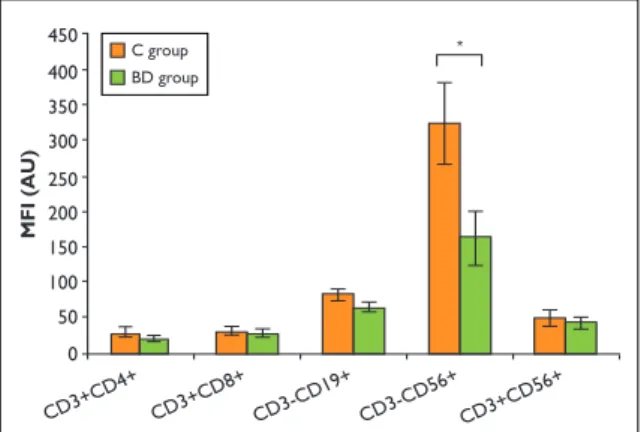
Additionally, results from flow cytometry analy-sis (Figure 1) showed a significant decrease of PBLCP from BD patients comparatively to controls (48,4±7,7 AU vs 77,7±10,9 AU; p=0,041). This diffe-rence was mainly due to a significant decrease (p=0,041) of CP surface expression in CD3-CD56+
cells (NK cells) of BD patients when compared to CD3-CD56+cells from controls (164,3±37,5 AU vs
323,62±57,6 AU; Figure 2).
In order to understand these results, an additio-nal comparison between PBLCP from BD patients under treatment and PBLCP from controls was performed. No significant differences were found between PBLCP from patients treated with colchi-cine (and/or corticosteroids) and PBLCP from con-trols (data not shown). However, BD patients trea-ted with azathioprine showed a significant
decrea-se of PBLCP (p=0,005) compared to controls (29,7
± 3,7 AU vs 77,7 ± 10,9, respectively; Figure 3). Also,
a significant decrease of PBLCP (p=0,026) was
found when comparing patients treated with azathioprine with non-azathioprine treated pa-tients (29,7 ± 3,7 AU vs 67,2 ±8,8 AU, respectively; Figure 3). Moreover, no significant difference in PBLCP was found between non-azathioprine trea-ted patients and controls (67,2 ±8,8 AU vs 77,7 ± 10,9, respectively; Figure 3).
Discussion
Oxidative stress has been implicated in the pathogenesis of certain disorders in-cluding BD.21Disturbance in the
prooxi-dant/antioxidant balance and the pro-duction of free radicals play a significant role in this process.4On the other hand, Fe
metabolism and oxidative stress are cle-arly interactive, especially under pa-thological conditions. In fact, Fe is extre-mely important due to its capacity of acting both as a donor and acceptor of electrons.22However, this property allows
Fe to be potentially toxic since it catalyses the conversion of hydrogen peroxide
Table I. Iron metabolism and inflammatory proteins measured in serum from BD patients (BD group) and controls (C group).
Iron Metabolism C group BD group Parameters (Mean±SE) (Mean±SE)
Fe (µg/dL) 103,2 ± 5,7 105,3 ± 10,3 Ft (ng/dL) 68,6 ± 22,9 119,5 ± 25,1 Tf (mg/dL) * 251,5 ± 10,7 298,7 ± 13,3 TIBC (mg/dL) * 314,4 ± 13,4 373,4 ± 16,6 Inflammatory proteins CP (mg/dL) 31,4 ± 2,2 39,9 ± 4,6 CRP (mg/dL) 0,3 ± 0,1 0,5 ± 0,1 β2-m (µg/L) 983,2 ± 68,3 1068,8 ± 64,0
Ceru-and Ft help to prevent this oxidative attack by se-questering Fe and avoiding radicals formation and/or lipid peroxidation.23
In this study, an increase in serum Fe and Ft con-centrations and a significant increase of serum le-vels of Tf and TIBC were observed in the BD group comparatively to controls (Table I). These results suggest that the raise of Tf and Ft observed in BD patients may be related to a possible compensa-tory mechanism to limit oxidative stress in this di-sease.
During the active phase of the disease, BD is as-sociated with many non-specific features of syste-mic inflammation, including an increase in the
le-vel of circulating pro-inflammatory cytokines, in-creased CRP and β2m.24The results obtained in this
study give additional support for these previous
findings, since an increase of CRP and β2m,
al-though not significant, was found in BD patients comparatively to controls. On the other hand, se-rum CP is also considered an acute phase reactant. Accordingly, an increase of CP serum concentra-tions has already been reported in BD patients in other studies.25Although not statistically
signifi-cant, results obtained in this study also showed an increase of serum CP levels in BD group compared to controls. However, a significant decrease in PBLCP was found in BD patients comparatively to controls. This decrease seemed to be due to a sig-nificant reduction of PBLCP observed in BD tients treated with azathioprine. In fact, these pa-tients showed a significant decrease of PBLCP when compared to non-azathioprine treated BD patients. Furthermore, a decrease in PBLCP was also found when comparing azathioprine treated patients with the respective controls. Overall, these results suggest that azathioprine treatment might have a direct effect on CP expression at the cell sur-face of PBL.
Conclusions
The results obtained in this study suggest that the LY M P H O C Y T E C E R U L O P L A S M I N A N D B E H Ç E T’S D I S E A S E PBLCP 100 90 80 70 60 50 40 30 20 10 0 * ** MF I ( A U) Non-azathioprine BD group C group Azathioprine BD group
Figure 3. Mean fluorescence intensity (MFI) ratio of CP at the surface of peripheral blood lymphocytes (PBLCP) in BD patients treated with azathioprine (azathioprine BD group), non-azathioprine treated BD patients (non-azathio-prine BD group) and control group (C group) (*: p= 0,026; **: p= 0,005). PBLCP 100 80 70 60 20 10 0 90 50 40 30 C group BD group * MF I ( A U)
Figure 1. Mean fluorescence intensity (MFI) ratio of CP at the surface of peripheral blood lymphocytes (PBLCP) in BD patients (BD group) and controls (C group) (*: p= 0,041).
CD3+CD 4+ CD3+CD 8+ CD3-CD 19+ CD3-C D56+ CD3+C D56+ 450 400 300 200 150 0 350 250 100 50 * MFI ( A U) C group BD group
Figure 2. Mean fluorescence intensity (MFI) ratio of CP at the surface of lymphocyte subpopulations in BD patients (BD group) and controls (C group). CD3+CD4+= T helper
lymphocytes; CD3+CD8+ = T cytotoxic lymphocytes;
CD3-CD19+= B lymphocytes; CD3-CD56+= Natural
Kil-ler (NK) lymphocytes; CD3+CD56+ = NKT lymphocytes
significant decrease of PBLCP found in BD patients comparatively to controls is due to the azathiopri-ne treatment and not related to BD. However, fur-ther studies including a larger number of patients are needed to fully understand the role played by PBLCP in BD pathophysiology.
Acknowledgemets
We would like to acknowledge the IPR for the funding to this project as well as all the members of Núcleo de
Diag-nóstico do Centro de Biopatologia from Instituto Nacional de Saúde Dr. Ricardo Jorge for the collaboration on the
la-boratorial characterization of samples.
Corresponding author Luciana Costa
Unidade de I&D em Imunologia Centro de Biopatologia
Instituto Nacional de Saúde Dr. Ricardo Jorge Av. Padre Cruz
1649-016 Lisboa, Portugal References
1. Kontogiannis V, Powell RJ. Behcet’s disease. Postgrad Med J 2000; 76: 629-637.
2. Arayssi T, Hamdan A. New insights into the pathoge-nesis and therapy of Behcet’s disease. Curr Opin Pharmacol 2004; 4: 183-188.
3. Verity DH, Wallace GR, Vaughan RW, Stanford MR. Behcet’s disease: from Hippocrates to the third mil-lennium. Br J Ophthalmol 2003; 87: 1175-1183. 4. Dogan P, Tanrikulu G, Soyuer U, Kose K. Oxidative
enzymes of polymorphonuclear leucocytes and plas-ma fibrinogen, ceruloplasmin, and copper levels in Behcet’s disease. Clin Biochem 1994; 27: 413-418. 5. Kose K, Yazici C, Cambay N, Ascioglu O, Dogan P.
Li-pid peroxidation and erythrocyte antioxidant en-zymes in patients with Behcet’s disease. Tohoku J Exp Med 2002; 197: 9-16.
6. Aydin E, Sogut S, Ozyurt H, Ozugurlu F, Akyol O. Comparison of serum nitric oxide, malondialdehyde levels, and antioxidant enzyme activities in Behcet’s disease with and without ocular disease. Ophthalmic Res 2004; 36: 177-182.
7. Kose K, Dogan P, Ascioglu M, Erkilic K, Ascioglu O. Oxidative stress and antioxidant defenses in plasma of patients with Behcet’s disease. Tohoku J Exp Med 1995; 176: 239-248.
8. Dincer Y, Alademir Z, Hamuryudan V, Fresko I, Akcay T. Superoxide dismutase activity and glutathione sys-tem in erythrocytes of men with Behcet’s disease. To-hoku J Exp Med 2002; 198: 191-195.
9. Orem A, Yandi YE, Vanizor B, Cimsit G, Uydu HA, Malkoc M. The evaluation of autoantibodies against oxidatively modified low-density lipoprotein (LDL),
susceptibility of LDL to oxidation, serum lipids and lipid hydroperoxide levels, total antioxidant status, antioxidant enzyme activities, and endothelial dysfunction in patients with Behcet’s disease. Clin Bi-ochem 2002; 35: 217-224.
10. Shukla N, Maher J, Masters J, Angelini GD, Jeremy JY. Does oxidative stress change ceruloplasmin from a protective to a vasculopathic factor? Atherosclerosis 2006; 187: 238-250.
11. Hellman NE, Gitlin JD. Ceruloplasmin metabolism and function. Annu Rev Nutr 2002; 22: 439-458. 12. Banha J, Penque D, Costa L. Synthesis of
Ceruloplas-min by human peripheral blood lymphocytes. Con-gress of the BioIron Society 2005; 63.
13. Banha J, Martins F, Costa L. Flow Cytometry Analysis of Ceruloplasmin Surface Expression in Peripheral Blood Leukocytes from Patients with Iron Deficient Anemia. Euroconference on Clinical Cell Analysis 2005.
14. Costa L, Martins F, Fonseca A, et al. Ceruloplasmin expression in peripheral blood lymphocytes from Wilson disease patients. Keystone Simposia Central nervous system inflammation: mechanisms, conse-quences and therapeutic strategies 2005; 95. 15. Theisen P, Banha J, Afonso B, et al. Ceruloplasmin
surface expression in lymphocyte subpopulations: preliminary studies on pregnant women. European Iron Club 2004; 103.
16. Costa L, Martins F. Iron metabolism and immune system: a new role for human ceruloplasmin? Euro-pean Iron Club 2002; 65.
17. Banha J, Martins F, Penque D, Costa L. Human Perip-heral Blood Lymphocytes Express and Secrete Ceru-loplasmin. Young Investigator’s Day (INSA) 2006; 40. 18. Fox PL, Mukhopadhyay C, Ehrenwald E. Structure,
oxidant activity, and cardiovascular mechanisms of human ceruloplasmin. Life Sci 1995; 56:1749-1758. 19. Patel BN, Dunn RJ, Jeong SY, Zhu Q, Julien JP, David
S. Ceruloplasmin regulates iron levels in the CNS and prevents free radical injury. J Neurosci 2002; 22: 6578-6586.
20. Ke Y, Ho K, Du J, et al. Role of soluble ceruloplasmin in iron uptake by midbrain and hippocampus neu-rons. J Cell Biochem 2006; 98: 912-919.
21. Sepici-Dincel A, Ozkan Y, Yardim-Akaydin S, Kay-mak-Karatas G, Onder M, Simsek B.
22. Andrews NC. Disorders of iron metabolism. N Engl J Med 1999; 341: 1986-1995.
23. Emerit J, Beaumont C, Trivin F. Iron metabolism, free radicals, and oxidative injury. Biomed Pharmacother 2001; 55: 333-339.
24. Marshall SE. Behcet's disease. Best Pract Res Clin Rheumatol 2004; 18: 291-311.
25. Taysi S, Kocer I, Memisogullari R, Kiziltunc A. Serum oxidant/antioxidant status in patients with Behcet's disease. Ann Clin Lab Sci 2002; 32:377-382.