http://www.uem.br/acta ISSN printed: 1679-9275 ISSN on-line: 1807-8621
Acta Scientiarum
Doi: 10.4025/actasciagron.v35i3.16322
Characterizing zinc use efficiency in varieties of Arabica coffee
Adriene Woods Pedrosa1, Hermínia Emilia Prieto Martinez2*, Cosme Damião Cruz3, Fábio Murilo
DaMatta3, Junia Maria Clemente2 and Ana Paula Neto1
1
Departamento de Produção Vegetal-Fitotecnia, Escola Superior de Agricultura “Luiz de Queiroz”, Universidade de São Paulo, Piracicaba, São Paulo, Brazil. 2
Departamento de Fitotecnia, Universidade Federal de Viçosa, Av. P.H. Rolfs, s/n, 36570-000, Viçosa, Minas Gerais, Brazil. 3
Departamento de Biologia Vegetal, Universidade Federal de Viçosa, Viçosa, Minas Gerais, Brazil. *Author for correspondence. E-mail: [email protected]
ABSTRACT. Among micronutrients, zinc (Zn) is important for coffee tree cultivation, especially in the clayey acid soils of Brazil’s southeast region, where coffee production is an important activity. This study aimed to evaluate the Zn use efficiency of coffee tree varieties using two zinc concentrations. Seedlings of 11 varieties of coffee trees were grown in a greenhouse in nutrient solution containing either 0.0 or 6.0
μmol L-1 of Zn. After eight months, we evaluated the total biomass production, leaf biomass production,
concentration of Zn in the plant organs, absorption efficiency, and Zn use efficiency. All characteristics were affected by the Zn concentration. The biomass production of apical leaves was most affected by the Zn treatments, with high variability for the studied varieties. The ‘IPR-103’ variety had the highest Zn use efficiency, and the ‘San Ramon’ and ‘San Bernardo’ varieties had the lowest Zn use efficiency. The ‘Rubi’ variety had a high and low Zn use efficiency when grown at 0.0 and 6.0 μmol L-1 of zinc, respectively. The
‘Oeiras’ variety had a low Zn use efficiency when cultivated at 6.0 μmol L-1 of zinc. The other varieties
studied were moderately efficient in their use of zinc.
Keywords:Coffea arabica L., micronutrient, zinc content, nutritional efficiency.
Caracterização da eficiência do uso de zinco em variedades de café arábica
RESUMO. Dentre os micronutrientes, o Zn é um dos mais importantes para o cafeeiro, especialmente em solos argilosos e ácidos do sudeste brasileiro, onde seu cultivo é uma importante atividade econômica. Este trabalho objetivou avaliar a eficiência de uso do zinco por variedades de cafeeiro cultivadas em doses contrastantes do elemento. Mudas de 11 variedades foram cultivadas, em casa de vegetação, em solução nutritiva, com duas concentrações de zinco (0,0 e 6,0 μmol L-1). Após oito meses determinaram-se:
biomassa seca dos órgãos da planta, concentração de zinco, eficiências de absorção, de produção de biomassa, de produção de biomassa foliar e de utilização de zinco. A concentração de zinco fornecida afetou todas as características avaliadas. A produção de biomassa seca de folhas apicais foi a mais afetada, proporcionando grande variabilidade de resposta entre as variedades. A variedade IPR-103 foi a mais eficiente no uso de zinco, as variedades San Ramon e São Bernardo as menos eficientes. A ‘Rubi’ apresentou alta e baixa eficiência de utilização de zinco quando cultivada nas doses 0,0 e 6,0 μmol L-1. A
variedade Oeiras apresentou baixa eficiência de utilização na dose de 6,0 μmol L-1. As demais variedades
estudadas foram moderadamente eficientes no uso do elemento.
Palavras-chave: Coffea arabica L., micronutrientes, conteúdo de Zn, eficiência nutricional.
Introduction
Zinc deficiency can impair crop productivity by interfering with the growth and development of plants (EPSTEIN; BLOOM, 2006). Significant differences in micronutrient content among varieties that grow in similar environments are due to genetic variation, the intensity of the demand in sink tissues and interactions among nutrients (MALAVOLTA et al., 2002).
The nutrient use efficiency in plants may be related to their absorption efficiency, translocation efficiency, and nutrient utilization efficiency. A higher efficiency
in absorbing nutrients from soil is sometimes related to root structure and function, including morphological features and the biochemical mechanisms responsible for transferring ions through the membranes of root cells (AHMAD et al., 2001).
absorption mechanism efficiency and the fine root growth, while the use efficiency is a measure of the efficiency of the transport and production of biomass per unit of nutrient absorbed.
Fageria et al. (2002) observed that different mechanisms can affect the absorption efficiency of micronutrients, including Zn, and that some of these mechanisms are specific to certain elements while others are common to all nutrients. These authors concluded that the response to Zn deficiency depends on the genetic characteristics of the plant and the growing environment. Higher nutrient utilization efficiency correlates with higher efficiency of a variety in producing dry matter per unit of nutrient absorbed. The utilization efficiency results from interactions among the absorption, transport, redistribution, and metabolism of nutrients in a plant.
The absorption, transport and redistribution of nutrients are genetically controlled, allowing improvement or selection (or both) of varieties that are more efficient in nutrient utilization (GALBEMAN; GERLOFF, 1983). Understanding differences in the nutritional needs of varieties will allow us to establish varieties that are less zinc demanding in poorer soils and avoid future problems. Therefore, this work aims to define the zinc use efficiency of the varieties of Arabica coffee cultivated in Brazil.
Material and methods
The experiment was conducted in a greenhouse at the Departamento de Fitotecnia at the Universidade Federal de Viçosa, from February to October 2007. The coffee varieties studied were ‘Acaiá Cerrado’ MG-1474 (1), ‘Caturra Amarelo’ IAC-476 (2), ‘Catucaí Vermelho’ 785-15 (3), ‘IPR-102’ (4), ‘Oeiras’ MG-6851 (5), ‘Paraíso’ MGH-419-1 (6), ‘Rubi’ MG-1192 (7), ‘San Ramon’ (8), ‘São Bernardo’ (9), ‘Topazio’ MG-1190 (10), and ‘Tupi’ IAC 1669-33 (11).
Seeds of these coffee varieties were germinated in sand and irrigated with deionized water until emergence. The seeds were then transplanted into trays containing ¼ strength Clark’s nutrient solution. After the onset of the first pair of leaves, the plants were transplanted into eight-liter pots with Clark’s solution modified according to Martinez and Clemente (2011), with zinc supplied at 0.0 and 6.0 μmol L-1. The
experiment consisted of an 11 x 2 factorial (eleven varieties and two zinc concentrations), in a completely randomized design with three replicates.
The ferric chloride and macronutrient stock solutions were purified using the APDC method described by Martinez and Clemente (2011) to avoid contamination with Zn.
The solution was aerated with compressed air, and the pH was adjusted daily to 5.0 0.5. The nutrient solution was exchanged after a 30% depletion of the initial electrical conductivity. At the end of the experiment, eight months after transplantation, the plant material was rinsed in deionized water, and the plant organs were dried separately in an oven at 70°C for 72h. Next, the dried material was weighed and ground in a Wiley mill.
Zinc concentrations in the plant organs were determined by atomic absorption spectrophotometry after nitro-perchloric mineralization according to MALAVOLTA et al. (1997). The zinc content and nutritional efficiency indexes were measured in all organs of the plant and were calculated according to the following formulas:
Zinc content (ZnC);
ZnC (μg) = {Zn concentration (μg g-1) x dry
biomass (g)};
Absorption efficiency (AE); AE (μg g-1) = TZnC / RDB;
Efficiency to produce leaf biomass (EPLB); EPLB (g2μg-1) = LDB2 / LZnC;
Efficiency of biomass production (EBP); EBP (g2μg-1) = ShDB2 / CZnSh;
Zinc utilization efficiency (UE); UE (g2μg-1) = TDB2 / TZnC.
where:
TDB = total plant dry biomass (g); RDB = root dry biomass (g); ShDB = shoot dry biomass (g); LDB = leaf dry biomass (g);
TZnC = total zinc content in the plant (μg); ShZnC = zinc content in shoot (μg); LZnC = zinc content in plant leaves (μg). All data were subjected to Lilliefors, Cochran and Bartlet tests prior to being submitted to analyses of variance andF-test. When the data did not fit a normal distribution or the variances were not homogeneous, the analyses of variance were performed with the data transformed into root square of X. The means were compared by Duncan's test at 5% probability. Statistical analyses were performed with the GENES software (CRUZ, 2010).
Results and discussion
The zinc content of the plants grown at 6.0
μmol L-1 of Zn was significantly higher than the
content observed in plants grown at 0.0 μmol L-1 in
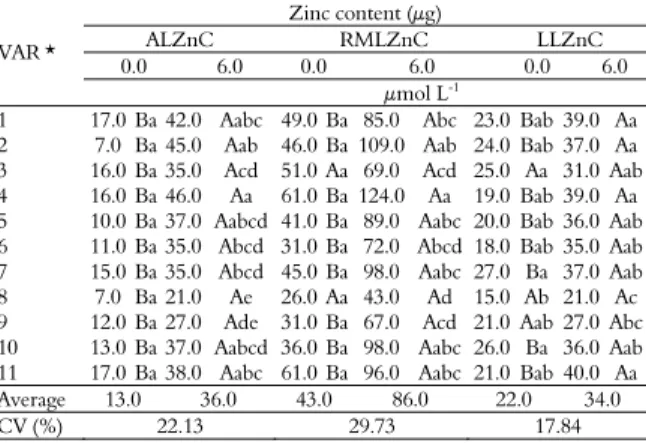
When Zn was omitted from the nutrient solution, the lowest average Zn content was observed in the apical leaves, not the recent mature or lower leaves, which indicates that Zn is an element with low mobility in the phloem, at least in coffee trees (Table 1).
Table1. Zinc content in apical leaves (ALZnC), recent mature leaves (RMLZnC) and lower leaves (LLZnC) of 11 varieties of coffee trees submited to two zinc doses (0.0 and 6.0μmolL-1
) in nutritive solution.
Zinc content (μg)
ALZnC RMLZnC LLZnC
0.0 6.0 0.0 6.0 0.0 6.0
VAR *
μmol L-1
1 17.0 Ba 42.0 Aabc 49.0 Ba 85.0 Abc 23.0 Bab 39.0 Aa 2 7.0 Ba 45.0 Aab 46.0 Ba 109.0 Aab 24.0 Bab 37.0 Aa 3 16.0 Ba 35.0 Acd 51.0 Aa 69.0 Acd 25.0 Aa 31.0 Aab 4 16.0 Ba 46.0 Aa 61.0 Ba 124.0 Aa 19.0 Bab 39.0 Aa 5 10.0 Ba 37.0 Aabcd 41.0 Ba 89.0 Aabc 20.0 Bab 36.0 Aab 6 11.0 Ba 35.0 Abcd 31.0 Ba 72.0 Abcd 18.0 Bab 35.0 Aab 7 15.0 Ba 35.0 Abcd 45.0 Ba 98.0 Aabc 27.0 Ba 37.0 Aab 8 7.0 Ba 21.0 Ae 26.0 Aa 43.0 Ad 15.0 Ab 21.0 Ac 9 12.0 Ba 27.0 Ade 31.0 Ba 67.0 Acd 21.0 Aab 27.0 Abc 10 13.0 Ba 37.0 Aabcd 36.0 Ba 98.0 Aabc 26.0 Ba 36.0 Aab 11 17.0 Ba 38.0 Aabc 61.0 Ba 96.0 Aabc 21.0 Bab 40.0 Aa
Average 13.0 36.0 43.0 86.0 22.0 34.0
CV (%) 22.13 29.73 17.84
*1 Acaiá Cerrado, 2 Caturra Amarelo, 3 Catucaí Vermelho, 4 IPR-102, 5 Oeiras, 6
Paraíso, 7 Rubi, 8 San Ramon, 9 São Bernardo, 10 Topázio, and 11 Tupi. Means followed by the same letter, horizontal upper case or vertical lower case, do not differ among themselves by Duncan’s MRT at 5% of probability. **Variance analyses made
with the data transformed into root square of X.
Reis Jr. and Martinez (2002) studied the absorption, translocation, and utilization of Zn and P in coffee trees and observed that the content of Zn in stems, shoots, and roots increased with the zinc supply. Similar results were observed in this study (Tables 1 and 2).
Table 2. Zinc content in stems (SZnC), roots (RZnC) and total (TZnC) of 11 varieties of coffee trees submitted to two zinc doses (0.0 and 6.0 μmol L-1) in nutritive solution.
Zinc content (μg)
SZnC** RZnC** TZnC 0.0 6.0 0.0 6.0 0.0 6.0 VAR *
μmol L-1
1 37.0 Ba 113.0 Ab 43.0 Ba 172.0 Aab 169.0 Ba 452.0 Aab 2 19.0 Ba 142.0 Aab 44.0 Ba 116.0 Aab 139.0 Ba 449.0 Aabc 3 19.0 Ba 139.0 Aab 47.0 Ba 113.0 Aab 159.0 Ba 388.0 Abcd 4 31.0 Ba 241.0 Aa 42.0 Ba 129.0 Aab 171.0 Ba 580.0 Aa 5 19.0 Ba 144.0 Aab 31.0 Ba 218.0 Aa 122.0 Ba 525.0 Aab 6 22.0 Ba 110.0 Ab 38.0 Ba 165.0 Aab 119.0 Ba 417.0 Abc 7 21.0 Ba 109.0 Ab 49.0 Ba 139.0 Aab 156.0 Ba 417.0 Abc 8 11.0 Ba 79.0 Ab 28.0 Aa 67.0 Ab 86.0 Ba 231.0 Ad 9 18.0 Ba 86.0 Ab 34.0 Ba 82.0 Ab 115.0 Ba 288.0 Acd 10 20.0 Ba 144.0 Aab 37.0 Ba 116.0 Aab 132.0 Ba 431.0 Aabc 11 18.0 Ba 177.0 Aab 31.0 Ba 136.0 Aab 148.0 Ba 488.0 Ab Average 21.0 135.0 38.0 132.0 138.0 424.0
CV (%) 21.71 21.02 29.70
*1 Acaiá Cerrado, 2 Caturra Amarelo, 3 Catucaí Vermelho, 4 IPR-102, 5 Oeiras, 6
Paraíso, 7 Rubi, 8 San Ramon, 9 São Bernardo, 10 Topázio, and 11 Tupi. Means followed by the same letter, horizontal upper case or vertical lower case, do not differ among themselves by Duncan’s MRT at 5 % of probability. **Variance analyses made
with the data transformed into root square of X.
The stem accumulated the most Zn (SZnC) when plants were grown at 6.0 μmol L-1 Zn,
accumulating an average of 135.0 μg, while with no Zn added to the nutrient solution, the average Zn content was 21.0 μg. In the treatment without the addition of Zn, there were no differences between the varieties, but the ‘Acaiá Cerrado’ variety had the highest average SZnC (37.0 μg), and the ‘San Ramon’ variety had the lowest average SZnC (11.0
μg). In the treatment with 6.0 μmol L-1 Zn, the
highest mean SZnC was observed for the ‘IPR-102’ variety (241.0 μg), which was statistically different from the ‘Rubi’, ‘Acaia Cerrado’, ‘São Benardo’, ‘San Ramon’ and ‘Paraíso’ varieties (Table 2).
In the roots, there was an accumulation of 38.0 μg of zinc (RZnC) for the treatment with a zinc concentration of 0.0 μmol L-1 and 132.0 μg of zinc
for the treatment with a zinc concentration of 6.0
μmol L-1 Zn, which indicates that the greater
availability of Zn in solution increased the Zn retention by the root system. By omitting zinc, there was a greater RZnC observed for the ‘Rubi’ variety (49.0 μg), while the varieties with the lowest average RZnC were the ‘Oeiras’ and ‘Tupi’ varieties (31.0
μg). However, for the 0.0 μmol L-1 Zn treatment,
these differences were not significant. Nevertheless, the highest accumulation of Zn was in the roots of the ‘Rubi’ variety in the low nutrient solution concentration (Table 2).
At a zinc concentration of 6.0 μmol L-1, higher
RZnC was observed in the ‘Oeiras’ variety (218.0 μg); however, measured zinc content was not different from that in the other varieties, except ‘San Ramon’ and ‘São Bernardo’, which had the lowest RZnC (67.0 and 82.0 μg, respectively). These results demonstrate that ‘Oeiras’ has a low Zn absorption efficiency at low Zn concentrations in the cultivation medium. However, at a concentration of 6.0 μmol L-1 Zn, this variety was able to accumulate
more zinc in roots than the other varieties (Table 2). Reis Jr. and Martinez (2002) compared the ‘Catuaí’
(Coffea arabica L.) and ‘Conilon’ (Coffea canephora
Pierre ex Froehner) coffee varieties and observed that high zinc concentrations in the roots of ‘Catuaí’ were compensated for by higher production of root dry biomass in ‘Conilon’. As a result, no significant differences were found in the Zn content in roots of the two varieties.
The highest total zinc content, TZnC, in the 6.0 μmol L-1 Zn treatment was observed in the
decreased zinc requirement may be due to a lower growth rate or greater efficiency in using the element. As observed by Martinez et al. (2011), the progeny UFV 4066-5 had low total zinc content due to its low zinc requirement but also showed low efficiency in producing biomass, which demonstrates that a low zinc requirement does not necessarily imply a greater nutritional efficiency.
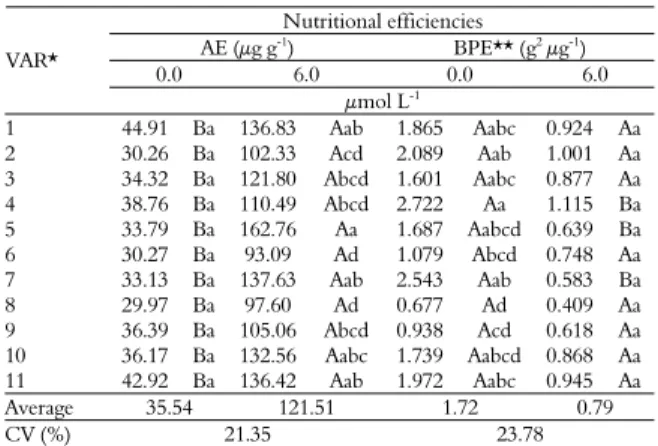
Regarding the zinc supply, the varieties behaved very differently for the nutritional efficiency variables studied. The absorption efficiency (AE) was higher in all varieties when grown with a zinc concentration of 6.0 μmol L-1 compared to 0.0 μmol L-1 (Table 3). These
results demonstrate that the plants were able to absorb more zinc per unit of root dry matter when Zn was provided at a higher concentration in the nutrient solution. Differences in nutrient efficiency between the genotypes may be related to the demand of the nutrient at the cellular level, the affinity of the absorption system, compartmentalization in roots or other plant organs, the mobility in the xylem and phloem vessels, and changes in the rhizosphere during growth (MARSCHNER, 1995). Baligar and Fageria (1999) summarize the features related to plant nutritional efficiency as absorption, translocation, and nutrient utilization efficiencies. However, the usage efficiency of a particular nutrient reflects not only the content of the nutrient placed in different organs at a given nutritional condition but also the amount of dry matter produced per unit of nutrient acquired.
Table3. Absorption efficiency (AE) and efficiency of biomass production (BPE) of 11 varieties of coffee tree submitted to two zinc doses (0.0 and 6.0μmolL-1
) in nutritive solution.
Nutritional efficiencies
AE (μg g-1) BPE** (g2μg-1)
0.0 6.0 0.0 6.0 VAR*
μmol L-1
1 44.91 Ba 136.83 Aab 1.865 Aabc 0.924 Aa
2 30.26 Ba 102.33 Acd 2.089 Aab 1.001 Aa
3 34.32 Ba 121.80 Abcd 1.601 Aabc 0.877 Aa
4 38.76 Ba 110.49 Abcd 2.722 Aa 1.115 Ba
5 33.79 Ba 162.76 Aa 1.687 Aabcd 0.639 Ba
6 30.27 Ba 93.09 Ad 1.079 Abcd 0.748 Aa
7 33.13 Ba 137.63 Aab 2.543 Aab 0.583 Ba
8 29.97 Ba 97.60 Ad 0.677 Ad 0.409 Aa
9 36.39 Ba 105.06 Abcd 0.938 Acd 0.618 Aa
10 36.17 Ba 132.56 Aabc 1.739 Aabcd 0.868 Aa
11 42.92 Ba 136.42 Aab 1.972 Aabc 0.945 Aa
Average 35.54 121.51 1.72 0.79
CV (%) 21.35 23.78
1 Acaiá Cerrado, 2 Caturra Amarelo, 3 Catucaí Vermelho, 4 IPR-102, 5 Oeiras, 6 Paraíso, 7 Rubi, 8 San Ramon, 9 São Bernardo, 10 Topázio, and 11 Tupi. Means followed by the same letter, horizontal upper case or vertical lower case, do not differ among themselves by Duncan’s MRT at 5% of probability. **Variance analyses made with the data transformed into root square of X.
The highest average absorption efficiency (AE) at a zinc concentration of 0.0 μmol L-1 was presented by the
‘Acaiá Cerrado’ variety (44.91 μg g-1), and when
grown with a zinc concentration of 6.0 μmol L-1, this
variety had an AE of 136.83 μg g-1. This variety showed
intermediate values for the efficiency of biomass production (BPE) (1.865 and 0.924 g2 g-1), leaf biomass
production (LBPE) (1.169 and 0.674 g2 g-1), and zinc
utilization (UE) (2.143 and 0.846 g2 g-1) when grown
at 0.0 and 6.0 μmol L-1 of Zn. These results indicate
that, although this variety has a high zinc absorption efficiency, it has a moderate ability to use the element because of its lower fitness in producing biomass per unit of absorbed Zn in both the zinc concentrations studied (Tables 3 and 4).
The ‘Caturra Amarelo’ variety showed low AE when grown at 0.0 and 6.0 μmol L-1 Zn (Table 3
and 4). However, it presented intermediate BPE (2.089 and 1.001 g2 g-1), LBPE (1.323 and 0.941 g2 g-1)
and UE (2.497 and 1.151 g2 g-1) when compared to
the other varieties studied. These results show that despite its low absorption efficiency, this variety has a moderate capacity for zinc utilization for the two zinc concentrations assessed.
The ‘IPR-102’ variety when grown in the zinc concentration of 0.0 or 6.0 μmol L-1, showed the
highest BPE (2.722 and 1.115 g2 g-1), LBPE (1.742 and
1.279 g2 g-1), and UE of zinc (3.175 and 1.325 g2 g-1).
However, in these same situations, this variety had an AE of 38.76 and 110.49 μg g-1 (Table 3 and 4). These
results indicate that ‘IPR-102’ has high zinc capacity utilization because of the greater ability to use the absorbed zinc for biomass production, even with a moderate zinc absorption efficiency in the two zinc concentrations tested.
Table 4. Efficiency of leaf biomass production (LBPE), and utilization efficiency of zinc (UE) of 11 varieties of coffee tree submitted to two zinc doses (0.0 and 6.0μmolL-1) in nutritive
solution.
Nutritional efficiencies
LBPE (g2μg-1) UE** (g2μg-1)
0.0 6.0 0.0 6.0 VAR*
μmol L-1
1 1.169 Abcd 0.674 Bbc 2.143 Aabc 0.846 Bab
2 1.323 Aabc 0.941 Aabc 2.497 Aab 1.151 Aab
3 1.374 Aab 0.869 Babc 2.149 Aabc 0.925 Bab
4 1.742 Aa 1.279 Ba 3.175 Aa 1.325 Ba
5 1.149 Abcd 0.649 Bbc 2.122 Aabcd 0.566 Bab
6 0.822 Acde 0.745 Aabc 1.501 Abcd 0.831 Aab
7 1.187 Abcd 0.606 Bbc 2.909 Aab 0.614 Bab
8 0.552 Ae 0.530 Ac 0.971 Ad 0.481 Ab
9 0.708 Ade 0.633 Abc 1.224 Acd 0.694 Aab
10 1.215 Aabcd 0.860 Aabc 2.118 Aabcd 0.925 Bab
11 1.354 Aabc 1.083 Aab 2.266 Aabcd 1.005 Aab
Average 1.14 0.81 2.09 0.85
CV (%) 28.31 23.65
1 Acaiá Cerrado, 2 Caturra Amarelo, 3 Catucaí Vermelho, 4 IPR-102, 5 Oeiras, 6 Paraíso, 7 Rubi, 8 San Ramon, 9 São Bernardo, 10 Topázio, and 11 Tupi. Means followed by the same letter, horizontal upper case or vertical lower case, do not differ among themselves by Duncan’sMRT at 5% of probability. **Variance analyses made
with the data transformed into root square of X.
The lowest AE at the zinc concentration of 0.0 μmol L-1 was presented by the ‘San Ramon’
significantly different from the other varieties, and when grown with a zinc concentration of 6.0 μmol L-1,
this same variety, along with the ‘Paraíso’ variety showed low AE (97.60 and 93.09 μg g-1). ‘San
Ramon’ presented the lowest BEP (0.677 and 0.409 g2 g-1), LBPE (0.552 and 0.530 g2 g-1), and UE
of zinc (0.971 and 0.481 g2 g-1) when grown at 0.0 and
6.0 μmol L-1 Zn. These results show that this variety
presents a low zinc absorption efficiency as well as a low zinc utilization, as a result of the decreased ability to produce biomass per unit of absorbed Zn, in both zinc concentrations studied (Tables 3 and 4).
The ‘Paraíso’ variety had the lowest AE (93.09 μg g-1) when grown with a zinc concentration of
6.0 μmol L-1. Furthermore, when grown with a zinc
concentration of 0.0 μmol L-1, this variety showed a
low AE (30.27 μg g-1). However, when grown at 0.0
and 6.0 μmol L-1 Zn, this variety exhibited moderate
BPE (1.079 and 0.748 g2 g-1), LBPE (0.822 and 0.745
g2 g-1), and UE of zinc (1.501 and 0.831 g2 g-1).
These results show the low efficiency of the ‘Paraíso’ variety in absorbing zinc, when compared with other varieties in both studied concentrations of zinc. These results also demonstrate that ‘Paraíso’ could use zinc more or less efficiently, since it could achieve good biomass production per unit of absorbed Zn, though it had a lower efficiency in absorbing the element (Table 3 and 4).
The ‘Oeiras’ variety had the highest AE at a zinc concentration of 6.0 μmol L-1 (162.76 μg g-1).
However, under the same conditions, this variety showed low BPE (0.639 g2 g-1), low LBPE (0.649 g2
g-1), and low UE of zinc (0.566 g2 g-1). These results
demonstrate that under these conditions, this variety, despite its high efficiency to absorb zinc, has a low zinc utilization efficiency due to the reduced ability to produce biomass per unit of Zn absorbed (Table 3 and 4).
For efficiency of biomass production (BPE), differences between treatments for the ‘Catucaí Vermelho’, ‘Paraíso’, ‘San Ramon’, and ‘São Bernardo’ varieties were not observed. The other varieties studied showed differences between treatments, and all these varieties exhibited higher BPE when they were grown with a zinc concentration of 0.0 μmol L-1. However,
differences between treatments were observed for LBPE only in the ‘Acaiá Cerrado’, ‘Catucaí Vermelho’, ‘IPR-102’, ‘Oeiras’, and ‘Rubi’ varieties, with best LBPE attained at a zinc concentration of 6.0 μmol L-1
(Tables 3 and 4).
Several varieties had higher UE of zinc when grown with a zinc concentration of 0.0 μmol L-1.
Only the ‘Caturra Amarelo’, ‘Paraíso’, ‘San Ramon’, ‘São Bernardo’ and ‘Tupi’ varieties showed no differences between treatments (Table 4).
In this study, the increase in the zinc concentration from 0.0 to 6.0 μmol L-1 reduced the BPE, LBPE, and
UE of zinc for several varieties (Tables 3 and 4). However, the ‘Rubi’ variety was the most negatively affected by the zinc concentration of 6.0 μmol L-1,
causing low BPE, LBPE, and UE. These results show that this zinc concentration was excessive for the variety. Variations in zinc concentration affect the absorption efficiency of coffee trees. Thus, the zinc content in all plant parts studied, especially in leaves, indicates the zinc use efficiency of the plants.
Conclusion
The ‘IPR-102’ variety was highly efficient in using zinc. The ‘Rubi’ variety had high Zn utilization efficiency when grown with a zinc concentration of 0.0
μmol L-1 and low utilization efficiency when cultivated
with a zinc concentration of 6.0 μmol L-1, which is
excessive for such a variety. The ‘San Ramon’ and ‘São Bernardo’ varieties showed low zinc utilization efficiency. The ‘Oeiras’ variety had low zinc utilization efficiency when grown with a zinc concentration of 6.0
μmol L-1. The other varieties studied are moderately
efficient in the use of zinc.
Acknowledgements
The authors thank the Federal University of Viçosa and the Department of Fitotecnia for the help with their facilities, equipment, support and collaboration. They also thank the CNP & D Café, CNPq and CAPES for the financial aid.
References
AHMAD, Z.; GILL, M. A.; QURESHI, R. H. Genotypic variations of phosphorus utilization efficiency of crops.
Journal Plant Nutrition, v. 24, n. 8, p. 1149-1171, 2001. BALIGAR, V. C.; FAGERIA, N. K. Plant nutrient efficiency: towards the second paradigm. In: SIQUEIRA, J. O.; MOREIRA, F. M. S.; LOPES, A. S. (Org.). Inter-relação fertilidade, biologia do solo e nutrição de plantas. Lavras: SBCS/UFLA/DCS, 1999. p. 183-204. CRUZ, C. D. Programa GENES: aplicativos computacional em genética e estatística. Versão Português/Inglês/Espanhol. Viçosa: UFV, 2010.
EPSTEIN, E.; BLOOM, A. J. Nutrição Mineral das Plantas: princípios e perspectivas. 2. ed. Londrina: Editora Planta, 2006.
FAGERIA, N. K.; BALIGAR, V. C.; CLARK, R. B. Micronutrients in crop production. Advances in Agronomy, v. 77, n. 1, p. 185-268, 2002.
LI, B.; MCKEAND, S. E.; ALLEN, H. L. Genetic variation in nitrogen use efficiency of loblolly pine seedlings. Forest Science, v. 37, n. 2, p. 613-626, 1991. MALAVOLTA, E.; VITTI, G. C.; OLIVEIRA, S. A.
Avaliação do estado nutricional das plantas: princípios e aplicações. 2. ed. Piracicaba: Potafós, 1997.
MALAVOLTA, E.; FAVARIN, J. L.; MALAVOLTA, M.; CABRAL, C. P.; HEINRICHS, R.; SILVEIRA, J. S. M. Repartição de nutrientes nos ramos, folhas e flores do cafeeiro. Pesquisa Agropecuária Brasileira, v. 37, n. 7, p. 1017-1022, 2002.
MARSCHNER, H. Mineral nutrition of higher plants. 2nd ed. New York: Academic Press, 1995.
MARTINEZ, H. E. P.; CLEMENTE, J. M. O uso do cultivo hidropônico de plantas em pesquisa. Viçosa: Editora UFV, 2011.
MARTINEZ, H. E. P.; ZABINI, A. V.; CRUZ, C. D.; PEREIRA, A. A.; FINGER, F. L. Differential tolerance to zinc deficiency in coffee-plant progenies. Journal of Plant Nutrition, v. 34, n. 11, p. 1654-1674, 2011.
REIS JR., R. A.; MARTINEZ, H. E. P. Adição de Zn e absorção, translocação e utilização de Zn e P por cultivares de cafeeiro. Scientia Agricola, v. 59, n. 3, p. 537-542, 2002.
Received on March 10, 2012. Accepted on June 6, 2012.