Sugar Cane Juice Fermentation by Zymomonas mobilis CP4
Subjected to Inhibition by Ethanol and High Initial
Concentration of Substrate
Marcia S. Tano
∗∗, João B. Buzato
and Maria Antonia P. C. Celligoi
Departamento de Bioquímica – Universidade Estadual de Londrina, Caixa Postal 6001- CEP: 86051-900 – Londrina – PR , Brazil
ABSTRACT
Sugar cane juice fermentation by Z. mobilis CP4 subject to stress by ethanol and high concentration of sucrose was investigated. Supplementation with saponifiable portion of soybean oil deodourising destillate (SOD) at 5; 10 and 15 mL/L.The ethanol production resulted values of 15.91; 16.99 and 15.63 g/L respectively. Values of Yp/s 0.35; 0.36 and 0.37 were achieved, which represented 20.69; 24.14 and 27.59% respectively higher when unsupplemented medium fermentation was carried out.
Key words: Zymomonas mobilis, fermentation, lipids, ethanol
∗ Author for correspondence
INTRODUCTION
For the fuel ethanol industry to expand, there is a requiriment for search of more competitive
ethanologenic microorganisms. Zymomonas
mobilis has attracted the attention as a promising bacterium regarding improving ethanol production
(Daugulis et al., 1997). Microorganisms are
usually subjected to stressing conditions in ethanol destilleries. High sucrose concentrations and
ethanol are a case in point (Falcão de Morais et al.,
1993). Growth in high osmolar sugar solutions promotes by-products formation and the substrate is not fully metabolised. Ethanol has been established as the primary end product responsible
for inhibiting fermentations (Moreau et al., 1997;
Hallsworth, 1998). Tano (1999) has found that concentration of ethanol added in the fermentation medium as low as 25 mL/L has an inhibitory effect. The fermetantion showed a long lag phase and it was incomplete as sugars were not fully metabolised.
Cells of microorganisms grown in the presence of ethanol show changes in the lipid composition of
the cell plasma membrane (Hermans et al., 1991;
Weir & Chase Jr., 1995; Mizoguchi & Hara,
1997). In Z. mobilis there are two possible
mechanisms involving lipids to explain the ethanol tolerance. In the first mechanism, it is postulated
that the high levels of cyclic lipids in the cell membranes protect the bacterium from the toxic
effects of ethanol (Hermans et al., 1991). In the
second mechanism, it is postulated that the high levels of cis-vaccenic acid in the phospholipids of the bacterial membrane protect the bacterium from
ethanol toxicity (Ohta et al., 1981; Moreau et al.,
1997).
There has been several publications dealing with the inhibitory effect of both ethanol and high initial concentration of substrate. These publications have used enrichment of fermentation medium such as salts, vitamin, proteins and lipids aiming fermentation improvement (Weir & Chase
Jr., 1995; Ohta et al., 1981; Mizoguchi & Hara,
1997; Lawford & Rousseau, 1997; Duarte et al.,
1996). Minimization of cost are also associated with nutritional supplement for large scale production of ethanol (Lawford & Rousseau, 1997).
Commercial dispersants and detergents are utilised when lipids are used as supplement in the culture
medium (Ohta & Hayashida, 1983; Duarte et al.,
1996; Bruheim et al., 1997).
depends on soy bean variety and soy bean oil processing utilised. Free fatty acids and triglycerides constitute its saponifiable portion.
(Almeida et al., 1994; Kao et al., 1998).
In the currenty study we have used the saponifiable portion of SOD as a nutritional
supplement for ethanol production by Z. mobilis
CP4, subjected to inhibitory fermentation conditions. Such conditions were achieved by adding ethanol into the culture medium and a high initial sucrose concentration.
MATERIAL AND METHODS
Microorganism: Bacterial strain used in this study was Zymomonas mobilis var. recifensis. It was maintained by montly transfer to the following medium (g/L): sucrose 50, yeast extract 5, KH2PO4 1, (NH4)2SO4 1, MgSO4 0.5.
Fermentation medium contained (g/L) sugar cane juice with total reducing sugars adjusted to 150, yeast extract 5, KH2PO4 1, MgSO4 0.5, (NH4)2SO4 1. The media in duplicates were supplemented with SOD at the following concentrations (mL/L): 5; 10 and 15. These media concentrations were carried out in the three repetitions according
statistical methodology by Barros Neto et al.
(1996). The media were sterilised by autoclaving and after cooling, 25 mL/L the ethanol GR was added. The saponifiable portion of SOD was extracted according to Rabassi (1997). A sample of 20g of SOD was mixed with 40mL of ethanol and then let it boil. After adding 20 g of KOH at 50% (W/V), it was refluxed. After cooling HCl was added for neutralization
The total reducing sugar concentration of 150 g/L in the cane juice and lipid supplementation were utilised according to statistical method (Barros
Neto et al., 1996). The determination of biomass
was by measuring the absortion at 605 nm and the corresponding dry weight was obtained from a
standard plot (Duarte et al., 1996). Reducing
sugars and total reducing sugars were assayed by the method of Somogyi (1945) and Nelson (1944). Samples for total reducing sugars determination were treated according to Diez & Yokoya (1996).
Ethanol concentrations were analysed using a gas chromatograph CG-17A SHIMADZU, with
DBwax columm with 2100C injector temperature
(Diez & Yokoya, 1996).
RESULTS AND DISCUSSION
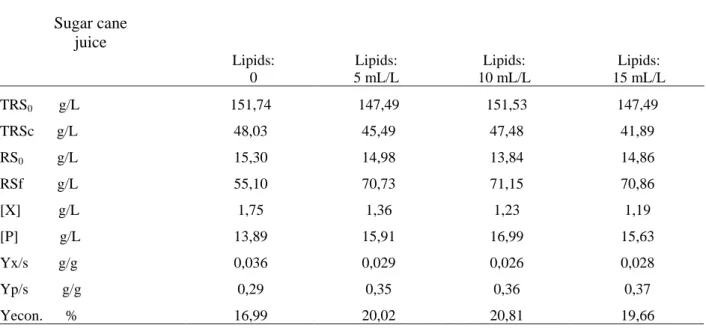
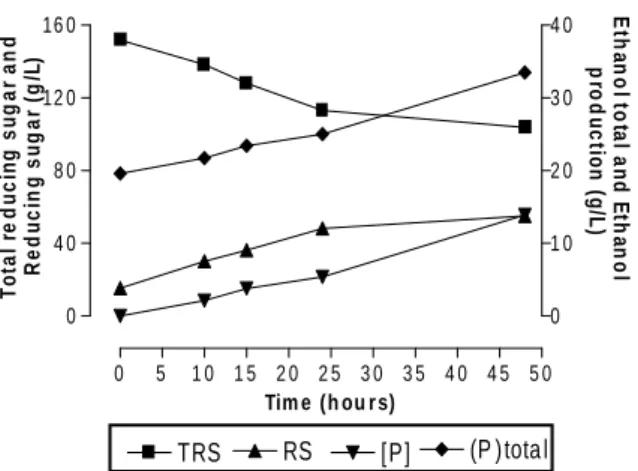
Table I and Figures 1-4 show the results of biomass, ethanol, values for total reducing sugars
and reducing sugars from cultures of Z. mobilis
CP4. When the medium with no-lipid supplement was used, ethanol production reached 13.89 g/L (Fig. 1). However a gradually raising in the ethanol production was observed when the lipid-supplement media were used. Ethanol concentrations of 15.91, 16.99 and 15.63 g/L (Figures 2-4) were found when the medium was enriched with SOD at concentration of 5, 10 and 15 mL/L respectively. These results were 14.54, 22.31 and 12.52% superior when the medium with supplementation was used. Increased values of ethanol production have also been found by other authors. Weir & Chase Jr. (1995) have reported
values 12% higher and Ohta et al. (1981) have
achieved values 20% superior when the culture media were enriched with proteolipids.
In Z. mobilis when both substrate metabolism and ethanol production continue while there is a cessation of cellular growth, it is said that growth
is uncoupled. Joachimsthal et al. (1998) have
reported an increased ethanol excretation in the presence of acetate while growth was negligible.
Calazans et al. (1990) have demonstrated abscence
Table 1. Comparative kinetic parameters for sugar cane juice fermentation added with 25 mL/L of ethanol by Z. mobilis CP4 (28oC, 180 rpm, 48 hours).
Sugar cane juice
Lipids: 0
Lipids: 5 mL/L
Lipids: 10 mL/L
Lipids: 15 mL/L
TRS0 g/L 151,74 147,49 151,53 147,49
TRSc g/L 48,03 45,49 47,48 41,89
RS0 g/L 15,30 14,98 13,84 14,86
RSf g/L 55,10 70,73 71,15 70,86
[X] g/L 1,75 1,36 1,23 1,19
[P] g/L 13,89 15,91 16,99 15,63
Yx/s g/g 0,036 0,029 0,026 0,028
Yp/s g/g 0,29 0,35 0,36 0,37
Yecon. % 16,99 20,02 20,81 19,66
When the medium without SOD-supplementation was used, a value of 0.036 for Yx/s was found.
This value was similar to that of Lee et al. (1981)
when glicose at 100 g/L and temperature of 300C
were used. However when SOD-enriched medium with 5, 10 and 15 mL/L was used, the values of 0.029, 0.026 and 0.028 were found. These values were similar when high concentration of substrate
were used (Rogers et al., 1982). Lower values of
Yx/s have been presented by other authors (Diez & Yokoya, 1996).
When the medium without supplementation was used a value of 0.29 for Yp/s was found. However, when enriched medium with 5, 10 and 15 mL/L was used, higher values were found for Yp/s 0.35, 0.36 and 0.37. Similar results have been achieved
by Toran-Diaz et al. (1983) when high
concentration of fructose was used. Toran-Diaz et
al. (1983) have presented values of 0.38 and 0.34
for Yp/s. When medium was supplemented with yeast extract even higher values were found by Favela Torres & Baratti (1987).
When the medium without SOD was used, a value of 16.99% for Yecon. was found. However, values of 20.02, 20.81 and 19.66% were achieved. These
values are lower to that of Duarte et al. (1996).
Duarte et al. (1996) have also utilised soybean oil
deodourising destillate and achieved 22.40% for Yecon.. However ethanol had not been added in the culture medium.
Incomplete fermentations have been reported when high initial substrate concentrations were
used (Doelle & Greenfield, 1985; Daugulis et al.,
1997). Such fermentations accumulated high levels of reducing sugars (Figures 1-4) (Calazans et al., 1990). Lyness & Doelle (1981) have suggested that when initial sucrose concentration was high there was a low value for Yecon. due to poor utilisation of fructose rather than lack of hydrolysis of sucrose. These considerations are in aggreement with our results as the final reducing sugar values are high.
In addition to inhibition effects of ethanol
(Calazans et al., 1990), several authors have
concluded that medium composition might also reduce the total amount of carbon available for ethanol formation and lowering fermentation efficiencies. The low efficiencies obtained in this study could probably be ascribe to the presence of certain compounds in the sugar cane juice which could be inhibitory to growth and ethanol
production by Z. mobilis (Doelle et al., 1990;
Duarte et al., 1996). However the results in this
study, utilising sugar cane juice with supplementation of SOD, have improved the
catabolic activity of Z. mobilis which has led to an
Figure 1. Batch fermentation of sugar cane juice
medium added with 25 mL/L of ethanol by Z. mobilis.
Figure 2. Influence of SOD (5 mL/L) on batch
fermentation of sugar cane juice medium added with 25 mL/L of ethanol by Z. mobilis.
Figure 3. Influence of SOD (10 mL/L) on batch
fermentation of sugar cane juice medium added with 25 mL/L of ethanol by Z. mobilis.
Figure 4. Influence of SOD (15 mL/L) on batch
fermentation of sugar cane juice medium added with 25 mL/L of ethanol by Z. mobilis.
NOMENCLATURE
TRS= total reducing sugars; TRS0=initial total reducing sugars; TRSc=consumption of total reducing sugars; RS=reducing sugars; RS0=initial reducing sugars; RSf=final reducing sugars; [X]=biomass production; [P]=ethanol production; (P)total = ethanol total (added+production); Yp/s=ethanol yield coefficient (g ethanol/g glucose consumed); Yx/s=biomass yield coefficient (g biomass/g glucose consumed);
Yecon.(fermentation efficiency) = [ethanol] / (0.511
. TRS0)
ACKNOWLEDGMENTS
Marcia S. Tano is grateful for the financial support given by CAPES. The authors are grateful to Ieda Spacinio Scarmínio for the statistical analysis.
RESUMO
Este trabalho investigou a fermentação de
caldo de cana-de-açúcar por células de
Z.
mobilis
submetidas ao estresse pelo etanol e
elevada concentração inicial de sacarose. Foi
utilizado como suplementação a porção
0 5 1 0 1 5 2 0 2 5 3 0 3 5 4 0 4 5 5 0 0
4 0 8 0 12 0 16 0
TRS RS [P] (P )tota l
0 1 0 2 0 3 0 4 0
Tim e (h ou r s)
T o ta l r e d u c in g s u ga r a n d R e d u c in g s ug a r ( g /L ) E th a n o l t o ta l a n d E tha nol p ro d u c tio n ( g /L )
0 5 10 15 20 25 30 35 40 45 50 0
40 80 1 20 1 60
TRS RS [P ] (P )tota l
0 10 20 30 40
Tim e (h ou r s )
T o ta l r e d u c in g s u g a r a n d R e d u c in g s u g a r ( g /L ) E th a n o l t o ta l a n d E th a nol p ro d u c tio n ( g /L )
0 5 10 15 20 25 30 35 40 45 50 0
40 80 1 20 1 60
TRS RS [P] (P)total
0 10 20 30 40
Tim e (h ou r s )
Tot a l r e d u c in g s u g a r a n d R e d u c in g s u g a r ( g /L ) E th a n o l t o ta l a n d E th a n o l p rodu c tio n ( g /L )
0 5 10 15 20 25 30 35 40 45 50 0
40 80 1 20 1 60
TRS R S [P] ( P) tota l
0 10 20 30 40
Tim e (h ou r s )
saponificável do destilado da desodorização
de óleo de soja (SOD) nas seguintes
concentrações: 5, 10 e 15 mL/L. Os valores de
produção de etanol foram respectivamente:
15,91; 16,99 e 15,63 g/L. Os valores de Y
p/sforam: 0,35; 0,36 e 0,37, os quais representam
respectivamente: 20,69; 24,14 e 27,59%,
superiores daquele cujo meio não foi
suplementado.
REFERENCES
Almeida, M. E. M.; Gusman, E. C.; Carvalho, P. R. N.; Rusig, O. (1994), Avaliação de destilado da desodorização do óleo de soja para a extração de vitamina E. Arq. Biol. Tecnol., 37(4): 1003-1011 Barros Neto, B. de; Scarmínio, I. S.; Bruns, R. E.
(1996), Planejamento e otimização deexperimentos. 2 ed., Campinas: Ed. da UNICAMP, 1996. 299 Bruheim, P.; Bredholt, H.; Eimhjellen, K. (1997),
Bacterial degradation of emulsified crude oil and the effect of various surfactants. Can. J. Microbiol., 43: 17-22
Calazans, G. M. T.; Eugênia, M. R.; Falcão de Morais, F. O. (1990), Efeito da concentração de glicose, do pH inicial e da temperatura na fermentação alcoólica por Zymomonas mobilis ZAP. Arq. Bio. Tecnol.,
33(2) 439-455
Daugulis, A. J.; McLellan, P. J.; Li, J. (1997), Experimental investigation and modeling of oscillatory behavior in the continuous culture of Zymomonas mobilis. Biotechnol. Bioeng., 56(1): 99-105
Diez, J. C.; Yokoya, F. (1996), Efeito da temperatura e pH na produção de etanol e levana durante a fermentação de sacarose por Zymomonas mobilis. Arq. Biol. Tecnol., 39(3): 129-137
Doelle, H. W.; Greenfield, P. H. (1985), The production of ethanol from sucrose using Zymomonas mobilis. Appl. Microbiol. Biotechnol., 22: 405-410 Doelle, M. B.; Greenfield, P. F.; Doelle, H. W. (1990),
Effect of mineral ions on ethanol formation during sugar cane molasses fermentation using Zymomonas mobilis ATCC 39679. Proc. Biochem. Intern., 151-156
Duarte, J. C.; Celligoi, M. A. P. C.; Buzato, J. B. (1996), Fermentação alcoólica por Zymomonas mobilis CP4 ou por Saccharomyces cerevisiae em caldo de cana com e sem suplemento lipídico. Arq. Biol. Tecnol., 39(2): 285-293
Falcão de Morais, J. O.; Rios, E. M. M. M.; Calazans, G. M. T.; Lopes, C. E. (1993), Zymomonas mobilis research in the Pernambuco Federal University. J. Biotechnol., 31: 75-91
Favela Torres, E.; Baratti, J. (1987), The effect of pH, temperature and sucrose concentration on high productivity continuous ethanol fermentation using Zymomonas mobilis. Appl. Microbiol. Biotechnol.,
27: 121-128
Hallsworth, J. E. (1998), Ethanol-induced water stress in yeast. J. Ferment. Bioeng., 85(2): 125-127 Hermans, M. A. F.; Neuss, B.; Sahm, H. (1991),
Content and composition of hopanoids in Zymomonas mobilis under various growth conditions. J. Bacteriol., 173(17); 5592-5595
Joachimsthal, E. Haggett, K. D.; Jang, J-H.; Rogers, P. L. (1998), A mutant of Zymomonas mobilis ZM4 capable of ethanol production from glucose in the presence of high acetate concentrations. Biotechnol. Lett., 20(2) 137-142
Kao, J-W.; Hammond, E. G.; White, P. J. (1998), Volatile compounds produced during deodorization of soybean oil and their flavor significance. JAOCS.,
75(9): 1103-1107
Lawford, H. G.; Rousseau, J. D. (1997), Corn steep liquor as a cost-effective nutrition adjunct in high-performance Zymomonas ethanol fermentations. Appl. Biochem. Biotechnol., 63-65: 287-304
Lee, K. J.; Skotnicki, M. L.; Tribe, D. E.; Rogers, P. L. (1981), The effect of temperature on the kinetics of ethanol production by strains of Zymomonas mobilis. Biotechnol. Lett., 3(6): 291-296
Lyness, E.; Doelle, H. W. (1981), Ethanol production from cane juice by Zymomonas mobilis. Biotechnol. Lett., 3(5): 257-260
Mizoguchi, H.; Hara, S. (1997), Ethanol-induced alterations in lipid composition of Saccharomyces cerevisiae in the presence of exogenous fatty acid. J. Ferm. Bioeng., 83(1): 12-16
Moreau, R. A.; Powell, M. J.; Fett, W. F.; Whitaker, D. (1997), The effect of ethanol and oxygen on the growth of Zymomonas mobilis and the levels of hopanoids and other membrane lipids. Cur. Microbiol., 35: 124-128
Nelson, N. A. (1944), Colorimetric adaptation of the Somogyi method for determination of glucose. Biochem., 153: 376-380
Ohta, K.; Hayashida, S. (1983), Role of Tween 80 and monoolein in a lipid-sterol-protein complex which enhances ethanol tolerance of sake yeasts. Appl. Envir. Microbiol., 46: 821
Ohta, K.; Supanwong, K.; Hayashida, S. (1981), Environmental effects on ethanol tolerance of Zymomonas mobilis. J. Ferment. Technol., 59(6): 435-439
Rogers, P. L.; Skotnicki, M. L.; Tribe, D. E. (1982), Ethanol production by Zymomonas mobilis. Adv. Biochem. Eng., 23: 37-84
Somogyi, M. A. (1945), A new reagent for the determination of sugar. Biol. Chem., 160: 61-68 Tano, M. S. (1999), Utilização da porção lipídica
saponificável do destilado da desodorização do óleo de soja na fermentação da garapa por Zymomonas mobilis CP4 induzida ao estresse. 53p. (Dissertação apresentada ao Curso de Mestrado em Microbiologia, Universidade Estadual de Londrina).
Toran-Diaz, C.; Delezon; Baratti, J. (1983), The kinetcs of ethanol production by Zymomonas mobilis on fructose medium. Biotechnol. Lett., 5(6): 409-412
Weir, P. M.; Chase Jr., T. (1995), Effect of proteolipid on Zymomonas fermentation of 25 % glucose media. J. Ind. Microbiol., 15: 442-445