Universidade dos Açores
Departamento de Oceanografia e Pescas
Behavioural ecology of the sperm whale
(Physeter macrocephalus) in the
North Atlantic Ocean
Cláudia Inês Botelho de Oliveira
Dissertação apresentada à Universidade dos Açores para obtenção do Grau de
Doutor no Ramo de Ciências do Mar, Especialidade em Ecologia Marinha
Behavioural ecology of the sperm whale
(Physeter macrocephalus) in the
North Atlantic Ocean
Cláudia Inês Botelho de Oliveira
Under supervision of:
Doutor João M. Gonçalves
Departamento de Oceanografia e Pescas da Universidade dos Açores
Doutora Mónica A. Silva
Centro do IMAR da Universidade dos Açores
Doctor Magnus Wahlberg
Marine Biological Research Center, Department of Biology – University of Southern
Denmark
This PhD was supported by:
PhD fellowship to Cláudia Oliveira (SFRH/BD/37668/2007)
Research project TRACE-PTDC/MAR/74071/2006
Acknowledgements
My PhD project and path was only possible due to the contribution of innumerous people to whom I would like to express my profound gratitude.
First of all I would like to thank my supervisors Mónica Silva, Magnus Wahlberg and João Gonçalves. They always believed in this project and supported me. Their supervision was of extreme importance and they were very efficient on “putting me back on track”.
I would like to acknowledge DOP’s directors, Ricardo Serrão Santos and Helder Marques da Silva for hosting me and supporting my PhD.
During the PhD, I was very fortunate on having extra non-official supervisors, Peter Madsen and Rui Prieto that supported me during field work, data analysis and writing the dissertation.
I am very grateful to Lisa Steiner for her help and for kindly providing her photo-id data set.
Also, I am extremely grateful to Mark Johnson who allowed the use of Dtags during this study and was always available to help with the Matlab Dtag tools and providing new ideas.
Field work off Andenes involved many people and I would like to acknowledge: the crew of R/V Narhvalen, S. Spjelkavik, Hisnakul, Whale Safari Andenes, A. Svensson and his crew on Iolaire, and T. Sletten with crew on Reine.
Field work at the Azores occurred due to the contribution of so many people. I would like to thank them all: Mónica Silva, Magnus Wahlberg, Rui Prieto, Peter Madsen, Mark Johnson, Irma Cascão, João Medeiros, Maria João Cruz, Tiago Sá, Yves Cuenot, Paulo Martins, Vítor Rosa, Franz Hutschenreuter, Sérgio Bairos, Bertel Møhl, Asger Hansen, Danuta Wisniewska, Andrea Fais, Rasmus Buchanan, Anders Heerfordt, Anders Lund, Fritz Vollrath, Christian Mølhave, Pedro Amaral, Mafalda Freitas, Jacobo Marrero Pérez, Natacha Aguilar Soto, Michael Hansen, Rikke Buchholz, Nina Iversen, Kim Lundgreen, Sara Green, João Decq Mota, Hélio Bicho, Pedro Alves, Norberto Serpa, Jorge Fontes, Doutor Humberto Lopes, Luís Pires, Fátima Mendes, Nelson Campino, Marco Ávila, Pedro Filipe, Sr. Manuel Fernandes and Michael Leandro.
I also would like to express my gratitude to the local “vigias” (Martins, Sr. Antero, Carlos, Sr. Vargas, Chico) and all the whale watching companies of Faial and Pico Islands that contributed to the success of field work.
While in Denmark, I received the support of the University of Southern Denmark to which I am very grateful. Many friends and colleagues (Magnus, Henriette, Peter, Nina, Danuta, Anne, Meike, Kim, Sara, Jacob, Danish, Ali, Nana, Lucas and Frantz) contributed for such a good time in Denmark. Thank you very much!
During the data analysis and writing up this dissertation, besides the help and ideas of my supervisors Mónica and Magnus, and non-official supervisors Peter and Rui, I had a substantial contribution from Ricardo Antunes, to whom I would like to express my profound gratitude. He was “always there” during data analysis and writing, provided Matlab tools and gave a set of ideas that were extremely helpful.
Along the data analysis and elaboration of the dissertation I received contributes from several people in different ways to which I am very grateful: Danuta Wisniewska, Andrea Fais, Ricardo Medeiros, Filipa Samarra, Christopher Kim Pham, Roberto Silva, Paula Lourinho, Sandra Andrade, Sandra Silva, José António, Joana Maciel, Paulo Castro and Alierta Pereira.
At the Azores, my friends and colleagues were very important during the whole path: Mónica, Rui, Maria João, Ricardo, Hugo, Sofia, Irma, Marta, Pitta, Renata, Sara, Carla, manos bANdARRA, Inês, Patrícia, Ângela, Rogério, Anabela, Daphne, Fred, Joana, Adriana, Xana R., Vanessa, Dário, Vera, Paulo, Roberto, Xana G., Sandra, Paulinha, Ana Marisa and the “Frozen Community” that was so good in keeping up the mood!
I am profoundly grateful to Sr. Fernando, D. Rosa, Paulo, Natália, Pedro, Paula e Ana for all their support.
To my family, especially my parents and my sister, they are my foundation and always will be. For that and all the support they always gave and continue giving, thank you, with all my heart!
And finally, my uppermost acknowledgement goes to Marco and Margarida, who supported me in so many ways and always were my haven. I dedicate this dissertation to them, my own M&M’s.
I would like to acknowledge the funding from Fundação para a Ciência e Tecnologia (FCT) through my PhD fellowship SFRH/BD/37668/2007 and the research project TRACE-PTDC/MAR/74071/2006, Fundo Regional da Ciência, Tecnologia (FRCT) for funding the research project MAPCET-M2.1.2/F/012/2011 [FEDER, the Competitiveness Factors Operational (COMPETE), QREN European Social Fund, and Proconvergencia Açores/EU Program], Danish Research Council, the Carlsberg Foundation, and the support from Department of Oceanography and Fisheries (University of the Azores), Centro do IMAR da Universidade dos Açores, University of Southern Denmark, Aarhus University, Woods Hole Oceanographic Institution, and University of La Laguna. I also acknowledge funds provided by FCT to LARSyS Associated Laboratory & IMAR-University of the Azores/the Thematic Area D & E of the Strategic Project PEst-OE/EEI/LA0009/2011-1012 and 2013-2014 (OE & Compete) and by the FRCT – Government of the Azores pluriannual funding.
Table of contents
Abstract ……… i
Resumo ……… iii
List of figures ……… v
List of tables ……… vi
Chapter I: General introduction ……… 1
Marine mammals and cetaceans 2 Behavioural ecology in cetaceans 2 Tagging tools and deployments for cetacean studies 4 The sperm whale 5 Morphology 5 Distribution, movements and life history 5 Sound production mechanism and sound types 6 Diet, foraging and resting 9 Social behaviour and communication 10 Study area 11 The Azores 12 The Andøya Canyon 13 Previous research on sperm whales and a link between the study areas 14 Motivation of the current study 16 Objectives and thesis overview 17 Chapter II: Foraging and resting behaviour of the sperm whale in the Azores ……… 19
Introduction 20 Methods 21 Study area 21 Tagging 22 Data analysis 23 Results 25 Discussion 36 Chapter III: Are sperm whale codas only encoding clan identity or also individuality? ……… 41
Introduction 42 Methods 43 Study area 43 Tagging 44 Data analysis 45 Results 48 Discussion 57 Chapter IV: Underwater 3-D behaviour of a breaching sperm whale ……… 63
Introduction 64 Methods 65 Study area 65 Tagging 65 Data analysis 66 Results 68 Discussion 74
Chapter V: The function of male sperm whale slow clicks in a high latitude habitat ……… 77 Introduction 78 Methods 80 Study area 80 Tagging 80 Data analysis 80 Results 82 Discussion 89
Chapter VI: General discussion ……… 95
The importance of sound to sperm whales 96
Behavioural ecology of the sperm whale in the North Atlantic Ocean: major findings 97
Global threats affecting sperm whales 99
Contribution to reduce impacts on sperm whales at the study areas 100
Future research 101
References ……… 103 Annex ……… 121
i
Abstract
Sperm whales (Physeter macrocephalus) rely on sound for the majority of their activities. They produce different click types for echolocation and communication. Usual clicks and buzzes have been related with foraging contexts. Among social units coda clicks have been associated with communication and group (clan) recognition. Besides being able to communicate by “vocal” emissions, sperm whales frequently exhibit aerial displays that were hypothesized to have several functions, including intraspecific communication. The function of slow clicks is not very well understood, but apparently they are only produced by males either at higher latitudes or while in breeding grounds when in search for a female to mate.
The Azores and the Andøya Canyon (off Andenes, northern Norway) are known habitats for sperm whales. The former is a breeding and foraging ground, characterized by the presence of groups of females, immatures and calves, where mature males occur occasionally. The second location is a high latitude foraging ground where mature males spend the majority of their time feeding.
In the present study we used different types of tags (time-depth recorders and digital acoustic recording tags) to investigate the foraging, resting and social behaviours of sperm whales both at the Azores and off Andenes, with the ultimate goal of providing new insights into the behavioural ecology of the species.
The results demonstrate that, at the Azores, sperm whales foraged and rested in a highly stereotyped behaviour. However, individual whales differed in the depths where they started searching for food and ended the foraging phase, possibly as a result of a combination of external factors (e.g. prey vertical distribution) and of individual features related with individual auditory and phonating capabilities, diving ability and efficiency at manoeuvring to capture prey. During a dive descents were mainly achieved by stroke and glide. Longer gliding periods were more frequent during ascents, mainly at their final stage. After several foraging dives, sperm whales appeared to rest between 9:00 PM and 7:00 AM in vertical (heads up or down) or horizontal positions. We found individual-specific features in the inter-click intervals, inter-pulse intervals, centroid frequency, root-mean-square bandwidth and inter-pulse decay rate of sperm whale codas, which may contribute to individual identification within a social group. Additionally, our study revealed that sperm whales produced different coda types in different phases of their foraging dive cycle. This provides the first indication that coda production may also be influenced by the environmental or behavioural context of the animals. We therefore suggest that codas are used by sperm whales to convey individual information within a social group to a larger extent than has been previously assumed.
ii
Breaching is believed to be an energetically demanding behaviour but previous investigations of this display were based solely on surface observations. This study is the first to describe the underwater movements associated with breaching behaviour of sperm whales. Before breaching, sperm whales perform V-shaped dives to 11-41 m depth, significantly less than previously assumed. During the descent, whales interspersed fluke strokes with periods of gliding. In contrast, whales glided through most of their ascent movement prior breaching. Their velocity and acceleration during the ascent phase appears to be a product of the velocity and acceleration attained during descent and of their natural buoyancy. We also found that sperm whales rotate during the dives that precede breaches possibly to gain speed to leap out of the water. Mature male sperm whales at the Andøya Canyon produced slow clicks mainly at the surface and while ascending from a foraging dive, contradicting earlier suggestions that these signals could be used during foraging to debilitate prey. Further, some slow clicks were emitted in apparent repetitive temporal patterns. These findings supported the hypothesis that slow clicks’ function is long range communication between males at higher latitudes and they may encode information on individual identity or behavioural states.
Within the whole dissertation the results suggested influence of individual specific features on sperm whale acoustic behaviour while foraging, their position while resting, the production of coda clicks and different coda types, some aspects of the dive before breaching, and on the possible temporal patterns of slow clicks. Thus, individual physical features may influence their capacity to move, capture prey, and rest possibly due to differences on their body weight and mass, hearing and acoustic emission capabilities. Moreover, the information encoded in coda and slow clicks may extend the notion of communication within social units and among male sperm whales at higher latitudes.
iii
Resumo
Os cachalotes (Physeter macrocephalus) dependem do som na maior parte das suas actividades. Eles produzem diferentes tipos de cliques para eco-localização e comunicação. Os “usual clicks” e os “buzzes” têm sido relacionados com a alimentação. Nas unidades sociais, as “codas” têm sido associadas a comunicação e ao reconhecimento de grupo (clã). Para além de poderem comunicar por emissões “vocais”, os cachalotes efectuam exibições aéreas com alguma frequência e este tipo de comportamento tem sido atribuído a diversas funções, nomeadamente a comunicação intra-específica. A função dos “slow clicks” ainda não está totalmente compreendida, mas aparentemente estas “vocalizações” são emitidas somente por machos, tanto em latitudes altas como em zonas de reprodução, quando os machos estão à procura de fêmeas para acasalar.
Os Açores e o Canhão de Andøya (ao largo de Andenes no norte da Noruega) são habitats para os cachalotes. Os Açores são uma zona de reprodução e alimentação que é caracterizada pela presença de cachalotes fêmea, juvenis e crias e, ocasionalmente, machos adultos. O Canhão de Andøya é uma zona de alimentação em latitudes elevadas, onde os machos de grande porte passam a maior parte do seu tempo em alimentação.
Neste estudo utilizaram-se diferentes tipos de marcas (computadores de mergulho, “TDRs”; e marcas digitais acústicas, “Dtags”) para estudar o comportamento alimentar, de repouso e social dos cachalotes nos Açores e ao largo de Andenes. Desta forma, pretendeu-se fornecer novos contributos para o conhecimento da ecologia comportamental desta espécie.
Os resultados obtidos demostram que, nos Açores, os cachalotes alimentaram-se e repousaram de forma estereotipada. No entanto, detectaram-se diferenças individuais nas profundidades onde os cachalotes iniciaram a fase de procura e terminaram a fase de alimentação. Isto poderá dever-se à combinação de factores externos (como a distribuição vertical de presas) e de características individuais relacionadas com a sua capacidade auditiva e de emissão de sons, capacidade de mergulho e eficiência na captura de presas. O movimento durante as fases descendentes do mergulho foi essencialmente efectuado pelo tipo “batimento caudal e deslize”. Os “deslizes” de duração superior foram mais frequentes nas fases ascendentes e ocorreram essencialmente durante a parte final das subidas. Após vários mergulhos de alimentação os cachalotes aparentaram estar em repouso em posição vertical (cabeças para cima ou para baixo) ou horizontal, entre as 21:00 e 7:00. Foram detectadas características individuais nos intervalos entre cliques, intervalos entre pulsos dos cliques, no centróide de frequências, na raiz quadrada da média da largura de banda e na taxa de decaimento entre os pulsos dos cliques, o que poderá contribuir para o reconhecimento individual dentro de um grupo social. Além disso, os resultados sugerem que os cachalotes produzem
iv
diferentes tipos de “codas” em fases distintas de um ciclo de mergulho de alimentação. Este resultado é uma primeira indicação que a produção de “codas” poderá ser influenciada pelo contexto ambiental ou comportamental dos animais. Assim, sugere-se que as “codas” são usadas pelos cachalotes para transmitir informação individual dentro de um grupo social, o que estende a própria noção de grupo social estabelecida até ao momento. Os saltos fora de água (“breachings”) têm sido classificados como um comportamento energeticamente exigente, mas até agora só foram estudados a partir de observações efectuadas na superfície. Este estudo é o primeiro a descrever os movimentos debaixo de água associados aos “breachings” dos cachalotes. Antes de saltar fora de água os cachalotes efectuaram mergulhos em forma de V até aos 11-41m de profundidade, o que é significativamente inferior ao que se encontrava descrito para estes movimentos. Durante a descida, os cachalotes intercalaram os “batimentos caudais” com períodos de “deslize”. Na subida, os períodos de “deslize” foram mais frequentes. A velocidade e aceleração durante a subida pareceram ser fruto da combinação da velocidade e aceleração obtidas durante a descida, e da flutuabilidade natural dos cachalotes. Adicionalmente, os cachalotes rodam o seu corpo durante os mergulhos, possivelmente para atingir maior velocidade para saltar fora de água. Os machos adultos no Canhão de Andøya produziram “slow clicks” essencialmente na superfície e durante as subidas de mergulhos de alimentação, contrariando o que havia sido sugerido sobre estes sinais acústicos poderem ser usados na debilitação de presas. Além disso, estas “vocalizações” foram emitidas em aparentes padrões repetitivos. Estes resultados corroboram a hipótese que a função dos “slow clicks” é comunicação de longo alcance entre os machos em latitudes elevadas e podem conter informação sobre a identidade e comportamento do indivíduo.
Ao longo desta dissertação, os resultados sugeriram a influência de características individuais no comportamento acústico dos cachalotes durante a alimentação, na posição de repouso, na produção das “codas” e nos seus diferentes tipos, em alguns aspectos dos mergulhos que antecedem os “breachings”, e nos possíveis padrões temporais dos “slow clicks”. Assim, as características físicas de cada indivíduo podem influenciar a sua capacidade de locomoção e captura de presas, e na forma como repousam, possivelmente devido ao seu peso e massa corporal e na capacidade auditiva e de emissão acústica. Além disso, a informação presente nas “codas” e nos “slow clicks” poderá estender a noção de comunicação em unidades sociais e entre machos em latitudes mais elevadas.
v
List of figures
Chapter.Fig
Figure I. 1 – Cross section of the head of a sperm whale . ... 7
Figure I. 2 – Waveform and spectrogram of usual clicks, buzz, codas and slow clicks ... 8
Figure I. 3 – Study sites in the Azores archipelago and in the Andøya Canyon ... 12
Figure I. 4 – Detail of the Azorean islands in the Mid-Atlantic Ridge ... 13
Figure I. 5 – Location of the Andøya Canyon ... 14
Figure II. 1 – Dive profiles of the sperm whales tagged off the Azores . ... 30
Figure II. 2 – Depths where usual clicks and buzzes were produced in a foraging dive . ... 31
Figure II. 3 – Positions of the tagged sperm whales in 2005, 2008, 2009 and 2010 . ... 31
Figure II. 4 – Coda exchanges of a tagged whale and another untagged whale ... 32
Figure II. 5 – Frequency of gliding periods ... 33
Figure II. 6 – Fluke strokes and gliding periods . ... 34
Figure II. 7 – Pitch, depth profile and velocity of resting behaviour . ... 35
Figure III. 1 – Angle-of-arrival of usual clicks and codas of the sperm whales tagged off the Azores . 46 Figure III. 2 – Depth profiles and acoustic signals . ... 48
Figure III. 3 – Two Principal Components of 5 click codas ... 50
Figure III. 4 – Canonical discriminant functions of 5Reg non-clipped codas . ... 52
Figure III. 5 – Discriminatory parameters in relation to depth . ... 54
Figure III. 6 – Coda types in relation to depth ... 55
Figure III. 7 – IPI-based length measurements of the sperm whales that produced codas ... 56
Figure IV. 1 – Underwater details to detect a breach ... 67
Figure IV. 2 – Dive profiles showing the timing of breaching . ... 69
Figure IV. 3 – Dive profile, pitch, roll, vertical velocity and acceleration and MSA of the breaches. ... 72
Figure IV. 4 – Pseudotracks of the descent and ascent before breaching . ... 73
Figure V. 1 - Untagged and tagged usual and slow clicks of the sperm whales off Norway . ... 81
Figure V. 2 - Dive profiles, usual clicks, slow clicks and buzzes . ... 84
Figure V. 3 - Sound velocity profiles from CTDs and depth distribution of slow clicks ... 85
Figure V. 4 - Slow clicks produced in regular patterns and a possible slow click exchange ... 87
Figure V. 5 - Mean of the minimum specific acceleration of buzzes and slow clicks ... 88
vi
List of tables
Chapter.Fig
Table II. I – Details of recorded data of the sperm whales tagged off the Azores... 25
Table II. II – Dive data for sperm whales tagged with TDRs and Dtags ... 27
Table II. III – Acoustic and foraging data for sperm whales tagged with Dtags ... 28
Table II. IV – Percentage of time spent resting and resting periods . ... 33
Table III. I – Dtag deployments of sperm whales producing codas off the Azores . ... 45
Table III. II – Body length from IPIs and types of codas ... 49
Table III. III – Significance values for DFA scenarios . ... 51
Table III. IV – Explained variance and standardized coefficients for the canonical variables ... 53
Table III. V – Linear regression values for the parameters as a function of depth. ... 56
Table IV. I – Details of the breaches performed by sperm whales tagged off the Azores... 70
Table IV. II – Vertical velocity and acceleration of descents and ascents ... 70
Table IV. III – Details of change in vertical acceleration and fluke strokes . ... 71
Table IV. IV – Length, weight and daily food consumption ... 71
Table V. I – Dtag deployment details of sperm whales tagged off Norway ... 83
Table V. II – Detaisl of slow clicks and their bouts ... 85
Table V. III – Intervals between a slow click and its closest buzz ... 86
Chapter I
Chapter I __________________________________________________________________________
2
Marine mammals and cetaceans
Marine mammals (class Mammalia) are animals that live in the aquatic environment, including species of cetaceans, sirenians, pinnipeds, sea otters and the polar bear (Martin and Reeves 2002). Within the order Cetacea there are two suborders, Odontoceti (toothed whales) and Mysticeti (baleen whales) (Reeves et al. 2003). Eighty-six species of whales, dolphins and porpoises are currently recognized (Beasley et al. 2005; Perrin et al. 2009; Hrbek et al. 2014). Cetaceans spend all their lives in water, where they forage, rest, mate, and bear their young. Their distribution is extremely wide, inhabiting in all the oceans, major seas and many of the main rivers of the world, from cold polar waters to the warm tropical areas (Pompa et al. 2011). They occupy very diverse habitats, from shallow coastal and inshore waters to the deepest oceanic areas (Martin and Reeves 2002).
Behavioural ecology in cetaceans
Behavioural ecology consists of two words, ecology and behaviour. Ecology is the study of how
organisms live and interact with their environment (Chapman and Reiss 1999), or, with specific reference to cetacean ecology, the study of relationships between the animals and their physical and biological environment (Balance 2009). Behaviour consists of a combination of topics, such as animal movement, social interaction, cognition and learning (Breed and Moore 2012). The combination of those two words, behavioural ecology, is a fast growing scientific field using notions from evolution, ecology and behaviour (Krebs and Davies 1997). Behavioural ecology may, therefore, be defined as the study of how and why the behaviour of organisms evolve and adapt to changes in their environment.
To perceive and interact with their physical environment, conspecifics, predators and prey of terrestrial species depend mostly on a combination of visual, olfactory, auditory and chemical cues. Although cetaceans also use these senses, most species rely heavily on sound to communicate with conspecifics during socializing and reproductive activities, and, as in the case of odontocetes, to forage and explore their environment.
Foraging is intimately related with environmental features and may occur in shallow depths or in very deep environments depending on the location of their prey (Schreer and Kovacs 1997; Tyack et al. 2006; Aguilar Soto et al. 2008; Arranz et al. 2011). Some species have easily identifiable dive patterns while others have more variable dives, and they can change depending on the tidal state or
_________________________________________________________________ General introduction
3 the time of the day (Gregory and Rowden 2001; Baird et al. 2002, 2008). Most often, cetaceans forage in areas or at depths where light is scarce. Like bats, toothed whales echolocate to locate and capture prey as well as to navigate (Johnson et al. 2004; Miller et al. 2004a; Aguilar Soto et al. 2008; Au and Hastings 2008). “Echolocation is the process in which an animal obtains an assessment of its environment by emitting sounds and listening to echoes as the sound waves reflect off different objects in the environment” (Au 2009). To echolocate, cetaceans usually produce several types of pulsed sounds (clicks) with distinct strength and inter-click intervals (ICIs), depending on the distance to and the type of target (Benoit-Bird and Au 2001; Jaquet et al. 2001; Madsen et al. 2002a, b; Zimmer et al. 2003; Johnson et al. 2006).
Cetacean communication is mainly associated with social, mating and foraging contexts. Intraspecific acoustic communication in whales may be used while cooperating in foraging events (Pitman et al. 2001; Benoit-Bird and Au 2009) and may convey individual information (Caldwell and Caldwell 1965; Sayigh et al. 1990; Gordon and Tyack, 2001) or group identity (Rendell and Whitehead 2003a), that may be essential to survival and reproduction (Winn and Winn 1978; Darling and Bérubé 2001; Acevedo-Gutiérrez 2009). The ability to communicate with conspecifics is critical to the maintenance of social bonds in group living animals like cetaceans. For most cetacean species, benefits arising from living with conspecifics (e. g. reduction of predation risk, communal care of the young and defense of resources) may translate into increased survival and reproductive success (Acevedo-Gutiérrez 2009).
There are mainly three ways to communicate among cetaceans: visually, acoustically and by tactile sensing (Bradbury and Vehrencamp 1998; Perrin et al. 2009). Whereas tactile and vision only works at very close ranges, whales can communicate over vast distances (tens, or even hundreds of kilometers) using acoustics. All cetaceans studied so far have sensitive hearing (Gordon and Tyack 2001) and a great part of their communication is performed acoustically, by producing different types of sound emissions (e.g. clicks, whistles, moans and songs). Clicks are short, pulsed sounds that are frequently broadband. Whistles are continuous, narrow-band tonal sounds that often have a rich harmonic content. Moans are low frequency pure-tone sounds or more complex tones with a strong harmonic structure and may last up to 30 s. Songs are possibly the most well-known type of vocalization of baleen whales. They are only produced by males and are probably related with attracting mates for reproduction purposes (Dudzinski et al. 2002).
“Non-vocal” sounds may also be important for communication among conspecifics, mainly at or near the surface. These sounds can be produced by flukes, flippers, teeth, jaws, bubbles, respirations and also by striking the body (completely or partially) against the water surface (Herman and Tavolga, 1980; Perrin et al. 2009). Examples where such “non-vocal” communication sounds occur
Chapter I __________________________________________________________________________
4
are the aerial displays of spinner dolphins (Stenella longirostris) and the breaching of humpback whales (Megaptera novaeangliae).
Tagging tools and deployments for cetacean studies
During the last decades, cetacean studies relied mostly on data collected from surface observations, depth sounders and hydrophone arrays. In order to obtain a better insight into their underwater lives, several new types of tags (e.g. time-depth recorders, bioacoustic probes, A-tags and digital acoustic recording tags) have recently been developed, that collect underwater data on their movement, acoustic emissions and some environmental parameters (Burgess 2000; Akamatsu et al 2005; Johnson and Tyack 2003). These tags brought a new perspective into studies of the diving behaviour of cetaceans.
In the work presented in this thesis, two tags were used to study several aspects of the behavioural ecology of the sperm whale (Physeter macrocephalus): time-depth recorders (TDRs, Wildlife Computers, Redmond, WA) and digital acoustic recording tags (Dtags, Johnson and Tyack 2003). TDRs are small size devices that record time, depth, temperature and light levels data and may be incorporated into a custom-built housing. Frequently the housing also has a VHF radio transmitter that allows animal tracking and the device recovery. Often TDRs are attached to the animals either with suction cups or barbs/hooks (Hooker and Baird 2001). TDRs have been successfully used in several studies on the diving behaviour of cetacean species (e.g. Hooker and Baird 1999; Watkins et al. 2002; Amano and Yoshioka 2003; Baird et al. 2008). The Dtag is a small, lightweight, non-invasive tag that records pressure and three-dimensional movement data from the tagged individual, water temperature data, and acoustic data from the tagged animal and its surroundings (either sounds from conspecifics or from other biological or non-biological sources). There are several versions of this device. The versions used here (known as Dtag2 and Dtag3) have four suction cups, and their release from the animal is controlled within a pre-programmed period after which an electric conductor penetrating the suction cup is burnt off and thereby causes the suction cups to be released from the whale after which the tag is ascending to the surface due to positive buoyancy. Dtags have a VHF radio transmitter that allows animal tracking and tag recovery while at the surface. In the last decade, Dtags have been widely used to study different aspects of the diving, foraging, acoustic and three-dimensional behaviour of several cetaceans (e.g. Tyack et al. 2006; Aguilar Soto et al. 2008; Arranz et al. 2011).
_________________________________________________________________ General introduction
5 Tagging is usually performed with long poles, guns or crossbows, depending on the type of tag and species behaviour at the sea surface (Watkins and Tyack 1991; Madsen et al. 2002b; Amano and Yoshioka 2003). Usually, the target animal is approached from behind or laterally, with the boat speed depending on the behaviour of the target species. When using a pole (hand-pole or cantilevered pole), the attachment is usually made with suction-cups and at short distances from the animals (as for sperm whales; Madsen et al. 2002b; Teloni et al. 2008). Guns (air-guns, launchers or modified spear guns) and crossbows are employed on faster species (Watkins and Tyack 1991; Panigada et al. 2003) and when boats cannot approach the animals at close range.
The sperm whale Morphology
The sperm whale is the largest of the toothed whales and has the largest brain of any animal. A prominent feature of this species is the squarish nose of the head containing the spermaceti organ (Berzin 1972; Whitehead 2003). This species is the most sexually dimorphic of all cetaceans – maximum length of females and males is about 12 and 18 m, respectively (Berzin 1972; Best et al. 1984; Gosho et al. 1984).
The sperm whale body is dark brown-grey with a lighter belly. The Y-shaped lower jaw has about 20 teeth and has a white coloration (Berzin 1972; Gosho et al. 1984; Rice 1989). The white colour has been proposed to serve to lure prey while foraging (Fristrup and Harbison 2002).
The head of the sperm whales is about one-quarter to one-third of the body size (Berzin 1972; Gosho et al. 1984). It contains the spermaceti organ which is involved in sound production (Norris and Harvey 1972; Møhl 2001). The blowhole is located at the tip of the head on the left side and when the animals are at the surface they project a blow which is directed forward and to the left side (Berzin 1972). The dorsal fin of sperm whales is thick, rounded and quite low, the flippers are broad and rounded and the fluke is triangular (Rice 1989).
Distribution, movements and life history
Sperm whales have a cosmopolitan distribution that is mainly related to food availability (Gosho et al. 1984; Rice 1989). Even though this species can be found in any deep waters of the world, they
Chapter I __________________________________________________________________________
6
tend to aggregate in some areas (called “grounds” by whalers; Townsend 1935). Adult females, juveniles and calves of both genders live in long-term stable social units in lower latitudes and perform nomadic movements within tropical and temperate waters (Berzin 1972; Whitehead 2003). Between the age of 3 and 15, young males are observed in loose groups of males of the same age (called bachelor groups), and at a higher age they move to colder waters at higher latitudes (Gosho et al. 1984; Whitehead 2003). There, the groups become smaller. As the whales get older, they move to the ice-edges living more solitary lives (Whitehead 2003). Males become migratory when they are in their late twenties, moving between low latitudes used for mating and high latitudes for foraging (Gosho et al. 1984; Whitehead 2003).
Sperm whales may live at least until 50 years of age (Whitehead 2009). Females may conceive at 9 years of age and their gestation period is about 15-16 months (Best et al 1984; Whitehead 2003). The newborns, with a length of around 4 m and a weight of about 1 ton, receive care not only from their mothers but also from other females and/or juveniles of both sexes in the social group. The care from these helpers is called “alloparental care” (Best et al. 1984; Whitehead 2003).
Sound production mechanism and sound types
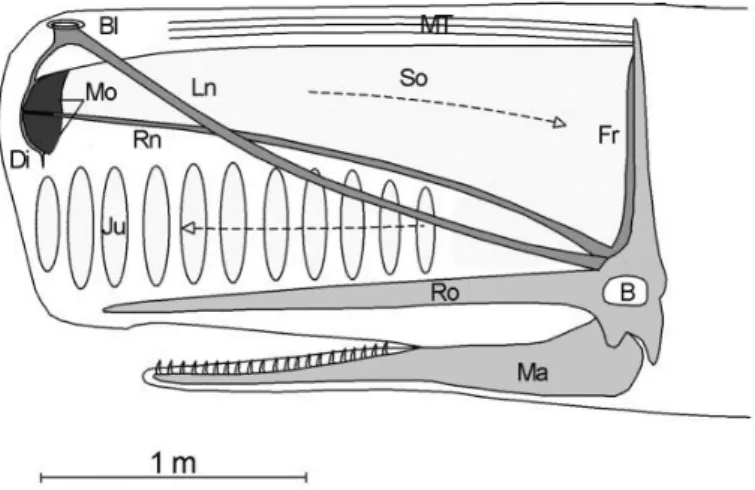
Many marine mammals, such as seals and probably also baleen whales, produce sounds in the vocal folds of the larynx, whereas odontocetes produce both clicks and whistles in the nasal passages, in a pair of structures called the “monkey lips”. In sperm whales the sound production mechanism is unique and more complex (Cranford et al. 1996; Møhl 2001; Reidenberg and Laitman 2007). The barrel shaped head is composed of several structures, such as two air sacs, the so-called “junk” (which is composed of connective tissue that contains a longitudinal stacked series of lens-shaped bodies of spermaceti), two nasal passages, the “museau de singe” and the spermaceti organ (Cranford 1999; Møhl et al. 2000) (Fig. I.1). In the past, the spermaceti organ was thought of having a hydrostactic or buoyancy regulation function (Clarke 1978a, b). Nowadays, the sound generation function (Norris and Harvey 1972; Cranford 1999; Møhl et al. 2000; Madsen et al. 2002b) has been completely accepted.
The greater part of sound emissions made by the sperm whales are clicks with frequency content between 2 and 25 kHz (Madsen et al. 2002a, b; Whitehead 2009). Clicks are produced by forcing the air from the right naris through the “museau de singe” in the distal part of the head, producing the sound pulse. The majority of the energy of the click is directed backwards along the spermaceti organ. Then it is reflected in the frontal air sac and part of this signal is redirected by the junk into the water. The rest of the signal is reflected back in the distal air sac and again in the frontal air sac,
_________________________________________________________________ General introduction
7 creating a second pulse that is equally redirected to the water by the junk (Cranford 1999; Madsen et al. 2002b). Successive reflections back and forth explain the multi-pulsed structure of sperm whale clicks, where each inter-pulse interval (IPI) is proportional to the size of the spermaceti organ. Based on this relationship, Gordon (1991a) and Rhinelander and Dawson (2004) developed methods to calculate the body length of sperm whales through the use of the IPI.
Figure I. 1 – Cross section of the head of a sperm whale, showing anatomical structures relevant for sound production. B, brain; Bl, blow hole; Di, distal air sac; Fr, frontal air sac; Ju, junk; Ln, left naris; Ma, mandible; Mo, monkey lips/museau de singe; MT, muscle/tendon layer; Ro, rostrum; Rn, right naris; So, spermaceti organ (adapted from Madsen et al. 2002b).
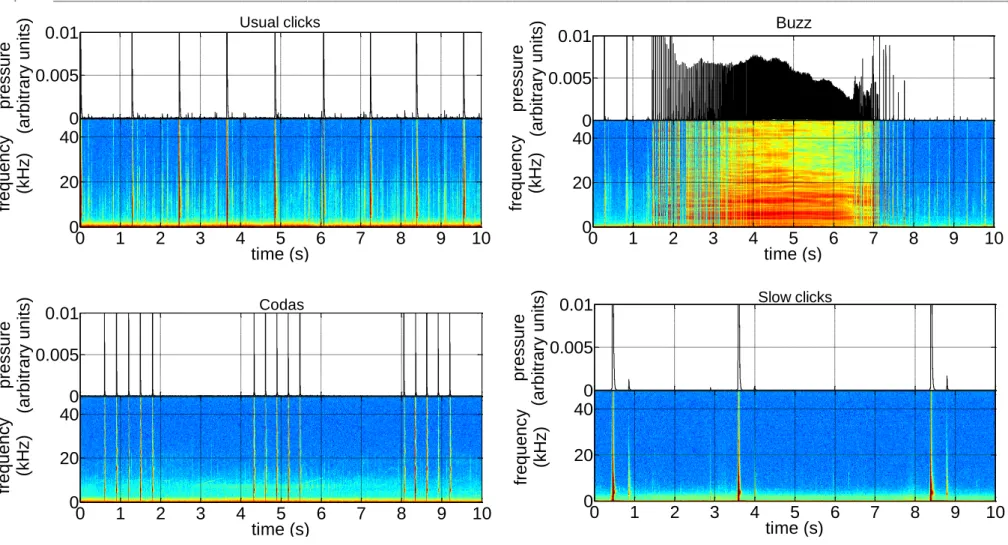
Sperm whales produce at least four click types (usual clicks, buzzes, codas, and slow clicks; Fig. I.2) and occasional tonal sounds (e.g. trumpets, squeals, and pips) (Goold 1999; Whitehead 2003; Teloni 2005). Clicks are sharp-onset broadband pulses with their main energy centred between 2 and 25 kHz (Madsen et al. 2002a, b). Usual clicks are highly directional (Møhl et al. 2000), have regularly spaced intervals of 0.5-1.0 s which change with depth (Madsen et al. 2002a; Thode et al. 2002). Buzzes are a rapid series of clicks with short ICIs of 15–100 ms (Whitehead 2003), and occur within a foraging context (Jaquet et al. 2001). Codas are stereotyped patterns of 3 to 20 clicks, having a duration of 0.2–5 s (Watkins and Schevill 1977b) and are mostly produced within social units (Weilgart and Whitehead 1993). Slow clicks have a distinctive metallic sound, longer ICIs (5-8 s) and are apparently only produced by males (Mullins et al. 1988; Weilgart and Whitehead 1988; Jaquet et al. 2001; Madsen et al. 2002a).
Chapter I _______________________________________________________________________________________________________________________
8
Figure I. 2 – Waveform and spectrogram (512 FFT block size with 10 s segments, 5 Hz sampling rate) of usual clicks, buzz, codas and slow clicks.
0 0.005 0.01 pressure (arbitra ry unit s) Usual clicks freque ncy (kHz) time (s) 0 1 2 3 4 5 6 7 8 9 10 0 20 40 0 0.005 0.01 pressure (arbitra ry unit s) Buzz freque ncy (kHz) time (s) 0 1 2 3 4 5 6 7 8 9 10 0 20 40 0 0.005 0.01 pressure (arbitra ry unit s) Codas freque ncy (kHz) time (s) 0 1 2 3 4 5 6 7 8 9 10 0 20 40 0 0.005 0.01 pressure (arbitra ry unit s) Slow clicks freque ncy (kHz) time (s) 0 1 2 3 4 5 6 7 8 9 10 0 20 40
________________________________________________________________ General introduction
9
Diet, foraging and resting
The diet of sperm whales is mainly comprised of deep water prey items - cephalopods (Gosho et al. 1984) and also fish (teleosts and occasionally elasmobranchs; Berzin 1972). Sometimes other animals are also ingested, such as tunicates, crustaceans, sponges, starfish, sea cucumbers and ascidians (Berzin 1972). The prey items found in sperm whale stomachs during the whaling era were related to the geographical area where the animals were caught. For example, large males in high latitudes seemed to consume much more fish than females in low latitudes, due to the greater abundance of fish at their foraging depths (Whitehead 2003).
In order to search and capture prey items, sperm whales generally perform deep dives and use acoustic emissions (usual clicks and buzzes; Watwood et al. 2006). In lower latitudes, sperm whales usually perform 30-45 min dives to a maximum depth of 1200 m (Amano and Yoshioka 2003; Watwood et al. 2006) but in colder waters males explore a wider range of water depths (100-1900 m depth) (Teloni et al. 2008). For sperm whales who are part of social units (mainly females and juvenile males), usually start emitting usual clicks (meaning they started searching for food) around 100-220 m depth, and the foraging phase (the period between the first and last buzzes within a dive) start at about 500-640 m and last around 29 min (Watwood et al. 2006). Buzzes have been related with prey capture events (Miller et al. 2004a) and the bursts of speed observed in the dive data may indicate the capture of more powerful prey (Amano and Yoshioka 2003; Aoki et al. 2012). Sperm whale usual clicks and buzzes seem therefore related with long- and short-range echolocation, respectively (Jaquet et al. 2001; Madsen et al. 2002a).
Overall, it seems that sperm whales exhibit a highly stereotyped foraging behaviour (Watwood et al. 2006). However, it remains to be shown if the stereotyped foraging behaviour may be influenced by other aspects, such as food availability or individual specific features. Additionally, sperm whales do not seem to cooperate while foraging, rather they seem to forage independently (Whitehead 2003) and avoid interfering with each other through the choice of different prey patches. Synchronous dives and surfacings were documented from visual observations at the surface (Whitehead 2003) but the underwater movements of synchronous diving whales remain unknown and could provide a novel perspective of the intraspecific relation while foraging.
Frequently after a foraging period, sperm whale groups are observed socializing or staying quiet at the surface, apparently resting (Whitehead and Weilgart 1991; Watkins et al. 1999). Often their heads or flukes break the surface with the animal in a vertical position (Gordon 1991b; Miller et al. 2008). Large males in higher latitudes seem to rest for longer periods but less often than females and immature at lower latitudes (Whitehead et al. 1992).
Chapter I __________________________________________________________________________
10
Social behaviour and communication
As mentioned above, females, immatures and calves of both sexes live in social units. These units have a mean of about 11 individuals that live and travel together for several years (Christal et al. 1998). However, sperm whales also socialize and gather with other conspecifics that do not belong to their social unit. There are several terminologies among scientists studying sperm whale social behaviour. Here we follow the commonly accepted nomenclature of Whitehead (2003). Sperm whales may be observed in: groups of about 20-30 animals that move together in a coordinated fashion over periods of at least hours; aggregations of several animals within a certain area of a few kilometers at a particular time; clusters of various animals separated by a few body lengths that swim side by side in a coordinated manner; and clans of animals that use a similar coda repertoire. Long-term relationships bring advantages to sperm whales - reduction of predation risk, “babysitting” or alloparental care and, perhaps also an increased foraging success (Whitehead 2003). Reduction of predation risk benefits adults, immatures and calves. Frequently, sperm whales dispose themselves in a “marguerite formation” to protect against predators: the animals form a circle with or without a protecting target (that may be a young or injured animal) in the middle, and may react with their flukes or jaws against the aggressors (Arnbom et al. 1987; Pitman et al. 2001). The communal care of the young is beneficial to both calf and mother. The first one receives protection and sometimes also milk from other lactating females (allosuckling) and the mother may continue foraging at great depths (Best et al. 1984; Gordon 1987a; Whitehead 1996). Increased foraging success may be accomplished by avoiding interfering with other sperm whales foraging in the area, or by eavesdropping at other conspecifics to find good places for foraging (Whitehead 1989).
Therefore, group recognition and individual recognition may be of extreme importance. For group or individual recognition sperm whales use acoustic communication and their social behaviour is intimately related to the production of coda clicks. Codas have been related with the reinforcement of group cohesion (Weilgart and Whitehead 1993; Whitehead 2003). Distinct groups of sperm whales that share different coda types constitute the “vocal clans” (Weilgart and Whitehead 1997; Rendell and Whitehead 2003a). Additionally, there is a proposed clan signature function that would convey a cultural identity to its members, which may be very important for their reproduction and survival (Rendell and Whitehead 2003a). A recent study performed with hydrophone arrays recognized that there were individual-specific features in 5Reg codas (Antunes et al. 2011). If confirmed, the possibility of individual recognition in coda clicks may be of extreme importance among conspecifics within social units, like mother-calf pairs, and it would bring a new insight into the function of codas.
_________________________________________________________________ General introduction
11 Male sperm whales that live in higher latitudes have been described to possess a weak social organization (Whitehead et al. 1992; Whitehead 2003) with no preferred companionship (Letteval et al. 2002). However, there is an occasional tendency to form clusters and seek the company of other conspecifics (Letteval et al. 2002). Slow clicks may have a communication purpose among mature males in cold feeding grounds (Madsen et al. 2002a). Yet, the way they communicate within this apparent low interaction rate is still poorly understood.
Sperm whales perform several surface activities – spyhopping, lobtailing, breaching, fluking-up, sidefluking – that have been observed with a lot of enthusiasm by humans. Breaching, i.e. jumping out of the water, has been related with several purposes, but the mostly accepted ones are related to communication, parasite removal, excitement and disturbance (Beale 1839; Whitehead 1985a, 2002, 2003). Apparently, sperm whales have the tendency to breach in sequences and frequently splashing into the water by falling on the same body side (Gordon 1987b; Waters and Whitehead 1990; Whitehead 2003). Mature males have not been observed to breach frequently (Waters and Whitehead 1990), so breaching may have a strong social component within social units. Until now, the breaching behaviour of sperm whales has only been described from surface observations and its function is not yet well understood (Whitehead 1985b, 2002; Waters and Whitehead 1990). Underwater movements before breaching have not been described yet and they may contribute to the determination of the function of this behaviour.
Study area
This work was conducted at two study sites: the Azores archipelago, Portugal, and the Andøya Canyon, off Andenes, northern Norway (Fig. I.3). In the Azores, sperm whale data were collected during July and August, 2010, and at the Norwegian site, data were collected in July, 2005, and May, 2010.
Chapter I __________________________________________________________________________
12
Figure I. 3 – Study sites in the Azores archipelago (Portugal) and in the Andøya Canyon, off Andenes (Norway). R.Medeiros©ImagDOP.
The Azores
The Azores is a volcanic archipelago with nine islands divided into three groups (eastern, central and western groups), that extends for more than 600 km between 37 and 40° N and 25 and 32° W in the Atlantic Ocean (Fig. I.4; Santos et al. 1995). The Azores delimitates the triple junction of three major lithospheric plates in the Mid-Atlantic Ridge: the American Plate, the African Plate and the Eurasian Plate (Morton et al. 1998). The Azorean sea floor is very deep close to the coast which favours the proximity of oceanic species to the islands. The area is indirectly influenced by the Gulf Stream. This stream splits in the North Atlantic Current and the Azores Current both having some influence in the local oceanography (Santos et al. 1995).
_________________________________________________________________ General introduction
13
Figure I. 4 – Detail of the Azorean islands in the Mid-Atlantic Ridge. R.Medeiros©ImagDOP.
In the Azores it is possible to find about 27 cetacean species (Silva et al. 2014). Here sperm whales can be found almost daily (weather permitting) year-round (Silva et al. 2014) and relatively near the coast, mainly because of the topography of the Azorean sea floor (Silva et al. 2003). Groups of females, juveniles and calves are commonly observed and mature males are occasionally encountered (Matthews et al. 2001). Sperm whales are one of the main target species of a regional whale watching activity that has been increasing since 1993 (Oliveira et al. 2007).
The Andøya Canyon
The Andøya Canyon is an underwater canyon located in the NE Norwegian-Greenland Sea. It is about 40-50 km long, has a maximum depth of over 2000 m and is locatedbetween 69 and 70° N and 15 and 16° E, in the narrowest and steepest part of the northern Norwegian margin (Fig. I.5; Laberg et al. 2000, 2005). There, the Norwegian Current transfers masses of Atlantic water which are the warmest ones in the area (ranging from 2 to 12° C, depending on the season; Kostianoy et al. 2004). In May, the daylight period is about 24h: 22h with the sun visible and about 2h when the sun is not visible, and in July the sun is visible for the entire 24h of the day (http://weatherspark.com).
Chapter I __________________________________________________________________________
14
In the region of the Norwegian Sea that includes the Andøya Canyon it is possible to find several cetacean species and, as in the Azores archipelago, the sperm whale is one of the main target species of the local whale watching operations (Nøttestad and Olsen 2004). Off Andenes, male sperm whales are found in deep waters along the continental slope and they are usually found either foraging or resting, with low interaction rates between conspecifics (Letteval et al. 2002).
Figure I. 5 – Location of the Andøya Canyon, off Andenes, northern Norway. R.Medeiros©ImagDOP.
Previous research on sperm whales and a link between the study areas
Sperm whales have been studied in the Azores archipelago for some decades. Until 1984 there was a whaling industry in the archipelago and besides the local economical profits it also contributed carcasses to study the diet and some morphological aspects of this species (Clarke 1956; Ávila de Melo 1986; Clarke et al. 1993). Azorean sperm whales mostly feed on cephalopods, but sometimes they also ingest different species of fish (Clarke 1956).
_________________________________________________________________ General introduction
15 Using closed capture-recapture models, Matthews et al. (2001) estimated a population of 300-800 female and immature sperm whales between 1987 and 1995 in the central group of islands of the Azores. Open models provided estimates for the same area of 400-700 female and immature whales in 1988-1990 and 1600-2200, in 1991-1994 (Matthews et al. 2001). Silva et al. (2006) reported an annual estimate of about 700 whales using lagged identification rate models. A recent study suggested that a few thousand whales may forage in the Azores every year (Silva et al. 2014). Based on seasonal variations in the observation rates of newborns in the Azores, Silva et al. (2014) estimated a breeding activity between April and June in the area.
The only study on the dive behaviour of sperm whales in the area was based on surface observations and reported that whales take a breath (blow) about every 12 s (females and immature males) and 18 s (large males) and their complete dive cycle lasted on average 52 min (Gordon and Steiner 1992). Sperm whales may be disturbed from whale watching activities in the area, with reports of changes in the swimming speed and increased exhibition of aerial displays (Magalhães et al. 2002).
Male sperm whales have been studied in the Andøya Canyon for several years. Between 1987 and 2000, 365 different animals were photographically identified (Nøttestad and Olsen 2004). As previously referred, several acoustical studies of the sound producing mechanism in sperm whales and their click properties have been conducted in this region (e. g. Møhl et al. 2000; Madsen et al. 2002b). The diving behaviour of male sperm whales was studied with both hydrophone arrays and Dtags, showing that they can forage both at shallow and great depths. In the deeper environments, prey seem to be more densely distributed than in shallower layers (Wahlberg 2002; Teloni et al. 2008).
As previously referred, male sperm whales leave their natal units and migrate to higher latitudes, where they forage and apparently do not interact much with other conspecifics. The link between male sperm whales observed in the Azores and other northern locations has first been made by Martin (1982) that reported a male sperm whale that was captured in Iceland having a harpoon used by an Azorean whaling company from Flores Island. Recently, Steiner et al. (2012) reported three photo-identification matches from sperm whales photographed in 1993, 1999 and 2003 in the Azores and observed in Norway in 2007 and 2008. Thus, even though the Azorean waters and the Andøya Canyon are two very distant and different locations, they are habitat for the same population of male sperm whales that use these two sites in distinct seasons and different parts of their life-cycle. Thus, there is a need to better understand and relate the behavioural ecology of the lower latitude social units and the large males in the colder high latitudes.
Chapter I __________________________________________________________________________
16
Motivation of the current study
Cetaceans are presently protected by several legal tools (e.g. the International Whaling Commission, the Convention on International Trade in Endangered Species of Wild Fauna and Flora, EC Habitats Directive). However, noise pollution from various sources (such as whale watching, hydrocarbon and mineral drilling, marine dredging and construction, sonars, explosions and transportation; Richardson et al. 1995). Is growing and is believed to be a major threat to several cetaceans. As shown before, sperm whales are highly dependent on sound (to forage, interact with conspecifics and reproduce). Studies on how sperm whales use sound to forage and communicate are of extreme importance to understand the impacts from the increasing noise levels in the ocean and the constant human presence and disturbance of their habitat. Consequently, behavioural ecology studies on sperm whales, both at the individual and population levels, are crucial to contribute to their global conservation and to the reduction of some anthropogenic impacts.
In the current study, acoustic emissions are a major focus, either for foraging or communication purposes, for the sperm whales in the North Atlantic Ocean. Several results obtained in previous studies instigated a set of questions, which I intend to answer in this thesis.
a. The waters of the Azores archipelago are described as oligotrophic, which certainly influences the life of marine predators. However, sperm whales are known to occur on a year-round basis in the region and repeatedly over the years. How do these whales organize their daily activities, namely how do they balance foraging and resting behaviours, to cope with a supposedly lower food supply in the Azores?
b. Codas apparently convey individual information rather than just clan identity (Antunes et al. 2011). Is it possible to find individuality in codas recorded from sperm whales in the Azores archipelago? Which signal features contribute to the individuality of coda clicks?
c. Sperm whale acoustic communication may occur with other “non-vocal” emissions (Perrin et al. 2009). The breaching behaviour is believed to also play a communicative role among cetaceans (Tyack and Miller 2002). Within sperm whale social units, how do they perform the breaching behaviour? Do they need to perform a long dive to be able to jump out of the water?
d. Apparently large males at high latitudes exhibit a low interaction rate (Letteval et al. 2002). Do they lose all their social bonds or do they also interact within a social context? How do they communicate with each other?
_________________________________________________________________ General introduction
17
Objectives and thesis overview
In the present study, sperm whales were instrumented with TDRs and Dtags to investigate the diving, acoustic and surface behaviour of sperm whales off the Azores archipelago and at the Andøya Canyon, off Andenes.
The current thesis is organized in six chapters: a general introduction reviewing current knowledge on the behavioural ecology of cetaceans and of the sperm whale in particular, identifying several knowledge gaps that are the focus of this work, and describing the study areas; four chapters of research into distinct aspects of the foraging and diving behaviour, and acoustic and non-acoustic communication of the sperm whale; and a general discussion chapter that summarizes the conclusions of each chapter relating them in a broader ecological perspective.
Chapter II centres on the foraging (diving and acoustical) and resting behaviour of the sperm whales tagged with TDRs and Dtags around the Azores archipelago.
In Chapter III the individuality of coda clicks is investigated for several different signal parameters using data from tagged sperm whales around the Azores archipelago.
Chapter IV explores the underwater movement of the breaching behaviour among sperm whales tagged around the Azores archipelago.
Finally, Chapter V focuses on the communication function of slow clicks among males in colder waters (higher latitudes habitats) that were tagged in the Andøya Canyon.