Engineering
ISSN: 1809-4430 (on-line)
_________________________
2 UNIOESTE - Western Paraná State University/ Cascavel - PR, Brazil. 3 UFGD - Federal University of Grande Dourados/ Dourados - MS, Brazil.
4 UTFPR - Federal Technological University of Paraná/ Francisco Beltrão - PR, Brazil.
TECHNOLOGICAL QUALITY OF SOYBEAN OIL OBTAINED FROM STORED GRAIN UNDER CONTROLLED ENVIRONMENTAL CONDITIONS
Doi:http://dx.doi.org/10.1590/1809-4430-Eng.Agric.v36n6p1145-1156/2016
TÁBATA Z. BISCHOFF1*, SILVIA R. M. COELHO2, VANDERLEIA SCHOENINGER3,
FLÁVIA D. R. CASSOL2, NAIMARA V. DO PRADO4, DIVAIR CHRIST2
1*Corresponding author.UNIOESTE - Western Paraná State University/ Cascavel - PR, Brazil. E-mail:
ABSTRACT: Soybean oil has many important components, but for its maintenance it is essential that there is an appropriate storage, temperature, relative humidity and optimum grain moisture content, because the oxidation reactions occur by improper storage, causing product deterioration. The objective of this study was to evaluate the main changes in the quality of soybean crude oil, from grain storage in temperature of 30°C and different relative humidity (59.6%, 67.0% and 76.0%). Soybean grains were packaged in plastic recipients, where saturated salt solutions were added so the grains reached the desired moisture. The analyses of moisture content, lipid, acidity index, color, antioxidant capacity, specific extension by absorption in the ultraviolet region were realized during storage for 180 days, because they indicate the degree of oil oxidation. A completely randomized design was conducted, and analysis of variance and Tukey test were performed. The storage time caused changes in physical-chemical properties of the grains, indicating that the oil was degraded over time.
KEYWORDS: extinction specific, Glycine max, oxidation lipid, relative humidity.
INTRODUCTION
Soybean, Glycine max (L.) has great importance for being versatile as the production of
products intended for human and animal consumption, as well as high economic value in domestic and Internacional market. Consumption of soybean and its derivatives can be related to human health, because it contains nutritional characteristics as high content of adequate nutritional quality protein, a significant amount of minerals and fibers, little saturated fat and no cholesterol (MARTINEZ et al., 2011; PAULETTO & FOGAÇA, 2012; CARVALHO, 2014).
According to CARRERA et al. (2011), soybean contains 40% protein, 20% lipids, 30% carbohydrates and 5% minerals and ash, when with 13% of humidity. Soybean is a source of protein, saturated and unsaturated fatty acids that help maintain appropriate levels of cholesterol, having some vitamins and polyphenolic compounds (isoflavones) (MARTINEZ et al., 2011).
The oil is characterized by having unsaturated fatty acids (approximately 85% of total), particularly palmitic acid (varying between 7% - 14%), oleic acid (19% - 30%), linoleic acid (between 44% - 62 %) and linolenic acid (4% - 11%) (CARRERA et al., 2011).
Lipids are the more prone fraction to degradation in soybean. Occurrence of lipids oxidation is related to several mechanisms of complex reactions. Some factors are able to produce or accelerate oxidation, as heat, light, ionizing reactions, metals traces (copper and zinc), by metalloproteins and by lipoxygenase (CANDEIA et al., 2011). They can also be influenced by: fatty acid composition, concentration and type of oxygen, free fatty acids, mono- and diacylglycerols, peroxides, oxidized compounds, pigments and antioxidants (DECKER et al., 2010; SOARES et al., 2012; RAMALHO & SUAREZ, 2012).
The soybean storage with high water content results in higher free fatty acid content. According to CORREA et al. (2010), during storage, when its water content is high, there is hydrolytic rancidity process. This lipidic fraction is slowly hydrolyzed by water at high temperature by the action of natural lipolytic enzymes or produced by microbial contaminants, contributing to the hydrolytic rancidity of the grains. The acid content shows the oil conservation status because the decomposition of glycerides is accelerated by heat and light; rancidity is almost always accompanied by the formation of free fatty acid. The free acidity of a fat is not a constant or a characteristic, but it is a variable related to the nature, quality of raw material, degree of fat purity, with processing and especially with the oil storage conditions (VIANA et al., 2014).
The oxidation process may also be accompanied by the determination of antioxidant capacity and specific extinction coefficients. Antioxidants are substances that retard the rate of oxidation and the reduction of the antioxidant content reflects the increase of the oxidative process. The specific extinction coefficients are important parameters in determining the quality of oil, being that the absorbance of 232 nanometers is indicative of the presence of peroxides, hydroperoxides and conjugated dienes (primary oxidation products). The absorbance of 270 nanometers is already indicative of the presence of secondary oxidation products (alcohols, ketones, aldehydes) and conjugated trienes ((RODRIGUES et al., 2012).
The oxidation process can also affect the color of the product. The CIELAB color space measures the a * and b * coordinates, in which system a * ranges from green (- a *) and red (+ a *), b * from blue (- b *) and yellow (- b *), which are representative parameters for assessing the quality of a product (GRANATTO & MASSON, 2010).
Given the above, the objective of this study was to evaluate the quality changes of crude soybean oil present in soybeans, from its storage at 30 °C of temperature and different air humidity (59.6%, 67.0% and 76.0%).
MATERIAL AND METHODS
It was used soybean (Glycine maxL.), variety SYN 1059 RR, freshly harvested, grown in the
western Paraná region. Soybeans were dried in the drying chamber, up to 12% water content.
To control soybeans humidity during storage at temperature of 30 °C, the relative humidity values of the air balance are shown in Table 1 with their respective combination of temperature and product moisture content. For this, it was used the model proposed by Chung Pfost, shown in [eq. (1)]:
RHe = exp[ *exp( B* W)] (1)
where,
RHe = relative humidity balance, decimal;
W = water content of the soybeans, dry basis; T = temperature, ºC,
A, B and C are product constants and correspond to the 138.45; 14.967 and 24,576 respectively for soybean (NAVARRO & NOYES, 2001).
TABLE 1. Values of equilibrium relative humidity for soybean moisture content at 30oC.
Water content (%) Relative humidity (percentage)
9.6 59.6
11.2 67.0
12.8 76.0
The desired relative humidity was obtained by saturated salt solutions (Table 2) and with combinations of temperature and water activity ranges for saturated saline solution, obtaining relative humidity values between 59.6% and 76.0%. The soybean was stored in jars and stored in a chamber with control temperature, at temperature of 30 °C (± 1 °C). After each storage time, to perform the analysis, the grains were ground on a cooled mill knives. After this procedure, samples were sieved through a 26 mesh sieve. To carry out the analysis from the oil, it was extracted by cold extraction, by solvents preventing oxidation. Analyses were performed in triplicate.
TABLE 2. Water activity of the saturated salt solutions.
Temperature (oC)
Salt 30
NaBr NaCl KI
0.5610 0.7496 0.6793
Source: CHRIST et al., 2012.
The water content was analyzed every 45 days also, lipid content and acidity content in the flour from the stored product. In the oil were performed analysis of acidity index, color, determination of antioxidant capacity and specific extinction by absorption in the ultraviolet region. The storage time was 180 days.
The determination of water content was performed by gravimetry by standard oven method and determination of lipid content was made by Soxhlet as determined by the ADOLFO LUTZ INSTITUTE (2008).
The determination of the lipid content by the Bligh and Dyer method for extraction with different degrees of polarity was performed using the chloroform; methanol and distilled water was added according to CARVALHO et al. (2002).
For the determination of titratable acidity, it was used titration in the presence of phenolphthalein solution with 0.01 M sodium hydroxide solution (ADOLFO LUTZ INSTITUTE, 2008).
For the oil extraction by cold, it was followed the Bligh and Dyer method. For this purpose it was used chloroform, methanol and distilled water (1: 2: 1) (CARVALHO et al., 2002).
In the extracted oil were determined the titratable acidity, color parameters a *, b * (source analysis) and determination of the antioxidant capacity by DPPH method according to REZIG et al. (2012). The results were expressed as percentage concentration (REZIG et al., 2012).
Color determination was done with direct reading in soybean oil using a digital colorimeter Konica Minolta ® brand, model CR 410, with 50mm opening. Readings were performed with three replicates of the samples, obtaining average values of a * and b * (GRANATTO & MASSON, 2010). It was chosen a * and b * in the color parameters as a * indicates the variation between the green and red and b * indicates the variation between blue and yellow. For the determination of specific extinction by absorption in the ultraviolet region the oil was dissolved in a suitable solvent and the extinction of the determined solution at the specified wavelengths, using as reference the pure solvent ( ADOLFO LUTZ INSTITUTE, 2008).
(Tukey test). The significance level was equal to or less than 5%. Analyses of variance were performed by R statistical program.
In this experiment, with three relative humidity in the storage room (59.6%, 67.0% and 76.0%), obtained by means of three saturated salt solutions, respectively (sodium bromide - NaBr , potassium iodide - KI and sodium chloride - NaCl), which allowed three water contents in oleaginous plants (9.6%, 11.2% and 12.8%). It was used the NaBr salt to achieve the relative humidity of 59.6%, the KI salt to the relative humidity of 67.0% and the NaCl salt to the relative humidity of 76.0%. The material stored in these conditions was evaluated at five different times, for 180 days, with samples taken every 45 days. The experiment was conducted in a completely randomized design, in a split plot with three replications for each treatment. The type of storage (combination at temperature of 30 °C and relative humidity of the air (59.6%, 67.0% and 76.0%)) was the parcels and storage time (0 days 45days, 90 days, 135 days and 180 days), the subplot.
RESULTS AND DISCUSSION
Quality assessment of stored oleaginous plants
Because the interaction of the water content between treatment and time was significant, it was realized the mean comparisons of the treatments in each of the storage times.
It can be observed (Table 3), that in all treatments evaluated the desired balance was reached near 45 days but in all treatments at 90 days decreased the desired humidity, which was stabilized again after this period.
TABLE 3. Average values of percentage moisture content in the stored soybean at a relative
humidity of 59.6% (T1), 67.0% (T2) and 76.0% (T3), at 30oC, for 180 days.
59.6% RH* 67% RH 76% RH
Time 0 8.56 aA 8.56 aA 8.56 aA
Time 45 9.92 cdB 10.31 cdB 12.31 cA
Time 90 8.74 abC 9.37 bB 11.28 bA
Time 135 9.35 bcC 10.06 cB 12.06 cA
Time 180 10.04 dC 10.84 dB 12.38 cA
Means followed by the same letter lowercase on the column and capitalized on the line; do not differ by Tukey test at 5% significance.
* RH - relative humidity
A similar situation was found by ALENCAR et al. (2009) while working with soybean stored for 180 days under different conditions in which water contents were practically constant, except for minor variations with those stored at higher storage temperatures, close to those used in this study. In airtight storage conditions soybean presents smaller variations in water content due to the lack of exchange with the environment, allowing the hygroscopic stability, represented by small variations of the water content. In study carried out, that did not seek the balance of water content during storage, it decreased over storage time (SMANIOTTO et al., 2014).
The content of lipids in oleaginous plants by Soxhlet method was significant for the treatments and time (Figure1a and1b).
There is greater lipid content in the treatment with a relative humidity of 76.0% (Figure 1a) and increased lipid content during storage, with soybeans with higher values at 90 days and 135 days (Figure 1b). HOU & CHANG (2004), studying the chemical composition of soybeans during
storage at 30 oC and 84% relative humidity, observed an increase in lipid content during the storage
time, corroborating with the obtained results in this study. However, TOCI et al, (2013), found
decrease in triglyceride content in coffee beans storage at 30 oC in six months of storage.
as respiration or oxidation processes, which may be caused by enzymes as lipases, phospholipases and peroxidases, present in the grains themselves or by being associated to the microflora.
FIGURE 1. Lipids content percentage in each treatment (a), and in each time storage (b) in stored
soybeans at a relative humidity of 59.6% (T1), 67.0% (T2) and 76.0% (T3), at 30oC,
for 180 days.
When the lipid content was analyzed by the Bligh and Dyer method, which extracts polar lipid classes, there was a reduction of the content during the storage period (Figure 2).
FIGURE 2. Comparison of the means, in each time, of the lipid content percentage (method Bligh
and Dyer) in soybeans stored at relative humidity of 59.6%, 67.0% and 76.0%, at 30oC,
for 180 days.
When compared to the Soxhlet extraction method, the values for the Bligh and Dyer extraction method were lower in all treatments and over the time. In the study on the comparison of total lipid extraction methods in samples from animal and plant origin, by TANAMATI et al. (2010), the Bligh and Dyer method showed lower values in comparison with the Soxhlet method (ethanol) applied to soybean bran. The explanation for this is that due to the polarity of ethanol
during the process of extraction of total lipids, it can drag other polar soluble solvents compounds, such as proteins and minerals. The same happened to DIAS et al. (2013), studying coffee beans and the average extraction by Soxhlet was higher than the average extraction by Bligh and Dyer.
In the analysis of the acid content in the oleaginous plants (Table 4), there was interaction between storage time and conditions, but may be noted increment on the average acidity with increasing of the storage time.
TABLE 4. Comparison of acidity levels percentage means in the soybeans stored in relative
humidity of 59.6% (T1), 67.0% (T2) and 76.0% (T3), at 30oC, for 180 days.
59.6% RH* 67% RH 76% RH
Time 0 17.62 aA 17.62 aA 17.62 aA
Time 45 16.91 aB 21.85 bA 18.48 aAB
Time 90 20.13 bcA 19.18 abA 19.11 abA
Time 135 19.81 bcA 20.67 bcA 21.54 bcA
Time 180 21.93 cA 22.87 cA 22.47 cA
Means followed by the same letter, lower case on the column and capitalized on the line, do not differ by Tukey test at 5% significance.
* RH - relative humidity
With the relative humidity of 59.6%, higher acidity levels were observed from 90 days. For the relative humidity of 67.0% and 76.0% this increase is most striking from 135 days, and for all storage conditions, higher acidity levels were found after 180 days of storage, indicating deterioration of the material. It was just observed differences between 59.6% and 67.0% relative humidity, at 45 days of storage, because, in general there were no differences in the used relative humidity. PARK et al. (2012) also observed a significant increase in acidity of polished rice grain storage for four months. Increases in acidity levels are results of lipases and phospholipases action present in these grains or produced by microflora associated that contribute to the breakdown of triglycerides ether linkages and from the oxidation of unsaturated carbon chains in the fatty acids (NAZ et al., 2004).
The checking of the oil quality extracted from the stored product at different relative humidity
at a temperature of 30 oC, was made through acid content analysis, color parameters, antioxidant
capacity and specific extinction by absorption in the ultraviolet region.
Quality assessment of the crude oil extracted from the stored soybeans
In the assessment of the acidity index of the crude oil (Table 5), there was an interaction between storage conditions and time; same behavior was observed in the acidity of the oil, with an upward trend of this index, indicating deterioration of the product during storage.
TABLE 5. Comparison of the acidity index means in the oil (mg.g-1 KOH) extracted from soybean
stored at relative humidity of 59.6% (T1), 67.0% (T2) and 76.0% (T3), at 30oC, for 180
days.
59,6% RH* 67% RH 76% RH
Time 0 2.63 bA 2.63 abA 2.63 aA
Time 45 2.45 aB 2.28 aB 3.68 bcA
Time 90 2.46 aA 2.72 abA 3.51 bA
Time 135 3.16 bcB 2.63 abC 4.20 cdA
Time 180 3.33 cB 3.14 bB 4.72 dA
Means followed by the same letter, lower case on the column and capitalized on the line, do not differ by Tukey test at 5% significance.
* RH - relative humidity
already observed higher acidity levels in oil extracted from the product stored in the highest relative humidity. In all storage conditions there were increases on the acidity index with increasing storage time, but for the oil obtained from the storage at 76.0%, significant differences were observed from 45 days with greater oil deterioration on that treatment and beginning of the oxidation process. The soybean storage conditions are reflected directly on the yield and quality of the final product. The chemical reactions involved in the respiratory process are controlled by enzymes and increase the relative humidity, which promotes biological activity because enzymes are more easily mobilized for the process (ZUCHI et al., 2011).
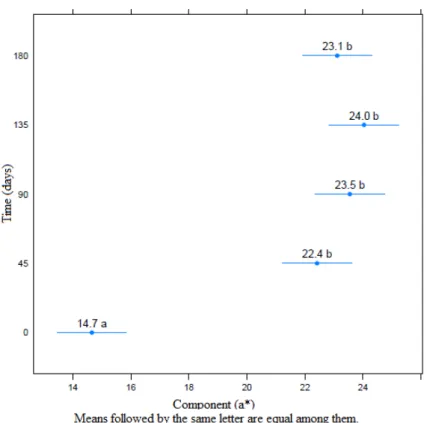
The a* coordinated or a* component showed variations in crude oil only during storage (Figure 3), observing a significant increase from 45 days of storage, indicating an increase of green color and increased of red color.
FIGURE 3. Mean values, at each time, of (a*) component, of the oil extracted from soybean stored
in relative humidity of 59.6%, 67.0% and 76.0%, at 30oC, for 180 days.
ALENCAR et al. (2009) noted an increase in color variation according to the increase of soybean humidity and storage temperature, which was not observed in this study since the variation was only influenced by storage. However, it can be considered that this increase was a positive factor, since the green color is related to the presence of chlorophyll in the oil, which should not be present because it reduces the commercial value.
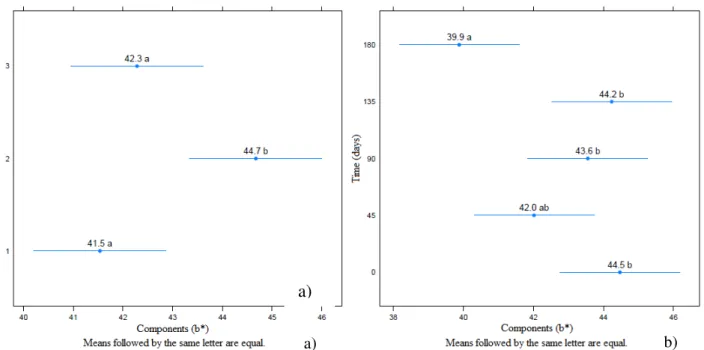
FIGURE 4. (b*) Component of the oil in each treatment (a), and at each time storage (b) extracted from the grains stored in relative humidity of 59.6% (T1), 67.0% (T2) and 76.0% (T3),
at 30oC, for 180 days.
The b* component takes positive values for yellow tone colors and negative for blue colors (-60 to 60) and reducing the amount of this component shows a tendency of loss of yellow color of the product. The change of color during storage can be related to oxidative processes occurring in the oil, as evidenced by the analysis of acidity index.
In the evaluation of the oil antioxidant capacity were observed significant differences between the storage conditions and storage time (Figure 5 a and b). The lowest values of antioxidant capacity were found in the oil of stored soybeans at 76.0% of relative humidity and higher values, at a relative humidity of 67.0%, indicating that lower soybean moisture content, so with higher of these values arising from storage at different relative humidity have lower antioxidant capacity, which can lead to increase the product oxidation.
FIGURE 5. Oil antioxidant capacity in each treatment (a), and at each storage time (b) extracted from the soybean stored in relative humidity of 59.6% (T1), 67.0% (T2) and 76.0%
(T3), at 30oC, for 180 days.
a)
a)
a)
b)
The antioxidant capacity is measured by capturing DPPH radicals present in the sample and as higher the value obtained, the better the oil storage. In high humidity storage conditions, there was a lower catch, probably because of the antioxidants have already rusted and no longer exist on these radicals. Most of the antioxidant capacity of certain vegetable oils is due to the large amount of phenolic compounds present (CASTELO-BRANCO & TORRES, 2011).
In specific extinction by absorption in the ultraviolet region, absorbance at a wavelength of 232 nanometers, the interaction between treatment and time were significant (Table 6).
TABLE 6. Comparison of the means of oil specific extinction, absorbance of 232 nanometers, extracted from soybean stored at a relative humidity of 59.6% (T1), 67.0% (T2) and 76.0% (T3), at 30°C, for 180 days.
59.6% RH* 67.0% RH 76.0% RH
Time 0 0.38 aA 0.38 abA 0.38 aA
Time 45 0.66 abA 0.42 abAB 0.30 aB
Time 90 0.87 bA 0.58 abB 0.85 bA
Time 135 0.89 bA 0.66 aA 0.77 bA
Time 180 0.98 bA 0.28 bB 0.30 aB
Means followed by the same letter, lower case on the column and capitalized on the line, do not differ by Tukey test at 5% significance.
* RH - relative humidity
The soybean oil stored in lower and higher relative humidity presented higher values of specific extinction from 90 days. This can be explained because the peroxides and hydroperoxides are very unstable and are rapidly decomposed to form low molecular weight products such as aldehydes. As the primary products (absorbance 270 nm) from oxidation were formed, they were broken down into secondary products, However when there was a reduction of primary compounds at the end of the storage, the secondary compounds increased even more which is explained by the fact that the formation of secondary compounds were already higher than the formation of primary compounds, what is normal, because from a certain point of degradation of the fatty acids, the formation of peroxides and hydroperoxides are limited (RODRIGUES et al., 2012 ).
In absorbance at a wavelength of 270 nanometers, the interaction between treatment and time were significant (Table 7) and the specific absorption at 270 nm showed a similar behavior to
absorption at 232 nanometers.
TABLE 7. Comparison of the means of oil specific extinction, absorbance of 270 nanometers, extracted from soybean stored at relative humidity of 59.6% (T1), 67.0% (T2) and
76.0% (T3), at 30oC, for 180 days.
59.6% RH* 67.0% RH 76,0% RH
Time 0 0.64 aA 0.64 bcA 0.64 abA
Time 45 0.50 aAB 0.24 aB 0.57 aA
Time 90 0.87 bA 0.56 bB 0.84 bcA
Time 135 0.93 bA 0.78 cA 0.87 cA
Time180 0.88 bA 0.46 bB 0.58 aB
Means followed by the same letter, lower case on the column and capitalized on the line, do not differ by Tukey test at 5% significance.
* RH - relative humidity
CONCLUSIONS
The storage time causes changes in the physicochemical properties of soybean, being the greatest changes in the evaluated parameters in environments with higher relative humidity. The grains stored at 30 °C in all the relative humidity had at the end of the storage oxidation problems. In crude oil, in all relative humidity occurred lipidic oxidation. This caused reductions in the parameter lipids content, specific extinction in the ultraviolet region (absorbance of 232 nm) of the oil, antioxidant activity, increased antioxidant capacity, in absorbance of 270 nanometers, in the acidity index and with variation also in the color of the beans. This indicates that oxidation has occurred, or the oil has been degraded over time, and especially in that stored for six months at 30 °C, with the lowest relative humidity (59.6%) and with higher relative humidity (76.0%).
The major degradation problems were most noticeable at 180 days of storage and with the increased relative humidity. Thus, the best way to store soybeans at 30 °C is to keep the intermediate humidity for short periods of storage.
REFERENCES
ALENCAR, E.R.; FARONI, L.R.D.; FILHO, A.F.L.; PETERNELLI, L.A.; COSTA, A.R.
Qualidade dos grãos de soja armazenados em diferentes condições. Engenharia Agrícola e
Ambiental, Campina Grande, v.13, n.5, p.606-613, 2009.
CANDEIA, R.A.; SINFRONIO, F.S.; BICUDO, T.C.; QUEIROZ, N.; BARROS FILHO, A.K.D.; SOLEDADE, L.E.B.; SANTOS, I.M.G.; SOUZA, A.L.; SOUZA, A.G. Influence of the storage on
the thermo-oxidative stability of methyl and ethyl esters by PDSC. Journal of Thermal Analysis
and Calorimetry, London, v.106, n.2, p.581-586, 2011.
CARRERA, C.; MARTINEZ, M. J.; DARDANELLI, J.; BALZARINI, M. Environmental variation and correlation of seed components in nontransgenic soybeans: protein, oil, unsaturated fatty acids,
tocopherols andisoflavones. Crop Science, Madison, v.51, n.1, p. 800-809, 2011.
CARVALHO, H.H.; JONG, E.V.; BELLÓ, R.M.; SOUZA, R.B.; TERRA, M.F. Alimentos:
métodos físicos e químicos de análise. Porto Alegre: Editora da Universidade/ UFRGS, 2002. CARVALHO, H.V.M. As evidências dos benefícios do consumo das isoflavonas da soja na saúde
da mulher: revisão de literatura. Científica Ciências Biológicas e da Saúde, Ribeirão Preto, v.16,
n.4, p.353-359, 2014.
CASTELO-BRANCO, V.N.; TORRES, A.G. Capacidade antioxidante total de óleos vegetais
comestíveis: determinantes químicos e sua relação com a qualidade dos óleos. Revista Nutrição,
Campinas, v.24, n.1. p.173-187, 2011.
CHRIST, D.; CUNHA, R.L.; MENEGALLI, F.C.; TAKEUCHI, K.P.; COELHO, S.R.M.;
NÓBREGA, L.H.P. Sorption isotherms of albúmen dried in a spout fluidised bed. Journal of Food,
Agriculture & Environment, Helsinki, v.10, n.2, p.151-155, 2012.
CORREA, C.R.; LI, L.; ALDINI, G.; CARINI, M.; OLIVER CHEN, C.Y.; CHUN, H.K.; CHO, S.M., PARK, K.M.; RUSSELL, R.M.; BLUMBERG, J.B. Composition and stability of
phytochemicals in five varieties of black soybeans (Glycine max). Food Chemistry, London,
v.123, n.4, p.1176-1184, 2010.
DECKER, E.A.; ALAMED, J.; CASTRO, I.A. Interaction between polar components and the
degree of unsaturation of fatty acids on the oxidative stability of emulsions. Journal of The
American Oil Chemists Society, Champaign, v.87, n.7, p.771-780, 2010.
DIAS, R.C.E.; FARIA, A.F.; MERCADANTE, A.Z.; BRAGAGNOLO, N.; BENASSI, M.T.
Comparison of extraction methods for kahweol and cafetol analysis in roasted cofee. Journal of the
GRANATTO, D.; MASSON, M.L. Instrumental color and sensory acceptance of soy-based
emulsions: a responser surface approach. Ciência e Tecnologia de Alimentos, Campinas, v.30, n.4,
p.1090-1096, 2010.
HOU, H.J.; CHANG, K.C. Storage conditions affect soybean color, chemical composition and tofu
qualities. Journal of Food Processing and Preservation, Oxford, v.28, n.6, p.473-488, 2004.
INSTITUTO ADOLFO LUTZ. Métodos físico-químicos para análise de alimentos. 4. ed. São
Paulo, 2008.
MARTINEZ, A.P.C.; MARTINEZ, P.C.C.; SOUZA, M.C.; BRAZACA, S.G.C. Alterações
químicas em grãos de soja com a germinação. Ciência e Tecnologia de Alimentos, Campinas,
v.31, n.1, p.23-30, 2011.
NAVARRO, S.; NOYES, S.T. The mechanics and physics of modern grain aeration
management. Boca Raton: CRC Press, 2001. 672 p.
NAZ, S.; SHEIKH, H.; SIDDIQI, R.; SAYEED, S.A. Oxidative stability of olive, corn and soybean
oil under different conditions. Food Chemistry, London, v.88, p.253-259, 2004.
PARK, C.; KIM, Y.; PARK, K.; KIM, B. Changes in physicochemical characteristics of rice during
storage at different temperatures. Journal of Stored Products Research, Oxford, v.48, p.25-29,
2012.
PAULETTO, F.B.; FOGAÇA, A.O. Avaliação da composição centesimal de tofu e okara.
Disciplinarum Scientia, Santa Maria, v.13, n.1, p.85-95, 2012.
RAMALHO, H.F.; SUAREZ, P.A.Z. A química dos óleos e gorduras e seus processos de extração e
refino. Revista Virtual de Química, Rio de Janeiro, v.5, n.1, p.2-15, 2012.
REZIG, L.; CHOUAIBI, M.; MSAADA, K.; HAMDI, S. Chemical composition and profile
characterisation of pumpkin (Cucurbita maxima) seed oil. Industrial Crops and Produtcs,
Amsterdam, v.37, p.82-87, 2012.
RODRIGUES, N.; MALHEIRO, R.; CASAL, S.; MANZANERA, M.C.A.S.; ALBINO, B.; PEREIRA, J.A. Influence of spike lavender (Lavandulalatifolia Med.) essential oil in the quality,
stability and composition of soybean oil during microwave heating. Food and Chemical
Toxicology, Oxford, v.50, p.2894-2901, 2012.
RUPOLLO, G.; GUTKOSKI, L.C.; MARINI, L.J .; ELIAS, M.C. Sistemas de armazenamentos
hermético e convencional na conservabilidade de grãos de aveia. Ciência Rural, Santa Maria, v.34,
n.6, p.1715-1722, 2004.
SMANIOTTO, T.A.S.; RESENDE, O.; MARÇAL, K.A.F.; OLIVEIRA, D.E.O.; SIMON, G.A.
Qualidade fisiológica das sementes de soja armazenadas em diferentes condições. Revista
Brasileira de Engenharia Agrícola e Ambiental, Campina Grande, v.18, n.4, p.446-453, 2014. SOARES, D.J.; TAVARES, T.M.; BRASIL, I.M.; FIGUEIREDO, R.W.; SOUSA, P.H.M.
Processos oxidativos na fração lipídica de alimentos. Boletim do Centro de Pesquisa e
Processamento de Alimentos, Curitiba, v.30, n.2, p.263-272, 2012.
TANAMATI, A.A.C.; TANAMATI, A.; GANZAROLI, J.F.; SANCHEZ, J.L.; SILVA, M.V. Estudo comparativo de métodos de extração de lipídios totais me amostras de origem animal e
vegetal. Revista Brasileira de Pesquisa em Alimentos, Curitiba, v.1, n.2, p.73-77, 2010.
THODE FILHO, S.; CABRAL, G.B.; MARANHÃO, F.S.; SENA, M.F.M.; SILVA, E.R.
Deterioração de óleos vegetais expostos a diferentes condições de armazenamento. Revista
TOCI, A.; NETO, V.; TORRES, A.; FARAH, A. Changes in triacylglycerols and free fatty acids
composition during storage of roasted coffee. LWT - Food Science and Technology, Amsterdam,
v.50, p.581-590, 2013.
VIANA, R.D.; OLIVEIRA, F.C.; MONTE, M.J.S.; PEREIRA, L.M.R.; CARVALHO, J.O. Ação de
antioxidantes no reaproveitamento de óleos vegerais. Revista Interdisciplinar, Teresina, v.7, n.4,
p.13-21, 2014.
ZUCHI, J.; SEDIYAMA, C.S.; LACERDA FILHO, A.F.; REIS, M.S.; FRANÇA NETO, J.B.; ZANUNCIO, J.C.; ARAÚJO, E.F. Variação da temperatura de sementes de soja durante o