Received August 11, 2011 and accepted April 9, 2012 Corresponding author: [email protected]
Technical Note
Energetic and nutrient metabolizability values of corn obtained with
nutritional corrections for broilers
Letícia Makiyama1, Renata Ribeiro Alvarenga1, Paulo Borges Rodrigues1, Márcio Gilberto Zangeronimo2, Evelyn Cristina de Oliveira1, Verônica Maria Pereira Bernardino1, Antônio
Amandio Pinto Garcia Júnior1, Antônio Gilberto Bertechini1
1Departamento de Zootecnia/Universidade Federal de Lavras – UFLA. 2Departmento de Medicina Veterinária/Universidade Federal de Lavras – UFLA.
ABSTRACT - The experiment was carried out to evaluate the influence of nutritional correction on the partial diet replacement or pure-food methodology to determine the energy values (apparent metabolizable energy - AME and nitrogen-correct apparent metabolizable energy - AMEn) and coefficient of metabolizability of nutrients of maize. The method of total excreta collection was used, with 120 female Cobb 500® broilers weighing 1,339±3 g and at 28 days of age distributed in a
completely randomized design with five replicates and four birds per experimental unit. The treatments were pure maize with three levels of nutritional correction (0, 50 and 100%) and a maize-replaced basal diet (400 g/kg) with two levels of correction (0 and 100%). The corrections were made in order to meet the nutritional requirements of calcium, available phosphorus and sodium yonder trace minerals, vitamins, choline, lysine, methionine + cystine, threonine and tryptophan. The AME and AMEn of maize and coefficient of metabolizability of dry matter were higher when correction at 100% was made, regardless of the methodology used (pure feed or replaced basal diet). The correction at 50% of nutrients increased the coefficient of metabolizability of crude protein in pure maize when compared with 0 or 100% of correction. The values determined with pure maize were lower than those determined with the method of partial replacement. The absence of nutritional correction underestimates the energy values and metabolizability of nutrients from maize.
Key Words: metabolism, metabolizable energy, replacement methodology, total collection
www.sbz.org.br
Introduction
Improvements in the genetic potential of poultry have resulted in changes in their dietary and nutritional needs. Thus, to adequate the feed formulation to the poultry requirement, it is essential to know the correct energy values and digestibility of nutrients in the feed.
In the literature, the traditional methodology to determine the metabolizable energy (ME) of feedstuffs consists of simply replacing a percentage of the basal diet by tested feed (Matterson et al., 1965). Another possibility to determine the nutritional values of feedstuffs is to use them in their pure form. However, Albino et al. (1987) pointed out that the values of ME of feedstuffs can be influenced by amino acid, vitamin and mineral compositions of the diets.
In this sense, the addition of some nutrients during the feed test can adequate the diets to the animal requirements, since their concentrations in feedstuffs are not sufficient to meet the requirements (Coehlo, 2000). It is known that unbalanced diets can affect the growth and health of birds
(Marks, 1975) and therefore the metabolism of nutrients of the feedstuffs (Lohakare et al., 2006).
Studies have shown, for example, that different amounts of vitamins can influence the metabolizability values of nutrients and energy from feedstuffs; among them are vitamin E (Chae et al., 2006), zinc (Trindade Neto et al., 2010), calcium and phosphorus (Cardoso Júnior et al., 2010) and amino acids such as lysine (Trindade Neto et al., 2010). Determining the energetic values of soybean meal for broilers, Avila et al. (2006) observed that adjusting the amounts of vitamins and microminerals in the test diet resulted in higher values.
Material and Methods
The experiment was conducted in the Department of Animal Husbandry, at Universidade Federal de Lavras (UFLA), located in the city of Lavras, Minas Gerais. All procedures were approved by the bioethics committee on utilization of animals of the institution. One hundred and twenty Cobb500® female broilers with initial average weight of 1,339±3g from 28 to 36 days of age were used. Animals were previously kept in a brick barn with bedding of wood shavings, receiving corn-soybean meal diets supplemented with other ingredients to meet the nutritional requirements recommended by Rostagno et al. (2005).
After this period, birds were weighed, homogenized and housed in metabolic cages (50 × 50 × 50 cm) equipped with aluminum trays with feeders and drinkers. The cages were located in a room with settings partly controlled through digital devices and artificial light for 24 hours. The experimental period lasted eight days: five for adaptation of animals to the experimental conditions and three for total excreta collection (Sibbald & Slinger, 1963, adapted by Rodrigues et al., 2005). A completely randomized
design with five replicates of four birds in each experimental unit was used.
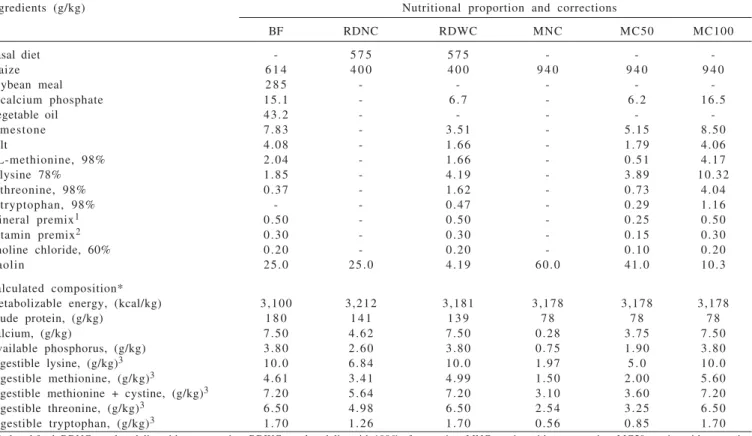
The test diets consisted of pure maize supplied with three levels of nutritional correction for growing broilers (0, 50 and 100%) and the basal diet partially replaced with maize (400 g/kg on natural matter) as described by Matterson et al. (1965) at two levels of nutritional corrections (0 and 100%). The corrections were to meet the nutritional requirement for amino acids (lysine, methionine + cystine, threonine and tryptophan), minerals (calcium, phosphorus, sodium and trace elements), vitamins and choline, according to the recommendations by Rostagno et al. (2005), replacing the kaolim (Table 1). Diets were provided ad libitum and feeders were filled three times a
day to avoid wasting.
The excreta collection was performed once a day starting at 8:00 am in trays coated with plastic to prevent loss. Diets and leftovers were weighed and recorded, respectively, at the beginning and the end of the experimental period of collection for determining the feed intake of each experimental unit. Animals were also weighted in the beginning and end of experiment (eight days). During the
Ingredients (g/kg) Nutritional proportion and corrections
BF RDNC RDWC MNC MC50 MC100
Basal diet - 5 7 5 5 7 5 - -
-Maize 6 1 4 4 0 0 4 0 0 9 4 0 9 4 0 9 4 0
Soybean meal 2 8 5 - - - -
-Dicalcium phosphate 15.1 - 6 . 7 - 6 . 2 16.5
Vegetable oil 43.2 - - - -
-Limestone 7.83 - 3.51 - 5.15 8.50
Salt 4.08 - 1.66 - 1.79 4.06
DL-methionine, 98% 2.04 - 1.66 - 0.51 4.17
L-lysine 78% 1.85 - 4.19 - 3.89 10.32
L-threonine, 98% 0.37 - 1.62 - 0.73 4.04
L-tryptophan, 98% - - 0.47 - 0.29 1.16
Mineral premix1 0.50 - 0.50 - 0.25 0.50
Vitamin premix2 0.30 - 0.30 - 0.15 0.30
Choline chloride, 60% 0.20 - 0.20 - 0.10 0.20
Kaolin 25.0 25.0 4.19 60.0 41.0 10.3
Calculated composition*
Metabolizable energy, (kcal/kg) 3,100 3,212 3,181 3,178 3,178 3,178
Crude protein, (g/kg) 1 8 0 1 4 1 1 3 9 7 8 7 8 7 8
Calcium, (g/kg) 7.50 4.62 7.50 0.28 3.75 7.50
Available phosphorus, (g/kg) 3.80 2.60 3.80 0.75 1.90 3.80
Digestible lysine, (g/kg)3 10.0 6.84 10.0 1.97 5 . 0 10.0
Digestible methionine, (g/kg)3 4.61 3.41 4.99 1.50 2.00 5.60
Digestible methionine + cystine, (g/kg)3 7.20 5.64 7.20 3.10 3.60 7.20
Digestible threonine, (g/kg)3 6.50 4.98 6.50 2.54 3.25 6.50
Digestible tryptophan, (g/kg)3 1.70 1.26 1.70 0.56 0.85 1.70
BF - basal feed; RDNC - replaced diet with no correction; RDWC - replaced diet with 100% of correction; MNC - maize with no correction, MC50 - maize with correction at 50%; MC100 - maize with correction at 100%.
1 Containing per kg of the product: zinc - 110 g; selenium - 360 mg; iodine - 1,400 mg; copper - 20 g; manganese - 156 g; and iron - 96 g.
2 Containig per kg of the product: folic acid - 1,600 mg; pantothenic acid - 29,000 mg; biotin - 60 mg; butylated hydroxytoluene (BHT) - 5,000 mg; niacin - 37,000 mg;
vitamin A - 20,000,000 UI; vitamin B1 - 3,000 mg; vitamin E - 40,500 UI; vitamin B12 - 27,000 mcg; vitamin B2 - 12,000 mg; vitamin B6 - 6,000 mg; vitamin D3 - 5,000,000 UI;
and vitamin K3 - 4,800 mg.
3 Amino acids expressed in ileal digestibility.
* Composition calculated according to Rostagno et al. (2005).
collection period, excreta were packed in plastic bags and stored at -5 °C until the end of the experiment, when they were thawed, weighed and homogenized.
Homogenized samples of approximately 400 g of excreta were collected and pre-dried in forced ventilation oven (55 °C) during 72 hours. Later, they were weighed again to determine the air-dried sample and ground in a knife-type mill with 1.0 mm sieve. Then, they were forwarded to the laboratory to determine the dry matter (DM), gross energy (GE) and nitrogen (N), along with samples of experimental diets. All laboratory analyses were performed at the Laboratory of Animal Nutrition at the DZO - UFLA, following methodology described by Silva & Queiroz (2002).
The apparent metabolizable energy - AME and nitrogen-correct apparent metabolizable energy - AMEn
values, apparent metabolizable coefficient of dry matter (AMCDM) and crude protein (AMCCP) were determined using the equations proposed by Matterson et al. (1965). Data were submitted to analysis of variance after the normality test (Shapiro-Wilk) and means were compared by the Scott-Knott test adopting probability of 0.05. All statistical analyzes were performed using the SISVAR (System for Analysis of Variance for Balanced Data, version 5.0).
Results and Discussion
The total correction of the nutrients increased (P<0.01) the AME and AMEn values as in the maize-replaced basal diet as pure-feed methodology (Table 2). Pure maize with 100% of nutritional correction increased the AMEn in dry matter in 912 kcal/kg (33%), while 50% of correction increased it in 282 kcal/kg (8.4%) compared with non-corrected maize. In the maize-replaced basal diet, the nutritional correction increased the AMEn in 234 kcal/kg (6.6%). These results are in agreement with Avila et al. (2006), who observed that the correction of diets with microminerals, vitamins and choline increased the energetic values of soybean meal. Even
working with enzyme complex, Groppo et al. (2010a) also observed an increase of 326 kcal/kg of AMEn in maize when nutritional corrections were made in the diets. These results can be linked to the imbalance in nutrients in test diets without nutritional correction, which can probably lead to lower absorption in the gastrointestinal tract and lower energetic values of feed determined.
Considering 100% of corrections, no difference (P<0.01) was observed in values of AMEn determined by pure maize or by the diet partially replaced. However, when the correction was not performed or was partially used, the use of pure maize resulted (P<0.01) in lower AMEn when compared with partially-replaced diet. This result shows that the presence of essential nutrients can influence the energetic values of feeds.
Recently, Trindade Neto et al. (2010) verified that lysine levels affected the AMEn values of the diet, but did not observe the same effect with different levels of zinc. Silva et al. (2008) also observed no differences in energy levels of the diets when working with different levels of phosphorus. On the other hand, Cardoso Júnior et al. (2010) verified that the relationship of this element with calcium is important in determining the energy values of the diets. It is important to mention that these authors did not work with a particular feedstuff, but the little variation of some nutrients can influence the energy values of the feedstuffs and probably of the diet as well. This occurs because of metabolic changes due to imbalance of dietary nutrients. In the present study, where there was a wide variation in nutritional composition between experimental diets, such metabolic changes can be better evidenced. In this case, the nutritional diet corrections may be important to estimate of energetic values of feeds, leading to an adequate balancing of diets to poultry.
These results suggest that the energy values normally determined with no nutritional correction may be underestimated, probably due to the greater deficiency of vitamins, minerals and amino acids, mainly in pure
Experimental diet AME (kcal/kg) AMEn (kcal/kg) AMCDM (g/g) AMCCP (g/g)
Maize with no correction 2,795d 2,736d 0.647d 0.455e
Maize with 50% of correction 3,459c 3,366c 0.794c 0.642c
Maize with 100% of correction 3,736b 3,648a 0.859b 0.565d
Replaced diet with no correction 3,634c 3,533b 0.830c 0.744b
Replaced diet with 100% of correction 3,950a 3,767a 0.905a 0.862a
Basal diet 3,661 3,503 0.756 0.669
P value <0.001 <0.001 <0.001 <0.001
Coefficient of variation (%) 3.59 3.66 3.69 5.28
Means followed by different letters in the column differ (P<0.05) by Scott-Knott test.
maize. These nutrients have a notable role in the absorptive process.
Regarding the apparent metabolizability coefficient of dry matter (AMCDM), it was observed that the nutritional correction of pure maize and maize-replaced diet resulted in higher (P<0.01) values. The 50 or 100% nutritional correction of pure maize increased the AMCDM values in 23 and 33% and the 100% of nutritional correction of partially-replaced diets increased it in 9%. Once more, this result suggests a better balance of nutrients when values are corrected, improving the use of nutrients in. The same result can be seen with the apparent metabolizability coefficient of crude protein (AMCCP), but for pure maize, 50% of nutritional correction showed better results. In both variables, the use of partially-replaced diet with nutritional correction resulted in higher values when compared with pure maize, with values 5.3 and 52.5% higher for AMCDM and AMCCP, respectively. This shows that the AMCCP is more influenced by nutrient balance of the diets than the AMCDM.
It was observed that the 50% nutritional correction in pure maize resulted in higher AMCCP, in comparison with pure maize with or without 100% of corrections. This increase was of 14 and 41%, respectively. This can be due to excess or lack of free amino acid in these diets, reducing the AMCCP values. In both cases, a competition between amino acids by the absorption site in enterocytes may have influenced these negative values. According to Rutz (2002), the existence of transport proteins common to amino acids indicates the competition between them during the absorptive process. In addition, the amino acid unbalance is critical because diets deficient in one or more essential amino acids harm the normal growth of the birds.
Groppo et al. (2010b) also verified an increase in the AMCDM and AMCCP when using nutritional correction on the test diets. Reports in the literature show that individual levels of some nutrients can also interfere with the determination of these values. Sahin et al. (2001) found that dietary supplementation with vitamin C and chromium increased the nutrient digestibility of dry matter, organic
matter, crude protein and ether extract of poultry diets. Sahin & Kucuk (2001) also observed an increase in nutrient digestibility after dietary supplementation only with vitamin C in Japanese quails. On the other hand, Chae et al. (2006) reported that energy use and apparent metabolizability coefficient of crude protein and ether extract of the diets were significantly reduced when vitamin E was added. In spite of these results, considering nutrients separately, it is important to consider the many interactions between them, which not only influence the intestinal absorption capacity, but also the gastrointestinal health and the use by the cells of the organism.
It was observed that pure maize supplied with 100% nutritional corrections showed lower (P<0.01) feed intake and weight gain during the experimental period, confirming previous findings of lower utilization of nutrients (Table 3). According Bertechini (2006), the imbalance of amino acids in the diet can lead to physiological and metabolic changes that influence the feeding behavior of animals in an attempt to regulate the concentration of amino acids in plasma and tissues due to inadequate absorption. This results in limited tissue protein synthesis and an excess of amino acids that are not used for this purpose, increasing the nitrogen excretion by birds, confirming the lower AMCCP obtained with pure maize without correction or with 100% of corrections, which represent a condition of excessive amino acids.
The weight gain was higher (P<0.01) when the partially-replaced diets were used with regard to pure maize, regardless of corrections. This result confirms that the methodology by replacement is better to determine the nutritional values of feedstuffs due to performance closer to the conditions in which poultry are raised. However, it must be considered that the short experimental period may have not been enough for the birds to manifest negative response to the test diet with no correction. Nevertheless, the use of pure feed results in lower bird performance in this period.
The results of present study confirm the importance of using nutritional correction, either with pure feed or with
Means followed by different letters in the column differ (P<0.05) by Scott-Knott test.
Experimental diet Feed intake, g/bird/day Weight gain, g/bird/day
Maize with no correction 179.6a 44.3c
Maize with 50% of correction 170.6a 96.7b
Maize with 100% of correction 139.8b 29.5c
Maize-replaced diet with no correction 196.3a 199.8a
Maize-replaced diet with 100% of correction 186.0a 200.3a
Basal diet 182.1 209.5
P value <0.001 <0.001
Coefficient of variation (%) 8.03 11.34
partially-replaced diet and provide subsidies to future research studies with others ingredients that can be used in poultry nutrition. The knowledge of real nutritional values of feedstuffs leads to lower errors at the formulation of diets and improves broiler performance.
Conclusions
The absence of nutritional correction underestimates energy and metabolizability values of nutrients from maize. The method of partial replacement of feed in the basal feed is the most suitable when determining the nutritional value of the feed.
Acknowledgments
To Conselho Nacional de Desenvolvimento Científico e Tecnológico - CNPq andInstituto Nacional de Ciência e Tecnologia em Ciência Animal – INCT CA.
References
ALBINO, L.F.T.; COELHO, M.G.R.; RUTZ, F. et al. Valores energéticos e de triptofano de alguns alimentos determinados, em aves jovens e adultas. Pesquisa Agropecuária Brasileira, v.22, p.1301-1306, 1987.
AVILA, V.S.; PAULA, A.; BRUM, P.A.R. et al. Uso da metodologia de coleta total de excretas na determinação da energia metabolizável em rações para frangos de corte ajustadas ou não quanto aos níveis de vitaminas e minerais. Revista Brasileira de Zootecnia, v.35, p.1691-1695, 2006.
BERTECHINI, A.G. Nutrição de monogástricos. Lavras: UFLA, 2006. 301p.
CARDOSO JÚNIOR, A.; RODRIGUES, P.B.; BERTECHINI, A.G. et al. Levels of available phosphorus and calcium for broilers from 8 to 35 days of age fed rations containing phytase. Revista Brasileira de Zootecnia, v.39, p.1237-1245, 2010. CHAE, B.J.; LOHAKARE, J.D.; CHOI, J.Y. Effects of incremental
levels of α-tocopherol acetate on performance, nutrient
digestibility and meat quality of commercial broilers. Asian-Australasian Journal of Animal Sciences, v.19, p.203-208, 2006.
COEHLO, M. [2000]. Poultry, swine and dairy vitamin supplementation updated. Feedstuffs. Available at: <http:// www.highbeam.com/doc/1G1-64438696.html> Accessed on: Jul. 20, 2011.
GROPPO, D.P.; CASTRO, S.F.; FARIA, J.H. et al. Valores energéticos do milho utilizando correções nutricionais para
frangos de corte na fase final de criação. In: CONGRESSO LATINO AMERICANO DE NUTRIÇÃO ANIMAL, 4., 2010, São Pedro. Anais... São Pedro: CBNA, [2010a]. (CD-ROM). GROPPO, D.P.; NARDELLI, N.B.S.; CASTRO, S.F. et al. Avaliação
da digestibilidade dos nutrientes do milho em rações com correções nutricionais na fase final de criação de frangos de corte. In: CONGRESSO LATINO AMERICANO DE NUTRIÇÃO ANIMAL, 4., 2010, São Pedro. Anais... São Pedro: CBNA, [2010b]. (CD-ROM).
LOHAKARE, J.D.; LEE, S.H.; CHAE, B.J. Effect of dietary fat-soluble vitamins on growth performance and nutrient digestibility growing pigs. Asian-Australasian Journal Animal Science, v.19, p.563-567, 2006.
MARKS, J. A guide to the vitamins: their role in health and disease. 5.ed. England: Medical and Technical Publishing, 1975. 208p.
MATTERSON, L.D.; POTTER, L.M.; STUTZ, M.W. et al. The metabolizable energy of feed ingredients for chickens. Connecticut: The University of Connecticut, Agricultural Experiment Station, 1965. p.3-11. (Research Report). RODRIGUES, P.B.; MARTINEZ, R.S.; FREITAS, R.T.F. et al.
Influência do tempo de coleta e metodologias sobre a digestibilidade e o valor energético de rações para aves. Revista Brasileira de Zootecnia, v.34, p.882-889, 2005.
ROSTAGNO, H.S.; ALBINO, L.F.T.; DONZELE, J.L. et al. Tabelas brasileiras para aves e suínos: composição de alimentos e exigências nutricionais. 2.ed. Viçosa, MG: UFV, Departamento de Zootecnia, 2005. 186p.
RUTZ, F. Proteínas: digestão e absorção. In: MACARI, M.; FURLAN, R.L.; GONZALES, E. (Eds.) Fisiologia aviária aplicada a frangos de corte. 2.ed. Jaboticabal: Funep, 2002. p.135-141.
SAHIN, K.; KUCUK, O. Effects of vitamin C and vitamin E on performance, digestion of nutrients and carcass characteristics of Japanese quails reared under heat stress (34°C). Journal of Animal Physiology and Animal Nutrition, v.85, p.335-341, 2001.
SAHIN, K.; SAHIN, N.; KUCUK, O. Effects of dietary chromium and ascorbic acid supplementation on digestion of nutrients, serum antioxidant status, and mineral concentrations in laying hens reared at a low ambient temperature. Biological Trace Element Research, v.87, p.113-124, 2001.
SIBBALD, I.R.; SLINGER, S.J. A biological assay for metabolizable energy in poultry feed ingredients together with findings which demonstrate some of the problems associated with evaluation of fats. Poultry Science, v.42, p.13-25, 1963.
SILVA, D.J.; QUEIROZ, A.C. Análise de alimentos: métodos químicos e biológicos. 3.ed. Viçosa, MG: UFV, 2002. 235p. SILVA, Y.L.; RODRIGUES, P.B.; FREITAS, R.T.F. et al. Níveis de
proteína e fósforo em rações com fitase para frangos de corte, na fase de 14 a 21 dias de idade. 2. Valores energéticos e digestibilidade de nutrientes. Revista Brasileira de Zootecnia, v.37, p.469-477, 2008.