A Work Project, presented as part of the requirements for the Award of a Master Degree in Management from the NOVA – School of Business and Economics.
Export and Internationalization Field Lab Vicaima Business Plan
Pedro Miguel Oliveira Atão Resende 24649
A Project carried out on the Master in Management Program, under the supervision of: Pedro Gonçalves e Pedro Santos
1 Abstract
This master thesis studies the most appropriate entry mode to Cuba for Vicaima and its subsequent stages of internationalization. I analyze the general business environment in Cuba and the attractiveness of the interior door industry in Cuba with a Pestle analysis and 5 forces of Porter, respectively, and we define the company’s organizational resource platform. I also study the pros and cons of diverse internationalization modes and concluded that a successive stage model approach is the most suitable for SME companies like Vicaima. I conclude that Vicaima should start its internationalization mode with Indirect Exportation and evolve into a servicing facility. Key words: Vicaima; Internationalization Plan; Cuba, Entry modes; Hotel industry.
2
Contents
Introduction ... 3
Country and industry Analysis ... 4
PESTLE Analysis ... 4 Political... 4 Economic ... 5 Social ... 5 Technological ... 6 Legal ... 6 Environment ... 7
The Future of Cuba’s Tourism ... 7
Five forces of Porter... 9
Bargaining power of buyers ... 10
Bargaining power of Suppliers ... 11
Threat of substitutes ... 11
Competitive rivalry ... 11
Threat of New entrants ... 12
Resources Based View ... 13
Entry mode ... 14
3
Introduction
Vicaima - Indústria de Madeiras e Derivados, S.A was born in 1959, and is currently the market leader in Portugal, producing mainly interior doors, including technical doors, closets and frames. The company focus mainly in Hotel and Residential sector. Its ability to design the whole room and their value engineering are factors that differentiate the company from its competitors, consequently enticing customers from all around the world. Its vast experience in exporting while being present directly in different countries gives Vicaima a solid general knowledge about internationalization. To remain successful and continue growing it needs to stay alert about the global industry’s environment and scan for new opportunities. The recent easiness of relations between the USA and Cuba plus the strong continued growth of tourists are strong reasons to believe that the Hotel industry is about to develop, thus creating an interesting demand for Vicaima’s products. Nonetheless caution is advised as Cuba is a country full of uncertainties. A country with a communist political system, with an embargo with the USA still in place, (problem that was further increased with the recent election of Trump), a degraded economy that is highly dependent on few partners and a legal system with a lot of room to improve, among others. For these reasons, it is important to enter the Cuban market with the strategy that implies less risk while still broadcasting to the hotel industry that Vicaima is present in the Cuban market and ready to fulfill their orders. After acquiring more knowledge and understanding the market’s direction, the company should upgrade its market commitment with a greater presence in Cuba, enabling a stronger growth.
Vicaima has direct presence in Portugal, Spain, Morocco and the UK and exports more than 90% of its production worldwide and is committed to the quality of raw materials and the innovative design of its products. Their position is sustained in the ability to develop integrated and customized solutions targeted at various sectors, including residential, hotel, health, education and commercial, even though the hotel and residential sectors are the most important for the brand.
After gaining insight of what the company is, and what is the final purpose of this study one can continue by studying the surrounding environment.
4
Country and industry Analysis
Before committing resources into international expansion any business should undertake an analysis of the environment in the country concerned. The better the understanding of a country’s political, economic, and cultural environment, the greater the probability of the product succeeding and the less risk to a company’s profitability and reputation.
PESTLE Analysis
Political
US-Cuban relations have been easing in the past years but not as fast as it was expected. In July 2015, the US and Cuba formally announced the re-establishment of diplomatic ties. In the meantime, United States have relaxed several of the restrictions on trade and travel between the two countries. Still the longest embargo in the history of the world remains which and can only be removed by legislation, and a consensus about this matter still seems to be distant in time since many Republicans in Congress still oppose any move to lift the embargo. Concerning this matter one can say that the recent presidential elections in the US have shaken the negotiations in favor of the normalization of the relations between the countries, since Trump declared to be against this and threatened a drawback, criticizing the lack of religious and political freedom in the country (Euromonitor International 2016).
The resumption of relations, reformed the procedures for an USA citizen to travel to Cuba. A formal application process was dropped and most travelers from the US to Cuba in 2015 were successfully able to self-licensed trips subject to specific criteria. Approved activities included: family visits, educational activities, humanitarian projects, journalism, and a broadly defined “people-to-people” activities designation. Traveling to Cuba with the purpose of leisure tourism is still not legalized, however, official criteria purpose for travel was not monitored very closely by the relevant US entities, which resulted in an increase to 300 thousand of visitors (Euromonitor International 2015).
5 Relations with the EU have also improved after formal ties were resumed in 2005, furthermore, Cuban and EU officials have been meeting, and in 15th and 16th of June held the 4th round of negotiations on a “Political Dialogue
and Cooperation Agreement” (European Commission 2016).
Economic
Cuba’s GDP growth has been slowing in the recent years despite the efforts. Cuba’s national statistics point that the country’s GDP accounted to 1925 billion pesos, officially corresponding to 77 Billion dollars. One of the reasons for the slowdown is the poor performance of major Cuban partners such as Brazil, China or Venezuela. To worsen the situation, Cuba lost some of its exporting power with the tumble of global oil prices, that in 2007 was priced at about 100$ and currently is 50,93$, since Venezuela sells it heavily subsidized to Cuba, and the island re-exports part of it (DeSilver 2015).
Additionally, former International Monetary Fund economist Ernesto Hernandez-Cata estimates that Cuba’s private and cooperative sector generated 25.3% of GDP in 2012, compared with just 5% in 1989. But the government, both directly and through state-owned enterprises, was still the source of more than three-quarters of Cuba’s economic activity. Government investment represented just 9.1% of GDP in 2012, versus 14.2% in 1989, revealing one of the most disturbing aspects of Cuba’s recent economic history that is the weakness of capital formation. Furthermore, Cuban economy is highly dependent on international trade. In 2014, Cuba exported $4.4B and imported $11.5B, resulting in a negative trade balance of $4.17B (Euromonitor International 2015). While most of Cuba’s exports are in the form of services (e.g. healthcare), nearly all its imports are goods such as petroleum, food (nearly 80% is imported), machinery and equipment (DeSilver 2015).
Social
After the revolution, the income of the poorest people rose improving the redistribution of wealth and Cuba today is seen as the country with the smallest differences between rich and poor of Latin America, despite this, the income level is still low. The shift towards a more open economy and the great flow of tourists have also affected
6 education. Seeing that jobs related to tourism earn more than highly qualified jobs such as doctors, students see no point in further studies (Garcell 2010, 57-59).
Alike Portugal, there’s a stable population size of 11 million and absence of social violence which is good for making business. However, the increasing income differences due to remittances and tips, plus the lack of opportunities may trigger social violence in the future (Garcell 2010, 62 – 63).
Technological
The Cuban transportation infrastructure was before 1959 among one of the most developed in Latin America but after 1959 very little of the infrastructure has been updated (Garcell 2010, 64).
Communication technology, area of increased importance in the recent years, has had significant developments, e.g., now everyone is allowed to use the internet, and there are over 150 000 terminals where one can have access to it (conference with Cuban ambassador 2016).
Tourism-specific infrastructure, including hotels, taxi services and airports, have advanced to support the existing levels of tourist flows to Cuba. In 2014, there were just under three million travelers from countries other than the US visited Cuba, according to Euromonitor International and UNWTO estimates.
Legal
The previous law in place (Law 77 of 1995) was published in the late 90’s and initially it was a success. Despite the progresses that the law accomplished Cuba were still not able to capture enough FDI and it was lagging behind other countries in the region. The Law 118 of 2014 redefined the legal framework, offering greater incentives and guarantees to foreign investors in this moment where the Cuban government needs foreign investment to achieve its goals (Foxroth 2014). Under the new law, FDI is allowed in all economic activities except in telecommunications, public health, armed forces, education, and communication system. (conference with Cuban ambassador 2016), and there are several incentives for FDI, especially for Hotel Management.
7 One of the issues with this law is that no foreign investor can hire labor directly except for certain top management or technical positions to be held by nonpermanent residents. They are subject to a government employment agency that negotiates the salary of the worker in line with the average salary (25$ per month).
Finally, the new law nº11 supports that the 3 types of investment are entitled to export and import directly whatever is needed for their operation, yet the acquisition the acquisition of goods in the Cuban market is preferred, if these goods meet the same standards of the international market (Cuba Foreign Trade 2015).
Environment
Clearly Cuba is in need of the economic benefits that the lift of the embargo would mean, nevertheless one can understand that this could represent a threat for the admired Cuban natural environment. This factor allied to the Cuban socialism and the poor development has limited the erosion of beaches, deforestation, pollution of waters and other forms of environmental mayhem. Meaning that the island could face threats during the next decades if it expands the tourism industry and other industries into those more remote areas of the country, which might lead to contamination and deforestation (The New York times 2015).
The Future of Cuba’s Tourism
From the PESTLE analysis, it is clear that the Cuban infrastructures, namely tourism related, are not ready for the spike that is expected. This section serves to analyze the future evolution of tourists and hotel rooms expected in more depth.
The current state
Currently there are about 60.000 hotel rooms and more than 3.5M tourists with the numbers continually growing in the last years (17.4% increase from 2014 to 2015). This resulted in a significant demand creation and consequently, some hotels reported that they were fully booked for up to 18 months in 2015. Eyeing this opportunity, the number of private homestays have been increasing and they are estimated to be about 20.000, even though, some of these are not sufficiently equipped and cannot be booked in advance online (The guardian
8 2015). For this reason and with the intention to evolve an industry that is today already the second largest earner or foreign currency Cuba is working on 53 investment projects from different fields such as marketing and hospitality management, while 26 have already established (2015).
In June 2015, 18 international hotel chains managed nearly 36.000 (57%) hotel rooms, most of them managed by Spanish companies, where Melia Group manages 27 hotels. Interestingly, luxury (4 and 5 star hotels) hotels comprise 85% of these foreign-run resorts (Travel industry today 2016).
It is also important to highlight the readiness of American airlines to travel to Cuba as soon as the restrictions are eased. “If something changed tomorrow, we have everything we need to fly,” says Scott Laurence, senior vice president of network planning at JetBlue Airways which has been flying charters to Cuba since 2011 from 2 different Florida cities and New York. Havana has also given the green light to passenger cruise companies based in the U.S., including Carnival, which has spring departures planned, provided Cuba changes its policy barring nationals from returning by sea. One must note that logistics for the transportation of millions of Americans to Cuba won’t happen suddenly especially because flights to Cuba are likely to be regulated by the agreements that permit access to many other constrained airports meaning that flights will be carefully coordinated to ensure capacity limits aren’t breached. Consequently, airlines probably won’t be able to schedule flights whenever they want or wherever they want. Nevertheless, airline and ferry companies seem to be preparing for the future (Bloomberg 2015).
Predicting the Future
An IMF study of 2008, to date one of the most thorough analyses of tourism demand to Cuba, estimated that 10 million Americans would go to Cuba each year if they were legally allowed. Part of the estimates are based in history, in the 50’s Havana received lots of Americans, and the city was considered as a casino playground for them with several short flights. Moreover, after the restrictions eased there was an increase of 50% of American visitors from 2014 to 2015, (Euromonitor International 2015) regardless of the continuing difficulties and tourism
9 purposes still not being allowed. This shows the huge interest that Americans have in visiting a mystic country that has been closed to them for so long.
To accommodate the increasing tourists, the Cuban government expects the country to have 110.000 more hotel rooms by 2030. Clearly accommodating this many tourists seems like a difficult task especially when the country is already facing difficulties.
To date with over 60.000 hotel rooms and 3.5 million tourists, it is already facing lots of logistic problems to lodge all these people. Considering the 10 million American visitors and the nearly 300.000 current American visitors, Cuba will have 13,2 million visitors all other nationalities equal, even though tourist number from other countries have been gradually increasing as well. This shows the huge accommodation issues that Cuba will face in the near future.
One way to battle this issue will be with cruise ships, basically mobile hotels that can bring their own infrastructures helping with the tourist accommodation.All three of the major lines—Carnival, Royal Caribbean Cruises, and Norwegian Cruise Line—have already expressed interest in adding Cuba to their itineraries (Bloomberg 2015).
Furthermore, all expectations are being built in a distinct scenario. There is a huge hype internationally about visiting Cuba while it doesn’t change, trip advisor and other agencies nominated Hotel Royalton Cayo Santa Maria as the best all-inclusive in the world.
Five forces of Porter
According to Porter, the external environment plays a crucial role for the industry’s profitability and consequently, its attractiveness, thus it is crucial to project the future of the interior door market in Cuba to ascertain its potential. To complete this analysis, an interview was performed with Pedro Silva, Vicaima’s Board Director and secondary sources used.
10
Bargaining power of buyers
Enterprises are continually seeking to maximize their profits, and one big part of the exercise is buying the cheapest supplies while not compromising quality, and the hotel and residential industries isn’t different. In a normal situation for this industry where the buyers (hotels) are concentrated and their suppliers immense throughout the world, the buyer would have more power to dictate the terms of the deal, otherwise finding a different supplier easily.
Furthermore, situations in which the customer’s purchase represent a sizable portion of the firm’s output will give the buyer more power since suppliers are more averse to losing this project. In order to overcome this problem, companies are challenged to diversify the risk and have several major customers, while this type of big orders turn the customer more price sensitive increasing its power.
Despite the existence of switching costs due to the need of hotel groups to standardize their services in their different hotels around the world they are not very high, and are probably not big enough to lock a customer. Most arguments point towards a high customer power, nevertheless, the current situation in Cuba is a very distinct moment. Many hotels are being built, projected or even restored creating thus a huge demand. In addition to this, the fact that U.S suppliers that represent about 14% of the 167 billion $ of the door & windows industry worldwide, can’t compete due to the embargo restricting US companies to export or investing in Cuba. The number of hotels and their race to overcome their competitors plus the restrictions to some powerful suppliers should shift some of the bargaining power to the suppliers such as Vicaima (gminsights, 2015). When the embargo ends, the American hotel industry will want a piece of the market but they will have the challenge of being a late starter and will want to rush things, this should make the power shift towards the suppliers at that time even if supply competition is also increasing.
For these reasons the buyers bargaining power in Cuba shouldn’t be as high as in other regions which might be appealing for the industry.
11
Bargaining power of Suppliers
This industry’s relationship with their suppliers is much in line with what happens between the hotel industry and their suppliers such as Vicaima. Supplies for the door industry are mainly from 3 different types, wood and their derivatives, metal and finishing. These firms are atomized, meaning that there are a lot of different firms and none has massive power over each other. This very split market share increases rivalry among suppliers and companies such as Vicaima are able to do a good sourcing, whether in terms of price or in quality.
In brief, the lack of switching costs, game changing features but especially the large number of firms with similar power makes the buyer group once again more powerful in negotiations than their counterparts and change isn’t expected for the near future.
Threat of substitutes
Considering that we’re analyzing the interior door industry in Cuba as a whole it is hard/impossible to identify reliable substitutes that can replace the product/service.
Competitive rivalry
Notwithstanding the number of key competitors, a business faces, it is crucial for its success to understand the differences between its rivals. As said before this industry’s products don’t rely on unique game changing features nor excessive switching costs, therefore contributing for a lack brand loyalty and consequently firms compete on prices more often increasing the rivalry of the industry.
A large number of players involved in this industry increases the level of rivalry. This happens because there’s a larger number of organizations trying to increase their market share/profits or buying cheaper resources.
Fortunately for these firms, there has been a steady growth in the world market. While the door industry is growing 6% a year, (window and door, 2016). This means that there is space for most firms to grow, in different regions of the globe to focus on, thus declining the rivalry among competitors. Besides the construction of new
12 hotels, this growth is also supported by the hotel’s need to keep renovating in order for a hotel to keep up with standard but also because renovations have become a marketing strategy (Hotels news now 2013).
Indeed, most of the factors point to a high competitive level but once again we must point out the distinct situation in Cuba, the strong growth expected until 2030 in the demand should decrease the normally high rivalry.
Threat of New entrants
When a business is booming, every supporting activity will keep a close eye on it to check for opportunities. This case is no different, the strong growth expected for the tourism industry will drag along different companies increasing competition.
In this industry where it is easy to change supplier, brand loyalty will play a crucial role in a firm decision to enter or not the market. In this case where there’s low levels of brand loyalty it is quite easier for a firm to enter and start grabbing a significant piece of the market quickly.
Nonetheless, there are several challenges when doing business in Cuba that potential entrants will have into consideration. One of the most important will certainly be the slow decision making in the country, especially if one wants to be directly present the process can be very long but for exporting the new law entitles all business forms to import directly, they just have to register through MINCEX. Even though this is within the law, in practice there are several entities that serve as middleman for most imports, which for this industry one of most significant importer is “Tecnotex”. Another positive aspect for the industry in question is that tourism related industry has a quite different import authority since they are not subject to the standard practice for the Cuban state to buy on credit terms of 1 year. Another issue that investors will be eyeing, is the evolution of the relations with US that can undermine the development of the tourism industry as pointed earlier.
Concluding, the external environment appears to be favorable for the future, a strong demand expected will shift some of the hotel’s power to their suppliers, thus this industry should be highly profitable in Cuba. Consequently, the threat of new entrants is very high and competition fierce, hence the importance of the next section.
13 Resources Based View
In this context of high rivalry, Vicaima focus on key aspects of the industry that help the company to be one step ahead and to be successful and have a sustainable growth. One of those aspects that gives Vicaima competitive advantage in the hotel industry is the ability to design a full hotel room called, “joinery turn key hotel room”. This is appealing for hotels, because they can delegate the responsibility of designing the whole room to an experienced partner while for Vicaima this solution is attractive because it implies Vicaima selling more products such as the wooden frames or closets with higher margin, generating higher profit.
To fight the relatively standardization of the product mentioned in the industry analysis, Vicaima gives much focus to innovation, and is constantly looking to its product range in order to find ways to improve it or reorganize it. Moreover, to increase value in the eyes of the customer they engage in a value engineering policy. They present to their customer alternative solutions whether, lower cost solutions or solutions with improved specifications. This intends to surpass the customer’s expectations even if it is not the most immediate profitable solution for Vicaima and lock the customers.
A company should not only have good products but also needs to be able to effectively let their customers know them. For this reason, Vicaima is bold in their communication and invests simultaneously in an electronic strategy, via web and social network and other promotional materials such as exhibitions and public relations, that allow customers to know their products in depth. Finally, after working towards the goal of exceeding expectations, Vicaima focus on building a memorable brand. They don’t want to be simply remembered as another legal entity but as Vicaima – Unexpected Harmony.
In order to make the supply chain more integrated and work better they hold informal partnerships with other companies, beginning with suppliers of industrial components, going through companies of information technology and ending with partnerships with logistic and distribution firms.
14 As we can denote, these capabilities give Vicaima’s products more perceived value in the eyes of their potential customers such as the value engineering, the innovation, their flexibility, or the branding but also decrease costs with a global sourcing, always screening for better opportunities and an integrated supply chain. All these aspects will be helpful for a successful entry in the Cuban market, thus can be concluded that Vicaima would be competitive in this market otherwise an expansion would not be advisable.
Entry mode
After analyzing the business environment, the industry and the company one must conclude that an expansion to Cuba with wariness is advisable, thus the next section will ascertain the best feasible mode.
Literature review
When choosing entry modes, firms make trade-offs analysis between control and resource commitments (Peter Buckley, The internationalization of the firm 1998). If the manager does not expect to obtain accurate and reliable information, then he will opt for the strategy that implies less information gathering and less risks. Furthermore, country variables such as political stability, enforcement of laws, location, demand, and competition risk plus variables specific to the company/industry such as market knowledge, experience in internationalization or the know-how level. Besides these, home country factors such as regulations that could impede or undermine the entry modes which was found to be none, target country production factors such as cheap labor or a large production of supplies used by the company. Lastly, the product itself influences the entry strategy, some products can’t be exported, others imply a high initial investment or a large scale to be efficient such as this case. As seen in the previous sections, most factors favor a move to Cuba with caution due to high uncertainty which was further increased by the election of Trump. It may cause the drawback in the negotiations but can have also the opposite effect to force Cuba to accelerate the process of “westernization”.
Furthermore, a great deal of internationalization theories favor successive stages of commitment each one representing more resources committed by the company in that market, such as the Uppsala model, the I-model
15 or the IPLC theory. For example, in the Uppsala model, Johanson and Wiedersheim (1975) noticed that firms first start their operations in a foreign country by exporting (Appendix 3). Nevertheless, there are exceptions, when firms have large amounts of resources to be allocated, when market conditions are stable and homogeneous and when the firm has great experience from similar markets (Hollensen 2004 p54). Per the authors, the concept of market commitment lies on two factors, the amount of resource commitment can be thought of as the size of investment in the market (marketing, organization, personal), and the degree of commitment that refers to the difficulty of finding a reliable alternative use for those resources. (Appendix 3)
The Uppsala theory implies that additional market commitments will be made in incremental steps and that international activities require market specific knowledge, acquired mainly through experience in the market, and general knowledge that can be transferred from one country to another, meaning that this latter knowledge will facilitate lateral growth. The better the knowledge about a market, the more valuable are the company’s resources, and the stronger the commitment to the market. Finally, the commitment decisions are concerned with decisions to commit current resources to foreign operations. Assuming that these decisions are made in response to perceived problems/opportunities in the market, the commitment decisions will depend on knowledge. When this model was revisited in 2009, after the emergence of the network theory, the authors assumed that networks assume a crucial role in internationalization since this network can transfer knowledge to the company, give a more stable environment and present the company with better opportunities (Johanson and Vahlne, 2009) The I-Model, which shares significant similarities with the Uppsala model, focus on the learning sequence in connection with the adoption of innovation. (Bilkey and Teasar 1977, Cavusgil 1980 and Reid 1981). There are different views of the model, some authors defend that companies decide to internationalize due to a “push” mechanism and others defend a “pull” mechanism which should be more in line with our case, where the company notices a huge demand creation in Cuba, starts to search for information and evaluates the feasibility of the project. The model indicates that experiences, expectations, the attitude and motivations will significantly
16 impact the decision-making in the internationalization project. Fischer in 1997 suggests that the knowledge and the previous experiences may help SME skip steps while other companies may stop the internationalization process in the middle meaning that this process doesn’t have to be as regular as the Uppsala theory. (Simin Lin. Internationalization of the SME 2010)
In an unsuccessful attempt to study the phases transition, Cavusgil (1982) found an interesting result, the firms at Stage 3 perceived greater risk and lesser profits in exporting than the firms at Stage 2. (Stage 1: Non-exporting firms, not interested in gathering information. Stage 2: Non-exporting firms, interested in gathering information. Stage 3: Exporting firms. Export less than 10% of their output. Stage 4: Exporting firms. Export more than 10% of their output.) According to Cavusgil, "these firms are relatively new on exporting, finding themselves confronted with a number of unexpected hurdles." (Andersen, 1992)
We can understand that a successive stages approach, based on continued learning of the market is the approach that allows the SME to minimize risk in most cases and simultaneously be present in more world markets since the first stages require less resources to internationalize.
Description of the entry modes
Knowing the benefits of this entry strategy, it is important to define which modes are the best fit for Vicaima in Cuba. We can easily identify the first stage considering that in practice there are still entities responsible for most foreign transactions and that only a few hotels import directly whatever they need despite being within the law since 2014, the logical first step would be Indirect Exportation through a Cuban importer. This is the option that requires less resources and the most flexible option, therefore appropriate for markets with high uncertainty. This option shouldn’t imply any initial investment as Vicaima, it would only require an extra Export Manager and Sales Administrative, which would represent an increase of costs of 80.400€, including taxes, wages, travels, and work materials. Additionally, it leverages the capabilities and skills of foreign distributors and Vicaima might learn how to operate in Cuba from the importer for example in terms of logistics or legalities or even marketing
17 in a country where these infrastructures are not as developed as the host market. On the other hand, the firm will have fewer opportunities to meet the customers and the competitors and be too dependent on the importer, consequently having limited power to implement a marketing strategy and this importer will be offering similar products instead of exclusive representation.
The second step, after more hotel management start importing directly, the company having more knowledge about Cuba and the demand creation being more certain, would be settling a Commercial Office. The creation of this group of Vicaima’s representatives would give more autonomy for the company to pursue more clients, facilitate the syndication between them and the clients thus, enabling Vicaima to exploit one of their major competences which is the Value Engineering. Moreover, this could represent the cut of a middle agent which would raise the margins to 45% comparing to the previous 40%, it requires more personnel but also initial investments to have their own fully equipped office there, thus decreasing flexibility. When compared to the previous option this mode has the downside of increased costs associated, the rental of an office for about 2.500€ per month, and spending 20.000€ in basic equipment for this office plus an accountant, a sales representative, a country manager and another sales administrator that imply an increase of personnel costs to 180.000€.
Further on, Vicaima could complement the Commercial office with a Servicing Facility. This increment would serve to give better after sales service, therefore raising sales value, to help the company to save costs since the cargo would occupy less space but also to rebate the tariffs value ensuring an additional margin increase to 60%. The downsides here are very similar with the previous one, more personnel to ensure the mounting of the pieces and for the after sales and a bigger office to lodge all workers. A considerably bigger office would be needed, where the monthly rent should be near 7.500€, while another sales rep and accountant are necessary but also 3 labors, resulting an increase to 280.000€ in personnel, plus another 230.000€ in basic equipment for this facility plus 50.000€ in transports.
18 The FDI mode would be over with a Production Facility in Cuba, with this factory Vicaima would enjoy even greater margins, given an appropriate scale of production, and presence, not only in Cuba but the whole region which could potentially boost sales for the Caribbean region or Latin America while possibly avoiding exportation tariffs for that region in the future since Cuba is currently applying for Mercosur. Furthermore, this factory could enjoy a cheap labor, and timber is widely present in Cuba which should help decreasing the cost structure, on the other hand Cuba has major energy issues, a population that is not used to work in technologically advanced machines which could harm the quality and efficiency. Moreover, this entry mode strategy implies massive resources commitment and it is very time consuming which means Vicaima would entail in a substantial risk and uncertainty, thus an unreliable option for the near future.
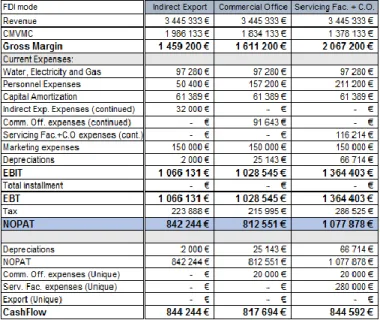
Every time the firm increases its commitment in Cuba not only the control level will increase but also the risk will rise, higher the complexity Vicaima will face and the flexibility will decline on the other hand, market commitment gives more visibility in the market enabling a stronger growth rate, and shows more strength to potential entrants which might disincentive a future entry. It is also important to mention that this expansion will use a considerable part of Vicaima’s capacity, which might lead to a loss of potential clients in other regions. Table 1 describes the financial implications of each entry mode.
19
Discussion and limitations
One of the criticism pointed towards the previous models is that they don’t quite explain what makes a company transition from one of the phases to another. The TCA theory helps us identify “triggers” for a company to move to another phase. The assumptions of this theory provide the incentives for companies to economize on transaction costs by choosing the most adequate organization form. This means that when adaption costs (environmental uncertainty), performance costs (behavioral uncertainty) and safeguarding costs (against asset specificity and opportunistic behavior) are low then firms will choose an entry mode which entails in more market control, if these costs are high the firm will opt for internal organization, minimizing the risk.
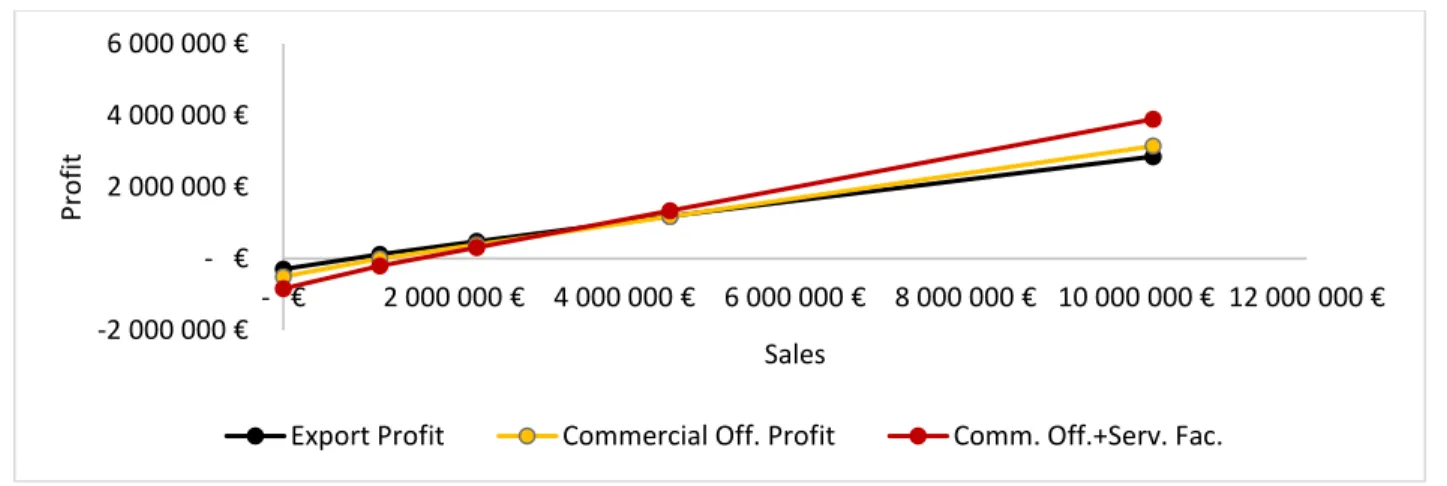
A financial analysis was conducted to estimate these triggers using the financial costs, sales points where it becomes more attractable to increase the commitment, and their timings. Essentially these triggers care about profit maximization in every sales point. This analysis corroborated with the U-model, saying that the
internationalization mode that represents more profit at initial sales volume is the exportation through an agent.
Figure 1 – Internationalization modes evolution with the increase of sales (1-year spawn)
Now, the most interesting result from this analysis, is that the second mode analyzed earlier, the commercial facility alone, would never be chosen to maximize the profit, instead it shows that Vicaima should upgrade its resource commitment directly from indirect exportation to having a commercial facility plus a servicing facility. This result can be explained by the small cost-benefit trade-off that the commercial office offers. While it raises yearly costs by about 142.800€ it only raises the margin by 5%, whereas the Servicing Facility,
-2 000 000 € - € 2 000 000 € 4 000 000 € 6 000 000 € - € 2 000 000 € 4 000 000 € 6 000 000 € 8 000 000 € 10 000 000 € 12 000 000 € Pro fit Sales
20 comparing once again with the Indirect Exportation, it raises yearly expenses by 202.800€ but raises the margins by 20%. An extra 15% of margin for the revenues projected after discussing with Vicaima’s Board director for an increase of 60.000€ yearly expenses and an initial investment of 280.000€, revealed to be greatly beneficial. When looking only into the financials, the servicing facility strikes to be the most advantageous mode for almost all revenue points except in the early life when the extra margin can’t offset the initial investment required. It is also important to highlight that this solution is feasible in this context, where we are focusing in the hotel sector that demands customized goods that the servicing facility offers and in a situation that the commercial office can easily gather enough service for the servicing facility.
This analysis followed a 1-year spawn assumption, but for example the initial investment necessary for the servicing facility could be divided through multiple years as shown in the Appendix 5.1, and in this case, the
trigger point would be with the considerably lower sales volume of 2.45M€ (Appendix 5.2). As seen in the
projected NPV analysis, and that the overall projected NPV would be of 17M € (appendix 5.3) but also all cash-flows are positive and over the initial investments which confirms that aren’t high enough to be an impediment to the Servicing facility. Additionally, most of this investment can’t be considered sunk costs, such as the 60.000€ on the product transports, and expenditures in tools and machines, because in the eventuality of the servicing facility not being successful these items could be transferred, thus the additional commitment isn’t high, assuming that the material can be re-exported. Analyzing a scenario where Vicaima chooses to transition to a commercial office before advancing to the servicing facility, we observe that the negative impact is of 287.000€ appendix 5.4, value that is near the additional current expenses for the first year plus the initial investment for the Servicing Facility, that ascends to 335.000€.
Moreover, Vicaima has a vast experience in the international market and exporting more than 90% of its output, that resorting to Cavusgil’s study corresponds to the last stage where firms are used to exporting know its hurdles and this could help mitigate risks.
21 In a scenario where Vicaima’s managers notice that Hotels don’t import these products directly, the
commercial office loses its purpose since it cannot gather new clients. Moreover, the servicing facility is only logic if there is a commercial office since the servicing facility needs a commercial team selling the product adaptations. Thus, the only option would be the indirect exportation, reducing significantly the profit potential. This model suffers from not considering non-financial costs/benefits as summed in the assumptions and limitations in the appendix 5 such as risk, control, commitment, flexibility, increased presence and growth rate, complexity or the capacity usage. Moreover, the model is highly dependent of the margins assumed for each mode, that were assumed to be aligned with other similar countries.
If we consider effects such as, the risk previously analyzed, the additional presence in the Cuban market associated with greater commitment strategies which would cause a higher growth rate, an increase in product value, while considering that the initial investment for the most advanced steps in the internationalization process is not considerably high, we conclude that the results would still be solid.
Furthermore, in the first entry mode analyzed, there’s an importer responsible for making the purchases that the clients require, thus limiting the contact with the clients and therefore Vicaima will have fewer opportunities to use their competences such as the value engineering or its brand. As this setup, doesn’t let Vicaima use some of its major competences it is advisable to move forward to the next mode of entry after noticing an increase in the demand and gaining more information and certainties about the market.
Conclusion
After the conduction of an internal and external analysis of Vicaima, scanning Cuba’s business environment and the hotel industry in more detail, we found several uncertainties in the market and advised caution when making business in Cuba. These problems can undermine the predictions made by the Cuban government, thus it is important to continuously scrutinize the Cuban environment due to such present ambiguity. Having this in mind, the objective of the paper was to find the most appropriate way to enter this market, which despite its challenges,
22 represents a huge opportunity. In accordance with models such as the Uppsala and the Innovation model it was concluded that a successive stage model was the best fit for a SME in a context of high uncertainty and limited resources. In this stage model, four different modes were analyzed, where the last one of the production facility was ruled out for the near future due to the high resources commitment and scale that it requires and therefore was left out of the financial analysis. The first two modes analyzed, the indirect exportation and the commercial office, differentiate in the sense of who is representing the company to the final clients
The strategy of how to proceed after entering the market should be dependent of certain KPIs. The percentage of hotels importing directly and the evolution of the number of tourists should be checked. Over 13 million tourists from a point of 3.5 million is certainly a long way, thus, one needs to be critical about this number. While in the indirect exportation phase, if it is observed that this evolution is far below expectations while there is a spare capacity in the hotels, Vicaima should stop increasing its resources commitment. In the same way, the evolution of the political risk should be assessed, having special detail for the relations with the USA, and the Cuban elections of 2018 that can reshape the direction of Cuba’s future. For this reason, big investments before this year are not advisable but as seen in the previous chapter, the servicing facility wouldn’t infer high investment when comparing with the benefits that Vicaima could enjoy with this mode in Cuba. Due to this advantageous trade-off, the servicing facility is estimated to be the maximizing mode in the second operating year, while in a scenario where sales are reduced by 40% this transition is expected one year later (Appendix 5.5), immediately after indirect exportation mode, thus advancing the commercial office mode to maximize the overall NPV. To further strengthen this project, one could have also analyzed the residential sector that is also important for Vicaima but undoubtfully, that the hotel sector would always represent the most interesting results in Cuba. Moreover, some of the model’s limitations, such as the constant prices or growth could be overcome, increasing its accuracy but also the complexity.
23 References:
Vicaima 2016 “Empresa Vicaima - Portas Interiores” Accessed 10 September. 2016.
http://www.vicaima.com/pt/empresa
Euromonitor International, 2016 “Cuba: Country Profile”. (2016) Retrieved from Passport database
http://www.portal.euromonitor.com.
Euromonitor International, 2015 “US-Cuba Relations, One Year Later: What’s Changed for Tourism”. (2015) Retrieved from Passport database http://www.portal.euromonitor.com.
European Commission. (2016). “EU-Cuba relations - European External Action Service” - European Commission Accessed 1 October Dec. 2016.
https://eeas.europa.eu/delegations/cuba/16558/eu-cuba-relations_en
DeSilver, Drew. (2015). What we know about Cuba’s economy. [online] Pew Research Center. Accessed 26 Sep. 2016. http://www.pewresearch.org/fact-tank/2015/05/28/what-we-know-about-cubas-economy/
Garcell, Tamilla. (2010). “Cuba: The Sleeping Caiman of the Caribbean. Master Thesis.” University of Iceland School of Business. (57-64)
Cuba Foreign Trade, (2015). “Special Edition on the Law no. 188 for Foreign Investment.” Official Publication of the Chamber of Commerce of the Republic of Cuba. pp.5-17.
Fox Rothschild LLP. (2016). “What Does the New Cuban Foreign Investment Act Mean” [Accessed 28 Sep. 2016]. http://www.foxrothschild.com/publications/what-does-the-new-cuban-foreign-investment-act-mean/
Goode, E. (2015). “Cuba’s Environmental Concerns Grow With Prospect of U.S. Presence.” Nytimes.com. Accessed 18 Oct. 2016 http://www.nytimes.com/2015/07/02/science/earth/cubas-environmental-concerns-grow-with-prospect-of-us-presence.html?_r=1
24 Wetherall, Tyler. (2016). “Obama’s Cuba visit highlights pace of change in country's tourism industry.” The Guardian: Accessed 18 Oct. 2016. https://www.theguardian.com/travel/2016/mar/22/obama-cuba-visit-tourism-industry-havana
Kauremszky, Ilona. (2016). “FITCuba 2015”. travelindustrytoday.com. Accessed 12 Oct. 2016.
http://travelindustrytoday.com/2015-06-05-fitcuba-2015:Seaworld_2015_mar:21798
Vora, Shivani. (2016). “U.S. Airlines Preparing to Offer Flights to Cuba.” Nytimes.com Accessed 7 Dec. 2016.
http://www.nytimes.com/2015/12/18/travel/cuba-flights-jet-blue.html
Gminsights.com. (2016). “Window And Door Market Share, Size | Industry Report, 2023” Accessed 2 Oct. 2016]. https://www.gminsights.com/industry-analysis/window-and-door-market
Windowanddoor.com. (2016). “The 2016 Industry Pulse: Production Capacity | Window & Door.” Accessed 11 Oct. 2016 http://windowanddoor.com/article/january-2016/2016-industry-pulse-production-capacity Hotelnewsnow.com. (2016). HNN – “Why do hotels keep renovating?” Accessed 21 Oct. 2016
http://www.hotelnewsnow.com/Articles/19495/Why-do-hotels-keep-renovating
Simin Lin. Internationalization of the SME: Towards an integrative approach of resources and competences. 1er Colloque Franco-Tch`eque : ”Trends in International Business”, 2010, France. pp.117-135. <halshs-00692465>