ABSTRACT It was aimed to evaluate the impact of the social programs: Bolsa Família Program and Family Health Strategy and fertility on child mortality in the brazilian Semiarid, during the period 2005-2010. The multivariate linear regression model of panel data with fixed effects was applied, using the Infant Mortality Rate as the dependent variable; and, as independents, the coverage of Bolsa Família and its conditionalities, coverage of the Family Health Strategy and the Fertility Rate. The public actions of the Programs, as well as the reduction of fertility levels, have greatly contributed to the decrease in infant mortality rates in the Semiarid.
KEYWORDS Infant mortality. Government programs. Family Health Strategy. Fertility. Brazil.
RESUMO Teve-se como objetivo avaliar o impacto dos programas sociais: Programa Bolsa Família e Estratégia Saúde da Família e da fecundidade sobre a mortalidade infantil do Semiárido bra-sileiro, no período 2005-2010. Foi aplicado o modelo de regressão linear multivariado de dados em painel com efeitos fixos, utilizando a Taxa de Mortalidade Infantil como variável dependen-te; e, como independentes, as coberturas do Bolsa Família e suas condicionalidades, cobertura da Estratégia Saúde da Família e a Taxa de Fecundidade. As ações públicas dos Programas, bem como a redução dos níveis da fecundidade contribuíram sobremaneira para decréscimos nos ní-veis da mortalidade infantil do Semiárido.
PALAVRAS-CHAVE Mortalidade infantil. Programas governamentais. Estratégia Saúde da Família. Fertilidade. Brasil.
Effects of government programs and fertility
on child mortality in the brazilian Semiarid
region
Efeitos dos programas governamentais e da fecundidade sobre a
mortalidade infantil do Semiárido brasileiro
Everlane Suane de Araújo da Silva1, Neir Antunes Paes2, Cesar Cavalcanti da Silva3
1 Universidade Federal
da Paraíba (UFPB), Departamento de Estatística (DE) – João Pessoa (PB), Brasil.
2 Universidade Federal da
Paraíba (UFPB), Programa de Pós-Graduação em Modelos de Decisão e Saúde (PPGMDS) – João Pessoa (PB), Brasil.
3 Universidade Federal
da Paraíba (UFPB), Departamento de Enfermagem Clínica (Denc) – João Pessoa (PB), Brasil.
Introduction
Studies related to mortality trends, particu-larly infant mortality, are important contri-butions for the monitoring of prevention actions, as they highlight existing and emerg-ing problems, strengthenemerg-ing the growemerg-ing need for debates and interventions in these areas. Reduction in child mortality is one of the eight Millennium Development Goals (MDGs) outlined by the United Nations (UN), in analyzing the greatest problems of the world, as child mortality is considered one of the main health indicators, reflect-ing the quality of life of a population, based on the level of development and access to health services.
In the period of ten years (2000-2010), the number of deaths of children under one year, in Brazil, fell from 29.7 to 15.6 for every thousand Live Births (LB), a decrease of 47.6% in the Infant Mortality Rate (IMR) of the Country1. According to the National
Monitoring Report for the MDGs 2013, Brazil has already reached the target set for the deaths of children under one year of age, surpassing the target of 15.7 deaths estimat-ed for 20152. Nevertheless, the Country must
go through a long way to reach the most de-veloped regions of the world, which is, ap-proximately, five deaths per thousand LB3.
Among the Brazilian regions, the largest decline in IMR from 2000 to 2010 occurred in the Northeast, from 44.7 to 18.5 deaths per thousand LB, although it is still the region with the highest levels in the Country1. The
Northeast has made significant progress in relation to the decrease in the IMR level, but still presents a pattern far from desir-able. Likewise, the less developed brazilian region, that of the Semiarid region, because it concentrates 89.5% of the geographic space in the Northeast, follows the rhythm of this region.
A drastic reduction in Brazil also occurred in relation to Total Fertility Rate (TFR) levels, when passing from 2.39 children, on
average, per woman, in 2000, to 1.87, in 2010, whose influence on infant mortality levels has been widely documented. In 2010, 29% of the Semiarid municipalities reached a TFR below the level of population replacement, reflecting a behavior of decline observed throughout the Country. Several studies have pointed out that reductions in fertility levels are related to improvements in the living conditions of the population4,5. Other
studies6,7 defends that Conditional Cash
Transfer Programs can be cited as a stimulus to increase fertility, which is counter-argued by authors like Simões and Soares8 and Alves
and Cavenaghi9, by justifying that the poor
population covered by the Programs reduced the birth rate, independently of them.
Surveys10-12 warn that, in order to combat
infant mortality in Brazil, government inter-vention is necessary to minimize the dispari-ties in income experienced by a large part of the people in this territory. In this regard, the report of the United Nations Children’s Fund (Unicef ), in addition to highlighting the focus on primary health care, improving maternal and newborn care, promoting breastfeeding and expanding immunization, emphasizes the creation of social protection incentives, such as income transfer programs2.
The Bolsa Família Program (PBF), created in Brazil in 2003, is one of the largest direct income transfer programs in the world. The benefits are specific for families living in poverty and extreme poverty with children, young people up to the age of 17, pregnant women and breastfeeding women13.
The family, when joining the PBF, has some commitments. Among them is compli-ance with health conditionalities: children up to 7 years of age need to be vaccinated and have nutritional monitoring; and pregnant women should have prenatal13. The Family
Health Strategy (FHS), the largest primary health care program of the Country, created in 1994, articulates with the PBF as it has a duty to guarantee access to quality health services for the lower income families. The
parallel performance of the PBF and FHS has been pointed out as an important reducer of infant mortality11.
For Shei12, IMRs were already falling
before the beginning of Bolsa Familia (2003), but the decline seems to have increased after the program was implemented. Altogether, 36 million brazilians are out of extreme poverty due to the transfer of income11.
Among the Semiarid regions of the world, Brazil is the largest in terms of size and pop-ulation density, and consists of nine states, covering 1.133 municipalities14. It is the
region with the most backward development indicators in the country, thus becoming one of the largest beneficiaries of government income transfer programs such as the PBF, and health care programs, such as the FHS.
It was, thus, the main objective of this study to assess the impact of government programs (PBF and FHS) and fertility on child mortality in the Brazilian Semiarid region in the period 2005-2010.
Methods
It is a longitudinal ecological study that had as a unit of analysis 1.125 municipali-ties of the brazilian Semiarid region, and the data arranged in panel with annual ob-servations from 2005 to 2010. The Ministry of National Integration, when launching the New Delimitation of the Brazilian SemiArid, defined that this region is made up of 1.133 municipalities14. The analysis excluded eight
municipalities, which was justified by prob-lems in the basic data, which made it im-possible to include them (São José de Peixe, Santana do Piauí, Juazeiro do Piauí, Alvorada do Gurguéia, Bocaína, Dirceu Arcoverde, all in the state of Piauí, Quixabá, Paraíba and Severiano Melo, in Rio Grande do Norte).
The dependent variable considered for the study was IMR. The direct calculation of the indicator has not been recommended for any state of the Semiarid region using data
from vital statistics provided by the Ministry of Health or even by the Brazilian Institute of Geography and Statistics Foundation (IBGE). For this, indirect methods of estimation are used. The Atlas of Human Development in Brazil has calculated the indicator using in-formation from the Demographic Census, making use of indirect techniques to obtain it. Once most of the Semiarid municipali-ties do not have reliable vital statistics, the mortality pattern of the state to which the municipality belongs is adopted. Despite the limitations related to the estimates of infant mortality provided by the Atlas, they were considered as satisfactory proxy of their levels for the municipalities15.
The databases of the Ministry of Social Development (MDS) were used to obtain the information related to the PBF. The data allowed the calculation of the independent variables: percentage of coverage of the PBF in relation to the total population of the municipality and percentage of beneficiary families of the PBF accompanied in health conditionalities13. For the independent
variable FHS coverage, the source was the Ministry of Health16.
Through the Atlas of Human Development in Brazil, the data of the independent vari-able TFR15 were accessed. Other
indepen-dent variables were incorporated into the analyzes due to their explanatory nature, as pointed out in other studies11,17-19. They were:
preliminary inquiries, the linear model pre-sented the most adequate to express the ex-pected evolution of the indicators.
The Stepwise method (p <0.05) was used in the selection of the independent vari-ables to compose the multiple linear regres-sion model. At this stage, the variables that were not significant were eliminated from the study: activity rate and percentage of mothers heads of household without com-plete primary education and children under 15 years of age in the total number of heads of the family.
The multiple linear regression for panel data was used to analyze the association of infant mortality with the selected variables. For the choice of the most suitable model, fixed or random effect, the Hausman speci-fication test was performed, and the first one was chosen. In addition to the error term, panel data models with fixed effects include a second term, to control unobserved, time-invariant characteristics such as: histori-cal, geographic and sociocultural of each Municipality. These models allow correla-tions between the invariable term in time and the independent variables of the model, making it generally more robust for the anal-ysis of the results of the interventions, and are constantly used in the literature. The sta-tistical program Stata, version 12.0, was used for data processing and analysis.
Because it was used for modeling a
database with secondary data, freely ac-cessible online, it is justified the absence of submission to the Brazil Platform and the subsequent referral to the Research Ethics Committee.
Results
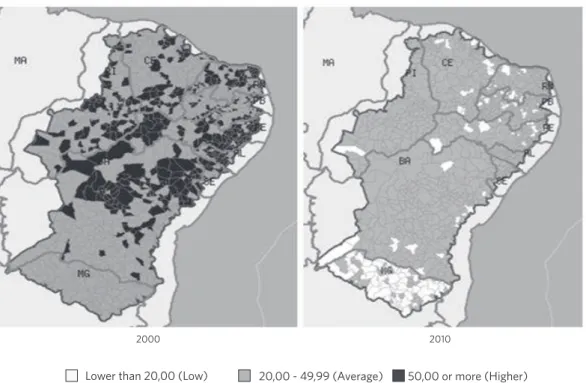
Figure 1 shows the decline of IMR in the mu-nicipalities of the brazilian Semiarid region when comparing the years 2000 and 2010. In 2000, 460 municipalities (41%) from all states, except Minas Gerais, had high IMRs, equal to or superior to 50 deaths of less than one year per thousand LB, as early as 2010, no municipality had an IMR at this level. Also in 2010, 119 municipalities (11%) started to have an IMR considered low (less than 20 deaths of children under one year per thou-sand LB), whose greatest advances were observed for the municipalities of the state of Minas Gerais. In the states of Alagoas and Sergipe, in 2010, no municipality had reached an IMR considered low. In 2010, most municipalities in the Semiarid region still had a IMR considered as average (20 to 49 per thousand), and only 39 municipalities (3%) had reached the fourth target of the Millennium Development Goals for Brazil (reduce IMR for 15.7 deaths of children under one year per thousand LB by 2015).
Figure 1. Spatial distribution of the Infant Mortality Rate indicator. Municipalities of the brazilian Semi-Arid, 2000 and 2010
Source: Data and cartographic base: Atlas of Human Development in Brazil (UNDP/FJP/Ipea)15 and National Institute of the Semi-Arid (Insa).
(minimum, maximum, average, median and standard deviation) of the municipalities of the brazilian Semiarid region, for selected indicators (2005 and 2010). The descriptive measures varied during the study period.
The highest IMR (68.79), in 2005, was found for the municipality of Jucati, in the state of Pernambuco, while, in 2010, the highest value was for the municipality of Olivença, in Alagoas (45.4). The IMR average for all municipalities reduced the level by 11.1 per thousand LB over the five-year period, that is, an average annual reduction of about 2.3 deaths. The standard deviation of this indicator reduced, indicating a lower level dispersion.
The average coverage of the PBF in relation to the total population of the municipalities increased from 45.7% (2005) to 54.3% (2010). In 2005, the maximum value of the indica-tor was 86.4% in the municipality of Capitão Gervásio Oliveira, in Piauí. The municipality of Guaribas, in the state of Piauí, presented the highest coverage of the PBF (84.6%) in
2010. The lowest coverage of the indicator (24.3) in 2010 was observed in the municipal-ity of Mossoró, Rio Grande do Norte.
An increase in the average number of ben-eficiary families of the PBF accompanied by health conditionalities was observed between 2005 and 2010, from 48.1% to 82.9%. In 2005, 255 municipalities (22.7%) of the brazilian Semiarid region had families enrolled in the PBF without any follow-up on health condi-tionalities. Already in 2010, this situation was not observed in any municipality.
The average coverage of the FHS reached 80.8% in 2005 and 91.3% in 2010. In 2005, 585 municipalities (52%) of the Semiarid region reached universal coverage (100%), among 1.125 municipalities. In 2010, this figure in-creased to 768 municipalities (about 68%). On the other hand, already in 2010, the municipali-ties of Buritirama, Gentio do Ouro, Paripiranga and Pilão Arcado, all in the state of Bahia, still did not receive the coverage of the FHS.
The mean TFR ranged from 2.7 to 2.2
2000 2010
children, on average, per woman, consider-ing the years 2005 and 2010. In 2005, the municipality of São João do Jaguaribe, in the state of Ceará, was observed the lowest TFR (1.8), and the highest (4.7) in the mu-nicipality of Canapi, in the state of Alagoas, revealing a total amplitude of 3 children, on average, per woman in the reproductive period within the Semiarid region. For 2010, the municipality of Triunfo, in Pernambuco, presented the lowest value (1.4) for the in-dicator, and the highest (3.7) occurred in the city of Pureza, in Rio Grande do Norte, whose total amplitude was reduced to 2.3 children, on average, per woman.
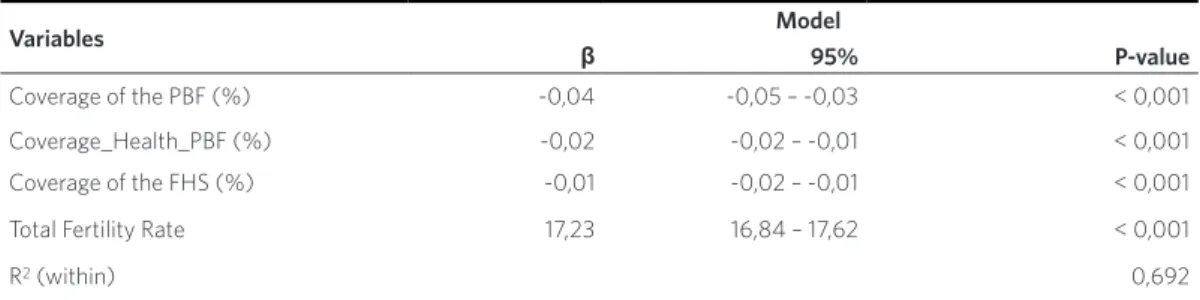
The linear regression model (table 2) provides estimates of the parameter β, con-fidence interval and P-value for the vari-ables related to government programs (PBF
and FHS) and fertility in infant mortality. According to the Hausman test, the model with random effect (H0) was rejected, that is, the fixed-effect model explained better the variations in IMR.
The linear regression with fixed effects showed a negative and statistically signifi-cant association (p <0.001) between infant mortality and co-variables: Coverage of the Bolsa Família Program, Percentage of ben-eficiary families of the PBF accompanied by health conditionalities and Coverage of the Family Health Strategy. On the other hand, TFR was also indicated as significant (p <0.001) for the reduction of IMR, but with a positive association. The fixed-effect model presented the R2 (within) value of 69.2%.
Table 1. Descriptive statistics for selected indicators. Brazilian Semi-arid, 2005 and 2010
Indicators Minimum Maximum Average Median Standard deviation
2005 2010 2005 2010 2005 2010 2005 2010 2005 2010
Child mortality rate 18,0 13,4 68,8 45,4 37,4 26,3 36,7 25,2 7,2 5,6 Coverage of the PBFa (%) 7,9 24,3 86,4 84,6 45,7 54,3 46,4 54,1 10,6 8,8
Coverage_Health_PBFb (%) 0,0 0,2 100,0 100,0 48,1 82,9 47,2 84,4 39,6 13,6
Coverage of the FHSc (%) 0,0 0,0 100,0 100,0 80,8 91,3 100,0 100,0 28,5 17,1
Total Fertility Rate 1,8 1,4 4,7 3,7 2,7 2,2 2,7 2,2 0,4 0,3
Source of basic data: Human Development Atlas in Brazil (UNDP/FJP/Ipea)15, Ministry of Social Development (MDS) and Ministry of
Health (MS).
aCoverage of the Bolsa Família Program; bCoverage of beneficiary families of the PBF accompanied by health conditionalities; cCoverage of
the Family Health Strategy.
Table 2. Fixed-effect regression model for the association between Infant Mortality Rate and selected indicators. Municipalities of the brazilian Semiarid region, 2005-2010.
Variables Model
β 95% P-value
Coverage of the PBF (%) -0,04 -0,05 – -0,03 < 0,001 Coverage_Health_PBF (%) -0,02 -0,02 – -0,01 < 0,001 Coverage of the FHS (%) -0,01 -0,02 – -0,01 < 0,001
Total Fertility Rate 17,23 16,84 – 17,62 < 0,001
R2 (within) 0,692
Source: Own elaboration. Atlas of Human Development in Brazil (UNDP/FJP/Ipea)15, Ministry of Social Development (MDS) and Ministry
of Health (MS).
Discussion
Government interventions reflect impor-tant advances related to improvements in the quality of life of people in the brazilian Semiarid region. The fight against social in-equality has been carried out with the pro-grams of income transfer and guarantee of access of the population to the health servic-es. These advances are reflected through the high coverage of the FHS and the PBF and are expressed in the Human Development Index of the municipalities of the Semiarid region (IDHM), where the average increased from 0.425, in 2000, to 0.591, in 201015.
Reduction of child mortality is one of the main goals of childhood policy in the world. The impact of the socioeconomic conditions of the geographical area of reference of the newborn can be observed when the levels of IMR are verified. They fell during the period (2005-2010) in the brazilian Semiarid, but are still considered high when compared to regions such as the South of Brazil, which, in 2010, showed an IMR of 12.6 deaths per thou-sand LB1. The lowest figure observed in 2010,
13.4 deaths per thousand LB, still contrasts with that considered acceptable by the WHO, which stipulated a number of deaths of less than two digits per thousand births21. The
de-crease in the standard deviation of the values in relation to the average in the 2005-2010 period suggests a tendency of homogeniza-tion of levels throughout the Semiarid.
In the brazilian Semiarid region, the average coverage of the PBF in relation to the total population of municipalities in-creased between 2005 and 2010. In 2014, approximately 3.5 million families benefited, involving a transfer of 7.1 billion reais13.
The coverage of the PBF has increased rapidly over the years. By the end of 2010, the PBF had reached almost 13 million fami-lies, and its pre-set target, covering 11 million brazilian families (48.441.100 people), would have been reached since 200613,22.
The conditionalities of the PBF target the
most vulnerable population groups to preven-tive health care, with important effects on the health of children and pregnant women. To that end, the PBF sought support from exist-ing service networks, such as the Family Health Strategy, to meet beneficiary health condi-tionalities. The average number of beneficiary families of the PBF accompanied by health conditionalities showed a significant increase in the comparison between 2005 (next year to the implementation of the PBF) and 2010 (already seven years after the Program was in existence). In 2010, the FHS already reached universality (100%) for most municipalities in the brazilian Semiarid region. Nevertheless, some munici-palities presented coverage of 0%. However, it should be noted that there was an important advance, with the average coverage of the in-dicator increasing from 80.8% in 2005 to 91.3% in 2010, and that the performance of health professionals is paramount in the monitoring of families participating in the exercise of con-ditionalities, in order to facilitate their access to actions and health services. Carvalho, Almeida and Jaime23 point out the need for a
compro-mise between all the social actors involved. Studies emphasize that managers must provide means to adequately fulfill the con-ditionalities imposed on program beneficia-ries, since the use of public social services depends on the ability of the Country to attend to demand10-12,24.
The negative and significant association revealed by the linear regression model with fixed effects between infant mortality and covariates – Coverage of the Bolsa Família Program, Percentage of beneficiary families of the PBF accompanied by health condi-tionalities and Coverage of the Family Health Strategy – corroborated the effects found between government programs and IMR, obtained in other longitudinal studies10,11.
with the transformations experienced by the brazilian population in the so-called ‘demo-graphic transition’, in which the rapid fall in fertility levels determined the population size and the new national configuration in terms of age structure.
There is a belief that the beneficiary families of the PBF would have more chil-dren, however, it is not confirmed by some authors6,25. Arguments in this sense show that
women beneficiaries of PBF have increased the use of contraceptive methods, which has contributed to the decline of fertility6.
The TFR average of the Semiarid region declined when comparing 2005 and 2010. Thus, the level of fertility followed the same trend of decline observed for Brazil. In 2010, the average TFR of the Semiarid region was 2.2 children per woman, a level very close to that of population replacement, which was 2.1. Some municipalities in the Semiarid region reached a TFR equivalent to that of states such as São Paulo (1.66), Rio de Janeiro (1.68) and Santa Catarina (1.71). The municipalities of Triunfo and Frei Miguelinho, both in the state of Pernambuco (1.4) and Brumado, Bahia (1.5), for example, already presented levels below the replace-ment and made possible a comparison with TFR of developed countries, such as Italy (1.4), Japan (1.4) and Spain (1.5), thus break-ing barriers never recorded for two decades for any municipality.
The R2 (within) of the fixed effects model was considered satisfactory, being explained by 69.2% of the internal association between IMR and co-variables. It is revealing to explore the joint effects of public interven-tions, especially in the Semiarid region. In this sense, it is possible to highlight the importance of using panel data to evaluate the association between government pro-grams and health, as an alternative to the use of classic cross-sectional data. In this way, causal inference obtains stronger evi-dence when panel data are used in relation to transversal ones.
Conclusions
The results obtained evidenced that the public actions of the PBF and the FHS, as well as the reduction of the fertility levels, contributed greatly with decreases in the infant mortality rates of the brazilian Semiarid region. The PBF, by establishing conditionalities that are attributions of the FHS, depends a lot on it for its success. To maintain the reduction of IMR, constant government interventions are necessary, among them, measures that minimize the income disparities experienced by the popu-lation. Increases in the income of people and, especially, their better distribution are essential to combat infant mortality.
Statistical evidence has detected the impor-tance of public actions that aim to help combat two major problems in the Country: poverty and high levels of infant mortality. It is empha-sized that programs with conditionalities in their composition have a potential on the social determinants of health and primary health care, and it should be highlighted that it is the responsibility of public managers to provide for the maintenance of the means for the ben-eficiaries to adequately meet the requirements imposed by these conditionalities.
It is highlighted the unprecedented ap-proach of this study when investigating the relationship between the actions of the governmental programs (FHS and PFB) on child mortality, specifically for the Semiarid region of Brazil.
Collaborators
References
1. Instituto Brasileiro de Geografia e Estatística. Censo 2010: escolaridade e rendimento aumentam e cai mortalidade infantil [internet]. Brasília, DF: IBGE; 2012 [acesso em 2016 mar 18]. Disponível em: http://censo2010.ibge.gov.br/noticias-censo.ht ml?view=noticia&id=1&idnoticia=2125&busca=1&t =censo-2010-escolaridade-rendimento-aumentam--cai-mortalidade-infantil.
2. Instituto Brasileiro de Geografia e Estatística. Objetivos de Desenvolvimento do Milênio: relatório Nacional de Acompanhamento. Brasília, DF: Ipea; 2014.
3. Brasil. Portal Brasil. Mortalidade infan-til cai 47,6% no País [internet]. Brasília, DF; 2012 [acesso em 2016 jun 20]. Disponível em: http://www.brasil.gov.br/governo/2012/04/ mortalidade-infantil-cai-47-6-no-pais.
4. Alves JED, Cavenaghi SM. Transições urbanas e da fecundidade e mudanças dos arranjos familia-res no Brasil. Cadernos de Estudos Sociais. 2012; 27(2):91-114.
5. Araújo Júnior AF, Salvato AM, Queiroz LB. Desenvolvimento e Fecundidade no Brasil: Reversão da fecundidade para municípios mais de-senvolvidos? PPP. 2013 Jul-Dez; (41):79-97.
6. Alves JED, Cavenaghi SM. O programa Bolsa Família e as taxas de fecundidade no Brasil. In: Campello T, Neri MC, organizadores. Programa Bolsa Família: uma década de inclusão e cidadania. Brasília, DF: Ipea; 2013. p. 233-245.
7. Stecklov G, Winters P, Todd J, et al. Unintended effects of poverty programmes on childbearing in less developed countries: Experimental evidence from Latin America. Popul Stud (Camb). 2007 Jul; 61(2):125-140.
8. Simões P, Soares RB. Efeitos do Programa Bolsa Família na fecundidade das beneficiárias. RBE. 2012 Out-Dez; 66(4):533-556.
9. Alves JED, Cavenaghi SM. O Programa Bolsa Família e a Transição da Fecundidade no Brasil [internet]. 2013 [acesso em 2017 jan 30]. Disponível em: http:// www.ipc-undp.org/pub/port/IPCOnePager227.pdf.
10. Guanais FC. The Combined Effects of the Expansion of Primary Health Care and Conditional Cash Transfers on Infant Mortality in Brazil, 1998-2010. Am J Public Health. 2013 Nov; 103(11):2000-6.
11. Rasella D, Aquino R, Santos CA, et al. Effect of a conditional cash transfer programme on childhood mortality: a nationwide analysis of Brazilian muni-cipalities. Lancet. 2013 Jul; 382(9886):57-64.
12. Shei A. Brazil’s Conditional Cash Transfer Program Associated With Declines In Infant Mortality Rates. Health Aff (Millwood). 2013 Jul; 32(7):1274-1281.
13. Brasil. Ministério do Desenvolvimento Social. Bolsa Família [internet]. Brasília, DF: MDS; 2014 [acesso em 2016 jul 14]. Disponível em: http://www.mds. gov.br/bolsafamilia.
14. Brasil. Ministério da Integração Nacional. Secretaria de Políticas de Desenvolvimento Regional. Nova Delimitação do Semi-Árido Brasileiro [internet]. Brasília, DF: MIS; 2005 [acesso em 2016 ago 16]. Disponível em: http://www.mi.gov.br/c/document_ library/get_file?uuid=0aa2b9b5-aa4d-4b55-a6e1-82faf0762763&groupId=24915.
15. Brasil. Fundação João Pinheiro. Instituto de Pesquisa Econômica e Aplicada. Atlas do Desenvolvimento Humano no Brasil [internet]. Brasília, DF: Ipea; 2013 [acesso em 2016 jul 16]. Disponível em: http://atlasbrasil.org.br/2013/.
16. Brasil. Ministério da Saúde. Datasus. Estratégia Saúde da Família. Histórico de Cobertura da Saúde da Família [internet]. Brasília, DF; 2014 [acesso em 2016 nov 12]. Disponível em: http://dab.saude.gov. br/portaldab/historico_cobertura_sf.php.
as tendências da mortalidade infantil no Brasil: revisão da literatura sobre a última década. Cad. Saúde Pública. 2007 Jul; 23(7):1511-1528.
18. Mosley WH, Chen LC. An analytical framework for the study of child survival in developing countries. 1984. Bull World Health Organ. 2003; 81(2):140-5.
19. Sardinha LMV. Mortalidade infantil e fatores asso-ciados à atenção à saúde: estudo caso-controle no Distrito Federal (2007-2010) [tese]. [Brasília, DF]: Universidade de Brasília; 2014. 182 p.
20. Guidi LF. Interpolação [internet]. [acesso em 2016 dez 15]. Disponível em: http://www.mat. ufrgs.br/~guidi/grad/MAT01169/ laminas. calculo_numerico.7.pdf.
21. Moreira LMC, Alves CRL, Belisário AS, et al. Políticas públicas voltadas para a redução da mor-talidade infantil: uma história de desafios. RMMG. 2012; 22( 7):48-55.
22. Rocha S. O programa Bolsa Família Evolução e efeitos sobre a pobreza. Econ. Soc. 2011 Abr;
20(1):113-139.
23. Carvalho AT, Almeida, ER, Jaime PC. Condicionalidades em saúde do programa Bolsa Família – Brasil: uma análise a partir de profissio-nais da saúde. Saúde Soc. 2014; 23(4):1370-1382.
24. Paes-Sousa R, Santos LM, Miazaki ÉS. Effects of a conditional cash transfer programme on child nu-trition in Brazil. Bull World Health Organ. 2011; (89):496-503.
25. Jannuzzi PM, Pinto AR. Bolsa Família e seus Impactos nas Condições de Vida da População Brasileira: uma Síntese dos Principais Achados da Pesquisa de Avaliação de Impacto do Bolsa Família II. In: Campello T, Neri MC, organizadores. Programa Bolsa Família: uma década de inclusão e cidadania. Brasília, DF: Ipea; 2013. p. 179-192.