ORIGINAL ARTICLE
Cannabidiol presents an inverted U-shaped dose-response
curve in a simulated public speaking test
Ila M. Linares,
1Antonio W. Zuardi,
1,2Luis C. Pereira,
3Regina H. Queiroz,
2,3Raphael Mechoulam,
4Francisco S. Guimara˜es,
2,5Jose´ A. Crippa
1,21Departamento de Neurocieˆncias e Cieˆncias do Comportamento, Faculdade de Medicina de Ribeira˜o Preto, Universidade de Sa˜o Paulo (USP),
Ribeira˜o Preto, SP, Brazil.2Instituto Nacional de Cieˆncia e Tecnologia (INCT), Conselho Nacional de Desenvolvimento Cientı´fico e Tecnolo´gico (CNPq), Brazil.3Departamento de Ana´lises Clı´nicas, Toxicolo´gicas e Bromatolo´gicas, Faculdade de Cieˆncias Farmaceˆuticas de Ribeira˜o Preto, USP, Ribeira˜o Preto, SP, Brazil.4Institute for Drug Research, Faculty of Medicine, Hebrew University, Jerusalem, Israel. 5Departamento de Farmacologia, Faculdade de Medicina de Ribeira˜o Preto, USP, Ribeira˜o Preto, SP, Brazil.
https://orcid.org/0000-0002-2283-5231
Objective: Cannabidiol (CBD), one of the non-psychotomimetic compounds of Cannabis sativa,
causes anxiolytic-like effects in animals, with typical bell-shaped dose-response curves. No study, however, has investigated whether increasing doses of this drug would also cause similar curves in humans. The objective of this study was to compare the acute effects of different doses of CBD and placebo in healthy volunteers performing a simulated public speaking test (SPST), a well-tested anxiety-inducing method.
Method: A total of 57 healthy male subjects were allocated to receive oral CBD at doses of 150 mg (n=15), 300 mg (n=15), 600 mg (n=12) or placebo (n=15) in a double-blind procedure. During the SPST, subjective ratings on the Visual Analogue Mood Scale (VAMS) and physiological measures (systolic and diastolic blood pressure, heart rate) were obtained at six different time points.
Results:Compared to placebo, pretreatment with 300 mg of CBD significantly reduced anxiety during the speech. No significant differences in VAMS scores were observed between groups receiving CBD 150 mg, 600 mg and placebo.
Conclusion:Our findings confirm the anxiolytic-like properties of CBD and are consonant with results of animal studies describing bell-shaped dose-response curves. Optimal therapeutic doses of CBD should be rigorously determined so that research findings can be adequately translated into clinical practice.
Keywords: Anxiety; cannabis; cannabidiol; CBD; simulated public speaking
Introduction
Historically,Cannabis sativahas been used by many cul-tures for medical purposes. The plant contains more than 80 cannabinoids, of which two have been the most studied: tetrahydrocannabinol (THC), responsible for the main psy-choactive effects of cannabis, and cannabidiol (CBD), which may account for up to 40% of the plant.1,2
CBD has been shown to be a safe compound with a favorable adverse effects profile.3 A number of studies have shown that this cannabinoid has a broad range of ther-apeutic properties, including antipsychotic,4sleep-regulating,5 antidepressant and mood-stabilizing,6antiepileptic,7 anti-inflammatory8and analgesic9effects, in addition to improv-ing Parkinson symptoms.10Reduced anxiety has also been one of the compound’s most consistently observed effects in both animal models and human studies.11-13
Regarding the former, anxiolytic-like effects have been observed in different experimental models, including the Vogel conflict test,14contextual fear conditioning,15and the elevated plus maze (EPM).16Using the EPM, Guimara˜es et al. observed that CBD increases open arm exploration (an anxiolytic-like effect) at doses of 2.5 to 10 mg/kg).12 Higher, doses, however, were ineffective. Inverted U-shaped dose-response curves in the EPM have also been described in mice17 and in rats after direct injection of CBD into peri-aqueductal gray matter.18 This dose-response curve pat-tern, which was also observed in other animal models such as an anxiety test in adult zebrafish19and forced swimming tests,6is similar to the known clinical effect of CBD. Despite these data, there are also contradictory results, Silveira Filho & Tufik19found no significant effects of high doses of CBD (100 mg/kg) in rats submitted to the Geller-Seifter conflict test. Another study registered anxiogenic-like effects
Correspondence: Jose´ Alexandre S Crippa, Hospital das Clı´nicas, Faculdade de Medicina de Ribeira˜o Preto, Universidade de Sa˜o Paulo (USP), Av. Bandeirantes, 3900, 3oandar, CEP 14048-900, Ribeira˜o
Preto, SP, Brazil.
E-mail: [email protected]
Submitted Feb 12 2017, accepted Jan 10 2018, Epub Oct 11 2018.
How to cite this article:Linares IM, Zuardi AW, Pereira LC, Queiroz RH, Mechoulam R, Guimara˜es FS, et al. Cannabidiol presents an inverted U-shaped dose-response curve in a simulated public speak-ing test. Braz J Psychiatry. 2019;41:9-14. http://dx.doi.org/10.1590/ 1516-4446-2017-0015
from chronic CBD administration in rats (10 mg/kg) sub-jected to two behavioral tests: locomotor activity and con-ditioned emotional response.20
The presence of anxiolytic properties has been supported by some human studies. The pioneer study was con-ducted in 1982 and concluded that oral administration of CBD (1 mg/kg) to healthy volunteers attenuates the anxiogenic effect of THC (0.5 mg/kg).21 In the 1990s, another trial compared the effects of ipsapirone (5 mg) and CBD (300 mg) to those of diazepam (10 mg) and placebo in healthy volunteers during a simulated public speaking test (SPST), an anxiety-inducing task. The results indicated that CBD attenuates speech-induced anxiety compared to placebo.13 However, for 600 mg CBD, Bhattycharyya et al.22 found only trend-level effects on anxiety as measured by the State-Trait Anxiety Inventory and no effect on a fearful faces task.
In a recent trial involving a SPST, our group found that pretreatment with CBD (600 mg) significantly reduced anxiety, cognitive impairment, and distress during speeches by patients with generalized social anxiety disorder, and significantly decreased alertness in the anticipatory period before the speech.23 Corroborating these findings, stu-dies using functional neuroimaging techniques showed that the anxiolytic properties of CBD are associated with the modulation of different limbic and paralimbic areas in both healthy volunteers24 and social anxiety disorder patients.25
Taken together, the results obtained after single-dose administration of CBD indicate that this cannabinoid could be anxiolytic in humans, although no study has yet investi-gated whether increasing doses of this drug would also cause bell-shaped dose-response curves in humans. This lack of data is of particular importance for determining the effective therapeutic windows of CBD for treating anxiety and other clinical conditions. Therefore, the present study aimed to compare the acute effects of three different doses CBD vs. placebo in healthy volunteers during a SPST.
Methods
Subjects
A total of 57 healthy male subjects were allocated to receive different doses of CBD (150 mg; 300 mg; 600 mg) or placebo in a double-blind, randomized design. Only men were included in the present investigation to decrease possible gender-related variations. The groups were matched according to age, years of education, and socioeconomic status. None of the participants suffered from psychiatric disorders according to the Portuguese version26 of the Structured Clinical Interview for the DSM-IV, clinical version (SCID-CV).27Individuals with a history of head trauma, neurological illness, or major medical illnesses (assessed with a semi-standardized medical questionnaire and physical examination) were not included. All partici-pants were non-smokers and had not taken any medica-tions for at least three months prior to study. None of the subjects had used marijuana more than five times in their lives (no use in the past year) and none had ever used any other illegal drugs. All subjects gave written consent to participate after being fully informed about the research procedures, which had been approved by the local ethics committee (process no. 0290/2012).
Experimental anxiety procedure
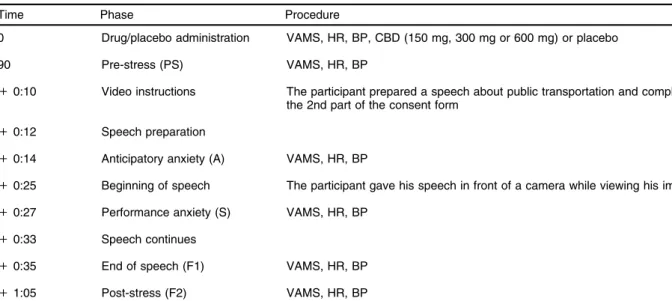
The SPST was performed according to the procedures described by McNair et al.,28 with minor modifications introduced by Guimara˜es et al.29 and Bergamaschi et al.23 (Table 1). In brief, after arriving at the Labo-ratory of Psychopharmacology at the Faculdade de Medicina de Ribeira˜o Preto university hospital, the first part of the consent form was carefully read and, after a 15-minute adaptation period, baseline measure-ments (B) were taken, followed by a single dose of oral CBD (150 mg, n=15; 300 mg, n=15; 600 mg, n=12) or placebo (n=15) in a double-blind procedure. CBD or placebo
Table 1 Phases and procedures of the experimental session
Time Phase Procedure
0 Drug/placebo administration VAMS, HR, BP, CBD (150 mg, 300 mg or 600 mg) or placebo
90 Pre-stress (PS) VAMS, HR, BP
+0:10 Video instructions The participant prepared a speech about public transportation and completed the 2nd part of the consent form
+0:12 Speech preparation
+0:14 Anticipatory anxiety (A) VAMS, HR, BP
+0:25 Beginning of speech The participant gave his speech in front of a camera while viewing his image on TV
+0:27 Performance anxiety (S) VAMS, HR, BP
+0:33 Speech continues
+0:35 End of speech (F1) VAMS, HR, BP
+1:05 Post-stress (F2) VAMS, HR, BP
was administered one hour and thirty minutes before the test.
Pretest measurements (P) were made 90 minutes after taking the drug or placebo. Immediately afterwards, the participants received the pre-recorded video instruc-tions for the test. The participants were told they had two minutes to prepare a four-minute speech about ‘‘the public transportation system of your city.’’ They were also informed that the speech would be recorded on video and later analyzed by trained psychologists. Measurements of anticipatory anxiety (A) were taken just prior to the speech. Each participant then began speaking in front of the camera while viewing his image on TV (LED 3D 49’ LG®
49LF6450 Full HD). The speech was interrupted in the middle and VAMS and BP measurements (S) were taken again. The remaining two minutes of speech were then recorded, with post-test measurements taken imme-diately after the end of the speech and 30 minutes later (F1 and F2, respectively).
CBD
CBD (150 mg, 300 mg, or 600 mg) in powder form (99.9% purity, kindly supplied by STI-Pharm, Brentwood, UK), was dissolved in corn oil.3,5 The same amount of corn oil was used as placebo, and both the drug and placebo were packed inside identical gelatin capsules. These doses were chosen based on previous evidence that acute anxiolytic effects have been observed in healthy subjects given doses ranging from 300 to 600 mg of CBD.24The interval between the administration of the capsules and the measurements was chosen based on previous evi-dence that the plasma peak of an oral dose of CBD usually occurs 1-2 h after ingestion.11,24,25,30,31
Psychological measurements
The Portuguese version32 of the Visual Analogue Mood Scale (VAMS),33was used to evaluate the state anxiety level and other subjective states during the test. It is a self-administered instrument in which subjects are asked to mark a point that identifies his/her current subjec-tive state on a 100-mm straight line between two words that describe opposite mood states (e.g., calm-excited). The VAMS contains 16 items that can be grouped into the following four factors for factorial analysis: 1) anxiety (items calm-excited, relaxed-tense, and tranquil-troubled); 2) sedation (items alert-drowsy and attentive-dreamy); 3) cognitive impairment (items quick witted-mentally slow,
proficient-incompetent, energetic-lethargic, clear headed-muzzy, gregarious-withdrawn, well-coordinated-clumsy, and strong-feeble); and 4) distress (items interested-bored, happy-sad, contented-discontented, and amicable-antagonistic).23,34
Physiological measurements
Systolic and diastolic blood pressure were measured with a mercury sphygmomanometer (Becton Dickinson, Brazil).
Data analysis
Clinical and demographic data were analyzed with Student’s
t-test for continuous data.
VAMS scores and systolic and diastolic measurements were transformed by calculating the difference between the score in each phase of the procedure and the pre-test measures for each participant (delta scores). Delta scores were then analyzed using repeated-measures analysis of variance (ANOVA) with group, phase, and group-phase interaction as factors. When sphericity was not attained, the degrees of freedom of repeated factors were cor-rected using Huynh-Feldt epsilon. Whenever a significant phase by group interaction occurred, comparisons among the groups were made at each phase using one-factor ANOVA followed by multiple comparisons with Bonferroni’s test.
All analyses were performed in SPSS version 20.0 and with statistical significance set at po0.05.
Results
The demographic characteristics of the study participants are shown in Table 2. No significant differences were observed between the four groups.
Visual Analogue Mood Scale (VAMS): anxiety
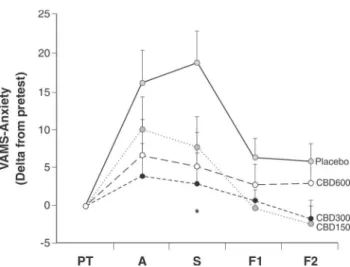
Figure 1 presents variations in the VAMS anxiety factor for groups receiving placebo and different doses of CBD during the SPST. The repeated-measures ANOVA showed phase (F2.48; 131.6 = 13.36; p o 0.001) and group effects (F3;53 = 2.714; p = 0.05), but no significant interaction between group and phase (F7.45;131.6 = 1.72; p = 0.1). Comparisons between groups for each phase with post hoc tests showed lower anxiety levels in the group treated with CBD 300 mg in phase S than placebo (p = 0.042).
Table 2 Demographic characteristics of the groups
Variable Placebo CBD 150 mg CBD 300 mg CBD 600 mg p-value
Group size (n) 15 15 15 12
Age 24.5 (4.04) 24.2 (3.08) 24.6 (2.93) 22.6 (3.4) 0.95
BMI 26.4 (2.4) 25.4 (4.6) 26.26 (4.1) 25.3 (3.7) 0.70
Socioeconomic level, median (range)* 2.5 (1.0-4.0) 2.7 (1.0-3.0) 2.8 (1.0-3.0) 2.6 (1.0-3.0) 0.87
Years of education 14.3 (3.1) 15.2 (2.9) 14.8 (3.7) 15.3 (3.8) 0.83
Data presented as mean (standard deviation), unless otherwise specified. BMI = body mass index; CBD = cannabidiol; SD = standard deviation.
No significant phase, group, or group-phase interaction effects were found for the VAMS factors sedation, cogni-tive impairment, or distress. Neither the task nor the drug affected any other VAMS dimensions.
Physiological measures: BP
Regarding systolic BP, we found a significant phase (F3.9; 211.314; 212= 6.7; po0.05) but not group (F3; 53= 0.7; p40.05) or group-phase interaction effect (F12; 211= 0.99; p 4 0.05). Repeated-measures ANOVA showed significant phase (F4; 212= 2.8; p = 0,027), but not group (F3; 53= 0.67; p40.05) or group-phase interaction effects (F12; 212= 0.46; p40.05) for diastolic BP.
Discussion
Confirming several preclinical and clinical studies, our results indicate that acute doses of CBD can decrease anxiety. This effect has also been previously demonstrated in studies using a SPST to induce anxiety in healthy subjects13and patients with social anxiety.23In the latter study, CBD (600 mg) treatment was associated with signifi-cant reductions in anxiety, cognitive impairment, and distress during the speech, as well as with reduced arousal during the anticipatory phase.23
Previous clinical investigations of the anxiolytic proper-ties of CBD, however, have been based on single doses. In the present study, we tested increasing doses of this drug in a SPST. The VAMS results showed that CDB at 150, 300 and 600 mg produced an inverted U-shaped dose-response curve. In other words, the lowest or highest doses of CBD had little or no effect on SPST- induced anxiety and a significant response was only achieved with an intermediate dose. This dose-response pattern is
consistent with evidence from CBD animal studies12,16,18 and with our recent findings in a group of subjects who underwent a real-life public speaking test.34
The molecular and neural mechanisms involved in the anxiolytic effects of CBD are incompletely understood. One complicated topic is the bell-shaped dose-response curve produced by CBD in distinct biological systems. CBD has several pharmacological targets (for a review, see Campos et al.36), among which is its activation of TRPV1 receptors at higher doses. These receptors increase glutamate release, which could oppose 5HT1A-or CB1-mediated anxiolytic/antidepressant effects.36,37 Campos et al.37showed that pretreatment with the TRPV1 receptor antagonist capsazepine turned the higher, ineffec-tive dose of CBD into an anxiolytic one. This result suggests that activation of TRPV1 receptors at high CBD concentra-tions could be one mechanism involved in its anxiolytic bell-shaped dose response curves.
It is worth mentioning, however, that CBD bell-shaped dose response curves are not exclusively associated with the drug’s anxiolytic effect. They have been described, for example, in depression using the forced swimming test6 and the tail suspension test,38 in compulsive behavior measured with the marble-burying test,39in schizophrenia using prepulse inhibition40 and pain,41 and in models of type 1 diabetes mellitus, inflammatory bowel disease, rheumatoid arthritis, and multiple sclerosis.8It is probable that different mechanisms are responsible for these effects.37 In addition, these results indicate that the optimal dose of CBD could depend on the condition, which highlights the need to test different doses when planning human and animal studies.
Neuroimaging investigations in humans indicate that the action of CBD occurs in limbic and paralimbic brain areas, which are known to be associated with anxiety. Previous studies using single-photon emission computed tomography and functional magnetic resonance imaging have shown that the anxiolytic effects of CBD are asso-ciated with activity modulation in the amygdala, hippo-campus, parahippocampal gyrus and cingulate cortex.24,25,27 In addition, studies using animal models of anxiety sug-gest that facilitation of serotonin 5HT1A receptor-mediated neurotransmission in defense-related areas6,17,37,42could be a major mechanism responsible for the acute anxiolytic effects of CBD. However, the decrease in the metabolism/ uptake of anandamide by CB1-receptor antagonists39 or facilitation of CB1-mediated pro-neurogenic responses43 could also be involved.
Despite the results, certain limitations should be men-tioned. This paper only reports the effects of CBD on sub-jective reports of anxiety, and not physiological effects, such as salivary cortisol levels or autonomic nervous system measures. Determining the effects of CBD on physiological responses to stress would have been a valuable addition to our findings. Since previous studies have shown that women present a greater arousing effect in SPST tests,44we decided to include only men in the pres-ent study and, thus, our findings cannot be generalized to women. Another relevant point is the relative similarity of CBD’s effects at all doses, which suggests that a larger sample is needed to enhance the statistical data.
In conclusion, we observed again that single acute doses of CBD cause an inverted U-shaped dose-response pattern in human subjects submitted to an experimental model of anxiety. The narrow therapeutic window of CBD makes it difficult to use the drug in clinical settings before rigorous chronic dose-response clinical trials have estab-lished optimal doses. Therefore, determining adequate treatment ranges for clinical anxiety (and any other medical condition for which CBD can be considered a treatment option) remains a challenge. However, recent well-designed clinical trials with large samples involving the chronic administration of CBD have shown that it is possible to establish the therapeutic windows of this compound for different conditions.7 Likewise, different preparations (e.g., inhaled, patches or i.v.) and combina-tions of cannabinoids can be produced in an attempt to optimize the therapeutic effects of CBD. Finally, further research is necessary to establish CBD’s precise mech-anisms of action in different disorders and to evaluate whether therapeutic drug monitoring would be helpful in optimizing CBD outcomes and safety.
Acknowledgements
AWZ, FSG, and JAC are recipients of fellowship awards from Conselho Nacional de Desenvolvimento Cientı´fico e Tecnolo´gico (CNPq, Brazil – 1A). The present study was supported by grants from CNPq and Fundac¸a˜o de Amparo
a` Pesquisa do Estado de Sa˜o Paulo (FAPESP) (CNPq/ MS/SCTIE/DECIT 26/2014 – Pesquisas sobre Distu´rbios Neuropsiquia´tricos; 466805/2014-4). IML is recipient of a CNPq fellowship. We kindly thank Dr. Mateus Berga-maschi and Mrs. Sandra Bernardo for the assistance in data collection.
Disclosure
STI-Pharm (Brentwood, UK) kindly supplied CBD at no cost. AWZ, FSG, RM and JAC are co-inventors (Mechoulam R, JAC, Guimara˜es FS, AWZ, Breuer A) of the patent ‘‘Fluorinated CBD compounds, compositions and uses thereof’’ (Pub. no. WO/2014/108899, International Applica-tion no. PCT/IL2014/050023, Def. US no. Reg. 62193296; 29/07/2015; registered in Brazil at INPI on 19/08/2015 [BR1120150164927]). The Universidade de Sa˜o Paulo (USP) has licensed the patent to Phytecs Pharm (USP Resolution no. 15.1.130002.1.1). USP has an agree-ment with Prati-Donaduzzi (Toledo, Brazil) to ‘‘develop a pharmaceutical product containing synthetic CBD and prove its safety and therapeutic efficacy in the treatment of epilepsy, schizophrenia, Parkinson’s disease, and anxiety disorders.’’ JAC and JECH have received travel support from and are medical advisors of BSPG-Pharm. The funding agency had no role in the study design or in the decision to submit the paper for publication. The other authors report no conflicts of interest.
References
1 Zuardi AW. History of cannabis as a medicine: a review. Rev Bras Psiquiatr. 2006;28:153-7.
2 Zuardi AW. Cannabidiol: from an inactive cannabinoid to a drug with wide spectrum of action. Rev Bras Psiquiatr. 2008;30:271-80. 3 Bergamaschi MM, Queiroz RH, Zuardi AW, Crippa JA. Safety and
side effects of cannabidiol, a Cannabis sativa constituent. Curr Drug Saf. 2011;6:237-49.
4 Campos AC, Fogac¸a MV, Sonego AB, Guimara˜es FS. Cannabidiol, neuroprotection and neuropsychiatric disorders. Pharmacol Res. 2016; 112:119-27.
5 Chagas MH, Crippa JA, Zuardi AW, Hallak JE, Machado-de-Sousa JP, Hirotsu C, et al. Effects of acute systemic administration of canna-bidiol on sleep-wake cycle in rats. J Psychopharmacol. 2013;27:312-6. 6 Zanelati TV, Biojone C, Moreira FA, Guimara˜es FS, Joca SR.
Anti-depressant-like effects of cannabidiol in mice: possible involvement of 5-HT1A receptors. Br J Pharmacol. 2010;159:122-8.
7 Devinsky O, Marsh E, Friedman D, Thiele E, Laux L, Sullivan J, et al. Cannabidiol in patients with treatment-resistant epilepsy: an open-label interventional trial. Lancet Neurol. 2016;15:270-8.
8 Esposito G, Filippis DD, Cirillo C, Iuvone T, Capoccia E, Scuderi C, et al. Cannabidiol in inflammatory bowel diseases: a brief overview. Phytother Res. 2013;27:633-6.
9 Boychuk DG, Goddard G, Mauro G, Orellana MF. The effectiveness of cannabinoids in the management of chronic nonmalignant neuro-pathic pain: a systematic review. J Oral Facial Pain Headache. 2015;29:7-14.
10 Chagas MH, Eckeli AL, Zuardi AW, Pena-Pereira MA, Sobreira-Neto MA, Sobreira ET, et al. Cannabidiol can improve complex sleep-related behaviours associated with rapid eye movement sleep beha-viour disorder in Parkinson’s disease patients: a case series. J Clin Pharm Ther. 2014;39:564-6.
11 Crippa JA, Zuardi AW, Hallak JE. [Therapeutical use of the canna-binoids in psychiatry]. Rev Bras Psiquiatr. 2010;32:S56-66. 12 Guimara˜es FS, Chiaretti TM, Graeff FG, Zuardi AW. Antianxiety
effect of cannabidiol in the elevated plus-maze. Psychopharmacology (Berl). 1990;100:558-9.
13 Zuardi AW, Cosme RA, Graeff FG, Guimara˜es FS. Effects of ipsa-pirone and cannabidiol on human experimental anxiety. J Psycho-pharmacol. 1993;7:82-8.
14 Moreira FA, Aguiar DC, Guimara˜es FS. Anxiolytic-like effect of can-nabidiol in the rat Vogel conflict test. Prog Neuropsychopharmacol Biol Psychiatry. 2006;30:1466-71.
15 Lemos JI, Resstel LB, Guimara˜es FS. Involvement of the prelimbic prefrontal cortex on cannabidiol-induced attenuation of contextual conditioned fear in rats. Behav Brain Res. 2010;207:105-11. 16 Onaivi ES, Green MR, Martin BR. Pharmacological characterization
of cannabinoids in the elevated plus maze. J Pharmacol Exp Ther. 1990;253:1002-9.
17 Campos AC, Guimara˜es FS. Involvement of 5HT1A receptors in the anxiolytic-like effects of cannabidiol injected into the dorsolateral peri-aqueductal gray of rats. Psychopharmacology (Berl). 2008;199:223-30. 18 Nazario LR, Antonioli RJ, Capiotti KM, Hallak JE, Zuardi AW, Crippa JA, et al. Reprint of ‘‘Caffeine protects against memory loss induced by high and non-anxiolytic dose of cannabidiol in adult zebrafish (Danio rerio)’’. Pharmacol Biochem Behav. 2015;139:134-40. 19 Silveira Filho NG, Tufik S. Comparative effects between cannabidiol
and diazepam on neophobia, food intake and conflict behaviour. Res Commun Psychol Psychiatr Behav. 1981;6:251-66.
20 ElBatsh MM, Assareh N, Marsden CA, Kendall DA. Anxiogenic-like effects of chronic cannabidiol administration in rats. Psychopharma-cology (Berl). 2012;221:239-47.
21 Zuardi AW, Shirakawa I, Finkelfarb E, Karniol IG. Action of canna-bidiol on the anxiety and other effects produced by delta 9-THC in normal subjects. Psychopharmacology (Berl). 1982;76:245-50. 22 Bhattacharyya S, Morrison PD, Fusar-Poli P, Martin-Santos R,
Borgwardt S, Winton-Brown T, et al. Opposite effects of delta-9-tetrahydrocannabinol and cannabidiol on human brain function and psychopathology. Neuropsychopharmacology. 2010;35:764-74. 23 Bergamaschi MM, Queiroz RH, Chagas MH, de Oliveira DC,
De Martinis BS, Kapczinski F, et al. Cannabidiol reduces the anxiety induced by simulated public speaking in treatment-naı¨ve social phobia patients. Neuropsychopharmacology. 2011;36:1219-26.
25 Crippa JA, Derenusson GN, Ferrari TB, Wichert-Ana L, Duran F, Martin-Santos R, et al. Neural basis of anxiolytic effects of cannabi-diol (CBD) in generalized social anxiety disorder: a preliminary report. J Psychopharmacol. 2011;25:121-30.
26 Del-Ben CM, Vilela JAA, Crippa Jade S, Hallak JEC, Labate CM, Zuardi AW. Confiabilidade da ‘‘Entrevista clı´nica estruturada para o DSM-IV – versa˜o clı´nica’’ traduzida para o portugueˆs. Rev Bras Psiquiatr. 2001;23:156-9.
27 First MB, Spitzer RL, Gibbon M, Williams JBW. Structured clinical interview for DSM-IV Axis I disorders -- clinician version (SCID-CV). Washington: American Psychiatric; 1997.
28 McNair DM, Frankenthaler LM, Czerlinsky T, White TW, Sasson S, Fisher S. Simulated public speaking as a model of clinical anxiety. Psychopharmacology (Berl). 1982;77:7-10.
29 Guimara˜es FS, Zuardi AW, Graeff FG. Effect of chlorimipramine and maprolitine on experimental anxiety in humans. J Psychopharmacol. 1987;1:184-92.
30 Agurell S, Carlsson S, Lindgren JE, Ohlsson A, Gillespie H, Hollister L. Interactions of delta 1-tetrahydrocannabinol with cannabinol and cannabidiol following oral administration in man. Assay of cannabinol and cannabidiol by mass fragmentography. Experientia. 1981;37: 1090-2.
31 Borgwardt SJ, Allen P, Bhattacharyya S, Fusar-Poli P, Crippa JA, Seal ML, et al. Neural basis of Delta-9-tetrahydrocannabinol and cannabidiol: effects during response inhibition. Biol Psychiatry. 2008; 64:966-73.
32 Zuardi AW, Karniol IG. Estudo transcultural de uma escala de auto-avaliac¸a˜o para estados subjetivos. J Bras Psiquiatr. 1981;30:403-6. 33 Norris H. The action of sedatives on brain stem oculomotor systems
in man. Neuropharmacology. 1971;10:181-91.
34 Zuardi AW, Rodrigues NP, Silva AL, Bernardo SA, Hallak JE, Guimara˜es FS, et al. Inverted U-shaped dose-response curve of the anxiolytic effect of cannabidiol during public speaking in real life. Front Pharmacol. 2017; 8:259.
35 Associac¸a˜o Brasileira de Anunciantes; Associac¸a˜o Nacional das Empresas de Pesquisa de Mercado; Associac¸a˜o Brasileira dos Institutos
de Pesquisa de Mercado. Crite´rio de classificac¸a˜o socioeconoˆmica Brasil (CCSEB). Sa˜o Paulo: ABA, ANEP, ABIPEME; 2008.
36 Campos AC, Moreira FA, Gomes FV, Del Bel EA, Guimara˜es FS. Multiple mechanisms involved in the large-spectrum therapeutic potential of cannabidiol in psychiatric disorders. Philos Trans R Soc Lond B Biol Sci. 2012;367:3364-78.
37 Campos AC, Guimara˜es FS. Evidence for a potential role for TRPV1 receptors in the dorsolateral periaqueductal gray in the attenuation of the anxiolytic effects of cannabinoids. Prog Neuropsychopharmacol Biol Psychiatry. 2009;33:1517-21.
38 Schiavon AP, Bonato JM, Milani H, Guimara˜es FS, Weffort de Oliveira RM. Influence of single and repeated cannabidiol adminis-tration on emotional behavior and markers of cell proliferation and neurogenesis in non-stressed mice. Prog Neuropsychopharmacol Biol Psychiatry. 2016;64:27-34.
39 Casarotto PC, Gomes FV, Resstel LB, Guimara˜es FS. Cannabidiol inhibitory effect on marble-burying behaviour: involvement of CB1 receptors. Behav Pharmacol. 2010;21:353-8.
40 Levin R, Peres FF, Almeida V, Calzavara MB, Zuardi AW, Hallak JE, et al. Effects of cannabinoid drugs on the deficit of prepulse inhibition of startle in an animal model of schizophrenia: the SHR strain. Front Pharmacol. 2014;5:10.
41 Genaro K, Fabris D, Arantes AL, Zuardi AW, Crippa JA, Prado WA. Cannabidiol is a potential therapeutic for the affective-motivational dimension of incision pain in rats. Front Pharmacol. 2017;8:391. 42 Resstel LB, Tavares RF, Lisboa SF, Joca SR, Correa FM, Guimara˜es
FS. 5-HT receptors are involved in the cannabidiol- induced attenua-tion of behavioural and cardiovascular responses to acute restraint stress in rats. Br J Pharmacol. 2009;156:181-8.
43 Syed YY, McKeage K, Scott LJ. Delta-9-tetrahydrocannabinol/ cannabidiol (Sativex®
): a review of its use in patients with moderate to severe spasticity due to multiple sclerosis. Drugs. 2014;74:563-78. 44 Monteiro-dos-Santos PC, Graeff FG, dos-Santos JE, Ribeiro RP,