DOI: http://dx.doi.org/10.5007/1980-0037.2013v15n3p315
original article
RBCDH
Licence Creative Commom CC BY1 Universidade Estadual de Lon-drina. Centro de Educação Física e Esporte. Grupo de Estudo e Pes-quisa em Metabolismo, Nutrição e Exercício, Londrina, PR, Brasil. 2 Universidade Estadual de Londri-na. Programa de Pós-Graduação Associado em Educação Física, Londrina, PR, Brasil.
3 Universidade de São Paulo. Es-cola de Educação Física e Esporte. Programa de Pós-Graduação em Educação Física, São Paulo, SP, Brasil.
Received: 20 August 2012 Accepted: 07 January 2013
Comparison between two motor tests used
for muscular strength/endurance analysis
in young women
Comparação entre dois testes motores utilizados para
análise da força/resistência muscular em mulheres jovens
Edilson Serpeloni Cyrino1,2
Danilo Rodrigues Pereira da Silva1,2
Gabriel Grizzo Cucato1,3
Juliano Casonatto1,2
Ademar Avelar1,2
Michele Caroline de Costa Trindade1
Letícia Trindade Cyrino1
Matheus Amarante do Nascimento1,2
Abstract – he aim of this study was to compare motor performance in modiied pull-up
(MPU) and lexed knee push-up (FKPU) tests in young women. hirty-ive apparently healthy women (20.1±2.2 years) were submitted to each one of the tests at an interval of 48 hours in a random balanced design. Most individuals performed between 0 and 10 repetitions (86%) of the MPU test, and approximately 17% did not perform even one repetitions. On the other hand, the highest prevalence of outcomes for the FKPU test was between 16 and 35 repetitions (71%). he Wilcoxon test identiied statistically signiicant diferences (p<0.01) on motor performance in the tests analyzed (FKPU > MPU). A moderate agreement (kappa =0.40) was found between the performance in both tests. Negative correlations of low magnitude (r=-0.23 to 0.46) were found between morphological variables (body weight, height, fat mass, and lean body mass) and motor performance in both tests. he results suggest that the FKPU test is presented as a better indicator of muscular endurance levels, whereas the MPU test seems to better discriminate muscular strength in young women.
Key words: Evaluation; Exercise test; Physical exercise; Physical exertion; Physical itness.
Resumo– O objetivo deste estudo foi comparar o desempenho motor nos testes de lexão e
INTRODUCTION
Muscular strength and endurance are considered physical capacity con-straints, fundamental to the practice of most sports, physical exercise pro-grams of diferent types, as well as to perform various daily activities. hus, the development and/or maintenance of adequate levels of muscular strength/ endurance can help prevent postural problems, fractures, musculoskeletal injuries, osteoporosis, decreased incidence of falls, in addition to promoting joint stability1,2. Additionally, individuals who have reduced muscular strength
with increasing age generally have a higher risk for all causes of mortality3.
Considering the importance and inluence of muscular strength/en-durance in diferent contexts, several methods have been used to evaluate these physical capabilities such as hand grip test, dynamometry, and ield tests4-6. herefore, several ield tests have been developed and recommended
by leading international organizations in an attempt to ofer relatively simple alternatives with good accuracy, low operating costs, and wide application in diferent professional environments (gyms, clubs, clinics, among other locations) and for research, particularly in studies involving a large number of subjects7.
If on the one hand the Canadian Fitness Survey, the YMCA, the American College of Sports Medicine (ACMS), and Cooper Institute for Aerobic Research recommend the lexed knee push-up (FKPU) test to assess muscular strength/endurance of the upper limbs in women; on the other hand the American Alliance for Heath, Physical Education, Recreation, and Dance (AAHPERD) and the President’s Council on Physical Fitness and Sports recommend, for the same purpose, the modiied pull-up (MPU) test7. It is worth noting, however, that the decision making process for
choosing one of these two tests to evaluate muscular strength/endurance should not be done indiscriminately since the muscle groups required and the level of muscle activation during the execution of each of these are not similar, which can lead to diferent responses depending on the speciic characteristics of the person being evaluated (level of physical itness, ex-perience in performing similar tasks, level of trainability of muscle groups required, body size).
Although researchers report high levels of reliable (r=0.71 to 0.95), when the criteria of standardization established are carefully followed8,
little is known about the power of discrimination of the results produced by the FKPU and MPU tests for analyzing muscular strength/endurance. his information could assist greatly in the decision making process for choosing these tests to assess muscular strength/endurance, especially in women since they in general have absolute muscle strength, body mass, and muscle mass very diferent from men, which could limit the applica-tion of some motor tests or generate measurements with a low power of discrimination in this population.
Addition-ally, the level of agreement between the scores produced by the two tests was investigated along with the possible associations between each one of them with anthropometric variables and body composition indicators. Whereas these tests are quite popular and frequently used for similar purposes (assessment of muscular strength/endurance), our hypothesis is that both tests have a good power of discrimination of the results, a good agreement between each other, and that some morphological variables can discriminate, at least in part, the physical performance in these motor tasks.
METHODS
Subjects
hirty-ive apparently healthy untrained women (20.1±2.2 years) partici-pated voluntarily in this study. All participants signed the terms of informed consent ater they had been previously clariied about the study’s proposal and the procedures to which they would be submitted. his study is part of a broader research project of a longitudinal character that investigated the efect of weight training and creatine supplementation on several parameters in young adults. he study was conducted in accordance with the instructions contained in Resolution 196/96 of the National Health Council for studies involving human beings from the Ministry of Health and approved by the Research Ethics Committee of the State University of Londrina (case no. 028/2012).
Anthropometry
Body mass was obtained using scales of the brand Urano, model PS 180A accurate to 0.1kg, and height was determined using a wooden stadiometer, accurate to 0.1cm, according to the procedures described in literature9. All
participants were measured and weighed barefoot. he body mass index (BMI) was calculated from these measurements by dividing body weight/height2 with
the body mass being expressed in kilograms (kg) and height in meters (m). Body composition was determined by the technique of skinfold thickness. hree measurements were taken at each anatomical point (su-prailiac, subscapular, triceps, and calf) in rotational sequence on the right hemisphere, and the median value was recorded. hese measurements were taken by a single measurer with a Lange scientiic caliper according to internationally standardized techniques10. he test-retest coeicient
exceeded 0.95 for each one of the anatomical points with a technical error of measurement of at the most 5%.
Relative body fat was calculated using Siri’s formula11 based on the
estimation of body density determined by the equation of four skinfolds proposed for women by Petroski12.
Motor tests
FKPU test, each participant was placed in the prone position with knees and hands resting on the loor with an aperture of 10 to 20cm from the shoulder line (outer side) with the ingers pointing forward. he positioning of the hands on the loor was maintained at the height of the shoulders. During the execution of a sequence, it was required that the participants at the eccentric phase of the movement, lower their body until the chest reached the elbow line (approximately 90° of elbow lexion) and from there the full extension of the elbows was carried out in the concentric phase. Regarding the MPU test, the participants were placed under the bar in the supine posi-tion with arms fully extended (elbows extended) with the shoulders aligned with the bar, body erect, and only the heels in contact with the loor. he hands were place in a pronated grip at a distance according to the width of the shoulders. During the concentric phase of the test, it was required that the participants elevate their body by lexing their elbows until the throat area touched the demarcation line placed two spaces below the bar. Next, the participants had to return to the starting position with elbows extended. he total number of completed repetitions was recorded for each of the two tests as long as properly executed in a single trial without a time limit and without stopping between repetitions15. It is worth noting that
no speciic execution cadence was required. he two tests were done in a random balanced way (cross-over) with a 48-hour interval between them.
Statistical analysis
he Shapiro-Wilk test was used to analyze the data distribution. Since the FKPU test data presented a Gaussian distribution and the MPU test data presented a non-Gaussian distribution, these variables were described in median amounts and interquartile intervals. he Wilcoxon test was used for comparisons between the scores obtained in these two tests. he other variables were normally distributed and therefore were represented in the average values, standard deviation, and conidence interval of 95%. We used the Kappa index (data categorized into tertiles) from the cutof points suggested by Svanholm et al.16 in order to analyze the agreement between
the scores produced by the two tests. A simple correlation analysis was used to analyze possible associations between morphological variables and the performance on the FKPU and MPU tests. he signiicance level adopted for all analyses was p<0.05. he data was processed using the sotware SPSS 17.0. Based on the average variation of the performance observed in the two tests, it was determined that 28 subjects would be needed to achieve a statistical power of 80% with an alpha of 95%.
RESULTS
Table 1. Physical characteristics of participants (n=35)
Variables Average SD CI95% Age (years) 20.1 2.2 19.3-20.8 Body mass (kg) 55.5 6.1 53.4-57.6 Height (cm) 163.1 6.3 160.9-165.3 BMI (kg/m2) 20.8 1.6 20.3-21.4
% Fat 22.8 3.9 21.4-24.1
FM (kg) 12.8 3.1 11.7-13.8 LBM (kg) 42.7 4.1 41.3-44.2
SD = standard deviation; CI95% = conidence interval of 95%; BMI = body mass index; FM = fat mass, LBM = lean body mass.
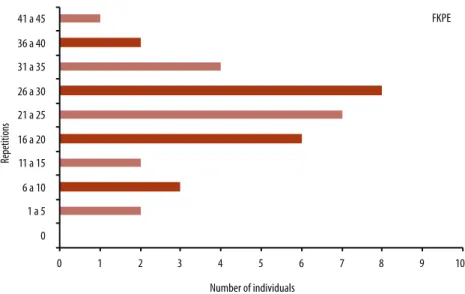
Figures 1 and 2 present the individual results obtained in the MPU and FKPU tests respectively. Most of the women performed between 0 and 10 repetitions (85.7%) of the MPU test, and 17.1% did not perform even one repetition. On the FKPU test, however, the results indicated a predominance of scores in the range between 16 and 35 sequences (71%). It is worth noting that in this test, all the volunteers were able to complete at least one repetition.
Figure 1. Distribution of the sample according to the motor performance for the MPU test (n=35).
he comparison between the scores on the FKPU and MPU tests is pre-sented in Figure 3. he motor performance analysis of the group analyzed in-dicated statistically signiicant diferences between the scores obtained in the two tests with the highest levels being identiied in the FKPU test (p<0.001).
Figure 3. Descriptive values of the scores obtained by women in the FKPU and MPU tests (n=35). *p<0.05
he correlation coeicients between each test and the morphologic variables studied are presented in Table 2. Negative correlations of low magnitude (r=-0.23 to 0.46) were found between body weight, height, fat mass, and lean body mass) and the FKPU and MPU tests.
Table 2. Simple correlation coeicients between morphological variables and performance on the MPU and FKPU tests (n=35)
MPU FKPU
Variables r p r p
Body mass (kg) -0.37 0.03 -0.32 0.06 Height (cm) -0.37 0.03 -0.46 <0.01 FM (kg) -0.34 0.04 -0.32 0.06 LBM (kg) -0.25 0.14 -0.23 0.18
FM = fat mass; LBM =lean body mass
A positive and moderate signiicant correlation (r=0.658; p<0.01) and a moderate agreement (Kappa =0.40; p<0.01) were identiied between the scores obtained in the FKPU and MPU tests.
DISCUSSION
and FKPU tests with the number of repetitions reached in the MPU test being much lower than that found in the FKPU test. Additionally, the two tests showed a moderate agreement between themselves and moderate to weak correlations were identiied between the morphological variables analyzed and the performance observed in each test. Furthermore, the ability to discriminate the performance in the tests investigated was greater in the FKPU test considering that the number of zero results observed in the MPU test did not make it possible to make a more consistent analysis of muscular strength/endurance based on the scores obtained in this test at approximately 1/5 of the sample.
It is believed that the high amount of scores equal to or greater than 15 in the FKPU test and equal to or less than ive in the MPU test identiied in this study can be explained, at least in part, by the diferent muscle groups involved in the concentric phase of the movement and by the overload imposed for sustaining the body, as required in each task. Despite the absence in this study of muscle activation measurements, previous studies that used EMG indicated that the main muscles activated during the MPU test are the infraspinatus, teres major, upper portion of the pectoralis major, biceps brachii, and latissimus dorsi17, while the triceps brachii, pectoralis
major, serratus anterior, and posterior deltoid muscles are the ones more activated during the FKPU test18. herefore, considering that the capacity
to generate force of the elbow lexor muscles, especially the biceps brachii, is less than the elbow extensors, a greater degree of diiculty was already expected in performing the MPU test when compared to FKPU test, which was conirmed by the results found in this study.
herefore, although muscle strength and endurance are physical capa-bilities that hold important relationships among themselves, to the point that most motor test batteries opt to use the joint designation between muscular endurance and strength13,14 to designate a particular test, the
application of the FKPU and MPU tests, indiscriminately, may hinder a more consistent analysis of these physical abilities in various subjects. Ac-cordingly, based on the distribution of the scores obtained in the two tests investigated in this study (Figures 1 and 2), it can be seen that the FKPU test presented scores of diferent magnitudes and with a higher amplitude. On the other hand, on the MPU test, part of the sample investigated (17.1%) was unable to perform even one repetition, which hampered the analysis of both the muscular strength and endurance of these women. Furthermore, the level of agreement between the tests was only moderate, suggesting that the categorization of the subjects based on the levels of muscular strength/ endurance is test-dependent in most cases, which in itself can lead to signii-cant interpretation errors (underestimation or overestimation of muscular strength/endurance) when these tests are applied indiscriminately.
Despite that the possible inluence of body mass and other morpho-logic variables on physical performance has been the subject of previous investigations in both anaerobic19,20 and aerobic21,22 activities, as well as in
in-conclusive since the magnitude of the contribution of these variables seems to depend on the characteristics of the motor task required. In this study it was believed that the motor performance in each test could be largely explained by the morphological variables, which was not conirmed, mainly in relation to body mass, fat mass, and lean body mass in the FKPU test. he only morphological variable investigated that presented an inverse and signiicant correlation with motor performance in both tests was height. hus, height seems to be a relevant factor in motor performance in both tests analyzed, with the shorter subjects presenting a tendency to better motor performance in both tests, which seems to be related to the shorter articular distance to be reached during the execution of each sequence, resulting consequently in a lower total energy expenditure. Relatively similar results to ours were reported by Mayhew et al.24 when analyzing
the performance with push-upsof male college students.
More recently, other factors have been investigated in an attempt to explain the motor performance on speciic tests such as genetic polymor-phism and chromosomal regions simultaneously related25,26. his
informa-tion, though preliminary, is very promising and deserves to be analyzed more consistently in further investigations since they were not analyzed in this study.
It is important to point out that neural adaptations such as increased recruitment of high-threshold motor units, improved synchronization of the antagonistic muscle groups, increasing the frequency of stimulation, and improving the synchronization of the stimulated motor units can distinguish the behavior of the subjects in motor tests depending on the individual itness level (sedentary, physically active, or athletes), experience before the exercise (inexperienced, with a little experience, or experienced), and type of exercise (mono-articular or multi-articular)27. herefore, it
should be considered that the lack of familiarization sessions before the two tests analyzed may have inluenced motor performance, especially in the MPU test since an important part of the sample investigated was un-able to perform even one single movement.
In this sense, some investigations based on the 1-RM test for assessing muscular strength have demonstrated the importance of conducting test familiarization sessions prior to the actual assessments themselves in order to produce more consistent scores by reducing the possible efects of learn-ing the motor gesture27.28. However, we found no information available in
the literature on the possible efect of familiarization sessions prior to the two tests analyzed in similar samples, which limits a more careful analysis of the possible limitations brought about by the lack of familiarization on the results.
cannot disregard the possible intra-individual efect of the diferences in muscular strength/endurance of the muscle groups required in each test and its impact on the categorization generated from the performance observed. In short, care must be taken with respect to the analysis of the results produced by the MPU and FKPU tests since the fragility of some muscle groups in comparison to others can result in a highly heterogene-ous physical performance and may compromise the diagnosis of muscular strength/endurance and prescription of exercises.
Finally, despite the great interest of the scientiic community in ofering alternatives that are relatively simple, of low cost, of large application in dif-ferent professional environments and research involving a large number of subjects, the indiscriminate application of the MPU and FKPU tests needs to be reconsidered. Based on the results found in this investigation, the FKPU test does not seem to discriminate the levels of muscular strength, being apparently more useful for assessing muscular endurance, conirm-ing previously published information24. Furthermore, although some
re-searchers have used the MPU test to evaluate muscular endurance29,30, the
results of this study indicate that this test, at least in young women, does not seem to discriminate muscular endurance for most of those evaluated and presents limitations for categorizing the levels of muscle strength, particularly in subjects who cannot complete even one repetition.
CONCLUSIONS
he results of this study indicate that the FKPU and MPU tests should not be applied indiscriminately to assess muscular strength/endurance in young women since the level of agreement between them is only moderate and the physical demands are relatively distinct. he amplitude analysis of the scores achieved in each test and the level of discrimination of the results in the sample investigated suggest that the FKPU test presents itself as a better indicator of the levels of muscular endurance, while the MPU test seems to discriminate better muscular strength in young women.
Acknowledgments
We would like to express thanks to all the participants for their engagement in this study, the Coordination of Improvement of Higher Education Per-sonnel (CAPES/Brazil) for the doctoral (A.A.) scholarship and the National Council of Technological and Scientiic Development (CNPq/Brazil) for the post-doctoral (M.C.C.T.), doctoral (G.G.C.), and scientiic initiation (L.T.C.) scholarship and for the grant conceded to E.S.C. (Process 306826/2009-7).
REFERENCES
1. Borst SE. Interventions for sarcopenia and muscle weakness in older people. Age Ageing 2004;33(6):548-55.
3. Cooper R, Kuh D, Hardy R, Mortality Review Group, FalCon, HalCyon Study Teams. Objectively measured physical capability levels and mortality: systematic review and meta-analysis. BMJ 2010;341:c4467.
4. Brown DA. Miller WC. Normative data for strength and lexibility of women throughout life. Eur J Appl Physiol 1998;78(1):77-82.
5. Hakkinen K, Hakkinen A. Muscle cross-sectional area, force production and relaxation characteristics in women at diferent ages. Eur J Appl Physiol Occup Physiol 1991;62(6):410-4.
6. Heyward VH, Johannes-Ellis SM, Romer JF. Gender diferences in strength. Res Q Exerc Sport 1998;57(3):154-9.
7. Nieman DC. Fitness and sports medicine: a health related approach. Califórnia: Bull Publishing Company; 1995.
8. Morrow JR, Jackson AW, Disch JG, Mood DP. Medida e avaliação do desempenho humano. Porto Alegre: Artmed; 2003.
9. Gordon CC, Chumlea WC, Roche AF. Stature, recumbent length and weight. In: Lohman TG, Roche AF, Martorell R, editors. Anthropometric standardization reference manual. Champaign: Human Kinetics Books; 1988. p. 3-8.
10. Harrison GC, Buskirk ER, Carter JEL, Johnston FE, Lohman TG, Pollock ML, et al. Skinfold thickness and measurement technique. In: Lohman TG, Roche AF, Martorell R, editors. Anthropometric standardization reference manual. Cham-paign: Human Kinetics Books; 1988. p. 55-80.
11. Siri WE. Body composition from luid space and density: analysis of methods. In: Brozek J & Henschel A. editors. Techniques for measuring body composition. Washington: National Academy of Science; 1961. p. 223-244.
12. Petroski EL. Antropometria: técnicas e padronizações. 5.ed. Jundiaí: Fontoura; 2011. 13. he American Alliance for Health, Physical Education, Recreation and Dance.
Physical Best: Reston; 1988.
14. American College of Sports Medicine (ACSM). ACSM’s health-related physical itness assessment manual. 2th edition. Baltimore: Lippincott Williams & Wilkins; 2008. 15. Marinho BF, Martins JCB. Teste de força/resistência de membros superiores: análise
metodológica e dados normativos. Fisioter Mov 2012;25(1):219-30.
16. Svanholm H, Starklint H, Gundersen HJ, Fabricius J, Barlebo H, Olsen S. Reproduc-ibility of histomorphologic diagnoses with special reference to the Kappa statistic. APMIS 1989;97(8):689-98.
17. Ricci B, Figura F, Felici F, Marchetti M. Comparison of male and female functional capacity in pull-ups. J Sports Med Phys Fitness 1988;28(2):168-75.
18. Youdas JW, Budach BD, Ellerbusch JV, Stucky CM, Wait KR, Hollman JH. Com-parison of muscle-activation patterns during the conventional push-up and per-fectpushupTM exercises. J Strength Cond Res 2010;24(12):3352-62.
19. Halet KA, Mayhew JL, Murphy C, Fanthorpe J. Relationship of 1 repetition maxi-mum lat-pull to pull-up and lat-pull repetitions in elite collegiate women swimmer. J Strength Cond Res 2009;23(5):1496-02.
20. Nimphius S, McGuigan MR, Newton RU. Relationship between strength, power, speed, and change of direction performance of female sotball players. J Strength Cond Res 2010;24(4):885-95.
21. Knechtle B, Knechtle P, Schulze I, Kohler G. Upper arm circumference is as-sociated with race performance in ultra-endurance runners. Br J Sports Med 2008;42(4):295-9.
22. Knechtle B, Duf B, Welzel U, Kohler G. Body mass and circumference of upper arm are associated with race performance in ultraendurance runners in a multistage race--the Isarrun 2006. Res Q Exerc Sport 2009;80(2):262-8.
23. Johnson D, Lynch J, Nash K, Cygan J, Mayhew JL. Relationship of lat-pull repeti-tions and pull-ups to maximal lat-pull and pull-up strength in men and women. J Strength Cond Res 2009;23(3):1022-8.
Corresponding author
Edilson Serpeloni Cyrino Laboratório de Metabolismo, Nutrição e Exercício
Centro de Educação Física e Esporte Universidade Estadual de Londrina Rod. Celso Garcia Cid, km 380 - Campus Universitário
CEP 86051-990 - Londrina, PR - Brasil E-mail: [email protected]
25. Orkunoglu-Suer FE, Gordish-Dressman H, Clarkson PM, hompson PD, An-gelopoulos TJ, Gordon PM, et al. INSIG2 gene polymorphism is associated with increased subcutaneous fat in women and poor response to resistance training in men. BMC Med Genet 2008;9:117.
26. Kostek MC, Devaney JM, Gordish-Dressman H, Harris TB, hompson PD, Clarkson PM, et al. A polymorphism near IGF1 is associated with body composition and muscle function in women from the Health, Aging, and Body Composition Study. Eur J Appl Physiol 2010;110(2):315-24.
27. Ritti-Dias RM, Cyrino ES, Salvador EM, Caldeira LS, Nakamura FY, Papst RR, et al. Inluence of familiarization process on muscular strength assessment in 1RM tests. Rev Bras Med Esporte 2005;11(1):34-8.
28. Levinger I, Goodman C, Hare DL, Jerums G, Toia D, Selig S. he reliability of the 1RM strength test for untrained middle-aged individuals. J Sci Med Sport 2009;12(2):310-6.
29. Kollath JA, Safrit MJ Zhu W, Gao LG. Measurement errors in modiied pull-ups testing. Res Q Exerc Sport 1991;62(4):432-5.