A Work Project presented as part of the requirements for the Award of a Master Degree in Finance from the NOVA – School of Business and Economics.
Disseminating top 5 African countries (2014 – 2017) with highest deal value in order to understand what characteristics are successful in attracting funding from a macroeconomic and
investor perspective.
Jaime Nunez Saracho – 34622
A Project carried out on the Master in Finance Program, under the supervision of: Francisco Queiro
Abstract
This paper aims to understand what characteristics are successful in attracting funding from an investor perspective. In order to assess such characteristics a compilation of all legally filled business acquisitions in Africa from 2014 to 2017 was analyzed. Diverse active investors in Africa were approached to understand and identify crucial characteristics they constantly search for. Using a sample of 2,329 deals and interviewing diverse investors, research concluded that Africa’s business acquisition is severely underdeveloped due to a lack of funding mainly caused by a difficulty to exit and uncertainty regarding political and macroeconomic stability, as well as poor law enforcement and investment regulations.
Key Words
Business Acquisition Industry Judicial Effectiveness
Investment Freedom Economic Freedom
Introduction
“In God we trust, but every other man must bring data” said Olamide Olayinka at the Big Data Economy Summit in October 2017. Donatien Beguy went a step further affirming that “Poor data hurts African countries ability to make good policy decisions”, if births, deaths, schooling and safety are not adequately measured how can we expect for investors to be attracted to all Africa has to offer. This paper is concerned with several questions related to business acquisitions in Africa. What characteristics are successful in attracting funding from an investor perspective? What key elements must countries develop in order to attract larger investments? Can governments incentivize investment by adopting a common law? How can investors potentialize Africa’s development through business acquisitions?
African Leadership Academy (ALA) has recently launched a matching fund “Venture for Your Entrepreneurs (VYE)” in which the ultimate goal is to prove the world that investing in “early stage, early age” entrepreneurs is actually profitable in Africa. Josh Adler and Aaron Fu strongly believe that successful young entrepreneurs leading cash and job generative business, continue to be unable to secure growth capital to scale. Poor track record, limited resources and complex due diligence are among the major obstacles for Africa’s entrepreneur development and hence small growth in business acquisition.
Africa’s top five countries in terms of deal amount were analyzed in order to assess similarities and provide the rest of African nations with a successful path to follow. Business acquisitions are fundamental in healthy economies, it brings efficiencies, synergies and growth. An increase in business acquisitions is associated with a bigger and stronger economy. South Africa, Nigeria,
Egypt, Democratic Republic of Congo and Mauritius are the top five countries in terms of business acquisitions in the period analyzed. Understanding macroeconomic facts and their score on the Economic Freedom report by The Heritage of these five nations can provide the reader and other countries in the region with insights on characteristics to develop in order to have a stronger economy. Diverse factors will be taken into account in order to develop a linear regression, not to predict, but to verify the validity of the arguments presented throughout this paper.
Literature Review
Developing studies on how underdeveloped nations can prosper has been one of the most popular fields of study in the modern era. One conclusion that stands above all, is the one presented by Josh Lesner and Antoinette Schoar (2003) in which they believe that the stronger law enforcement is the more opportunities of investment will exist for the nation. Authors also believe that common law nations provide more contractual protections and therefore generate incentives to invest and expand in different nations. The question left standing aims to debate the role of government programs and question their success and the possibility of replicating those programs of success.
There are two theories that aim to define success of financial markets discussed in the “Law, Endowments and Finance” paper by Beck, Demirgu-Kunt and Levine (2002). The authors aim to explain how the law adopted or the region characteristics define their financial success nowadays. The first of the two theories, “The Law and Finance Theory” concludes that countries that adopted a French Civil law tradition will enjoy lower levels of financial development than British Common law tradition. The law and finance theory concluded that the origin of a country’s legal tradition (colonizer) will dictate their financial success. The second theory known as “The Endowment
Theory” emphasized the role of geography and disease environment in shaping institutional development. The main different between both theories is that on the first one, “The Law and Finance Theory”, the colonizer is the key element on the colony development, while “The Endowment Theory” focuses on the conditions of the colony, not the colonizer.
Financial Development, Property Rights and Growth a paper produced by Claessens and Laeven (2003) “argues that an environment with poorly developed financial systems and weak property rights has two effects on firms: First, it reduces the access of firms to external financing and, second, it leads firms to allocate resources in a suboptimal way”. Claessens and Laeven conclusion is a huge reason why investors tend to overlook Africa and many undeveloped regions like Latin America. “Cross-country Determinants of Mergers and Acquisitions” by Stefano Rossi and Paolo Volpin (2003) found out that countries with better accounting standards and stronger shareholder protection have significantly larger M&A activity.
All the studies presented above indicate that stronger law enforcement will have a positive impact in a country’s economy and therefore boost investment opportunities.
Data Description
Booz & Company “dealogic analytics” between 2014 and 2017 was used to understand deal sizes, money sources, target industries and other characteristics relevant to the analysis. Database contains over 76,591 completed deals and worth over 13,789 billion USD. Africa’s 2014 – 2017 business acquisition activity represented a total of 127.7 billion USD or 0.93% of the total amount of worldwide transactions, being the year 2014 the one with highest business acquisition
investment registered with a total of 45.3 billion USD or 35.45% of the total amount in the analyzed period. Five countries represented 78.99% or 100.9 billion USD of the total amount of business acquisition in Africa, South Africa (50.57%), Nigeria (12.19%), Egypt (7.62%), Democratic Republic of Congo (4.67%) and Mauritius (3.94%).
Graph 1: Africa’s Annual Business Acquisitions and Percentage by Country
In this period span, six industries contributed 83.7 billion (65.58%) of all business acquisitions in Africa. Oil and Gas led all business-related acquisitions with 16.3 billion USD (12.74%) closely followed by Telecommunications 15.3 billion USD (12.01%), Mining 15.2 billion USD (11.91%), Real Estate and Property 13.4 billion USD (10.53%), Retail 12.3 billion USD (9.63%) and Finance 11.2 billion USD (8.76%).
Graph 2: Africa’s Business Acquisitions by Industry
$45,257 $27,506 $42,092 $12,812 $0 $10,000 $20,000 $30,000 $40,000 $50,000 2014 2015 2016 2017 M ill ions DR Congo 5% Egypt 8% Mauritius 4% Nigeria 12% Other 21% South Africa 50% $0 $5 $10 $15 $20 Finance Mining Oil & Gas Real Estate/Property Retail Telecommunications
Top five countries in total deal value and number of deals will be analyzed in order to understand similarities. There is a set of characteristics to be analyzed in order to determine how important they are in attracting investors and boosting business acquisitions. Macroeconomic characteristics are essential to develop a model country profile, meaning what a country must achieve in order to develop a stronger business acquisition industry. GDP, interest rates, inflation, FX rates, usage of financial services, easiness of doing business, tax friendliness, corruption perception index, startup costs, The Heritage Economic Freedom Index which includes property rights index, judicial effective index, government integrity, labor freedom, monetary freedom, trade freedom among others are the macroeconomic variables to be analyzed in this paper.
South Africa
South Africa has become the second strongest economy of Africa, only behind Nigeria. The twenty-five-year-old democracy has proven that adequate policy making can lead to economic benefits. South Africa’s 8-year GDP in USD Compounded Annual Growth Rate is -0.30%, among the lowest in the continent. 2018 USD GDP per capita ranks South Africa number 7 in the continent with 7,439.92, 3.1X higher than Nigeria, the largest economy in the continent. Foreign exchange has depreciated 34.03% with respect to the United States dollar in the past five years. Inflation is among the lowest in the continent with a range between 4.06% and 6.59% in the past 8 years. Interest rates spread is among the lowest in the continent at 3.08% only Mauritius has a lower interest rate. In 2017, 69.22% of the population had an account either with a registered bank or financial institution. Worldbank 2018 data ranks South Africa as the 82 country in the world in terms of easiness of doing business and number 6 in the continent. However, it takes an average of 40 days to complete the procedures to legally operate a business, among the highest in the
continent. Startup costs are among the lowest in the country with only 0.20% of the Gross National Income, compared to the continent average and median of 33.48% and 22.85% respectively.
The most recent corruption perception index perceived South Africa as the 73rd least corrupt country in world, placement has not changed significantly in the past seven years. The Heritage Foundation ranks South Africa number 81 in the economic freedom index, and number 6 in Africa. As a former British Empire colony, South Africa’s law has strong ties and similitudes with the British Common Law which in line with “Law, Endowments and Finance” paper by Beck, Demirgu-Kunt and Levine fosters stronger financial success than other types of legal systems.
In terms of business acquisitions, South Africa is responsible for 64.55 billion USD or 50.57% of the 127.7 billion USD worth of business acquisitions in Africa spread in 674 deals. Main business acquisition industries are Retail 11.89 billion, Real Estate 9.43 billion, Dining and Lodging 7.65 billion and Food and Beverage 7.00 billion. South Africa has become a great investment target for the United States with over 7.8 billion USD and the United Kingdom with over 3.7 billion USD, while 48.7 billion come from citizen acquisitions. Nationals invested 38.26 billion overseas mainly in the United Kingdom 12.29 billion and the United States 8.52 billion. Business acquisitions in South Africa represent a deficit of 22.43 billion in the period in question. South Africa only invests 1.95 billion in Africa excluding South Africa, mainly in Morocco (700 million) and Mauritius (683 million). Johannesburg Stock Exchange had 294 listed companies in 2017 making it the largest and most developed bourse in the continent.
South Africa current situation can be affected if current government is not able to reduce the levels of unemployment and criminality that continue to raise. Government must promote local acquisitions in order to increase efficiency, productivity and profitability.
Nigeria
Nigeria belongs to one of the most prosperous regions among the underdeveloped economies. The Western African region provides investors with huge opportunities of accessing a large population who share similar regulations. Sharing similar regulations allows companies to scale and expand operations overseas without incurring large cash outflows, making it extremely appealing to investors. Scalability has become one of the most important traits investors are looking for, making Nigeria one of the most attractive nations in the continent.
Nigeria has become the strongest economy of Africa since 2012, with its over 190 million habitants. Nigeria’s 8-year GDP in USD Compounded Annual Growth Rate is 1.12%, during the previous eight-year period (2003 to 2010) Nigeria grew at a CAGR of 7.31% which positioned the country as one of the continents role models. 2018 USD GDP per capita ranks Nigeria number 17 in the continent with 2,396.31. Foreign exchange has depreciated 111.63% with respect to the United States dollar in the past five years. One of the explanations to this continuous lose in value is mainly driven by a high inflation 12.09% in 2018. Inflation remains to be one of the macroeconomic factors Nigerian government has not been able to control and reduce considering that inflation in 2012 was at a similar level 12.22%. From a list of 26 countries, Nigeria’s interest rate spread of 7.20% ranks 200 basis points below average. In 2017, 39.67% of the population had an account either with a registered bank or financial institution. Worldbank 2018 data ranks
Nigeria as the 146 country in the world in terms of easiness of doing business and number 26 in the continent. However, it takes an average of 11 days to complete the procedures to legally operate a business, compared to the 31 days it took back in 2014. Startup costs are 29.80% of the total Gross National Income, making it a competitive disadvantage compared to other top economies in the region.
The most recent corruption perception index perceived Nigeria as one of the most corrupt countries in the world (144), placement has not changed significantly in the past seven years. The Heritage Foundation ranks Nigeria as the 115th freest economy in the world, and number 16 in Africa. As a former British Empire colony, Nigeria’s law has strong ties and similitudes with the British Common Law which in line with “Law, Endowments and Finance” paper by Beck, Demirgu-Kunt and Levine fosters stronger financial success than other types of legal systems.
In terms of business acquisitions, Nigeria is responsible for 15.56 billion USD or 12.19% of the 127.7 billion USD worth of business acquisitions in Africa spread into 68 deals. Nigeria’s main business acquisition industries are Telecommunications 5.42 billion, Oil & Gas 4.65 billion, Finance 1.74 billion and Food & Beverage 1.60 billion. Nigeria’s biggest investor is the United States with 60.87% or 2.67 billion of Nigeria’s total foreign business acquisitions. Nigerians invested 1.01 billion overseas mainly in Canada 493 million and South Africa 468 million. Business acquisitions in Nigeria represent a surplus of 3.29 billion in the period in question. Local acquisitions remain the main driver of the industry with 11.17 billion or 71.80% of the grand total. The Nigerian stock exchange had 166 listed companies in 2017, making it one of the most important stock exchanges in Africa.
Egypt
Egypt is the only Arab nation present in the top countries in terms of business acquisitions value, Egypt ranks as the 3rd nation with over 9.73 billion USD. Egypt’s economy has been strongly dependent on oil production, agriculture and tourism. Egypt’s 8-year GDP in USD Compounded Annual Growth Rate is 1.72%, 2018 USD GDP per capita ranks Egypt number 15 in the continent with 2,907.32, a 1.19% CAGR from 2010 to 2018. Foreign exchange has depreciated 130.50% with respect to the United States dollar in the past five years. One of the explanations to this continuous lose in value is mainly driven by a high inflation 29.51% in 2017. Egypt’s political instability results in a loss of economic activity and attractiveness to investors. For the past ten years Egypt has suffered from several revolutions and government coups, political stability is fundamental for investments to flow into the country. From a list of 26 countries, Egypt’s interest rate spread of 6.00% ranks 300 basis points below average. In 2017, 32.78% of the population had an account either with a registered bank or financial institution. Worldbank 2018 data ranks Egypt as the 120th country in the world in terms of easiness of doing business and number 17 in the continent. However, it takes an average of 12 days to complete the procedures to legally operate a business. Startup costs are 19.40% of the total Gross National Income, making it below average for the continent.
The most recent corruption perception index perceived Egypt as one of the most corrupt countries (105), a 12-place advancement for Egypt in one year. The Heritage Foundation ranks Egypt as the 144th freest economy in the world, and number 27 in Africa. Egyptian legal system regardless of being a British Colony follows a Civil law which in line with “Law, Endowments and Finance” paper by Beck, Demirgu-Kunt and Levine fosters lower levels of financial development.
In terms of business acquisitions, Egypt is responsible for 9.73 billion USD or 7.62% of the 127.7 billion USD worth of business acquisitions in Africa spread over 139 deals. Egypt’s main business acquisition industries are Construction 1.97 billion, Oil & Gas 1.77 billion, Finance 1.75 billion, Telecommunication 1.18 billion and Healthcare 1.17 billion. Egypt’s biggest investors are Canada 1.23 billion and Russia 1.13 billion. Egyptians invested 2.05 billion overseas mainly in the United Arab Emirates 1.73 billion and Mexico 167 million. Business acquisitions in Egypt represent a surplus of 3.59 billion in the period in question. Local acquisitions remain the main driver of the industry with 4.09 billion or 42.01% of the grand total. Egyptian Stock Exchange had 252 listed companies in 2017, making it one of the largest stock exchanges in Africa.
Democratic Republic of Congo (DRC)
Democratic Republic of Congo (DRC) is the twelve largest economy in Africa and one of the nations with highest growth rate in the past decade, moving four places up the ranking since 2010. DRC serves as an example that alliances with foreign governments could positively boost the economic output of a nation, in DRC’s case an alliance with China has yielded benefits in the mining and telecommunication sector.
DRC is part of the top 5 African nations with highest value of acquisitions due to recent acquisitions by the Chinese companies in DRC’s mining region. Sicomines, a consortium of Chinese companies has invested heavily in infrastructure and exploitation rights of Copper and Cobalt in the province of Katanga. DRC’s 8-year GDP in USD Compounded Annual Growth Rate is 10.29%, 2018 USD GDP per capita ranks DRC as the 46 in the continent with 418.74. Foreign exchange has depreciated 80.72% with respect to the United States dollar in the past five years.
The latest inflation reported by DRC was in 2016, 2.89%. From a list of 26 countries, DRC’s interest rate spread of 19.88% ranks 12% above average. In 2017, 25.83% of the population had an account either with a registered bank or financial institution. Worldbank 2018 data ranks DRC as the 184 country in the world in terms of easiness of doing business and number 49 in the continent. However, it takes an average of 22 days to complete the procedures to legally operate a business. Startup costs represent 28.60% of the Gross National Income, which is 4.98% lower than Africa’s average.
The most recent corruption perception index perceived DRC as one of the most corrupt countries (161), placement has not changed significantly in the past seven years. The Heritage Foundation ranks DRC as the 117th freest economy in the world, and number 17 in Africa. As a former Belgian Empire colony, DRC’s follows a Civil law system which in line with “Law, Endowments and Finance” paper by Beck, Demirgu-Kunt and Levine fosters lower levels of financial development.
In terms of business acquisitions, DRC is responsible for 5.97 billion USD or 4.67% of the 127.7 billion USD worth of business acquisitions in Africa spread in 20 deals. DRC’s main business acquisition industry is mining with 97.21% of the total or 5.80 billion. DRC’s biggest investors are China with 79.45% or 4.74 billion and Switzerland with 15.45% or 922 million of DCR’s total foreign business acquisitions. Databased shows no investments made by DCR nationals and the country has no established stock exchange which can difficult exits for investors.
Mauritius
Mauritius is the smallest of all the countries analyzed in this paper, government has focused on attracting funds by making their taxation as simplified and minimal as possible. PWC ranks Mauritius as the 6th most tax friendly country in the world, with a corporate tax rate of 15% and no taxation on capital gains. Mauritius has become the most attractive country in Africa by offering a regulated and transparent business environment.
Mauritius has the 27th largest economy in Africa, their 8-year GDP in USD Compounded Annual Growth Rate is 4.49% and a 7.25% growth in 2018. Foreign exchange has depreciated 15.08% with respect to the United States dollar in the past five years, Mauritius rupee performance is similar to the likes of the Euro and the British Pound. Mauritius macroeconomic performance is also supported by a low inflation rate 3.22% in 2018 and a low interest rate spread of 5.16%, 7th lowest in the continent. Mauritius government strategy to attract capital with reduced taxation and softer regulations has proven a success, GDP in USD has doubled in a 12-year period. In 2017, 89.84% of the population had an account either with a registered bank or financial institution, the highest in Africa. Worldbank 2018 data ranks Mauritius as the 20th country in the world in terms of easiness of doing business and number 1 in the continent. It takes an average of 5 days to complete the procedures to legally operate a business. Startup costs represent only 1.00% of the Gross National Income, 3rd lowest in the continent.
The most recent corruption perception index perceived Mauritius as the 56th less corrupt country in the world, ranked 6th among African countries. The Heritage Foundation ranks Mauritius as the 21th freest economy in the world, and the freest in Africa. As a former British and French colony,
Mauritius’s follows a mix between the common and civil law systems which can prove that a mix of both systems can be the best alternative.
Mauritius business acquisitions from 2014 to 2017 totaled 5.03 billion or 3.94% of the 127.7 billion USD worth of business acquisitions in Africa, the 5th highest across Africa spread in over 33 deals. Mauritius main business acquisition industries are Real Estate 3.15 billion, Professional Services 427 million and Finance 416 million. Mauritius biggest investors are Romania with a single deal worth over 3.15 billion and South Africa 683 million. Mauritians invested 657 million overseas mainly in Portugal 235 million and India 175 million. Business acquisitions in Mauritius represent a surplus of 1.23 billion in the period in question. The Stock Exchange of Mauritius had 74 listed companies in 2017, foreign companies have decided to incorporate in Mauritius in recent years due to ease of business and monetary freedom.
Discussion of the Topic
Aaron Fu, Clive Butkow, Niraj Varia and Sangu Dele provided deep insights on the limitations, risks and personal experiences on investment in Africa. All of them are currently investing in Africa, Aaron Fu is also assisting young entrepreneurs into developing skills that will allow their business to prosper. Aaron Fu and Josh Adler developed a matching fund for African Leadership Academy in which they aim to demonstrate that young entrepreneurs and early stage ventures can turn into profitable investments if access to funds is given. Understanding investors needs and characteristics they are on the hunt for could be crucial to potentialize and expand business acquisitions in Africa.
Conversations with investors were divided into three sections, the first one aims to understand what investors are looking for in terms of the team, product, segment and the business idea as a whole. This section provides insights on how investors initially approach deals and what business and personal traits are important in order to develop a stronger business acquisition segment in Africa. The second section of the interview aims to discover more about Africa, understanding the limitations, challenges, risks and characteristics or country conditions investors believe Africa needs to develop and improve. The last and most political section aims to understand investor’s perspective regarding what role should government play in the business acquisition industry.
Understanding investors mindset is a complex task, there is no guarantee for success. Different approaches can lead to success, there is no single route investors should be taking. The team in words of the investors is one of the most import characteristics they test when analyzing potential deals. In words of Niraj Varia a team must be “hungry, have a great chemistry, be willing to learn and to receive feedback”. Clive Butkow believes an entrepreneur needs to be coachable, have good communication skills, courage and conviction, curiosity to learn as much about the industry and competitors. Aaron Fu along with African Leadership Academy are developing young entrepreneurs into strong business minds without losing focus of the needs to develop and address Africa’s greatest challenges. All investors see the team as the essential element of success, and agree that it is a scarce commodity in today’s Africa.
Discovering more about Africa’s limitations, risks and needs is essential to test investors experience with real life data. All interviewed investors agreed that exiting is one of Africa’s biggest challenges, an underdeveloped financial market limits the ability for investors to cash out
their positions, which inhibits investment or investment is done under unfair valuations and restrictions. In terms of liquidity and capital Clive Butkow and Aaron Fu agree that there are no sufficient buyers and capital to achieve a good multiple, Aaron Fu added that “liquidity is a big issue in Africa, as well on being able to contractually pull your money out both from the company and out of the country”. Most importantly, Clive Butkow mentioned that Africa is consistently put into a single vessel, however “Africa is not a country but 54 countries with different regulation and policies”.
The second biggest challenge investors face is related to data, information and talent. Asymmetry of information is particularly complex in Africa; available information is not relevant, or it is not updated. Aaron Fu manifests that there is not enough data to make informed decisions. Niraj Varia strongly believes that the industry is still in early stages, consistency will be achieved once a track record of good exists start signaling the market. Investors believe that talent is scarce, brining talent to Africa is a major limitation, and most importantly keeping talent in the country. The third challenge and toughest is the unpredictability on how governments will act, political and regulatory risks are extremely high which inhibits many investors from deploying resources in the continent. There are many cases of scalable ventures that suffer from complex and different regulations across the continent. A challenge that could be solved if governments work together to insure or adopt a common law.
Previous section allows us to identify and test different variables that investors mentioned as the characteristics necessary to attract funding. Characteristics such as property rights, judicial effectiveness, financial freedom, government integrity, investment freedom, monetary freedom
among others are measured by the Heritage Foundation and the World Bank and are known as World Development Indicators (WDI). WDI’s will serve as the independent variables for the regression in the Empirical Results section of the paper.
What should government role be? Should government interfere? What would an ideal government be doing to improve Africa’s business acquisition industry? These are among the question’s investors faced throughout our conversations. Government role in words of Aaron Fu should be to “make it easier to move people and capital”, Niraj Varia goes into depth by urging governments to make regulations simple and clear, to foster entrepreneurship and to improve quality education. Niraj believes governments should provide a more attractive environment for investors, at least by setting clear competition rules. Niraj’s firm decided to withhold investment in Tanzania over the next years due to the lack of clear regulations, saying it “inhibits investment”. Clive Butkow with experience in South Africa’s investment industry says “Governments need to make it easier for good human capital to emigrate to South Africa” since current immigration regulations dissuade foreigners and companies to attract talent into the country. Investors opinion differ in regard to the optimal government involvement to foster entrepreneurship and incentivize investment. Aaron Fu believes governments should only focus on making things easier, meaning no or limited intervention. While Clive Butkow and Niraj Varia believe governments should intervene to develop and rethink regulations that are clearly not working. All investors are on track on what the next steps should be and the key elements that must be protected by governments in order to incentivize investors and entrepreneurs. Property rights, judicial effectiveness and investment freedom are the key areas where governments should be working to improve according to the investors.
To conclude, investors know there are great opportunities in Africa and investment firms have obtained good returns in the past years, however, more needs to be done to trigger investment in Africa. There are many good teams, entrepreneurs and ideas but government and political instability dissuade investors to enter the market. Political instability is affecting both investors and entrepreneurs, since all those risks are incorporated into the valuation of the firm.
Empirical Results
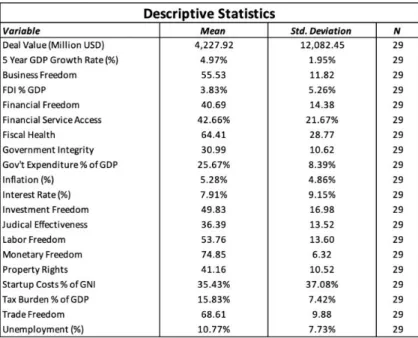
In this section, the regression results are presented. In the first set of regression, the dependent variable is the amount in million USD of business acquisition legally disclosed in Africa from 2014 to 2017. A regression analysis was performed in order to understand correlation and economic significance between the different variables studied in the paper. The aim is to quantify and compare investors insights with real life information. A linear regression analysis will allow us to understand the relationship between the deal value amount over the period analyzed and other variables such as startup costs, property rights, government integrity, business freedom, labor freedom, monetary freedom, investment freedom, financial freedom, foreign direct investment as a percentage of GDP, interest rates and unemployment. Descriptive statistics for all variables presented above can be observed in the appendix table I: Descriptive Statistics.
A regression will assist in defining which variables are statistically significant with a 90% confidence, as well as understanding the economic significance of each of the variables included in the regression. Correlations will also indicate how independent variables studied are linked and interdependent between each other. The regression presented below has no intention of predicting, the intention is for the regression to explain which variables are the most important in increasing
business acquisitions. Once the set of significant variables is obtained, each country in the region can focus efforts, skills and resources into improving such characteristics.
Correlation analysis shows how interdependent variables behave between each other, all correlations are significant at 0.01 level (2-tailed). Business Freedom is highly correlated with government integrity (0.554), Judicial Effectiveness (0.586), Property Rights (0.599) and Startup costs (-0.696). Deal Value in Million USD is highly correlated with Property Rights (0.443), Financial Freedom is highly correlated with Investment Freedom (0.645), Property Rights (0.640) and Trade Freedom (0.626). Financial Services Access is highly correlated with Judicial Effectiveness (0.647). Inflation is negatively correlated with Monetary Freedom (-0.839), all correlations can be observed in the appendix table II: Correlation Analysis.
The first tested regression includes the following Predictors: Unemployment (%), Investment Freedom , Fiscal Health, Interest Rate, Startup Costs, FDI % GDP, Labor Freedom, Monetary Freedom, Judicial Effectiveness, Financial Freedom, Tax Burden % of GDP, Government Integrity, Business Freedom, Trade Freedom, Gov't Expenditure % of GDP , Financial Service Access, Property Rights, Inflation (%) yielding an R2 of 0.719 and highly overfitting our model, most of the coefficients are not significant with a 90% confidence. Coefficients and predictor significance can be observed in the appendix table III: Regression I result.
A second regression was tested, in which correlations and investors insights were taken into consideration. All investors agreed that property rights, easiness of doing business, clear and just regulations, free flow of money and people are among the most important characteristics they
believe governments should fulfill in order to expand their business acquisition industry. Having information for most of the characteristics they expressed were essential, a second regression was constructed. The second tested regression includes the following predictors: Unemployment (%), Investment Freedom, Labor Freedom, Property Rights, Monetary Freedom, Business Freedom, Tax Burden % of GDP and Judicial Effectiveness yielding an R2 of 0.656. All predictors are significant with a 90% confidence except for Labor Freedom and Monetary Freedom. Coefficients and predictor significance can be observed in the appendix table IV: Regression II result.
A third regression was tested, in which insignificant predictors Monetary Freedom and Labor Freedom were removed from the analysis. As a result, all predictors from regression II, except the above mentioned are significant with a 90% confidence except for the constant, yielding an R2 of 0.641. Coefficients and predictor significance can be observed in the appendix table V: Regression III result.
Regression presented above aim to define the importance of the tested variables and should not be used to predict, the model suffers from several shortcomings and limitations. Omitted variable is the most important of the limitations, there are several other factors that could explain the same relationship and have been excluded from the analysis since there is no tangible, accurate and realistic measurement for most of the countries listed in the analysis. Results at a country level could be influence by a numerous number of variables that were not part of this analysis.
Conclusion
Identifying the characteristics that are successful in attracting funding is the first step to improve the business acquisition industry in Africa. Inexistent data, lack of quality and accuracy, measurement differences between countries are among the greatest challenges when working with Africa. Business acquisitions in Africa has tremendous growth potential, governments must focus on attracting investment by making clear regulations for both investors and entrepreneurs. All interviewed investors agreed that government participation must be transparent and supportive of entrepreneurs and businesses.
The regression analysis clearly shows how business freedom, property rights, investment freedom, judicial effectiveness, tax burden as a percentage of GDP and unemployment are fundamental for countries to improve in order to expand their business acquisition industry. All regression results confirm that the higher scores on the above-mentioned variables are, the larger the business acquisition industry will become. Regression limitations must be taken into account, such as omitted variables that could also explain the inferences obtained in this paper. Regressions presented in the Empirical Results section should not be used to predict.
Investors needs and characteristics necessary to attract funding are similar to the results the regression yielded. Investors believed that property rights, easiness of business and judicial effectiveness are among the most important characteristics a country must possess in order to incentivize investment and business acquisitions, and the empirical evidence backs their hypothesis. Uncertainty in Africa is extremely high, governments must focus on creating and setting clear regulations for all investors and entrepreneurs. Easiness of doing business is essential
for investors to be attracted to Africa, Mauritius a top 5 country in Africa has been doing an outstanding job in this regard and countries should follow their example. South Africa, has still a long way to go, however, regulations have been set and followed, property rights are highly protected and following the literature review presented in section III of the report a stronger law enforcement will have a positive impact in a country’s economy and therefore boost investment opportunities. Nigeria has the most attractive market of all Africa; more than 190 million Nigerians present an opportunity and a challenge of their own. If Nigeria’s government focuses on developing stronger regulations to promote entrepreneurship and protect property rights with no doubt will bring a huge impact not only to the country, but to the nearby regions.
The goal of this report was achieved, African civil society must push governments to be transparent and to develop regulations that foster entrepreneurship and the protection of property rights. There is a huge potential to be unleashed in Africa, the VYE matching fund developed by African Leadership Academy aims to prove that young entrepreneurs can be profitable and are the backbone and future of the African economy. Huge steps and efforts must be taken by all players of the industry (government, investors, entrepreneurs) in order to speed up change in Africa, unleashing all the economic benefits business acquisitions (Private Equity, Venture Capital, privatizations) has to offer and positively impact in other aspects Africa has been struggling with like reducing mortality rates, improving quality education, access to medicines and hospitals. Africa needs to become sustainable by itself, humanitarian assistance even though is a huge relief will not solve Africa’s problems. If governments are not working to foster entrepreneurship and investment, they at least should not be working against it.
References
World Development Indicators (2017)
https://databank.worldbank.org/reports.aspx?source=2&series=FP.CPI.TOTL.ZG&country=ZAF
PricewaterhouseCoopers, “Africa Continues to Attract Foreign Investment”
https://www.pwc.co.za/en/press-room/africa-investor-destination.html
Lerner, Josh and Schoar Antoinette, 2006, “Private Equity in the Developing World: The
Determinants of Transaction Structures”
http://www.law.harvard.edu/programs/corp_gov/papers/03.Josh-Lerner.pdf
Claessens, Stijn and Laeven Luc, 2006, “A Reader in International Corporate Finance”
Jeng, Leslie, and Philippe Wells, 2000, “The Determinants of Venture Capital Funding: Evidence across Countries”
Asli, Kunt, Levine, 2001, “Financial Structure and Economic Growth: A Cross-Country Comparison of Banks, Markets, and Development”
La Porta, Rafael, Florencio Lopez-de-Silanes, Andrei Shleifer, and Robert Vishny, 1998, “Law and Finance”
Pagano, Roell, Zechner, 2002. “The geography of equity listing: Why do companies list abroad?” Wurgler, 2000. “Financial markets and the allocation of capital”
Acemoglu, Johnson, Robinson, 2001. “The colonial origins of comparative development: an empirical investigation”
Appendix
Table I: Variable Descriptive Statistics