Underwater survey of ichthyofauna of eastern Atlantic
seamounts: Gettysburg and Ormond (Gorringe Bank)
Jorge M.S. Gonçalves1); João Bispo2); José Augusto Silva2)
1) Centro de Ciências do Mar (CCMAR), Universidade do Algarve, Faro, Portugal.
2) Wild Atlantic Association, Faro, Portugal.
Abstract
Gettysburg and Ormond are seamounts belonging to the Gorringe Bank, which is located on the Europen-African plate boundary. Given the importance of these oceanic features for understanding marine biodiversity patterns, two surveys were carried out in 1998 (Gettysburg) and 1999 (Ormond) using diving, photography and video for species identification and abundance evaluation. Of the 9 fish species found at Gettysburg and 11 at Ormond, 6 were common to both sites and these included the dominant species: the oceanic and commercially important, Seriola rivoliana, and the coastal, typically Atlantic-Mediterranean Coris julis and Anthias anthias. The strong representation of coastal, demersal and Atlantic-Mediterranean species in the Gorringe Bank region and the presence of Abudefduf luridus, an endemic Macaronesian species, at Gettysburg suggests that the upper part of these seamounts may have acted and still act as “stepping stones” for the dispersal of coastal species.
Kurzfassung
Unterwasserbeoabachtungen zur Fischfauna von Erhebungen am Meeresboden des östlichen Atlantiks: Gettysburg und Ormond (Gorringe Bank)
Gettysburg und Ormond sind Erhebungen am Meeresboden, die zur Gorringe Bank gehören, die sich an dem Zusammentreffen der europäischen und afrikanischen Kontinentalplatte gebildet hat. Um die Bedeutung dieser ozeanographischen Strukturen für die Biodiversität zu studieren, wurden zwei Expe-ditionen unternommen, eine 1998 (Gettysburg), eine weiter 1999 (Ormond), wobei Tauchgänge, Photographie und Video zur Bestimmung der Arten und deren Häufigkeit eingesetzt wurden. Von den 9 Fischarten auf Gettysburg und 11 auf Ormond waren 6 häufig an beiden Standorten; diese umfaßten die dominanten Arten wie die kommerziell wichtige Hochseeart Seriola rivoliana und zwei Arten der atlantischen und mediterranen Küsten, Coris julis und Anthias anthias. Das gehäufte Vor-kommen von Küstenformen, Bodenbewohnern und atlantisch-mediterranen Arten auf der Gorringe Bank und die Anwesenheit von Abudefduf luridus, einer endemischen Art Makronesiens auf Gettys-burg legen nahe, daß der obere Teil dieser Unterwasserhügel als Trittsteine für das Ausbreiten von Küstenbewohnern in der Vergangenheit gedient hat und auch weiterhin diese Funktion einnimmt. Resumo
Levantamento subaquático da ictiofauna de montes submarinos do Atlântico Este: Gettysburg e Ormond (Banco Gorringe)
Os montes submarinos Gettysburg e Ormond fazem parte do Banco Gorringe, que se situa na frontei-ra entre as placas Europeia e Africana. Dada a importância destas elevações oceânicas pafrontei-ra a
compreen-são dos padrões de biodiversidade marinha, realizaram-se duas expedições, uma em 1998 (Gettysburg) e outra em 1999 (Ormond), utilizando o mergulho com escafandro autónomo, fotografia e vídeo subaquáticos para a identificação da ictiofauna e avaliação da sua frequência e abundância relativas. Das 9 espécies de peixes encontradas no Gettysburg e 11 no Ormond, 6 eram comuns a ambos os montes submarinos, incluindo algumas espécies dominantes: uma oceânica e comercialmente importante, Se-riola rivoliana, e duas costeiras tipicamente Atlântico-Mediterrâneas, Coris julis e Anthias anthias. A grande representação de espécies costeiras, demersais e Atlântico-Mediterrâneas no Banco Gorringe e a presença de Abudefduf luridus em Gettysburg, uma espécie endémica da Macaronesia, sugere que as partes superiores destes montes submarinos poderão ter actuado e estarem a actuar como “pontes” para a dispersão de espécies costeiras.
Introduction
Gettysburg and Ormond are the two most important elevations of the volcanic Gorringe Bank, which is located on the European-African plate boundary, between Tagus Abyssal Plain to the north and Horseshoe Plain to the south (Figure 1). These peaks rise from a depth of almost 5000 m to less than 40 m and extend in a SW-NE direction 125 nm off
N 36˚50' 36˚40' 36˚30' 36˚20' 36˚10' 11˚50' 11˚40' 11˚30' 11˚20' 11˚10' 11˚00' 10˚50' E
Figure 1: Map of the Gorringe Bank. The two peaks of this seamount, Gettysburg and Ormond, rise from waters almost 5000 m deep to less than 40 m; extending in a SW-NE direction 125 NM off the SW coast of Portugal and 125 NM from Ampère Seamount (adapted from LaGabrielle and Auzende 1982).
Cabo de S. Vicente, SW coast of Portugal. Gorringe Bank is part of the Horseshoe Seamounts range and presents a topographic barrier to the flow of meddies, tending to deflect them to the west (Bower et al. 1995; Richardson et al. 2000). The surface of this bank is composed of serpentinites, basalts, gabbros and recent conglomerates (Auzende et al. 1979; Girardeau et al. 1998).
Little is known about the biology of the Gorringe Bank and references to marine fishes are hidden in grey fisheries-related literature.
Underwater surveys by divers in extreme environments such as these offshore seamounts are very unusual. Interest in visual and video methods for censuring reef fishes has increased greatly in recent years, especially for Marine Protected Areas (MPA) and other areas with sensitive biotopes. This is because of the inadequacy of some traditional sampling tech-niques and the need for reliable, non-destructive, fishery-independent sampling methods (Harmelin-Vivien et al. 1985; Bohnsack and Bannerot 1986; Bortone et al. 1986). These methods also have the potential to allow the recording of behavioural characteristics of some organisms and the recognition of habitat types and uses.
Given the importance of these oceanic features for understanding marine biodiversity patterns, a preliminary ichthyofauna assemblage survey on the upper part of Gorringe Bank seamounts was carried out.
Materials and methods
Two underwater surveys were carried out in 1998 (Gettysburg: 36º 31.55’ N, 11º 35.08’ W) and 1999 (Ormond: 36°42.90' N, 11°9.30' W) using visual census: direct observation, photography and video. The first two methods were used only for species identification while a random search method with video (Harmelin-Vivien et al. 1985; Bortone et al. 1986) was also used for quantification of demersal and pelagic ichthyofauna. This method consisted of a diver with a video camera slowly swimming “randomly” over the reef for a fixed period of time (10 minutes), recording straight ahead every species present within the camera field range. The rough weather conditions (waves and currents) and the diving time limitations due to the depths of 32 to 62 m, imposed the choice of this method where no surface-area sampling was feasible (Bortone et al. 1991).
Species identification, biogeographic origin, habitats, egg type and diets were reviewed with the help of Whitehead et al. (1986), Quéro et al. (1990), Lloris et al. (1991), Debe-lius (1997), and Froese and Pauly (2003). Fishery value was generally assessed from Froese and Pauly (2003) and conservation status in the eastern Atlantic was derived from IUCN (2003).
A species frequency index (F) was estimated: F = (f / ft) × 100, where f is the number of occurrences of a given species in the total duration of the video transect and ft is the total number of occurrences of all species within the same transect. Relative abundances were also obtained from video image analysis, by counting individuals during each video transect (code 1 = less than 10 individuals; code 2 = between 10 and 50 individuals and code 3 = more than 50 individuals).
All photos and videos are archived at the Centre of Marine Sciences (CCMAR-Univer-sidade do Algarve).
Results
Twelve underwater surveys were carried out in June 1998 at Gettysburg at depths from 32 to 47 m and twenty-four at Ormond in August 1999 from 36 to 62 m. Random video tracks of 10 minutes in Gettysburg and 20 minutes (2 × 10 min) in Ormond were carried out. In general, Gettysburg and Ormond peaks had similar habitats of hard bottom covered mainly by kelp forests and red gorgonians. There were no differences between any of the 3 methods deployed (visual, photography and video) with respect to the species identified.
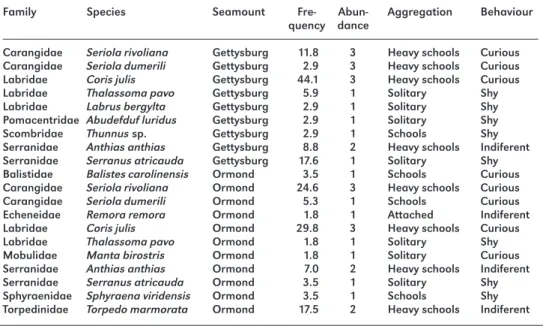
Of the 9 fish species found at Gettysburg and 11 at Ormond, 6 were common to both sites (42.9 % degree of species overlap). Labridae, Carangidae and Serranidae were the most representative families at both sites. Coris julis, Anthias anthias and Seriola rivoliana were the most frequent and abundant species at both sites (Table 1).
C. julis and S. rivoliana were grouped in large schools that dominated the landscape of both seamounts, while A. anthias and Torpedo marmorata formed dense, highly localised schools in small overhangs and on the bottom, respectively. Serranus atricauda, Abudefduf luridus and Thalassoma pavo were always found alone, with the first two species displaying a territorial behaviour. There were no apparent differences in behaviour with regard to human contact for all of the “coastal origin” species in the seamounts when compared to their counterparts from coastal habitats, with most being shy (Table 1). In contrast, “oceanic species” like Seriola spp. and Manta birostris were very curious and usually came close to the divers.
Family Species Seamount Fre- Abun- Aggregation Behaviour quency dance
Carangidae Seriola rivoliana Gettysburg 11.8 3 Heavy schools Curious
Carangidae Seriola dumerili Gettysburg 2.9 3 Heavy schools Curious
Labridae Coris julis Gettysburg 44.1 3 Heavy schools Curious
Labridae Thalassoma pavo Gettysburg 5.9 1 Solitary Shy
Labridae Labrus bergylta Gettysburg 2.9 1 Solitary Shy
Pomacentridae Abudefduf luridus Gettysburg 2.9 1 Solitary Shy
Scombridae Thunnus sp. Gettysburg 2.9 1 Schools Shy
Serranidae Anthias anthias Gettysburg 8.8 2 Heavy schools Indiferent
Serranidae Serranus atricauda Gettysburg 17.6 1 Solitary Shy
Balistidae Balistes carolinensis Ormond 3.5 1 Schools Curious
Carangidae Seriola rivoliana Ormond 24.6 3 Heavy schools Curious
Carangidae Seriola dumerili Ormond 5.3 1 Schools Curious
Echeneidae Remora remora Ormond 1.8 1 Attached Indiferent
Labridae Coris julis Ormond 29.8 3 Heavy schools Curious
Labridae Thalassoma pavo Ormond 1.8 1 Solitary Shy
Mobulidae Manta birostris Ormond 1.8 1 Solitary Curious
Serranidae Anthias anthias Ormond 7.0 2 Heavy schools Indiferent
Serranidae Serranus atricauda Ormond 3.5 1 Solitary Shy
Sphyraenidae Sphyraena viridensis Ormond 3.5 1 Schools Shy
Torpedinidae Torpedo marmorata Ormond 17.5 2 Heavy schools Indiferent Table 1: Fish species observed at Gettysburg and Ormond Seamounts. Frequency of occurrence, abun-dance category, aggregation type, habitat and general behaviour response to divers’ presence by species and seamount.
Most of the fish species found at both sampled sites were of Atlantic-Mediterranean origin, with coastal and demersal habitats. Cosmopolitan and oceanic species had a strong presence at both seamounts with benthonic species only represented by a mass aggregation of T. marmorata at Ormond Seamount. The majority of the species observed have a repro-duction pattern based on pelagic eggs, with the exceptions of Labrus bergylta, Abudefduf luridus and Balistes carolinensis, which have benthonic eggs, and T. marmorata and M. biros-tris, which are ovoviviparous. A mixed diet based on benthonic invertebrates, mainly crusta-ceans and gastropods, and on fishes is generally associated with the fish species identified (Whitehead et al. 1986; Froese and Pauly 2003). About 43 % of the species were of com-mercial value, with the most important being S. rivoliana and Thunnus sp., which is also a potentially threatened species (IUCN 2003) (Table 2).
Table 2: General biogeographic origin, habitat, egg type, diet, and conservation and fisheries status of the fish species found in Gorringe Bank, according to Whitehead et al. (1986), Quéro et al. (1990), Lloris et al. (1991), Debelius (1997), Froese and Pauly (2003) and IUCN (2003).
Gettysburg Ormond Total (Gorringe)
N % N % N % Biogeographic origin Macaronesian (endemic) 1 11.1 0 0.0 1 7.1 Atlantic-Mediterranean 6 66.7 8 72.7 9 64.3 Cosmopolitan 2 22.2 2 18.2 3 21.4 Amphi-Atlantic 0 0.0 1 9.1 1 7.1 Total Species 9 100.0 11 100.0 14 100.0 General habitat Oceanic 3 33.3 5 45.5 6 42.9 Coastal 6 66.7 6 54.5 8 57.1 Specific habitat Pelagic 3 33.3 6 54.5 7 50.0 Demersal 6 66.7 4 36.4 6 42.9 Benthic 0 0.0 1 9.1 1 7.1 Egg type Pelagic 7 77.8 8 88.9 9 64.3 Benthic 2 22.2 1 11.1 3 21.4 Internal 0 0.0 2 22.2 2 14.3 Diet Invertebrates 3 33.3 3 33.3 4 28.6 Invertebrates + fishes 5 55.6 6 66.7 7 50.0 Others (Planktonic, herbivorous) 1 11.1 2 22.2 3 21.4 Status
Threatened (IUCN Red List) 1 11.1 0 0.0 1 7.1 Commercial fisheries 3 33.3 5 45.5 6 42.9
Discussion
Gettysburg and Ormond shared the most frequent and abundant species, C. julis, A. anthias and S. rivoliana, which is not surprising because these are peaks of the same seamount, Gorringe Bank, separated by only 20 nm. Besides, both peaks showed similar biotopes dominated by kelp forests of Saccorhiza polyschides and Laminaria ochroleuca (Rui Santos,
pers. comm.) and red gorgonians, which are communities characteristic of exposed coasts and/or locations with strong currents.
Based on a single series of dives in July 2000 at depths from 30 to 60 m at the Ampere Seamount, located 125 nm SW of the Gorringe Bank, it was interesting to again observe the presence of C. julis and A. anthias in large numbers, along with another common but less abundant species, Serranus atricauda (Gonçalves et al., unpublished data). The algae cover of this peak proved to be different from the Gorringe Bank, with Zonaria tournefortii and red incrusting algae dominating instead of the kelp forests (Rui Santos, pers. comm.), which could indicate some generally successful adaptations of these three fish species to the ob-served eastern Atlantic seamount environments, and thus a probable common demersal fish community pattern. This could be in accordance with Koslow (1993) who identified zonal fish communities for different types of regional habitats.
The survivorship of a fish community characterised essentially by demersal habitats, planktonic eggs and an invertebrate-based diet, such as this one, in a relatively small, limited and unfavorable area like the Gorringe seamounts could be explained by the theory of “seamount effects”. It is postulated that interruption of ocean currents with subsequent formation of eddies and circular currents (“Taylor column”) as well as local upwelling are causative factors for increased local primary and secondary production (Fock et al. 2002).
The coloration of C. julis females was equivalent to the ones found in the Macaronesian Islands and the Mediterranean, but different from that found in the main adjacent coastal waters (south of Portugal), indicating that there is probably some chromatic adaptation to different habitats as observed by Arigoni et al. (2002) and/or a genetic dissimilarity with the nearby coastal region. Guillemaud et al. (2000) studied the genus Coris within these regions and found some genetic differences between Azores and continental Portugal C. julis sam-ples.
On the other hand, Thalassoma pavo was observed at both sites, although it is a rare species in Portuguese continental waters, which again raises the question about the way these species are disseminated. Another unexpected occurrence was the oceanic species Sphy-raena viridensis found at Ormond, which is only frequently observed in the Mediterranean and Macaronesia.
These results, in association with the strong presence of coastal, demersal, Atlantic-Mediterranean species and the presence of A. luridus at Gettysburg, an endemic Macaro-nesian species, suggests that the upper part of these seamounts may have acted and still act as “stepping stones” for the dispersal of coastal species.
To the best of our knowledge massive aggregations of T. marmorata have not been previously reported elsewhere and, given the extended spawning-period characteristic of this species, it is a phenomenon that is difficult to explain. The number of benthonic species identified may be underestimated given the limitations of sampling time and difficulties of carrying out underwater surveys in the open ocean. Some species of the Muraenidae family were expected to be present, but these were not observed by the divers or recorded on video. The present study was intended as a preliminary assessment of the ichthyofauna in the upper part of the Gorringe seamounts using visual census, a non-destructive sampling method. This methodology has some limitations in terms of sampling effort and species identifica-tion. In order to achieve a better picture of the ichthyofauna of these seamounts, an ROV and/or AUV could be used on a 24-h cycle and a seasonal basis, and data collection of
species for laboratory identification would be useful.
There is no official information about the type and intensity of fishing on these seamounts, but it is general knowledge that the Gorringe Bank is exploited by several deep-water commercial fleets, including longliners targeting scabbardfish (Lepidopus caudatus) and other species. Even though the shallower species may not be affected directly by these fisheries, there may be indirect consequences through mechanisms of competition and pre-dation due to the impact on the deeper species that undergo diel vertical migration. Al-though some organisations such as WWF (2003) have recently paid attention to these spe-cific oceanic “oases” within a conservation framework, a lot more can be done to understand their diversity patterns, degree of endemism and fisheries exploitation in order to ensure proper management and species and habitat preservation.
References
Arigoni, S.; Francour, P.; Harmelin-Vivien, M.; Zaninetti, L., 2002: Adaptive colouration of Mediterra-nean labrid fishes to the new habitat provided by the introduced tropical alga Caulerpa taxifolia. J. Fish Biol. 60(6): 1486–1497.
Auzende, J.-M.; Charvet, J.; Le Lann, A.; Le Pichon, X.; Monteiro, J.-H.; Nicolas, A.; Olivet, J.-L.; Ribeiro, A., 1979: Le banc de Gorringe: resultants de la campagne CYAGOR (août 1977). Bull. Soc. Géol. France XXI 5: 545-556.
Bohnsack, J. A.; Bannerot, S. P., 1986: A stationary visual census technique for quantitatively assessing community structure of coral reef fishes. NOAA Tech. Rep. NMFS 41: 1–15.
Bortone, S. A.; Hastings, H. W.; Oglesby, J. L., 1986: Quantification of reef fish assemblages: a compar-ison of several in situ methods. Northeast Gulf Sci. 8(1): 1–22.
Bortone, S. A.; Martin, T.; Bundrick, C. M., 1991: Visual census of reef assemblages: a comparison of slate, audio and video recording devices. Northeast Gulf Science 12(1): 17–23.
Bower, A. S.; Armi, L.; Ambar. I., 1995: Direct evidence of Meddy formation off the south-western coast of Portugal. Deep-Sea Res. 42(9): 1621–1630.
Debelius, H., 1997: Mediterranean and Atlantic Fish Guide. IKAN – Unterwasserarchiv, Frankfurt, 305 pp. Fock, H.; Uiblein, F.; Köster, F.; Westernhagen, H. von, 2002: Biodiversity and species-environment relationships of the demersal fish assemblage at the Great Meteor Seamount (subtropical NE Atlan-tic), sampled by different trawls. Mar. Biol. 141: 185–199.
Froese, R.; Pauly, D., 2003: FishBase. World Wide Web electronic publication. www.fishbase.org, 14 April 2003.
Girardeau, J.; Cornen, G.; Agrinier, P.; Beslier, M. O.; Dubuisson, G.; Le Gall, B.; Monnier, C.; Pinheiro, L.; Ribeiro, A.; Whitechurch, H., 1998: Preliminary results of Nautile dives on the Gorringe Bank (West Portugal). C. R. Acad. Sci. Paris Serie II a 326(4): 247–254.
Guillemaud, T.; Cancela, M. L.; Afonso, P.; Morato, T.; Santos, R. S.; Wirtz, P., 2000: Molecular insights into the taxonomic status of Coris atlantica (Pisces: Labridae). J. Mar. Biol. Ass. U.K. 80: 929–933.
Harmelin-Vivien, M.; Harmelin, J.-G.; Chauvet, C.; Duval, R.; Galzin, R.; Lejeune, P.; Barnabé, G.; Blanc, F.; Chevalier, R.; Duclerc, J.; Lasserre, G., 1985: Évaluation visuelle des peuplements et populations de poissons: méthods et problèmes. Rev. Ecol. 40(4): 467–539.
Koslow, J. A., 1993: Community structure in North Atlantic deep-sea fishes. Prog. Oceanogr. 31: 321–338.
Gor-ringe Bank: analogy with ophiolitic massives. Nature 297(5866): 490–493.
Quéro, J. C.; Hureau, J. C.; Karrer, C.; Post, A.; Saldanha, L. (eds.), 1990: Check-list of the fishes of the eastern tropical Atlantic (CLOFETA). Volume I, II and III. Paris: UNESCO, 1493 pp.
IUCN, 2003. 2000 IUCN Red List of Threatened Species. World Wide Web electronic publication. www.redlist.org, 14 April 2003.
Lloris, D.; Rucabado, J.; Figueroa, H., 1991: Biogeography of the Macaronesian Ichthyofauna. Bol. Mus. Mun. Funchal 43(234): 191–241.
Richardson, P. L.; Bower, A.S.; Zenk, W., 2000: A census of Meddies tracked by floats. Prog. Oceanogr. 45: 209–250.
Whitehead, P. J. P.; Bauchot, M. L.; Hureau, J. C.; Nielsen J.; Tortonese E., 1986: Fishes of the North-eastern Atlantic and the Mediterranean (FNAM), Volume I, II and III. Paris: UNESCO, 1473 pp. WWF, 2003: Banco Gorringe - A Potential MPA. WWF Briefing under. World Wide Web electronic publication. www.ngo.grida.no/wwfneap//Publication/briefings/BancoGorringe.pdf. 14 April 2003.
Acknowledgements
The authors wish to thank all the AAS and CCMAR members that participated in the expeditions, namely Carlos André, Nelson Soares, Paulo Morenito, Pedro Andrade, Pedro Neves and Rui Santos.
Authors’ addresses: Dr. Jorge M. S. Gonçalves, Centro de Ciências do Mar (CCMAR),
Universi-dade do Algarve, Campus de Gambelas, 8000-117 Faro, Portugal, Fax: +351 289 818353, e-mail: [email protected]; João Bispo; José Augusto Silva, Wild Atlantic Association, Rua Dr. Manuel D’Arriaga, 8000 Faro, Portugal, Fax: +351 289 823057, e-mail: [email protected]
Received: 20 January 2003, accepted: 23 September 2003, print proof received from author: 24 Au-gust 2004