i n f o r m a t i o n a n d e d u c a t i o n f o r c o a c h e s
c o a c h e s
i n f o
. c o m
Biomechanics and Medicine
in Swimming XI
Per-Ludvik Kjendlie, Robert Keig Stallman, Jan Cabri (eds)
OSLO 2010 NORWAY
Biomechanics and Medicine
in Swimming XI
Bibliographic information:
Biomechanics and Medicine in Swimming XI.
Proceedings of the XIth International Symposium for Biomechanics and Medicine in Swimming, Oslo, 16th -19th June 2010
Per-Ludvik Kjendlie, Robert Keig Stallman and Jan Cabri (Eds) Published by the Norwegian School of Sport Science, Oslo, 2010 ISBN 978-82-502-0438-6 (printed)
ISBN 978-82-502-0439-3 (electronic / pdf version) Printed by Nordbergtrykk as
Front cover photos © by Per Eide / Innovation Norway and Per-Ludvik Kjendlie
Scientific Committee
Kjendlie, Per-Ludvik, NOR, (Chair) Stallman, Robert, NOR, (Chair) Cabri, Jan, NOR, (Chair) Alves, Fransisco (POR) Arellano, Raul (ESP) Aspenes, Stian (NOR) Barbosa, Tiago (POR) Castro, Flavio (BRA) Chatard, Jean Claude (FRA) Chollet, Didier (FRA) Clarys, Jan Pieter (BEL) Costill, David (USA) da Silva, Antonio (POR) Daly, Dan (BEL) Dekerle, Jeanne (FRA) Dopsaj, Milivoj (SRB) Esser-Noethlics, Marc (NOR) Fernandes, Ricardo (POR) Hollander, Peter (HOL) Issurin, Vladimir (ISR) Jürimäe, Toivo (EST) Keskinen, Kari (FIN) Langendorfer, Steven (USA) Lemyre, Nicolas (NOR) Mason, Bruce (AUS) Millet, Gregoire (SUI) Moran, Kevin (NZL) Nomura , Teruo( JPN) Ogita, Futoshi ( JPN) Onodera, Sho ( JPN) Payton, Carl (GBR) Pendergast, David (USA) Prins, Jan (USA) Psychariakis, Stelios (GBR) Pyne, David (AUS) Rejman, Marek (POL) Rodrigues, Ferran (ESP) Sanders, Ross (GBR) Seifert, Ludovic (FRA) Stager, Joel (USA) Swaine, Ian (GBR) Toussaint, Huub (HOL) Ungerechts, Bodo (GER) Vikander, Nils (NOR) Vilas-Boas, João Paulo (POR) Wakayoshi, Kohji ( JPN) Zamparo, Paola (ITA)
BMS International Steering Group
Kari Keskinen, Finland (Chair) Jan Pieter Clarys, Belgium Bodo Ungerechts, Germany João Paulo Vilas-Boas, Portugal
Local Organizing Committee
Robert Stallman (Chair) Per-Ludvik Kjendlie (Chair) Cabri, Jan (Chair)
Bakke, Tom Atle Caspersen, Cecilie Dahl, Dagmar
Keskinen, Kari (intn. advisor) Midtun, Ingvild Riise Olstad, Bjørn Harald Steinbekken, Karoline
Vilas-Boas, João Paulo (intn. advisor)
Sponsors
The publishing of this book was supported by: World Commission for Sport Sciences The Norwegian School of Sport Sciences Department of Physical Performance
Norwegian Research Centre for Training and Performance Norwegian Swimming Federation
Norwegian Life Saving Society Norwegian Rheumatism Association AP Lab
Coaches Infoservices Cortex Biophysik GmbH Hector Engineering Inc. Ide AS
Klubben AS Nespresso Pahlen Norge Sensorize Srl Sport-Thieme GmbH Tine AS
BIOMECHANICSAND MEDICINEIN SWIMMING XI
6
Table of Contents
Preface
4Biomechancis and Medicine in Swimming.; 40 Years of Swimming
Science. 4
Chapter 1. Invited Lectures
1 1The Leon Lewillie Memorial Lecture: Biomechanics and Medicine in Swimming, Past, Present and Future - Vilas-Boas, J.P. 1 2
Applying a Developmental Perspective to Aquatics and Swimming -
Langendorfer, S.J. 2 0
The Psycho-Physiology of Overtraining and Athlete Burnout in Swimming - Lemyre, P.-N. 2 2
Biomechanical Services and Research for Top Level Swimming: the Australian Institute of Sport Model - Mason, B.R. 2 5
Aquatic Training in Rehabilitation and Preventive Medicine - Prins, J.
2 8
Training at Real and Simulated Altitude in Swimming: Too High Expectations? - Rodríguez, F.A. 3 0
Muscle Fatigue in Swimming - Rouard, A.H. 3 3
Inter-Limb Coordination in Swimming - Seifert, L. 3 5
Chapter 2. Biomechanics
4 1Comparison of Manikin Carry Performance by Lifeguards and Life-savers When Using Barefoot, Flexible and Fiber Fins - Abraldes, J.A., Soares, S.2, Lima, A.B., Fernandes, R.J. Vilas-Boas, J.P. 4 2
Effect of Stroke Drills on Intra-cycle Hip Velocity in Front Crawl - Arellano R., Domínguez-Castells R., Perez-Infantes E., Sánchez E. 4 5
The Usefulness of the Fully Tethered Swimming for 50-m Breaststroke Performance Prediction - Barbosa A.C. Milivoj Dopsaj M.2, Okicic T.
Andries Júnior O. 4 7
Joint Torque Request for Different Fin Uses - Gouvernet, G., Rao, G., Barla, C. 1, Baly, L., Grélot, L., Berton, E. 5 0
3D Computational Fluid-structure Interaction Model for the Estima-tion of Propulsive Forces of a Flexible Monofin
Bideau, N. , Razafimahery, F. , Monier, L. , Mahiou, B. ,
Nicolas, G. , Bideau, B. , Rakotomanana, L. 5 2
Do Fastskin Swimsuits Influence Coordination in Front Crawl Swim-ming and Glide? - Chollet, D., Chavallard, F., Seifert, L., Lemaître, F.
5 5
The Effect of Wearing a Synthetic Rubber Suit on Hydrostatic Lift and Lung Volume - Cortesi, M. , Zamparo, P. , Tam, E., Da Boit, M.,
Gatta, G. 5 7
The Development of a Component Based Approach for Swim Start Analysis - Cossor, J.M., Slawson, S.E.², Justham, L.M., Conway, P.P.²,
West, A.A. 5 9
Hydrodynamic Characterization of the First and Second Glide Posi-tions of the Underwater Stroke Technique in Breaststroke - Costa, L.; Ribeiro, J.; Figueiredo, P.; Fernandes, R.J.; Marinho, D.; Silva, A.J.,4; Rouboa, A.,4; Vilas-Boas, J.P.1; Machado, L. 6 2
Biomechanical Characterization of the Backstroke Start in Immerged and Emerged Feet Conditions - De Jesus, K., De Jesus, K., Figueiredo, P., Gonçalves, P., Pereira, S.M., Vilas-Boas, J.P. Fernandes, R.J. 6 4
Tethered Force Production in Standard and Contra-standard Scull-ing in Synchronized SwimmScull-ing - Diogo, V., Soares, S., Tourino, C., Abraldes, J.A., Ferragut, C., Morouço, P., Figueiredo, P., Vilas-Boas, J.P.,
Fernandes, R.J. 6 7
Pulling Force Characteristics of 10 s Maximal Tethered Eggbeater Kick in Elite Water Polo Players: A Pilot Study - Dopsaj, M. 6 9
Motor Coordination During the Underwater Undulatory Swimming Phase of the Start for High Level Swimmers - Elipot, M. , 2, Houel,
N. 2, Hellard, P. 2, Dietrich, G. 7 2
Relationship between Arm Coordination and Energy Cost in Front Crawl Swimming - Fernandes, R.J., Morais, P., Keskinen, K.L.,
Seif-ert, L., Chollet, D., Vilas-Boas, J.P. 7 4
Evaluation of the Validity of Radar for Measuring Throwing Velocities in Water Polo - Ferragut, C., Alcaraz, P.E.1, Vila, H., Abraldes, J.A.,
Rodriguez, N. 7 7
Biophysical Analysis of the 200m Front Crawl Swimming: a Case Study - Figueiredo, P., Sousa, A.1; Gonçalves, P., Pereira, S.M., Soares,
S., Vilas-Boas, J.P., Fernandes, R.J. 7 9
Measuring Active Drag within the Different Phases of Front Crawl Swimming - Formosa, D. P., Mason, B.R. & Burkett, B. J. 8 2
The Mechanical Power Output in Water Polo Game: a Case Report - Gatta, G., Fantozzi, S., Cortesi, M., Patti, F., Bonifazi, M. 84
Comparison of Combinations of Vectors to define the Plane of the Hand in order to calculate the Attack Angle during the Sculling Mo-tion - Gomes, L.E.1, Melo, M.O.1, La Torre, M. 1, Loss, J.F. 86
The Acute Effect of Front Crawl Sprint-resisted Swimming on the Direction of the Resultant Force of the Hand - Gourgoulis, V., Ag-geloussis, N., Mavridis, G., Boli, A., Toubekis, A.G., Kasimatis, P., Vezos,
N., Mavrommatis, G. 8 9
Relationship between Eggbeater Kick and Support Scull Skills, and Isokinetic Peak Torque - Homma, M. 9 1
A Biomechanical Comparison of Elite Swimmers Start Performance Using the Traditional Track Start and the New Kick Start - Honda, K.E., Sinclair, P.J., Mason, B.R. & Pease, D.L. 9 4
Kinematic Analysis of Undulatory Underwater Swimming during a Grab Start of National Level Swimmers - Houel N., Elipot M.,
Andrée F., Hellard H. 9 7
Comparison of Front Crawl Swimming Drag between Elite and Non-Elite Swimmers Using Pressure Measurement and Motion Analysis
- Ichikawa, H., Miwa, T., Takeda, T., Takagi, H., Tsubakimoto, S.
1 0 0
Whole Body Observation and Visualized Motion Analysis of
Swim-ming - Ito, S., Okuno, K. 1 0 2
A Full Body Computational Fluid Dynamic Analysis of the Freestyle Stroke of a Previous Sprint Freestyle World Record Holder - Keys, M.1; Lyttle, A.2; Blanksby, B.A.1 & Cheng, L. 105
An Analysis of an Underwater Turn for Butterfly and Breaststroke - Kishimoto, T.,Takeda, T.,Sugimoto, S., Tsubakimoto, S.2 and Takagi, H.
1 0 8
Mechanical and Propulsive Efficiency of Swimmers in Different Zones of Energy Supply - Kolmogorov, S.V., Vorontsov, A.R., Rumyantseva,
PREFACE
7
Prediction of Propulsive Force Exerted by the Hand in Swimming -
Kudo, S. and Lee, M.K. 1 1 2
Arm Coordination, Active Drag and Propelling Efficiency in Front Crawl - Seifert, L., Schnitzler, C., Alberty, M., Chollet, D. 1, Toussaint,
H.M. 1 1 5
Modelling Arm Coordination in Front Crawl - Seifert, L., Chollet, D.
1 1 7
Different Frequential Acceleration Spectrums in Front Crawl - Made-ra, J., González, L.M., García Massó, X., Benavent, J., Colado, J.C.,
Tella, V. 1 1 9
The Gliding Phase in Swimming: The Effect of Water Depth - Marin-ho, D.A., Barbosa, T.M., Mantripragada, N., Vilas-Boas, J.P., Rouard, A.H., Mantha, V.R., Rouboa, A.I., Silva, A.J. 1 2 2
A Method to Estimate Active Drag over a Range of Swimming Ve-locities which may be used to Evaluate the Stroke Mechanics of the Swimmer - Mason, B.R., Formosa, D.P., Toussaint, H.M. 1 2 4
50m Race Components Times Analysis Based on a Regression Analy-sis Model Applied to Age-Group Swimmers - Morales, E. , Arellano, R. , Femia, P. , Mercade, J. , Haljand R. 1 2 7
Regression Analysis Model Applied to Age-Group Swimmers: Study of Stroke Rate, Stroke Length and Stroke Index - Morales, E.,
Arel-lano, R., Femia, P., Mercade, J. 1 3 0
Advanced Biomechanical Simulations in Swimming Enabled by Exten-sions of Swimming Human Simulation Model “SWUM” -Nakashima, M., Kiuchi, H., Maeda, S., Kamiya, S., Nakajima, K.,
Takagi, H. 132
Influences of the Back Plate on Competitive Swimming Starting Mo-tion in Particular ProjecMo-tion Skill; Kinematical CharacterisaMo-tion of a Basic Head-out Aquatic Exercise during an Incremental Protocol
- Oliveira, C., Teixeira, G., Costa, M.J., Marinho, D.A., Silva, A.J.,
Barbosa, T.M. , 1 3 7
Influence of Swimming Speed on the Affected- and Unaffected-Arm Stroke Phases of Competitive Unilateral Arm Amputee Front Crawl Swimmers - Osborough, C.D., Payton, C.J., Daly, D.J. 1 4 0
Co-ordination Changes during a Maximal Effort 100 m Short Course Breaststroke Swim - Oxford, S., James, R., Price, M., Payton, C.
1 4 2
The Effect of Angle of Attack and Depth on Passive Drag - Pease, D.L.
1, Vennell, R. 1 4 5
Graphic Removal of Water Wave Impact in the Pool Wall during the Flip Turn - Pereira, S.M., Gonçalves, P., Fernandes, R.J., Machado, L.,
Roesler, H., Vilas-Boas, J.P. 1 4 8
Extending the Critical Force Model to Approach Critical Power in Tethered Swimming, and its Relationship to the Indices at Maximal Lactate Steady-State - Pessôa Filho, D.M., Denadai, B.S. 1 5 1
Preliminary Results of a “Multi-2D” Kinematic Analysis of “Straight- vs. Bent-arm” Freestyle Swimming, Using High-Speed Videogra-phy. - Prins, J.H., Murata, N.M., & Allen, J. S. III. 1 5 4
Biomechanical Factors Influencing Tumble Turn Performance of Elite Female Swimmers - Puel, F., Morlier, J., Cid, M., Chollet, D., Hellard,
P. 1 5 5
Front Crawl and Backstroke Arm Coordination in Swimmers with Down Syndrome - Querido, A., Marques-Aleixo, I., Figueiredo, P., Seifert, L., Chollet, D., Vilas-Boas, J.P., Daly, D.J., Corredeira, R.,
Fernandes, R.J. 1 5 7
Identifying Determinant Movement Sequences in Monofin Swim-ming Technique - Rejman, M. & Staszkiewicz, A. 1 6 0
Evaluation of the Gliding Capacity of a Swimmer - Roig, A. 1 6 3
Effects of a BlueseventyTM Bodysuit on Spatial-temporal and Coordinative Parameters During an All-out 50-m Front Crawl - Silveira, R.P., Kanefuku, J.Y., Moré, F.C., Castro, F.A.S.
1 6 5
Fatigue Analysis of 100 Meters All-Out Front Crawl Using Surface EMG - Stirn, I. Jarm, T., Kapus, V., Strojnik, V. 1 6 8
Comparison Among Three Types of Relay Starts in Competitive Swimming - Takeda, T., Takagi, H., Tsubakimoto, S. 1 7 0
A Study About the 3D Acceleration in Front Crawl and its Relation With Performance - Tella, V., Madera, J., Colado, J.C., Mateu, J.,
García Massó, X., González, L.M. 1 7 3
Aquatic Space Activities – Practice Needs Theory - Ungerechts, B.,
Klauck, J². 1 7 5
Analysis of Swim Turning, Underwater Gliding and Stroke Resump-tion Phases in Top Division Swimmers using a Wearable Inertial Sensor Device - Vannozzi, G., Donati, M., Gatta G. & Cappozzo, A.
1 7 8
Influence of Swimming Start Styles on Biomechanics and Angular Momentum - Vantorre, J., Seifert, L., Bideau, B., Nicolas, G.,
Fer-nandes, R.J., Vilas-Boas, J.P., Chollet, D. 1 8 0
The Validity and Reliability of a Procedure for Competition Analysis in Swimming Based on Individual Distance Measurements - Veiga, S., Cala, A., González Frutos, P., Navarro, E. 1 8 2
An Analysis of the Underwater Gliding Motion in Collegiate Com-petitive Swimmers - Wada, T., Sato, T., Ohishi, K., Tago, T., Izumi, T., Matsumoto, T., Yamamoto, N., Isaka, T., Shimoyama, Y. 1 8 5
Head Out Swimming in Water Polo: a Comparison with Front Crawl in Young Female Players - Zamparo, P., Falco, S. 1 8 7
Chapter 3. Physiology and Bioenergetics
1 9 1Models of Vertical Swimming Abilities in Elite Female Senior Water Polo Players - Dopsaj, M. 1 9 2
Critical Velocity and the Velocity at Maximal Lactate Steady State in Swimming - Espada, M.A., Alves, F.B. 1 9 4
Modelling the VO2 Slow Component in Elite Long Distance Swim-mers at the Velocity Associated with Lactate Threshold - Hellard, P. , Dekerle, J., Nesi, X., Toussaint, J.F., Houel, N., Hausswirth, C. 1 9 6
The Impact of Tension in Abdominal and Lumbar Musculature in Swimmers on Ventilatory and Cardiovascular Functions - Henrich,
T.W., Pankey, R.B. Soukup, G.J. 1 9 9
Relationship between Propelling Efficiency and Swimming Perfor-mance in Elite Swimmers. - Huang, Z., Kurobe, K., Nishiwaki, M., Ozawa, G., Tanaka, T., Taguchi, N., Ogita, F. 2 0 1
Effect of Increasing Energy Cost on Arm Coordination at Different Exercise Intensities in Elite Sprint Swimmers - Komar, J.1, Leprêtre, P.M.2, Alberty, M.3, Vantorre, J.1, Fernandes, R.J.4, Hellard, P.,6,
Chollet, D.1, Seifert, L. 2 0 4
BIOMECHANICSAND MEDICINEIN SWIMMING XI
8
Heart Rate Responses During Gradually Increasing and Decreasing Exercise in Water - Nishimura, K., Nose, Y., Yoshioka, A., Kawano, H.,
Onodera, S., Takamoto, N. 2 0 8
Effects of Recently Developed Swimwear on Drag During Front Crawl Swimming; - Ogita, F., Huang, Z., Kurobe, K., Ozawa, G.,
Taguchi,T., Tanaka, T. 2 1 1
Relationship between Heart Rate and Water Depth in the Stand-ing Position - Onodera, S., Yoshioka, A., Matsumoto, N., Takahara, T., Nose, Y. 1, Hirao, M., Seki, K., Nishimura, K., Baik, W., Hara, H.,
Murakawa, T. 2 1 3
Oxygen Uptake Kinetics Around the Respiratory Compensation Point in Swimming - Pessôa Filho, D.M., Reis, J.F., Alves, F.B., Denadai,
B.S. 2 1 5
Hormonal, Immune, Autonomic and Mood State Variation in the Initial Preparation Phase of a Winter Season, in Portuguese Male Swimmers - Rama, L., Alves, F., Teixeira, A. 2 1 7
Oxygen Uptake Kinetics and Performance in Swimming - Reis, J.F.,
Alves, F.B. 2 2 0
Maximum Blood Lactate Concentration after two Different Specific Tests in Freestyle Swimming - Rozi, G., Thanopoulos, V., Dopsaj, M.
2 2 2
Can Blood Glucose Threshold be Determined in Swimmers Early in the Swimming Season? - Sengoku, Y., Nakamura, K., Takeda, T. ,
Nabekura, Y., Tsubakimoto, S. 2 2 4
The Effects of Rubber Swimsuits on Swimmers Using a Lactic Acid Curve Test - Shiraki, T., Wakayoshi, K., Hata, H., Yamamoto, T.,
Tomi-kawa, M. 2 2 6
Some Factors Limiting Energy Supply in 200m Front Crawl Swim-ming - Strumbelj, B., Usaj, A., Kapus, J., Bednarik, J. 2 2 8
Lactate Comparison Between 100m Freestyle and Tethered Swim-ming of Equal Duration - Thanopoulos, V., Rozi, G., Platanou, T.
2 3 0
Blood Lactate Concentration and Clearance in Elite Swimmers Dur-ing Competition - Vescovi, J.D., Falenchuk, O., Wells G.D. 2 3 3
Determination and Validity of Critical Velocity in Front Crawl, Arm Stroke and Leg Kick as an Index of Endurance Performance in Competitive Swimmers - Wakayoshi, K., Shiraki, T., Ogita, F.,
Kita-jima, M. 2 3 6
Differences In Methods Determining The Anaerobic Threshold Of Triathletes In The Water - Zoretić, D., Wertheimer, V., Leko, G. 2 3 8
Chapter 4. Training and Performance
2 4 1Physiological Responses and Performance Characteristics of 200m Continuous Swimming and 4x50m ‘’Broken Swimming’’ with Dif-ferent Rest Intervals - Beidaris, N., Botonis, P. and Platanou, T. 2 4 2
General Indexes of Crawl Swimming Velocity of Junior Water Polo Players in a Match - Bratusa, F.Z., Perisic, S.M., Dopsaj, J.M. 2 4 5
Bench Press and Leg Press Strength and its Relationship with In-Water Force and Swimming Performance when Measured in-season in Male and Female Age-group Swimmers - Carl, D.L., Leslie, N.,
Dickerson, T., Griffin, B., Marksteiner, A. 2 4 7
Effect of Start Time Feedback on Swimming Start Performance. - de
la Fuente, B. and Arellano, R. 2 4 9
Predictors of Performance in Pre-Pubertal and Pubertal Male and Female Swimmers - Douda, H.T., Toubekis, A.G., Georgiou, Ch.,
Gourgoulis, V. and Tokmakidis, S.P. 2 5 2
Changes of Competitive Performance, Training Load and Tethered Force During Tapering in Young Swimmers - Drosou, E., Toubekis, A.G., Gourgoulis, V., Thomaidis, S., Douda, H., Tokmakidis, S.P. 2 5 4
Perceived Exertion at Different Percents of The Critical Velocity in Front Crawl - Franken, M., Diefenthaeler, F., de Souza Castro, F.A.
2 5 7
Ventilatory and Biomechanical Responses in Short vs. Long Interval Training in Elite Long Distance Swimmers. - Hellard, P., Dekerle, J., Nesi, X., Toussaint, J.F., Houel, N.1, Hausswirth, C. 2 5 9
Talent Prognosis in Young Swimmers - Hohmann, A.1, Seidel, I. 2 6 2
Determination of Lactate Threshold with Four Different Analysis Techniques for Pool Testing in Swimmers; Competitive Systemati-zation in Age-group Swimming: An Evaluation of Performances, Maturational Considerations, and International Paradigms - Kojima,
K. and Stager, J.M. 2 6 7
Effects of Reduced Knee-bend on 100 Butterfly Performance: A Case Study Using the Men’s Asian and Japanese Record Holder - Ide, T., Yoshimura, Y., Kawamoto, K., Takise, S., Kawakami, T. 2 7 0
Stability and Prediction of 100-m Breaststroke Performance During The Careers of Elite Swimmers - Costa, M.J.; Marinho, D.A., Reis, V.M., Silva, A.J., Bragada, J.A., Barbosa, T.M.,4 2 7 2
Effect of Subjective Effort on Stroke Timing in Breaststroke Swim-ming - Ohba, M., Sato, S., Shimoyama, Y., Sato, D. 2 7 4
Models for Assessing General Horizontal Swimming Abilities of Junior Water Polo Players According to Playing Position - Özkol,
Z., Dopsaj, M., Thanopoulos, V., Bratusa, Z. 2 7 6
A Markov Chain Model of Elite Water Polo Competition - Pfeiffer,
M., Hohmann, A., Siegel, A., Böhnlein, S. 2 7 8
Throwing Accuracy of Water Polo Players of Different Training Age and Fitness Levels in a Static Position and after Previous
Swim-ming - Platanou, T. and Botonis, P. 2 8 1
The Effect of Cognition-Based Technique Training on Stroke Length in Age-Group Swimmers - Schmidt, A.C., Ungerechts, B.E., Buss, W.1
& Schack, T. 2 8 3
Assessing Mental Workload at Maximal Intensity in Swimming Using the NASA-TLX Questionnaire - Schnitzler, C., Seifert, L., Chollet,
D. 2 8 6
Does the Y-Intercept of a Regression Line in the Critical Velocity Concept Represent the Index for Evaluating Anaerobic Capacity? - Shimoyama, Y., Okita, K., Baba,Y., Sato, D. 2 8 8
Evaluation of Force Production and Fatigue using an Anaerobic Test Performed by Differently Matured Swimmers - Soares, S., Silva, R., Aleixo, I., Machado, L., Fernandes, R.J., Maia, J., Vilas-Boas, J.P. 2 9 1
Identification of a Bias in the Natural Progression of Swim Perfor-mance - Stager, J.M., Brammer, C.L., Tanner, D.A. 2 9 4
Tethered Swimming as an Evaluation Tool of Single Arm-Stroke Force - Toubekis, A.G., Gourgoulis, V., Tokmakidis, S.P. 2 9 6
Blood Lactate Responses During Interval Training Corresponding to Critical Velocity in Age-Group Female Swimmers - Tsalis, G., Toubekis, A.G., Michailidou, D., Gourgoulis, V., Douda, H., Tokmakidis,
PREFACE
9
Monitoring Swim Training Based on Mean Intensity Strain and Individual Stress Reaction of an Elite Swimmer - Ungerechts, B.E.,
Steffen, R., and Vogel, K. 3 0 2
Accelerometry as a Means of Quantifying Training Distance and Speed in Competitive Swimmers. - Wright, B.V. , Hinman, M.G. ,
Stager, J.M. 3 0 5
Critical Swimming Speed Obtained by the 200-400 Meters Model in Young Swimmers - Zacca, R., Castro, F.A.S. 3 0 7
Chapter 5. Education, Advice and Biofeedback
3 1 1The Evolution of Swimming Science Research: Content analysis of the “Biomechanics and Medicine in Swimming” Proceedings Books from 1971 to 2006 - Barbosa, T.M., Pinto, E., Cruz, A.M., Marinho, D.A.,, Silva, A.J., Reis, V.M., Costa, M.J., Queirós ,T.M. 3 1 2
Quantitative Data Supplements Qualitative Evaluations of Butterfly Swimming - Becker, T.J., Havriluk, R. 3 1 4
The Effect of Restricting the Visual Perceptual Task in the Temporal Organization of Crawl Swimming: Surface Characteristics - Brito,
C.A.F., Belvis, W.C., Oliveira, M. 2 3 1 7
Analyses of Instruction for Breath Control While Swimming the Breaststroke - Hara, H., Yoshioka, A., Matsumoto, N., Nose, Y.,
Wata-nabe, R., Shibata, Y., Onodera, S. 3 1 9
Performance Level Differences in Swimming: Relative Contributions of Strength and Technique - Havriluk, R. 3 2 1
Evaluation of Kinaesthetic Differentiation Abilities in Male and Fe-male Swimmers - Invernizzi, P.L., Longo, S., Scurati, R., Michielon,
G. 3 2 4
Swimming in Eyesight Deprivation: Relationships with Sensory-Perception, Coordination and laterality - Invernizzi, P.L., Longo, S.,
Tadini, F., Scurati, R. 3 2 6
Progression in Teaching Beginning Swimming: Rank Order by Degree of Difficulty - Junge, M., Blixt, T., Stallman, R.K, , 3 2 9
The Construct Validity of a Traditional 25m Test of Swimming Com-petence - Junge, M., Blixt, T., Stallman, R.K., 3 3 1
Using a Scalogram to Identify an Appropriate Instructional Order for Swimming Items - Langendorfer, S.J., Chaya, J.A. 3 3 3
Imagery Training in Young Swimmers: Effects on the Flow State and on Performance - Scurati, R., Michielon, G., Longo, S., Invernizzi,
P.L. 3 3 6
Shallow or Deep Water for Adjustment? A Study in Children Aged 3 to 6 Years - Scurati, R., Michielon, G., Longo, S., Invernizzi, P.L.
3 3 9
The Effect of a Target Sound Made by a Model Swimmer’s Dolphin Kick Movement on Another Swimmer’s Dolphin Kick Performance
- Shimojo, H., Ichikawa, H., Tsubakimoto, S., Takagi, H. 3 4 1
Tendencies in Natural Selection of High Level Young Swimmers -
TimakovaT.S., Klyuchnikova M.V. 3 4 3
The Cognitive Interplay Between Sensory and Biomechanical Features While Executing Flip Turns Wearing Different Swim Suits - Vieluf, S., Ungerechts, B.E., Toussaint, H.M., Lex, H. 1, Schack, T. 3 4 6
The Role of Verbal Information about Sensory Experience from Movement Apparatus in the Process of Swimming Economization
- Zatoń, K. 3 4 9
Chapter 6. Medicine and Water Safety
3 5 3Crucial Findings from the 4W Model of Drowning for Practical and Teaching Applications - Avramidis, S., McKenna, J., Long, J.,
But-terly, R., Llewellyn, J.D. 3 5 4
Swimming, Cycling, Running and Cardiovascular Health - Bagheri, A.B., Mohebbi, H.D., Azizi, M.H., Saiiari, A.R. 3 5 7
Analysis of Aerobic/Anaerobic Performance in Functionally Disabled Swimmers: Low Classes vs High Classes - De Aymerich, J., Bena-vent, J., Tella, V., Colado, J.C., González, L.M., García-Massó, X. 2,
Madera, J. 3 5 9
Athletic Rehabilitation of a Platform Diver for Return to Competition after a Shoulder Dislocation - Fujinawa, O., Kondo, Y., Tachikawa,
K., Jigami, H., Hirose, K., Matsunaga, H. 3 6 2
Comparisons of Water- and Land-based Physical Activity Interven-tions in Japanese Subjects with Metabolic Syndrome - Hanai, A. and
Yamatsu, K. 3 6 4
Estimation Method for Energy Expenditure by Acceleration of Hu-man Head during Water Walking - Kaneda, K., Ohgi, Y., Tanaka, C.
3 6 6
Real and Perceived Swimming Competency, Risk Estimation, and Preventing Drowning among New Zealand Youth - Moran, K.
3 6 8
Keeping the Safety Messages Simple: The International Task Force on Open-Water Recreational Drowning Prevention - Quan, L.,
Ben-nett, E., Moran, K. (co-chairs) 3 7 1
Immune Status Changes and URTI Incidence in the Initial 7 Weeks of a Winter Training Season in Portuguese Swimmers - Rama, L., Alves, F.B., Rosado, F., Azevedo, S., Matos, A., Henriques, A., Paiva, A.
3, Teixeira, AM. 3 7 4
Swimming Ability, Perceived Competence and Perceived Risk among Young Adults - Stallman, R.K., Dahl D.1, Moran, K., Kjendlie, P.L.,
3 7 7
Movement Economy in Breaststroke Swimming: A Survival Perspec-tive - Stallman R.K., Major J., Hemmer S., Haavaag G. 3 7 9
Post-exercise Hypotension and Blood Lipoprotein Changes follow-ing Swimmfollow-ing Exercise - Tanaka, H., Sommerlad, S.M., Renzi, C.P.,
Barnes, J.N., and Nualnim, N. 3 8 1
A Conceptual Paper on the Benefits of a Non-Governmental Search and Rescue Organization - Wengelin, M., de Wet, T. 3 8 4
BIOMECHANICSAND MEDICINEIN SWIMMING XI
122
rate, distance per stroke, and velocity relationships during training for competitive swimming. In Swimming Science III (edited by J. Terauds and E.W. Bedingfield), pp. 265–274. University Park Press: Baltimore, MD: University Park Press.
Counsilman, J.E. and Wasilak, J. (1982). The importance of hand speed and hand acceleration. In ASCA World Clinic Yearbook. American Swimming Coaches Association: Fort Lauderle.
Holmer, I. (1979). Analysis of acceleration as a measure of swimming proficiency. In Swimming Science III. (edited by J. Terauds & E.W. Bedingfield), pp 119-125. Baltimore, Maryland: University Park Press.
Miller, D. (1975). Biomechanics of swimming. Exercise of Sport Science Review, 3, 219-248.
Miyashita M. (1971). An analysis of fluctuations of swimming speed. In Proceeding of the First International Symposium on Biomechanics in Swimming, Waterpolo and Diving. (edited by L. Lewillie & J.P. Clarys JP), pp 53-58. Bruxelles: Université Libre de Bruxelles.
Pelayo, P., Sidney, M., Kherif, T., Chollet, D. and Tourny, C. (1996). Stroking characteristics in freestyle swimming and relationships with anthropometric characteristics. Journal of Applied Biomechanics, 12, 197–206.
Pollock, D.G.S., 1999. A Handbook of time-series Analysis Signal Pro-cessing and Dynamics. Academic Press, London, pp. 399–425. Tella, V., Toca-Herrera, J.L., Gallach, J.E., Benavent, J., González, L.M.
& Arellano R. (2008). Effect of fatigue on the intra-cycle accelera-tion in front crawl swimming: A time-frequency analysis. Journal of Biomechanics, 41, 86-92.
Vilas-Boas JP. (1992). A photo-optical method for acquisition of bio-mechanical data in swimmers. In X Symposium of the International Society of Biomechanics in Sports (edited by R. Ronado, G. Ferringo & G. Santambrogio), pp 142-146. Milan: Ermes.
Vilas-Boas JP. (1996). Speed fluctuations and energy cost of different breaststroke techniques. In Biomechanics and Medicine in Swimming: Swimming Science VII. (edited by J.P. Troup, A.P. Hollander, D. Strass, S.W. Trappe, J.M. Cappaert & T.A. Trappe), pp 167-171. London: E. & F. N. Spon.
The Gliding Phase in Swimming: The Effect of Water
Depth
Marinho, D.A. 1,2, Barbosa, t.M. 2,3, Mantripragada, n. 2,4,
Vilas-Boas, J.P. 5,6, rouard, A.H. 7, Mantha, V.r. 2, rouboa, A.I. 8,
Silva, A.J. 2,8
1 University of Beira Interior, Covilhã, Portugal
2 Research Centre in Sports, Health and Human Development, Vila Real,
Portugal
3 Polytechnic Institute of Bragança, Bragança, Portugal 4 IIT Kharagpur, Mumbai, India
5 University of Porto, Faculty of Sport, Porto, Portugal
6 Research Centre of Education, Innovation and Intervention in Sports,
Porto, Portugal
7 University of Savoie, Chambery, France
8 University of Trás-os-Montes and Alto Douro, Vila Real, Portugal
The aim of this study was to analyse the effect of depth on drag dur-ing the underwater gliddur-ing. CFD simulations were applied to the flow around a 3D model of a male adult swimmer in a prone gliding position with the arms extended at the front. The domain to perform the simula-tions was created with 3.0 m depth, 3.0 m width and 11.0 m length. The drag coefficient and the hydrodynamic drag force were computed, using a steady flow velocity of 2.50 m/s for depths of 0.20, 0.50, 1.0, 1.50, 2.0, 2.50 and 2.80 m. As the depth increased, the drag coefficient and drag force decreased. The water depth seems to have a positive ef-fect on reducing hydrodynamic drag during the gliding after starts and turns, although a compromise between decreasing drag (by increasing water depth) and gliding travel distance should be a main concern of swimmers.
Key words: CFD, Hydrodynamics, Simulations, Human model
IntrODUCtIOn
CHAPTER 2. BIOMECHANICS
123
MEtHODSTo obtain the geometry of a male human body, a model was created through computer tomography scans techniques (Marinho et al., 2010). The surfaces of the swimmer were then developed using ANSYS-FLU-ENT 6.3 pre-processor GAMBIT, (Ansys Inc®. Canonsburg, USA). The
entire computational domain was volume meshed and solved through FLUENT solver.
The three-dimensional computational domain representing a part of swimming pool was about 3.0 m in depth, 3.0 m wide and 11.0 m in length. The entire computational domain consisted of 900 millions cells of hybrid mesh composed of prisms and pyramids.
Computational fluid dynamics simulations were carried out to simu-late the flow around a three-dimensional model of a male adult swim-mer in a prone gliding position with the arms extended at the front (Marinho et al., 2009). General Moving Object (GMO) model was used to model the body as the moving object. During the gliding, the swimmer model’s horizontal axis line running lengthwise was placed at different water depths viz., (i) 0.20 m (just under the surface), (ii) 0.50 m, (iii) 1.0 m, (iv) 1.50 m (middle of the pool), (v) 2.0 m, (vi) 2.50 m and, (vii) 2.80 m (bottom of the pool), respectively. The drag coefficient and the hydrodynamic drag force were computed using a steady flow velocity of 2.5 m/s for the different depths in each case.
rESULtS
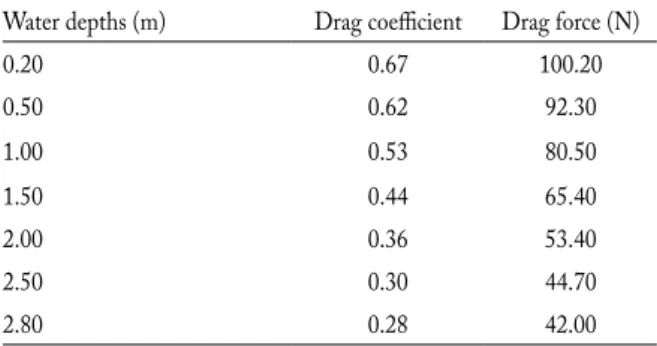
Table 1 presents the drag coefficient and the drag force values when gliding at a water depth of 0.20 m, 0.50 m, 1.0 m, 1.50 m, 2.0 m, 2.50 m and 2.80 m. These values were computed at the time of 2 seconds when the swimmer was approximately at the middle of the computa-tional pool.
It was observed that, both drag coefficient and drag force values fall with increase in depth of swimming tank, which swimmer model is chosen for simulation of gliding.
Table 1. Drag coefficient and drag force values for different water depths during gliding at the time of 2 seconds.
Water depths (m) Drag coefficient Drag force (N)
0.20 0.67 100.20
0.50 0.62 92.30
1.00 0.53 80.50
1.50 0.44 65.40
2.00 0.36 53.40
2.50 0.30 44.70
2.80 0.28 42.00
DISCUSSIOn
The aim of this study was to analyse the effect of depth on drag during the underwater gliding, using computational fluid dynamics. It was no-ticed that hydrodynamic drag decreased with depth increase, presenting the lowest hydrodynamic drag values near the bottom of the computa-tional swimming pool (water depth of 2.80 m).
Computational fluid dynamics methodology has been shown to be a reliable tool to examine the water flow around a submerged human body model (Bixler et al., 2007). Thus, an attempt was performed to anal-yse the hydrodynamic drag during the underwater gliding, simulating a swimming pool with 3.0 m depth and to verify if drag values remained constant at depths higher than a critical point, beyond which wave drag seems to be almost null (Lyttle et al., 1999; Vennel et al., 2006).
The water depth seems to have a positive effect on reducing hydro-dynamic drag during the gliding. Moreover, gliding near the bottom of the pool also presented lower drag values compared to gliding at a water
depth, for instance, in the middle of the swimming pool. This finding could suggest that the positive effects of water depth are more powerful than the possible negative hydrodynamic effects of turbulence near the bottom of the pool, expected when the simulations are not carried-out with a moving model. In fact, one of the innovations of this study was the possibility to carry-out the simulations and the drag analysis with a moving human body, as performed by Lecrivain et al. (2008) in the analysis of the upper arm propulsion.
The values found in this study, concerning hydrodynamic drag, were very similar to others presented in CFD studies (e.g., Bixler et al., 2007; Marinho et al., 2009), using similar velocities and similar water depths. Nevertheless, in opposition to what occurred in the studies of Lyttle et al. (1999) and Vennel et al. (2006), hydrodynamic drag decreased with depth, in the entire range of depths computed in FLUENT 6.3 (0.20 m to 2.80 m). These differences signify an interesting aspect for future investigation and to further analysis with computational fluid dynamics simulations. However, one can attribute these differences between the experimental analysis and computational fluid dynamics could be one of the reasons not to find good match of data. Indeed, although significant improvements on computational fluid dynamics simulations, it raises the question, whereas this methodology truly represents the real swimming conditions. In this paper, a significant effort was performed to diminish this difference, using a moving human body. We believe this approach could lead to obtain more accurate results. In the future, it should be also attempted to perform the same analysis with the swimmer kick-ing (underwater dolphin kickkick-ing), since the time when the swimmer is passively gliding is very short comparing with the total underwater dis-tance. Moreover, active drag can be significantly different from passive drag values (Kjendlie & Stallman, 2008), thus generalizing these data to the underwater dolphin kicking should be made with careful.
COnCLUSIOnS
Reducing the drag experienced by swimmers during the glide of the wall can enhance start and turn performances. Therefore, a compro-mise between decreasing drag (by increasing swimmer’s deepness from water surface) and gliding travel distance should be a main concern of swimmers and an important goal to be studied in future investigations. Although increasing depth position could contribute to decrease drag force, this reduction seems to be lower with depth, especially after 2.0 m depth, thus suggesting that possibly performing the underwater gliding (and the underwater dolphin kicking) more than 2.0 m depth could not be gainful for the swimmer.
rEFErEnCES
Bixler, B., Pease, D., & Fairhurst, F. (2007). The accuracy of computa-tional fluid dynamics analysis of the passive drag of a male swimmer.
Sports Biomechanics, 6, 81-98.
Kjendlie, P.L., & Stallman, R. (2008). Drag characteristics of competi-tive swimming children and Adults. Journal of Applied Biomechanics, 24, 35-42.
Lecrivain, G., Slaouti, A., Payton, C., & Kennedy, I. (2008). Using re-verse engineering and computational fluid dynamics to investigate a lower arm amputee swimmer’s performance. Journal of Biomechanics, 41, 2855-2859.
Lyttle, A.D., Blanksby, B.A., Elliott, B.C., & Lloyd, D.G. (1999). Op-timal depth for streamlined gliding. In K.L. Keskinen, P.V. Komi, & A.P. Hollander (Eds.), Biomechanics and Medicine in Swimming VIII
(pp. 165-170). Jyvaskyla: Gummerus Printing.
Marinho, D.A., Reis, V.M., Alves, F.B., Vilas-Boas, J.P., Machado, L., Silva, AJ, et al. (2009). The hydrodynamic drag during gliding in swimming. Journal of Applied Biomechanics, 25, 253-257.
BIOMECHANICSAND MEDICINEIN SWIMMING XI
124
Vennel, R., Pease, D., & Wilson, B. (2006). Wave drag on human swim-mers. Journal of Biomechanics, 39, 664-671.
Vilas-Boas, J.P., Cruz, M.J., Sousa, F., Conceição, F., & Carvalho, J.M. (2000). Integrated kinematic and dynamic analysis of two track-start techniques. In R. Sanders, & Y. Hong (Eds.), Proceedings of the XVIII International Symposium on Biomechanics in Sports, Applied Program – Application of Biomechanical Study in Swimming (pp.113-117). Hong Kong: The Chinese University Press.
ACKnOWLEDGEMEntS
This work was supported by the Portuguese Government by Grants of FCT (PTDC/DES/098532/2008).
A Method to Estimate Active Drag over a Range of
Swimming Velocities which may be used to Evaluate
the Stroke Mechanics of the Swimmer
Mason, B.r. 1, Formosa, D.P. 1, toussaint, H.M. 2
1 Australian Institute of Sport, Australia 2 Innosport, The Netherlands
This research project aimed to estimate values of active drag over a range of swimming velocities. The data required to do this was the passive drag values for the swimmer at various swim velocities, together with the active drag force value for the individual at their maximum swim velocity. The drag force is represented by an exponential equation F a e(b⋅V)
⋅
= , where
a
andb
are constants for a particular swimmer. The constant ap (pas-sive) reflects the more innate characteristics of the individual swimmer and their suitability to aquatics motion. The constantaa−p (active-pas-sive) reflects the efficiency of the swimmer’s technique. In both cases, the lower the constant’s value, the better suited the swimmer is to aquatics motion or to technical efficiency. The aa−p and the
a
p provide anindex to evaluate a swimmer’s capabilities.
Keywords: Biomechanics, swimming, active drag, passive drag, stroke mechanics
IntrODUCtIOn
A swimmer’s ability to swim faster is depended upon an increase of pro-pulsive force, which exceeds the drag force presently acting on the swim-mer’s motion. However, active drag increases exponentially with a pro-gressive increase in the swimmer’s mean velocity. When the active drag and mean maximal propulsive force generated by the swimmer reach equilibrium, the swimmer attains their mean maximum swim velocity. However, at any constant swim velocity, mean active drag is equal in magnitude to the mean propulsive force exerted by the swimmer. Know-ing the magnitude of the mean active drag opposKnow-ing the forward motion provides information that may be used to evaluate the swimmer’s mean propulsive force.