Cross-cultural adaptation of the Beliefs about Medicines
Questionnaire into Portuguese
Adaptação transcultural do Beliefs about Medicines Questionnaire para o Português
Teresa Salgado
I, Alexandra Marques
II, Leonor Geraldes
II, Shalom Benrimoj
III, Robert Horne
IV, Fernando Fernandez-Llimos
VPublic hospitals and outpatient clinics in Guarda and Covilhã, Portugal
ABSTRACT
CONTEXT AND OBJECTIVES: The Beliefs about Medicines Questionnaire (BMQ-Speciic) has proven use-ful for measuring patients’ beliefs and associating them with non-adherence to treatment in several illness groups. The aim was to cross-culturally adapt the BMQ-Speciic into Portuguese for the general population of medicine users.
DESIGN AND SETTING: Cross-sectional study conducted among users of public hospitals and outpatient clinics in Guarda and Covilhã, Portugal.
METHODS: The BMQ-Speciic was translated using international recommendations for performing cross-cultural adaptation and was administered to 300 patients. An initial principal component analysis (PCA) was conducted with the extraction criterion of eigenvalue > 1.0, followed by a second PCA with restriction to two components. Reliability was assessed by calculating Cronbach’s alpha coeicient.
RESULTS: The mean scores obtained for the Necessity and Concerns subscales of the Portuguese BMQ-Speciic were 19.9 (standard deviation, SD = 2.8) (range 10 to 25) and 17.7 (SD = 3.9) (range 6 to 30), respec-tively. The irst PCA produced an unstable three-component structure for the Portuguese BMQ-Speciic. The inal PCA solution yielded a two-component structure identical to the original English version (a ive-item Necessity and a six-ive-item Concerns subscale), and explained 44% of the variance. Cronbach’s alpha for the complete Portuguese BMQ-Speciic was 0.70, and 0.76 and 0.67 for the Necessity and Concerns subscales, respectively.
CONCLUSION: A cross-culturally adapted Portuguese version of the BMQ-Speciic questionnaire for use among the general population of medicine users was obtained, presenting good internal consistency and component structure identical to the original English version.
RESUMO
CONTEXTO E OBJETIVO: O Beliefs about Medicines Questionnaire (BMQ-Especíico) tem se mostrado útil na mensuração sobre as crenças dos pacientes e associando-os à não adesão ao tratamento em vários grupos de doença. O objetivo foi realizar a adaptação transcultural do BMQ-Especíico em Português para a população geral de usuários de medicamentos.
TIPO DE ESTUDO E LOCAL: Estudo transversal conduzido com usuários de hospitais públicos e clínicas ambulatoriais em Guarda e Covilhã, Portugal.
MÉTODOS: O BMQ-Especíico foi traduzido utilizando-se recomendações internacionais para realizar a adaptação transcultural e foi administrado a 300 pacientes. Uma primeira análise de componentes princi-pais (ACP) com critério de extração eigenvalue > 1.0 foi realizada, seguida de uma segunda ACP com res-trição para dois componentes. A coniabilidade foi avaliada calculando-se o coeiciente alfa de Cronbach.
RESULTADOS: Os escores médios obtidos para as subescalas de Necessidade e Preocupação do BMQ-especíico em Português foram de 19,9 (desvio padrão, DP = 2,8; intervalo 10 a 25) e 17,7 (DP = 3,9; intervalo 6 a 30), respectivamente. A primeira ACP produziu estrutura instável de três componentes para o BMQ-especíico em português. A solução inal de ACP produziu estrutura de dois componentes idênticos à versão original em inglês (subescala de Necessidade de 5 itens e subescala de Preocupação de 6 itens), explicando 44% da variância. Alfa de Cronbach para o BMQ-Especíico em Português completo foi de 0,70, sendo 0,76 e 0,67 para as subescalas de Necessidade e Preocupação, respectivamente.
CONCLUSÃO: A versão adaptada do questionário BMQ-Especíico em português para ser utilizada na população em geral dos usuários de medicamentos foi obtida, apresentando boa consistência interna e estrutura do componente idêntica à versão original em inglês.
IMSc. Pharmacist, Research Institute for
Medicines and Pharmaceutical Sciences (iMed. UL), Faculty of Pharmacy, Universidade de Lisboa, Lisbon, Portugal.
IIMSc. Pharmacist, Faculty of Pharmacy,
Universidade de Lisboa, Lisbon, Portugal.
IIIPhD. Head of School of Pharmacy Graduate
School of Health, University of Technology Sydney, Sydney, Australia.
IVPhD. Professor and Director of the Centre
for Behavioural Medicine, UCL School of Pharmacy, University College London, London, United Kingdom.
VPhD. Assistant Professor, Faculty of Pharmacy,
Universidade de Lisboa, Lisbon, Portugal.
KEY WORDS:
Psychometrics. Questionnaires. Medication adherence. Reproducibility of results. Portugal.
PALAVRAS-CHAVE:
INTRODUCTION
he World Health Organization has recognized non-adherence to long-term therapies as a “worldwide problem of striking mag-nitude” averaging 50% in developed countries.1 Evidence from several studies has shown the impact of non-adherence in terms of poor health outcomes and higher healthcare costs relating to conditions such as diabetes,2-4 hypertension5,6 or asthma.7
Adherence is determined by the interplay of a multitude of factors, of which some are patient-related and include patients’ resources, knowledge, attitudes, beliefs, perceptions and expec-tations towards medication.1 Treatment adherence appears to depend primarily on patients’ beliefs about treatment beneits and, to a lesser extent, on sociodemographic and clinical factors.8-10 Intentional non-adherence appears to be related to patients’ beliefs and their motivation to take the prescribed medication, whereas unintentional non-adherence has to do with patients’ skills or abil-ity to take that medication (e.g. forgetfulness or manual dexter-ity).11 Intentional non-adherers hold beliefs signiicantly diferent from those of adherers and unintentional non-adherers.12
he Beliefs about Medicines Questionnaire (BMQ) was cre-ated to respond to a need for practical measurements on com-monly held beliefs about medication. In addition, it aimed to assess the nature of beliefs about medications, the distribution of these beliefs among diferent populations and the relation-ships between beliefs about medicines, beliefs about illnesses and adherence behavior. he questionnaire was developed based on beliefs identiied in the literature that appeared to be common to patients with a range of chronic illnesses, and based on inter-views conducted with patients receiving regular medication for chronic illnesses. he questionnaire was validated among a sam-ple of asthmatic, diabetic, renal, cardiac, psychiatric and general medical patients. he inal version of the BMQ is composed of two sections: the General section (BMQ-General), which assesses more general beliefs about medicines and includes the General-Harm and the General-Overuse subscales; and the Speciic sec-tion (BMQ-Speciic), which explores beliefs about particular medication and comprises the Necessity and Speciic-Concerns subscales.13
he BMQ-Speciic section was designed to put into prac-tice the Necessity-Concerns framework in an attempt to predict patients’ adherence, based on their beliefs about their personal need for the treatment versus their concerns regarding potential adverse efects. Several studies have shown the usefulness of the Necessity-Concerns framework for correlating patients’ beliefs and treatment non-adherence across a range of chronic illness groups: diabetes,14 hypertension,15 asthma,16 cystic ibrosis,17 depression,18 mental illness,19 bipolar disorder,20 inlammatory bowel disease,21 HIV/AIDS,22 rheumatoid arthritis,23 renal dis-ease, cardiac disease and cancer.10 Not only has the BMQ-Speciic
been useful in providing insight on patients’ intentions to take medication, but also it has been informative regarding patients’ actual medication-taking behavior.16 Additionally, the short administration time makes the BMQ-Speciic a potentially appli-cable instrument in clinical practice.
he BMQ has been adapted and used in several coun-tries,16,24-27 but no cross-cultural adaptation into Portuguese has been performed to date. herefore, the aim of this study was to cross-culturally adapt the Speciic section of the Beliefs about Medicines Questionnaire (BMQ-Speciic) into Portuguese for the general population of medicine users.
METHODS
he BMQ-Speciic is an eleven-item questionnaire that comprises two subscales: a ive-item Necessity scale, to assess beliefs about the necessity for prescribed medication (Speciic-Necessity), and a six-item Concerns scale, to assess beliefs about the danger of dependence and long-term toxicity and the disruptive efects of medication (Speciic-Concerns).13 Each item is scored on a ive-point Likert scale (1 = strongly disagree, 2 = disagree, 3 = uncertain, 4 = agree and 5 = strongly agree), and the total scores for the Necessity and Concerns subscales range from 5 to 25 and from 6 to 30, respectively. he higher the score is, the greater the patient’s belief in the concept represented by the scale is. A neces-sity-concerns diferential can also be calculated by subtracting the Concerns subscale scores from the Necessity subscale scores, such that higher diferential scores indicate higher perceived necessity and/or lower concerns, thereby representing lower like-lihood of intentional non-adherence.12
Cultural adaptation
Written authorization to translate the original English version of the BMQ-Speciic into Portuguese was obtained from Prof. Robert Horne at the School of Pharmacy, University of London. Prof. Horne requested that the adaptation should be done on the modiied version of the BMQ-Speciic, given that it has been sub-jected to reinements since its original publication in 1999 to bet-ter respond to problems resulting from its administration.
and the original version of the questionnaire were concealed. he back-translated and original versions of the BMQ-Speciic were compared by Prof. Robert Horne and his team, and subsequent discrepancies were resolved via e-mail correspondence between the Portuguese and English research teams. he forward transla-tion was then inalized based on the preceding discussion and a conceptual, semantic and operational version29 of the Portuguese BMQ-Speciic was thus obtained.
Participants and recruitment
he study was conducted in two diferent cities in Portugal (Guarda and Covilhã) between March and June 2010. Ethical approval was granted by two ethics boards: the Ethics Committee of the General Hospital of Cova da Beira, and the Ethics Committee of the Local Health Unit of Guarda. he authori-zation included the above mentioned sites, as well as subsid-iary outpatient clinics. Patients in an external consultation wait-ing room were approached by a member of the research team and were invited to participate. Informed written or verbal con-sent in accordance with the requirements of each committee was obtained from individuals who agreed to participate in the study.
he sample size was calculated based on a minimum subject-to-item ratio of 20:1 (20 x 11 = 220), since it had previously been shown that larger samples tend to produce more accurate solu-tions.30 However, the Portuguese version of the BMQ-Speciic was ultimately administered to a sample of 300 participants (150 in Guarda and 150 in Covilhã), which is the minimum required for good adequacy of sample size according to some authors.31
Participants over 18 years of age who answered airma-tively to the question “Do you frequently take medicines?” were included in the study. To reduce the risk of bias, participants were informed that the questionnaires would be kept conidential and anonymous, and that the results would not be seen by health-care providers, thus not afecting the quality of health-care received. Sociodemographic data such as age, gender, level of education and origin (rural/urban) were also collected. he questionnaire was administered by a member of the research team in the form of a structured interview.
Data analysis
Descriptive statistical analyses were used on the sociodemo-graphic data. An exploratory principal component analysis (PCA) with non-orthogonal rotation (oblimin with Kaiser nor-malization) was performed to examine the number of compo-nents in the Portuguese version of the BMQ-Speciic.32 he crite-rion for component extraction was an eigenvalue > 1.0 (Kaiser’s criterion). Since the original English version presents a two-component structure, a subsequent PCA was conducted with restriction to two components. Cronbach’s alpha coeicient was
calculated to assess the internal consistency of the Portuguese version of the BMQ-Speciic. A Cronbach’s alpha value over 0.70 indicated acceptable internal consistency.33 he statistical analy-ses were performed using the Statistical Package for the Social Sciences (SPSS), version 16.
RESULTS
Sample characteristics
Among the 300 participants enrolled in the study, 69.7% were female and 52.3% originated from an urban area. he mean age of the respondents was 62.0 years (standard deviation, SD = 14.4) (range 18 to 94) and their level of education was as follows: 9.7% were unable to read or write, 8.0% were able to read and/or write but had not had any formal education, 51.3% had completed ele-mentary school, 20.0% had completed high school and 11.0% had had higher education.
he mean scores obtained for the Necessity and Concerns subscales of the Portuguese BMQ-Speciic were 19.9 (SD = 2.8) (range 10 to 25) and 17.7 (SD = 3.9) (range 6 to 30), respectively. he mean total score for the BMQ-Speciic was therefore 37.6 (SD = 5.2); the minimum score obtained was 22 and the maxi-mum was 54, out of the possible total of 55.
Principal component analysis
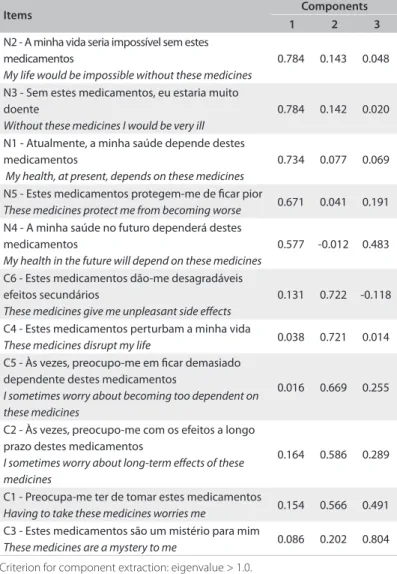
he Kaiser-Meyer-Olkin value was calculated as 0.75, which indicated that PCA on this dataset was feasible. he chi-square obtained for Bartlett’s test of sphericity was 617.8 (signiicance level < 0.001), which meant that the correlation matrix was not an iden-tity matrix and appeared to be factorable.32 he correlation matrix obtained showed that only the items N2 and N3 presented correla-tions over 0.500 (Pearson correlation coeicient = 0.603).
Component 1
C
omponen
t 2
Componen t 3
1
1 1 -1
-1
-1 0
0 0
C4
C2 C6
C1 C5
C3 N3 N2
N1 N5
N4
Table 1. Exploratory principal component analysis with non-orthogonal (oblimin with Kaiser normalization) rotation
Items Components
1 2 3
N2 - A minha vida seria impossível sem estes medicamentos
My life would be impossible without these medicines
0.784 0.143 0.048
N3 - Sem estes medicamentos, eu estaria muito doente
Without these medicines I would be very ill
0.784 0.142 0.020
N1 - Atualmente, a minha saúde depende destes medicamentos
My health, at present, depends on these medicines
0.734 0.077 0.069
N5 - Estes medicamentos protegem-me de icar pior
These medicines protect me from becoming worse 0.671 0.041 0.191
N4 - A minha saúde no futuro dependerá destes medicamentos
My health in the future will depend on these medicines
0.577 -0.012 0.483
C6 - Estes medicamentos dão-me desagradáveis efeitos secundários
These medicines give me unpleasant side efects
0.131 0.722 -0.118
C4 - Estes medicamentos perturbam a minha vida
These medicines disrupt my life 0.038 0.721 0.014
C5 - Às vezes, preocupo-me em icar demasiado dependente destes medicamentos
I sometimes worry about becoming too dependent on these medicines
0.016 0.669 0.255
C2 - Às vezes, preocupo-me com os efeitos a longo prazo destes medicamentos
I sometimes worry about long-term efects of these medicines
0.164 0.586 0.289
C1 - Preocupa-me ter de tomar estes medicamentos
Having to take these medicines worries me 0.154 0.566 0.491
C3 - Estes medicamentos são um mistério para mim
These medicines are a mystery to me 0.086 0.202 0.804
items, the second component marked by high loadings for the Concerns items and the third component comprising item C3, which appeared to be not very distant from the items in the sec-ond component (Concerns).
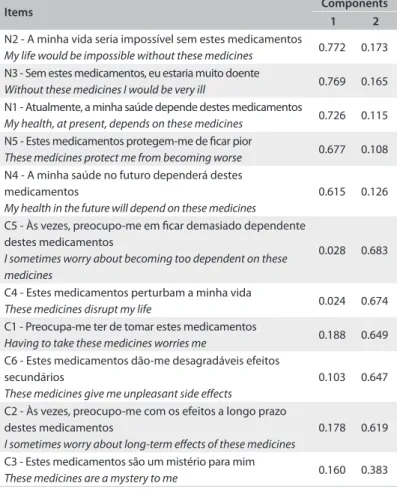
A second PCA with restriction to two components was then conducted to respect the original structure of the BMQ-Speciic. he criterion for component extraction in the second analysis was an eigenvalue > 1.007. he total variance explained in the two-component solution was 44.4%. In this new struc-ture, the previously isolated C3 item was now included in the second component, thus making the Portuguese BMQ-Speciic structurally identical to the original questionnaire (Table 2). he loadings of items included in the irst component ranged from 0.615 to 0.772, whereas the loadings of items in the sec-ond component ranged from 0.383 to 0.683. he component plot in rotated space (Figure 2) showed a robust inal solution of two components, in which Necessity items had high load-ings in the irst component while Concerns items had high loadings in the second component. Item C3 was clearly shown to be part of the Concerns component, and appeared to be suf-iciently distant from the Necessity component.
Reliability
Using Cronbach’s alpha coefficient, the internal consistency of the BMQ-Specific was 0.700 overall, while Cronbach’s alphas for the Necessity and Concerns subscales were 0.757 and 0.665, respectively. If item C3 was deleted, Cronbach’s alpha for the Concerns subscale would increase to 0.678, but the complete BMQ-Specific alpha would decrease to 0.698. Deletion of one of the items N2 or N3 would result in reduc-tion of the BMQ-Specific alpha from 0.700 to 0.671 or 0.672, respectively.
DISCUSSION
To the best of our knowledge, this is the irst study describing cross-cultural adaptation of the Portuguese version of the BMQ-Speciic, a “lexible instrument which can be adapted to assess beliefs about all medicines for a particular condition or for indi-vidual components of the regimen”.13
The high response rate to the questionnaire can be explained by our use of an interviewer-administered proce-dure. In a previous study in which the option of self-admin-istration or interviewer-adminself-admin-istration was available, only 10% of the participants chose to complete the BMQ inde-pendently.24 This may be even more relevant in a population in which 9.7% were illiterate and 59.3% did not begin high school. This level of education, along with the average age of the participants, is a common characteristic among people who regularly use medicines in Portugal.34
Figure 1. Component plot for irst principal component analysis (criterion for component extraction: eigenvalue > 1.000).
Table 2. Principal component analysis with restriction to two components
Items Components
1 2
N2 - A minha vida seria impossível sem estes medicamentos
My life would be impossible without these medicines 0.772 0.173
N3 - Sem estes medicamentos, eu estaria muito doente
Without these medicines I would be very ill 0.769 0.165
N1 - Atualmente, a minha saúde depende destes medicamentos
My health, at present, depends on these medicines 0.726 0.115
N5 - Estes medicamentos protegem-me de icar pior
These medicines protect me from becoming worse 0.677 0.108
N4 - A minha saúde no futuro dependerá destes medicamentos
My health in the future will depend on these medicines
0.615 0.126
C5 - Às vezes, preocupo-me em icar demasiado dependente destes medicamentos
I sometimes worry about becoming too dependent on these medicines
0.028 0.683
C4 - Estes medicamentos perturbam a minha vida
These medicines disrupt my life 0.024 0.674
C1 - Preocupa-me ter de tomar estes medicamentos
Having to take these medicines worries me 0.188 0.649
C6 - Estes medicamentos dão-me desagradáveis efeitos secundários
These medicines give me unpleasant side efects
0.103 0.647
C2 - Às vezes, preocupo-me com os efeitos a longo prazo destes medicamentos
I sometimes worry about long-term efects of these medicines
0.178 0.619
C3 - Estes medicamentos são um mistério para mim
These medicines are a mystery to me 0.160 0.383
he mean scores for the Necessity and Concerns subscales of the Portuguese version of the BMQ-Speciic (19.9 and 17.7, respectively) were comparable to what has been obtained using the original English version, in which the mean scores for the Necessity and Concerns subscales have ranged from 17.72 to 21.26 and from 12.91 to 15.75, respectively.13 he results
Component 1
C
omponen
t 2
1
1 -1
-1 0
0 C4
C1 C6 C5
C2 C3
N3 N2 N1 N5
N4
Figure 2. Component plot for second principal component analysis (criterion for component extraction: eigenvalue > 1.007).
reported from the German version were mean scores of 22.27 and 13.55 for the Necessity and Concerns subscales, respec-tively.25 he Portuguese results were similar to the English and German indings, although with a slightly lower Necessity-Concerns diferential.
he initial solution produced by the exploratory PCA was discarded because it let item C3 (“My medicines are a mystery to me”) isolated from the other two groups of items. Components with fewer than three items are known to be weak and unsta-ble.30 In the inal PCA solution, item C3 became part of the sec-ond component (Concerns), even though it presented a low component loading (0.383). Issues with this item had previously been raised during the development of the original instrument, in which item C3 had a loading of 0.39 on the Concerns sub-scale during the conirmatory factor analysis, and an even higher loading on the Harm subscale (0.55) of the General section of the BMQ.13 his suggests that inclusion of item C3 in the ques-tionnaire might not be appropriate. Indeed, the word “mystery” posed a challenge to the translation process into Portuguese, and this has also been reported for other languages like those of Scandinavia.35
he two-component inal solution of the Portuguese version of the BMQ-Speciic explained 44.4% of the total variance, which was slightly lower than the 51% variance reported in the original English version.13 his solution revealed a robust structure with clearly deined components, as can be seen in the component plot in rotated space (Figure 2).
The results provide good support for confirming the reli-ability of the Portuguese version of the BMQ-Specific. The Cronbach’s alphas for the Necessity and Concerns subscales (0.757 and 0.665, respectively) were in agreement with the values reported for the original English version, in which Cronbach’s alpha ranged from 0.55 to 0.86 and from 0.63 to 0.80 for the Necessity and Concerns subscales, respec-tively,13 as well as with the results obtained for the Italian version (0.78 for the Necessity and 0.72 for the Concerns subscales).24 However, all these values were lower than the Cronbach’s alphas attained for the German version (0.83 for both subscales).25
not justify the loss of the structural identicalness between the Portuguese and English versions of the questionnaire.
Our study presents some limitations. Since we used an interviewer-administered questionnaire, the cross-culturally adapted version should only be used this way. On the other hand, this is probably the best option for Portuguese medi-cine users. Although in-depth analysis was conducted on the construct validity of the original version of the BMQ, fur-ther analysis should be undertaken to determine whefur-ther the Portuguese version presents a correlation with medica-tion adherence. To accomplish this goal, a reliable and valid instrument to evaluate adherence that has previously been adapted into Portuguese should be selected. With regard to future research, further work is warranted in order to inves-tigate the relationship between beliefs and adherence among Portuguese-speaking patients who take medicines regularly, as well as to test the instrument on different populations and in different settings.
CONCLUSION
A cross-culturally adapted Portuguese version of the BMQ-Speciic questionnaire for use among the general population of medicine users was obtained. his version presented good inter-nal consistency and component structure identical to the origi-nal English version.
REFERENCES
1. World Health Organization. Adherence to long-term therapies:
evidence for action. Geneva: WHO; 2003.
2. Stuart B, Davidoff A, Lopert R, et al. Does medication adherence
lower Medicare spending among beneficiaries with diabetes?
Health Serv Res. 2011;46(4):1180-99.
3. Asche C, LaFleur J, Conner C. A review of diabetes treatment
adherence and the association with clinical and economic
outcomes. Clin Ther. 2011;33(1):74-109.
4. Hong JS, Kang HC. Relationship between oral antihyperglycemic
medication adherence and hospitalization, mortality, and
healthcare costs in adult ambulatory care patients with type 2
diabetes in South Korea. Med Care. 2011;49(4):378-84.
5. Dragomir A, Côté R, Roy L, et al. Impact of adherence to
antihypertensive agents on clinical outcomes and hospitalization
costs. Med Care. 2010;48(5):418-25.
6. Pittman DG, Tao Z, Chen W, Stettin GD. Antihypertensive
medication adherence and subsequent healthcare utilization and
costs. Am J Manag Care. 2010;16(8):568-76.
7. Williams LK, Pladevall M, Xi H, et al. Relationship between
adherence to inhaled corticosteroids and poor outcomes among
adults with asthma. J Allergy Clin Immunol. 2004;114(6):1288-93.
8. Le TT, Bilderback A, Bender B, et al. Do asthma medication beliefs
mediate the relationship between minority status and adherence
to therapy? J Asthma. 2008;45(1):33-7.
9. Horne R, Weinman J. Self-regulation and self-management in
asthma: exploring the role of illness perceptions and treatment
beliefs in explaining non-adherence to preventer medication.
Psychol Health. 2002;17(1):17-32. Available from: http://www.
tandfonline.com/doi/abs/10.1080/08870440290001502#preview.
Accessed in 2012 (Jun 25).
10. Horne R, Weinman J. Patients’ beliefs about prescribed medicines
and their role in adherence to treatment in chronic physical
illness. J Psychosom Res. 1999;47(6):555-67.
11. Horne R. Compliance, adherence and concordance. In: Taylor K,
editor. Pharmacy Practice. London: Taylor and Francis; 2001. p.165-84.
12. Clifford S, Barber N, Horne R. Understanding different beliefs
held by adherers, unintentional nonadherers, and intentional
nonadherers: application of the Necessity-Concerns Framework.
J Psychosom Res. 2008;64(1):41-6.
13. Horne R, Weinman J, Hankins M. The beliefs about medicines
questionnaire: the development and evaluation of a new
method for assessing the cognitive representation of medication.
Psychology Health. 1999;14(1):1-24. Available from: http://www.
nelm.nhs.uk/en/NeLM-Area/Evidence/Medicines-Management/
References/2006---May/08/The
-Beliefs-About-Medicines-
Questionnaire--the-development-and-evaluation-of-a-new-method-for-assess/. Accessed in 2012 (Jun 25).
14. Mann DM, Ponieman D, Leventhal H, Halm EA. Predictors of
adherence to diabetes medications: the role of disease and
medication beliefs. J Behav Med. 2009;32(3):278-84.
15. Ross S, Walker A, MacLeod MJ. Patient compliance in hypertension:
role of illness perceptions and treatment beliefs. J Hum Hypertens.
2004;18(9):607-13.
16. Menckeberg TT, Bouvy ML, Bracke M, et al. Beliefs about medicines
predict refill adherence to inhaled corticosteroids. J Psychosom
Res. 2008;64(1):47-54.
17. Bucks RS, Hawkins K, Skinner TC, et al. Adherence to treatment in
adolescents with cystic fibrosis: the role of illness perceptions and
treatment beliefs. J Pediatr Psychol. 2009;34(8):893-902.
18. Aikens JE, Nease DE Jr, Nau DP, Klinkman MS, Schwenk TL.
Adherence to maintenance-phase antidepressant medication as
a function of patient beliefs about medication. Ann Fam Med.
2005;3(1):23-30.
19. Jónsdóttir H, Friis S, Horne R, et al. Beliefs about medications:
measurement and relationship to adherence in patients with
severe mental disorders. Acta Psychiatr Scand. 2009;119(1):78-84.
20. Clatworthy J, Bowskill R, Parham R, et al. Understanding medication
non-adherence in bipolar disorders using a Necessity-Concerns
Framework. J Affect Disord. 2009;116(1-2):51-5.
21. Horne R, Parham R, Driscoll R, Robinson A. Patients’ attitudes
in inflammatory bowel disease. Inflamm Bowel Dis.
2009;15(6):837-44.
22. Horne R, Cooper V, Gellaitry G, Date HL, Fisher M. Patients’
perceptions of highly active antiretroviral therapy in relation
to treatment uptake and adherence: the utility of the
necessity-concerns framework. J Acquir Immune Defic Syndr.
2007;45(3):334-41.
23. Neame R, Hammond A. Beliefs about medications: a questionnaire
survey of people with rheumatoid arthritis. Rheumatology
(Oxford). 2005;44(6):762-7.
24. Tibaldi G, Clatworthy J, Torchio E, et al. The utility of the
Necessity--Concerns Framework in explaining treatment non-adherence in
four chronic illness groups in Italy. Chronic Illn. 2009;5(2):129-33.
25. Mahler C, Hermann K, Horne R, et al. Patients’ Beliefs about
Medicines in a primary care setting in Germany. J Eval Clin Pract.
2012;18(2):409-13.
26. Hedenrud T, Jonsson P, Linde M. Beliefs about medicines and
adherence among Swedish migraineurs. Ann Pharmacother.
2008;42(1):39-45.
27. Gauchet A, Tarquinio C, Fischer G. Psychosocial predictors of
medication adherence among persons living with HIV. Int J
Behav Med. 2007;14(3):141-50.
28. Wild D, Grove A, Martin M, et al. Principles of Good Practice for the
Translation and Cultural Adaptation Process for Patient-Reported
Outcomes (PRO) Measures: report of the ISPOR Task Force for
Translation and Cultural Adaptation. Value Health. 2005;8(2):94-104.
29. Streiner DL, Norman GR. Health Measurement Scales: a practical
guide to their development and use. 4th ed. Oxford: Oxford
University Press; 2008.
30. Costello AB, Osborne JW. Best practices in exploratory factor
analysis: Four recommendations for getting the most from your
analysis. Pract Assess Res Eval. 2005;10(7):1-9.
31. Comrey AL, Lee HB. A first course in factor analysis. Hillsdale:
Erlbaum; 1992.
32. Pett MA, Lackey NR, Sullivan JJ. Making sense of factor analysis:
the use of factor analysis for instrument development in health
care research. Thousand Oaks: SAGE Publications; 2003.
33. Nunnally J. Psychometric theory. 2nd ed. New York: McGraw-Hill; 1978.
34. Silva P, Luís S, Biscaia A. Polimedicação: um estudo de prevalência
nos Centros de Saúde do Lumiar e de Queluz [Polymedication: a
prevalence study at the Lumiar and Queluz health centres]. Rev
Port Clin Geral. 2004;20(3):323-36.
35. Granas AG, Haugbølle LS, Kälvemark Sporrong S. Lost in
translation? Comparing translations of the beliefs about
medicines questionnaire into the three Scandinavian languages.
Pharm Pract (Internet). 2010;8(suppl 1):75.
Sources of funding: Fundação para a Ciência e a Tecnologia (FCT), Ministry of Education and Science, Portugal (doctoral grant reference
number SFRH/BD/43999/2008)
Conlict of interest: None
Date of irst submission: November 21, 2011
Last received: July 5, 2012
Accepted: July 13, 2012
Address for correspondence:
Fernando Fernandez-Llimos
Departamento de Sócio-Farmácia, Faculdade de Farmácia
Universidade de Lisboa
Av. Prof. Gama Pinto
1649-003 Lisboa – Portugal
Tel.: +351 919 247 736
Fax: +351 217 946 470