SUS users’ knowledge of and
attitude to HPV virus and
vaccines available in Brazil
I Centro de Pesquisas em Saúde Reprodutiva de Campinas. Universidade Estadual de Campinas. Campinas, SP, Brasil II Departamento de Tocoginecologia.
Faculdade de Ciências Médicas. Universidade Estadual de Campinas. Campinas, SP, Brasil
Correspondence:
Maria José Duarte Osis
Rua Vital Brasil, 200 Cidade Universitária Zeferino Vaz
13083-888 Campinas, SP, Brasil E-mail: [email protected] Received: 7/5/2013
Approved: 10/10/2013
Article available from: www.scielo.br/rsp
ABSTRACT
OBJECTIVE: To investigate knowledge of HPV and HPV vaccines in men and women, users of the Brazilian Uniied Health System, and the intention to get themselves and their teenage children vaccinated.
METHODS: A descriptive, cross-sectional study with 286 women (18-49 years old) and 252 men (18-60 years old), users of ive primary health units and two polyclinics in Campinas, SP, Southeastern Brazil, was carried out. Participants were interviewed in 2011 using a structured questionnaire. Bivariate and Poisson regression analysis were performed to identify variables associated with knowledge of HPV and HPV vaccines, and participants vaccination intentions.
RESULTS: Almost 40.0% of the participants reported having heard of HPV and 28.9% mentioned adequate information. The main information source was the media (41.7%). Only 8.6% of the participants had heard of the HPV vaccines. Once the participants were informed of the existence of HPV vaccines about 94% of them said they would get vaccinated and/ or vaccinate their teenage children, if the vaccines were available in the public health system. Schooling of over 8 years and being female were the variables independently associated with having heard of HPV, the vaccines and having adequate knowledge of the virus. Advanced age was associated with having heard of HPV vaccines. There were no variables associated with the vaccination intentions.
CONCLUSIONS: These results reinforce the need for educational activities that provide the population with adequate information on HPV and preventive measures.
DESCRIPTORS: Human Papillomavirus 6. Human Papillomavirus 11. Human Papillomavirus 16. Human Papillomavirus 18. Human Papillomavirus 31. Papillomavirus Vaccines. Health Knowledge,
Attitudes, Practice. Patient Acceptance of Health Care. Uniied
Health System.
Maria José Duarte OsisI,II
Graciana Alves DuarteI
The HPV (human papillomavirus) is recognized to cause cancer of the uterus and has been linked to various other types of cancer.9 A recent review of the literature25 estimated HPV prevalence at 32.1% in 576,281 women, varying between 42.4% in developing and 22.6% in developed countries. It is estimated that between nine and 10 million people worldwide have the virus, with 700 thousand new cases annually.a A review of the literature3 with studies conducted with women in various regions of Brazil showed the prevalence of HPV to be between 14.0% and 54.0% in women in general, and from 10.0% to 24.0% in asymptomatic women.
In diverse populations around the world, levels of knowledge about HPV are poor, especially concerning its link with abnormal Pap smear results, cervical cancer and genital warts.5,13 There are few publications evalu-ating the Brazilian public’s knowledge of HPV. Existing studies involved small samples and indicated that the majority of men and women had little knowledge of the virus.14,17,23
Another often discussed aspect is the vaccine’s accept-ability. It is recommended that both girls and boys be vaccinated, although the age at which this occurs varies according to the country. Immunization before exposure to HPV results in long lasting protection for both men and women. However, this recommendation is not always well received or understood in various countries, not only on the part of the parents, but also on that of pediatricians.7,26 Vaccinating adults also involves obstacles, such as high cost for populations in which it is not provided by the public health system; the need for it to be administered in three injectable doses; as well as questions about its effectiveness, needs for men to be vaccinated and the impact of vaccination on preventing cervical cancer.7
The two vaccines (quadrivalent, approved in 2006 and bivalent, approved in 2008) were, up to 2013, only available in the private health care sector in Brazil. The Brazilian Immunization Societyb recommends that the vaccines be administered between nine and 26 years of age. Some municipalities implemented free vaccina-tion for girls aged between 11 and 13 in both public and private schools, with their parents’ permission. In one municipality in the state of Sao Paulo, high levels of acceptance on the part of the parents were observed after detailed information on the vaccine had been provided. Almost all of the girls, whose parents had given permission INTRODUCTION
for the vaccination, completed the course of three doses (97.0%).10 The Ministry of Health looked into including the HPV vaccination as part of the Brazilian Uniied Health System (SUS) National Immunization Program (PNI).c In Brazil, there is no consensus on vaccinating boys and men. Specialists defend this vaccination in view of the beneicial effects of protecting men from the consequences of being infected by the virus, but, mainly, to accelerate protection for women. Others consider that the cost-beneit relationship means it is not recommendable to vaccinate men due to lower incidence and mortality, for example, due to cancer of the penis.
The aim of this study was to analyze men and women’s knowledge of HPV and their intentions to get vaccinated and have their adolescent children vaccinated.
METHODS
This was a descriptive cross-sectional study, with a sample of 538 users of primary health care units (PHCU) and two SUS policlinics in Campinas, SP, Southeastern Brazil, in 2011, of which 286 were female (aged 18 to 49) and 252 male (18 to 60). A PHCU was selected in each area of the city and two policlinics with various specialties were also included, as there was a greater chance of inding males with appointments. Individuals were invited to participate in the research while waiting for their appointments.
Data were collected using structured questionnaires, appropriate to the sex of the interviewee and applied by trained interviewers. The questionnaires were developed based on the literature and assessed by two specialists in issues concerned with HPV and the vaccines available in Brazil. The questionnaires were pre-tested on small samples of SUS users with similar characteristics to the study subjects. The questionnaire was revised according to problems that appeared with understanding and with the low of the questions. This process was repeated until a version was obtained which was deemed suitable. The questionnaires contained four sections: sociodemographic, reproductive and sexual characteristics, knowledge of HPV and vaccines and socioeconomic strata.d
The questionnaires were reviewed and double entered. Next, procedures were performed to clean the database and maintain its consistency. The sample size was
a Instituto do HPV. Guia do HPV: entenda de vez os papillomavírus humanos, as doenças que causam e o que já é possível fazer para evitá-lo. São Paulo; 2013 [cited 2013 May 2]. Available from: http://www.incthpv.org.br/upl/fckUploads/file/Guia%20do%20HPV%20Julho%202013_2.pdf b SBIm/Febrasgo. Consenso 2012. Vacinação da Mulher. [cited 2014 Feb 5]. Available from: http://www.sbim.org.br/wp-content/uploads/2012/06/ consenso-sbim-febrasgo_vac-mulher_120604_bx.pdf
c Ministério da Saúde. Portal Brasil/Saúde. Cobertura da vacina HPV será ampliada a partir de 2014. Brasília (DF); 2013 [cited 2014 Feb 5]. Available from: http://www.brasil.gov.br/saude/2013/09/cobertura-da-vacina-hpv-sera-ampliada-a-partir-de-2014
calculated at 432 subjects, with an estimated prevalence of individuals (men and women) who had heard of HPV of 23.5%,6 and an absolute difference between the sample and population proportions of 4.0% and the probability of type 1 error ixed at 5%. While the data were being collected, 13 individuals refused to participate in the research.
The Chi-square test was used in the bivariate analysis and the independent variables were: age at time of the interview, sex, schooling, marital status, skin color, religion, number and sex of children, in paid work and socioeconomic strata.
The dependent variables were: having heard of HPV, information on HPV, having heard of the vaccines, intention of getting vaccinated, intention to have chil-dren vaccinated. Those who said they had heard of HPV were then asked questions about the vaccine. Those who had never heard of HPV were informed about it before being asked about their intention to get vaccinated. The variable “information on HPV” was categorized as “adequate information” if the individual gave at least one of the following responses: “it is a sexually transmitted disease (STD)”, “it can cause cervical/ penis cancer, it can lead to cancer”, “It causes warts/ disease/infection”. Other responses were classiied as “not adequate information”.
Six Poisson4 regression models were developed refer-ring to six dependent variables. There were eight independent variables in the models, with their corre-sponding categories: age (in years), sex (male; female), marital status (living in union; not living in union), skin color (white; non-white), schooling (eight or fewer years; nine or more years), in paid work (yes; no), socio-economic strata (A/B; C/D) and children (yes; no). This study was approved by the Research Ethics Committee of the Medical Science Faculty, Universidade Estadual de Campinas (Report 545/2008). Participation
was on a voluntary basis, after signing a consent form. Anonymity of those who responded to the questionnaire was guaranteed, as they contained no identifying data.
RESULTS
Almost half of the population studied (46.0%) were aged 35 or over; 53.0% were female, 54.0% had nine or more years of schooling and 59.0% reported their skin color as non-white. The majority were living in union (71.0%), in paid work (71.0%) and were of socioeconomic strata C and D (62.0%). A little over half of them (54.0%) had one or two living children; among those with a living child, 71.0% had at least one child and 67.0% had at least one daughter. The majority (86.0%) of the interviewees had a poor/medium score for knowledge about STD (data not shown).
A little under 2/5 of the interviewees reported having heard of HPV. The most commonly reported sources of information were: the media (42.0%), school/ university (26.0%) and health care services (21.0%). Gynecologists and friends/relatives were mentioned by 13.0% of participants (Data not shown).
In the bivariate analysis, having heard of HPV was associated with: being female (45.5%), having higher levels of schooling (49.3% of those with nine or more years), belonging to socioeconomic strata A and B (46.0%) (Table 1).
A little over 1/4 of participants reported having adequate information on HPV, and the variables associated in the bivariate analysis were: being female (37.2%), having a higher level of schooling (37.2% of those with nine or more years), belonging to socioeconomic strata A and B (35.7%) (Table 2).
Fewer than 9% of participants reported having heard of vaccines against HPV. The main source of information mentioned was the media (29 individuals); gynecolo -gists (ive participants) and one person mentioned health center. When questioned about what they had heard about the vaccines, 11 of the participants who knew about their existence stated: that they protect against/prevent HPV, that they are being tested and are only available privately and that, therefore, they are expensive. Six interviewees mentioned that the vaccines were only recommended for adolescents; nineteen thought that these vaccines should be given to those who had already had sexual relations; nine said they should be given to all women, regardless of age, and the same number thought that all men should also be vaccinated. Eight stated that everyone who had not yet had sexual relations should be vaccinated and six that they were aimed at adolescent females. Twenty ive interviewees said that the vaccines should be given between the ages of nine and 14; 19 believed that they were recommended for those aged 15 to 18. One inter-viewee said that the vaccines should be given in the irst few months of life, and another stated that they should be given at one year of age (data not shown).
In the bivariate analysis, schooling and socioeconomic strata were variables associated with having heard of HPV vaccines. Participants with nine or more years of schooling and those belonging to A/B strata were those who most commonly reported having heard of the vaccine (Table 3).
vaccines; and one as it was something new. The most commonly cited reason for not having their adolescent child vaccinated were that it was the child’s decision (seven individuals). Two participants said that they would
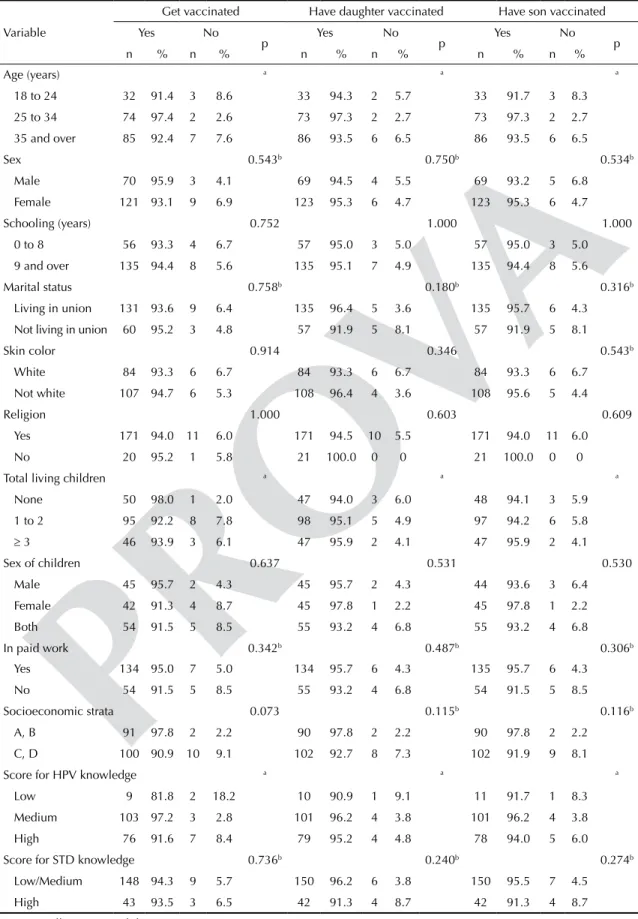
have their daughter, and one their son, vaccinated only if it were recommended by a doctor (data not shown). No variables were observed to be associated with the intention of getting vaccinated or having their child vaccinated in the bivariate analysis (Table 4).
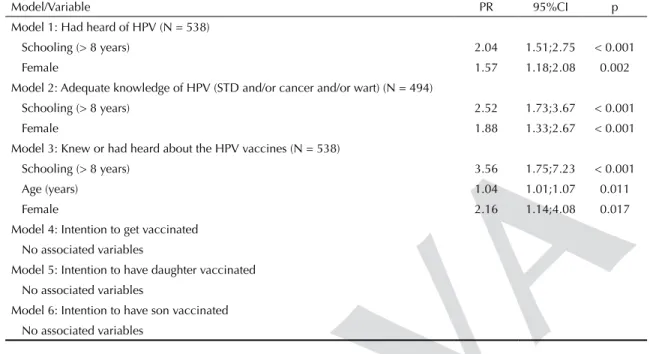
The Poisson regression model showed an association between having heard of HPV and higher levels of schooling (> 8 years) and being female. These variables were also associated with having adequate information on HPV. Schooling (> 8 years), age (being older) and sex (female) were independently associated with having heard of the vaccines, but no variables were indepen-dently associated with the intention to get vaccinated and/or have their child vaccinated (Table 5).
DISCUSSION
Most of those interviewed had never heard of HPV or of the vaccines which are available in Brazil, and the proportion of individuals with adequate information on the virus and consequences of infection was even lower. This conirms the literature, showing that knowledge about HPV is inadequate in various populations.1,5,6,13,17 As in other studies,6,16 women and those with higher levels of schooling were those who most commonly reported having heard of HPV and knew more about it.
These results reinforce the need for educational interventions in the population to provide them with adequate information about HPV and ways of preventing it.17 This does not only mean selecting and transmitting scientiically correct information about HPV, but doing it in a way suitable to the capacities of the different social strata to access and process such information. This is a growing concern in public health, even in developed countries.22 There is no doubt, however, that this presents a huge challenge given social inequalities, especially in education. The mean level of schooling of the population is below eight years of primary educatione and there is a large proportion of functional illiterates.f Within the SUS, health education is a task which normally takes place at the level of primary care. It is expected that health is promoted according to the principle of comprehensive care. This means working with the entire population and not only with those at risk of falling sick, or those who are already sick. However, there are some obstacles to this approach, both in the lack of training on the part of health care professionals and in the population’s expectations that health care units function as centers to treat illness in their everyday lives.15
Table 1. Public health care services users’ knowledge of HPV, according to sociodemographic characteristics. Campinas, SP, Southeastern Brazil, 2012. (N = 538)
Variable
Had heard of HPV p
Yes No
n % n %
Age (years) 0.058
18 to 24 36 30.5 82 69.5
25 to 34 76 44.2 96 55.8
35 and over 92 37.1 156 62.9
Sex < 0.001
Male 74 29.4 178 70.6
Female 130 45.5 156 54.5
Schooling (years) < 0.001
0 to 8 60 24.4 186 75.6
9 and over 144 49.3 148 50.7
Marital status 0.512
Living in union 141 36.9 241 63.1
Not living in union 63 40.4 93 59.6
Skin color 0.272
White 90 40.9 130 59.1
Not white 114 35.8 204 64.2
Religion 0.480
Yes 183 37.4 306 62.6
No 21 43.8 27 56.2
Total living children 0.433
None 52 41.9 72 58.1
1 to 2 103 35.6 186 64.4
≥ 3 49 39.8 74 60.2
Sex of children 0.685
Male 47 34.1 91 65.9
Female 46 39.0 72 61.0
Both 59 37.8 97 62.2
In paid work > 0.999
Yes 142 37.8 234 62.2
No 59 37.6 98 62.4
Socioeconomic strata 0.004
A, B 93 46.0 109 54.0
C, D 111 33.1 224 66.9
Missing information for two participants on total living children and if they had daughters; for five there was no information about whether they were in paid work, while one gave no information on socioeconomic strata.
e Instituto Brasileiro de Geografia e Estatística. Censo Demográfico 2010: resultados gerais da amostra. [cited 2013 May 21]. Available from: http://www.ibge.gov.br/home/estatistica/populacao/censo2010/resultados_gerais_amostra/default_resultados_gerais_amostra.shtm
The media play a large role as a source of information on HPV and HPV vaccines, compared with health care services and professionals. The proportion of individuals who had mentioned the media as a source of information on HPV was twice that of those who mentioned a health care center. The difference was even greater when it came to information on the vaccines. The SUS is inding it dificult to fulill its mission regarding health care education and preven-tive activities. Although the pillars on which the SUS was conceived was the concept of comprehensive care, preventive actions are not developed consistently in all areas.21 Even with today’s broad access to the media,
the messages which are transmitted are not always appropriate and/or suficient to lead people to adopt preventive behavior. This may occur due to misinfor-mation by the media itself or to dificulties that those who receive the messages have interpreting them.22
This study indicates gender-related differences regarding sexual health. Although the need to include men in sexual health initiatives has been emphasized, especially in recent years, it tends to be women who seek more information on the doubts concerning this area. Men have a more distant and resistant attitude to preventive Table 2. Public health care services users’ knowledge about HPV, and the adequacy of that knowledge, according to sociodemographic characteristics. Campinas, SP, Southeastern Brazil, 2012.
Variable
Knowledge of HPV
p
Adequate Not adequate
n % n %
Age (years) 0.188
18 to 24 31 27.0 84 73.0
25 to 34 54 34.4 103 65.6
35 and over 58 26.1 164 73.9
Sex < 0.001
Male 47 19.9 189 80.1
Female 96 37.2 162 62.8
Schooling (years) < 0.001
0 to 8 36 15.9 190 84.1
9 and over 107 39.9 161 60.1
Marital status 0.673
Living in union 98 28.2 249 71.8
Not living in union 45 30.6 102 69.4
Skin color 0.078
White 68 33.5 135 66.5
Not white 75 25.8 216 74.2
Religion 0.341
Yes 127 28.3 322 71.7
No 16 36.4 127 63.6
Total living children 0.064
None 44 36.1 78 63.9
1 or more 99 26.8 271 73.2
Sex of children 0.507
Male 29 23.2 96 76.8
Female 29 27.4 77 72.6
Both 41 29.5 98 70.5
In paid work 0.829
Yes 97 28.2 247 71.8
No 43 29.7 102 70.3
Socioeconomic strata 0.015
A, B 66 35.7 119 64.3
practices.18 In countries such as Brazil, in which more traditional gender relationships prevail, educating men in areas of reproductive and sexual health continues to be a challenge. It is not uncommon for initiative to focus almost exclusively on women.19 As regards preventing infection with HPV, this also poses a risk to men, but that faced by women is of much greater intensity.8,11
The proportion of men and women who had heard of HPV vaccines was low. This was perhaps because, although
both vaccines had been approved in Brazil, at the time of the research they were only available privately.
The results of this study indicate that the majority of interviewees would get vaccinated and would have their children vaccinated if it was available through the public health care network. This is in agreement with the obser-vations of Fregnani et al10 in a study conducted in another city in the state of São Paulo, in which the quadrivalent vaccine was offered to pupils in the sixth and seventh Table 3. Public health care services users’ knowledge of HPV vaccines available in Brazil according to sociodemographic characteristics and knowledge of HPV. Campinas, SP, Southeastern Brazil, 2012. (N = 538)
Variable
Had heard of the vaccine
p
Yes No
n % n %
Age (years) 0.310
18 to 24 6 5.1 112 94.9
25 to 34 16 9.3 156 90.7
35 and over 24 9.7 224 90.3
Sex 0.062
Male 15 6.0 237 94.0
Female 31 10.8 255 89.2
Schooling (years) < 0.001
0 to 8 10 4.1 236 95.9
9 to 11 36 12.3 256 87.7
Marital status 0.157
Living in union 28 7.5 354 92.7
Not living in union 18 11.5 138 88.5
Skin color 0.141
White 24 10.9 196 89.1
Not white 22 6.9 296 93.1
Religion 0.590
Yes 41 8.4 448 91.6
No 5 10.5 43 89.6
Total living children 0.296
None 14 11.3 110 88.7
1 or more 32 7.8 380 92.2
Sex of children 0.131
Male 6 4.3 132 95.7
Female 13 11.0 105 89.0
Both 13 8.3 143 91.7
In paid work 0.549
Yes 34 9.0 342 91.0
No 11 7.0 146 93.0
Socioeconomic strata 0.049
A, B 24 11.9 178 88.1
C, D 22 6.6 313 93.4
Table 4. Public health care services users’ intentions to get vaccinated or to have their children vaccinated against HPV if the vaccines were available in these services, according to sociodemographic characteristics. Campinas, SP, Southeastern Brazil, 2012.
Variable
Get vaccinated Have daughter vaccinated Have son vaccinated
Yes No
p Yes No p Yes No p
n % n % n % n % n % n %
Age (years) a a a
18 to 24 32 91.4 3 8.6 33 94.3 2 5.7 33 91.7 3 8.3
25 to 34 74 97.4 2 2.6 73 97.3 2 2.7 73 97.3 2 2.7
35 and over 85 92.4 7 7.6 86 93.5 6 6.5 86 93.5 6 6.5
Sex 0.543b 0.750b 0.534b
Male 70 95.9 3 4.1 69 94.5 4 5.5 69 93.2 5 6.8
Female 121 93.1 9 6.9 123 95.3 6 4.7 123 95.3 6 4.7
Schooling (years) 0.752 1.000 1.000
0 to 8 56 93.3 4 6.7 57 95.0 3 5.0 57 95.0 3 5.0
9 and over 135 94.4 8 5.6 135 95.1 7 4.9 135 94.4 8 5.6
Marital status 0.758b 0.180b 0.316b
Living in union 131 93.6 9 6.4 135 96.4 5 3.6 135 95.7 6 4.3
Not living in union 60 95.2 3 4.8 57 91.9 5 8.1 57 91.9 5 8.1
Skin color 0.914 0.346 0.543b
White 84 93.3 6 6.7 84 93.3 6 6.7 84 93.3 6 6.7
Not white 107 94.7 6 5.3 108 96.4 4 3.6 108 95.6 5 4.4
Religion 1.000 0.603 0.609
Yes 171 94.0 11 6.0 171 94.5 10 5.5 171 94.0 11 6.0
No 20 95.2 1 5.8 21 100.0 0 0 21 100.0 0 0
Total living children a a a
None 50 98.0 1 2.0 47 94.0 3 6.0 48 94.1 3 5.9
1 to 2 95 92.2 8 7.8 98 95.1 5 4.9 97 94.2 6 5.8
≥ 3 46 93.9 3 6.1 47 95.9 2 4.1 47 95.9 2 4.1
Sex of children 0.637 0.531 0.530
Male 45 95.7 2 4.3 45 95.7 2 4.3 44 93.6 3 6.4
Female 42 91.3 4 8.7 45 97.8 1 2.2 45 97.8 1 2.2
Both 54 91.5 5 8.5 55 93.2 4 6.8 55 93.2 4 6.8
In paid work 0.342b 0.487b 0.306b
Yes 134 95.0 7 5.0 134 95.7 6 4.3 135 95.7 6 4.3
No 54 91.5 5 8.5 55 93.2 4 6.8 54 91.5 5 8.5
Socioeconomic strata 0.073 0.115b 0.116b
A, B 91 97.8 2 2.2 90 97.8 2 2.2 90 97.8 2 2.2
C, D 100 90.9 10 9.1 102 92.7 8 7.3 102 91.9 9 8.1
Score for HPV knowledge a a a
Low 9 81.8 2 18.2 10 90.9 1 9.1 11 91.7 1 8.3
Medium 103 97.2 3 2.8 101 96.2 4 3.8 101 96.2 4 3.8
High 76 91.6 7 8.4 79 95.2 4 4.8 78 94.0 5 6.0
Score for STD knowledge 0.736b 0.240b 0.274b
Low/Medium 148 94.3 9 5.7 150 96.2 6 3.8 150 95.5 7 4.5
High 43 93.5 3 6.5 42 91.3 4 8.7 42 91.3 4 8.7
STD: sexually transmitted disease
grade of public and private education. Around 92.0% of parents gave permission for their daughters to be vaccinated after the vaccine had been explained to them. A similar willingness to vaccinate their children was observed in women in Argentina, in a study conducted before the vaccine was included in the public immuniza-tion program in that country, in 2011.2 A recent review of the literature24 indicated that, after the vaccines were approved by the Food and Drug Administration (FDA-USA) in 2006, studies carried out mainly in Europe and in the United States indicated that the proportion of parents intending to have their children vaccinated reached 80.0% in 2008. This proportion decreased, however, and fell to 41.0% in 2011. In the same review, the authors pointed out that there was evidence of doubt, on the part of the parents, regarding the safety of the vaccine and a desire to have more information before making a decision whether or not to have their children vaccinated. Pitts & Tufts20 found the same concern in a study in Virginia (USA), the irst North American state to make HPV vaccination mandatory in public school, in 2009. In this study, however, no variables were iden-tiied as being associated with the intention of getting vaccinated or having their children vaccinated. This was perhaps because the sample size was not calculated with the aim of assessing a possible association.
The results of this study cannot be generalized for adult men and women, as the sample was not proba-bilistic, nor was it population-based but rather speciic to public health care service users in a large city in the state of Sao Paulo, in the Southeast of Brazil, the
most developed area of the country. However, as more than 70.0% of the Brazilian population depend on the SUS for health care,12 we believe that the results of this study are useful in indicating the need for educational actions on HPV for both men and women, users of primary health care services, which corresponds to the greater part of the population.
The results of this research suggest that there is good receptivity towards HPV vaccines in SUS users, although this potential acceptability goes hand in hand with a lack of information and/or inadequate informa-tion. As the Ministry of Health is going to include quadrivalent vaccine for girls aged ten and eleven in the National Immunization Program from 2014 onwards, the public in general needs better access to adequate and important information on HPV, the consequences of infection and on the vaccines.
ACKNOWLEDGEMENTS
The authors would like to thank the health care profes-sionals in the Hospital da Mulher Prof. Dr. José Aristodemo Pinotti – CAISM/UNICAMP: Janaína Rodrigues Nunes, for her contributions to conceiving this research project and in collecting part of the data; Helaine MB Pires Mayer Milanez and Júlio César Teixeira, for assessing the construction of the questionnaires. They are also grateful to Ellen Hardy (in memoriam), who started the preparations for this research project but who, sadly, was unable to inish it.
Table 5. Variables related to knowledge about HPV, the adequacy of knowledge, knowledge about vaccines and the intention to get vaccinated and have children vaccinated (Poisson multiple regression analysis). Campinas, SP, Southeastern Brazil, 2012.
Model/Variable PR 95%CI p
Model 1: Had heard of HPV (N = 538)
Schooling (> 8 years) 2.04 1.51;2.75 < 0.001
Female 1.57 1.18;2.08 0.002
Model 2: Adequate knowledge of HPV (STD and/or cancer and/or wart) (N = 494)
Schooling (> 8 years) 2.52 1.73;3.67 < 0.001
Female 1.88 1.33;2.67 < 0.001
Model 3: Knew or had heard about the HPV vaccines (N = 538)
Schooling (> 8 years) 3.56 1.75;7.23 < 0.001
Age (years) 1.04 1.01;1.07 0.011
Female 2.16 1.14;4.08 0.017
Model 4: Intention to get vaccinated No associated variables
Model 5: Intention to have daughter vaccinated No associated variables
1. Anhang R, Goodman A, Goldie SJ. HPV communication: review of existing research and recommendations for patient education. CA Cancer J Clin. 2004;54(5):248-59.
2. Arrossi S, Maceira V, Paolino M, Sankaranarayanan. Acceptability and uptake of HPV vaccine
in Argentina before its inclusion in the immunization program: a population-based survey. Vaccine. 2012;30(14):2467-74. DOI:10.1016/j.vaccine.2012.01.032
3. Ayres ARG, Silva GA. Prevalência de infecção do colo do útero pelo HPV no Brasil: revisão sistemática. Rev Saude Publica. 2010;44(5):963-74. DOI:10.1590/S0034-89102010000500023
4. Barros AJD, Hirakata VN. Alternatives for regression in cross-sectional studies: an empirical comparison of models that directly estimate the prevalence ratio. BMC Med Res Methodol. 2003;3:21. DOI:10.1186/1471-2288-3-21
5. Cuschieri KS, Horne AW, Szarewski A, Cubie HA. Public awareness of human papillomavirus. J Med Screen. 2006;13(4):201-7.
6. Dahlström LA, Sundström K, Young C, Lundholm C, Sparén P, Tran TN. Awareness and knowledge of human papillomavirus in the Swedish adult population. J Adolesc Health. 2012;50(2):204-6. DOI:10.1016/j.jadohealth.2011.05.009
7. Darus CJ, Mueller JJ. Development and impact of human papillomavirus vaccines.
Clin Obstet Gynecol. 2013;56(1):10-6. DOI:10.1097/GRF.0b013e31827af770
8. Dunne EF, Nielson CM, Stone KM, Markowitz LE, Giuliano AR. Prevalence of HPV infection among men: a systematic review of the literature. J Infect Dis. 2006;194(8):1044-57. DOI:10.86/507432
9. Franco EL, Sanjosé S, Broker TR, Stanley MA, Chevarie-Davis M, Isidean SD, et al. Human papillomavirus and cancer prevention: gaps in knowledge and prospects for research, policy, and advocacy. Vaccine. 2012;30 (Suppl 5):F175- 82. DOI:10.1016/j.vaccine.2012.06.092
10. Fregnani JHTG, Carvalho AL, Eluf-Neto J, Ribeiro KCB, Kuil LM, Silva TA, et al. A school-based human papillomavirus vaccination program in Barretos, Brazil: final results of a demonstrative study. PLoS One. 2013;8(4):e62647. DOI:10.1371/ journal.pone.0062647
11. Gerend MA, Barley J. Human papillomavirus vaccine acceptability among young adult men. Sex Transm Dis.
2009;36(1):58-62. DOI:10.1097/OLQ.0b013e31818606fc
12. Guanais FC. Health equity in Brazil. BMJ. 2010;341:c6542. DOI:10.1136/bmj.c6542
13. Klug SJ, Hukelmann M, Blettner M. Knowledge about infection with human papillomavirus: a
systematic review. Prev Med. 2008;46(2):87-98. DOI:10.1016/j.ypmed.2007.09.003
14. Linard AG, Fernandes AFC, Rocha CM. Nível de conhecimento da mulher jovem sobre HPV (Papilomavirus Humano). Pesq Med Fortaleza. 1999;2(3/4):84-9.
15. Machado MFAS, Monteiro EMLM, Queiroz DT, Vieira NFC, Barroso MGT. Integralidade, formação de saúde, educação em saúde e as propostas do SUS: uma revisão conceitual. Cienc Saude Coletiva, 2007;12(2):335-42. DOI:10.1590/S1413-81232007000200009
16. Marlow LAV, Zimet GD, McCaffery KJ, Ostini R, Waller J. Knowledge of human papillomavirus (HPV) and HPV vaccination: an international comparison. Vaccine. 2013;31(5):763-9. DOI:10.1016/j.vaccine.2012.11.083
17. Moreira Jr ED, Oliveira BG, Ferraz FM, Costa S, Costa Filho JO, Karic G. Knowledge and attitudes about human papillomavirus, Pap smears, and cervical cancer among young women in Brazil: implications for health education and prevention. Int J Gynecol Cancer. 2006;16(2):599-603. DOI:10.1111/j.1525-1438.2006.00377.x
18. Oliffe JL, Chabot C, Knight R, Davis W, Bungay V, Shoveller JA. Women on men’s sexual health and sexually transmitted infection testing: a gender relations analysis. Sociol Health Illn. 2013;35(1):1-16. DOI:10.1111/j.1467-9566.2012.01470.x
19. Osis MJD, Faúndes A, Makuch MY, Mello MB, Sousa MH, Araújo MJO. Atenção ao planejamento familiar no Brasil hoje: reflexões sobre os resultados de uma pesquisa. Cad Saude Publica. 2006;22(11):2481-90. DOI:10.1590/S0102-311X2006001100023
20. Pitts MJ, Tufts KA. Implications of the Virginia human papillomavirus vaccine mandate for parental vaccine acceptance. Qual Health Res. 2013;23(5):605-17. DOI:10.1177/1049732312470871
21. Silva ZP, Ribeiro MCSA, Barata RB, Almeida MF. Perfil sociodemográfico e padrão de utilização dos serviços de saúde do Sistema Único de Saúde (SUS), 2003-2008. Cienc Saude Coletiva.2011;16(9):3807-16. DOI:10.1590/S1413-81232011001000016
22. Sorensen K, Van Den Broucke S, Fullam J, Doyle G, Pelikan J, Slonska Z, et al. Health literacy and public health: a systematic review and integration of definitions and models. BMC Public Health. 2012;12:80. DOI:10.1186/1471-2458-12-80
23. Sousa LB, Pinheiro AKB, Barroso MGT. Ser mulher portadora do HPV: uma abordagem cultural. Rev Esc Enferm USP. 2008;42(4):737-43. DOI:10.1590/S0080-62342008000400017
24. Trim K, Nagji N, Roy K. Parental knowledge, attitudes, and behaviours towards human papillomavirus vaccination for their children: a systematic review from 2001 to 2011. Obstet Gynecol Int. 2012;2012:921236. DOI:10.1155/2012/921236
25. Vinodhini K, Shanmughapriya S, Das BC, Natarajaseenivasan K. Prevalence and risk factors of HPV infection among women from various provinces of the world. Arch Gynecol Obstet. 2012;285(3):771-7. DOI:10.1007/s00404-011-2155-8
This study was supported by the Fundação de Amparo à Pesquisa do Estado de São Paulo (FAPESP – Process 2010/11663-2 – Regular Research Award).
The authors declare that there are no conflicts of interest. 26. Yeganeh N, Curtis D, Kuo A. Factors influencing
HIGHLIGHT
The Human Papilloma Virus (HPV) is known to cause cancer of the uterus and has been linked to other types of cancer. Studies with women in different regions of Brazil indicate a signiicant prevalence of HPV, even in asymp -tomatic women. Few studies, conducted with small samples, indicate that the majority of men and women know little about HPV and its consequences, which makes it dificult to adopt preventative measures. Additionally, the vaccines (bivalent and quadrivalent) against this virus have only become available in Brazil in the last few years and, up until now, only in the private health care sector. From 2014, the Ministry of Health will include the quadrivalent vaccine for girls aged 10 and 11 in the National Immunization Program. Against this backdrop, it is important to discover the population’s knowledge of HPV, the consequences of infection and the acceptability of the vaccine by the parents. This information is of use in drawing up health education strategies and promoting vaccination. The results show that the majority of those interviewed had never heard of HPV, nor of the vaccines available in Brazil. Still fewer had adequate information on HPV and the consequences of infection. However, the majority of those interviewed stated they would have their adolescent daughter vaccinated if this were available in the public health care system.
The results emphasize the need for educational interventions in order to promote adequate information on HPV and preventative measures.