Capsule Modification in
Campylobacter jejuni
Lieke B. van Alphen1., Cory Q. Wenzel1., Michele R. Richards1, Christopher Fodor1, Roger A. Ashmus2, Martin Stahl3, Andrey V. Karlyshev4, Brendan W. Wren5, Alain Stintzi3, William G. Miller6,
Todd L. Lowary2, Christine M. Szymanski1*
1Alberta Glycomics Centre, Department of Biological Sciences, University of Alberta, Edmonton, Alberta, Canada,2Alberta Glycomics Centre, Department of Chemistry, University of Alberta, Edmonton, Alberta, Canada,3Ottawa Institute of Systems Biology, Department of Biochemistry, Microbiology, and Immunology, University of Ottawa, Ottawa, Ontario, Canada,4School of Life Sciences, Kingston University, London, United Kingdom,5London School of Hygiene and Tropical Medicine, London, United Kingdom,6Produce Safety and Microbiology Research Unit, Agricultural Research Service, US Department of Agriculture, Albany, California, United States of America
Abstract
Campylobacter jejuniis a major cause of bacterial gastroenteritis worldwide, and the capsular polysaccharide (CPS) of this organism is required for persistence and disease.C. jejuniproduces over 47 different capsular structures, including a unique O-methyl phosphoramidate (MeOPN) modification present on mostC. jejuniisolates. Although the MeOPN structure is rare in nature it has structural similarity to some synthetic pesticides. In this study, we have demonstrated, by whole genome comparisons and high resolution magic angle spinning NMR, that MeOPN modifications are common to several Campylobacter species. Using MeOPN biosynthesis and transferase mutants generated in C. jejuni strain 81–176, we observed that loss of MeOPN from the cell surface correlated with increased invasion of Caco-2 epithelial cells and reduced resistance to killing by human serum. InC. jejuni, the observed serum mediated killing was determined to result primarily
from activation of the classical complement pathway. TheC. jejuni MeOPN transferase mutant showed similar levels of
colonization relative to the wild-type in chickens, but showed a five-fold drop in colonization when co-infected with the wild-type in piglets. InGalleria mellonellawaxmoth larvae, the MeOPN transferase mutant was able to kill the insects at wild-type levels. Furthermore, injection of the larvae with MeOPN-linked monosaccharides or CPS purified from the wild-wild-type strain did not result in larval killing, indicating that MeOPN does not have inherent insecticidal activity.
Citation:van Alphen LB, Wenzel CQ, Richards MR, Fodor C, Ashmus RA, et al. (2014) Biological Roles of theO-Methyl Phosphoramidate Capsule Modification in Campylobacter jejuni. PLoS ONE 9(1): e87051. doi:10.1371/journal.pone.0087051
Editor:Mikael Skurnik, University of Helsinki, Finland
ReceivedSeptember 7, 2013;AcceptedDecember 18, 2013;PublishedJanuary 30, 2014
This is an open-access article, free of all copyright, and may be freely reproduced, distributed, transmitted, modified, built upon, or otherwise used by anyone for any lawful purpose. The work is made available under the Creative Commons CC0 public domain dedication.
Funding:LVA held an Alberta Innovates Health Solutions Postdoctoral Fellowship. RAA is an Alberta Innovates Technology Futures Scholarship awardee. CMS is an Alberta Innovates Scholar. The funders had no role in study design, data collection and analysis, decision to publish, or preparation of the manuscript.
Competing Interests:The authors have declared that no competing interests exist. * E-mail: [email protected]
.These authors contributed equally to this work.
Introduction
Campylobacter jejuni is a Gram-negative bacterium that is a leading cause of bacterial gastroenteritis worldwide [1]. The handling and consumption of contaminated poultry are the most common routes of infection in developed countries [2], although contaminated water and dairy products can also be significant sources [3]. In developing countries, campylobacteriosis is endemic and represents a major cause of diarrheal disease and infant mortality. Symptoms of infection typically range from mild to severe inflammatory diarrhea, but in rare cases infection leads to the life-threatening autoimmune disorder known as the Guillain-Barre´ syndrome [4].
Capsular polysaccharide (CPS) forms the outermost structure on most bacteria and plays key roles in the interaction between the organism, host, and environment. In the case ofC. jejuni, CPS is the major determinant of the Penner serotyping scheme [5] and has been demonstrated to be important for both serum resistance and invasion of epithelial cells [6]. The CPS produced byC. jejuni strains are structurally complex and highly variable, due in part to
the addition of phase-variable modifications such as O-methyl, ethanolamine, aminoglycerol, and O-methyl phosphoramidate (MeOPN) groups [7,8,9]. Although phosphoramidates are rare in nature, our previous studies identified the presence of MeOPN modifications in,70% ofC. jejuniisolates [10]. InC. jejunistrain 11168H, we identified four genes required for the biosynthesis of MeOPN, cj14152cj1418, and two phase variable genes, cj1421 andcj1422,that encode transferases responsible for the addition of MeOPN to C-3 ofb-D-GalfNAc or to C-4 of D-glycero-a-L-gluco -Hep, respectively [10].
[15] demonstrated that disruption of a MeOPN biosynthetic gene in the virulent C. jejuni81–176 strain correlated to reductions in both serum resistance and colonization in a mouse intestinal model, relative to the wild-type strain. In combination, these studies indicate that, when present, MeOPN biosynthesis is important forC. jejunicellular interactions and infection.
In this study, we have determined that MeOPN modifications are prevalent among severalCampylobacterspecies, and not limited to C. jejuni. We have mutated the MeOPN transferase gene homologues inC. jejunistrains 81–176 and 11168H. Both mutants exhibited similar levels of insecticidal activity compared to wild-type in theG. mellonellainfection model, and no insecticidal activity was observed whenG. mellonellawas injected with either purified CPS or synthesized compounds containing MeOPN. However, the MeOPN mutant exhibits enhanced invasion of Caco-2 cells and reduced resistance to serum, primarily due to activation of the classical complement pathway. The mutant shows no difference in colonization of chickens compared to the wild-type, but the mutant shows a drop in colonization in piglets in co-infection studies with the wild-type. Our data suggests that, when present, MeOPN has a contributory role in pathogenesis.
Materials and Methods
Reagents, Strains, Plasmids and Growth Conditions Unless otherwise specified, all reagents were obtained from Sigma-Aldrich Canada (Oakville, ON), and all media were obtained from Difco Laboratories (Detroit, MI). Restriction enzymes were obtained from New England Biolabs (Herts, UK) and T4 DNA ligase was obtained from Promega (Southampton, UK). All Campylobacter strains (Table 1) were grown under microaerobic conditions (10% CO2, 5% O2, 85% N2) at 37uC.
For NMR experiments,Campylobacterstrains were grown on Brain Heart Infusion agar supplemented with 5% (v/v) defibrinated horse blood. Otherwise, C. jejuni 81–176 wild-type and mutant strains were routinely propagated on Mueller-Hinton (MH) agar or in MH broth with agitation at 100 r.p.m. Where appropriate, media were supplemented with 30mg ml21kanamycin (Km) and 20mg ml21chloramphenicol (Cm).
CampylobacterSpeciation/screening for Orthologues of cj1416–1418
Thirty-one proteomes, predicted from the complete or draft genomes of all current, validly-described Campylobacter taxa (Table 1), were combined into a FASTA-formatted file, which was then used to construct the binary files for a BLASTP database. This database was queried using BLASTP and the protein sequences of C. jejuni strain NCTC 11168 loci Cj1416-Cj1418. Positive matches were scored as those matches with .35% similarity and an alignment length across either the query or match sequences of.75%.
High Resolution Magic Angle Spinning (HR-MAS) NMR Spectroscopic Analysis ofCampylobacterStrains
The methods were followed as previously described [7], with minor modifications. Except where noted, all HR-MAS spectra were acquired in D2O on a 600 MHz spectrometer, equipped
with a 1H{15N–31P} 4 mm pulsed field gradient (PFG) indirect-detection nanoprobe. The first increment of1H–31P heteronuclear signal quantum correlation spectra (1D HSQC spectra) were acquired with the transients noted: 1780 for C. insulaenigrae RM5435; 2048 for C. lari UPTC NCTC 11845; 12,288 for C. larisubsp.concheusLMG 11760; 1320 forC. subantarcticusRM8523; 1532 for C. cuniculorum LMG 24588; 3072 for C. upsaliensis
RM3940; 512 for C. upsaliensis RM3195, C. helveticus CCUG 30566, C. jejuni NCTC 11168, and the C. jejuni 81–176 cjj81176_1415mutant; 256 for C. jejuni 81–176 and theC. jejuni 81–176 cjj81176_1420/cjj81176_1435 mutant. Note that the spectrum for the C. jejuni 81–176 cjj81176_1415 mutant was obtained on a 500 MHz spectrometer.
Construction of a MeOPN Transferase Knockout Mutant inC. jejuni81–176
Thecjj81176_1420andcjj81176_1435genes ofC. jejuni81–176 (Genome accession number: NC_008787) were disrupted by insertional inactivation and allelic replacement. Briefly, cjj81176_1420and cjj81176_1435were PCR amplified using the primer pairs ak265/ak266 and ak265/267 with the following sequences: ak265:59 -GCTCTAGAAGGAGTTTAAAATGTA-TAACCCAAACTCAGCTATAGAAAGAG-39; ak266:59 - GCTCTAGATTACAAATCTTTTTCCTGAATATCAC-CATCCAAC-39; ak267:59 -GCTCTAGACTATGTTT-TAATTTCTTTATAACTATACCAATTTTTAC-39. The 1.8 kb PCR products were cloned into the pGEM-T Easy vector (Promega). After confirmation of the inserts via restriction analysis, the recombinant plasmids were used for construction ofkanrand camrderivatives for insertional inactivation of genescjj81176_1420 and cjj81176_1435, respectively. The blunt-ended BamHI frag-ment of pJMK30 (sourse of thekanrcassette) was inserted into a unique HindIII site (after blunt-ending) ofcjj81176_1420, whilst thecamrcassette-carrying the SmaI fragment of plasmid pAV35 was inserted into a unique SwaI site of genecjj81176_1435[16]. Orientations of the camr and kanr cassettes were verified using restriction analysis to make sure that the antibiotic resistance genes are in colinear orientation with the target genes. The latter is essential for prevention of a negative polar effect.
After transformation of the cjj81176_1420::kanr derivative into 81–176 and selection of colonies on a Km plate (50mg ml21) the products of recombination were confirmed by PCR using primers ak265/ak266. The derived 81–176 cjj81176_1420::kanr mutant was then used for insertional inactivation of gene cjj81176_1435via trasformation with the cjj81176_1435::camr construct and selection of recombinant clones on plates supple-mented with both Km (50mg ml21) and Cm (10mg ml21). The resultantcjj81176_1420::kanr/cjj81176_1435::camr MeOPN trans-ferase double mutant isolates were verified by PCR with ak265/ 266, ak265/ak267 and ak265 with ak237 (reverse primer within the canr cassette; 59-TCCTGAACTCTTCATGTCGATTG-39) producing products of 3.3 kb, 2.7 kb and 1.4 kb respectively as expected. Several independent confirmed clonal isolates were stored in 50% glycerol at280uC.
Construction of a MeOPN Biosynthesis Knockout Mutant inC. jejuni81–176
using the CS-350/CS-351 primer pair, producing a 3.2 kb product as expected.
Reverse Transcriptase PCR
Reverse transcriptase PCR experiments were performed with wildtype and mutant strains to examine whether transcript levels of genes located immediately downstream from insertionally disrupted genes were affected in the MeOPN biosynthesis and MeOPN transferase knockout mutant strains used in this study (Fig. S1). Total RNA extracts were obtained fromC. jejuni11168H and 81–176 wildtype, 11168H cj1420::kanr mutant, 11168H cj1421/cj1422::kanr mutant, 81–176 cjj81176_1415::kanr mutant, and 81–176 cjj81176_1420::kanr/cjj81176_1435::camr mutant
strains using the AurumTM Total RNA Mini Kit (Bio Rad Laboratories, Inc., Hercules, CA). First strand synthesis of cDNA from RNA preparations was performed using the SuperScript III First-Strand Synthesis system (Life Technologies, Carlsbad, CA), using the following specific primers: CS-645 (59- CATTAGCTC-GAGGTTTTTTTGATATTG-39) forcjj81176_1414andcj1415; CS-1247 (59- GGAATCTCTATACTTTGCATATG-39) for cjj81176_1419 and cj1420; CS-1249 (59- GGACACTAACT-CAAATGGTAG-39) forcjj81176_1434; CS-869 (59- ATGACTT-GACGTCGTCCACACCTT -39) for 16S rRNA as an internal control. PCR reactions were performed using resultant cDNA preparations with Taq polymerase (Life Technologies) and the following primer pairs: CS-644 (59- GAGGTGCCATAT-Table 1.Bacterial strains.
Strain Description Ref/Source
Campylobacter aviumLMG 24591T [28]
Campylobacter coliRM2228 [29]
Campylobacter concisusRH 13826.98 [30]
Campylobacter cuniculorumLMG 24588T(RM8641) [31]
Campylobacter curvus525.92 Human oral isolate Al Lastovica
Campylobacter fetussubsp.fetus82–40 [32]
Campylobacter fetussubsp.venerealis97/608 [33]
Campylobacter gracilisATCC 33236T [34]
Campylobacter helveticusCCUG 30566 (RM4087) Feline Stephen On
Campylobacter hominisATCC BAA-381T [35]
Campylobacter hyointestinalissubsp.hyointestinalisLMG 9260 Human clinical Stephen On
Campylobacter hyointestinalissubsp.lawsoniiCCUG 27631 Porcine Stephen On
Campylobacter insulaenigraeNCTC 12927T(RM5435) [36]
Campylobacter jejunistrains
11168H Hypermotile variant [37]
11168HDcj1421-cj1422::kanr MeOPN transferase mutant [10]
81–176 [38]
81–176cjj81176_1420::kanr/cjj81176_1435::camr MeOPN transferase mutant This study
81–176kpsM::kanr acapsular mutant [6]
NCTC 11168 [39]
Campylobacter lanienaeNCTC13004T [40]
Campylobacter larisubsp.concheusLMG 11760 (RM2825) [41]
Campylobacter larisubsp.lariRM2100 [29]
Campylobacter lari(UPTC) NCTC 11845 (RM3659) [42]
Campylobacter mucosalisCCUG 21559 [43]
Campylobacter peloridisLMG 11251 [41]
Campylobacter rectusATCC 33238T [34]
Campylobacter showaeATCC 51146T [44]
Campylobacter sputorumbv. fecalis CCUG 20703 [45]
Campylobacter sputorumbv. paraureolyticus LMG 11764 [45]
Campylobacter sputorumbv. sputorum RM3237 Unknown Unknown
Campylobacter subantarcticusLMG 24377T(RM8523) [46]
Campylobacter upsaliensisRM3195 [29]
Campylobacter upsaliensisRM3940 [47]
Campylobacter ureolyticusRIGS9880 Human clinical Stephen On
Campylobacter volucrisLMG 24379 [46]
Ttype strain.
GAAAAATAATCC-39) and CS-645 for cjj81176_1414 and cj1415; CS-1246 (59- CAATAGACCTGCTTATAGTCC-39) and CS-1247 for cjj81176_1419 and cj1420; CS-1248 (59 -GTAAAATACGTGGCTGTTGTC-39) and CS-1249 for cjj81176_1434; CS-868 (59- GCGCAACCCACGTATT-TAGTTGCT -39) and CS-869 for 16S rRNA as an internal control. For each PCR reaction, a 75-ml reaction mix was generated and aliquoted into 7 individual 10-ml aliquots. These aliquots were placed in a thermocycler and subjected to PCR, with individual aliquots being removed in 5-cylce increments from 5 to 35 cycles, and analyzed by agarose gel electrophoresis.
Adherence and Invasion Assays
The human Caco-2 epithelial cell line was obtained from the American Type Culture Collection (ATCC HTB-37) and was routinely grown in Dulbecco’s minimal essential medium (DMEM) supplemented with 10% (v/v) fetal bovine serum, 2 mM L-glutamine and 1.0 mM sodium pyruvate and incubated at 37uC in a humidified atmosphere with 5% CO2. Two days prior
to infection, cells were trypsinized and seeded into a 24-well plate at 2.56105cells ml21, according to the method of Oelschlaeger et al. [17]. On the day of infection, Caco-2 cell medium was replaced with infection medium (modified Eagle’s medium supplemented with 2 mM L-glutamine, 1 mM sodium pyruvate, and 1% fetal bovine serum) 1 h prior to addition of the bacteria. Bacterial cells from an overnight culture were harvested by centrifugation (3,0006g, 10 min, 20uC), washed with phosphate buffered saline (PBS), and added to Caco-2 cells to a multiplicity of infection of 100. After a 3 h incubation at 37uC in 5% CO2,
Caco-2 cells were rinsed with 361 ml of PBS, lysed with 250ml of 0.1% Triton X-100 in PBS (15 min, 20uC), and dilutions of each well were plated on MH agar to yield combined adherence and invasion numbers. Invasion levels were determined after a 3 h incubation in 0.5 ml of medium containing 250mg ml21 of gentamicin (Gm), then extensive washing prior to lysis with Triton X-100. Adherence values were determined by subtraction of the invasion values from the combined adherence and invasion values. Experiments were performed in duplicate and the averages (mean
6 SEM) of three separate experiments are presented, and significance was assessed by an unpaired t-test.
Motility Assays
To assess the motility of theC. jejuni81–176cjj81176_1415::kanr, cjj81176_1420::kanr/cjj81176_1435::camr and kpsM::kanr mutants relative to the wild-type strain, sterile needles were dipped into liquid cultures of each strain and stabbed into semi-solid medium (thioglycollate medium containing 0.4% agar). Swarming was assessed after incubation under microaerobic conditions at 37uC for 24 h.
Serum Resistance Assays
Serum resistance assays were performed according to the method of Blaseret. al. [18] with modifications. Briefly, C. jejuni strains were grown for 16 h in biphasic MH medium, then washed and resuspended in HEPES buffer (10 mM HEPES, 150 mM NaCl, 5 mM CaCl2, 5 mM KCl, 5 mM MgCl2, 5 mM dextrose,
pH 7.4) to a final concentration of 106CFU ml21. For each culture, 100ml aliquots of cell suspension were combined with 350ml HEPES buffer and 50ml of either fresh pooled normal human complement serum (NHS) (Innovative Research, Inc, Novi, MI) or heat-inactivated NHS (56uC for 45 min) (final serum concentration of 10%). Aliquots were taken at 0 min, 30 min, and 60 min, and bacterial counts were enumerated via serial dilution on MH agar. Bacterial survival in active serum was calculated as
percentage of survival in inactive serum. Experiments were performed in triplicate and the averages (mean6SEM) of three separate experiments are presented, and significance was assessed by an unpaired t-test.
To determine if the classical complement activation pathway was involved in the observed killing, serum resistance assays were performed as above in both the presence and absence of 50 mM EGTA and incubated as above for 60 min before serial dilution and plating on MH to enumerate surviving bacteria. Experiments were performed in triplicate and the averages (mean6SEM) of three separate experiments are presented, and significance was assessed by an unpaired t-test.
Chicken Colonization
Animal procedures were approved by the Biosciences Animal Care and Use Committee at the University of Alberta. The animals were maintained and used in accordance with the recommendations of the Canadian Council on Animal Care. Chickens were obtained from the Poultry Research Facility, Department of Agriculture, Food and Nutrition Science, Univer-sity of Alberta and separated into three groups of eight birds.C. jejuni strains were grown overnight on MH agar with the appropriate antibiotic. Bacteria were harvested in PBS and adjusted to 107CFU/ml. One-day-old chicks were infected by oral gavage with 106CFU of C. jejuni81–176 wild-type and the cjj81176_1420::kanr/cjj81176_1435::camrmutant in 100ml of PBS or with PBS alone. Chicks were euthanized 6 days post-infection and the caecal content was aseptically removed, serially diluted in PBS, and plated onto Karmali selective agar plates. Colonies were counted after 2 days of incubation under microaerobic conditions (10% CO2, 5% O2, 85% N2) at 37uC to determine colonization
levels.
Pig Colonization
Animal procedures were approved by the Animal Care and Use Committee at the University of Ottawa. The animals were maintained and used in accordance with the recommendations of the Canadian Council on Animal Care. Five male, specific pathogen free neonatal colostrum-deprived piglets were acquired from the Canadian Food Inspection Agency and were allowed to acclimatize for at least 24 h to their environment. Overnight cultures ofC. jejuni81–176 wild-type and thecjj81176_1420::kanr/ cjj81176_1435::camrmutant were adjusted to an OD600 nmof 1.0,
combined to create a 1:1 ratio of mutant to wild-type, and were diluted in fresh MH broth to a 10 ml culture of approximately 107CFU/ml and used to inoculate each piglet. To confirm the exact ratio of wild-type to mutant, samples of the inoculum were serially diluted, plated on MH agar with and without Cm and enumerated.
Galleria MellonellaKilling Assays
G. mellonellalarvae (Bug Order Inc., Morinville, AB) were stored at 4uC in woodchips until needed, and used within 7 days of being received. Overnight cultures ofC. jejuni(grown on MH agar) were harvested and resuspended in 10 mM MgSO4 to a final
OD550 nm= 1.0 (,1.06109cfu ml21). Stock solutions (10 mg ml21) of synthesized MeOPN-linked monosaccharides (see below) (Ashmus et al., in preparation) and 1 mg ml21CPS were prepared immediately prior to injection. After swabbing larvae with ethanol, 5ml aliquots of cell suspension or diluted compound were injected into the left hindmost proleg using a 10ml Hamilton syringe. To prevent cross-contamination, the syringe was rinsed sequentially with methanol then water between groups. After injection, larvae were incubated at 37uC for 24 h, and survival numbers recorded. Larvae that were not responsive to touch were scored as dead.Campylobacterinjection results represent the mean (6SEM) of five independent experiments, MeOPN-containing compound injection results represent the mean (6SEM) of four independent experiments, and the 81–176 CPS injection data was the result of a single experiment. In all cases, each individual experiment consisted of three technical replicates, each containing 10 larvae.
Isolation of Capsular Polysaccharide
The CPS of C. jejuni 81–176 was purified according the enzymatic isolation method of McNally et al. [8] to avoid the partial loss of MeOPN modifications observed with phenol-based methods.
Synthesis of MeOPN-linked Monosaccharides
The synthesis of methyl 2-O -(methylphosphoramidyl)-a-D-glucopyranoside (2-MeOPN-Glc), methyl 6-O -(methylphosphora-midyl)-a-D-glucopyranoside (6-MeOPN-Glc), methyl 2-O -(methyl-phosphoramidyl)-a-D-galactopyranoside (2-MeOPN-Gal), and methyl 6-O-(methylphosphoramidyl)-a-D-galactopyranoside (6-MeOPN-Glc) will be described in a separate publication (unpublished data).
Results
MeOPN Biosynthetic Genes are Prevalent Amongst CampylobacterSpecies
Genetic analyses of representative members of theCampylobacter genus resulted in the identification of orthologues to theC. jejuni MeOPN biosynthesis genescj1416–1418in 13 of the 30 Campylo-bacterstrains analyzed (Fig. 1), with a high prevalence in strains closely related toC. jejuni.
The Presence of MeOPN Biosynthetic Genes Correlates to MeOPN Production for the Majority ofCampylobacter Species
A selection of theCampylobacterstrains identified as containing orthologues of cj1416-cj1418 were analyzed for the presence of MeOPN by HR-MAS NMR, and resonances consistent with the O-methyl group of MeOPN were observed in HSQC spectra of 9 of the 13 strains examined (Fig. 2). Signals corresponding to MeOPN were not observed in C. fetussubsp. fetus82.40,C. fetus subsp.venerealis97 608,C. larisubsp.lariRM2100, andC. sputorum sputorumRM3237 (data not shown).
C. jejuni81–176 Contains a Functional MeOPN
Biosynthesis Locus with Two Phase Variable Orthologues ofcj1422
To examine the biological role of MeOPN, we used the virulent C. jejuni81–176 strain.In silicoanalysis of the 81–176 genome led to the identification of a locus (cjj81176_1414-cj81176_j1417) with homology to the MeOPN biosynthesis locus of C. jejuni strain NCTC 11168 (cj1415-cj1418), as well as two putative MeOPN transferases (cjj81176_1420andcj81176_j1435) with homology to thecj1422MeOPN transferase gene from NCTC 11168. Unlike cj1421 and cj1422 in NCTC 11168, cjj81176_1420 and cjj81176_1435are not adjacent to each other andcjj81176_1435 is significantly downstream of the MeOPN biosynthesis locus but, similar tocj1422, both contain polyG:C tracts, causing them to be prone to phase variation. Sequencing results from our 81– 176 wild-type strain indicated that cjj81176_1435 is phased on while cjj81176_1420 is phased off, but a cjj81176_1420::kanr/ cjj81176_1435::camrdouble knockout was nonetheless generated to avoid any risk ofcjj81176_1420turning back on. HR-MAS NMR analyses indicated the presence of a single MeOPN in the 81– 176 wild-type strain which was absent in thecjj81176_1420::kanr/ cjj81176_1435::camrMeOPN transferase mutant (Fig. 3).
Loss of MeOPN on the Cell Surface Results in Increased Invasion of Epithelial Cells
To examine whether or not the presence of MeOPN on the cell surface has a significant effect on adherence and invasion, the ability of the cjj81176_1420::kanr/cjj81176_1435::camr mutant to adhere to and invade Caco-2 cells, relative to both the wild-type 81–176 and the acapsular 81–176kpsM::kanrmutant, was com-pared. The cjj81176_1420::kanr/cjj81176_1435::camr mutant ex-hibited similar adherence levels to wild-type, while the acapsular kpsM::kanrmutant showed a nearly 10-fold decrease in adherence relative to the wild-type strain (Fig. 4). These results indicate that although the capsule is important for adherence, the presence of MeOPN on the capsule is not. When invasion was assessed, the cjj81176_1420::kanr/cjj81176_1435::camrmutant displayed a nearly 10-fold increase in invasion relative to wild-type, while the control kpsM::kanrmutant invaded to significantly lower levels than wild-type, as expected (Fig. 4). Motility assays were performed to address the possibility that the differences observed between strains were due to changes in motility, and no significant differences in motility were observed between the three strains (data not shown). To ensure that the observed changes in invasion were due to loss of MeOPN, we also constructed a MeOPN biosynthesis mutant (cjj81176_1415::kanr) with homology tocj1416from NCTC 11168. Similar to the MeOPN transferase mutant, the biosynthesis mutant did not show a resonance for MeOPN in the HR-MAS NMR analysis (Fig. 3 B) or a difference in motility or adherence, but did show a statistically significant increase in invasion.
Loss of MeOPN from the Bacterial Surface Leads to a Pronounced Decrease in Serum Resistance
The MeOPN Modifications on 81–176 CPS have a Protective Influence Against Serum-mediated Killing via the Classical Complement Activation Pathway
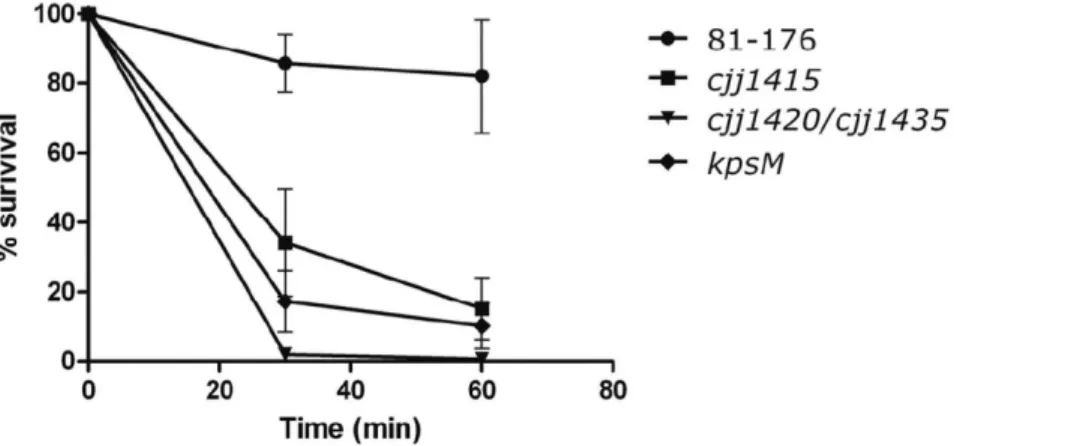
We speculated that the pronounced serum mediated killing observed with the mutants was primarily due to the classical pathway of complement activation since the commercial serum that we used contained antibodies against C. jejuni (data not shown). Therefore, we examined the effects of the presence or
absence of 50 mM EGTA on the level of serum resistance observed (Fig. 6). The cjj81176_1420::kanr/cjj81176_1435::camr mutant was unable to survive a 60 min incubation in serum assays without EGTA, but,100% survival was observed when EGTA was included, indicating that the observed serum killing is indeed primarily due to activation of the classical complement pathway. Furthermore, the wild-type strain showed approximately 60% survival in the absence of EGTA, but ,100% survival in the Figure 1. Prevalence of MeOPN biosynthesis genes within theCampylobactergenus.Dendrogram of AtpA amino acid sequences of
representativeCampylobacterspecies, with strains containing orthologues of the MeOPN biosynthesis genes (cj1416-1418) indicated with an asterisk.
The scale bar represents substitutions per site. Bootstrap values of.75%, generated from 1000 replicates using the Neighbor-Joining algorithm, are
shown in the nodes. The Cj1416-Cj1418 orthologues forC. jejuni, C. lariandC. fetusare present in the NCBI database: the accession number forC.
jejuni subsp. jejunistrain NCTC 11168 is AL111168; the accession number forC. colistrain 76339 (genes BN865_14280-14300) is HG326877; the
accession number forC. lari subsp. laristrain RM2100 (genes Cla_0314-316) is CP000932; the accession number forC. fetus subsp. fetusstrain 82–40
(genes CFF8240_1630-1632) is CP000487; and the accession number forC. fetus subsp. venerealisstrain NCTC 10354 (genes CFV354_1762-1764) is
CM001228. The accession numbers for theatpsequences and new Cj1416-Cj1418 orthologues from the otherCampylobacterspecies are listed in
Table S1.
presence of EGTA, indicating that the presence of MeOPN offers partial, but not complete, protection against serum killing via the classical complement pathway.
Chicken Colonization Levels are not Affected by the Presence or Absence of MeOPN on the Cell Surface
Because the presence of MeOPN on the cell surface ofC. jejuni negatively influences invasion of human Caco-2 cells, we examined whether or not MeOPN has any effect on the ability of C. jejuni to colonize chickens. No significant difference in colonization levels was observed between thecjj81176_1420::kanr/ cjj81176_1435::camr mutant and the wild-type strain (Fig. 7), suggesting that MeOPN does not play an important role in chicken colonization.
MeOPN is Contributory to Piglet Colonization
While MeOPN was not found to play a role in colonization of chickens, we examined the effects of MeOPN on colonization in piglets. Due to inherent variation in colonization levels between individual animals, competitive colonization assays were per-formed allowing the relative colonization efficiencies of the cjj81176_1420::kanr/cjj81176_1435::camr and wild-type strains in an individual animal to be evaluated. The numbers of colonizing bacteria were enumerated from samples of each section of the intestine (duodenum, jejunum, ileum, cecum, and colon), and the ratio of cjj81176_1420::kanr/cjj81176_1435::camr versus wild-type recovered was determined. The mutant was significantly outcom-peted by the wild-type strain with a 5-fold reduction in colonization level (Fig. 7), indicating that the presence of MeOPN plays a contributory role in piglet colonization.
MeOPN-containing Compounds and MeOPN-modified CPS do not have Insecticidal Activity againstG. mellonella
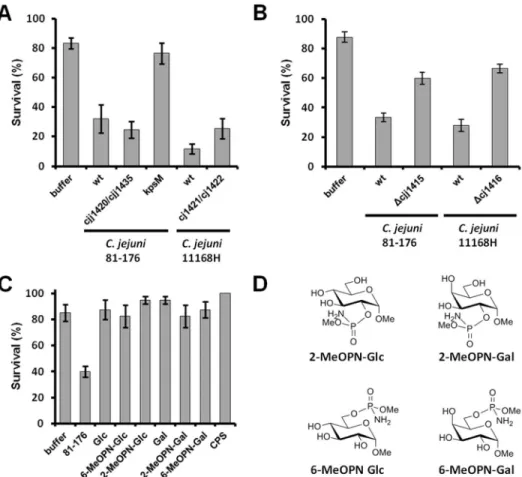
A recent study by Championet al. [14] demonstrated that the cj1416::kanr MeOPN biosynthetic mutant in C. jejuni 11168H showed a marked reduction in killing of G. mellonella larvae compared to wild-type, and that killing was restored in a complemented mutant. These results suggested that MeOPN has insecticidal activity, consistent with the fact that MeOPN has similarity to some synthetic pesticides. We assessed the cjj81176_1420::kanr/cjj81176_1435::camr mutant for the ability to killG. mellonella, because this mutant is not deficient in MeOPN biosynthesis but is unable to transfer MeOPN to the capsule. Interestingly, thecjj81176_1420::kanr/cjj81176_1435::camrmutant was able to killG. mellonellato similar levels as wild-type while the acapsular kpsM::kanr mutant showed a significant decrease in killing (Fig. 8 A). To investigate the possibility that this phenom-enon is unique to theC. jejuni81–176 background, the abilities of wild-type C. jejuni 11168H and its MeOPN transferase mutant (cj1421-cj1422::kanr) [10] to killG. mellonellawere also assessed. In this background, the MeOPN transferase mutant in theC. jejuni 11168H background was also able to killG. mellonella to similar levels to the wild-type, indicating that the presence of MeOPN on the CPS surface is not required for insecticidal activity for eitherC. jejuni11168H orC. jejuni81–176. In contrast, both theC. jejuni81– 176 cjj81176_1415::kanr and C. jejuni 11168H cj1416::kanr [10] MeOPN biosynthesis mutants showed reduced killing of G. mellonella(Fig. 8 B), consistent with Championet al. [14].
Therefore, to more directly examine the insecticidal potential of MeOPN, G. mellonella larvae were injected with chemically-synthesized MeOPN-functionalized monosaccharides, and MeOPN-containing CPS purified from the 81–176 wild-type Figure 2. 1D1H–31P HSQC spectra of selectCampylobacterspecies containing orthologues of thecj1416-cj1418genes.Spectra contain
the following resonances corresponding to MeOPN:C. insulaenigraeRM5435, peak at 3.74 ppm;C. lariUPTC NCTC 11845, peak at 3.70 ppm;C. lari
subsp.concheusLMG 11760, peak at 3.70 ppm;C. subantarcticusRM8523, peak at 3.75 ppm;C. cuniculorum LMG 24588, peak at 3.76 ppm;C.
upsaliensisRM3195, peak at 3.70 ppm;C. upsaliensisRM3940, peaks at 3.75 and 3.71 ppm;C. helveticusCCUG 30566, peak at 3.68 and 3.61 ppm;C. jejuniNCTC 11168, peaks at 3.71 and 3.68 ppm.
doi:10.1371/journal.pone.0087051.g002
Figure 3. 1D1H–31P HSQC analyses ofC. jejuni81-176 wild-type and the MeOPN biosynthesis and transferase mutants.Intact whole
cells ofC. jejuniwere analysed by HR-MAS NMR after 48 h growth on MH agar. Depicted are the 1D1H–31P HSQC spectra, which specifically show the
MeOPN resonance at 3.8 ppm in 81-176 wt (A), but not in the cjj81176_1415::kanr MeOPN biosynthesis mutant (B), and cjj81176_1420::kanr/
strain. In all cases, these compounds showed no larval killing relative to the PBS control (Fig. 8 C), indicating that the MeOPN functionality is not inherently insecticidal againstG. mellonella.
MeOPN Biosynthesis Mutants Show Reduced Transcription of Downstream Gene
RT-PCR experiments were done on all four MeOPN biosyn-thesis and transferase mutants to compare transcript levels of the downstream genes (Fig. S1). Although all downstream genes were
transcribed, cjj1414::kanr in 81–176 and cj1415::kanr in 11168H showed reduced expression compared to wild-type levels.
Discussion
Since our initial identification of MeOPN on the CPS ofC. jejuni NCTC 11168 [7], we have identified the genes involved in the biosynthesis and transfer of this unusual modification, as well as demonstrated that this modification is prevalent among mostC. jejuni isolates [10]. However, little is known regarding the prevalence of this modification outside of C. jejuni and the biological role of this modification is still not well understood. In this study we sought to determine how common this modification is among the Campylobacter genus and to further explore its biological importance.
Genetic analyses of representative members of theCampylobacter genus indicated that orthologues of the MeOPN biosynthetic genescj1416-cj1418were not limited only toC. jejuni.Furthermore, while these genes were most common among species more closely related toC. jejuni(Fig. 1), they were absent in theC. colistrain that we examined, which is somewhat surprising, given the close relatedness of these two species and the rate of genetic exchange between them [19,20], but these results are nonetheless consistent with previous observations in which MeOPN was not detected for any of the 18C. coli isolates we examined [10]. It should be pointed out however, that 3 other sequenced strains of C. coli, including the type strain, do contain thecj1416-cj1418 ortholo-gues, but no obvious cj1421/cj1422 orthologues. Twelve of the Campylobacterspecies containing orthologous genes were analyzed by HSQC HR-MAS NMR to screen for the presence of MeOPN, and resonances consistent with MeOPN were observed for the majority ofCampylobacterstrains screened (9 of 13). One possible reason why we did not detect MeOPN in the otherCampylobacter species is that these strains could produce a phosphoramidate lacking the O-methyl group, as has been observed in the lipopolysaccharides of Xanthomonas campestris [21] and Shewanella [22], because the diagnostic signal in the HSQC spectra is based on detection of the protons in theO-methyl of the MeOPN group. Alternatively, the MeOPN biosynthesis or transferase genes in these strains could be phased off, given that the MeOPN biosynthesis and transferase genes identified in both C. jejuni 11168H andC. jejuni81–176 were found to be phase variable [10]; however, thecj1416-cj1418orthologues ofC. fetussubsp. fetus,C. fetussubsp.venerealis,C. larisubsp.lari, andC. sputorumbv.sputorum strains tested in this study do not contain GC tracts typically associated with phase variability inCampylobacter. Most likely the reason for not detecting MeOPN in these strains is due to the lack of MeOPN transferase orthologues (cj1421orcj1422) although it is possible they may contain MeOPN transferase genes with low similarity tocj1421orcj1422.
To investigate the biological role of MeOPN, we usedC. jejuni 81–176 due to the virulent nature of this strain. We generated mutants that were deficient in both the biosynthesis and transfer of MeOPN, to be confident that any effects observed could be correlated specifically to loss of MeOPN, and confirmed that there were no obvious changes to CPS besides the lack of MeOPN. The identification of two orthologues ofcj1422, with one phased off in our 81–176 wild-type strain¸ is interesting because it is unclear whether an isolate with both these genes phased on would display a second distinct MeOPN modification or whether the transferases play redundant roles. The published structure of the 81–176 CPS indicates only one MeOPN modification [23,24], but it is not known whether both transferases are functional in this back-Figure 4. Loss of MeOPN results in increased invasion of
Caco-2 cells.Adherence and invasion of Caco-2 cells byC. jejuni81-176
wild-type, c j j 8 1 1 7 6 _ 1 4 1 5::k anr (MeOP N biosy nthesis mutant) ,
cjj81176_1420::kanr/cjj81176_1435::camr (MeOPN transferase mutant),
and kpsM::kanr(capsule mutant) in the gentamicin protection assay.
Note that a significant difference (p#0.05, unpaired t-test) in adherence
was observed between C. jejuni81-176 wild-type and thekpsM::kanr
mutant, and significant differences in invasion were observed between theC. jejuniwild-type, and thecjj81176_1415::kanr(MeOPN biosynthesis
mutant), cjj81176_1420::kanr/cjj81176_1435::camr and kpsM::kanr
mu-tants. Results represent the mean (6 SEM) of three independent
experiments.
ground. To avoid potential confusion due to phase variation, we generated a mutant with both of these genes disrupted.
We first examined whether or not the presence/absence of MeOPN on the cell surface affects the adherence/invasion and serum resistance ofC. jejuni. The results obtained from the assays
indicated that MeOPN influences the ability ofC. jejunito invade and resist serum killing. It is noteworthy that the serum resistance results with the cjj81176_1420::kanr/cjj81176_1435::camr mutant are consistent with those recently reported by Maueet al. [15] with a C. jejuni 81–176 MeOPN biosynthetic mutant, which we also tested. BecauseC. jejuniis primarily considered a gastrointestinal pathogen, these results are relevant as they indicate that CPS MeOPN modifications play a role in protection against humoral immunity. However, becauseC. jejunican also cause bacteremia [25], these observations may be directly relevant to infections in this context. To better understand the mechanisms underlying the improved serum resistance of wild-type 81–176 versus the MeOPN transferase mutant, we examined what effect, if any, the addition of EGTA to serum assays would have on bacterial survival. EGTA is a chelator with high selectivity for Ca2+
; therefore, the addition of EGTA acts as an effective inhibitor of the classical pathway of complement activation, which is Ca2+
-dependent [26]. The effect of EGTA addition was drastic in the case of the MeOPN mutant, which was unable to survive a 60 min incubation with serum in the absence of EGTA but showed ,100% survival when EGTA was added, indicating that the serum killing observed is mediated primarily via the classical complement pathway. This is consistent with our observation that the commercial serum that we used containedC. jejuniantibodies. The intermediate level of serum survival observed with the wild-type strain in the absence of EGTA indicates that the CPS MeOPN modifications offer a moderate degree of protection by interfering with serum killing.
The phase variability of thecjj81176_1420 andcjj81176_1435 genes suggests that MeOPN expression is desirable early in the infection process for protection against humoral immunity, but that phase variation to a MeOPN2 phenotype later in the infection process would be beneficial and enhance the invasiveness and virulence ofC. jejuni. Interestingly, theC. jejuniNCTC 11168 variant that we isolated, which became bacteriophage resistant through the loss of MeOPN [11], also showed increased invasiveness relative to the parental strain (M.C. Holst-Sorensen et al., unpublished data). It is not yet clear whether or not the presence of MeOPN enhances serum resistance by preventing antibody deposition, by inhibiting binding by CRP or another acute phase serum protein, or by functioning through another Figure 5. Loss of MeOPN results in a decrease in serum resistance.Survival ofC. jejuni 81-176 wild-type,cjj81176_1415::kanr(MeOPN
biosynthesis mutant),cjj81176_1420::kanr/cjj81176_1435::camr(MeOPN transferase mutant), andkpsM::kanr(capsule mutant) in 10% natural human
complement serum relative to survival in heat inactivated serum. Serum resistance was significantly different betweenC. jejuni81-176 wild-type, the
cjj81176_1415::kanr(MeOPN biosynthesis mutant), and thecjj81176_1420::kanr/cjj81176_1435::camrmutant at both 30 and 60 min (p
,0.0001). Serum
resistance was significantly different betweenC. jejuni81-176 wild-type and thekpsM::KmRmutant at both 30 and 60 min (p = 0.005 and p = 0.014,
respectively) using an unpaired t-test. Results represent the mean (6SEM) of three independent experiments.
doi:10.1371/journal.pone.0087051.g005
Figure 6. MeOPN modifications provide protection against serum mediated killing by interfering with the classical complement activation pathway.Survival ofC. jejuni81-176
wild-type and cjj81176_1420::kanr/cjj81176_1435::camr (MeOPN transferase
mutant) in 10% natural human complement serum. The samples were tested in the presence or absence of 50 mM EGTA after 60 min incubation, relative to survival in heat inactivated serum. Serum
resistance was significantly different betweenC. jejuni81-176 wild-type
in the presence versus absence of EGTA (p = 0.0030), the
cjj81176_1420::kanr/cjj81176_1435::camrmutant in the presence versus
absence of EGTA (p = 0.0014), and the 81-176 wild-type versus the
cjj81176_1420::kanr/cjj81176_1435::camrmutant in the absence of EGTA
(p = 0.0047) using an unpaired t-test. Results represent the mean (6
SEM) of three independent experiments. Note that both the wild-type and MeOPN transferase mutant approach 100% survival in the presence of EGTA.
mechanism. Studies are currently underway to determine if CRP plays a role in the observed serum mediated killing and whether other components of human serum bind preferentially to whole cells and/or CPS lacking MeOPN relative to wild-type.
Given that MeOPN was found to influence both serum resistance and invasion, we proceeded to examine the effects of loss of MeOPN in vivo in both commensal (chicken) and mammalian (piglet) colonization models. Loss of MeOPN in the 81–176 transferase mutant was found to have no effect on chicken colonization. This is consistent with our recent results demon-strating that C. jejuni NCTC 11168 fed to chickens along with bacteriophages recognizing the MeOPN modification caused a selection forC. jejunivariants without the CPS modification, but did not change levels of C. jejuni colonization [12]. However,
MeOPN did influence colonization of piglets relative to wild-type suggesting that this modification may be important in an infection model, but it is still premature to make any definitive conclusions since one model is using direct challenge while the other model used competitive challenge. Combined, these results suggest that MeOPN does not play a significant role in commensal coloniza-tion, but may play a contributory role in pathogenesis. Maueet al. [15] also recently reported that an 81–176 MeOPN biosynthesis mutant showed a reduction in colonization levels compared to wild-type 10 days post-infection in mice, another mammalian model system. These studies suggest an interplay between the benefits and disadvantages of MeOPN expression at various stages of the infection process. It is interesting to note that, although the presence of MeOPN had an effect on piglet colonization, MeOPN modifications were not observed for any of the 19C. coli strains that we have examined by HR-MAS NMR to date [10], in spite of the latter having a greater affinity for pigs as a host [27]. It will be interesting to explore these relationships further and to examine a broader range of isolates within each species [20]. It is also possible that the primary role of MeOPN modification may in fact be in the mediation of interactions between Campylobacter species and phages and we have already demonstrated that this relationship indeed exists forC. jejuni[11,12].
In a previous study investigating the ability ofC. jejuni11168H to killG. mellonellalarvae, a MeOPN biosynthetic mutant showed a marked decrease in larval killing relative to wild-type and complementation of the mutation was able to restore wild-type killing, suggesting that MeOPN has insecticidal activity againstG. mellonella[14]. Given that MeOPN appeared to be responsible for the larval killing observed, we were interested in testing MeOPN transferase mutants in the larval killing assay. The ability of both the C. jejuni 81–176 and C. jejuni 11168H MeOPN transferase mutants to kill G. mellonella larvae to wild-type levels was unexpected, and suggested that MeOPN might be accumulating to significant levels within the bacterial cell in our mutants. However, we were unable to detect MeOPN or MeOPN intermediates in metabolomics studies with the cjj81176_1420::kanr/cjj81176_1435::camr mutant (results not shown), so we examined potential insecticidal activity directly. MeOPN-linked monosaccharides were synthesized and injected intoG. mellonellalarvae, but none of the compounds showed any level of insecticidal activity. To rule out the possibility that MeOPN needs to be presented in a specific context to elicit the insecticidal activity, purified CPS from 81–176 wild-type was injected intoG. mellonella, but again no insecticidal activity was observed. It is worth noting that concentrated solutions were used for both the MeOPN-linked monosaccharides and the purified CPS injections, and therefore the MeOPN levels in these injections are significantly higher than those in theC. jejuniinjections. The inability of MeOPN, MeOPN-linked oligosaccharides, or purified 81–176 CPS to induce larval killing provided conclusive evidence that MeOPN does not have insecticidal activity as previously suggested [14].
While it is possible that MeOPN could contribute indirectly to larval killing by protecting the bacteria from the humoral responses of the larval immune system, the ability of the cjj81176_1420::kanr/cjj81176_1435::camr mutant to kill larvae at wild-type levels suggests that larval killing byC. jejuniis MeOPN-independent. The observation that MeOPN biosynthetic mutants show a decreased ability to killG. mellonellalarvae as observed by Championet al. and by us in this study, is contrary to the other findings, and suggests that MeOPN biosynthetic intermediates may accumulate in the cytoplasm, causing the mutant to be less able to survive inside the larvae, or that the mutation causes Figure 7. Influence of MeOPN on colonization.(A) Colonization
levels of C. jejuni 81-176 wild-type and cjj81176_1420::kanr/
cjj81176_1435::camr(MeOPN transferase mutant) in a chicken
coloniza-tion model, 6 days post-infeccoloniza-tion. (B) Relative colonization levels ofC.
jejuni 81-176 wild-type and the MeOPN transferase mutant in a competitive piglet infection model. Note that no significant difference was observed between strains in the chicken colonization model. In the competitive piglet infection model, the MeOPN transferase mutant displays a 5-fold reduction in colonization relative to wild-type comparing the measured wild-type-to-mutant ratio of the inoculum to the ratio recovered from the piglet intestine following infection (p = 0.0005). Statistical significance was determined using a
Man-n2Whitney test. Horizontal bars represent median values.
downstream effects. Examination of all the mutants in this study by RT-PCR demonstrated wild-type levels of gene transcripts downstream of both MeOPN transferase mutants. In contrast, mutants in the biosynthesis homologuecj1416 (which is also the gene mutated by Champion et al.) show slightly less cj1415 transcription in both strain backgrounds. This is of relevance because in our earlier study [10], we noted thatcj1415mutation results in reduced CPS expression (based on the need to do 2816 NMR scans of the cj1415 mutant to see similar capsule resonance signals compared to 256 scans for the wild-type and other MeOPN mutants). So, the MeOPN biosynthesis mutants may show higher levels of survival compared to the wild-types because they are actually producing less CPS. Future studies to elucidate the biochemical pathway for MeOPN biosynthesis and to develop methods to accurately quantitate CPS expression will be invaluable to advance our understanding of this unique modification.
In summary, we have demonstrated that MeOPN modifications are common within the Campylobacter genus, and especially
prevalent in species more closely related to C. jejuni, with the possible exception ofC. coli. We identified MeOPN biosynthesis and transferase genes inC. jejuni81–176, and generated mutants in this pathway. We demonstrated that MeOPN moieties are not inherently insecticidal againstG. mellonellaand that larval killing by C. jejuniis not directly related to MeOPN. We further showed that loss of MeOPN on the cell surface results in a drastic decrease in serum resistance while enhancing invasion of Caco-2 cells. Loss of MeOPN was found to have no effect on colonization in a commensal chicken model, but showed a reduction in colonization relative to wild-type in a piglet model, suggesting that MeOPN has a contributory role in pathogenesis.
Supporting Information
Figure S1 RT-PCR analyses of genes located down-stream from theCampylobacter jejunimutated genes in this study. Reverse Transcriptase PCR analyses of genes downstream of the chromosomally disrupted genes indicates Figure 8. MeOPN does not have insecticidal activity againstGalleria mellonella. (A) Insecticidal activity of C. jejuni81-176 wild-type,
cjj81176_1420::kanr/cjj81176_1435::camr(MeOPN transferase mutant),C. jejuni81-176kpsM::kanr(capsule mutant),C. jejuni11168H wild-type, andC.
jejuni 11168H cj1421-1422::kanr (MeOPN transferase mutant). (B) Insecticidal activity of C. jejuni 81-176 wild-type,cjj81176_1415::kanr (MeOPN
biosynthesis mutant),C. jejuni11168H wild-type, andC. jejuni11168Hcj1416::kanr(MeOPN biosynthesis mutant). (C) Insectidal activity ofC. jejuni
81-176 wild-type,C. jejuni81-176 purified CPS, or MeOPN-containing compounds in aG. mellonellalarval model. (D) Chemical structures of
MeOPN-containing compounds. Glc – methyla-D-glucopyranoside; 2-MeOPN-Glc - methyl 2-O(methylphosphoramidyl)aDglucopyranoside; 6MeOPNGlc
-methyl 6-O-(methylphosphoramidyl)-a-D-glucopyranoside; Gal – methyla-D-galactopyranoside; 2-MeOPN-Gal - methyl 2-O
-(methylphosphoramidyl)-a-D-galactopyranoside; 6-MeOPN-Glc - methyl 6-O-(methylphosphoramidyl)-a-D-galactopyranoside; CPS – purified capsular polysaccharide from
81-176 wild-type. Survival percentages were significantly different between wild-type 81-81-176 and the kpsM::kanr mutant (p = 0.0031), the
cjj81176_1420::kanr/cjj81176_1435::camr and kpsM::kanr mutants (p = 0.0026), and between wild-type 81-176 and all tested MeOPN-containing
compounds (p,0.005 in all cases). Note that no statistically significant difference was observed between the wild-type and MeOPN transferase
mutant in either the 81-176 (p = 0.264) or 11168H (p = 0.063) strains. Results represent the mean (6SEM) of five independent experiments in (A) and
similar transcript levels between wild-type and MeOPN transfer-ase mutants for (A)cj1420downstream ofcj1421andcj1422inC. jejuni11168H andcjj81176_1419downstream ofcjj81176_1420in C. jejuni 81–176, and (B) cjj81176_1434 downstream of cjj81176_1435 in the 81–176 background. Lower levels of transcripts were observed in the MeOPN biosynthesis mutant backgrounds relative to the wild-type strain for (C) cj1415 downstream ofcj1416in 11168H andcjj81176_1414downstream ofcjj81176_1415in 81–176.
(DOC)
Table S1 Accession numbers for the Cj1416-Cj1418
homologues and AtpA sequences from Campylobacter
species used in this study.
(DOC)
Acknowledgments
The authors thank NMR experts Albin Otter, Mark Miskolzie, Guy Bernard, Tom Nakashima and Roderick E. Wasylishen from the Department of Chemistry for their enthusiasm in setting up HR-MAS NMR at the University of Alberta. The authors also thank the reviewers of this manuscript for their insightful comments and suggestions.
Author Contributions
Conceived and designed the experiments: LBVA CQW RAA AVK AS WGM TLL CMS. Performed the experiments: LBVA CQW MRR CF RAA MS AVK WGM. Analyzed the data: LBVA CQW MRR MS AVK AS WGM TLL CMS. Contributed reagents/materials/analysis tools: BWW AS WGM TLL CMS. Wrote the paper: LBVA CQW MRR MS RAA AVK WGM CMS.
References
1. Allos BM (2001)Campylobacter jejuni Infections: update on emerging issues and trends. Clin Infect Dis 32: 1201–1206.
2. Humphrey T, O’Brien S, Madsen M (2007) Campylobacters as zoonotic pathogens: a food production perspective. Int J Food Microbiol 117: 237–257. 3. Friedman CR, Hoekstra RM, Samuel M, Marcus R, Bender J, et al. (2004) Risk factors for sporadicCampylobacterinfection in the United States: A case-control study in FoodNet sites. Clin Infect Dis 38 Suppl 3: S285–296.
4. Mishu B, Blaser MJ (1993) Role of infection due toCampylobacter jejuniin the initiation of Guillain-Barre syndrome. Clin Infect Dis 17: 104–108. 5. Karlyshev AV, Linton D, Gregson NA, Lastovica AJ, Wren BW (2000) Genetic
and biochemical evidence of aCampylobacter jejunicapsular polysaccharide that accounts for Penner serotype specificity. Mol Microbiol 35: 529–541. 6. Bacon DJ, Szymanski CM, Burr DH, Silver RP, Alm RA, et al. (2001) A
phase-variable capsule is involved in virulence ofCampylobacter jejuni 81–176. Mol Microbiol 40: 769–777.
7. Szymanski CM, Michael FS, Jarrell HC, Li J, Gilbert M, et al. (2003) Detection of conserved N-linked glycans and phase-variable lipooligosaccharides and capsules from campylobacter cells by mass spectrometry and high resolution magic angle spinning NMR spectroscopy. J Biol Chem 278: 24509–24520. 8. McNally DJ, Jarrell HC, Li J, Khieu NH, Vinogradov E, et al. (2005) The HS:1
serostrain of Campylobacter jejuni has a complex teichoic acid-like capsular polysaccharide with nonstoichiometric fructofuranose branches andO-methyl phosphoramidate groups. FEBS J 272: 4407–4422.
9. McNally DJ, Jarrell HC, Khieu NH, Li J, Vinogradov E, et al. (2006) The HS:19 serostrain ofCampylobacter jejunihas a hyaluronic acid-type capsular polysaccha-ride with a nonstoichiometric sorbose branch andO-methyl phosphoramidate group. FEBS J 273: 3975–3989.
10. McNally DJ, Lamoureux MP, Karlyshev AV, Fiori LM, Li J, et al. (2007) Commonality and biosynthesis of the O-methyl phosphoramidate capsule modification inCampylobacter jejuni. J Biol Chem 282: 28566–28576. 11. Sorensen MC, van Alphen LB, Harboe A, Li J, Christensen BB, et al. (2011)
Bacteriophage F336 recognizes the capsular phosphoramidate modification of Campylobacter jejuniNCTC11168. J Bacteriol 193: 6742–6749.
12. Sorensen MC, van Alphen LB, Fodor C, Crowley SM, Christensen BB, et al. (2012) Phase Variable Expression of Capsular Polysaccharide Modifications AllowsCampylobacter jejunito Avoid Bacteriophage Infection in Chickens. Front Cell Infect Microbiol 2: 11.
13. Miyamoto T, Kasagami T, Asai M, Yamamoto I (1999) A novel bioactivation mechanism of phosphoramidate insecticides. Pesticide Biochemistry and Physiology 63: 151–162.
14. Champion OL, Karlyshev AV, Senior NJ, Woodward M, La Ragione R, et al. (2010) Insect Infection Model forCampylobacter jejuniReveals That O-methyl Phosphoramidate Has Insecticidal Activity. Journal of Infectious Diseases 201: 776–782.
15. Maue AC, Mohawk KL, Giles DK, Poly F, Ewing CP, et al. (2013) The Polysaccharide Capsule ofCampylobacter jejuni Modulates the Host Immune Response. Infect Immun 81: 665–672.
16. van Vliet AH, Wooldridge KG, Ketley JM (1998) Iron-responsive gene regulation in aCampylobacter jejuni furmutant. J Bacteriol 180: 5291–5298. 17. Oelschlaeger TA, Guerry P, Kopecko DJ (1993) Unusual
microtubule-dependent endocytosis mechanisms triggered by Campylobacter jejuni and Citrobacter freundii. Proc Natl Acad Sci U S A 90: 6884–6888.
18. Blaser MJ, Smith PF, Kohler PF (1985) Susceptibility ofCampylobacterisolates to the bactericidal activity of human serum. Journal of Infectious Diseases 151: 227–235.
19. Sheppard SK, McCarthy ND, Falush D, Maiden MC (2008) Convergence of Campylobacterspecies: implications for bacterial evolution. Science 320: 237–239. 20. Wilson DJ, Gabriel E, Leatherbarrow AJ, Cheesbrough J, Gee S, et al. (2009) Rapid evolution and the importance of recombination to the gastroenteric pathogenCampylobacter jejuni. Mol Biol Evol 26: 385–397.
21. Silipo A, Molinaro A, Sturiale L, Dow JM, Erbs G, et al. (2005) The elicitation of plant innate immunity by lipooligosaccharide ofXanthomonas campestris. J Biol Chem 280: 33660–33668.
22. Vinogradov E, Kubler-Kielb J, Korenevsky A (2008) The structure of the carbohydrate backbone of the LPS fromShewanellaspp. MR-4. Carbohydr Res 343: 2701–2705.
23. Kanipes MI, Papp-Szabo E, Guerry P, Monteiro MA (2006) Mutation ofwaaC, encoding heptosyltransferase I inCampylobacter jejuni81–176, affects the structure of both lipooligosaccharide and capsular carbohydrate. J Bacteriol 188: 3273– 3279.
24. Aspinall GO, McDonald AG, Pang H (1992) Structures of the O chains from lipopolysaccharides ofCampylobacter jejuniserotypes O:23 and O:36. Carbohydr Res 231: 13–30.
25. Bleumink-Pluym NM, van Alphen LB, Bouwman LI, Wosten MM, van Putten JP (2013) Identification of a Functional Type VI Secretion System in Campylobacter jejuni Conferring Capsule Polysaccharide Sensitive Cytotoxicity. PLoS Pathog 9: e1003393.
26. Forsgren A, McLean RH, Michael AF, Quie PG (1975) Studies of the alternate pathway in chelated serum. J Lab Clin Med 85: 904–912.
27. Dingle KE, Colles FM, Falush D, Maiden MC (2005) Sequence typing and comparison of population biology ofCampylobacter coliandCampylobacter jejuni. J Clin Microbiol 43: 340–347.
28. Rossi M, Debruyne L, Zanoni RG, Manfreda G, Revez J, et al. (2009) Campylobacter aviumsp. nov., a hippurate-positive species isolated from poultry. Int J Syst Evol Microbiol 59: 2364–2369.
29. Fouts DE, Mongodin EF, Mandrell RE, Miller WG, Rasko DA, et al. (2005) Major structural differences and novel potential virulence mechanisms from the genomes of multiple campylobacter species. PLoS Biol 3: e15.
30. Aabenhus R, On SL, Siemer BL, Permin H, Andersen LP (2005) Delineation of Campylobacter concisus genomospecies by amplified fragment length polymor-phism analysis and correlation of results with clinical data. J Clin Microbiol 43: 5091–5096.
31. Zanoni RG, Debruyne L, Rossi M, Revez J, Vandamme P (2009)Campylobacter cuniculorumsp. nov., from rabbits. Int J Syst Evol Microbiol 59: 1666–1671. 32. Perez GI, Hopkins JA, Blaser MJ (1985) Antigenic heterogeneity of
lipopolysaccharides from Campylobacter jejuni and Campylobacter fetus. Infect Immun 48: 528–533.
33. van Bergen MA, Dingle KE, Maiden MC, Newell DG, van der Graaf-Van Bloois L, et al. (2005) Clonal nature of Campylobacter fetus as defined by multilocus sequence typing. J Clin Microbiol 43: 5888–5898.
34. Tanner ACR, Badger S, Lai C-H, Listgarten MA, Visconti RA, et al. (1981) Wolinellagen. nov.,Wolinella succinogenes(Vibrio succinogenesWolin et al.) comb. nov., and Description of Bacteroides gracilissp. nov., Wolinella rectasp. nov., Campylobacter concisus sp. nov., and Eikenella corrodens from Humans with Periodontal Disease. Int J Syst Bacteriol 31: 432–445.
35. Lawson AJ, On SL, Logan JM, Stanley J (2001) Campylobacter hominis sp. nov., from the human gastrointestinal tract. Int J Syst Evol Microbiol 51: 651– 660.
36. Foster G, Holmes B, Steigerwalt AG, Lawson PA, Thorne P, et al. (2004) Campylobacter insulaenigrae sp. nov., isolated from marine mammals. Int J Syst Evol Microbiol 54: 2369–2373.
37. Jones MA, Marston KL, Woodall CA, Maskell DJ, Linton D, et al. (2004) Adaptation of Campylobacter jejuni NCTC11168 to high-level colonization of the avian gastrointestinal tract. Infect Immun 72: 3769–3776.
38. Black RE, Levine MM, Clements ML, Hughes TP, Blaser MJ (1988) ExperimentalCampylobacter jejuniinfection in humans. J Infect Dis 157: 472–479. 39. Parkhill J, Wren BW, Mungall K, Ketley JM, Churcher C, et al. (2000) The genome sequence of the food-borne pathogen Campylobacter jejuni reveals hypervariable sequences. Nature 403: 665–668.
41. Debruyne L, On SL, De Brandt E, Vandamme P (2009) NovelCampylobacter lari-like bacteria from humans and molluscs: description ofCampylobacter peloridissp. nov.,Campylobacter larisubsp.concheussubsp. nov. andCampylobacter larisubsp.lari subsp. nov. Int J Syst Evol Microbiol 59: 1126–1132.
42. Bolton FJ, Holt AV, Hutchinson DN (1984) Campylobacter biotyping scheme of epidemiological value. J Clin Pathol 37: 677–681.
43. Lawson GH, Rowland AC, Roberts L (1976) Studies on Campylobacter sputorum subspecies Mucosalis. J Med Microbiol 9: 163–171.
44. Etoh Y, Dewhirst FE, Paster BJ, Yamamoto A, Goto N (1993) Campylobacter showae sp. nov., isolated from the human oral cavity. Int J Syst Bacteriol 43: 631–639.
45. On SL, Atabay HI, Corry JE, Harrington CS, Vandamme P (1998) Emended description of Campylobacter sputorum and revision of its infrasubspecific (biovar) divisions, including C. sputorum biovar paraureolyticus, a urease-producing variant from cattle and humans. Int J Syst Bacteriol 48 Pt 1: 195–206. 46. Debruyne L, Broman T, Bergstrom S, Olsen B, On SL, et al. (2010) Campylobacter subantarcticus sp. nov., isolated from birds in the sub-Antarctic region. Int J Syst Evol Microbiol 60: 815–819.