This is the pre-peer reviewed version of the following article
Pedro J. Silva and Maria J. Ramos (2011) “Computational insights
into the photochemical step of the reaction catalyzed by
protochlorophylide oxidoreductase”. which has been puclished in
Computational insights into the photochemical step of
the reaction catalyzed by protochlorophylide
oxidoreductase
Pedro J. Silva§ and Maria João Ramos†*
§
Fac. de Ciências da Saúde, Univ. Fernando Pessoa, Rua Carlos da Maia, 296, 4200-150 Porto-Portugal
†
Abstract:
The light-dependent enzyme protochlorophyllide oxidoreductase (PChOR) (EC:1.3.1.33) catalyzes the conversion of protochlorophyllide into chlorophyllide, during chlorophyll synthesis. The reaction has been proposed to proceed through light-induced weakening of the C17-C18 double bond in protochlorophyllide, which then facilitates hydride transfer from a NADPH co-substrate molecule. We have performed DFT and TDDFT computations on the reaction mechanism of this interesting enzyme. The results show that whereas in the ground state the reaction is strongly endergonic and has a very high activation free energy (38 kcal.mol-1), the first four excited states (corresponding to excitations within
the conjugated porphyrin π-system) afford much lower activation free energies (<25 kcal.mol-1) and spontaneous (or only slightly endergonic) reaction paths. The sharp shape of the potential energy surface along the reaction coordinate in these excited states allows hydrogen tunneling to occur efficiently on the first excited state surface, lowering the barrier to values closer to experiment, in agreement with recent suggestions.
*
I. Introduction
Chlorophyll is by far the most abundant biological pigment in Nature. Due to its role harvesting sunlight in photosynthesis, it is ultimately responsible for the fixation of almost all free energy available to biological systems. In vivo, chlorophyll is synthesized from protoporphyrin IX in a pathway1 that leads (through sequential Mg insertion, methylation and a six-electron oxidation) to protochlorophyllide (PChlide). Stereospecific reduction of the PChlide D ring followed by esterification with a long-chain polyisoprenol then yields chlorophyll. The reduction of the protochlorophyllide D ring may be catalyzed by two different-enzymes: angiosperms contain a light-dependent PChlide oxidoreductase (EC 1.3.1.33) which uses NADPH as electron donor, whereas other plants, algae and cyanobacteria also contain a light-independent PChlide oxidoreductase (EC 1.18.-.-)2.
Fig. 1: The reaction catalyzed by the light-dependent protochlorophyllide oxidoreductase.
the reaction at low temperatures have shown the reaction to consist of an initial light-driven step (which yields a charge-transfer complex6) followed by several light-independent steps (corresponding to proton transfer from the enzyme to the charge-transfer complex and to a series of ordered product release and cofactor binding events7,8,9). In spite of these extensive investigations, the precise mechanism of the light-dependent step remains poorly understood. Recently, Heyes et al. described unusual kinetic isotopic effects in the reaction mechanism10, characteristic of quantum tunneling of hydrogen nuclei in the reaction mechanism, and characterized its ground-state potential energy surface through density-functional computations.
In this report, we describe additional quantum-mechanical computations on the ground- and excited-state potential energy surfaces of the (light-dependent) hydride transfer step of this interesting enzyme. The results show that whereas in the ground state the reaction is strongly endergonic and has a very high activation free energy (38 kcal.mol-1), the first excited states (corresponding to excitations within the conjugated porphyrin π-system) afford much lower activation free energies (<25 kcal.mol-1) and spontaneous (or only slightly endergonic) reaction paths. We also computed the probability of quantum tunneling of hydrogen nuclei along the reaction coordinate in these low-lying excited states, and show that hydrogen tunneling may occur efficiently on the first few excited potential energy surfaces, lowering the barriers to values closer to experiment.
II. Computational Methods
separation may be computed from this value by applying a correction based on the CIS formalism26, which does not suffer from the electron-transfer self-interaction observed in TDDFT. The total stabilization when bringing the oppositely-charged moieties to a 2.06 Å distance amounts to 35 kcal.mol-1 (3.3 kcal.mol-1 from taking two oppositely charged electronic point charges from infinity to within 100 Å of each other, as computed through Coulomb’s law, plus 31.7 kcal.mol-1 excited state stabilization when taking the system from 100 Å to 2.06 Å, computed from CIS). Low-wavelength photons (≈300 nm) are still required to attain this charge-separated state (in considerable disagreement with the experimental observation of catalysis upon irradiation with 690 nm photons). These charge-transfer states were therefore excluded from our analysis.
The contribution of hydrogen tunneling to the reaction rate was computed with the well-known semiclassical approximation to the transmission probability for an energy E below the barrier height Vmax27,28,29,30,31, as described by Garret and Truhlar32. In this methodology, the variation in transmission coefficient, κ, due to quantum effects (tunneling though the barrier and reflection above the barrier) is computed as the ratio of Boltzmann-averaged quantum and classical transmission probabilities:
∫
∫
∞ − ∞ − = max 0 ) ( V E E dE e dE e E T β βκ , where β=1/kBT, kB is Boltzmann’s constant, and T(E) is the quantum
transmission coefficient at energy E. For energies below the barrier, T(E) is computed from the semiclassical approximation ) ( 2 1 1 ) ( E e E T θ +
= , where the barrier penetration integral θ(E) is given by
∫
− = b a ds E s V hE) 2 2 ( ( ) )
( π µ
in excess of 2×Vmax, and T(E) between ½ and 1 for energies between Vmax and 2×Vmax. Since a parabolic approximation is not suitable for the potential energy surfaces studied in this work, we took a conservative approach in the evaluation of transmission probabilities above the barrier: for energies slightly above the barrier (between Vmax and 2×Vmax), we set T(E)=T(Vmax)=½, and set T(E)=1 for energies above 2×Vmax. In any case, the precise choice of values for the transmission coefficient above the barrier does not usually affect the computations (except in the case of very low barriers or very high temperatures), since Boltzman-averaging ensures that most of the quantum-mechanical contributions to the transmission coefficient arise from highly-populated (and therefore low-energy) paths.
It must be noted that the presence of hydrogen tunneling affects the reaction rate by altering the value of the transmission coefficient (κ) in the Eyring equation
R S RT H B e h T k k ‡ ‡ ∆ + ∆ − =κ
, rather than the energetic barrier itself. On the other hand, estimates of the energetic barrier from experimental values of the reaction rate usually assume that the transmission coefficient equals 1. Therefore, the energetic barrier deduced from measurements of the light-dependent reaction rate of PChOR10 (as well as its decomposition in enthalpic and entropic contributions) is an apparent value, and is actually a function of both the real thermodynamic barrier and the tunneling-dependent transmission coefficient.
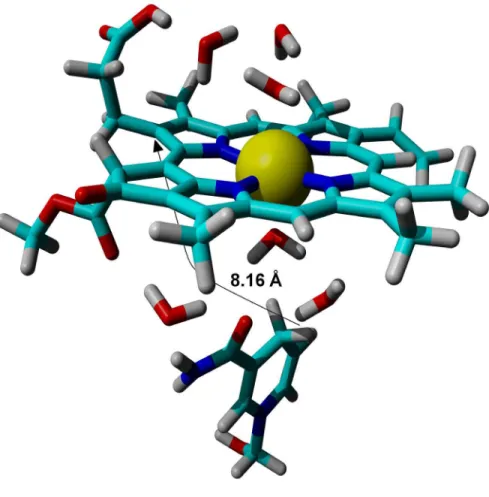
Fig. 2: Optimized structure of the reactants in the light-dependent PChOR-catalyzed reaction.
structure imposed by the catalytic site yield thermodynamically “sub-optimal” structures, the electronic stabilization of the complex still provides an incentive for complex formation. For example, as the distance between the pro-S hydrogen and the C17 atom decreases to 3.96 Å the complex becomes less stable by 3.0 kcal.mol-1, but its formation from the isolated reactants is still favored by 2.5 kcal.mol-1. These observations, coupled with the fact that the experimental geometry of the enzyme-bound NADPH-PChlide complex has not been determined, mean that the absolute value of the energetic barrier between the enzyme-bound reactants and the transition state cannot be confidently computed. The relative differences of these energetic barriers in the ground- and the first excited-states, however, is quite insensitive to the initial geometry, since their potential energy surfaces are almost parallel from the optimized reactants to a hydrogen-carbon distance of 2.0 Å (Fig. 3).
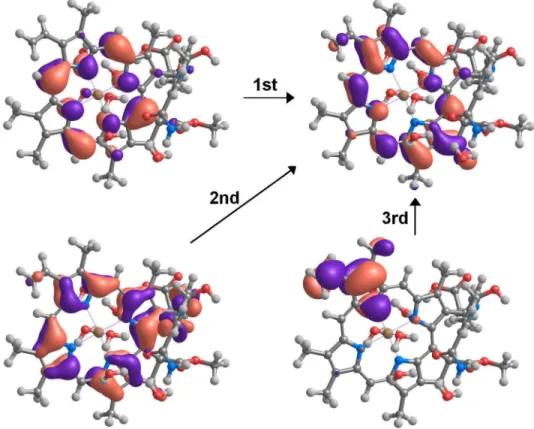
Fig. 4: Molecular orbitals involved in the transitions to the first three excited states, as computed by time-dependent DFT. As explained in the Methods section, TDDFT computations detect two additional (charge-transfer) excited states with energies between those of the 2nd and 3rd transitions shown.
For ease of comparison with the homology modeled structure of PChOR, all energies reported henceforth are measured relative to the structure bearing a hydride-C17 distance of 3.96 Å. The ground-state potential energy surface is highly endergonic (27.7 kcal.mol-1) and is clearly incompatible with the fast reaction rates observed experimentally, as it yields an activation electronic energy of 36.6 kcal.mol -1
excited state, and 6-7 kcal.mol-1 in the remaining states) in regard to that of the ground state (Table 1), although they still remain above the experimentally determined activation free energies (apparentΔG‡ = 6.7 kcal.mol-1 at 298 K, computed from the values in ref. 10). The difference may be partially attributed to the neglect, in our computations, of vibrational contributions to the enthalpy, which are prohibitively expensive to compute as they require the very demanding computation of the matrix of second partial derivatives on geometries optimized separately at each ground- and excited-state. An additional factor that intervenes in lowering the activation energies has been identified by Heyes et al.10 in measurements of the enzyme kinetic parameters with naturally occurring vs. deuterated NADPH: the very strong kinetic isotope effect measured experimentally clearly shows the involvement of quantum tunneling of hydrogen nuclei34 from NADPH to the porphyrin substrate.
ΔE (kcal.mol-1
) ΔE‡ (kcal.mol-1)
Apparent ΔE‡
(kcal.mol-1) (including quantum effects)
Ground State 27.7 36.6 30.0
First excited state 6.3 23.8 18.4
Second excited
state 10.3 30.3 19.9
Third excited state 11.6 31.2 21.2
Table 1: Reaction and activation energies of the PChOR reaction on the ground- and the first five excited potential energy surfaces.
thermodynamic activation barrier decreases exponentially, so that the relative contribution of quantum tunneling increases dramatically. An Eyring plot of the predicted reaction rates therefore shows a spurious dependence on temperature (Fig.5), an often overlooked fact which prevents the collection of meaningful estimates of the reaction activation enthalpy and entropies from experimental reaction rates whenever tunneling (or other effects) yields temperature-dependent transmission coefficients.
Fig. 5: Eyring plots of the computed reaction rates of hydride transfer on the (○) 1st and (●) 2nd excited potential energy surfaces, assuming constant activation barriers of 23.8 kcal.mol-1 (1st excited state) and 30.3 kcal.mol-1 (2nd excited state), either excluding (lined data) or including (scattered data) tunneling effects. In this representation, the activation ΔS and ΔH may be computed from the ordinates at the origin and slope (respectively) of the straight lines drawn from the experimental data. Inclusion of
tunneling effects leads to wrong estimates of ΔH‡
(8.8 kcal.mol-1 for the 1st excited state and 10.8 kcal.mol-1 for 2nd excited state) and ΔS‡ (-33.6 cal.mol-1.K-1 for the 1st excited state and -31.0 cal.mol -1
Fig. 6: Comparison of selected bond orders between the ground state and 1st excited states as NADPH approaches the PChlide.
measureable differences be found (which is consistent with the constant energy separation between these two electronic states at separations above 2.0 Å): the bond between C17 and C18 then becomes weaker on the excited state, at the same time as the bond pattern on the nicotinamide ring changes from the familiar two-double/four-single bonds characteristic of NADPH to the six fully-delocalized π-electrons characteristic of NADP+.
Conclusions
Although the lack of a crystal structure of the PChOR:PChlide:NADPH and the large computational cost of excited-state optimization prevented us from performing a fully detailed and realistic analysis, the simplified model we used afforded several interesting insights into the reaction mechanism of this interesting enzyme:
a) the potential energy surface on the 1st excited state (which is expected to be the most relevant state, since the reaction proceeds upon illumination of the lowest-energy absorption band) affords a ≈12 kcal.mol-1 lowering of the activation energy vs. the reaction in the ground state;
b) hydrogen tunneling decreases the activation energy (in the 1st excited state surface) by 5.4 kcal.mol-1, which corresponds to an increase of the reaction rate by a factor of approximately 104
c) measurable differences between the ground and 1st excited state only arise as the C17-pro-S NADPH hydrogen distance becomes shorter than 2.0 Å. Dynamic factors such as ground-state protein motions may therefore play a relevant role in bringing the NADPH molecule into close proximity of the PChlide substrate, even if in their initial binding states the two molecules lie relatively far from each other. d) the relative magnitude of hydrogen tunneling changes dramatically with temperature, which prevents the estimation of activation ΔH and ΔS in this reaction through the familiar Eyring equation.
V. References
1. Masuda, T.; Fujita, Y. (2008) Photochem. Photobiol. Sci., 7: 1131-1149
2. Fujita Y, Bauer CE. (2003) The light-independent protochlorophyllide reductase: a nitrogenase-like enzyme catalyzing a key reaction for greening in the dark. In Chlorophylls and Bilins: Biosynthesis, Synthesis, and Degradation, ed. KM Kadish, KM Smith, R Guilard, pp. 109–56. New York: Academic Press.
3. Valera, V.; Fung,, M.; Wessler, A.N.; Richards, W.R. (1987) Biochem. Biophys. Res. Commun.
148: 515–520.
4. Begley, T.P.; Young, H. (1989) J. Am. Chem. Soc., 111:3095-3096
5. Wilks, H.M. ;Timko, H.P. (1995) Proc. Natl. Acad. Sci. USA, 92:724-728
6 Heyes, D.J.; Heathcote, P.; Rigby, S.E.J.; Palacios, M.A.; van Grondelle, R.; Hunter, N.C. (2006) J. Biol. Chem., 281:26847-26853
7 Heyes, D. J., Ruban, A. V., Wilks, H. M. and Hunter, C. N. (2002) Proc. Natl. Acad. Sci. U.S.A., 99: 11145–11150
8 Heyes, D. J., Ruban, A. V. and Hunter, C. N. (2003) Biochemistry, 42: 523–528 9 Heyes, D. J. and Hunter, C. N. (2004) Biochemistry, 43: 8265–8271
10 Heyes, D.J.; Sakuma, M.; de Visser, S.P.; Scrutton, N.S. (2009) J. Biol. Chem., 284:3762-3767 11 Becke, A. D. (1993) J. Chem. Phys. I, 98: 5648.
14 Baker, J., Kessi, A., Delley, B. (1996) J.Chem.Phys. 105: 192-212 15. Fernandes, P. A.; Ramos, M. J. (2004) Chemistry, 10: 257-266
16 Fernandes, P. A.; Ramos, M. J. (2003) J. Am. Chem. Soc., 125: 6311-6322
17 Riley K.E., Op’t Holt, B.T., Merz Jr., K.M. (2007) J. Chem. Theory Comput., 3: 407-433 18 Townley, H.E., Sessions, R.B., Clarke, A.R., Dafforn, T.R. and Grifiths W.T. (2001) Proteins, 44: 329-335
19 Mulliken, R.S. J. Chem. Phys. (1995) 23: 1833 20 Lowdin, P.-O. (1970) Adv. Chem. Phys. 5: 185-199
21 A. A. Granovsky, PC GAMESS version 7.0, http://classic.chem.msu.su/gran/gamess/index.html 22 Schmidt, M.W., Baldridge, K.K., Boatz, J.A., Elbert, S.T., Gordon, M.S., Jensen, J.J., Koseki, S., Matsunaga, N., Nguyen, K.A., Su, S., Windus, T.L., Dupuis, M., Montgomery, J.A. (1993)
J.Comput.Chem. 14: 1347-1363
23 Dreuw, A.; Weisman, J.L. and Head-Gordon, M. (2003), J. Chem. Phys., 119: 2943-2946 24 Dreuw, A. and Head-Gordon, M. (2004), J. Am. Chem. Soc., 126: 4007-4016
25 Starcke, J. H. ; Wormit, M.; Schirmer, J. and Dreuw, A. (2006) Chem. Phys., 329: 39-49 26 Dreuw, A. and M. Head-Gordon (2005) Chem. Rev., 105: 4009-4037
27 Kemble, E.C. (1937) "The Fundamental Principles of Quantum Mechanics with Elementary Applications", Dover Publications, New York.
28 Connor, J.N.L. (1968) Mol. Phys., 15: 37-46
29 Marcus, R.A. (1965) J. Chem. Phys., 43: 1598-1605 30 Miller, W.H. (1977) Faraday Discuss. Chem. Soc. 62: 40
31 Marcus, R.A. and Coltrin, M.E. (1977) J. Phys. Chem., 67: 2609-2613 32 Garrett, B.C. and Truhlar, D. (1979) J. Phys. Chem., 83: 2921-2926 33 Boys, S.F.; Bernardi, F. (1970) Mol. Phys., 19: 553-566