Perturbation Theory Approah to
Rotational Tunneling Systems
LuianoT. Peixoto
Departamentode Fsia
UniversidadeFederaldoEspiritoSanto
29060-900 Vitoria,ES, Brazil
Reeived5Otober1999
Diagrammatiperturbationtheoryisused toonsidertheproblem oftheouplingofamoleular
grouplibrationtothelattievibrationsinsolidsexhibitingrotationaltunnelingdetetedbyinelasti
neutron sattering. The tehniqueis applied to a moleular groupof symmetry C
3
inpresene
of the hindering potential of the solid. The spetral density for transitions between rotational
tunneling states in the ground librational level is obtained as a funtion of temperature. Low
temperature results are presented for dierent phonon spetrum parameters. They are used to
hek theassumptionthatthis ouplingistheorigin ofthepeuliarbehaviourofthelineshifting
andbroadeningasafuntionoftemperatureintheINSspetraofsuhsystems.
I Introdution
Theuseofhigh-resolutionneutronsatteringapparatus
hasmadepossibletodetetrotationaltunnelingstates
of moleular groupsin solids. They are statesarising
from the quantum mehanial tunneling of the group
betweenequivalent orientations in a hindering
poten-tial. Thetunneling liftsthepointgroupsymmetry
de-generayofthelibrationallevelsandtheneutron
sat-tering proess produes transitions among them (The
termlibrationreferstotheosillationofanangular
o-ordinateharaterizingtheorientationofthemoleule.)
Theexplanationof thetemperaturedependeneof
thelinesin theinelastineutronsattering(INS)
spe-tra from solids ontaining methyl and other similar
groups was subjet of ontroversy in the past[1, 2℄.
Fromthesoalledthermometripointofview,thesolid
wouldworksimplyasaheatbath,anditwouldbethe
random jumps between equivalent orientations of the
groupthatgovernthepeuliartemperaturedependene
of thelines[3, 4, 5℄. In ontrast, amirosopi model
hasbeenproposedthataountsfortheouplingofthe
moleular groupto the lattiephonons. This
spetro-metripiturewasappliedtotheproblemofa
moleu-largroupofsymmetryC
3
(likethemethylgroup)
sub-jeted to adeep potential barrier,rst byonsidering
the ouplingtoeahpotentialwellindependently[6,7℄
andlaterbyexpressingtheneutronsattering
dieren-tialrosssetionintermsoftimedependentorrelation
funtionsofstandardbasisoperatorsfortherotational
tunnelingstates[8,9℄. Theseorrelationfuntionswere
alulated for a model with a linear oupling of the
equationofmotiontehnique. Lowtemperature
expres-sionsfor the shifting and broadening of the lines
or-respondingtotransitionsbetweenstatesintheground
librational level were obtained. The resultsreprodue
the observed straight line for the broadening and an
approximatestraightlinewithsmallergradientforthe
shiftwhenthesequantitiesareplottedinalogarithmi
saleagainst1=T.
The low and high temperature regimes were
studied[10℄in the spetrometri piture by apath
in-tegral approah, and the results not only predit the
samehigh temperature behavior as the lassial
hop-ping model but also onrm the lowtemperature
al-ulationsoftheperturbationtheoryapproah. More
re-ently,astudyusingthegeneralizedLangevinequation
(the Nakajima-Zwanzing theory) for the spetral
den-sityprojetedin thesub-spaeof thetunneling states,
sueededtoyieldexpressionsforthelineshiftandline
widthfromtheLaplaetransformofthefrequeny
ma-trix and of the memory funtion, an approah whih
avoids the Random Phase Approximation implied in
the former equation of motion treatment[11℄. It is
shown that these expressions redue to those of
ref-erene[9℄ in the appropriatelimits, and from them it
isdisussed how thephonon spetrum aets theINS
spetra.
The ritiism onerning the spetrometri model
has been based on the fat that, ompared with
ex-istingexperimental data,theirresultsreettoomuh
the details of the phonon spetrum. More reent
ex-perimental studies[2℄ of the methyl group in dierent
po-temperature behavior of the linewidth expeted from
the thermometri piture, onehas remarkable
quanti-tativediereneswhihdonothappenathigh
temper-atures. Althoughaqualitativeagreementstillpersists,
this shows learlythe limitations ofthe thermometri
piture. Intriguing in this study, however, is the
o-urreneofaneetiveoinideneofthetemperature
dependeneofthelineshiftforsomeofthesamples
on-sideredsothat, although mirosopiallyjustiedand
inspiteofitsoverallsuess,thespetrometripiture
stillhassomepointstolarify.
Our aim here is to improve the perturbation
the-oryalulationforthisproblem,usingasingle
moleu-largroupapproahto systemswithmoleules of
sym-metry C
3
. Wealulate theGreen funtion by a
dia-grammatiperturbation expansion,inludingthe
on-tribution of the vertex part, instead of simply using
the equation-of-motion formalism. This enables us to
onsider strongeroupling between rotational and
vi-brationalstatesthaninpreviousworks,thusextending
therangeofparametervaluesforwhihthe
spetromet-ritheoryanbetested. Inpartiularweareinterested
to study the importane of the vertex partto explain
experimentaldata. ThemaindiÆultywiththeuseof
thediagramatiperturbationtheoryiswiththelakof
simplebosonior fermioniommutation rulesforthe
standardbasisoperators,implyingthatthereisnosuh
devieasWik'stheoremtoallowadiretevaluationof
thediagrams.Soweusetheontourintegral
represen-tationfor thermalGreen funtions,adapting an
exist-ingdiagrammatitehnique[12℄. Inthespirit oftheso
alled non-rossingapproximation(NCA)we obtaina
self-onsistentsetof oupledintegralequations
involv-ing propagators, self-energies and vertex parts. From
aniterativesolutionoftheseequationsweonstrutthe
logarithmi plot of the linewidth and of the lineshift
against1=T fordierentphononspetrumparameters.
Theresultsonrmpreviousonesfromthe
spetromet-ri piture and an be haraterized, in view of the
widerrangeoftheparameterswewereabletoexplore,
asratherinsensitivetothedetails ofthephonon
spe-trum. Atthesametimewethinkthatavaluablefeature
of this work is the developmentof the self-onsistente
alulationof theGreenfuntion withthevertexpart
ontribution.
Asweworkherewith ashematiform of the
phononspetrum,wethinkthatanyfurtheradvaneon
this problem will onlyhappenon quantitativeaspets
by using phononspetraorresponding to spei
sit-uations. On the other hand, the general problem of
hindered rotationof the methyl group is under
inves-tigation in a variety of situations. A promising area
has been initiated with the observation of rotational
quantum tunneling of methyl in polymers[13℄. The
transition from quantum tunneling regime to lassial
randomjump motionasthetemperatureisraisedisa
pointnotyetompletelyunderstood[14℄,andtheeets
of interation between twoor moremehtyl groups, as
interpreted from observedlevel-rossingNulear
Mag-neti Resonane,is asubjet under urrent
investiga-tion[15,16,17℄.
II Desription of the
Calula-tion
The fullHamiltonian for theproblem ontainsa term
desribingtheinterationoftheneutronbeamwiththe
solidwhihisresponsiblefortransitionsofthe
moleu-largroupsbetweenlibrational statessplitbyquantum
tunneling. Expressing this interation as a
superposi-tionofstandardbasisoperators,thedierentialneutron
satteringrosssetionin theBornapproximationan
beobtainedasalinearombinationoftimeorrelation
funtions of these operators. Using Fourier transform
and integration in the omplex plane, the line
inten-sityorrespondingtothetransitionjms>!jm 0
s 0
>is
givenin proportiontothespetraldensity
ss
0
mm 0
(w)= 1
2i h
G ss
0
mm 0
(w iÆ) G ss
0
mm
0(w+iÆ) i
;
(1)
where m is the librational quantum number and s is
the symmetry label indiating one of the irreduible
representations A, E a
and E b
of thesymmetry group
C
3
. Intheontourintegralrepresentation,theGreen's
funtions aretheanalytialontinuationof[12℄
G ss
0
mm 0(iw
n )=
1
2iZ I
dz exp( z)Tr h
R (z)X ss
0
mm
0R (z+iw
n )X
s 0
s
m 0
m i
; (2)
where Z = Trexp( H) is the partition funtion, w
n
is the Matsubara frequeny, and R (z) = (z H) 1
is
the resolvent. The X ss
0
mm 0
=jms >< m 0
s 0
j are standardbasis operator and the ontouris hosen to enirles all
the singularities of theintegrand. Thesolid is desribedin termsof the set of rotational tunneling states of the
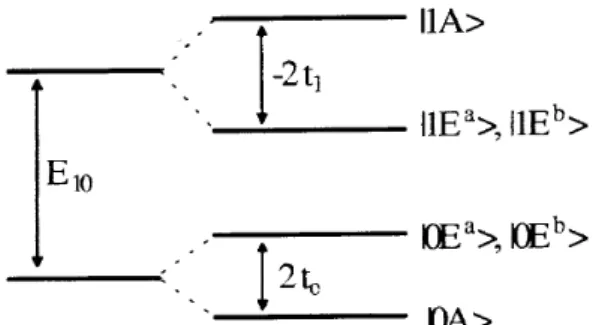
moleulatrgroupsindiatedinFig. 1oupledtothephononstates,withtheHamiltonian
H = X
ms E
m
s X
ss
mm +
X
q hw
q b
+
q b
q +
X
qs X
mm 0
g
mm 0
(q)(b +
q +b
q )X
ss
mm
Figure1. Theenergylevelshemeorrespondingtothetwo
lowest rotational levels of a moleular group of symmetry
C
3 .
HereE m
s
arethelibrationalenergiesandb +
q andb
q
are phonon reation and annihilation operators. The
rsttwotermsonstitutethenoninterating
Hamilto-nian with eigenstates given by the produts j m;si j
fn
q
gi. The third term represents the seond
quan-tized form of the oupling ^
V between librationaland
vibrationallevelswhihanbeshownbysymmetry
ar-gumentstoouronlybetweenlibrationallevelsofthe
samesymmetry. Forlargeenoughpotentialbarriersthe
oupling is also independent of thesymmetry type[8℄,
as alreadyimpliitinexpression(03). Theng
mm 0(q)is
thematrixelementg
mm 0
of ^
V betweenthestatesjms>
andjm 0
s>dividedby p
2w
q
. Theassumptionoflarge
potentialbarriers implieslargeseparationbetween
ro-tationalstatessothat forlowenoughtemperatureswe
onsider the transitions indued by the phonons only
from the ground to the rst rotational level. We are
thusleftwithadoubletwolevelsystem,oneomposed
by thestatesj0A>and j1A>, withenergiesE 0
A and
E 1
A
respetively,andtheotherbythedegeneratepairs
j0E a
>,j0E b
>andj1E a
>;j1E b
>,withenergiesE 0
E
andE 1
E
respetively(seeFig. 1).
We onsider here only the absorption line,
orre-sponding to the transitions j0A >! j0E > indued
by the neutron sattering proess.With appropriate
hangesitiseasytoalulatetheemissionlinej0E>!
j0A>andtheelastilinej0E a
>!j0E b
>. Evaluating
thetraeintheGreenfuntion,
G AE
00 (iw
n
)G(iw
n )=
Z
v
2iZ I
dz exp( z)I(z;z 0
)
(4)
withz 0
=z+iw
n and
I(z;z 0
) = 1
Z
v X
k e
E
k
[< 0A
k k (z+E
k )<
0E
k k (z
0
+E
k )
+ X
k 0
6=k <
0A
k k 0
(z+E
k )<
0E
k 0
k (z
0
+E
k
)℄ (5)
where Z
v
is the partition funtion for the vibrational
system. The sumis overvibrational states with
ener-gies E
k
and in the matrixelements< ms
k k 0
(z+E
k )<
mskj(z+E
k H)
1
jmsk 0
>wehavemadetheenergy
shiftz!z+E
k
. Nowusingtheidentity
1
z+E
k H
=
1
z+E
k H
0 +
1
z+E
k H
0 V
1
z+E
k H
weobtain
< 0s
k k 0(z+E
k )=
1
z+E 0
s =
0s
k k (z+E
k )
2
4
Æ
k k 0
+ X
k "6=k =
0s
k k " (z+E
k )<
0s
k "k 0(z+E
k )
3
5
; (6)
where wewillusethenotationR 0s
k k (z+E
k
)fortheexpressionbeforethebraketand
= 0s
k k 0
(z+E
k )=
X
k 00
<s0kjVjk 00
1s><s1k 00
jVjk 0
0s>
z+E
k E
k 00
E 1
s
(7)
istheseondorderapproximationfortheself-energy. Inthesubstitutionof(06)in(05)weusethetrunatedform
< 0s
k k (z+E
k )=R
0s
k k (z+E
k )
< 0s
k k 0(z+E
k )=R
0s
k k (z+E
k )=
0s
k k 0(z+E
k )R
0s
k 0
k 0(z+E
k )
from whih
I(z;z 0
)= 1
Z
v X
k
exp( E
k )R
0A
k k (z+E
k )
0
k k (z+E
k ;z
0
+E
k )R
0E
k k (z
0
+E
k
) (8)
0
k k (z+E
k ;z
0
+E
k )=1+
X
0 =
0A
k k 0
(z+E
k )R
0A
k 0
k 0
(z+E
k )R
0E
k 0
k 0
(z 0
+E
k )=
0E
k 0
k (z
0
+E
k
Theseond termin (08-b)representsthe vertexorretion. The expression (08-a) isan averageovervibrational
statesof aprodutofdressedpropagatorsandself-energies. Consideringtheexpansion
R (z+E
k )=
1
z+E
k H
0 1
X
n=0
=(z+E
k )
z+E
k H
0
n
in allmatrix elements of R (z+E
k
), the alulation redues,term by term in the produt of expansions, to the
averageofprodutsoffree propagatorsand self-energies. Introduingtheoupation numberrepresentation,this
transformsintoaprodutofaveragesoverphononmodes,andafter somealulationwendthesetofexpressions
I(z;z 0
)=R 0
A
(z) (z;z 0
)R 0
E (z
0
) (10)
R m
s (z)=
1
z E
m
s =
m
s (z)
(11)
(z;z 0
) = 1+ X
pnpqnq jg
p j
2 e
n
p w
p
Z
p
< n 0
p jb
+
p +b
p )jn
p >
z E
1
A +(n
p n
0
p )w
p x
pq x
x
1
z 0
E 1
E +(n
p n
0
p )w
p +
1
z 0
E 1
E +(n
q n
0
q )w
q
(12)
with
pq
= jg
q j
2 e
n
q w
q
Z
q <n
p jb
+
p +b
p )jn
0
p ><n
q jb
+
q +b
q )jn
0
q >
z E
0
A +(n
p n
0
p )w
p +(n
q n
0
q )w
q
x <n
0
q jb
+
q +b
q )jn
q ><n
0
p jb
+
p +b
p )jn
p >
z 0
E 0
E +(n
p n
0
p )w
p +(n
q n
0
q )w
q
= 0
s (z)=
X
q jg
q j
2
Z
q X
nqn 0
q e
nqwq <n
q jb
+
q +b
q )jn
0
q ><n
0
q jb
+
q +b
q )jn
q >
z E
1
s +(n
q n
0
q )w
q
Z
q =
X
exp( n
q w
q ):
d
Weareusingg
q
asashorthandnotationforg
01 (w
q ).
Theexpression(11)anbeviewedasthelowestorder
term in a produt of dressed resolvents. With ev
alu-ation of thematrix elements it hasthe diagrammati
representationshowedinFig. 2,wherethedashedand
thefullstraightlinesrepresentfreepropagatorsforthe
torsionallevelsj0Aiandj0Eirespetively. Theurved
lines representthe phononpropagatorswith diagrams
for opposite diretions of the phonon lines ombined
into one. In the NCA approximation we neglet the
seondtypeofdiagramsandtheremainingoneanbe
viewed as the seond term ofa ladderexpansion
on-sistent with the NCA. The renormalizationproedure
within theNCA orrespondsto a partial sum leading
tothediagramssequeneofFig3.
Notethat thepropagatorsforthelibrationalstates
appear renormalizedas well. With replaementofthe
sumoverthephononmodesbyanintegraloverphonon
frequenies, introduing the density of phonon modes
(w
q
),therenormalizationproessorrespondstosolve
iterativelythepairofoupledintegralequationsforthe
vertexorretion
Figure2. Diagramatiexpansionorrespondingtothe
expression(11).
Figure3. Diagramatirenormalization ofexpression(11)
0
(z;z 0
)=1+ 1 Z 1 R 1 A (z+w
q )
1
(z+w
q ;z 0 +w q )R 1 E (z 0 +w q )g(w q )dw q ; (13) 1 (z;z 0 )= 1 Z 1 R 0 A (z+w
q )
0
(z+w
q ;z 0 +w q )R 0 E (z 0 +w q )g(w q )dw q ; (14) whereg(w q )=g
2 q f(w q )(w q
),withf(w
q )=hb
+
q b
q
ibeingthebosefuntion. Toreduethelengthoftheexpressions
wehaveimposedtheondition( w
q
)=(w
q
)andextendedtherangeofintegrationtoinludenegativefrequenies.
Thesamereasoningappliedto theself energiesyields
= m s (z)= 1 Z 1 R m s (z+w
q )g(w q )dw q (15)
andwith (10)wehavetheompleteset ofequationsfortheproblem.
Fromthesameequation(10)weseethatthepolesofG(iw
n )are"
0 A and" 0 E iw n
satisfyingtheequation
" m s =E m s
+Re= m s (" m s ): (16)
Fromtheresiduetheoremandusing[12℄exp(iw
n
)= 1,wendfrom equation(04)
G(iw n ) = Z v Z [e " 0 A 0 (" 0 A ;" 0 A +iw n )R 0 E (" 0 A +iw n )S 0 A e " 0 E R 0 A (" 0 E iw n ) 0 (" 0 E iw n ;" 0 E )S 0 E ℄ (17) with S 0 s = " 1 d d" Re= 0 s (") " 0 s # 1 :
Insertingtheanalytialontinuationiw
n
!w+iÆ wehavefrom (04)theresult
(w) = Z v Z fe " 0 A [X 0 E (" 0 A +w)V 0 E (" 0 A
+w)+Y 0 E (" 0 A +w)U 0 E (" 0 A +w)℄S 0 A + e " 0 E [X 0 A (" 0 E w)V 0 A (" 0 E
w)+Y 0 A (" 0 E w)U 0 A (" 0 E w)℄S 0 E g (18) where U m s
(x) = Æ
0;m + 1 Z 1 [X n s (x+w
q )U
n
s (x+w
q )
Y n
s (x+w
q )V
n
s (x+w
q )℄R n s 0 (" 0 s 0 +w q )g(w q )dw q (19) V m s (x) = 1 Z 1 [X n s (x+w
q )V
n
s (x+w
q )
+Y n
s (x+w
q )U
n
s (x+w
q )℄R n s 0(" 0 s 0+w
q )g(w q )dw q (20) X m s
(x)iY m s (x)= [x E m s A m s
(x)℄iB m s (x) [x E m s A m s (x)℄ 2 +[B m s (x)℄ 2 (21) A m s
(x)iB m s (x)= 1 Z 1 [X n s (x+w
q )iY
n
s (x+w
In these expressions, m=1 whenn =0and
vie-versa, andalso U =R e( ), V =Im( ), X = R e(R ),
Y =Im(R ), A = R e(=)and B = Im(=). Note that
theinput valueof x in these expressionswhen m =0
istheoutputvaluex=x+w
q
whenm=1,and
vie-versa. In this way, when solvingthis system by
itera-tion, we arein eah stepadding anew variable w
q to
theargument. Aording to (16),there aretwo
start-ingexpressionsforx: x=" 0
A
+w(sE;s 0
A)and
x=" 0
E
w(sA;s 0
E).
III Solving the Equations: the
Phonon Spetrum
Tosolvethissetofequationswerenametheintegrands
of(17-a,b)andintroduevariablesu
0 andu
1
and
fun-tionsCandD,doublingthenumberofequations,and
working withtheset
U m
s (u
m )=Æ
0;m + 1 Z 1 C n s (u n )f(u n u m )du n (23) V m s (u m )= 1 Z 1 D n s (u n )f(u n u m )du n (24) C n s (u m )=X
n s (u m )U n s (u n ) Y n s (u m )V n s (u n ) (25) D n s (u n )=X
n s (u n )V n s (u n )+Y
n s (u n )U n s (u n ) (26)
where n = 1 when m = 0 and vie-versa. From the
Lorentzianshape(andofitsderivative)ofthefuntion
Y m s (andX m s
)weseethateahofthefuntionsC n s and D n s
isdierentfromzeroonlyinalimitedintervalofits
argument,enteredat" 0
s or"
1
s
,eahwitha
harateris-tienergysale. Weexploitthisfat andalsothatthe
phonon density of states, through the funtion f(w),
introduesauto atw =w
. So,when hoosingthe
grid ofvaluesfor thevariables to performthe
numer-ial integrations, weare seletingadisrete and nite
set of valuesof thefuntions U, V, C and D, dened
at these grid points and orresponding to
harateris-tienergyinrementsu
n
. Thentheiterationproess
beginswith a initial set of values forU 0
and V 0
(the
naturalhoie is 1 forall U 0
and 0for all V 0
), using
them in (19-,d) to nd the set of C 0
and D 0
, whih
are substituted in (19-a,b) to nd now the set of U 1
and V 1
, then in (19-,d)to ndthe setof C 1
and D 1
and then bak in (19-a,b)to nd new set of valuesof
U 0
andV 0
. Theproessontinuestoanydesiredorder
ofapproximationanditisitsonvergenethatwill
val-idatetheassumptionsonthebehaviorofthefuntions
and thehoie of the grid inrement of the variables.
Attheend, thespetraldensityisobtainedfrom
(w)= Z v Z [e " 0 A C 0 E (" 0 A
+w)+e " 0 E C 0 A (" 0 E w)℄: (27)
The disrete set of values of the funtions X and
Y,denedforthesamegridpointsofthevariablesand
usedintheaboveequations,hastobefoundpreviously,
fromtheorrespondingsystem
A m s (u m )= 1 Z 1 X n s (u n )g(u n u m )du n (28) B m s (u m )= 1 Z 1 Y n s (u n )g(u n u m )du n (29) X m s (u m )= u m E m s A m s (u m ) [u m E m s A m s (u m )℄ 2 +[B m s (u m )℄ 2 (30) Y m s (u m )= B m s (u m ) [u m E m s A m s (u m )℄ 2 +[B m s (u m )℄ 2 : (31)
Asabove,theindexsdistinguishestwosetofequations,
oneforthestatesAandtheotherforthestatesE,and
againwehaven=1whenm=0andvie-versa. Note
thattheenergies" m
A and"
m
E
areobtainedforeah
tem-peraturefromthemaximumoftheexpression(21-d)for
sAandsE,respetively. Inthisway,ontraryto
whatisimpliitinprevioustreatments,wedonotwork
here with approximate expressions for the line width
andthelineshiftofthetunnelingstates,butrather
de-terminethemselfonsistently,usingtheresultstond
theINSlinebehaviorfromthehalf-widthandthepoint
ofmaximumofthefuntion(w).
ThefuntionCorDappearingin(19)issimplythe
terminbraketsintheorrespondingexpressions(17),
sothatthefuntionf(x)in(19)istheprodutofg(x)
by theorrespondingpropagatorR n s 0 (" 0 s 0 +w q ), whih
isreal. WeuseheretheapproximationR n s 0 (" 0 s 0 +w q ) [w q (" n s 0 " 0 s 0 )℄ 1
whihimpliesthatweanalsotake
S 0
s
=1in (16). Inotherwords,wehave
f(u n u m )= g(u n u m ) u n u m (" 1 s " 0 s ) :
A m
s (u
m ) =
um+w
Z
u
m w
F(u
n )
g(u
n u
m )du
n
u
n u
m Æ"
= um+w
Z
u
m w
F(u
n )g(u
n u
m
) F(v)g(u Æ")du
n
u
n u
m Æ"
+
+F(u
m
+Æ")g(Æ")ln
w Æ"
w+Æ"
;
where Frepresentsthefuntion CorD.
Weuseashematiform forthephonon spetrum[9℄ satisfying( w
q
)=(w
q
)withautofrequenyw
:
g(w
q )=
8
>
>
>
>
<
>
>
>
>
: 2
g1
w
2
w
q +Cg
2
2 w
q w
q
0<jw
q j<w
1 ,
2
g
1
w
2
w
q +Cg
2
2 (w
2 jw
q j)
n
w
q
jwqj
w
1 <jw
q j<w
2 ,
2
g1
w
2
w
q
w
2 <jw
q j<w
,
d
where
n=2log(w
1
)=log(w
2 w
1 )
C= "
w 3
1
3 +
(w
2 w
1 )
n+1
w
q
n+1 #
1
:
With this expression for n, the funtion g(w
q ) is
ontinuous at w
q = w
1
and the expression for C
as-suresthat
u+w
Z
u w (w
q )
2w
q dw
q =1
issatisedseparatelybytheaoustialandtheoptial
ontributions. Wheng
2
=0theaboveexpressions
or-respondtoaDebyespetrumfromw
q
=0tow
q =w
;
g
2
6= 0 adds an optial ontribution from w
q
= 0 to
w
q =w
2
peakedat w
q =w
1 .
IV Results and Disussions
We have taken here E 0
A
= 0, E 0
E = 2t
0 , E
1
A =
E
10 +t
0 t
1 andE
1
E =E
10 +t
0 +t
1
(seeFig. 1), with
the followingvalues ofthe parameters E
10
=10meV,
2t
0
=35eV, 2t
1
= 1meV,w
1
=5meV,w
2
=8meV
andw
=30meV,andfourombinationsofthe
remain-ing parameters: (a) g
1
= 1:5meV and g
2
= 1:5meV,
(b) g
1
=2:0meV and g
2
=1:5meV, () g
1
=2:0meV
and g
2
=2:0meV,(d)g
1
=2:0meV andg
2
=2:5meV.
Thesevaluesofg
1 andg
2
aresigniantlygreaterthan
those seleted in the referene[9℄, but are those for
Tosimulateanon-zeroinstrumentalresolutionwehave
added1:5eV totheimaginarypartoftheself-energies.
Theomputation were performed with a
FORTRAN-77programwithatypialruntimeof1hourinaDEC
2000Alpha-XPworkstation.Fig. 4showsthespetral
densityfordierenttemperaturesorrespondingtothe
ase()withthevertexpartalreadyinluded. Theline
intensityhasbeenalulatedtakingZ =Z
r Z
v
,an
ap-proximation whih does not aet the lineshift orthe
linewidthbehavior.
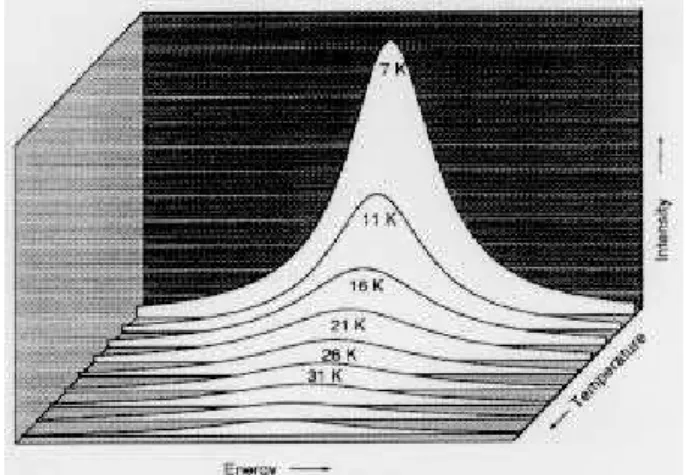
Figure4. Spetrallinesfordierenttemperatures(35K,40K
and45Kforthethreelowestlines).
We see the tendeny of the absorption line to
broaden(and ultimately itwill merge with theelasti
and the emission lines) as the temperature inreases.
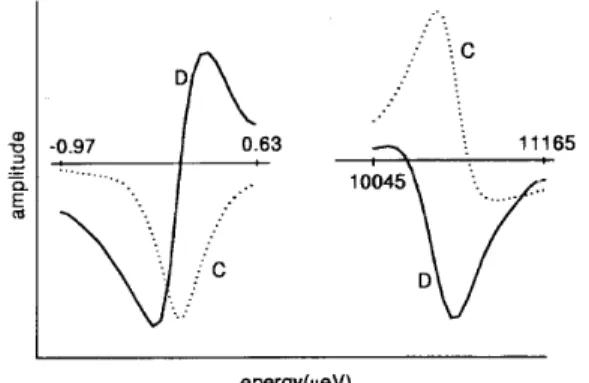
Fig. 5 shows the typial form of the real and of the
imaginary parts of the funtions C 1
A
(u) and D 1
A (u).
Eahofthesefuntionsrevealstwointervalswheretheir
valuesaresigniantlydierent fromzero, thetwo
funtion in thetwo intervalskeepsan inverse relation
withtheorrespondingenergysale,afatnotreeted
in thegure foronveniene. Of ourse, onlyafter an
exhaustive searh it was possible to unover the full
behaviorofthesefuntions.
Figure5.TypialaspetofthefuntionsC 1
A
(")andD 1
A (")
asdisussedinthetext.
Fig. 6toFig. 9ontainthemainresultsofour
al-ulation, orresponding to the ases(a), (b), (), and
(d)itedabove.Theyshowthegraphsofthelogarithm
ofthelineshift(dashedlines)andofthelinewidth
(solidlines)asafuntionof1=T. Theeetofthe
ver-texpartorretionisalsoshown,andisrepresentedin
eahgurebythe pieeof solidline that seemsto
ex-tendthestraightlineharaterofthelineshiftbehavior.
Toonstrut these graphs we haveused the following
proedure: for eah temperature we tted the points
along the urve (w) near half height at eah side of
the maximumand the pointsnear the maximum to a
polynomialfuntion. Foreahsetion ofthe urvewe
workedwith50outofatotalof600pointsusedto
gen-erate(w), produingttings withstandarddeviation
always less than 1.5%. By other hand, trying to t
all the600pointsto a singleLorentzian urve, we
al-waysfoundstandarddeviationbetween12%and 16%,
this beause the atual form of (w) is of a distorted
Lorentzian.
Figure7. Plotorrespondingtothease (b)(seetext).
Figure8. Plotorrespondingtothease ()(seetext).
Figure9. Plotorrespondingtothease (d)(seetext).
From Fig. 6 to Fig. 7 we inrease the weight of
the aoustialphonons, andfrom Fig. 8to Fig. 9we
inrease the weight of the optial phonons. Clearly,
thevertexparthangesverylittlethebehaviorof the
linewidth, at least in the range of temperatures
is presentalsoat highertemperatures,asfoundin the
referene[10℄,weseeherethattheorrespondingslopes
aremuhlargerthanthoseforlowtemperatures. Inthe
aseofthelineshift,thevertexpartorretionbeginsto
be eetive onlyat temperatures beyond whih
prob-ably the ontribution of higher librational levels than
those orrespondingtom=0andm=1onsideredhere
beomes important. Theorretion inreaseswith
in-reasingweightoftheoptialphonons,anditpartially
ompensates the tendeny of the lineshift to deviate
fromastraightlineinthelog 1=Tplotathigher
tem-peratures. Interestingintheplotsofthelineshiftisthe
systemati ourreneof twostraightlinesof dierent
slopesatdierenttemperatureintervals.Asweheked
alsoforothervaluesoftheparameters,thestraightline
at lowertemperatureshasasmallerslopethanthatat
highertemperatureswhentheweightof theaoustial
phonons is greater than that of the optial phonons,
andonverselywhentheweightoftheoptialphonons
is greater than that of the aoustial phonons. Suh
hangeofslopeinthelineshiftbehaviorismuhsmaller
and ours at lowertemperatures than the equivalent
one that, aordingthe results in the referene[10℄, is
possibletotakeplaein thelinewidthbehavior.
Our results are qualitatively similar to those
ob-tained in previousworks [9, 11℄. Taking into aount
thedierenesinthephononspetrum,theyalsoreveal
atemperaturedependeneoftheINSspetrallinesthat
is ratherinsensitiveto thedetails of thephonon
spe-trum. This is partiularly true in our results for the
lineshift behavior, and in remarkable agreement with
the morereentexperimental observation[2℄. Sine we
havenotworkedwithexpliitexpressionsfor nor;
it is diÆult to aess thephysial reason forsomeof
the resultsin thepresentalulationand in partiular
to disusstheinuene ofthephononspetrum.
Any-way,wethinkthatanyfurtheradvaneinthisproblem
willonlyhappenonquantitativeaspetsandonlywith
the use of more realisti phonon spetra. As a nal
remark,onesees thatthe vertexpartenters asweight
fators to the urves Y 0
A ("
0
E
w) and Y 0
E ("
0
A
+w) in
theexpressionof(w) . Thesefatorsrepresent
orre-tionstothevaluesU 0
A ("
0
E
w)=1andU 0
E ("
0
A
+w)=1,
andthefatthattheydonotontributesigniantlyto
the linewidthbehaviormeansthat thisontributionis
proportionaltowwithnearlythesameproportionality
onstantforbothurves. Infat,wesueededto
simu-lateoursgraphswithaweightingof[1+(T)w℄, with
(T) as an adjustable parameter that inreases with
temperature. Thissuggeststhattherstordertermof
anexpansionforthevertexpartwouldbesuÆient.
Aknowledgments
We are grateful to Dr. Wiebe Geertsma for his
omments and suggestions. We are also grateful to
CAPES/COPLAG-ESfornanialsupport.
Referenes
[1℄ A.Wurger,J.Phys.Cond.Matter1,1673 (1989).
[2℄ A.Buekenhoudt,L.VanGerven,Phys.Rev.B46,5377
(1992).
[3℄ P.S.Allen,J.Phys.C:SolidSt.Phys.7,L22(1974).
[4℄ S.Clough,J.Phys.C:SolidSt.Phys.18,L1(1985).
[5℄ J.M. F. Gunn, J.Phys.C: SolidSt. Phys. 18,L357
(1985).
[6℄ S.CloughandJ.R.Hill,J.Phys.C:SolidSt.Phys.9,
L645(1976).
[7℄ A.Huller,Z.Phys.B-Cond.Matter36,215(1980).
[8℄ A. C. Hewson, J. Phys. C: Solid St. Phys. 15, 3841
(1982).
[9℄ A. C. Hewson, J. Phys. C: Solid St. Phys. 15, 3855
(1982).
[10℄ M.W. G.Whittall, G.A.Gehring, J. Phys.C:Solid
St.Phys.20,1619 (1986).
[11℄ AWurger,Z.Phys.B-Cond.Matter76,65(1989).
[12℄ H.Keiter, G..Morandi,Phys.Rep.109,227(1984).
[13℄ J.Colmenero,R.Mukhopadhyay,A.Alegr
ia,B.Frik,
Phys.Rev.Lett.80,2350(1998).
[14℄ J.Peternelj,T.Kranj,M.M.Pintar,Phys.RevB54,
955(1996).
[15℄ G.Voll,PhysiaB202,239(1994).
[16℄ ChanghoChoiandMikM.Pintar,Phys.Rev.Lett.76,
527(1996).
[17℄ C.H.ChoiandM.M.Pintar,J.Chem.Phys.109,5542