FREE THEMES
1 Grupo de Investigación en Atención Farmacéutica, Facultad de Farmacia, Universidad de Granada. Calle Real de Cartuja 36. 18012 Granada España. [email protected] 2 Grupo de Investigação em Cuidados Farmacêuticos, Universidade Lusófona de Humanidades e Tecnologias. 3 Instituto Pharmcare.
Measurement of patients’ knowledge of their medication
in community pharmacies in Portugal
Abstract The scope of this article is to determine patients’ knowledge about the medication they take. For this purpose, a cross-sectional, obser-vational and descriptive study was conducted. Knowledge was measured by a valid and reliable questionnaire (CPM-PT-PT), given to the pa-tients attending community pharmacies partici-pating in the study, who had prescriptions for one or more drugs in the Lisbon Metropolitan Area. Knowledge was assessed in four dimensions: ther-apeutic objective, process of use, safety and main-tenance of the medications that the patient takes. Thirty-five pharmacies participated, and 633 val-id patients were obtained. Fully 82.5% (95% CI: 79.3% -85.3%) were uninformed about the na-ture of the drug they use. In all items, there was a high percentage of patients with incorrect knowl-edge, with emphasis on precautions (44.7%). The dimension that the patients were least aware of was “drug safety” (1.9%). Eight out of 10 patients in the population do not know what drug they use. The highest lack of correct information was with respect to the “safety” of the medication.
Key words Questionnaires, Patient, Medication,
Knowledge
Joaquín Salmerón Rubio 1
Pilar García-Delgado 1
Paula Iglésias-Ferreira 2
Henrique Mateus-Santos 3
R
ub
Introduction
Patients´ insufficient or wrong knowledge regard-ing the medication they use may vary and prob-ably lead to the incorrect use of the latter, thus causing a decrease in its efficacy, or the appear-ance of other health problems. The prevalence of negative results associated to medication (NRM) is so high that it is deemed an important pub-lic health problem1-4. A basic pillar to facilitate
obtaining excellent results in pharmacotherapy lies in adequate knowledge of patients regarding their own pharmacological treatment. Because of this, patients´ knowledge on their medication (PKM) is a key part to minimize the appear-ance of NRM. Although PKM is a term used frequently in health sciences, most of the stud-ies found measure PKM without having a clear definition of this variable. García-Delgado et al. define PKM as “The set of information acquired by the patient on his/her medication, needed for the correct use of the latter, and which includes the therapeutic goal (indication and efficacy), the process for use (posology, regimen, means of administration and treatment duration), safety (adverse effects, precautions, contraindications and interactions) and its conservation“5.
There is not much data published on patients knowledge of their medication, and, the few stud-ies found measure concrete aspects of knowl-edge and/or specific therapeutic groups, without counting upon a valid tool for this. Despite this, all of the results point to a lack of knowledge of patients when it comes to their pharmacological treatments6-20.
At present, the only validated questionnaire that has been found to measure PKM in a general way, that is, that could be applied to a patient un-dergoing treatment with any type of medication and with any type of pathology, is the one vali-dated by García-Delgado et al.5.
To evaluate which sanitary interventions are necessary in Portugal, it is necessary to deter-mine if there really does exist a lack of informa-tion regarding medicainforma-tion at large. If this holds true, discover concrete cases of this lack of in-formation, identify the degree of knowledge of Portuguese patients, and if it suffices, verify the correct process in the use of the medication. This would help justify the use of means and person-nel in sanitary education programs that are more adequate, to cover the true needs of patients in Portugal and facilitate an enhancement in this clinical practice.
Objective
Determine the knowledge of patients, users of the community pharmacies belonging to the Metro-politan Area of Lisbon, regarding their medica-tion, including the degree of global knowledge, by dimensions and items.
Methods
A descriptive crosscut (transversal) study carried out in volunteer community pharmacies started in December of 2009 and extended until January of 2010, in a convenience sampling for patients who resort to these community pharmacies on the Greater Lisbon Metropolitan Area. The pop-ulation were all users of medication or caregivers who resorted to community pharmacies to pick up one or more medications, with or without prescriptions. Patients with difficulties in com-munication and those referred from other ser-vices aware of the pharmacy and those who had already participated in the study were excluded.
To determine the degree of patients´ knowl-edge regarding their medication, the transcultur-al adaptation to European Portuguese was used
for questionnaire PKM-PT-PT21, which showed
its validity and reliability in a prior study on the psychometric properties of the adapted
question-naire22. Interviewers and evaluators were always
pharmacists trained for this specific purpose. The PKM of a medication was evaluated per patient. If the patient requested more than one medication, the pharmacist selected one of them randomly. The pharmacist who did the evalua-tion had also carried out the interview.
This was done by allocating a score to each of the patient´s responses, based on the degree of agreement between the information given by the patient and the reference information (medical prescription or, when not available, the Summa-ry of Characteristics of Medications (SMC from Infarmed-the National Authority on Medication and Health Products I.P):
.
Incorrect: Score-1 (The information thatpatient has does not match the reference infor-mation);
.
Does not know: Score 0 (The patientverbal-ly indicates lack of knowledge);
e C
ole
tiv
a,
20(1):219-228,
2015
.
Correct: Score 2 (The patient´s informationis in accordance to the reference information). For this purpose, each patient obtained a score between -1 to 2, for each question in the PKM questionnaire. To calculate final total knowledge about the medication (PKM), each receives a dif-ferent score based on the dimension it belongs to, applying the following formula obtained from the prioritization set forth by the expert panel in the design phase of the original questionnaire, and the dimensions extracted from statistics (AFCP)21,22:
* PiX = Score obtained by the patient
for each question from each dimension X. Where:
.
Process for use: Posology (question 2); Reg-imen (question 3); Treatment duration (question 4); Form of administration (question 5);.
Therapeutic goal: Indication (question 1);Efficacy (question 9);
.
Safety: Precautions (question 6); Adverseeffects (question 7); Contraindications (question 8); Interactions (question 10);
.
Conservation: Conservation (question 11).The maximum score is 2 and the minimum 0. The minimum criteria set forth for knowl-edge (2 points) are the first five questions. If the partial score of one of them is lower than 2, it is deemed that the patient did not have the necessary information to ensure the cor-rect process of use of the medication (PKM =0) Knowledge of the medication was classified in:
.
Does not know medication: 0 points..
Insufficient knowledge: From 0.60 to 1.26..
Sufficient knowledge: From 1.27 to 1.60..
Optimal knowledge: From 1.61 to 2.This variable is reclassified in:
.
Does not know the medication thatencom-passes the categories or does not know and insuf-ficient knowledge.
.
Knows the medication which encompassesthe categories of sufficient and optimal knowledge. Thirteen (13) independent variables were recompiled referring to the study phar-macy, the patient and the medication. There was a calculation of the sampling size needed to estimate the percentage of patients who had no knowledge regarding the medication of 50% (based on the results of the pilot study),
with a maximum admissible error of ± 4% and a confidence level of 95%. 598 patients were neces-sary for the Greater Lisbon Area23.
Screening of the sampling subjects was done through a systematic sampling at each pharmacy, collecting information from the 20 patients ser-viced throughout the day, in a day chosen ran-domly, based on a sampling spreadsheet. Thirty (30) pharmacies had to participate. To be able to encode and define the variables, to calculate the aggregated variables and for statistical analysis, the SPSS statistical package was used 17.0.
For allocation to therapeutic groups, accord-ing to the anatomic-therapeutic classification of specialties, ATC level 1, ATC level 2, ATC level 4, the information collected in the updated RCM was used, approved by Infarmed for Portugal. The variables for the pharmaceutical form were also recoded and the means of administration based on the ATC data, as well as the information collected at Infomed.
A uni-variant descriptive analysis was car-ried out, showing the frequency of appearance of the different variables in the study population, as well as the losses produced during field work. For the qualitative variables, absolute and rela-tive tables were obtained, and for the quantitarela-tive ones, core trend measurements (mean), disper-sion measures (standard deviation) and position measurements (quartiles). Population estimates for the prevalence of patients´ knowledge on the medication were calculated, including their cor-responding errors in sampling for the confidence intervals.
Results
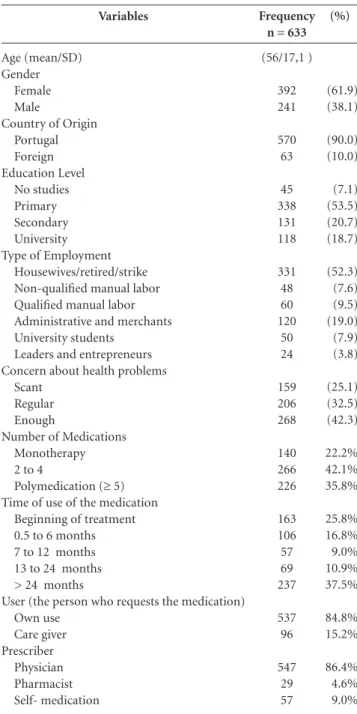
Thirty five (35) community pharmacies from the Greater Lisbon Area took part in the study, distributed as follows: Amadora (4), Cascais (2), Lisboa (12), Odivelas (4), Oeiras (2), Sin-tra (8), Vila Franca de Xira (3), which screened 633 patients, with a rate of response of 90.4%. From the 700 initial patients, 12 refused the in-vitation to participate in the study, and from the 688 chosen for evaluation, 36 did not ac-cept to continue and participate and 19 ques-tionnaires had no reading, 6 were not finished. The type of pharmacy most represented was that of “urban pharmacies” (24 of 35) that serviced a population of “middle” social economic brackets. In Table 1 there is a description of the study population, based on the patients´ own charac-[1.2 Σ PiA] + [1.1 Σ P
iB] + [0.85 Σ PiC]+ [0.6 Σ PiD]
R
ub
teristics, highlighting that 61.9% were women. 85% acquired the medication for their personal use. The average age was of 56 years (DE = 17.1). Only 10% were foreigners and more than half carried out paid labor (52.3%). Most of the pa-tients had basic education, albeit a significant per-centage (18.7%) had received higher education. When it comes to the description of the sample, based on the characteristics of the medication itself: 25% of patients stated that they were not
concerned about their health problem, while those with great concern regarding their health problem represented 42.3%. 22% of the partici-pants used a single medication, compared to 36% of patients that were poly-medicated. A high per-centage of patients (78%) knew the name of the medication they were taking. 86% of the drugs studied had been prescribed by a physician, 5% recommended by a pharmacist, and 9% referred to self-medication.
Twenty six percent (26%) of the medication requested was to initiate the treatment. The ther-apeutic group most used was “C: Cardiovascular apparatus” with 24.6%, followed by 21.5% of medication belonging to the “N: Nervous Sys-tem” and group “A: Digestive tract and metabo-lism with 12.9%.
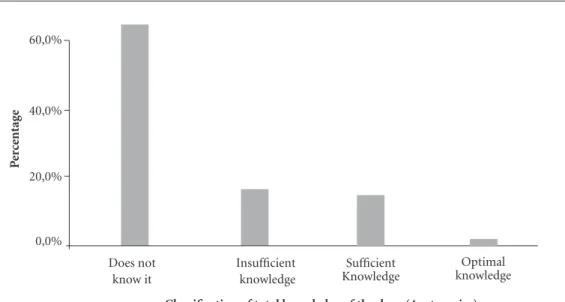
Graph 1 shows the patients´ global knowl-edge regarding their medication, highlighting that 82.5% (IC95%: 79.3%-85.3%) do not know the medication they use.
When it comes to the PKM distribution by dimensions, the one which presented a greater percentage of knowledge was “therapeutic goal” (70.9%), followed by “process of use” with 36.7%, being that the dimensions of “safety” and conser-vation” were the ones presenting the lower level of knowledge, with 1.9% and 5.8% respectively. Table 2 shows the distribution on the degree of knowledge in the study population, for each of the PKM items. It is worthwhile pointing out that the percentage of patients with incorrect in-formation for each of the knowledge items goes beyond 18%, except for the precautions with the medication, which is the indicator with the great-est incorrect information accumulated (44.7%). The percentage of patients that knew the medication was of 17.5%, corresponding to 15.1% of sufficient knowledge and a 2.4% of optimal knowledge. Of the 82.5% that does not know the medication (IC95%: 79,3%-85,3%), 16.6% had insufficient knowledge and 65.9% had none at all, or which is the same, 4 out of every 5 patients do not know the medication they use (Graph 1).
The dimension that presents the best knowl-edge was “therapeutic goal”, with 70.9% (p < 0,001), followed by “process of use” with 36.7% (p = 0,032), with the dimensions of “safety” and “conservation” as those with the lowest levels of knowledge, with 1.9% and 5.8% respectively. Knowledge of the medication reached percent-ages higher than 70% in the items of indication (89%), posology, regime, means of administra-tion and efficacy. Notwithstanding this,
knowl-Variables
Age (mean/SD) Gender
Female Male
Country of Origin Portugal Foreign Education Level No studies Primary Secondary University Type of Employment
Housewives/retired/strike Non-qualified manual labor Qualified manual labor Administrative and merchants University students
Leaders and entrepreneurs Concern about health problems
Scant Regular Enough
Number of Medications Monotherapy 2 to 4
Polymedication (≥ 5) Time of use of the medication
Beginning of treatment 0.5 to 6 months 7 to 12 months 13 to 24 months > 24 months
User (the person who requests the medication) Own use Care giver Prescriber Physician Pharmacist Self- medication Frequency n = 633
(56/17,1 ) 392 241 570 63 45 338 131 118 331 48 60 120 50 24 159 206 268 140 266 226 163 106 57 69 237 537 96 547 29 57 (%) (61.9) (38.1) (90.0) (10.0) (7.1) (53.5) (20.7) (18.7) (52.3) (7.6) (9.5) (19.0) (7.9) (3.8) (25.1) (32.5) (42.3) 22.2% 42.1% 35.8% 25.8% 16.8% 9.0% 10.9% 37.5% 84.8% 15.2% 86.4% 4.6% 9.0%
e C
ole
tiv
a,
20(1):219-228,
2015
edge of the contraindications reached a mere 3%, conservation 6% and adverse effects and contra-indications about 7%2.
The greatest percentages of knowledge we at-tained in the items that refer to the therapeutic goal and the process of use, and the lowest were those referring to safety and conservation (Graph 2). The percentage of patients with incorrect in-formation for each of the knowledge items is not greater than 18%, except for the precau-tions with the medication, which is the indicator with the greatest accrued information (44.7%).
The percentages of no knowledge stood out in the items that refer to medication safety, and were the lowest in those referring to the thera-peutic goal and process of use.
The form of conservation ended up being the item with the greatest percentage of insufficient knowledge.
Percentages greater than 70% were found for the items of indication, posology, regimen, form of administration and efficacy. However, the per-centage did not reach 10% in those referring to safety and conservation (Graph 2).
Graph 1. Distribution of the degree of global knowledge of the study population. 0,0%
40,0% 60,0%
P
er
ce
ntag
e
Classification of total knowledge of the drug (4 categories)
Does not know it
Sufficient Knowledge Insufficient
knowledge
Optimal knowledge 20,0%
Items
Indication Dosage Regimen
Treatment duration Form of administration Precautions
Adverse effects Contraindications Effectiveness Interactions Conservation
Incorrect Knowledge
39 (6.2%) 77 (12.2%) 82 (13.0%) 59 (9.3%) 67 (10.6%) 283 (44.7%) 77 (12.2%) 95 (15.0%) 38 (6.0%) 110 (17.4%) 87 (13.7%)
Table 2. Distribution of the degree of knowledge of the study population for each of the PKM items.
Does not know it
20 (3.2%) 30 (4.7%) 28 (4.4%) 178 (28.1%) 36 (5.7%) 219 (34.6%) 466 (73.6%) 460 (72.7%) 112 (17.7%) 407 (64.3%) 90 (14.2%)
Insufficient knowledge
12 (1.9%) 32 (5.1%) 42 (6.6%) 13 (2.1%) 62 (9.8%) 59 (9.3%) 44 (7.0%) 58 (9.2%) 26 (4.1%) 68 (10.7%) 419 (66.2%)
Knows it
R
ub
Discussion
There has not been much data published on PKM. The studies found, despite using differ-ent methods, reveal a lack of PKM similar to the results found in the present study; over half of the patients studied do not know the medication they use. Some locate the prevalence of
knowl-edge between 17% and 29.4%9,15,24, other studies
obtain higher results and locate prevalence of the necessary knowledge for correct use between
42.5 % and 57%10,11,16. Domecq and Belmar
Her-rera9 state that only 29.4% of patients have an
ac-ceptable degree of knowledge. Etges Fröhlich et al.10, set forth that 42.5 % have “regular”
knowl-edge and that 46.3 % “insufficient” and the rest
null. For Silva and Mangue16, 57% of outpatient
patients from a region in Brazil have “regular” knowledge of the medication they take. Perera
et al.24, refer to good knowledge of the
medica-tion prescribed in 17.5%, insufficient in 36% and poor in 46%. Menolli et al.11, state that only
46.6% of patients have the necessary informa-tion to correctly use their medicainforma-tion. Altimiras et al.15, in a study at the hospital San Pau in
Bar-celona conclude that there is very little knowl-edge regarding medication, only 17% know their medication. According to the only study found that uses a method of valid and reliable measures,
66% (IC95%: 63.3%-68.7%) of the patients do not know the medication they use5,25.
Several biases that could affect the internal va-lidity of the study were encountered. One of them could be the degree of voluntariness of pharma-cists to participate in the study, and this could limit how representative the sampling is. Howev-er, the unit of analysis were the patients, a reason why it is indispensable to study the influence that the location of the pharmacy may have on the patients´ knowledge. As results show, the phar-macies that participated did not have the correct profile to distinguish them from the rest of the pharmacies that did not take part in the study.
The researching team was aware that a nega-tive response could introduce a bias in screening, given that a group of the population with simi-lar characteristics could refuse to participate, all pointing towards a similar profile of knowledge. Nevertheless, a 91.7% rate of response was ob-tained, and only a small percentage refused to take part in the study, that is, 58 of 700, which did not make it possible to carry out the statisti-cal analysis of non-response.
On the other hand, the erroneous or incom-plete filling-in of the knowledge items condi-tioned this to having to exclude this information in the study, with the possibility of leading to a bias in classification. However, in this study,
Graph 2. Distribution of patients that know each of the different items of the medication. Indication
Posology
Regimen
Treatment duration
Form of administration
Precautions
Adverse effects
Contraindications
Effectiveness
Interactions
Conservation
e C
ole
tiv
a,
20(1):219-228,
2015
the frequency of erroneous filling was (1.28%), which could make it possible to state that the results obtained are not biased due to this lim-itation. We contemplated the possibility that the choice of the study medication could also repre-sent a screening bias, overestimating the results obtained. To minimize that possibility, when the patient had several medications, the medication used for the measurement ended up being cho-sen randomly.
There was the possibility that, as there were 35 different interviewers, the interviewers bias would also appear. This was minimized with spe-cific training for the latter. On the other hand, evaluation could introduce a bias in classification, which we attempted to dilute with the specific training of the 4 evaluating pharmacists, who in-dependently evaluated all of the questionnaires.
he investigator team once again evaluated the pharmacists, specially emphasizing the discrep-ancies in classification among the 4 evaluators. Analyzing the results obtained, and after the eval-uation of the biases in screening, classification and confusion, it can be stated that the sample selected adequately presents the total of the study population: users of community pharmacies lo-cated in the Greater Lisbon Area.
Due to the fact that in the present study the PKM was measured with the transcultural
adap-tation into Portuguese (European)21, and
subse-quent validation22 of the only generic and
vali-dated questionnaire that has been found, what will preferably be compared is the prevalence re-sults in both studies (original questionnaire mea-sured in the provinces in Spain and adaptation and re-validation applied in Portugal).
The prevalence of lack of knowledge (cate-gory “does not know”) is identical in Spain and Portugal, with a value of 65.9% in Portugal, com-pared to 66% in Spain. In Spain, the category “in-sufficient knowledge” was not represented, while it was in Portugal, with 16.6%. Because of this, when reclassifying this variable, the percentage of lack of knowledge in Portugal increases.
It is very important to highlight that in both studies, the safety dimension is the least known (4.4%) in Spain and (1.9 %) in Portugal. This implies that patients ignore what it is the med-ication could cause and how to prevent safety problems. This lack of knowledge could give place to a greater risk of non-compliance, and even to untreated health problems, with the consequent health expenses associated to this. Few studies have differentiated the knowledge regarding concrete aspects of the medication,
de-spite this; they coincide with the results of this study6-11,13-16,24.
Based on the results of the correct informa-tion for each item, we can deduce that patients know some of the minimum criteria of PKM, but not all. Because of this, despite the fact the per-centage of knowledge of items 1 to 5 ranges from 60.5 % to 88.8% do not know everything they need to know to adequately use the medication (have a partial score of 2 points in all of these). The dimension with the greatest knowledge is “Therapeutic goal” 70.9 %, a reason why many of the Portuguese know “what the medication is for” and “what they should expect” from it. Neverthe-less, the knowledge of the “Process of use” is much lower, at 36.7 % in Portugal. This leads us to think that the majority of patients know about different points in the medication, but do not know every-thing that is necessary to use it correctly. This is extremely relevant, as there was a high percentage of patients who consume medication and have no information whatsoever to warrant a rational use of the latter. With the use of the PKM-PT-PT questionnaire in pharmaceutical practice, it will be possible to identify these patients, and apply strategies to minimize the problem.
The fact that only 5.8% of the Portuguese patients have no knowledge about the ade-quate conservation of their medication re-veals that there could exists the risk that pa-tients are consuming poorly preserved medi-cation, with the potential problem of hazards in the public health system entailed by this. Not all of the studies found measure the patients’ knowledge regarding all of the items of the PKM. In Table 3, there is a comparison, by indicator, of the results of this study and the data available in the literature consulted.
The percentages of knowledge obtained in this study are similar to that of others, albeit in the ma-jority of aspects, our results fall within the higher ranges. This could be explained because of the dif-ferences in the characteristics of the population studied, and/or the PKM measurement methods. Practically all of the studies measure knowledge regarding the name of the medication, conclud-ing that over 60% of patients have knowledge of
that5,12,14,16,24,26.
The result of the patient’s knowledge on the administration regimen for the medication ob-tained in this study is located in the percentage interval given by other authors, between 70% and 90%5,10,16,24,26. It seems logical that the
R
ub
the most known, given that it implies a direct ac-tion; taking the medication at a given time.
Knowledge of the indication, posology and the duration of treatment have also been studied by other authors, with the conclusion that there is a range of correct information for these indi-cators of about 60% to 80%5,10,16,24,26, excluding
some results that are higher in indication26 or
lower in indication24, in posology6,12, in treatment
duration14,27. The results of this study for
posol-ogy and treatment duration fall within the inter-val. Despite this, the percentage of knowledge of indication is the highest, close to 90%. This dif-ference may be due to the lower mean age in our study population, a group that grants a great deal of importance to knowing why they have to take the medication.
Items with the lowest degree of knowledge observed in the study population were those re-ferring to contraindications, adverse effects, in-teractions and precautions, data that is support-ed by several publishsupport-ed results5,6,16,26,27.
Definitely, the dimension “Process of use” is known by only 36.7 % in the Portuguese pop-ulation, which points to the fact that there is a percentage of patients who lack the necessary information to ensure they are using the medi-cation correctly. This means that over 60% of the population is at risk of suffering a NRM due to lack of the necessary information to adequately use medication. On the other hand, the extreme-ly high percentage of lack of knowledge of the “safety” dimension (98.1%) points to the need of setting forth strategies to inform patients, as part of the lines of activity in health policies aimed at increasing the safe use of medication among the Portuguese population.
Based on all of the results obtained, it is worthwhile pointing out that patients know more the name of the medication, than the med-ication per se, and that what is definitely lacking are those aspects that relate to safety and the nec-essary information to carry out the correct use of the medication.
Table 3. Percentage of knowledge of each aspect of the medication, according to different studies.
Studies
CPM Portugal
CPM García-Delgado et al.5
Cline CM et al.14
Perera et al.24
Jaye et al.12
Oenning et al.26
Silva Portela et al.27
Silva y Mengue16
Fröhlich et al.10
Delgado Silvera6
Name of the medication
(%)
84 75.4 55 65.5 85 92.7
69 56.9
Indication (%)
88.8 73
47
97.6
69 56.9
Posology (%)
78 87
72 50
81
24
Regimen (%)
76 79.3
78 36 92
69 80.6
Treatment duration
(%)
60.5 64.7 48
82 29.9
75.6
Form of administration
(%)
73.9 63.5
Estudios
CPM Portugal
CPM García-Delgado et al.5
Cline CM et al.14
Perera et al.24
Jaye et al.12
Oenning et al.26
Silva Portela et al.27
Silva y Mengue16
Fröhlich et al.10
Delgado Silvera6
Precautions (%)
11.4 9.2
4.9
19
Adverse effects
(%)
7.3 4.2
3 16 16.2
Contraindications (%)
3.2 4.2
Efectiveness (%)
72.2 55.1
Interactions (%)
7.6 5.5
e C
ole
tiv
a,
20(1):219-228,
2015
Conclusions
The results obtained show a very high lack of knowledge among patients regarding the med-ication they use, despite the numerous sanitary strategies adopted. The use of this questionnaire to measure PKM-PT-PT, valid and reliable, could be incorporated by pharmacies in their daily practice, and as part of the services they offer, to help patients understand the correct process of use of their own medication, thus, thus ensuring positive clinical results will be attained.
Collaborations
R
ub
Eric Edward BS, Amy Pasanen AA. Evaluation of Knowledge and Medication Use in Patients in Rural Clinics. [cited 2008 Sept 20]. Available from: http:// ahec.health.ufl.edu/chs/2003/Edwards.pdf.
Huang YM, Wang HP, Yang YH, Lin SJ, Lin HW, Chen CS, Wu FL. Effects of a national health education pro-gram on the medication knowledge of the public in Taiwan. Ann Pharmacother 2006; 40(1):102-108. Hughes L, Wittlesea C, Luscombe D. Patients’ knowle-dge and perceptions of the side-effects of OTC medica-tion. J Clin Pharm Ther 2002; 27(4):243-248. Boonstra E, Lindbaek M, Ngome E, Tshukudu K, Fu-gelli P. Labelling and patient knowledge of dispensed drugs as quality indicators in primary care in Botswa-na. Qual Saf Health Care 2003; 12(3):168-175. Salmerón-Rubio J, Iglésias-Ferreira P, Delgado PG, Mateus-Santos H, Martínez-Martínez F. Adaptação intercultural para português europeu do questionário “Conocimiento del Paciente sobre sus Medicamentos” (CPM-ES-ES). Cien Saude Colet 2013; 18(12):3633-3644.
Salmerón-Rubio J, Iglésias-Ferreira P, Delgado PG, Mateus-Santos H, Martínez-Martínez F. Validación del cuestionario de medida del conocimiento del pacien-te sobre su medicamento adaptado al portugués. Cien Saude Colet 2011; 19(4):1141-1150.
Portugal. Instituto Nacional de Estatística. Retrato Te-rritorial de Portugal 2009. Lisboa: Instituto Nacional de Estatística; 2011.
Perera T, Ranasinghe P, Perera U, Perera S, Adikari M, Jayasinghe S, Constantine GR. Knowledge of pres-cribed medication information among patients with limited English proficiency in Sri Lanka. BMC Reseach Notes 2012; 5:658.
Delgado PG. Conocimiento del paciente sobre sus me-dicamentos [tese]. Granada: Universidade de Granada; 2008.
Oenning D, de Oliveira BV, Blatt CR. Conhecimento dos pacientes sobre os medicamentos prescritos após consulta médica e dispensação. Cien Saude Colet 2011; 16(7):3277-3283.
Silva Portela A, Silva Simões MO, Fook SML, Neto ANM, Silva PCD, Oliveira BH. Prescrição médica: orientações adequadas para o uso de medicamentos? Cien Saude Colet 2010; 15(Supl. 3):3523-3528.
Article submitted 22/10/2013 Approved 25/11/2013
Final version submitted 28/11/2013 17.
18.
19.
20.
21.
22.
23.
24.
25.
26.
27. References
Johnson JA, Bootman JL. Drug-related morbidity and mortality. A cost-of-illness Model. Arch Intern Med 1995; 155(18):1949-1956.
Ernst FR, Grizzle AJ. Drug-related morbidity and mor-tality: updating the cost-of-illness model. J Am Pharm Assoc 2001; 41(2):192-199.
Climente M, Quintana I, Martinez G, Atienza A, Jimé-nez NV. Prevalencia y características de la morbilidad relacionada con los medicamentos como causa de in-greso hospitalario. Aten Farm 2001; 3(1):9-22. MI, Faus MJ, Fajardo PC, Luque FM, Sierra F, nez-Olmos J, Cabrera A, Fernandez-Llimos F, Marti-nez-Martinez F, Jiménez J, Zarzuelo A. Medicine-rela-ted problems resulting in emergency department visits. Eur J Clin Pharmacol 2006; 62(5):387-393.
García-Delgado P, Gastelurrutia MA, Baena MI, Fisac F, Martínez-Martínez F. Validación de un cuestionario para medir el conocimiento de los pacientes sobre sus medicamentos. Aten Primaria 2009; 41(12):661-669. Delgado Silvera E. Información de medicamentos al paciente anciano [tesis]: Universidad Complutense de Madrid; 1999.
O’Neil CK, Poirer TI. Impact of patient knowledge, patient-pharmacist relationship, and drug perceptions on adverse drug therapy outcomes. Pharmacotherapy 1998; 18(2):333-340.
Akici A, Kalaça S, Uğurlu MU, Toklu HZ, Iskender E, Oktay S. Patient knowledge about drugs prescribed at primary healthcare facilities. Pharmacoepidemiol Drug Saf 2004; 13(12):871-876.
Domecq Jeldres C, Belmar Herrera A. Atención prima-ria de salud: perfil de uso de los medicamentos en adul-tos mayores. Acta Farmacéutica Bonaerense 1999; 14(2). Fröhlich SE, Silva T, Dal-Pizzol F, Sotero Serrante M. Instrumento para avaliação do nível de conhecimiento da prescrição na atenção primária. Rev Saude Publica 2010; 44(6):1046-1054.
Menolli PVS, Ivama AM, Cordoni Junior L. Caracteri-zación de los servicios farmacéuticos de atención pri-maria del Sistema Único de Salud en Londrina, Paraná, Brasil Rev Panam Salud Publica 2009; 25(3):254-259. Jaye C, Hope J, Martin JR. What do general practice pa-tients know about their prescription medications? N Z Med J 2002; 115(1162):U183.
Cyr JG, McLean W. Patient knowledge of prescription medication: present lack-future necessity. Can Pharm J 1978; 17:361-367.
Cline CMJ, Björck-Linné AK, Israelsson BY, Willen-heimer RB, Erhardt LR. Erhardt. Non-compliance and knowledge of prescribed medication in elderly patients with heart failure. Eur J Heart Fail 1999; 1(2):145-149. Altimiras J, Bassons I, Gelonch A, Selva C. Evaluación del conocimiento de los pacientes crónicos sobre su tratamiento. Farm Clin 1987; 4(2):150-158.
Silva TSE, Mengue SS. Nivel de informação respeito de medicamentos prescritos a pacientes ambulato-riais de hospital universitário. Cad Saude Publica 2000; 16(2):449-455.
1.
2.
3.
4.
5.
6.
7.
8.
9.
10.
11.
12.
13.
14.
15.