The relationship between memory
complaints and age in normal aging
Thaís Bento Lima-Silva
1, Mônica Sanches Yassuda
2Abstract: Normal aging can be characterized by a gradual decline in some cognitive functions, such as memory. Memory complaints are common among older adults, and may indicate depression, anxiety, or cognitive decline.
Objectives: To investigate the association between memory complaints and age in cognitively unimpaired older
adults, and the relationship between memory complaints and memory performance. Methods: Cognitive
screening tests as well as memory complaint questionnaires validated for the Brazilian population were used: the Mini-Mental State Examination (MMSE), Geriatric Depression Scale (GDS), Memory Complaint Questionnaire (MAC-Q), Memory test of 18 pictures, Forward and Backward Digit Span (WAIS-III). Fifty seven regular members of the SESC social club participated (50 women), having a mean age of 71.4 years, and 4 to 8 years of education - 34 from 4 to 7 years and 23 with 8 years of education. Results: Results revealed no significant association between cognitive complaints and age or cognitive performance. Older participants in this sample did not show worse performance or a higher level of complaints. There was no significant association between age and GDS scores. Conclusions: The studied sample constitutes a particular group of older adults whose participation in activities may be protecting them from cognitive decline, thus highlighting the impact of lifestyle on cognitive performance during the aging process.
Key words: memory complaints, memory, age, elderly, cognition.
A relação entre a queixa de memória e a idade no envelhecimento normal
Resumo – O envelhecimento normal caracteriza-se por um declínio gradual em algumas funções cognitivas, como a memória. As queixas de memória são comuns entre os idosos, podendo sinalizar depressão, ansiedade, ou declínio cognitivo. Objetivos: Verificar a relação entre a queixa de memória e a idade no envelhecimento normal e a relação da queixa com o desempenho cognitivo. Métodos: Foram aplicados testes de rastreio cognitivo e escalas de queixas validados para a população idosa brasileira: Mini-Exame do Estado Mental (MEEM), Escala de Depressão Geriátrica (GDS), Questionário de Queixas de Memória (MAC-Q), Escala de freqüência de esquecimentos, Teste de memorização de 18 figuras, Dígitos ordem direta e inversa (WAIS-III). Participaram 57 freqüentadores do SESC (50 mulheres), com idade média de 71,4 anos, e escolaridade entre 4 e 8 anos, 34 com Ensino Fundamental incompleto (entre 4 e 7 anos), e 23 com Ensino Fundamental completo. Resultados: Não houve associação significativa entre queixa de memória, idade e desempenho cognitivo. Os participantes mais velhos não apresentaram pior desempenho ou maior número de queixas de memória. Não houve associação entre idade e GDS. Conclusões: A amostra estudada pode constituir um grupo particular de idosos, entre os quais as atividades desenvolvidas poderiam atuar como fator de proteção da cognição, destacando a possiblidade do estilo de vida influenciar o desempenho cognitivo durante o processo de envelhecimento.
Palavras-chave: queixas de memória, memória, idade, idosos, cognição.
1Undergraduate student in Gerontology at EACH-USP, São Paulo, SP, Brazil. 2PhD, Assistant professor of Gerontology at EACH-USP, São Paulo, SP, Brazil.
Mônica Sanches Yassuda – Escola de Artes, Ciências e Humanidades Gerontologia - Av. Arlindo Bettio, 1000 - 03828-000 São Paulo SP - Brazil. E-mail: [email protected]
Disclosure: The authors report no conflicts of interest.
Received April 23, 2009. Accepted in final form May 20, 2009.
Memory complaints are known to be part of the meta-memory construct.1 This construct refers to knowledge and beliefs held about memory. It encompasses the knowledge we have on the mnemonic demands imposed by different tasks
and situations, as well as the knowledge about the strategies which may be employed to enhance memory efficiency.2
prevalent with increasing age.3 Many studies have inves-tigated the significance of memory complaints in older adults and principally, have sought to identify the exis-tence of an association between subjective perception of memory loss and objective impairment verified by objec-tive testing.4,5 The association between objective memory (performance on memory tasks) and subjective memory (complaints, perceptions, affects, beliefs about memory) has been the subject of study for at least 30 years. Moreover, the extent to which memory complaints are predictive of age-associated cognitive decline and dementia onset has been investigated in the clinical context.
A broad range of studies on the association between subjective and objective memory are available in the inter-national literature. These findings, however, remain contro-versial. The majority of cross-sectional studies have found no strong association between memory complaints and performance.6 Nevertheless, several cross-sectional stud-ies showing a positive association between complaints and cognitive decline are worthy of note.
Jonker and colleagues7 conducted a study involving 2367 patients without dementia or depressive symptoms and found a strong association between memory com-plaints and poor performance on the animal category ver-bal fluency test, even after adjusting for age, gender and verbal intelligence.
A significant correlation between memory complaints and the presence of depressive symptoms has also been reported in cross sectional studies – a relationship which appears to be stronger than the association between com-plaints and cognitive performance.4,8-10 Studies such as that the one conducted by Hanninen and colleagues,11 have re-ported that individuals with cognitive complaints have a greater propensity to present somatic complaints, as well as a greater feeling of incompetence and incapacity than non-complainers. These findings reveal that complaints are linked to other variables. For example, Van Oijen and colleagues12 showed that the association between memory complaints and risk of developing Alzheimer’s disease var-ied according to educational strata, there being a stronger link among more highly educated individuals. Thus, mem-ory complaints among highly schooled individuals could represent a significant indicator of dementia onset.
Longitudinal studies frequently suggest that complaints are predictive of cognitive decline. As reported by Scho-field and colleagues,13 complaints may be more informative if reported by individuals who do not present the profile of a complainer. These authors studied patients who had previously denied having a problem and who subsequently reported complaints. After a one year period, 26% of ini-tial non-complainers had gone on to report memory
com-plaints. These recent complainers had a five-fold higher risk of developing mild cognitive impairment than those who remained with no complaints.
Dik and colleagues14 conducted a six-year follow-up study in a cohort of patients, and the presence of com-plaints was associated with cognitive decline in two out of the four cognitive tests used. Patients with complaints performed worse than non-complainers on both the let-ter substitution test and the immediate recall test of the Rey Auditory Verbal Learning Test (RAVLT). However, performance on the delayed recall of the RAVLT and on the Mini-Mental State Exam (MMSE) was similar for both complainers and non-complainers.
The sample followed by Palmer and colleagues15 includ-ed a proportion of individuals with cognitive decline but without dementia, characterized by scores on the MMSE greater than or equal to 20. These authors found a positive correlation between complaints and progression to demen-tia after three and a half years. It should be emphasized that their statistical analysis was not adjusted to compensate for possible differences in dementia prediction due to cogni-tive status at study baseline.
In Brazil, the study by Mattos and colleagues16 compared the use of a self-report structured questionnaire versus di-rect questioning about memory problems in a sample of healthy community-dwelling elderly persons (63 women) without risk factors for cognitive deficits. Participants were asked about subjective memory complaints (SMC), submit-ted to the Memory Complaints Questionnaire (MAC-Q) and the Rey Auditory Verbal Learning Test (RAVLT). It was noted that although the presence of complaints was correlated with higher scores on the MAC-Q, a significant percentage of the sample obtained low scores on this in-strument despite having presented with complaints. More-over, some individuals without memory complaints scored highly on the MAC-Q. Performance on the RAVLT was sig-nificantly worse in the group reporting complaints during direct questioning (p<0.05), but not in the group with high scores on the MAC-Q. Therefore, direct questioning about complaints may be clinically more valuable than a self-re-port questionnaire, at least among community-dwelling el-derly without risk factors for cognitive deficit or depression.
tasks were considered complainers. Significant differences between complainers and non-complainers were found only for the verbal fluency test and the Geriatric Depres-sion Scale (GDS). According to Minett and colleagues,6 the frequency of memory complaints found among older adults can vary substantially depending on the study sam-ple profile, being higher in community-based studies which typically include a higher proportion of older elderly than studies involving volunteers.
Amid this context of controversial findings, the aim of the present study was to investigate the relationship be-tween the age and the presence of memory complaints. It is known that some cognitive functions become sig-nificantly compromised with aging. Therefore, we tested the hypotheses that older elderly present more frequent memory complaints, and that a greater number complaints are associated to worst cognitive performance on objective memory tests.
Methods
A total of 67 elderly individuals were recruited, aged fifty six years and older, given that memory complaints tend to emerge more frequently after fifty. Participants had between 4 to 8 years of schooling and were active members of SESC. The range of schooling years was restricted in order to reduce any effect of age on complaints and cogni-tive results. Participants were divided into two age groups, Group 1 aged between 56 and 74 years, and Group 2 aged between 75 and 92 years.
All subjects underwent an initial assessment composed of a socio-demographic questionnaire, and screening tests to detect possible presence of depression and/or dementia. Elderly who presented signs of the pathologies outlined above were not interviewed according to the exclusion cri-teria of the study, which were being younger than 55 years of age, presenting signs of depression or cognitive decline, and presenting auditory or visual decline that prevented conducting the interview.
The recruited participants all signed a free and in-formed consent term. Participants were subsequently sub-mitted to a pre-assessment using the Geriatric Depression Scale. A cut-off point of 5, initially proposed by Almeida and Almeida,18 was adopted in the present study, whereby older adults scoring 6 or more on the GDS were not in-cluded in the study.
Dementia screening entailed application of the Mini-Mental State Exam proposed by Brucki and colleagues,19 where reported medians were adopted as the cut-off points, namely, a score of 25 for older adults with up to 4 years of schooling, and 26.5 for older adults with 5 to 8 years of schooling.
The Memory Complaints Questionnaire – MAC-Q16,20 was used to assess memory complaints. The MAC comprises six questions assessing memory complaints in five everyday situations, for example, recalling telephone numbers or codes which are used daily or weekly, recall of items from a shopping list, and one question address-ing global mnemonic performance. Subjects were asked to compare current mnemonic performance with that at 18 years of age. Responses ranged from “much worse now” to “much better now”, with five different possible answers. Scores greater than or equal to 25 points were considered indicative of subjective memory impairment,16,21 with a maximum score of 30 points.
An adapted version of the scale by McNair and Kahn23 of frequency of forgetfulness was also used. Based on this scale, participants indicated how often they forgot pass-words, peoples’ names, among other commonly forgotten items, selecting Never (0), Sometimes (1), Frequently (2), or Always (3). Scores range from 0 to 45 points on this scale, with higher scores denoting greater frequency of memory complaints or forgotten items. To date, no studies have established a cut-off point, for frequency of forgotten items, which would be indicative of clinically significant memory deficits.
The scale proposed by Carvalho,24 containing 18 com-mon black and white pictures categorized into three differ-ent semantic groups, was used to assess episodic memory. Participants were given one minute to examine the pic-tures. Subsequently, participants carried out a five-minute distractor task in the form of the Forward and Backward Digit Span test from the WAIS-III battery.25 This requires the interviewee to repeat several sequences of digits in for-ward and backfor-ward direction. The total score is the sum of the correctly repeated sequences of 16 and 14 points, re-spectively. Upon task completion, the interviewee returned to the picture task and recalled the name of as many pic-tures studied as possible.
Statistical analysis
Frequency tables of categorical variables (gender, schooling, personal income and current occupation) were built to provide a profile of the sample. Descriptive statis-tics (mean, standard deviation, minimum and maximum values) of the continuous variables were calculated, includ-ing scores on the cognitive scales and complaints.
was tested using the Kolmogorov-Smirnov’s test. Only the GDS variable did not present a normal distribution. In this case, the difference between the two age groups was as-sessed by Mann-Whitney’s non-parametric test. Pearson’s correlation coefficient was used to analyze the relationship among numeric variables. The level of significance adopted for the statistical tests was 5% (p<0.05). Version 6 of the SPSS statistical package was used for all statistical analyses.
Results
A total of 67 individuals were interviewed, seven of whom were excluded for having completed higher level education. Other three individuals were excluded because they presented with depressive symptoms. This gave a final sample of 57 participants, 50 of whom were women.
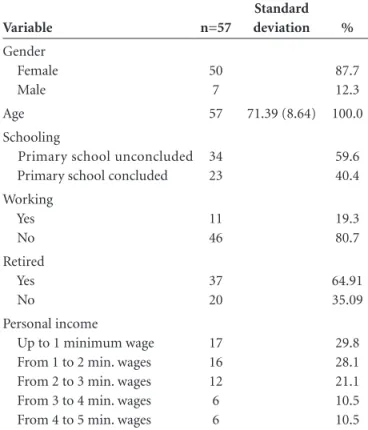
Table 1 presents the socio-demographic data of the to-tal sample. The sample was stratified into two age groups: Group 1, younger elderly, containing individuals aged between 56 and 74 years (n=35) and group 2, containing older elderly aged between 75 and 92 years (n=22). Com-parisons between groups for categorical and continuous variables were performed. No significant difference was found between the groups for categorical variables (school-ing and income). As expected, only a statistical difference for age was detected. The two age groups proved similar in terms of the socio-demographic profile.
No statistical difference was found between Group 1 and Group 2 for performance on episodic and working memory tests or for overall cognitive performance. Similar-ly, no differences were seen between groups on the MAC-Q or the forgetfulness frequency scale as shown in Table 2.
As depicted in Table 3, age was found not to be associ-ated with the complaint or cognitive performance variables for the overall sample. However, significant correlations between cognitive variables and the two subjective memory measures (MAC-Q and the Forgetfulness Frequency Scale) were found, which was to be expected since these measures involve the same domain.
Discussion
The aim of the present study was to recruit communi-ty-dwelling healthy elders who were participants at SESC, to ascertain any relationship between memory complaints and age, and between memory complaints and perfor-mance on cognitive tests in two different age groups. The results showed age not to be associated with any of the study variables. Cognitive performance in the two age group categories was statistically similar. Also, no signifi-cant difference was found between age groups in terms of memory complaints.
Although the literature reports decline in some
memo-ry modalities during the process of normal aging, including episodic and working memory, the present study found no significant correlation between age and cognitive variables, nor significant differences between the two age groups. The data suggest that the older adults recruited presented sta-bility in the memory subsystems assessed. In other words, no age-related deficits, a typical finding in cross-sectional studies,26 was detected in our sample.
The findings of the present study are consistent with other such studies involving community-dwelling elders, in which memory complaints were shown to be unassoci-ated with age.9,27-29
Table 1. Socio-demographic profile of overall sample.
Variable n=57
Standard
deviation %
Gender Female Male
50 7
87.7 12.3
Age 57 71.39 (8.64) 100.0
Schooling
Primary school unconcluded Primary school concluded
34 23
59.6 40.4
Working Yes No
11 46
19.3 80.7
Retired Yes No
37 20
64.91 35.09
Personal income
Up to 1 minimum wage From 1 to 2 min. wages From 2 to 3 min. wages From 3 to 4 min. wages From 4 to 5 min. wages
17 16 12 6 6
29.8 28.1 21.1 10.5 10.5
Table 2. Results of comparisons between groups.
Variable
56 to 74 years Mean and SD
75 to 92 years
Mean and SD p-value
GDS 2.26 (1.31) 1.86 (1.49) 0.300a
MMSE 26.06 (2.87) 26.82 (2.59) 0.317b
FFS 11.94 (6.02) 11.32 (5.30) 0.692b
MAC-Q 23.46 (5.44) 22.91 (4.30) 0.691b
FIGURES 10.37 (2.64) 9.59 (3.08) 0.312b
DIGITS 14.44 (3.88) 14.91 (3.48) 0.648b
GDS: Geriatric Depression Scale; MMSE: Mini-Mental State Exam; FFS: Forget-fulness Frequency Scale; MAC-Q: Memory Complaint Questionnaire; FIGURES: Test with 18 figures; DIGITS: Sum of scores on forward and backward digit span.
According to Germano-Neto,2 the notion that older elderly present greater memory complaints than younger elderly can be called into question, particularly when per-formance is preserved. The results reported contrast with those of the studies by Blazer and colleagues30 as well as Jonker and colleagues,7 who found a positive association between age and memory complaints.
Comparison of scores on complaint instruments (For-getfulness frequency scales and MAC-Q) with the other variables revealed no significant correlations, with the exception of the correlation between the two scales as-sessing memory complaints, which revealed that subjects who reported a high frequency of forgetfulness also re-ported greater perceived memory impairment. Mattos and colleagues,16 in their study on a clinical population, also found a strong association between complaints reported to the interviewer and score on the MAC-Q.
The absence of an association in the present study be-tween complaints and age or performance on cognitive tests may be explained by lifestyle, in that all participants had frequented SESC for many years. The older elderly were shown not to present worse cognitive performance, or to report greater memory complaints, thus constituting per-haps a particular sample. Participants in this study engaged in a range of physical, social, occupational and intellectual activities at the center such as yoga, swimming, handicrafts, drama workshops, intergenerational projects and
discus-sion groups. This engagement may have contributed to the preservation of cognitive function in this group, de-scribed by several studies in healthy community elderly.31-33 Physical activity is considered a key factor in promoting health in general and has been identified as a strategy to prevent cognitive decline, and delay the onset of demen-tias.32 Other studies have also demonstrated the relation-ship between physical exercise and cognitive performance in the elderly.34-36 Wang and colleagues,28 in a community-based study, reported that intellectual, physical, social and leisure activities were positive factors toward maintaining good mental function among participants.
The data presented in the present study are consistent with the hypothesis that frequenting an organization such as SESC, which provides an opportunity to take part in a host of activities and engage socially, constitutes a protec-tive factor against cogniprotec-tive decline.
Final considerations
It is important to note that this study is not subject to the characteristic bias of clinical and outpatient popula-tions. Nevertheless, the sample studied is selective in as far as it only includes active elderly members of SESC. This group comprises elderly who are not ailing or presenting with severe handicaps, thus forming a group of “super” old which may not be representative of the Brazilian el-derly population as a whole. Nevertheless, the data from Table 3. Correlations between scores for cognitive variables and age.
GDS MMSE FFS MAC–Q Figures Digits
Age Pearson p value n –0.07 0.62 57 0.08 0.53 57 0.07 0.60 57 0.32 0.81 57 0.10 0.96 57 0.12 0.38 56 GDS Pearson p value n –0.24 0.08 57 0.50 0.75 57 0.77 0.58 57 –0.04 0.75 57 –0.19 0.16 56 MMSE Pearson p value n –0.99 0.47 57 –0.08 0.96 57 0.35 0.10 57 0.30 0.25 56 FFS Pearson p value n 0.43 0.01 57 –0.12 0.37 57 –0.07 0.97 56 MAC-Q Pearson p value n –0.122 0.38 57 –0.10 0.97 56 Figures Pearson p value n 0.27 0.05 56
this sample appears to suggest that engagement in physi-cal, intellectual and social activities are conducive to good cognitive performance.
Future studies should further investigate the theme of memory complaints by verifying correlation with other variables such as schooling, gender, marital status, income and lifestyle, and elucidating the relationship between re-ported complaints and cognitive performance in the elderly population.
References
1. Sé EVG, Queroz NM, Yassuda MS. “O envelhecimento do cére-bro e a memória”. In: Neri AL., Yassuda MS e Cachioni M (Eds). Velhice bem-sucedida. Campinas, SP: Papirus;2004:141-162. 2. Germano-Neto J. Queixas de memória e desempenho
mne-mônico e cognitivo entre idosos. Tese. Faculdade de Medicina de Ribeirão Preto, Universidade de São Paulo, SP, 2003. 3. Comissaris CJ, Ponds, RW, Jolles, J. Subjective forgetfulness in
a normal Dutch population: possibilities for health education and other interventions. Patient Educ Couns 1998;34:25-32. 4. Bolla KI, Lindgren KN, Bonaccorsy C, Bleecker ML. Mem-ory complaints in older adults. Fact or fiction? Arch Neurol 1991;48:61-64.
5. Riedel-Heller SG, Matschinger H, Schork A, Angermeyer MC. Do memory complaints indicate the presence of cognitive impairment? Results of a field study. Eur Arch Psychiatry Clin Neurosci 1999;249:97-204.
6. Minett TSC, Da Silva RV, Ortiz KZ, Bertolucci PHF. Subjective memory complaints in an elderly sample: a cross sectional-study, Int J Geriatr Psychiatry 2008;23:49-54.
7. Jonker C, Launer LJ, Hooijer C, Lindeboom J. Memory com-plaints and memory impairment in older individuals. J Am Geriatr Soc 1996;44:144-149.
8. Feehan M, Knight RG, Partridge FM. Cognitive complaint and test performance in elderly patients suffering from de-mentia. Int J Geriatr Psychiatry 1991;6:287-293.
9. Jorm AF, Christensen H, Korten AE, et al. Complaints of cognitive decline in the elderly: A comparison of reports by subjects and informants in a community survey. Psychol Med 1994;24:365-374.
10. Dentone MJ, Insua AM. Memory complaints and memory deficits in healthy and depressed elderly individuals. Medicina (Buenos Aires);1997;57:535-540.
11. Hanninen T, Reinikainen KJ, Helkala EL, Koivisto K, Myk-kanen L, Laakso M. Subjective memory complaints and per-sonality traits in normal elderly subjects. J Am Geriatr Soc 1994;42:1-4.
12. Van Oijen M, Jong FJ, Hofman A, Koudstaal PJ, Breteler MMB. Subjective memory complaints, education, and risk of Alzheimer´s disease. Alz Dement 2007;3:92-97.
13. Schofield PW, Marder K, Dooneief G, Jacobs D, Sano M, Stern Y. Association of subjective memory complaints with subse-quent cognitive decline in community-dwelling elderly indi-viduals with baseline cognitive impairment. Am J Psychiatry 1997;154:609-615.
14. Dik MG, Jonker C, Comijs HC, et al. Memory complaints and APOE-4 accelerate cognitive decline in cognitively normal elderly Neurology 2001;57:2217-2222.
15. Palmer K, Backman L, Winblad B, Fratiglioni L. Detection of Alzheimer’s disease and dementia in the preclinical phase: Population based cohort study. Br Med J 2003;326:245-250. 16. Mattos P, Lino V, Rizo L, Alfano A, Araújo C, Raggio R.
Memory complaints and test performance in healthy elderly persons. Arq Neuropsiquiatr 2003;61:920-924.
17. Almeida OP. Queixas de problemas com a memória e o diag-nóstico de demência. Arq Neuropsiquiatr 1998;56:412-418. 18. Almeida OP, Almeida SA. Confiabilidade da versão brasileira
da escala de depressão em geriatria (GDS) versão reduzida. Arq Neuropsiquiatr 1999;57:421-426.
19. Brucki SMD, Nitrini R, Caramelli P, Bertolucci PHF, Okamoto IH. Sugestões Para o Uso do Mini-Exame do Estado Mental. Arq Neuropsiquiatr 2003;61:777-781.
20. Crook TH, Feher EP, Larabee GJ. Assessment of memory com-plaint in age-associated memory impairment: the MAC-Q. Int Psychogeriatr 1992;4:165-175.
21. Guerreiro TC, Veras R, Motta LB, Veronesi AS, Schmidt S. Queixas de memória e disfunção objetiva de memória em idosos que ingressam na Oficina de Memória da UNATI/ UERJ. Rev Bras Geriatr Gerontol 2006;9:7-20.
22. Questionnaire de plainte mnésique, de Mac Nair Obtido em 30 de julho de 2007, disponível em: http://www.geocities. com/bpradines/MacNair.html.
23. McNair M, Kahn R. Self-assessment of cognitive deficits. In: T. Crook, S. Ferris & R. Bartus (Eds). Assessment in geriatric psychopharmacology, New Canaan: Powey;1983:137-144. 24. Carvalho FCR. Treino de memória episódica com idosos
normais. Dissertação. Unicamp– Faculdade de Educação, Universidade Estadual de Campinas, São Paulo, 2006. 25. Wechsler D. Escala de Inteligência Wechsler para Adultos,
Manual para Administração e Avaliação. 1º edição, São Paulo, SP: Casa do Psicólogo;2004:123-125.
26. Yassuda MS, Lasca VB, Neri AL. Meta-memória e auto-eficá-cia: Um estudo de Validação de Instrumentos de Pesquisa so-bre Memória e Envelhecimento, Psicologia: Reflexão e Crítica 2005;18:78-90.
27. Grut M, Jorm AF, Fratiglioni L, Forsell Y, Vitanen M, Winblad B. Memory complaints of elderly people in a population sur-vey: Variation according to dementia stage and depression. J Am Geriatric Soc 1993;41:1295-1300.
Decreased Risk of Dementia: A Longitudinal Study from the Kungsholmen Project. Am J Epidemiol 2002;155:1081-1087. 29. Stewart R, Russ C, Richards M, Brayne C, Levestone S, Mann A. Depression, APOE genotype and subjective memory im-pairment. A cross-sectional study in an African-caribbean population. Psychol Med 2001;31:431-440.
30. Blazer DG, Hays JC, Fillenbaun GG, Gold DT. Memory com-plaint as a predictor of cognitive decline: A comparison of African American and white elders. J Aging Health, 1997;9: 171-184.
31. Ribeiro PCC. Estilo de vida ativo no envelhecimento e sua relação com desempenho cognitivo: um estudo com idosos residentes na comunidade 2006. Dissertação. Unicamp– Faculdade de Ed-ucação, Universidade Estadual de Campinas, São Paulo, 2006. 32. Pate RR, Pratt M, Blair SN, et. al. Physical Activity and Public
Health: A Recommendation From the Centers for Disease Control and Prevention and the American College of Sports Medicine. JAMA 1995;273:402-407.
33. Gómez-Pinilla F, So V, Kesslak, JP. Spatial learning and physi-cal activity contribute to the induction of fibroblast growth factor: neural substrates for increased cognition associated with exercise. Neuroscience 1998;85:53-61.
34. Colcombe S, Kramer, A.F. Fitness effects on the cognitive function of older adults: a meta-analytic study. Psychol Sci 2003;14:125-130.
35. Schuit AJ, Feskens EJ, Launer LJ, Kromhout D. Physical activ-ity and cognitive decline, the role of the apolipoprotein e4 allele. Med Sci Sports Exerc 2001;33:772-777.