Washington Komatsu Assumpção1, George Kenji Bezerra Ota1, Rívea Inês Ferreira2, Flávio Augusto Cotrim-Ferreira2
Orthodontic retainers: Analysis of prescriptions
sent to laboratories
Objective: To investigate the most commonly fabricated orthodontic retainers.
Methods: Information on the type and amount of maxillary and mandibular retainers produced in a three-month period was collected from six laboratories in the cities of São Paulo, Mauá and Guarulhos — Brazil. The retainers were grouped according to the total production. For the maxillary arch, the groups were: 1S – Begg retainer, 2S – Hawley retainer, 3S – transpalatal arch retainer, 4S – buccal resin-arch retainer and 5S – vacuum-formed retainer, Planas appliance, bonded lingual retainer and V-loop bonded lingual retainer. The groups relative to the mandibu-lar arch were: 1I – 3-3 bonded lingual retainer (canine to canine), 2I – Hawley retainer and V-loop bonded lingual retainer, 3I – Begg retainer, 4I – buccal resin-arch retainer, vacuum-formed retainer and Planas appliance. The data were presented in box plots. Groups were compared using the Student’s-t test with Bonferroni correction.
Results: The average of maxillary appliances fabricated ranged from 189.5 (1S) to 3.95 (5S). There were significant differences between groups 1S versus 5S and 2S versus 5S (p < 0.0001). Mean values for the mandibular retainers ranged from 55.3 (1I) to 4.2 (4I). Significant difference was observed between groups 2I and 4I (p < 0.0001).
Conclusions: For the maxillary arch, the most requested retainers were Begg and Hawley retainers. Regarding the mandibular arch, bonded lingual retainers and Hawley retainer were the most frequent ones.
Keywords: Orthodontics. Corrective. Orthodontic appliances. Relapse.
How to cite this article: Assumpção WK, Ota GKB, Ferreira RI, Cotrim-Ferreira FA. Orthodontic retainers: Analysis of prescriptions sent to laboratories. Dental Press J Orthod. 2012 Mar-Apr;17(2):36.e1-6.
Submitted: October 30, 2008 - Revised and accepted: March 2, 2009
» The authors report no commercial, proprietary, or financial interest in the products or companies described in this article.
Contact address: Rívea Inês Ferreira
Rua Cesário Galeno, 448 Bloco A – CEP: 03071-000 – Tatuapé / SP – Brazil E-mail: [email protected]
1 Specialist in Orthodontics, School of Dentistry, University of the City of São Paulo (UNICID).
INTRODUCTION
The relapse of orthodontic treatment may be as-sociated to several aspects, including periodontal and occlusal factors, pressure from the oral soft tissues
and growth.14 Therefore, orthodontic retainers have
the substantial function of providing stability for the
outcomes achieved at the end of treatment.3,7,8,13,18
The orthodontic retainers may be removable,
fixed, active or passive.4,5 These appliances should
maintain the six keys to normal occlusion of An-drews (curve of Spee, molar relationship, adequate crown angulation and inclination, absence of rota-tions and diastema), achieved by orthodontic
treat-ment, as well as periodontal health,4,6,18,22 absence
of harmful habits, muscular balance and the
estab-lished functional occlusion.13
The bonded lingual retainer fixed on the surfaces of mandibular anterior teeth is considered an
effec-tive method for long-term stabilization6,17 and is well
accepted by the patients because it is esthetic and does not depend on their compliance. A clinical trial comparing fixed retainers manufactured with multi-stranded metallic wire and a direct-bonded polyethyl-ene ribbon-reinforced resin composite, from mandib-ular canine to canine, revealed that the polyethylene strip had a mean durability of 11.5 months, compared
to 23.6 months for the metallic wire retention.19
Ac-cording to another study, 74% of fixed mandibular 3-3 lingual retainers were still present in the patients’ mouth after four years and only 2% of patients
exhib-ited gingival alterations after five years of use.10
Regarding the removable retainers, the Hawley
retainer and its variations are the most indicated.1
In cases of orthodontic treatment with four premo-lar extraction followed by use of Hawley retainers, both in maxillary and mandibular arches, there was a significant increase in occlusal contacts of posterior
teeth.20 There is some evidence that these retainers
are more hygienic than other appliances.18 However,
patient compliance is a matter of concern when re-movable appliances are indicated.
A study conducted in the United Kingdom evalu-ated the cost-benefit relationship and patient satis-faction with the use of Hawley retainers and
vacuum-formed retainers.9 The results indicated that the
vac-uum-formed retainers presented better cost-benefit relationship. The first retainers had lower costs for
fabrication and repair, caused less discomfort to the patients and did not impair the speech, which
con-firmed its preference at this geographic region.9
Several devices are used for orthodontic retention and the frequency of indication of some appliances is
still controversial,2 since it may vary depending on the
geographic region and patient characteristics. Thus, the aim of this study was to assess the most frequently requested orthodontic retainers to laboratories locat-ed in São Paulo and two neighbor cities. This survey indirectly aimed at demonstrating the preferences of part of orthodontists from the metropolitan area of São Paulo, and also may contribute to investigations on orthodontic retention, especially concerning the indications of the available retainers.
MATERIAL AND METHODS
This study was conducted in accordance with the ethical principles foreseen in the Resolution 196/96 of the Brazilian National Health Council and was ap-proved by the Institutional Review Board.
Information on the type and amount of retainers for the maxillary and mandibular dental arches, fab-ricated in a continuous period of three months in six laboratories that deliver these services at the cities of São Paulo (n = 4), Mauá (n = 1) and Guarulhos (n = 1), was collected. After consenting to the voluntary par-ticipation in this study, the directors of the laborato-ries were instructed to fill monthly spreadsheets in which they recorded data on the retainers requested by orthodontists. Seven laboratories were initially included in the study, yet data from one of them were excluded because of incompleteness.
The descriptive analysis comprised evaluation of numbers related to the production of each re-tainer, formation of clusters/groups and graphic presentation in box plots.
The formation of clusters was influenced by the amount of retainers produced. Hence, retainers pre-senting the greatest production were gathered in the same group, in descending order of fabrication.
For the maxillary arch, in decreasing order of de-mand, the groups were: 1S – Begg retainer, 2S – Haw-ley retainer, 3S – transpalatal arch retainer, 4S – buc-cal resin-arch retainer, and 5S – vacuum-formed re-tainer using acetate or polyethylene, Planas appliance, bonded lingual retainer and V-loop bonded lingual retainer or hygienic retainer. The groups for the man-dibular arch were: 1I – 3-3 bonded lingual retainer, 2I – Hawley retainer and V-loop bonded lingual retainer or hygienic retainer, 3I – Begg retainer, and 4I – buc-cal resin-arch retainer, vacuum-formed retainer using acetate or polyethylene and Planas appliance.
The groups of maxillary and mandibular retainers
were compared using the Student’s-t test (α = 5%) with
Bonferroni correction. It is important to explain that, since the sample was small, did not present normal dis-tribution and the total production of some retainers cor-responded to zero, data were converted into ranks, which allowed the use of the above mentioned parametric test.
RESULTS
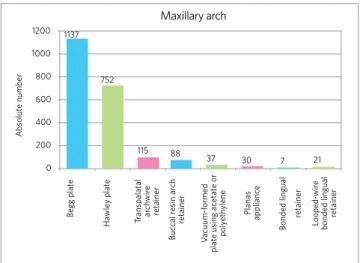
The distribution of maxillary retainers fabricated by the six laboratories surveyed, in absolute numbers, is shown in Figure 1. The production of Begg and Haw-ley retainers was much higher compared to the other appliances. The data from Figure 2 and Table 1 cor-roborate the observation related to Figure 1.
Table 1 -Measures of central tendency (median and mean) and variability (standard deviation, minimum and maximum values) relative to the groups of maxillary orthodontic retainers.
Group n Median Mean s.d. Minimum Maximum
1S 6 134.0 189.5 215.2 23.0 592.0
2S 6 116.0 125.3 52.0 45.0 190.0
3S 6 11.0 19.2 19.8 0.0 52.0
4S 6 10.0 14.7 18.8 0.0 47.0
5S 24 0.0 3.95 8.3 0.0 30.0
Figure 2 - Box plots representing the distribution pattern for data relative to the production of maxillary orthodontic retainers.
Maxillary arch
Total pr
oduction in the study period
600
200
400
0
1S 2S 3S 4S 5S
The most frequently fabricated retainer was the Begg retainer (1S), however, this appliance also pre-sented the greatest variation. The standard devia-tion was much higher than the mean for this retainer (Table 1). The second maxillary retainer most often requested was the Hawley retainer (2S). The other groups had progressively lower mean frequencies of fabrication, with significantly lower mean value for the group 5S compared to groups 1S and 2S (Table 2).
In absolute numbers, the production of man-dibular retainers was much lower compared to the maxillary appliances (Figs 1 and 3). The most often fabricated retainer was the 3-3 bonded lingual re-tainer. Concerning the magnitude of production, the maxillary Begg retainer reached an absolute number of 1,137 in the three months surveyed. On the other hand, 332 were the amount of 3-3 bonded lingual re-tainers produced in the same period.
Figure 1 - Absolute numbers corresponding to the total production of maxillary orthodontic retainers in six laboratories.
1200 1137
752
115 88
37 30 7 21
Maxillary arch
Absolut
e number
Begg plat
e
Ha
wle
y plat
e
Tr
anspalatal arch
wir
e
retainer
Buc
cal r
esin ar
ch
retainer
V
acuum-formed
plat
e using ac
etat
e or
poly
eth
ylene
Planas
applianc
e
Bonded lingual
retainer
Looped-wir
e
bonded lingual
retainer
Table 2 -Comparison between groups of maxillary retainers.
Bonferroni’s correction: p < 0.005.
Comparisons t p-value
1S vs 2S -0.31 0.7602
1S vs 3S 2.36 0.0479
1S vs 4S 3.05 0.0202
1S vs 5S 8.35 0.0000
2S vs 3S 2.77 0.0357
2S vs 4S 3.37 0.0183
2S vs 5S 11.74 0.0000
3S vs 4S 1.01 0.3358
3S vs 5S 2.88 0.0222
4S vs 5S 1.04 0.3224
Table 3 -Measures of central tendency (median and mean) and variability (standard deviation, minimum and maximum values) relative to the groups of mandibular orthodontic retainers.
Groups n Median Mean s.d. Minimum Maximum
1I 6 9.5 55.3 78.0 0.0 163.0
2I 12 20.5 42.8 41.7 3.0 115.0
3I 6 4.5 26.5 38.2 0.0 85.0
4I 18 0.0 4.2 8.8 0.0 30.0
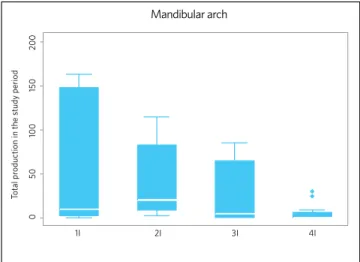
Figure 4 -Box plots representing the distribution pattern for data relative to the production of mandibular orthodontic retainers.
Total pr
oduction in the study period
200
150
100
50
0
1I 2I 3I 4I
Mandibular arch
Table 4 -Comparison between groups of mandibular retainers.
*Bonferroni’s correction: p-value < 0.0083.
Comparisons t p-value
1I vs 2I -0.90 0.4031
1I vs 3I 0.63 0.5381
1I vs 4I 2.52 0.0367
2I vs 3I 1.68 0.1454
2I vs 4I 6.58 0.0000
3I vs 4I 1.59 0.1536
According to Figure 4 and Table 3, the most fre-quently fabricated mandibular retainer was the 3-3 bonded lingual retainer (1I), but it also demon-strated the highest standard deviation. This retainer was followed by the appliances in group 2I (Hawley retainer and V-loop bonded lingual retainer). Based on the comparisons shown in Table 4, the retainers in group 2I were fabricated with significantly higher
frequencies compared to group 4I (buccal resin-arch retainer, vacuum-formed retainer using acetate or polyethylene and Planas appliance).
DISCUSSION
The orthodontic literature shows wide discussions on retainers, specifically concerning their indication, type of appliance and time during which they should be maintained after completion of active orthodon-tic treatment. While some authors indicate the use of
retainers for an indefinite period in some situations,14
others advocate that the retention period should be as
long as the active treatment lasted.3
The use of maxillary retainers is necessary mainly due to the possibility of relapse of diastemas and ro-tations, as well as for maintenance of intercanine and
intermolar widths after maxillary expansion.3,5,8,13,22
According to this study findings, the Begg and Haw-ley retainers were the maxillary retainers most often requested by orthodontists to the laboratories sur-veyed, with mean productions of 189.5 and 125.3, re-spectively, in a three-month period. The production
Figure 3 -Absolute numbers corresponding to the total production of man-dibular orthodontic retainers in six laboratories.
Mandibular arch
Absolut
e number
Begg plat
e
Ha
wle
y plat
e
Buc
cal r
esin ar
ch
V
acuum-formed
plat
e using ac
etat
e or
poly
eth
ylene
Planas
applianc
e
3X3 Bonded lingual
retainer
Looped-wir
e
bonded lingual
retainer
350 300
332 305
209 159
15 31 30 250
of these two types of retainers was significantly higher compared to the others in group 5S (Table 2). These data agree with other studies that indicate the Hawley retainer and its variations as the most used removable
appliances for maxillary retention.18,22
The Hawley retainer is fabricated with acrylic resin, covering the palate, and presents a stainless steel buccal arch that usually extends from the dis-tal surfaces of canines, contouring the buccal aspect of maxillary anterior teeth. Moreover, this appli-ance has additional retentions as Adams or circum-ferential clasps. Conversely, in the Hawley retainer with continuous arch or Begg retainer, the buccal arch is initiated on the distal surfaces of second molars and contours the buccal aspects of anterior
and posterior teeth,18 without the need of retention
clasps. However, in some cases, clasps may be added to stabilize the continuous arch.
The Hawley retainer has high durability,18 provides
better intercuspation of posterior teeth20 and may
pro-mote small tooth movements.3 Some authors state that
the Hawley retainer may last up to 15 years, allows easy hygiene maintenance, has relatively low cost and does
not cause discomfort to the patient during utilization.1,18
Nevertheless, the intercuspation may be impaired in ar-eas with occlusal interferences from the stainless steel wire of the retention clasps. The modification from the Hawley to the Begg retainer would provide a solution to minimize the problem of occlusal interferences, by
eliminating the retention clasps.18
Retention in the mandibular arch is even more im-portant, not only to prevent relapses, but also to avoid
the secondary crowding of incisors,16,17 which may be
explained as an anatomical-physiological adaptation
phenomenon.7,8,13 As demonstrated in Figure 3 and
Table 3, the mandibular retainers most frequently re-quested were the 3-3 bonded lingual retainer (from canine to canine), the Hawley retainer and the V-loop bonded lingual retainer or hygienic retainer. Con-sidering that the two latter appliances were grouped into a cluster (2I), the mean values relative to their production in the study period were 55.3 (1I) and 42.8 (2I), respectively. However, the detailed analysis of Table 3 reveals great discrepancy between the me-dian (9.5) and mean (55.3) calculated for the canine-to-canine bonded lingual retainer. The median value calls attention to the fact that 50% of the laboratories
produced up to 9 appliances. After observation of the crude data, it was found that very high numbers of this appliance were fabricated in a single laboratory, which increased the mean value. Thus, because of the lack of consistency in the distribution of data on the canine-to-canine bonded lingual retainer, the Hawley retainer and the V-loop bonded lingual retainer or hy-gienic retainer were significantly more requested than the other appliances in group 4I (Table 4). It should be highlighted that data in this study were based on the outsourced production of orthodontic retainers, and consequently information on the type of appli-ance most often used in the mandibular arch may be masked. This is explained by the fact that the bonded lingual retainer may be easily manufactured in the dental office and, therefore, many orthodontists do not request this type of appliance to laboratories.
The canine-to-canine bonded mandibular lin-gual retainer was introduced in the United States in the 1970s and has been used as an integral part
of orthodontic treatment since then.11,16,23 Most
mandibular retainers are bonded/fixed, because mandibular removable plates have a large bulk of acrylic on the lingual aspect, decreasing the tongue
space, impairing the speech and swallowing.7,22 This
drawback would preclude adequate utilization of the appliance, damaging the treatment outcomes. Notably, the greatest disadvantage of removable retainers is the need of patient compliance, both in
maxillary and mandibular arches.1,2,4,15,18,20,22
The use of mandibular fixed retainers fabricated with smooth stainless steel wire bonded only to the
canines is encouraged.17 The greatest advantage
of canine-to-canine bonded mandibular retainers compared to removable retainers lies in the esthetic quality, because they are not easily perceptible and
are well tolerated by patients.16,24 This type of
man-dibular retainer is also adequate in cases in which the
periodontal support is reduced.18
The difficulty of patients to perform the hygiene of proximal surfaces in regions where the fixed retainer is bonded led to its modification, in order to facilitate the use of dental floss within the interproximal spac-es. For that purpose, loops may be fabricated in the stainless steel archwire in opposite direction than the gingival papillae. However, a comparative study
without loops and bonded only to the mandibular ca-nines evidenced higher accumulation of biofilm and dental calculus at the region of the modified fixed re-tainer, with gingival inflammation probably caused by the greater length of wire and presence of angles in the
loops.21 Therefore, these loops would constitute the
most retentive areas, which would impair the hygiene. A study on the effectiveness of bonded retainers and their effects on the periodontal status, conducted for at least 20 years follow-up, reported that these ap-pliances are very effective to maintain the tooth align-ment and allow the maintenance of acceptable levels
of hygiene and periodontal health.6 The authors
fur-ther mentioned that when good bonding techniques are used for the placement of fixed retainers they are not frequently loosened by breakage, thus not
contra-indicating their prescription.6
The duration of retainer wear is related to the pa-tient age, characteristics and severity of malocclusion.
The oral habits and other etiologic factors of malocclu-sions, as well as the orthodontic mechanics employed and the clinical experience of the orthodontist are also
relevant factors to estimate the retention period.14,21
From a clinical standpoint, maintenance of the man-dibular retainer for an undetermined period assures the outcomes of active orthodontic treatment, since it is not possible to predict the cases that will present
relapse.5,10,17,18 The stability should be monitored and
controlled by the orthodontists during the routine
as-sessments of retainers for a long time.12
CONCLUSIONS
1. For the maxillary arch, the Begg and Hawley re-tainers were the orthodontic rere-tainers most often requested to the laboratories surveyed.
2. Among the mandibular retainers, the most fquently requested were the bonded lingual re-tainers and Hawley retainer.
1. Al-Suliaman S, Hashim HA, Cordovez JL. The reinforced removable retainer. J Contemp Dent Pract. 2006;7(2):145-52.
2. Atack N, Harradine N, Sandy JR, Ireland AJ. Which way forward? Fixed or removable lower retainers. Angle Orthod. 2007;77(6):954-9.
3. Bengtson AL, Bengtson NG. Contenção ortodôntica: sugestão para uma placa retentora. Rev Assoc Paul Cir Dent. 1996;50(4):333-6.
4. Bicalho JS, Bicalho KT. Descrição do método de contenção fixa, com livre acesso do fio dental. Rev Dental Press Ortod Ortop Facial. 2001;6(5):97-104. 5. Bicalho JS, Bicalho KT. Descrição do método de contenção fixa, com livre acesso
do fio dental. Rev Clin Ortod Dental Press. 2002;1(1):9-13.
6. Booth FA, Edelman JM, Proffit WR. Twenty-year follow-up of patients with permanently bonded mandibular canine-to-canine retainers. Am J Orthod Dentofacial Orthop. 2008;133(1):70-6.
7. Cerny R. The reliability of bonded lingual retainers. Aust Orthod J. 2007;23(1):1-6.
8. Fonte PP, Fonte MLM. Contenção ortodôntica. Rev Fac Odontol Pernambuco. 2000;18(1-3):9-23.
9. Hichens L, Rowland H, Williams A, Hollinghurst S, Ewings P, Clark S, et al. Cost-effectiveness and patient satisfaction: Hawley and vacuum-formed retainers. Eur J Orthod. 2007;29(4):372-8.
10. Johnsson AC, Tofeldt LN, Kjellberg H. Subjective evaluation of orthodontic treatment and potential side effects of bonded lingual retainers. Swed Dent J. 2007;31(1):35-44.
11. Katsaros C, Livas C, Renkema AM. Unexpected complications of bonded mandibular lingual retainers. Am J Orthod Dentofacial Orthop. 2007;132(6):838-41.
12. Kortam SI, El-Beialy AR, Mostafa YA. Retention checklist. J Clin Orthod. 2007;41(7):382-3.
13. Kuramae M, Almeida MHC, Noüer DF, Magnani MBBA. Principais fatores relacionados à estabilidade ortodôntica: uma revisão de literatura. J Bras Ortodon Ortop Facial. 2002;7(39):194-200.
REFERENCES
14. Littlewood SJ, Millett DT, Doubleday B, Bearn DR, Worthington HV. Retention procedures for stabilising tooth position after treatment with orthodontic braces. Cochrane Database Syst Rev. 200625;(1):CD002283.
15. Lumsden KW, Saidler G, Mccoll JH. Breakage incidence with direct bonded lingual retainers. Br J Orthod. 1999;26(3):191-4.
16. Pandis N, Vlahopoulos K, Madianos ETP. Long-term periodontal status of patients with mandibular lingual fixed retention. Eur J Orthod. 2007;29(5):471-6. 17. Renkema AM, Al-Assad S, Bronkhorst E, Weindel S, Katsaros C, Lisson JA.
Effectiveness of lingual retainers bonded to the canines in preventing mandibular incisor relapse. Am J Orthod Dentofacial Orthop. 2008;134(2):179e1-8. 18. Rinchuse DJ, Miles PG, Sheridan JJ. Orthodontic retention and stability: a clinical
perspective. J Clin Orthod. 2007;41(3):125-32.
19. Rose E, Jonas E. Clinical comparison of a multistranded wire and a direct-bonded polyethylene ribbon-reinforced resin composite used for lingual retention. Quintessence Int. 2002;33(8):579-83.
20. Sauget E, Covell DA Jr, Boero RP, Lieber WS. Comparison of occlusal contacts with use of Hawley and clear overlay retainers. Angle Orthod. 1997;67(3):223-30.
21. Shirasu BK, Hayacibara RM, Ramos AL. Comparação de parâmetros periodontais após utilização de contenção convencional 3x3 plana e contenção modificada. Rev Dental Press Ortod Ortop Facial. 2007;12(1):41-7.
22. Silveira M. O uso do P.E.T. (Polietileno Tereftalato) na construção de contenções ortodônticas removíveis. J Bras Ortodon Ortop Facial. 1998;3(14):33-7. 23. Upadhyay M, Yadav S, Keluskar KM. Molar bands for precision bonding of lingual
retainers. J Orthod. 2007;34(1):12-5.