Dental caries in the primary dentition
in public nursery school children
in Juiz de Fora, M inas Gerais, Brazil
Cárie d e ntária na d e ntiç ão d e c íd ua
d e c rianç as assistid as e m alg umas c re c he s
p úb lic as e m Juiz d e Fo ra, Minas G e rais, Brasil
1 Facu ld ad e d e Od on tologia, Cen t ro In t egra d o d e Sa ú d e, Un iv ersid a d e Fed era l d e Ju iz d e Fora . Ca m p u s Un iv ersit á rio, Ju iz d e Fora , M G 36030- 330, Bra sil. b el@od on t o.u fjf.b r
Isa b el Crist in a Gon ça lv es Leit e 1 Rosa n gela Alm eid a Rib eiro 1
Abstract Th e aim of t h is st u d y w as t o assess t h e p revalen ce of d en t al caries in t h e p rim ary d en -t i-t ion an d associa-t ed variables in low socioecon om ic p resch ool ch ild ren en rolled in p u blic n u rs-ery sch ools in Ju iz d e Fora , M in a s Gera is, Bra z il. Fou r p u b lic in st it u t ion s w ere select ed b y geogra p h ic crit eria (t w o in t h e cen t ra l region a n d t w o in t h e p erip h era l region ). Th e st u d y p op u la -t ion com p rised 338 ch ild ren (181 b oys; 157 girls) a ged 2- 6 yea rs old . Den -t a l ca ries w a s record ed u sin g t h e d eca yed , m issin g, a n d filled t eet h (d m f- t ) in d ex . Am on g t h e ex a m in ed ch ild ren , 50.6% w ere ca ries-free. Th e m ea n d m f-t in d ex w a s 2.03. It w a s h igh er in t h e p erip h era l n u rsery sch ools (p < 0.01). A t ren d t ow ard s a d ifferen ce bet w een sex es (p = 0.06) w as observed . Logist ic regression a n a lysis select ed a p rev iou s ch ild ’s v isit t o d en t ist (p < 0.001), geogra p h ic loca t ion of t h e p u b lic n u rsery sch ool (p < 0.01), an d age (p < 0.01) as p red ict ive variables for t h e d m f-t in d ex . Th e st u d y sh ow ed t h e n eed for a n ora l h ea lt h p rogra m for t h is p op u la t ion , in clu d in g b ot h cu ra t iv e a n d p rev en t i v e m ea su res i n o rd er t o a ch i ev e t h e W H O/FD I go a ls f o r t h e yea r 2000, n a m ely 50% o f ch ild ren free of caries at age 5-6 years.
Key words Den t al Caries; Prim ary Den t it ion ; Prevalen ce; Ep id em iology
Introduction
Th ere is am p le eviden ce th at p revalen ce of den -ta l ca ries h a s b een d eclin in g over th e la st two d eca d es in m o st co u n tries in Western Eu ro p e an d North Am erica. Th e red u ction in th e aver-a ge d ecaver-a yed , m issin g, aver-a n d filled teeth (d m f-t) sco res h a s b een rep o rted to b e b etween 40% a n d 60% in m o st a ge gro u p s. Th e d eclin e in ca ries h a s b een a sso cia ted m a in ly with th e wid esp read availab ility of flu orid e tooth p astes a n d ch a n ges in th e p a ttern a n d a m o u n t o f extrin sic su ga r co n su m p tio n , wh erea s th e in -cre a se is p rim a rily re la te d to th e in -cre a se in con su m p tion of extrin sic su gars, esp ecially su -crose (Sh eih am , 1984; Holm , 1990; Freire et al., 1996). Prevalen ce of d en tal caries in Brazil still con stitu tes a p u blic h ealth p roblem , p articu lar-ly in som e areas. Data from a n ation al ep id em i-ological su rvey sh owed a m ean d m f-t of 4.84 at age 12 years (SESI, 1995).
In tern ation ally, den tal disease in you n g ch il-d re n h a s b e e n le ss stu il-d ie il-d th a n in o lil-d e r a ge grou p s. Desp ite p oor den tal con dition s, few ep id em io lo gica l stu id ies fo cu seid o n ch ilid ren u n -d er 6 yea rs o f a ge in Bra zil. Freire et a l. (1996) assessed d en tal caries in th e p rim ary d en tition of 2,267 p resch ool ch ild ren , aged 0-6 years old , in Goiân ia, Goiás, atten d in g p u b lic (low socioe-co n o m ic) a n d p riva te (h igh so cio e socioe-co n o m ic) n u rsery sch ools. Caries p revalen ce was h igh er in p u b lic th an p rivate n u rsery sch ool ch ild ren (p < 0.05). Am on g ch ild ren from p u b lic n u rsery sch ools, th e h igh est d m ft com p on en t was u n -treated d ecay, wh ile in p rivate n u rseries it was filled teeth . Ma tto s-Gra n er et a l. (1996) d eter-m in e d th e p re va le n ce o f d e n ta l ca rie s in 322 Brazilian ch ild ren aged 6-36 m on th s in Piraccab a, São Pau lo. Th e earliest ages at wh ich in i-tia l a n d m a n ifest ca ries were record ed in ch ild re n we re 612 m o n th s a n ild 1318 m o n th s re -sp e ctive ly. Sixty-five p e r ce n t o f th e ch ild re n were ca ries-free. Seven teen p er cen t o f th e a f-fected ch ild ren sh owed 46% of th e tota l ca ries lesion s, wh ich d em on strates th e n eed for early id e n tifica tio n o f th o se with a h igh ca rie s risk. In a n e p id e m io lo gica l su r ve y o f ca rie s p re va -len ce an d d istrib u tion in 0-36-m on th -old ch ild ren livin g in Diaild em a, São Pau lo, Brazil, con -d u cte -d b y Bö n e cke r e t a l. (1997), m e a n -d m f-t p er ch ild was 0.16 at on e year, 0.87 at two years, an d 2.54 at th ree years of age. Mean d m f-s val-u e s fo r th e sa m e gro val-u p s we re 0.17, 1.13, a n d 3.68, resp ectively.
Ora l h e a lth co n d itio n s o f p re sch o o l ch il-d ren h ail-d n ever b een il-d ocu m en teil-d in th e city of Ju iz d e Fo ra , Min a s Ge ra is. Th e cu rre n t stu d y was th u s con d u cted to in vestigate d en tal caries
prevalen ce in the prim ary den tition of p resch ool ch ild re n a tte n d in g p u b lic n u rse r y sch o o ls in th is city in o rd e r to p rovid e d a ta fo r fo rm u la -tio n o f o ra l h e a lth p ro gra m s fo r th is sp e cific p op u lation .
M ethods
Subjects
Th e stu d y wa s p erform ed in th e first sem ester of 1998 in th e city of Ju iz de Fora, State of Min as Gerais, Sou th east Brazil, wh ich h as h ad flu ori-d a te ori-d wa te r (0.8m gF/ l) sin ce 1983. Th e stu ori-d y gro u p co m p rised 338 p resch o o l ch ild ren with com p lete p rim ary den tition (181 boys; 157 girls) aged 2-6 years old (m ean age 4.3 years old ) at-te n d in g p u b lic n u rse r y sch o o ls o n we e kd a ys. Th e sa m p le in clu d e d fo u r ra n d o m ly se le cte d p u b lic n u rsery sch ools rep resen tin g 22% of th e 18 existin g p u b lic n u rseries in 1998. A h o u se-h old in com e lower tse-h an tse-h e Brazilian m on tse-h ly m in im u m wage (R$136,00 or US$75.00) was re-q u ire d fo r th e se ch ild re n to b e a d m itte d to su ch n u rsery sch ools. Th e stu d y sam p le rep re-sen ted 16.1% of th e total p op u lation (aged 2-6 ye a rs-o ld ) se r ve d b y th e se in stitu tio n s (338/ 2,100 ch ild ren ). Th e n u rseries were ra n d o m ly selected on th e b a sis of th eir geogra p h ic loca -tio n a cco rd in g to d a ta p rovid e d b y th e lo ca l h ea lth a u th ority. Th e sa m p le in clu d ed two in -stitu tio n s lo ca te d in th e ce n tra l re gio n o f th e city an d two located on th e p erip h ery. Th e stu dy d e sign re ce ive d p rio r a p p rova l b y th e Eth ics Com m ittee of the School of Medicin e at the Fed-eral Un iversity in Ju iz d e Fora. Paren tal con sen t fo rm s we re a lso o b ta in e d . Distrib u tio n o f th e sam p le by age, sex, an d geograp h ic location of th e p u b lic n u rsery sch ools is sh own in Tab le 1.
Clinical recordings
Th e crite ria u se d fo r d e ca y se ve rity wa s ad ap ted by th e au th ors from th e WHO classifi-ca tio n fo r p e rm a n e n t d e n titio n (FDI/ WH O, 1982), after wh ich th e very low p revalen ce was re p re se n te d b y a d m f-t fro m 0.1 to 0.7, low p reva len ce a s d m f-t fro m 0.8 to 1.6, m o d era te fro m 1.7 to 2.7, h igh fro m 2.8 to 4.0, a n d ve r y h igh over 4.1.
Da ta o n in d e p e n d e n t va ria b le s we re o b -tain ed from th e m oth ers wh o agreed to p artici-p ate in th e stu d y. Th e race variab le was classifie d a s wh ite o r b la ck. Visit to d e n tist wa s d e scrib ed as th e p resen ce of p rivate an d / or p u b -lic re sto ra tive in te r ve n tio n a t a n y tim e in th e ch ild’s life (d ata p rovid ed by m oth er an d visu -a l in sp e ctio n ). Nu m b e r o f tim e s te e th b ru sh p er d ay in th e n u rsery sch ool was record ed ac-cord in g to in form ation ob tain ed by th e sch ool n u rse.
Da ta we re p ro ce sse d a n d a n a lyze d u sin g Ep iIn foversio n 6.0 a n d SPSS 6.0 for W in d ow s. Co m p a riso n s b e twe e n gro u p s we re m a d e u s-in g χ2test, an alysis of varian ce was ap p lied for
th e stu d y of d m f-t in d ex related to race, sex,
ge-o gra p h ic lge-o ca tige-o n , a n d p rige-o r visits tge-o d e n tist. Th e in flu en ce of in d ep en d en t variab les an d th e d m f-t in d ex was estab lish ed by logistic regres-sion an alysis.
Results
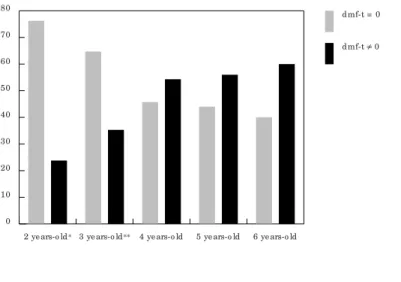
Th e n u m b e r o f c h ild re n in e a c h a ge b ra c ke t a n d th eir exp erien ce with ca ries a re sh own in Ta b le 2. D a t a fr o m 338 c h ild re n in d ic a t e d t h a t 50.6% were caries-free. Th e p rop ortion of ca rie s-fre e ch ild re n ra n ge d fro m 76.2% in 2-year-old ch ild ren to 40.0% in six-years-old (Fig-u re 1). Of all th e caries-free ch ild ren (n = 171), 26.9% were from n u rsery sch ools in n eigh b or-h oods, wor-h ereas 73.1% atten ded n u rsery scor-h ools in n eigh b orh ood s with relatively h igh er socioe-co n o m ic sta tu s. An a lyzin g th e p ro p o rtio n o f caries-free ch ild ren by geograp h ic location , th e d a ta re ve a le d a sta tistica l d iffe re n ce b e twe e n ce n tra l a n d p e rip h e ra l n u rse r y sch o o ls (p < 0.01). For th e sa m p le a s a wh ole, th e d m ft in d e x wa s 2.03. Me a n d m ft wa s lowe r in two
-Tab le 1
Distrib utio n o f p re sc ho o l c hild re n (n = 338) se x and g e o g rap hic lo c atio n o f the p ub lic nurse ry sc ho o ls – Juiz d e Fo ra, Minas G e rais, Brazil, 1998.
Age Central region Peripheral region Central and peripheral region
n Male Fe male n Male Fe male n Male Fe male
2 23 47.8% 52.2% 19 62.6% 37.4% 42 50.0% 50.0% 3 31 54.8% 45.2% 20 60.0% 40.0% 51 56.9% 43.1% 4 52 55.8% 44.2% 35 48.6% 51.4% 81 40.5% 59.5% 5 49 34.7% 65.3% 35 48.6% 51.4% 84 63.8% 36.2% 6 52 63.8% 36.2% 28 69.3% 31.7% 80 63.8% 36.2%
Total 207 51.7% 48.3% 131 56.5% 43.5% 338 181 157
Tab le 2
Carie s e xp e rie nc e in re latio n to ag e o f a g ro up o f 338 p re sc ho o l c hild re n – Juiz d e Fo ra, Minas G e rais, Brazil, 1998.
Age noin groups no(%) caries free M ean dmf-t M ean dmf-t d (M ean ± SD m (M ean ± SD f (M ean ± SD (years) (± SD) all (± SD) excluding and % of dmf-t) and % of dmf-t) and % of dmf-t)
children caries free children
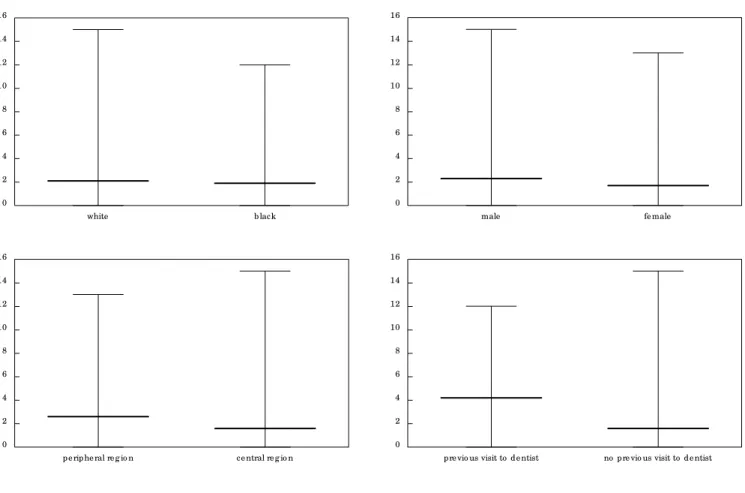
ye a o ld (0.7 ± 1.50) a n d h igh e r in six-ye a rs-old (2.9 ± 3.30); th ese d ifferen ces were statisti-cally sign ifican t (Table 2). Th e dm f-t com p on en t va lu e s sh own in Ta b le 2 sh ow th a t th e in d e x co n siste d la rge ly o f d e ca ye d te e th (d co m p o -n e-n t), wh ich co-n stitu ted 0.6 of th e total i-n two-ye a rs-o ld , 1.3 in th re e -two-ye a rs-o ld , 1.6 in fo u r-yea rs-o ld , 2.1 in five-r-yea rs-o ld , a n d 2.6 in six-years-old. An alysis of varian ce showed n o sign if-ican t d ifferen ces in caries scores b etween races or sexes (p = 0.62 an d 0.06, resp ectively). How-ever, geograp h ic location of th e p u b lic n u rsery sch o o l a n d th e ch ild ’s p rio r visit to d e n tist sh owed a h igh ly sign ifican t in flu en ce (Figu re 2). Ta b le 3 p re se n ts o d d s ra tio s ca lcu la te d b y u sin g b co e fficie n t o b ta in e d d u rin g ste p wise logistic regression . Data in d icated th at ch ild ren with a t lea st on e p rior visit to th e d en tist were 12 tim e s m o re like ly to b e in th e h igh e r d m f-t gro u p (d m f-t > = 4) th a n th e o th er, h o ld in g a ll oth er va ria b les con sta n t. Geogra p h ic loca tion sh owed a sim ilar stron g effect in th e m odel (i. e., ch ild ren atten d in g p erip h eral n u rsery sch ools were alm ost 4 tim es m ore likely to h ave a h igh -e r d m f-t th a n w-e r-e th o s-e a tt-e n d in g c-e n tra l n u rsery sch ools). Tab le 3 also sh ows th at if th e va ria b le s with p -va lu e s ra n gin g fro m 0.05 to 0.10 we re ke p t in th e fin a l p ro gn o stic m o d e l, se x a n d n u m b e r o f tim e s te e th we re b ru sh e d p er d ay in th e n u rsery sch ool wou ld h ave b een in clu d ed . Data su ggested th at th e overall p rob -a b ility o f b oys h -a vin g -a h igh e r d m f-t (-a b ove
2.8) th a n girls wa s 0.80. In a d d itio n , th e n u m b er of d aily b ru sh in gs at n u rsery sch ool was in -versely p rop ortion al to d m f-t.
Discussion
Th e p re se n t stu d y d e m o n stra te d e a rly in itia -tion of tooth d ecay in Brazilian p resch ool ch il-d ren , con firm in g p reviou s ob servation s (Freire et al., 1996; Mattos-Gran er et al., 1996; Bön ecker e t a l., 1997). Th e re su lts a lso d e m o n stra te d a sign ifican t relation sh ip between age an d caries. Th is re la tio n sh ip h a d b e e n sh own in b o th yo u n ge r (Fre ire e t a l., 1996; Ma tto s-Gra n e r e t al., 1996; Bön ecker et al., 1997) an d old er ch il-dren (Din i et al., 1996; Moreira et al., 1996; Vigild et al., 1996).
Me a n d m f-t a n d th e p ro p o rtio n s o f ch il-d ren with ca ries a re sim ila r to th o se o b serveil-d in an oth er grou p of Brazilian p resch ool ch ild ren a tten d in g p u b lic a n d p riva te n u rsery sch o o ls: d m f-t = 2.03 (Freire et a l., 1996). Th e ra tes a re higher than those foun d am on gst n ursery sch ool ch ild ren in Nairob i, Ken ya: d m f-t = 1.88 (Masi-ga & Holt, 1993). However, th ey are lower th ose fro m in stu d ie s in Ho n g Ko n g: d m f-t = 2.93 (Wei et al., 1993); Ku wait: d m f-t = 6.2 (Vigild et a l., 1996), a n d Sa n Fe rn a n d o, Sp a in : d m f-t = 3.19 (Rom ero-Ru iz et al., 1996).
An a lysis o f e a ch co m p o n e n t in th e d m f-t in dex sh owed a m arked in flu en ce of th e D com -p on en t, as also ob served in oth er su rveys (Wei et al., 1993; Freire et al., 1996; Mattos-Gran er et al., 1996; Bön ecker et al., 1997). In oth er word s, it a p p e a rs th a t th e p re ssin g n e e d fo r d e n ta l treatm en t in th e p rim ary d en tition reflects th e cu rre n t e co n o m ic a n d p ra ctica l d ifficu ltie s with in th e h ealth services system ad m in istered by local h ealth au th orities, su p p ortin g th e con -clu sion s rep orted by Petersen et al. (1994).
Th e se re su lts sh owe d a low p e rce n ta ge o f ch ild re n with a h igh n u m b e r o f d e n ta l ca rie s. Of th e 338 ch ildren , 18.3% h ad a very h igh dm f-t (n = 62), a n d 6.2% h a d a h igh d m f-t (n = 21). Th re e p e r ce n t o f th e a ffe cte d ch ild re n h a d d m f-t > 10. Th e se re su lts d e m o n stra te d th e n eed for early id en tification of ch ild ren at h igh risk o f ca rie s, a s su gge ste d b y o th e r stu d ie s (Ma n d e l, 1989; We i e t a l., 1993; Fre ire e t a l., 1996). In a d d itio n , ch ild ren’s p rio r exp erien ce with caries h as often b een sh own to b e th e sin gle b est p red ictor of fu tu re d en tal d isease (Sæ -m u n d sso n e t a l., 1997). Ou r re su lts in d ica te d th e in flu en ce o f p rio r d en ta l resto ra tive trea t-m e n t o n a h igh e r d t-m f-t sco re, wh e n a ll o th e r va ria b le s re m a in e d co n sta n t ( Ta b le 3). It a p -p e a rs th a t th e so rt o f d e n ta l ca re o ffe re d to
Fig ure 1
Pe rc e ntag e s o f c hild re n c arie s fre e and c arie s p o sitive in re latio n to ag e (= 338).
* ind ic ate s statistic ally sig nific ant d iffe re nc e (p < 0.01) ** ind ic ate s statistic ally sig nific ant d iffe re nc e (p < 0.05)
0 10 20 30 40 50 60 70 80
d mf-t ≠ 0 d mf-t = 0
6 ye ars-o ld 5 ye ars-o ld
4 ye ars-o ld 3 ye ars-o ld**
Fig ure 2
Dmf-t ind e x b y rac e (p = 0.62), se x (p = 0.06), g e o g rap hic lo c atio n o f the nurse ry sc ho o l (p < 0.01), and a p re vio us c hild ’s visit to d e ntist (p < 0.001).
white b lack
0 2 4 6 8 10 12 14 16
male fe male
0 2 4 6 8 10 12 14 16
p e rip he ral re g io n ce ntral re g io n
0 2 4 6 8 10 12 14 16
p re vio us visit to d e ntist no p re vio us visit to d e ntist 0
2 4 6 8 10 12 14 16
Tab le 3
O d d s ratio s with 95% lo we r and up p e r c o nfid e nc e b o und s (L95, U95) o f inc re ase d risk.
Predictors O R L95 U95 p-valor
Pre vio us visit to d e ntist 12.50 5.58 26.31 p < 0.001
Child re n atte nd ing p e rip he ral nurse ry sc ho o ls 3.52 1.97 6.30 p < 0.001
Ag e 1.40 1.11 1.75 p < 0.01
Se x 1.77 1.01 3.06 p = 0.06
th ese ch ild ren is in su fficien t to p ro m o te th eir oral h ealth , as related by Freire et al. (1996).
Fo rty p er cen t o f ch ild ren were ca ries-free at age six years. Th is rate is still lower th an th e first oral h ealth goal of FDI/ WHO (1982) for th e year 2000 (i. e. 50% of ch ild ren free of caries at th is age). However, th is rate is b etter th an th at of Brazilian p resch ool ch ildren atten din g p u blic n u rsery sch ools in Goiân ia (Freire et al., 1996). It is also better th an th ose observed am on g ch il-d ren from oth er cou n tries, wh ere rates ran geil-d from 9% to 34% (Holb rook, 1993; Petersen et al., 1994; Ro m e ro -Ru iz e t a l., 1996; Vigild e t a l., 1996). Ta kin g in to a cco u n t th e ge o gra p h ic lo -ca tio n o f p u b lic n u rsery sch o o ls, we n o te th a t 26.9% o f th e ca riesfree ch ild ren were a tten d -in g p erip h eral n u rsery sch ools, wh ereas 73.1% were atten d in g n u rsery sch ools in m ore cen tral a n d re la tive ly m o re a fflu e n t n e igh b o rh o o d s. Th is p a ttern a p p ea red in th e ep id em io lo gica l
su rvey con d u cted in São Pau lo (NEPESS, 1999). In 1998, th e m e a n d m f-t wa s 2.94 (2.90-2.98) an d 39% 5-year-old ch ild ren were in th e caries-free grou p. However, th is p ercen tage was h igh er in p rivate (59%) as com p ared to p u b lic sch ools (38%).
In ligh t of th ese resu lts from ou r su rvey, on e ca n co n clu d e th a t im p le m e n ta tio n o f a n o ra l h e a lth p ro gra m fo r ch ild re n a tte n d in g p u b lic n u rsery sch ools sh ou ld b e a h igh p riority. Su ch a p rogra m sh ou ld in clu d e n ot on ly p reven tive m easu res b u t also cu rative treatm en t of th e af-fected p rim ary teeth , in ord er to allow for p er-m a n e n t te e th to e ru p t u n d e r er-m o re fa vo ra b le co n d itio n s. Th e e d u ca tio n a l p ro gra m sh o u ld e m p h a size p re n a ta l o rie n ta tio n fo r gro u p s o f p regn an t wom en as well as p rofession al train -in g fo r p re ve n tive a tte n tio n to b a b ie s (0-3 years) in ord er to en cou rage h ealth y oral h ab its d u rin g th is p eriod .
References
BÖNECKER, M. J. S.; GU EDES-PINTO, A. C. & WAL-TER, L. R. F., 1997. Prevalên cia, distribu ição e grau d e a ffecçã o d e cá rie d en tá ria em cria n ça s d e 0 a 36 m eses d e id ad e. Revista d a Associação Pau lista d e Ciru rgiões-Den tistas, 51:535-540.
DINI, E. L.; ROZATO-FOSCHINI, A. L.; CASARINI-DE-MENDONÇA, F. C.; DE-NARDO, G.; GARDIM-ABBAD, M. T. & MARSON - SECCH EV- FRAIS, R. L., 1996. Ch a n ges in d en ta l ca ries p reva len ce o f sch ool ch ild ren in Araraqu ara, SP, Brazil.In tern a-tion al Den tal Jou rn al, 46:82-85.
FDI (Fédération Den taire In tern ation ale)/ WHO (World Health Organ ization ), 1982. Glob al goals for oral h ealth by th e year 2000. In tern ation al Den tal Jou r-n al, 32:74-77.
FREIRE, M. C. M.; MELO, R. B. & SILVA, S. A., 1996. Den tal caries p revalen ce in relation to socioeco-n om ic statu s of socioeco-n u rsery sch ool ch ild resocioeco-n isocioeco-n Goiâ-n ia -GO, Bra zil. Com m u n it y Den t ist ry a n d Ora l Ep id em iology, 24:357-361.
HOLBROOK, W. P., 1993. Den tal caries an d cariogen ic fa cto rs in p re -sch o o l u rb a n Ice la n d ch ild re n .
Caries Research, 27:431-437.
HOLM, A. K., 1990. Diet an d caries in h igh -risk grou p s in d e ve lo p e d a n d d e ve lo p in g co u n trie s. Ca ries Research, 24:44-52.
MANDEL, I. D., 1989. Preface. In :Cariology (E. New-b ru n , ed .), 3rdEd . Ch icago: Qu in tessen ce. MASIGA, M. A. & HOLT, R. D., 1993. Th e p revalen ce of
d en tal caries an d gin givitis an d th eir relation sh ip to social class am on g n u rsery-sch ool ch ild ren in Nairob i, Ken ya. In tern ation al Jou rn al of Ped iatric Den tistry, 3:135-140.
MATTOS-GRANER, R. O.; RONTANI, R. M. P.; GAVIÃO, M. B. D. G. & BOCATTO, H ., 1996. Ca rie s p re va -len ce in 3-36-m on th -old Brazilian ch ild ren . Com -m u n ity Den tal Health, 13:96-98.
MOREIRA, B. H. W.; PEREIRA, A. C. & OLIVEIRA, S. P., 1996. Ava lia çã o d a p reva lên cia d e cá rie d en tá ria
em escolares de localidade urban a da região Su d es-te d o Brasil.Revista d e Saú d e Pú blica, 30:280-284. NEPESS (Nú cleo d e Estu d os e Pesq u isas d e Sistem as d e Sa ú d e ), 1999. Lev a n t a m en t o Ep id em iológico em Saú d e Bu cal – Estad o d e São Pau lo, 1998.São Pau lo: Secretaria de Estado de Saú de de São Pau lo. PETERSEN, P. E.; DANILA, I.; DALEAN, A.; GRIVU, O.; IONITA, G.; POP, M. & SAMOLIA, A., 1994. Ora l h ealth statu s am on g sch ool ch ild ren in Rom an ia, 1992. Com m u n ity Den tistry an d Oral Ep id em iolo-gy, 22:90-99.
ROMERO-RU IZ, M. M.; SERRANO-GONZALEZ, A.; ALVAREZ-OSORIO, G. S.; M. R. & ZAFRA-MEZCUA, J. A., 1996. Prevalen ce of d en tal caries in a 6-year old p op u lation from San Fern an d o. Aten ción Pri-m aria, 18:431-435.
SÆMUNDSSON, S. R.; SLADE, G. D.; SPENCER, A. J. & DAVIES, M. J., 1997. Th e b a sis fo r clin icia n s’ ca rie s risk gro u p in g in ch ild re n . Ped ia t ric Den -tistry, 19:331-338.
SESI (Serviço So cia l d a In d ú stria ), 1995. Est u d o Ep i-d em iológico sobre Preven ção i-d a Cárie Den t al em Crian ças d e 3 a 14 An os. Brasília: SESI.
SHEIHAM, A., 1984. Ch an gin g tren d s in d en tal caries.
In tern ation al Jou rn al of Ep id em iology,13:142-147. VIGILD, M.; SKOUGAARD, M.; HADI, R. A.; AL-ZAABI, F. & ALYASSEEN, I., 1996. Den tal caries an d d en -tal flu orosis in 4-, 6-, 12- an d 15-year-old ch ild ren in kin d e rga rte n s a n d p u b lic sch o o ls in Ku wa it.
Com m u n ity Den tal Health, 13:47-50.
WEI, S. H . Y.; H OLM, A. K.; TONG, L. S. M. & YUE, S. W. H., 1993. Den tal caries p revalen ce an d related fa cto rs in 5-yea r-o ld ch ild ren in Ho n g Ko n g. Pe-d iatric Den tistry, 16:116-119.