CLINICS 2010;65(6):583-6
Copyright © 2010 CLINICS – This is an Open Access article distributed under the terms of the Creative Commons Attribution Non-Commercial License (http://creativecommons. org/licenses/by-nc/3.0/) which permits unrestricted non-commercial use, distribution, and reproduction in any medium, provided the original work is properly cited.
CLINICAL SCIENCE
I Vascular Surgery Division, Hospital das Clinicas, Faculdade de Medicina, Universidade de São Paulo - São Paulo/SP, Brazil.
II Thoracic Surgery Division, Hospital das Clinicas, Faculdade de Medicina, Universidade de São Paulo - São Paulo/SP, Brazil.
Email: [email protected] Tel: 55 11 3078-4104
Received for publication on February 12, 2010 First review completed on March 08, 2010 Accepted for publication on March 15, 2010
IS GENDER A PREDICTIVE FACTOR FOR SATISFACTION AMONG PATIENTS
UNDERGOING SYMPATHECTOMY TO TREAT PALMAR HYPERHIDROSIS?
Nelson Wolosker, Marco Antonio Soares Munia, Paulo Kauffman, José Ribas Milanez de Campos, Guilherme Yazbek, Pedro Puech-Leão
doi: 10.1590/S1807-59322010000600004
Wolosker N, Munia MAS, Kauffman P, de Campos JRM, Yazbek G, Puech-Leão P. Is gender a predictive factor for satisfaction among patients undergoing sympathectomy to treat palmar hyperhidrosis? Clinics. 2010;65(6):583-6.
ABSTRACT: Video-assisted thoracic sympathectomy (VATS) is currently the procedure of choise for the deinitive treatment of primary hyperhidrosis because it is an effective, safe, and minimally invasive method. The aim of VATS treatment is to improve the quality of life through the reduction of excessive sudoresis. The purpose of this study was to assess the quality of life after VATS for treating palmar hyperhidrosis according to gender.
METHODS: A total of 1044 patients who submitted to the surgical treatment for palmar hyperhidrosis from June 2000 to Febru-ary 2008 were retrospectively evaluated. The patients were divided into two groups according to gender [719 (68.8%) females and 325 (31.2%) males].
RESULTS: There are no statistically signiicant differences between genders with regard to the quality of life in palmar hyper-hidrosis patients (p = 0.726). In the interview that was performed 30 days after surgery, the quality of life in the two groups had improved, with no statistical difference between the groups.
CONCLUSION: Patients with palmar hyperhidrosis present with an improvement in the quality of life after VATS regardless of gender.
KEYWORDS: Hyperhidrosis; Palmar; Sympathectomy; Quality of life; Sudoresis.
INTRODUCTION
Palmar hyperhidrosis is a disease characterized by sweating in the palms beyond the physiological needs of the body, with higher prevalence between the ages of 18 to 54. The disease often signiicantly affects the patient’s quality of life.1
Video-assisted thoracic sympathectomy (VATS) is currently the choice procedure for the deinitive treatment of primary hyperhidrosis because it is an effective, safe, and minimally invasive method.2 Since the development of VATS
in the 1990s, this therapeutic modality has been used more frequently, regardless of gender, with favorable results.3 The aim of the treatment is to improve the quality of life through the reduction of excessive sudoresis.
The major outcome of initial studies was the elimination of sudoresis. However, this outlook has changed, and quality of life has become the most important outcome. In the search for improved outcomes, researchers have looked for possible predictive factors that would indicate better surgical outcomes. Failure in the primary treatment,4 postoperative compensatory hyperhidrosis,5 the level of resection of the sympathetic chain,6 and extension of the resection7 may negatively inluence the results of the surgery.8,9
It is well known that women seek surgical treatment more often than men; nevertheless, studies comparing the results of VATS treatment between genders are not available.
584
CLINICS 2010;65(6):583-6 Gender as predictive factor in sympathectomy
Wolosker N et al.
Copyright © 2010 CLINICS MATERIALS AND METHODS
After obtaining ethical approval for the study, 1044 patients who had been submitted to surgical treatment for palmar hyperhidrosis from June 2000 to February 2008 were retrospectively evaluated. The patients were divided into two groups according to gender [719 (68.8%) females and 325 (31.2%) males].
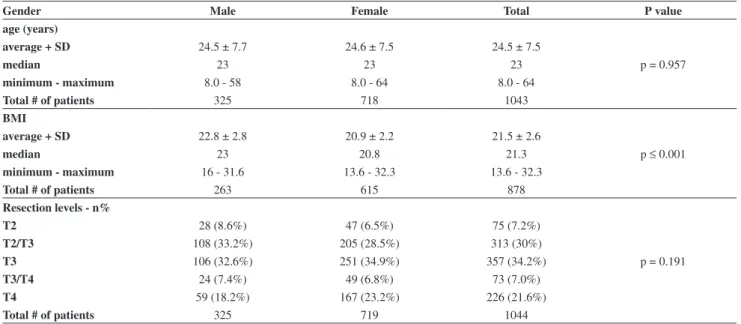
The age distribution, body mass index (BMI), and resection levels of all patients are shown in Table 1.
The groups were similar in age at the time of the treatment. In addition, all of the patients presented with a BMI in the normal range (between 20 and 25). All of the patients underwent similar treatment following the same protocol and level of ganglion resection.
Until 2002, we performed sympathectomy at the T2 and T3 levels. In 2003, we performed sympathectomy at only the T2 level. In 2004, the procedure was performed at T3 and T4, and in 2005 at the T3 level. Since 2007, we have performed the procedure at the T3 or T4 levels. The treatment was in accordance with the hospital’s ethical standards as set by the Ethics Committee for Analysis of Research Projects on Human Experimentation.
All patients underwent bilateral VATS sympathectomy with two 5-mm incisions. The irst incision was made in the fourth submammary intercostal space to introduce the camera (30º), and the second incision was in the second mid-axillary intercostal space to provide a route of entry for the surgical instruments. Ablation using an electrical or harmonic scalpel was the chosen technique in all cases.10,11
No mortality or conversion to open surgery occurred in our series. Surgical failure occurred in four (1.2%) male patients and in nine (1.2%) female patients.
All of the patients underwent two evaluations for the purpose of this study: before surgery and one month after surgery. During each visit, the patient’s quality of life was assessed using a standard clinical protocol.2,12 Postoperative incidence and intensity of compensatory hyperhidrosis was also studied.
Quality of life was classiied according to ive different satisfaction levels based upon the summed total score from the protocol (range from 20 to 100) before and after the surgery. A summed total score of greater than 84 before surgery indicated a very poor quality of life (from 69 to 84, poor; from 52 to 68, good; from 36 to 51, very good; and from 20 to 35, excellent). A summed total score of greater than 84 after surgery was considered much worse (from 69 to 84, a little worse; from 52 to 68, the same; from 36 to 51, a little better; and from 20 to 35, much better).3
A chi-squared test was used to evaluate differences between genders. P-values ≤ 0.05 were considered to indicate statistical signiicance.
RESULTS
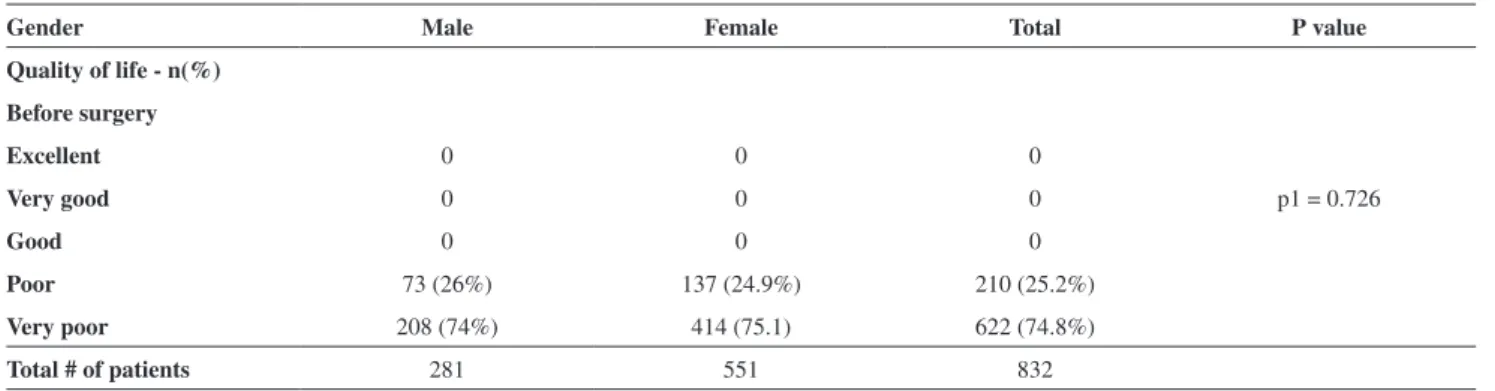
The quality of life before surgery is shown in Table 2. There were no statistically signiicant differences between genders in regard to quality of life in palmar hyperhidrosis patients (p = 0.726).
All patients presented with a poor quality of life before
Table 1 - Descriptive analysis of each gender.
Gender Male Female Total P value
age (years)
average + SD 24.5 ± 7.7 24.6 ± 7.5 24.5 ± 7.5
median 23 23 23 p = 0.957
minimum - maximum 8.0 - 58 8.0 - 64 8.0 - 64
Total # of patients 325 718 1043
BMI
average + SD 22.8 ± 2.8 20.9 ± 2.2 21.5 ± 2.6
median 23 20.8 21.3 p ≤ 0.001
minimum - maximum 16 - 31.6 13.6 - 32.3 13.6 - 32.3
Total # of patients 263 615 878
Resection levels - n%
T2 28 (8.6%) 47 (6.5%) 75 (7.2%)
T2/T3 108 (33.2%) 205 (28.5%) 313 (30%)
T3 106 (32.6%) 251 (34.9%) 357 (34.2%) p = 0.191
T3/T4 24 (7.4%) 49 (6.8%) 73 (7.0%)
T4 59 (18.2%) 167 (23.2%) 226 (21.6%)
Total # of patients 325 719 1044
585
CLINICS 2010;65(6):583-6 Gender as predictive factor in sympathectomy
Wolosker N et al.
Copyright © 2010 CLINICS
the treatment, with a predominance of “very poor” ratings (71.2%). No statistical difference was found between genders at this time point.
The quality of life in the postoperative period is presented in Table 3. In the interview performed 30 days after surgery, the quality of life in the two groups had improved, with no statistical difference between the groups.
DISCUSSION
Palmar hyperhidrosis is a disease that causes deep psycho-social disorders in patients, leading to a poor quality of life regardless of gender. This observation indicates the signiicant need for a deinitive treatment of this disease.14
All of the patients evaluated in this study came from the same clinic and were operated on by the same surgical team using similar technical criteria for both groups.15 The level of resection used in each case was the best at the time that the surgeries were performed. There was no outcome difference between the groups in regard to the level of resection. We observed a similar distribution of the types of resection for both genders, which made the type of resection homogeneous.
Generic methods of assessing the quality of life do not allow for the evaluation of changes in the quality of life for patients with hyperhidrosis. The quality of life protocol
employed in this study has been validated and has been used in several studies in the literature that have focused on hyperhidrosis symptoms in different daily life situations and their inluence on the overall quality of life in patients.
We observed a predominance of women (66.3%) in our study population, which can be explained by the greater esthetic/social concern that these patients present regarding this problem, leading them to seek medical attention.16
In the postoperative period, assuming no technical failure, there is a substantial change in the patient’s daily life. This change has been veriied by the individual’s level of satisfaction and by their overall improvement in quality of life.17,18 This improvement is maintained from the irst month until 12 months following surgery.20
We performed sympathectomies from 2000 to 2008 during different seasons. We followed patients that returned from summer to summer, without identifying a difference between the groups.
It is well known that patients with palmar hyperhidrosis present with a poor quality of life19 that is dependent on the intensity of the hyperhidrosis20 and on how well the patient adapts to his or her situation.21 Some individuals do not have very severe hyperhidrosis, but they present with a very poor quality of life, whereas other patients with severe hyperhidrosis may report a not-so-poor quality of life
Table 2 - Quality of life before surgery.
Gender Male Female Total P value
Quality of life - n(%)
Before surgery
Excellent 0 0 0
Very good 0 0 0 p1 = 0.726
Good 0 0 0
Poor 73 (26%) 137 (24.9%) 210 (25.2%)
Very poor 208 (74%) 414 (75.1) 622 (74.8%)
Total # of patients 281 551 832
Table 3 - Quality of life after surgery.
Gender Male Female Total P value
Quality of life - n(%)
After surgery
Much better 222 (83.5%) 416 (79.2%) 638 (80.7%)
Better 36 (13.5%) 77 (14.7%) 113 (14.3%) p2 = 0.097
The same 5 (1.9%) 23 (4.4%) 28 (3.5%)
A little worse 1 (0.4%) 8 (1.5%) 9 (1.1%)
Much worse 2 (0.8%) 1 (0.2%) 3 (0.4%)
586
CLINICS 2010;65(6):583-6 Gender as predictive factor in sympathectomy
Wolosker N et al.
Copyright © 2010 CLINICS
(adapted patients). In our study, we only operated on patients indicating a poor or very poor quality of life.
The only preoperative factors currently associated with a decrease in the quality of life after thoracic sympathectomy for treatment of palmar hyperhidrosis are surgical failure, higher levels of ganglion resection, and resections at various levels. In an attempt to ind a new prognostic factor, we veriied the same levels of quality of life (much better) in the postoperative period in all of the patients, regardless of their gender.
VATS is a very safe surgery that immediately eliminates the intense suffering of the patients,22 generating a high level of satisfaction for all patients.
CONCLUSION
Patients with palmar hyperhidrosis present with an improvement in quality of life after VATS regardless of their gender.
REFERENCES
1. Lear W, Kessler E, Solish N, Glaser DA. An epidemiological study of
hyperhidrosis.Dermatol Surg. 2007 Jan;33(1 Spec No.):S69-75.
2. Alric P, Branchereau P, Berthet JP, Leger P, Mary H, Mary-Ane C. Video-assisted thoracoscopic sympathectomy for palmar hyperhidrosis: results in 102 cases. Ann Vasc Surg. 2002;16:708-13.
3. De Campos JRM, Kauffman P, Werebe E de C, Andrade Filho LO, Kusniek S, Wolosker N, et al. Quality of life, before and after thoracic sympathectomy: report on 378 operated patients. Ann Thorac Surg. 2003;76:886-91.
4. Bachmann K, Standl N, Kaii J, Busch P, Winkler E, Mann O, et al. Thoracoscopic sympathectomy for palmar and axillary hyperhidrosis: four-year outcome and quality of life after bilateral 5-mm dual port
approach.Surg Endosc. 2009;23:1587-93.
5. Chwajol M, Barrenechea IJ, Chakraborty S, Lesser JB, Connery CP, Perin NI. Impact of compensatory hyperhidrosis on patient satisfaction
after endoscopic thoracic sympathectomy.Neurosurgery.
2009;64:511-8; discussion 518.
6. Sugimura H, Spratt EH, Compeau CG, Kattail D, Shargall Y. Thoracoscopic sympathetic clipping for hyperhidrosis: long-term results and reversibility. J Thorac Cardiovasc Surg. 2009;137:1370-6; discussion 1376-7.
7. Chang YT, Li HP, Lee JY, Lin PJ, Lin CC, Kao EL, et al. Treatment of
palmar hyperhidrosis: T(4) level compared with T(3) and T(2). Ann
Surg. 2007;246:330-6.
8. Neumayer CH, Bischof G, Függer R, Imhof M, Jakesz R Plas EG, et al. Eficacy and safety of thoracoscopic sympathectomy for hyperhidrosis of the upper limb. Results of 734 sympathectomies. Ann Chir Gynaecol. 2001;90:2000-2.
9. de Campos JR, Wolosker N, Takeda FR, Kauffman P, Kuzniec S, Jatene FB, et al. The body mass index and level of resection: predictive factors
for compensatory sweating after sympathectomy.Clin Auton Res.
2005;15:116-20.
10. Munia MA, Wolosker N, Kauffman P, de Campos JRM, Puech-Leão P. A randomized Trial of T3-T4 versus T4 sympathectomy for isolated axillary hyperhidrosis. J Vasc Surg. 2007;45:130-3.
11. Ribas Milanez de Campos J, Kauffman P, Wolosker N, Munia MA, de Campos Werebe E, Andrade Filho LO, et al. Axillary hyperhidrosis: T3/T4 versus T4 thoracic sympathectomy in a series of 276 cases. J Laparoendosc Adv Surg Tech A. 2006;16:598-603.
12. Yazbek G, Wolosker N, de Campos JR, Kauffman P, Ishy A, Puech-Leão P. Palmar hyperhidrosis--which is the best level of denervation using video-assisted thoracoscopic sympathectomy: T2 or T3 ganglion? J Vasc Surg. 2005;42:281-5.
13. Bachmann K, Standl N, Kaii J, Busch P, Winkler E, Mann O, et al. Thoracoscopic sympathectomy for palmar and axillary hyperhidrosis: four-year outcome and quality of life after bilateral 5-mm dual port
approach.Surg Endosc. 2009;23:1587-93.
14. Grunfeld A, Murray CA, Solish N. Botulinum toxin for hyperhidrosis: a review. Am J Clin Dermatol. 2009;10:87-102.
15. Shachor D, Jedeikin R, Olsfanger D, Bendahan J, Sivak G, Freund U. Endoscopic transthoracic sympathectomy in the treatment of primary hyperhidrosis. A review of 290 sympathectomies. Arch Surg. 1994;129:241-4.
16. Lin CC, Wu HH. Lin-Telaranta classiication: the importance of different procedures for different indications in sympathetic surgery. Ann Chir Gynaecol. 2001;90:161-6.
17. O’riordain DS, Maher M, Waldron DJ, O’Donovan B, Brady MP. Limiting the anatomic extent of upper thoracic sympathectomy for primary palmar hyperhidrosis. Surg Gynecol Obstet. 1993;176:151-4.
18. Doblas M, Gutierrez R, Fontcuberta J, Orgaz A, Lopez P, Criado E. Thoracodorsal sympathectomy for severe hyperhydrosis: posterior bilateral versus unilateral staged sympathectomy. Ann Vasc Surg. 2003;17:97-102.
19. Yazbek G, Wolosker N, Kauffman P, de Campos JR, Puech-Leão P, Jatene FB. Twenty Months of Evolution Following Sympathectomy on Patients with Palmar Hyperhidrosis: Sympathectomy at the T3 Level is Better than at the T2 Level. Clinics. 2009;64:743-9.
20. Munia MA, Wolosker N, Kaufmann P, de Campos JR, Puech-Leão P. Sustained benefit lasting one year from T4 instead of T3-T4 sympathectomy for isolated axillary hyperhidrosis. Clinics. 2008;63:771-4.
21. Wolosker N, Yazbek G, Ishy A, de Campos JR, Kauffman P, Puech-Leão P. Is sympathectomy at T4 level better than at T3 level for treating palmar hyperhidrosis? J Laparoendosc Adv Surg Tech A. 2008;18:102-6.