IMPACTUL GENULUI ŞI A VÂRSTEI ASUPRA DURATEI ŞOMAJULUI PERSOANELOR ISCED 5
Lect. univ. dr. Daniela-Emanuela Dănăcică Facultatea de Ştiin e Economice şi Gestiunea Afacerilor,
Universitatea Constantin Brâncuşi din Târgu-Jiu, Romania, [email protected]
Prof. univ. dr. Ana Gabriela Babucea
Facultatea de Ştiin e Economice şi Gestiunea Afacerilor, Universitatea Constantin Brâncuşi din Târgu-Jiu,
Romania, [email protected]
Prof. univ. dr. Doru Cîrnu
Facultatea de Ştiin e Economice şi Gestiunea Afacerilor, Universitatea Constantin Brâncuşi din Târgu-Jiu,
Romania, [email protected]
Rezumat
Scopul principal al acestui studiu este acela de
a analiza impactul vârstei şi genului asupra duratei
şomajului persoanelor aparţinând nivelului educaţional
ISCED 5, înregistrate ca “şomer” pe piaţa muncii
judeţului Gorj. Rezultatele obţinute arată că vârsta are
un impact negativ semnificativ asupra duratei şomajului,
în timp ce variabila gen nu influenţează semnificativ
durata şomajului şi şansa de angajare a subiecţilor
analizaţi.
Cuvinte cheie: şomaj, probabilitate, hazard, angajare
Acknowledgments: Acest studiu a fost finan at de către Universitatea Constantin Brâncuşi din Târgu-Jiu, România. prin grantul UCB-TP-T nr. 433C/2010.
1. Introducere
Scopul acestui studiu este de a determina impactul variabilelor gen şi vârstă asupra duratei
şomajului persoanelor apar inând nivelului educa ional ISCED 5, înregistrate ca “şomer” la Agen ia Na ională pentru Ocuparea For ei de Muncă Bucureşti. Conform manualului indicatorilor na ionali pentru educa ie elaborat de Ministerul Educa iei, Cercetării, Tineretului
şi Sportului, clasificarea nivelurilor educa ionale în România este următoarea: ISCED 0 - nivel pre-primar, ISCED 1- nivel primar, ISCED 2 – învă ământ gimnazial, ISCED 3 - învă ământ secundar superior (liceal), ISCED 4 – învă ământ post-secundar
non-DOES AGE AND GENDER INFLUENCE THE DURATION OF UNEMPLOYMENT FOR ISCED 5
UNEMPLOYED PERSONS?
Lecturer PhD. Daniela-Emanuela Dănăcică Faculty of Economics and Business Administration, Constantin Brâncuşi University of Târgu-Jiu, Romania,
Professor PhD. Ana-Gabriela Babucea Faculty of Economics and Business Administration, Constantin Brâncuşi University of Târgu-Jiu, Romania,
Professor PhD. Doru Cîrnu
Faculty of Economics and Business Administration, Constantin Brâncuşi University of Târgu-Jiu, Romania,
Abstract
The aim of this study was to determine the impact of age and gender for the duration of unemployment for the ISCED 5 subjects registered as unemployed on the labor market of Gorj County. The obtained results show that age has a significant negative impact for the duration of unemployment, while gender doesn’t have a significant impact for the duration of unemployment of analyzed ISCED 5 subjects.
Key words: unemployment, probability, hazard, employment
Acknowledgments: This study was supported by the research grant UCB-TP-T no. 433 C/2010, funded by Constantin Brancusi University of Targu-Jiu, Romania.
1. Introduction
ter iar, ISCED 5, învă ământ ter iar, primul ciclul, ISCED 6 – învă ământ ter iar, ciclu secundar (masterat + doctorat).
În cadrul acestui studiu, subiec ii supuşi analizei statistice sunt persoanele înregistrate ca şomer în perioada 1 ianuarie 2004-31 decembrie 2006, absolven i de studii superioare, forma scurtă (colegiu) sau învă ământ superior de lungă durată. Eşantionul cuprinde 3672 înregistrări, cu informa ii referitoare la data de intrare în şomaj, data de ieşire din şomaj, gen, vârstă, tipul nivelului educa ional (colegiu sau învă ământ superior de lungă durată), motivul ieşirii din
şomaj pentru fiecare subiect înregistrat. Ca metodologie am utilizat analiza datelor de supravie uire. Structura lucrării este următoarea: 1. Introducere, 2. Literatură, 3. Descrierea bazei de date, 4. Analiza empirică, 5. Concluzii.
2. Literatură
Pe plan interna ional, Kooreman şi Ridder (1983) au demonstrat în studiul lor o asociere negativă între vârstă şi durata şomajului pe pia a muncii din Olanda. Kupets (2006), într-un studiu realizat pentru Ucraina arată că vârsta are un impact negativ asupra probabilităii de angajare a persoanelor înregistrate ca
şomer. D’Agostino şi Mealli (2000) dezvoltă un model Cox cu hazard propor ional pentru a studia factorii ce influen ează durata şomajului în 9 ări europene, iar rezultatele ob inute arată că în Portugalia, Fran a şi Danemarca dificultăi de a ieşi din şomaj întâmpină, în principal, persoanele în vârstă, în timp ce tinerii au şanse mai mici de angajare în Italia, Marea Britanie şi Spania. Kavkler şi Borsic (2009) demonstrează că modificarea cu un an în sensul creşterii a variabilei vârstă determină o scădere cu 2.4 % a ratei hazardului de a ieşi din şomaj pentru persoanele înregistrate ca şomer. Acelaşi rezultat l-au ob inut şi Tevdovski şi Tosevska (2009) pentru Macedonia (1% reducere a ratei hazardului a ieşi din
şomaj), Boehm (2009) pentru Austria (2,4% reducere a ratei hazardului a ieşi din şomaj) şi Bicanic (2009) pentru Croa ia (2,4% reducere a ratei hazardului a ieşi din şomaj). În ceea ce priveşte impactul variabilei gen asupra duratei şomajului, studiul lui Hunt (2004) pentru Germania demonstrează că există diferen e de gen privind durata şomajului pentru subiec ii germani înregistra i ca şomeri. Rezultatele estimării influen ei factorului gen asupra duratei şomajului au arătat că pentru Belgia, Grecia, Fran a, Spania, Danemarca şi Portugalia femeile au o probabilitate mai mică de a ieşi din şomaj (D’Agostino şi Mealli, 2000). Rezultate asemănătoare au ob inut Tansel şi Tasci (2005) pentru Turcia, Kavkler şi Borsic pentru Slovenia, Tevdovski şi Tosevska (2009) pentru Macedonia şi Bicanic (2009) pentru Croa ia. În contrast, Boehm (2009) arată că femeile au o probabilitate mai bună de a ieşi din şomaj pe pia a muncii din Austria.
education, second level (master + PhD).
During this study we focused on the ISCED 5 unemployed subjects registered at the National Agency of Employment during 1st January 2004 until 31st December 2006. The sample contains 3672 registrations, with information concerning the start date and the end date of the unemployment spells, gender, age, level of education (college or university) and the reason of unemployment leaving for each registered person. As a methodology we used the survival analysis. The rest of the paper is organized as follows: 2. Literature review, 3. Database description, 4. Empirical Analysis and 5. Conclusions.
2. Literature review
At international level, Kooreman and Ridder (1983) demonstrated in their study a negative association between age and unemployment duration on the Dutch Labor Market. Kupets (2006) in a study for Ukraine shows that age has a negative impact for the employment probability. In a study published in 2000 D’Agostino and Mealli proved that in Portugal, France, and Denmark difficulties in leaving unemployment are encountered mainly by older subjects, whereas the young and the old subjects have lower probabilities for reemployment in Italy, the UK, and Spain. Kavkler and Borsic (2009) show that on year increase of the age variable led to a 2.4 % decrease of employment probability for the analyzed subjects. The same result was obtained by Tevdovski and Tosevska (2009) for Macedonia (1% decrease of the hazard rate of employment probability), Boehm (2009) for Austria (2.4% decrease of the hazard rate of employment probability) and Bicanic (2009) for Croatia (2.4% decrease of the hazard rate of employment probability). Regarding the gender variable, Hunt (2004) in a study made for Germany showed that there is gender gap regarding the duration of unemployment for German unemployed persons. D’Agostino and Mealli (2000) results show that in Belgium, Greece, France, Spain, Denmark, and Portugal women have lower probabilities of leaving unemployment compared with the male subjects. Similar results were obtained by Tansel and Tasci (2005) for Turkey, Kavkler and Borsic (2009) for Slovenia, Tevdovski and Tosevska (2009) for Macedonia and Bicanic (2009) for Croatia. In contrast, Boehn (2009) shows that women have a higher probability of employment on the Austrian labor market, during 2000-2003.
Pe plan na ional, Dănăcică şi Babucea (2007, 2008 şi 2009) au analizat efectul variabilelor vârstă, gen, nivel educa ional asupra duratei şomajului şi a probabilităii de angajare pentru persoanele înregistrate ca şomere în jude ul Gorj. Nu există însă nici un studiu care să analizeze impactul variabilelor gen şi vârstă asupra grupului de şomeri ISCED 5.
3. Descrierea bazei de date
În perioada 1 ianuarie 2004-31 decembrie 2006 la Agen ia Na ională pentru Ocuparea For ei de Muncă Bucureşti au fost înregistra i ca şomer, la nivelul jude ului Gorj, 3672 subiec i apar inând nivelului educa ional ISCED 5. Durata minimă a şomajului pentru grupul ISCED 5 a fost de 0 zile, iar durata maximă de 974 zile, cu o medie de 136 zile, şi o mediană de 158 zile. Din cei 3672 subiec i înregistra i, 2093 sunt femei
şi 1579 bărba i (57%, respectiv 43%). Durata medie a
şomajului pentru femei este de 121 zile, iar durata medie a şomajului pentru bărba i a fost de 154 zile. 43,6 % din persoanele ISCDE 5 înregistrate ca şomer apar in grupei de vârstă 22-24 ani, 29,1% grupei de vârstă 25-34 ani, 13,5 % apar in grupei de vârstă 35-44 ani, 11,4 % apar in grupei de vârstă 45-54 ani şi 2.1 % apar in grupei de vârstă 55-64 ani. Aşa cum se poate observa din cifrele prezentate, numărul mare de şomeri apar inând grupei de vârstă 22-24 ani arată dificultatea tinerilor absolven i de a-şi găsi un loc de muncă la finalizarea studiilor, pe pia a jude ului nostru. Din cei 3672 subiec i înregistra i, 6,9% sunt absolven i de colegiu şi 93,1% sunt absolven i de învă ământ superior, formă lungă. Durata medie a
şomajului pentru absolven ii de colegiu este de 86 zile, iar durata medie a şomajului pentru absolven ii de învă ământ superior formă lungă este de 140 zile.
4. Analiza empirică
Ca abordare metodologică, pentru analiza empirică a studiului nostru am folosit analiza datelor de supravie uire, respectiv metoda Kaplan Meier şi regresia Cox. Rezultate sunt prezentate în cele ce urmează.
4.1.Rezultatele analizei Kaplan-Meier
Pentru studiul nostru evenimentul prestabilit este angajarea, acestui eveniment atribuindu-se valoarea 1. Subiec ii ce nu au realizat evenimentul, sau nu au dată de ieşire din şomaj au fost cenzura i la dreapta, atribuindu-li-se valoarea 0. Din cei 3672 subiec i observa i, doar 35% au realizat evenimentul, angajarea, 65% dintre ei fiind cenzura i la dreapta.
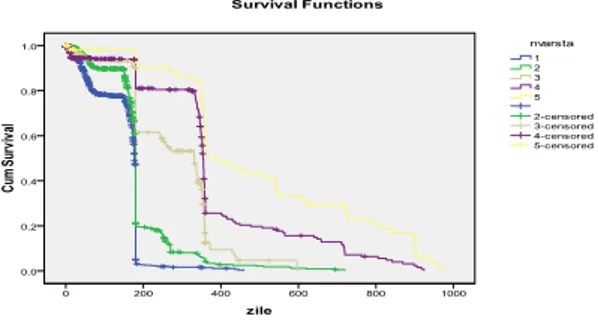
În figura 1 sunt reprezentate curbele de supravie uire pentru fiecare grupă de vârstă a subiec ilor analiza i.
Figura 1: Curbe de supravieţuire pentru grupele de
vârstă 21-24 ani, 25-34 ani, 35-44, 45-54, 55-64 ani
and probability of (re) employment for unemployed persons on the Gorj County labor market. Until now, there is no study focused on the impact of age and gender for the duration of unemployment of the ISCED 5 group.
3. Database description
During 1st January 2004 – 31st December 2006, 3672 subjects were registered as unemployed at the National Agency for Employment for Gorj County, belonging to the ISCED 5 educational level. The minimum duration of unemployment was 0 days, the maximum 974 days, with an average of 135 days and a median of 158 days. From 3672 registered subjects, 2093 are women and 1578 men (57%, respectively 43%). Median duration of unemployment for women is 121 days and for men is 154 days. 43.6% of ISCED unemployed subjects belong to the age group 22-24 years, 29.1% to the 25-34 years group, 13.5% belong to the 35-44 age group, 11.4% belong to the 45-54 age group and 2.1% belong to the 55-64 age group. As we can notice, the high number of young persons registered as unemployed show the difficulties of young graduates to find a job after finishing school, on the labor market of our county. From 3672 registered subjects, 6.9% are college graduates and 92.1% are university graduates. Median duration of unemployment for college graduates is 86 days, and median duration for unemployment for university graduates is 140 days.
4. Empirical analysis
We used survival analysis (Kaplan-Meier method and Cox regression) in our study, as a methodological approach. The results are presented in the following:
4.1.Kaplan-Meier results
The pre-established event for our study is employment, this event being ascribed the
value 1. The subjects that didn’t achieve the event, or their track has been lost (they don’t have the date of unemployment leaving) were right censored, being ascribed the value 0. From the 3672 observed subjects, only 35% did achieve the event–employment; 65% subjects were right censored.
In figure 1 there is presented the survival curve for each age group of the analyzed subjects.
ISCED 5.
Analizând curbele de supravie uire observăm că pe măsură ce vârsta unei persoane apar inând grupului ISCED 5 creşte, creşte şi probabilitatea de a rămâne în
şomaj a acestuia. Astfel, cel mai avantajat grup pe pia a muncii este grupa 15-24 ani, iar cea mai dezavantajată este grupa 55-64 ani. Testul Log Rank arată că diferen ele observate între grupele de vârstă ale
şomerilor ISCED 5 sunt semnificative din punct de vedere statistic.
În figura 2 sunt prezentate curbele de
supravie uire pentru subiec ii bărba i şi femei ISCED 5 înregistra i ca şomeri în jude ul nostru.
Figura 2: Curbe de supravieţuire pentru femeile şi
bărbaţii şomeri ISCED 5
Analizând curbele de supravie uire observăm că probabilitatea de a rămâne în şomaj este mai mare pentru bărba ii ISCED 5 comparativ cu femeile. Femeile au o probabilitate de a îşi găsi un loc de muncă mai mare comparativ cu bărba ii. Rezultatele testului Log Rank arată că diferen ele observate sunt semnificative.
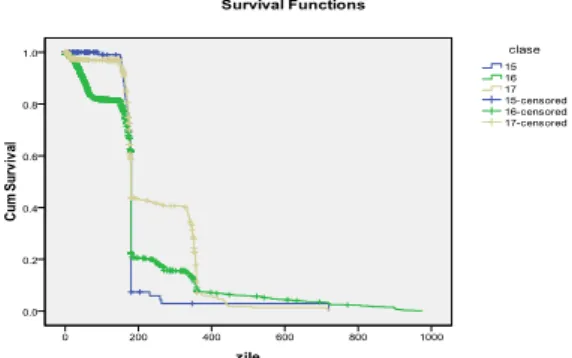
Am analizat de asemenea şi poten iale diferen e între absolven ii de învă ământ superior, formă scurtă şi absolven ii de învă ământ superior, formă lungă, în ceea ce priveşte durata şomajului. În figura 3 sunt prezentate curbele de supravie uire pentru şomerii ISCED 5 absolven i de colegiu, respectiv învă ământ superior de lungă durată.
Figura 3: Curbe de supravieţuire pentru şomerii ISCED
5 absolvenţi de colegiu, respectiv învăţământ superior
de lungă durată
years, 35-44 years, 45-54 years and 55-64 years, ISCED 5 subjects
Analyzing the figure 1 we observe that with the increase of age increase also the probability of remaining unemployed for a ISCED 5 subjects. The most advantaged group on the Gorj county labor market is 21-24 years group, and the most disadvantaged is the 55-64 year group. The result of the Log Rank test shows that the observed differences between these age groups are statistically significant.
In the figure 2 are presented the survival curves for the male and female ISCED 5 unemployed persons registered in our county.
Figure 2: Survival curves for male and female ISCED 5 unemployed persons.
Analyzing the figure 2 we observe that we have a higher statistically significant probability of remaining unemployed for male compared to the female ISCED 5 subjects.
Analizând curbele de supravie uire prezentate în figura 3 observăm că, paradoxal, şomerii ISCED 5 absolven i de colegiu au şanse mai mari de a ieşi din
şomaj comparativ cu subiec ii absolven i de învă ământ de lungă durată. Cei mai dezavantaja i sunt persoanele având cel mai mare nivel educa ional (17 ani studiu). O posibilă explica ie pentru această situa ie este faptul că, în general, absolven ii de învă ământ superior de lungă durată cu 17 ani de studiu, în perioada respectivă, erau absolven i de învă ământ superior tehnic, persoane dezavantajate pe pia a muncii jude ului nostru deoarece sectorul industrial a cunoscut în aceea perioadă restructurări masive.
4.2.Rezultatele regresiei Cox cu hazard proporţional
Pentru a determina impactul vârstei şi a genului asupra şomerilor ISCED 5 înregistra i la nivelul jude ului Gorj am folosit modelul Cox cu hazard propor ional. Vom avea:
)] ( ) ( [ 0
2 1
)
(
)
(
vârstă geni
t
t
e
β β
λ
λ
=
⋅
+(1)
unde vârsta şi genul sunt variabilele factoriale ale modelului Cox cu hazard propor ional,
β
1şiβ
2 suntcoeficien ii de regresie corespunzători,
λ
i( )
t
estehazardul calculat pentru fiecare unitate individuală i, iar
0
( )
t
λ
este hazardul de bază. Hazardul reprezintă riscul angajării pentru un subiect care a rămas în şomaj până la aceea dată.Prelucrarea datelor a fost realizată cu ajutorul programului SPSS 16.0. Metoda selectată pentru regresia Cox a fost metoda Enter, variabilele factoriale fiind analizate simultan. În tabelul 1 sunt prezentate rezultatele testului Omnibus pentru coeficien ii de regresie.
Rezultatele testului
χ
2şi ale ratei de verosimilitate -2LL înregistrate la pasul 1 comparativ cu pasul ini ial 0 ne-au permit respingerea ipotezei nule (H
0:
β
=
0
) şiacceptarea ipotezei alternative, modelul este valid.
Tabelul 1: Rezultate test Omnibus pentru coeficienţii de regresie
Figure 3: Survival curves for ISCED 5 unemployed subjects, college and university graduates
Analyzing the results presented in the figure 3 we observe that, paradoxical, the ISCED 5 unemployed subjects that are college graduates have better chances to leave unemployment, compared to the university graduates unemployed subjects. The most disadvantaged are the subjects with the higher educational level (17 years of study). A possible explanation for this situation is the fact that, in general, during the analyzed period the university graduates with 5 years of university studies were the persons that graduated technical universities. These persons are disadvantaged on the labor market of our county, due to the fact that, during 2002-2004, the industrial sector traversed a period with large dismissals.
4. Cox proportional hazard model results
We used the Cox proportional hazard model to determine the impact of age and gender for the duration of unemployment of the ISCED 5 group. We have:
)] ( ) ( [ 0
2 1
)
(
)
(
vârstă geni
t
t
e
β β
λ
λ
=
⋅
+(1)
where age and gender are the independent variables of the Co model,
β
1,β
2, are the regression coefficients,λ
i( )
t
is thazard calculated for each individual subject and
λ
0( )
t
is tbaseline hazard. The hazard represents the probability of t event (employment in our case) for a subject that survived un that moment.
We used the SPSS 16.0 to compute the data. T selected method for the Cox proportional hazard model was th Enter method; age and gender were simultaneous analyzed. table 1 are presented the results of the Omnibus tests for t
regression coefficients. The results of the
2
χ
test and of tmaximum likelihood test registered at the step 1 compared the initial step allowed us to reject the null hypothesis and accept the alternative hypothesis; the model is valid.
Rezultatele regresiei Cox sunt prezentate în tabelul 2. Factorul de referină este ultima categorie, grupa de vârstă 55-64 ani pentru variabila vârstă, şi respectiv masculin pentru variabila gen. Nivelurile estimate ale coeficien ilor de regresie
β
sunt notate cu B. Exp(B) reprezintă creşterea sau descreşterea estimată a hazardului, la o modificare cu o unitate a variabilelor factoriale.Tabelul 2: Rezultatele regresiei Cox Variables in the Equation
B SE Wald df Sig. Exp(B)
Vârst a
110.35
6
4 .00 0 21-24 1.47
1
.312 22.268 1 .00 0
4.351
25-34 1.58 2
.312 25.718 1 .00 0
4.865
35-44 2.08 1
.314 44.0 9
1 .00 0
8.010
45-54 1.16 3
.317 13.499 1 .00 0
3.199
Gen -.096
.058 2.751 1 .09 7
.908
Analizând rezultatele regresiei Cox prezentate observăm că rata hazardului de a ieşi din şomaj este de 4.351 pentru grupa 21-24 ani comparativ cu grupa factor de referină, 55-64 ani, de 4.865 pentru grupa 25-34 şi de 8.010 pentru grupa 35-44 ani, grupă ce se situează cel mai bine în ceea ce priveşte hazardul de a se produce evenimentul, angajarea. Observăm şi că impactul factorului gen asupra duratei şomajului pentru persoanele ISCED 5 nu este semnificativ din punct de vedere statistic. Am analizat şi ratele hazardului producerii evenimentului, angajarea, pentru subiec ii ISCED 5 absolven i de colegiu şi subiec ii ISCED 5 absolven i de învă ământ de lungă durată (4 ani), comparativ cu absolven ii ISCED 5 - învă ământ de lungă durată, 5 ani. Surprinzător, ratele hazardului de producere a evenimentului, angajarea, sunt mai mari pentru absolven ii de colegiu comparativ cu absolven ii de învă ământ superior de lungă durată. Cei mai dezavantaja i în ceea ce priveşte găsirea unui loc de muncă sunt absolven ii de învă ământ tehnic de lungă durată. Rezultatele ob inute sunt semnificative din punct de vedere statistic. Am testat presupunerea hazardului propor ional pentru variabila vârstă; hazardurile de bază pentru categoriile variabilei vârstă nu se intersectează, deci
Ove all (score)
Change From Previous Step -2 Log
Likelihood square df Sig. Chi- square dfChi- Sig.
1 416.355 119.65 5
5 .000 119.139 5 .000
The results of the Cox regression are presented table 2. The reference factor is the last category, the ag group 55-64 years, respectively masculine for the gend variable. B is the estimate vector of the regressio coefficients. Exp (B) is the predicted change in the haza for each unit increase in the covariate.
Table 2: Cox regression results
Variables in the Equation
B SE Wald df Sig. Exp(B)
Age 110.35
6
4 .000
21-24 1.471 .31 2
22.268 1 .000 4.351
25-34 1.582 .31 2
25.718 1 .000 4.865
35-44 2.081 .31 4
44.039 1 .000 8.010
45-54 1.163 .31 7
13.499 1 .000 3.199
Gende r
-.096 .05 8
2.751 1 .097 .908
We can observe that the hazard rate is 4.351 for the age group 21-24 compared with the age group 55-64 years, 4.865 for the age group 25-34 compared with the last category, and 8.010 for the age group 35-44 years. The most advantaged group is the group of 35-44 years. We also observe that the impact of gender on the duration of unemployment for ISCED 5 unemployed subjects is not statistically significant.
The authors analyzed also the hazard rate for the college graduates subjects and for the university graduate subjects. Surprisingly, the hazard rates of the event, employment, are higher for college graduates compared with the university graduates. The most disadvantaged ISCED 5 subjects on the labor market of our county are the persons who graduate the technical universities. The obtained results are statistically significant. We tested the proportional hazard assumption for the age variable. The baseline hazards for the age variable were proportional, therefore the proportional hazard assumption is not violated, and the Cox proportional hazard model is suited for estimating the impact of age and gender for the duration of unemployment of ISCED 5 subjects.
Overall (score)
Change From Previous Step -2 Log
Likelihoo
d squareChi- df Sig. square Chi- df Sig.
19416.355 119.65 5
presupunerea hazardului propor ional nu este încălcată, modelul ales estimând corect impactul variabilelor vârstăşi gen asupra duratei şomajului persoanelor ISCED 5.
5. Concluzii
Scopul principal al acestui studiu a fost acela de a cuantifica impactul variabilelor vârstăşi gen asupra duratei
şomajului subiec ilor ISCED 5 înregistra i la Agen ia Na ională pentru Ocuparea For ei de Muncă, pentru jude ul Gorj. Eşantionul supus analizei a cuprins 3672 înregistrări, cu informa ii referitoare la data de intrare în şomaj, data de ieşire din şomaj, gen, vârstă, tipul nivelului educa ional (colegiu sau învă ământ superior de lungă durată), motivul ieşirii din
şomaj pentru fiecare subiect înregistrat. Ca metodologie am utilizat analiza datelor de supravie uire. Rezultatele ob inute arată că pe măsură ce vârsta unei persoane creşte, hazardul de a ieşi din şomaj prin realizarea evenimentului, angajarea, scade cu 0.5%. Pe grupe de vârstă, cea mai mare rata a hazardului de a ieşi din şomaj o are grupa de vârstă 35-44 ani, iar cea mai defavorizată este grupa 55-64 ani. Durata
şomajului pentru grupa de vârstă 35-44 ani este de 124 zile, comparativ cu 254 zile pentru grupa 45-54, şi 428 zile pentru grupa 55-64 ani. În ceea ce priveşte genul unei persoane, rezultatele analizei econometrice au arătat că diferen ele observate între şomerii ISCED 5 de gen feminin şi masculin nu sunt semnificative din punct de vedere statistic. Autorii au analizat şi poten ialele diferen e în ceea ce priveşte durata
şomajului pentru absolven ii de colegiu, comparativ cu absolven ii de învă ământ de lungă durată (4, respectiv 5 ani). Rezultatele analizei econometrice au arătat că absolven ii de învă ământ de lungă durată au rate ale hazardului de a ieşi din
şomaj prin angajare mai mici decât absolven ii de colegiu. Pentru grupul ISCED 5 educa ia pare să aibă un efect negativ asupra duratei şomajului. Rezultatul trebuie analizat în corela ie cu profilul economic al jude ului Gorj. De asemenea ar fi foarte util de analizat corela ia dintre specializarea profesională a acestor subiec i şi durata şomajului lor. Din păcate autorii nu au avut la dispozi ie astfel de date. inând cont de faptul că, în perioada supusă analizei, învă ământul de lungă durată de 5 ani era specific învă ământului superior tehnic, putem totuşi concluziona că absolven ii de învă ământ superior tehnic sunt cei mai dezavantaja i în ceea ce priveşte găsirea unui loc de muncă, în perioada analizată.
Bibliografie
[1] Armitage P, B. G (1959) Statistical Methods in Medical Research, Blackwell.
[2] Berthoud, R. (2003), Multiple Disadvantage in Employment, Joseph Rowntree Foundation, The Homestead, 40 Water End, York YO30 6WP.
[3] Boehm, B., (2007), Effects of the Education Level on the Duration of Unemployment in Austria, SOR’07 Proceedings, page 261-266.
[4] Borsic D., Kavkler A. (2009), Modeling Unemployment Duration in Slovenia using Cox Regression Models, Transition Studies Review, Volume 16, Number 1 / May,
5. Conclusions
The aim of this study was to determine
the impact of age and gender for the duration of unemployment of the ISCED 5 unemployed persons registered at the National Agency for Employment for Gorj County. The sample contains 3672 registrations, with information concerning the start date and the end date of the unemployment spells, gender, age, educational level and the reason of unemployment leaving for each registered person. As a methodology we used the survival analysis. The obtained results show that one year increase of the age variable determines a 0.5% percent decrease of the hazard rate. The age group of 35-44 years has the higher hazard rate of event, employment, and the most disadvantaged age group is 55-64. The unemployment duration of the age group 35-44 is 124 days, compared with 254 days for the age group 45-54 and 428 days for the age group 55-64. Regarding the gender variable, the results of the statistical analysis show that the observed differences between male and female ISCED 5 are not statistical significant. The authors analyzed also the differenced between college graduates (short form of tertiary education) compared with university graduates (4 or 5 years of study). The results of our econometric analysis show that the university graduates have lower hazard rate of leaving unemployment compared with college graduates. For the ISCED 5 group education seems to have a negative effect on the unemployment duration. However, this result should be considered in conjunction with the economic profile of Gorj County. Also, it would be very useful to analyze the correlation between professional specialization of these persons and duration of their unemployment. Unfortunately, we didn’t have such a type of data. Given the fact that in the analyzed period, long term education (5 years) corresponds to technical education, we can draw the conclusion that technical university graduates are the most disadvantaged in terms of finding a job, during the observed period.
References
[1] Armitage P, B. G (1959) Statistical Methods in Medical Research, Blackwell.
[2] Berthoud, R. (2003), Multiple Disadvantage in
Employment, Joseph Rowntree Foundation, The
Homestead, 40 Water End, York YO30 6WP.
[3] Boehm, B., (2007), Effects of the Education Level on the Duration of Unemployment in Austria, SOR’07 Proceedings, page 261-266.
[4] Borsic D., Kavkler A. (2009), Modeling Unemployment Duration in Slovenia using Cox Regression Models, Transition Studies Review, Volume 16, Number 1 / May, 2009, 145-156.
2009, 145-156.
[6] D’Agostino, A., and F. Mealli (2000), Modelling Short Unemployment in Europe. Institute for Social & Economic Research Working Paper 06.
[7] Dănăcică, D.E., Babucea A.G. (2007), The Role of Education for the Duration of Unemployment in Gorj Country, Studia Universitatis Babes Bolyai – Oeconomica, ISSN 1220-0506, Nr.1, pag. 67-82.
[8] Dănăcică, D., and A. Babucea (2008), Modelarea
Duratei Somajului cu Ajutorul Analizei de Supravietuire,
Research in Cybernetics, Computational Economics and Statistics, nr.3-2008.
[9] Domadenik, P., and F. Pastore (2004), The Impact of Education and Training Systems on the Labour Market Participation of Young People in CEE Economies. A Comparison of Poland and Slovenia. GDN Research Competition III.
[10] Kooreman P., Ridder G. (1983), The Effects of Age and Unemployment Percentage on the Duration of
Unemployment, European Economic Review, Vol. 20
(1983), pp. 41-57.
[11] Greene, William H. (2003). Econometric Analysis. New York: Prentice-Hall.
[12] Hunt, J. (2004), Convergence and Determinants of Non Employment Durations in Eastern and Western Germany Journal of Population Economics 17 (2): 249–266.
[13] Kavkler A, Dănăcică, D.E., Babucea A.G., Boehm B., Bicanic I., Tevdovski D., Tosevska K., Borsic D., (2009). Cox Regression Models for Unemployment Duration in Romania, Austria, Slovenia, Croatia and Macedonia, Romanian Journal of Economic Forecasting, Vol. X, Issue 2/2009, pag. 81-105.
[14] Klein, J. P., L. Moeschberger (2005), Survival Analysis: Techniques for Censored and Truncated Data. New York: Springer Verlag.
[15] Kupets, O. (2006), Determinants of Unemployment Duration in Ukraine. Journal of Comparative Economics 34 (2): 228–247.
[16] Moffitt, R.A., (1999), New developments in econometric methods for labor market analysis. In: O. Ashenfelter, and D. Card (eds). Handbook of Labor Economics. Chapter 24: 1367-1397.
[17] Nivorozhkin, A. (2006), Essays on Unemployment Duration and Programme Evaluation. Economic Studies no. 149. Available at: http://www.handels.gu.se/epc/archive/ 00004686/
[18] Tansel, A. and H. M. Tasci (2005), Determinants of Unemployment Duration for Men and Women in Turkey. IZA Discussion Paper no. 1258.
[19] Therneau, Terry M., and Patricia M. Grambsch (2001), Modeling Survival Data: Extending the Cox Model. New York: Springer Verlag.
[20] Tunali, I. and R. Asaad (1992), Market Structure and Spells of Employment and Unemployment: Evidence from the Construction Sector in Egypt, Journal of Applied Econometrics, 7, 339-367.
Unemployment in Europe. Institute for Social & Economic Research Working Paper 06.
[7] Dănăcică, D.E., Babucea A.G. (2007), The Role of Education for the Duration of Unemployment in Gorj Country, Studia Universitatis Babes Bolyai – Oeconomica, ISSN 1220-0506, Nr.1, pag. 67-82.
[8] Dănăcică, D., and A. Babucea (2008), Modelarea
Duratei Somajului cu Ajutorul Analizei de Supravietuire,
Research in Cybernetics, Computational Economics and Statistics, nr.3-2008.
[9] Domadenik, P., and F. Pastore (2004), The Impact of Education and Training Systems on the Labour Market Participation of Young People in CEE Economies. A Comparison of Poland and Slovenia. GDN Research Competition III.
[10] Kooreman P., Ridder G. (1983), The Effects of Age and Unemployment Percentage on the Duration of
Unemployment, European Economic Review, Vol. 20
(1983), pp. 41-57.
[11] Greene, William H. (2003). Econometric Analysis. New York: Prentice-Hall.
[12] Hunt, J. (2004), Convergence and Determinants of Non Employment Durations in Eastern and Western Germany Journal of Population Economics 17 (2): 249–266.
[13] Kavkler A, Dănăcică, D.E., Babucea A.G., Boehm B., Bicanic I., Tevdovski D., Tosevska K., Borsic D., (2009). Cox Regression Models for Unemployment Duration in Romania, Austria, Slovenia, Croatia and Macedonia, Romanian Journal of Economic Forecasting, Vol. X, Issue 2/2009, pag. 81-105.
[14] Klein, J. P., L. Moeschberger (2005), Survival Analysis: Techniques for Censored and Truncated Data. New York: Springer Verlag.
[15] Kupets, O. (2006), Determinants of Unemployment Duration in Ukraine. Journal of Comparative Economics 34 (2): 228–247.
[16] Moffitt, R.A., (1999), New developments in econometric methods for labor market analysis. In: O. Ashenfelter, and D. Card (eds). Handbook of Labor Economics. Chapter 24: 1367-1397.
[17] Nivorozhkin, A. (2006), Essays on Unemployment Duration and Programme Evaluation. Economic Studies no. 149. Available at: http://www.handels.gu.se/epc/ archive/00004686/
[18] Tansel, A. and H. M. Tasci (2005), Determinants of Unemployment Duration for Men and Women in Turkey. IZA Discussion Paper no. 1258.
[19] Therneau, Terry M., and Patricia M. Grambsch (2001), Modeling Survival Data: Extending the Cox Model. New York: Springer Verlag.