SPITTLEBUG INFESTATION IN SUGARCANE AFFECTS
ETHANOLIC FERMENTATION
Gisele Cristina Ravaneli1; Leonardo Lucas Madaleno1; Leandro Eduardo Presotti1; Miguel
Angelo Mutton2; Márcia Justino Rossini Mutton1*
1
UNESP/FCAV Depto. de Tecnologia, Via de Acesso Prof. Paulo Donato Castellane s/n 14884900 Jaboticabal, SP - Brasil.
2
UNESP/FCAV - Depto. de Produção Vegetal. *Corresponding author <[email protected]>
ABSTRACT: The spittlebug (Mahanarva fimbriolata) has become a key pest of the sugarcane crop in Brazil with the increase of green-cane harvesting, causing stalk yield and cane quality losses. This research was undertaken to evaluate the effects of the spittlebug (Mahanarva fimbriolata) on cane quality and juice fermentation. The experiment was arranged in a completely randomized 5 × 2 factorial design, with five spittlebug infestation levels (0-0.5; 0.6-2.5; 2.6-5; 5.1-8; 8.1-12.5 nymphs m-1), controlled or not with thiamethoxam (0.2 kg of active ingredient ha-1
). To conduct fermentation, Saccharomyces cerevisiae (fresh and pressed baker’s yeast) was inoculated to musts at a concentration of 30 g L-1. Microbiological analyses were performed at the beginning, middle and end of the fermentation process. The alcohol content and total residual reducing sugars were measured in the wine. Spittlebug attack influenced negatively sugarcane quality, yeast cell and bud viability, and wine alcohol content. Insecticide application resulted in higher cane quality and cell and bud viabilities, resulting in increased fermentation yield.
Key words: Saccharum spp., Mahanarva fimbriolata, fermentation process, ethanol production
A INFESTAÇÃO DE CIGARRINHA-DAS-RAÍZES EM
CANA-DE-AÇÚCAR AFETA A FERMENTAÇÃO ETANÓLICA
RESUMO: A cigarrinha-das-raízes (Mahanarva fimbriolata) tornou-se praga-chave na cultura da cana-de-açúcar com a expansão das áreas de colheita sem queima, comprometendo a produtividade e a qualidade da matéria-prima e consequentemente o processamento industrial. Essa pesquisa objetivou avaliar os efeitos da cigarrinha-das-raízes (Mahanarva fimbriolata) sobre a qualidade da cana-de-açúcar e a fermentação do caldo. O delineamento experimental utilizado foi inteiramente casualizado, em esquema fatorial 5 × 2, sendo cinco níveis iniciais de infestação da cigarrinha-das-raízes (0-0,5; 0,6-2,5; 2,6-5; 5,1-8; 8,1-12,5 ninfas m-1), controlados ou não com o inseticida thiamethoxam (0,2 kg de ingrediente ativo ha-1). Para a fermentação alcoólica, o fermento prensado Saccharomyces cerevisiae foi inoculado aos mostos na concentração de 30 g L-1. As analises microbiológicas foram realizadas no início, meio e final do processo. O teor alcoólico e os açúcares redutores residuais totais foram analisados nos vinhos. O ataque da cigarrinha-das-raízes influenciou negativamente a qualidade da cana-de-açúcar, viabilidade celular e de brotos de leveduras e o teor alcoólico dos vinhos. A aplicação do inseticida controlou a praga e resultou em melhor qualidade da cana, viabilidade de células e brotos de leveduras, aumentando a produção de etanol. Palavras-chave: Saccharum spp., Mahanarva fimbriolata, processo fermentativo, produção de etanol
INTRODUCTION
Sugarcane (Saccharum spp.) is one of the most
important crops in Brazil, grown for raw material of several industrial products. Among these products is ethanol, which is becoming more important over the past years because of its use as renewable fuel source. The fermentation is a key step in ethanol production, during which yeast cells transform substrate sugars into ethanol, CO2 and secondary compounds. This process is influenced by cane quality, which depends on
sug-arcane variety, environment conditions, ripening stage, pests and diseases (Mutton & Mutton, 2002).
The spittlebug Mahanarva fimbriolata (Stål,
1996). The damages may be severe for most sugarcane genotypes, especially middle and end of season vari-eties(Dinardo-Miranda et al., 1999). Metabolic alter-ations take place in the sugarcane in response to spittle-bug infestation, producing a wide variety of organic acids and phenolic compounds. These substances re-duce sugar recovery, yeast metabolism during fermen-tation, decrease ethanol yield, and alter the composi-tion of the final products (Mutton & Mutton, 2002).
M. fimbriolata can be controlled biologically,
with pesticides (Dinardo-Miranda et al., 2000a) or by cultural practices like removing the litter from the rows (Dinardo-Miranda et al., 2004). Previous studies report that an efficient control of this pest significantly in-creases cane quality (Dinardo-Miranda et al., 1999), and that this improvement may reflect on fermentation yield. This research was carried out determine the effects of M. fimbriolata and its chemical control on
cane quality, fermentation microorganisms and ethanol production.
MATERIAL AND METHODS
Experimental conditions
The experiment was set in a sugarcane field harvested with no trash burn, in Jaboticabal-SP (21o15’22'’ S; 48o18’58'’ W), during the 2003/2004
season. The sugarcane variety SP80-1816 (3rd ratoon),
which is susceptible to M. fimbriolata
(Dinardo-Miranda et al., 2000a) was initially established on sixty plots, comprising two 4 m rows, spaced 1.5 m, with plots 6 m apart of each other. In 2003, the first occur-rence of spittlebug nymphs was observed on Decem-ber 12, when plants were five months old. After this observation, thirty plots were selected with the follow-ing initial infestation levels: 0-0.5; 0.6-2.5; 2.6-5.0; 5.1-8.0; 8.1-12.5 nymphs m-1
. Six replicates were used and the nymph count was performed by removing the litter, counting nymphs and replacing the litter. On De-cember 30, thiamethoxam (0.2 kg active ingredient ha-1) was applied with a pressurized sprayer at constant
pressure to three plots of each infestation level. These plots represented treated and non-treated replicates for each initial infestation level. Population levels were monthly monitored by counting nymphs in the soil un-til March, which corresponds to the end of the rainy season, when M. fimbriolata egg diapause starts.
In July 2004, ten stalks per plot were sequen-tially harvested from each row, defoliated and topped at the apex bud line. The juice was extracted as rec-ommended by Tanimoto(1964).
The experiment was arranged in a 5 × 2 facto-rial as a completely randomized design. Treatments corresponded to the spittlebug infestation levels
(fac-tor A) and pesticide applications (control and insecti-cide treated, factor B). Microbiological and technologi-cal analyses were performed with two and three repli-cations, respectively. Data were submitted to the ANOVA and linear regression and means were com-pared by Tukey test at 5%.
Technological analysis
The extracted juice was analyzed for sucrose content (pol) (Scheneider, 1979), purity (CONSECANA, 2004), reducing sugars (Lane & Eynon, 1934), total phenolic compounds (Folin & Ciocalteau, 1927). Total juice acidity was analyzed by titration with NaOH 0.05N, and pH was analyzed us-ing a digital pHmeter.
Fermentation process
The fresh baker’s yeast (Saccharomyces cerevisiae)was used at a concentration of 30g of yeast
per liter of must (20.2 × 10⁸ cel mL-1). Musts (500 mL)
were prepared with the sugarcane juices of all treat-ments at 14° Brix and pH 3.5 (± 0.2) (Gonçalves, 2003) and fermentations were conducted in 1L erlenmeyers, in a BOD incubator set at 29°C, monitoring the pro-cess with the help of a Brix densimeter. The end of fer-mentation was established as ten hours after inocula-tion, when the level of soluble solids was lower than 1 ºBrix. After fermentation, wines were centrifuged (16900 × g, 5 minutes, 25°C) to separate yeast cells.
Technological and microbiological analyses
At the beginning (To, 40 minutes after inocu-lation), middle (Tm, 5 hours after) and end of the fer-mentation process (Tf), cell and bud viability and bac-terial concentration analyses were performed (Lee et al., 1981). Wines were analyzed for alcohol content by a digital densimeter (after 1:1 dilution with water), and total residual reducing sugars (Lane & Eynon, 1934).
RESULTS AND DISCUSSION
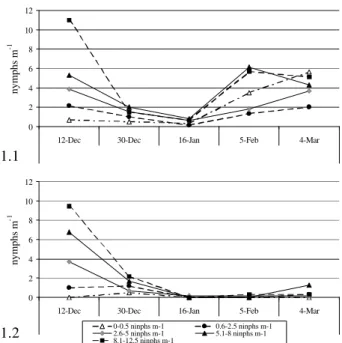
Thiamethoxam efficiently controlled M. fimbriolata (Figure 1). In plots where the pesticide was
applied there was a reduction in population levels, and the second infestation peak after January which oc-curred in non-treated plots was not observed. These results are in accordance to previous studies (Dinardo-Miranda et al., 2000a; 2003), which also show higher efficiency of chemical control in comparison to bio-logical control or cultural practices, especially at in-festation levels higher than 2 nymphs m-1. The
non-oc-currence of the second infestation peak of M. fimbriolata nymphs may be explained by the residual
0 2 4 6 8 10 12
12-Dec 30-Dec 16-Jan 5-Feb 4-Mar
Nynfas/m
nymphs m
-1
0 2 4 6 8 10 12
12-Dec 30-Dec 16-Jan 5-Feb 4-Mar
Nynfas/m
nymphs m
-1
0-0.5 ninphs m-1 0.6-2.5 ninphs m-1
2.6-5 ninphs m-1 5.1-8 ninphs m-1
8.1-12.5 ninphs m-1
Yeast cell viability was lower in higher infes-tation levels, especially after the middle of the fermen-tation process (Figure 2). The decrease in cell viabil-ity is due to several factors, such as nutrient availabil-ity and bacterial contamination, which result from cane deterioration. Previous studies found similar results (Gonçalves, 2003) wich were associated with a de-crease in cane quality under spittlebug infestation (Dinardo-Miranda et al., 1999; 2000b; 2002). The same association can be made in this study, which shows sig-nificant sucrose level reductions and increased total acidity and phenolics in the sugarcane juice associated with M. fimbriolata populations (Figure 3).
Phenolics are known to negatively affect yeast metabolism during fermentation (Polakovic et al., 1992; Narendranath et al., 2001). A less sharp decrease in cell viability was observed when M. fimbriolata was
controlled (Figures 2.2 and 2.3), showing the negative impact of spittlebug attack on the performance of the fermentation yeasts. This effect became more evident from the second M. fimbriolata infestation level on
(data not shown), confirming that the cane quality in-crease due to spittlebug control favors the maintenance of viable yeast cells during ethanolic fermentation.
Infestation levels affect on bud viability, even at the beginning of fermentation (Figure 4), which also seems to be due to cane deterioration. The rate of vi-able cells and buds during fermentation is important to keep yeast population levels, and often reflect on the fermentation yield.
Similarly to cell viability, a less steep reduc-tion in bud viability was observed during fermentareduc-tion when M. fimbriolata was controlled (Figure 4)
prob-ably because of the increased cane quality caused by the pest control.
The highest yeast cell and bud viability rates were observed at the beginning of the fermentation process. The reduction of viable cells as the fermen-tation goes on is due to an increase in the concentra-tion of ethanol, CO2 and acidity, and a reduction of sugar levels in the wine during fermentation. The in-tracellular accumulation of ethanol and other metabo-lites favors the decrease of live yeast cells (Stokes, 1971; Hallsworth, 1998). This reduction often takes place in industrial conditions without affecting fermen-tation conduction and viability (Mutton, 1998). Con-sidering that in Brazil ethanolic fermentations yeasts are reused in fermentation cycles, it is extremely im-portant to have viable cells and buds at the end of each cycle.
Figure 1 - Population variation of M. fimbriolata nymphs in sugarcane roots from December 2003 to March 2004. 1.1-Control. 1.2-Thiamethoxam (0.2 kg of active ingredient ha-1).
1.2 1.1
y = -0.139x + 90.816 R2 = 0.0315ns
y = 0.0966x + 87 R2 = 0.0085ns
40 50 60 70 80 90 100
0 2 4 6 8 10 12
nymphs m-1
%
Figure 2 - Yeast cell viability during the fermentation process under M. fimbriolata infestation. 2.1- Beginning; 2.2-Middle; 2.3- End of fermentation.
y = -0.0051x + 92.299 R2 = 0.0026ns
y = -2.9334x + 92.924 R2
= 0.9408**
40 50 60 70 80 90 100
0 2 4 6 8 10 12
nymphs m-1
%
control thiamethoxam
y = -1.0517x + 97.378 R2 = 0.958*
y = -1.0671x + 89.036 R2 = 0.3175*
40 50 60 70 80 90 100
0 2 4 6 8 10 12
nymphs m-1
%
2.1
2.2
The main source of sugarcane juice contami-nation is the field because soil microorganisms find wide and favorable conditions for their development in sugarcane stalks, resulting in highly contaminated sugarcane juices (Stupiello & Horii, 1981). Another factor that counts for increasing contamination in fer-mentation is the quality of the raw material. Spittle-bug infestation caused no effect on bacterial concen-tration in the beginning and middle of the fermenta-tion (Figure 5), showing that a decrease on yeast
performance may be more related to cane quality parameters than on microbiological deterioration. This result agrees with previous studies (Gonçalves, 2003), which reported that sometimes the loss of quality is not related to bacterial contamination, but due to a biochemical reaction of plants against pests, which use part of the sugar stored in stem pa-renchyma cells to provide carbon and energy for the biosynthesis of defense-related metabolites. However, further investigation is necessary to confirm this hy-pothesis.
At the end of the fermentation process, an in-crease in bacterial contamination was observed,
pos-sibly favored by a higher amount of residual sugars combined with a low viability of yeast cells.
The attack of M. fimbriolata resulted in higher
levels of total residual reducing sugars in the wine (Table 1), reflecting in alcohol yield decrease. In re-sponse to spittlebug infestation, sugarcane defense mechanisms may produce lignin, phenolic compounds (Mutton, 2003) and other metabolites. As in other stud-ies on plant defense against pests and diseases (Phelps & Young, 1996; Fontaniella et al., 2003), this study showed an increase in the level of total phenolics in sugarcane juice (Figure 3). In the presence of pheno-lics, yeast invertase activity is reduced (Polakovic et al., 1992), resulting in yeast population decrease and even fermentation inhibition. Phenolic compounds pos-sibly played a negative role on yeast physiology dur-ing fermentation, which resulted in cell and bud viabil-ity reduction. As a consequence, there was an increase of total residual reducing sugars and alcohol content.
A decrease in the wine alcohol content was ob-served from the second to the highest infestation level (Table 1). This is an expected result, since the attack of spittlebugs negatively influenced yeast performance Figure 3 - Technological analysis of the sugarcane juice under M. fimbriolata infestation.
Purity
y = -0.1037x + 89.212
R2
= 0.1734ns
y = -0.1352x + 88.887
R2 = 0.42ns
87 87.5 88 88.5 89 89.5 90 90.5
0 2 4 6 8 10 12
nymphs m-1
%
Sucrose
y = 0.0037x + 17.293
R2 = 0.0005ns
y = -0.1764x + 17.825
R2 = 0.6437**
15 15.5 16 16.5 17 17.5 18
0 2 4 6 8 10 12
nymphs m-1
%
Total Phenolic Compounds
y = 0.0254x + 0.3201
R2 = 0.9521**
y = 0.0202x + 0.3713
R2 = 0.6272**
0.2 0.25 0.3 0.35 0.4 0.45 0.5 0.55 0.6
0 2 4 6 8 10 12
nymphs m-1
ug mL
-1
control thiamethoxam
Reducing Sugars
y = 0.0089x + 0.2528
R2 = 0.6524**
y = 0.0112x + 0.2261
R2
= 0.8071**
0.15 0.17 0.19 0.21 0.23 0.25 0.27 0.29 0.31 0.33 0.35
0 2 4 6 8 10 12
nymphs m-1
%
Total Acidity
y = 0.0139x + 1.0901
R2 = 0.2005ns
y = 0.1057x + 0.8639
R2 = 0.7963**
0 0.25 0.5 0.75 1 1.25 1.5 1.75 2 2.25
0 2 4 6 8 10 12
nymphs m-1
g L
-1
Brix
y = -0.0625x + 19.496
R2
= 0.4534ns y = -0.0043x + 19.305
R2 = 0.001ns
18.2 18.4 18.6 18.8 19 19.2 19.4 19.6 19.8 20
0 2 4 6 8 10 12
nymphs m-1
during fermentation (Figures 2 and 4). Also, when thiamethoxam was applied, the alcohol content was higher, evidencing the importance of a high quality cane for fermentation. These results are in accordance with Gonçalves (2003), who showed that less damaged the sugarcane, increase the level of sugars and fermen-tation yield.
CONCLUSIONS
• Spittlebug infestation negatively influences the sug-arcane juice fermentation process.
• The efficient control of this pest improves cane qual-ity, which reflects in a better fermentation process. • The yeast cell and bud viability decrease may be due to defense metabolites that the sugarcane plant pro-duces against M. fimbriolata, like organic acids and
phenolic compounds.
ACKNOWLEDGEMENTS
To Usina São Carlos – Coinbra, for providing the sugarcane and for their help with experiment con-Figure 5 - Bacterial contamination during the fermentation process in juices from sugarcane under M. fimbriolata infestation. 5.1- Beginning; 5.2- Middle; 5.3- End of fermentation.
Figure 4 - Yeast bud viability during the fermentation process in juices from sugarcane under M. fimbriolata infestation. 4.1- Beginning; 4.2- Middle; 4.3- End of fermentation.
y = -0.8759x + 91.72 R2 = 0.1269ns
y = -2.2471x + 87.795 R2 = 0.6369ns
0 20 40 60 80 100 120
0 2 4 6 8 10 12
nymphs m-1
%
4.1
y = -1.6883x + 91.637 R2 = 0.476*
y = -6.6538x + 99.107 R2 = 0.8138**
0 20 40 60 80 100 120
0 2 4 6 8 10 12
%
control thiamethoxam
nymphs m-1
4.3
y = -1.2711x + 101.29 R2 = 0.724ns
y = -4.9987x + 109 R2 = 0.8568**
0 20 40 60 80 100 120
0 2 4 6 8 10 12
nymphs m-1
%
4.2
y = -0.0078x + 0.7841 R2 = 0.1257ns
y = -0.0066x + 0.5916 R2 = 0.0686ns
0 0.1 0.2 0.3 0.4 0.5 0.6 0.7 0.8 0.9 1
0 2 4 6 8 10 12
nynphs m-1
cel mL
-1
5.1
y = 0.0113x + 0.7614 R2 = 0.2615ns
y = 0.0076x + 0.4659 R2 = 0.1175ns
0.2 0.3 0.4 0.5 0.6 0.7 0.8 0.9 1
0 2 4 6 8 10 12
nynphs m-1
cel mL
-1
5.2
y = 0.0586x + 0.5042 R2 = 0.8897*
y = -0.0026x + 0.5737 R2 = 0.0104ns
0.2 0.4 0.6 0.8 1 1.2
0 2 4 6 8 10 12
nynphs m-1
cel mL
-1
control thiamethoxam 5.3
Table 1 - Effect of M. fimbriolata infestation levels on
total residual reducing sugars and alcohol contents in wines.
ns = non-significant; * = significant at 5%; ** = significant at 1%.
Residual Reducing Sugars
Alcohol Content
% % v v- 1
Nymphs m-1 (N)
0 to 0.5 0.0575 B 6.9 A
0.6 to 2.5 0.2107 A 6.4 B
2.6 to 5,0 0.1553 AB 6.15 B
5.1 to 8.0 0.1567 A 6.30 B
8.1 to 12.5 0.1643 A 6.34 B
F Test (N) 6.463** 6.452**
LSD (Tukey) 0.0813 0.472
Treatments (T)
control 0.17 A 6.15 B
thiamethoxam 0.14 A 6.68 A
F Test (T) 2.381ns 28.163**
LSD (Tukey) 0.0359 0.208
F Test (N × T) 3.517* 1.228ns
duction, and Syngenta Proteção de Cultivos Ltda. for financial support. To Eduardo Rossini Guimarães for his helpful suggestions and critical review of the manu-script. Gisele Cristina Ravaneli and Leonardo Lucas Madaleno are CNPq scholar. Leandro Eduardo Presotti is a CAPES’ scholar.
REFERENCES
CONSECANA. Normas de avaliação da qualidade da cana-de-açúcar. 2004. Disponível em: http://www.unica.com.br/files/ consecana/normaseprecos.pdf. Acesso em: 21 set. 2004.
DINARDO-MIRANDA, L.L. Cigarrinha-das-raízes em cana-de-açúcar. Campinas: Instituto Agronômico, 2003. 72p.
DINARDO-MIRANDA, L.L.; FIGUEIREDO, P.; LANDELL, M.G.A.; FERREIRA, J.M.G.; CARVALHO, P.A.M. Danos causados pelas cigarrinhas-das-raízes (Mahanarva fimbriolata) a diversos genótipos de cana-de-açúcar. Stab: Açúcar, Álcool e Subprodutos, v.17, p.48-52, 1999.
DINARDO-MIRANDA, L.L.; FERREIRA, J.M.G.; DURIGAN, A.M.P.R.; BARBOSA, V. Eficiência de inseticidas e medidas culturais no controle de Mahanarva fimbriolata em cana-de-açúcar. Stab: Açúcar, Álcool e Subprodutos, v.18, p.34-36, 2000a. DINARDO-MIRANDA, L.L.; FERREIRA, J.M.G.; CARVALHO,
P.A.M. Influência da cigarrinha-das-raízes, Mahanarva fimbriolata, sobre a qualidade tecnológica da cana-de-açúcar. Stab: Açúcar, Álcool e Subprodutos, v.19, p.34-35, 2000b.
DINARDO-MIRANDA, L.L.; GARCIA, V.; PARAZZI, V.J. Efeito de inseticidas no controle de Mahanarva fimbriolata (Stal) (Hemiptera: Cercopidae) e de nematóides fitoparasitos na qualidade tecnológica e na produtividade da cana-de-açúcar. Neotropical Entomology, v.31, p.909-914, 2002.
DINARDO-MIRANDA, L.L.; NAKAMURA, G.; ZOTARELLI, L.; BRAZ, B.A.; EUZEBIO, O. Viabilidade técnica e econômica de Actara 250WG, aplicado em diversas doses, no controle da cigarrinha-das-raízes. Stab: Açúcar, Álcool e Subprodutos, v.22, p.39-43, 2003.
DINARDO-MIRANDA, L.L.; COELHO, A.L.; FERREIRA, J.M.G., Influência da época de aplicação de inseticidas no controle de Mahanarva fimbriolata (Stal) (Hemiptera:Cercopidae), na qualidade e produtividade da cana-de-açúcar. Neotropical Entomology, v.33, p.92-98, 2004.
FOLIN, O.; CIOCALTEAU, V. On tyrosine and tryptophane determinations in proteins. The Journal of Biological Chemistry, v.7, p.101-120, 1927.
FONTANIELLA, B.; VICENTE, C.; LEGAZ, M.E.; ARMAS, R. de; RODRIGUEZ, C.W.; MARTINEZ, M.; PINÕN, D.; ACEVEDO, R.; SOLAS, M.T. Yellow leaf syndrome modifies the composition of sugarcane juices in polysaccharides, phenols and polyamines. Plant Physiology Biochemistry, v.41, p.1027-1036, 2003.
GONÇALVES, T.D. Danos causados por Mahanarva fimbriolata em cana-de-açúcar: reflexos na qualidade da matéria-prima e fermentação etanólica. Jaboticabal: FCAV/UNESP, 2003. 51p. (Dissertação -Mestrado).
HALLSWORTH, J.E. Ethanol-induced water stress in yeast. Journal of Fermentation Bioengineering, v.85, p.125-137, 1998. LANE, J.H.; EYNON, L. Determination of reducing sugars by
Fehling solution with methylene blue indicator. London: Norman Rodger, 1934. 8p.
LEE, S.S.; ROBINSON, F.M.; WONG, H.Y. Rapid determination of yeast viability. Biotechnology Bioengineering Symposium, n.11, p.641-649, 1981.
MENDONÇA, A.F.; BARBOSA, G.V.S.; MARQUES, E.J. As cigarrinhas da cana-de-açúcar (Hemiptera: Cercopidae) no Brasil. In: MENDONÇA, A.F. (Ed.). Pragas da cana-de-açúcar. Maceió: Insetos & Cia,1996. 200p.
MUTTON, M.J.R. Avaliação da fermentação etanólica do caldo de cana-de-açúcar (Saccharum spp) tratadas com maturadores químicos. Jaboticabal: FCAV; UNESP, 1998. 178p. (Tese - Livre Docência). MUTTON, M.J.R. Reflexos da qualidade da matéria-prima no processo
industrial. In: SIMPÓSIO INTERNACIONAL DA STAB, 3., Águas de São Pedro, 2003. Perdas de açúcares: do campo ao produto final. Águas de São Pedro: STAB, 2005. 1 CD ROOM.
MUTTON, M.J.R.; MUTTON, M.A. Maturadores químicos em cana-de-açúcar: III – Efeitos na fermentação etanólica e microbiota do mosto. In: CONGRESSO NACIONAL DA STAB,8., Recife, 2002. Anais. Recife: STAB, 2002. p.452-457.
NARENDRANATH, N.V.; THOMAS, K.C.; INGLEDEW, W.M. Effects of acetic acid ad lactic acid on the growth of Saccharomyces
cerevisiae in a minimal medium. Journal of Industrial
Microbiology and Biotechnology, v. 26, p.171-177, 2001. PHELPS, C.D.; YOUNG, L.Y. Microbial metabolism of the plant
phenolic compounds ferulic and syringic acids under three anaerobic conditions. Microbial Ecology, v.33, p.206-215, 1996.
POLAKOVIC, M.; HANDRIKOVÁ, G.; KOSIK, M. Inhibitory effects of some phenolic compounds on enzymatic hydrolysis of sucrose. Biomass and Bioenergy, v.3, p.369-371, 1992.
SCHNEIDER, F. Sugar analysis: ICUMSA methods. Peterborough: ICUMSA, 1979, 265p.
STOKES, J.L. Influence of temperature on the growth and metabolism of yeast. In: ROSE, A.H.; HARRISON, J. S. (Ed.). The yeast. New York: Academic Press, 1971. p.119-134.
STUPIELLO, J.P.; HORII, J. Condução da fermentação alcoólica. Saccharum, v.17, p.43-46, 1981.
TANIMOTO, T. The press method of cane analysis. Hawaiian Planter’s Record, v.57, p.133-150, 1964.