INTRODUCTION
Robotic-assisted laparoscopic prosta-tectomy (RALP) is a widely utilized, minimally invasive option for the treatment of prostate cancer and, in the short term, has
demonstrat-ed similar oncologic outcomes when compardemonstrat-ed with the open radical prostatectomy (1,2). The urethrovesical anastomosis (UVA) is a techni-cally challenging aspect of RALP (3). Several UVA techniques have been described including a running suture anastomosis, interrupted
su-Purpose: V-Loc™180 (Covidien Healthcare, Mansfield, MA) is a new unidirectional barbed suture that may reduce loss of tension during a running closure. We evalu-ated the use of the barbed suture for urethrovesical anastomosis (UVA) during robotic assisted laparoscopic prostatectomy (RALP). Time to completion of UVA, post-operative anastomotic leak rate, and urinary incontinence were compared in patients undergoing UVA with 3-0 unidirectional-barbed suture vs. 3-0 Monocryl™ (Ethicon, Somerville, NJ).
Materials and Methods: Data were prospectively collected for 70 consecutive pa-tients undergoing RALP for prostate cancer between November 2009 and October 2010. In the first 35 patients, the UVA was performed using a modified running van Velthoven anastomosis technique using two separate 3-0 monofilament sutures. In the subsequent 35 patients, the UVA was performed using two running novel uni-directional barbed sutures. At 7-12 days postoperatively, all patients were evalu-ated with a cystogram to determine anastomotic integrity. Urinary incontinence was assessed at two months and five months by total daily pad usage. Clinical symptoms suggestive of bladder neck contracture were elicited.
Results: Age, PSA, Gleason score, prostate size, estimated blood loss, body mass in-dex, and clinical and pathologic stage between the 2 groups were similar. Compar-ing the monofilament group and V-Loc™180 cohorts, average time to complete the anastomosis was similar (27.4 vs. 26.4 minutes, p = 0.73) as was the rate of urinary extravasation on cystogram (5.7 % vs. 8.6%, p = 0.65). There were no symptom-atic bladder neck contractures noted at 5 months of follow-up. At 2 months, the percentage of patients using 2 or more pads per day was lower in the V-Loc™180 cohort (24% vs. 44%, p < 0.02). At 5 months, this difference was no longer evident.
Conclusions: Time to complete the UVA was similar in the intervention and control groups. Rates of urine leak were also comparable. While the V-Loc™180 was as-sociated with improved early continence, this difference was transient.
Unidirectional barbed suture versus standard
monofilament for urethrovesical anastomosis during
robotic assisted laparoscopic radical prostatectomy
_______________________________________________
Marc Manganiello, Patrick Kenney, David Canes, Andrea Sorcini, Alireza Moinzadeh
Institute of Urology, Lahey Clinic, Burlington, MA, USA
ABSTRACT
ARTICLE
INFO
_______________________________________________________________ _____________________
Key words:
sutures; anastomosis; prostatectomy; robotics
Int Braz J Urol. 2012; 38: 89-96
________________
Submitted for publication: August 17, 2011
________________
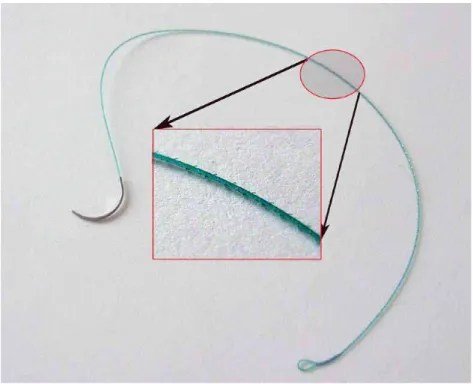
ture anastomosis, and use of a Lapra-Ty (Ethi-con Endosurgery, Cincinnati, Ohio) to secure the posterior anastomosis (4,5). Drawbacks to these techniques include slippage and relaxation of the suture and Lapra-Ty clip erosion. Recently, an absorbable unidirectional barbed suture has become available (V-Loc™180, Covidien, Mans-field, MA) (Figure-1). This suture has been used for skin and soft tissue closures, gynecologic procedures, and bowel anastomosis in a porcine
model (6-8). Anastomoses using standard mono-filament for running closure requires frequent re-tightening, with some surgeons relying on the assistant to follow the suture to maintain ten-sion. Anchoring barbs have the potential to ob-viate many of these maneuvers, as the barbs may minimize loosening of the suture and allow for optimal cooptation of the urethra and bladder neck. In fact, the need for an assistant during the UVA may be obviated with the barbed su-ture. We sought to evaluate UVA time, urine leak
Figure 1 - V-Loc™ 180 suture.
rate, symptomatic bladder neck contractures, and urinary continence in patients undergoing RALP with barbed versus non-barbed suture.
MATERIALS AND METHODS
We assessed 70 consecutive patients un-dergoing RALP for prostate cancer by one sur-geon over a 10-month period. Prior to enrollment and prospective data collection, the Institutional
Review Board approved data collection for our radical prostatectomy patients. Patients were re-cruited during routine evaluation for their pros-tate cancer. Inclusion criteria included clinically organ confined or locally advanced prostate can-cer (clinical ≤ T3a). Exclusion criteria included a history of chronic steroid use, severe vascular disease, or evidence of gross disease invading the bladder neck at the time of surgery.
(5). Briefly, two separate 3-0 monocryl sutures cut to 7 inches with a Lapra-Ty on the distal end were used to perform a running anastomo-sis. The first suture was run clockwise from 6 o’clock to 12 o’clock. The second was run coun-ter clockwise from 5 o’ clock to 12 o’clock. The two sutures were tied to each other at 12 o’clock with the knot resting on the exterior of the anas-tomosis.
In the subsequent 35 patients, the UVA was performed with the 3-0 unidirectional ab-sorbable barbed suture. This anastomotic suture is designed such that the 3 centimeters distal to the needle are non-barbed. This allows the sur-geon to remove the suture in the event the initial throw is suboptimal. The remainder of the suture is barbed. The tail-end of the suture is a loop that is used to anchor the stitch at the bladder neck without a knot. The stitch is anchored at the 6 o’clock position on the bladder neck. The needle is then passed through the 6 o’clock position on the bladder neck followed by the urethra. This is continued clockwise for three to four passes. The suture is then tightened to approximate the urethrovesical anastomosis. Care is taken not to pull these sutures too tight, allowing optimal cooptation of the urethra and bladder neck. This suture is then run in a clockwise fashion towards the 12 o’clock position. A second unidirectional barbed suture is anchored at the 5 o’clock posi-tion and run counterclockwise. The second su-ture is cinched prior to tying the two susu-tures together. In all cases, the anastomosis is tested for leak intraoperatively with retrograde filling of the bladder with 120cc of sterile irrigant. A 10 mm flat Jackson Pratt drain (JP) was inserted in all patients. All patients with JP fluid output greater than 75cc over an 8 hour shift had fluid sent for creatinine.
Anastomotic time was recorded; starting once the anchoring suture was placed and fin-ished when the two running sutures were tied to-gether. At 7 to 12 days postoperatively (depend-ing on surgical date and date of surgeon’s clinic schedule), all patients underwent evaluation with a cystogram to evaluate for anastomotic leak. Those patients without leak had their catheters removed. If a significant anastomotic leak was
detected, catheter drainage was continued with a follow-up study scheduled within 2 weeks. Post-operative urinary incontinence was assessed at both the 2 and 5-month follow-up visits by pa-tient reported total daily pad usage during post operative follow-up visits. Endpoints between groups were compared using student t test, log rank test, and fisher’s exact test as appropriate.
RESULTS
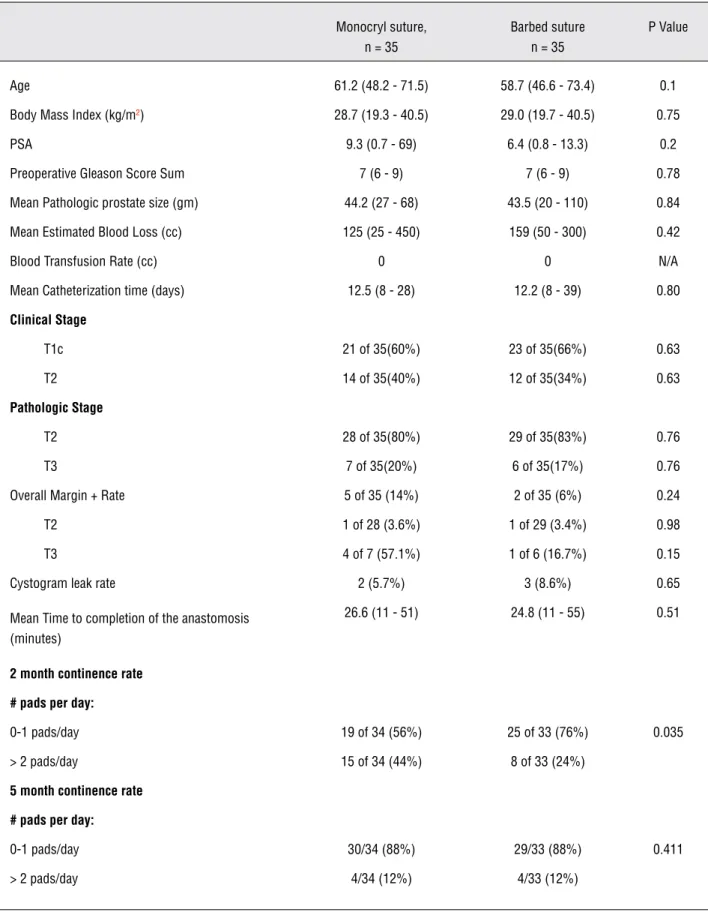
Patient age, body mass index, PSA, Glea-son score, clinical and pathologic stage, prostate size, positive margin rates, estimated blood loss, and transfusion rates were comparable between the barbed and non-barbed cohorts (Table-1). No patient was excluded based on the exclusion cri-teria as outlined above. Time to completion of the UVA was not significantly different between the monofilament suture group (avg. 26.6, range 11-51 minutes) when compared to the barbed su-ture group (avg. 24.8, range 11-55 minutes), p = 0.51. All drain creatinine values were consistent with serum and all JPs were removed before hos-pital discharge.
There was no detectable difference in the rate of radiographic urine leak between the barbed and non-barbed groups (8.6% vs. 5.7%, p = 0.65). There were no significant differences between groups in terms of total catherization time (Table-1).
None of the patients in either group ex-perienced symptomatic bladder neck contracture. At 2 months, overall pad usage was significantly lower in the V-Loc™180 cohort (p = 0.035) and the percentage of patients using 2 or more pads per day was lower in the V-Loc™180 cohort (24% vs. 44%). At 2 months, 76% of V-Loc™180 pa-tients reported using 0 or 1 pad per day, as com-pared to 56% of non-barbed patients.
Table 1 - Comparison of Patients undergoing UVA with Monofilament vs. Barbed Suture.
Monocryl suture, n = 35
Barbed suture n = 35
P Value
Age 61.2 (48.2 - 71.5) 58.7 (46.6 - 73.4) 0.1
Body Mass Index (kg/m2) 28.7 (19.3 - 40.5) 29.0 (19.7 - 40.5) 0.75
PSA 9.3 (0.7 - 69) 6.4 (0.8 - 13.3) 0.2
Preoperative Gleason Score Sum 7 (6 - 9) 7 (6 - 9) 0.78
Mean Pathologic prostate size (gm) 44.2 (27 - 68) 43.5 (20 - 110) 0.84
Mean Estimated Blood Loss (cc) 125 (25 - 450) 159 (50 - 300) 0.42
Blood Transfusion Rate (cc) 0 0 N/A
Mean Catheterization time (days) 12.5 (8 - 28) 12.2 (8 - 39) 0.80
Clinical Stage
T1c 21 of 35(60%) 23 of 35(66%) 0.63
T2 14 of 35(40%) 12 of 35(34%) 0.63
Pathologic Stage
T2 28 of 35(80%) 29 of 35(83%) 0.76
T3 7 of 35(20%) 6 of 35(17%) 0.76
Overall Margin + Rate 5 of 35 (14%) 2 of 35 (6%) 0.24
T2 1 of 28 (3.6%) 1 of 29 (3.4%) 0.98
T3 4 of 7 (57.1%) 1 of 6 (16.7%) 0.15
Cystogram leak rate 2 (5.7%) 3 (8.6%) 0.65
Mean Time to completion of the anastomosis (minutes)
26.6 (11 - 51) 24.8 (11 - 55) 0.51
2 month continence rate
# pads per day:
0-1 pads/day 19 of 34 (56%) 25 of 33 (76%) 0.035
> 2 pads/day 15 of 34 (44%) 8 of 33 (24%)
5 month continence rate
# pads per day:
0-1 pads/day 30/34 (88%) 29/33 (88%) 0.411
DISCUSSION
The urethrovesical anastomosis is a criti-cal step in RALP and may play a role in urine leak, bladder neck contracture, continence, and duration of catheterization. Unidirectional barbed suture may maintain tension during a running closure such as the UVA, and may therefore re-duce urine leak and bladder neck contracture. In our cohort of patients, all anastomoses were checked intraoperatively for watertight closure. There were no instances of urinary leak on intra-operative testing of the urethrovesical anastomo-sis, suggesting good tissue approximation. There was also no detectable difference in cystographic urine leak between the barbed and non-barbed cohorts (8.6% vs. 5.7%, p = 0.65).
In general, published rates of urine leak in RALP range from 0 to 12.7% (9-12). One se-ries of 2500 patients undergoing RALP by a sin-gle surgeon reported the anastomotic leak rate of 1.40% (3). Our cystographic leak rate was 8.6% and 5.7% in the monocryl versus barbed suture group respectively. In another series of UVA per-formed with barbed suture, Williams et al report a significantly higher incidence of urine leak in the barbed group (20% vs. 2.8%, p = 0.019) and, consequently, a longer mean catheterization time (11.1 days vs. 8.3 days, p = 0.048). Our data is consistent with other published studies and ar-gues against an association between barbed su-ture and anastomotic leak, although it is possible that our sample size was too small to detect a very small difference in urine leak. However, this small difference would most likely be clinically insig-nificant given our relative low percentage of leak. Studies have shown that a majority (79 to 95%) of patients undergoing radical prostatectomy do not have a urine leak by cystogram seven days post-operatively (13-15). By 15 to 21 days after surgery, nearly 100% of patients do not have a urinary leak at the UVA (13,16). The type or number of sutures used has not seemed to affect urinary leak rates, suggesting that the most important factor in a leak-free UVA is good tissue approximation and an intraoperative watertight closure.
In the contemporary literature, bladder neck contractures are reported in 0 to 7.4% of
RALP patients and in 2.6 to 9% of patients af-ter open radical prostatectomy (9,10,12,17,18). The exact cause of bladder neck contracture is not known although several theories exist. These potential hypotheses include increased operative blood loss, poor mucosal approximation during UVA, ischemia of bladder neck tissue, extended length of urinary catheterization, urinary infec-tion, and urinary extravasation. However, no study has demonstrated with significance any of these variables leading to a bladder neck contrac-ture (18-20). Webb et al. found a significant dif-ference in the number of bladder neck contrac-tures between patients undergoing RALP vs. open radical prostatectomy (0 vs. 9%, p < 0.005). This was attributed to difference in technique since the open procedure requires bladder neck stoma-tization and mucosal eversion (18). With exces-sive tension on the urethrovesical anastomosis, future tissue ischemia may develop with subse-quent fibrosis and scarring, leading to bladder neck contracture. The unidirectional sutures may aide in improved tissue handling and decrease the tension placed on the running suture during the anastomosis while re-approximating the ure-thra and bladder neck. Msezane et al. reported that patients who ultimately developed a bladder neck contracture had significantly longer opera-tive times (283 vs. 225 min, p = 0.04). All other patient and operative variables, however, were equal (20). In the present study, there were no symptomatic bladder neck contractures detected in either group. This may again be a function of the relatively small sample size and short follow-up. In addition, it is possible that there were as-ymptomatic bladder neck contractures that went undetected. In order to assess for bladder neck contracture, all patients would have needed to be submitted to cystoscopy and uroflow studies which were not completed in this study.
resident involvement in operative cases, as our institution is a teaching hospital. Under the guid-ance of the attending surgeon, the chief resident may perform a portion of the procedure. As such, the anastomosis time is not representative of one single surgeon, and will vary.
Several groups have recently compared the unidirectional barbed suture to the standard monocryl suture in the UVA during RALP. Only immediate perioperative data have been assessed in these studies and as such 2 and 5 month fol-low-up for continence or bladder neck contrac-tures are not reported (21-24). In the comparative studies, no data is provided for urinary inconti-nence between patients undergoing the UVA with barbed versus standard monofilament suture. However, theories on the potential improvements of barbed suture versus monofilament suture were discussed. Moran et al. stated that a bidirectional barbed suture allows for minimal tension during the UVA, resulting in less inflammation, scar for-mation, and tissue ischemia (24).
Urinary incontinence is one of the most common long term complications following RALP. A large series of > 2700 men undergoing RALP reported a minimum of 12 months (mean of 28 months, complete data on 1110 patients) follow-up as regards their post-operative urinary function (25). Overall, 93% (1032 of 1110) of pa-tients were wearing less than or equal to 1 pad per day at last follow-up for a mean of 28 months (range 12 to 71 months); 23.7% actually felt they had complete continence at the time of catheter removal (mean post-operative day 7 to 8). Our 5 month reported ≤ 1 pad usage of 88% in each group compares favorably with other published series. However, patient reports of daily pad us-age are subjective and dependent on individual preference as to when a pad should be changed. No difference was noted in our series. We did not objectively calculate the amount of urine leak-age a patient experienced. This may have been performed by recording differences in pad weight rather than differences in number of daily pads used. The measurement of pad weight for quanti-fying urine leakage is certainly a superior method to pad number, and we acknowledge this as a
lim-itation of our study. However, it is likely that con-tinence is determined to a greater degree by pa-tient’s baseline function, precise apical dissection that respects the pelvic floor anatomy, the degree of bladder neck preservation, nerve sparing and other as yet undetermined factors other than the technical nuances of the anastomosis itself (26).
While data driven aspects of this suture are important, the surgeon’s subjective impres-sion also needs consideration, as other authors have recognized. Kaul et al. reported the UVA using barbed suture was easier than standard monofilament, an important consideration espe-cially for the inexperienced robotic surgeon. The barbed suture prevents slippage. Often an assis-tant provides intermittent traction between each throw with the non barbed running anastomosis to prevent inadvertent slippage. The need for an assistant in this regard is eliminated, minimizing instrument clashes and potentially excessive ten-sion placed on the anastomosis by the assistant. Lapra-Ty has been used in the past to help secure the posterior urethral reconstruction; however, with the use of barbed suture, the erosion of dis-solvable clips is eliminated.
CONCLUSIONS
Our findings demonstrate that time to com-pletion of the UVA as well as postoperative urine leak rates on cystogram were similar between a barbed or standard monofilament suture. Subjec-tive urinary incontinence at 2 months for patients with the barbed suture was improved when com-pared to those who underwent the anastomosis with monocryl. The clinical significance of this in a small sample size is unclear. At 5 months, this significance was no longer demonstrated.
CONFLICT OF INTEREST
None declared.
REFERENCES
1. Hakimi AA, Feder M, Ghavamian R: Minimally invasive ap-proaches to prostate cancer: a review of the current litera-ture. Urol J. 2007; 4: 130-7.
2. Herrmann TR, Rabenalt R, Stolzenburg JU, Liatsikos EN, Imkamp F, Tezval H, et al.: Oncological and functional re-sults of open, robot-assisted and laparoscopic radical prostatectomy: does surgical approach and surgical expe-rience matter? World J Urol. 2007; 25: 149-60.
3. Coelho RF, Palmer KJ, Rocco B, Moniz RR, Chauhan S, Orvieto MA, et al.: Early complication rates in a single-surgeon series of 2500 robotic-assisted radical prostatec-tomies: report applying a standardized grading system. Eur Urol. 2010; 57: 945-52.
4. Ball AJ, Bordeau KP, Davis JW, Given RW, Lynch DF, Fab-rizio MD: Modified running vesicourethral anastomosis af-ter robotically assisted laparoscopic radical prostatectomy: use of solitary Lapra-Ty to secure posterior approximation. Urology. 2005; 66: 16-8.
5. Van Velthoven RF, Ahlering TE, Peltier A, Skarecky DW, Clayman RV: Technique for laparoscopic running ure-throvesical anastomosis:the single knot method. Urology. 2003; 61: 699-702.
6. Demyttenaere SV, Nau P, Henn M, Beck C, Zaruby J, Pri-mavera M, Kirsch D, Miller J, Liu JJ, Bellizzi A, Melvin WS. Barbed suture for gastrointestinal closure: a randomized control trial. Surg Innov. 2009; 16: 237-42.
7. Einarsson JI, Chavan NR, Suzuki Y, Jonsdottir G, Vellinga TT, Greenberg JA: Use of bidirectional barbed suture in laparoscopic myomectomy: evaluation of perioperative outcomes, safety, and efficacy. J Minim Invasive Gynecol. 2011; 18: 92-5.
8. Shermak MA, Mallalieu J, Chang D: Barbed suture impact on wound closure in body contouring surgery. Plast Re-constr Surg. 2010; 126: 1735-41.
9. Rebuck DA, Haywood S, McDermott K, Perry KT, Nadler RB: What is the long-term relevance of clinically detected postoperative anastomotic urine leakage after robotic-assisted laparoscopic prostatectomy? BJU Int. 2011; 108: 733-8.
10. Sammon JD, Muhletaler F, Peabody JO, Diaz-Insua M, Satyanaryana R, Menon M: Long-term functional urinary outcomes comparing single- vs double-layer urethrovesi-cal anastomosis: two-year follow-up of a two-group paral-lel randomized controlled trial. Urology. 2010; 76: 1102-7. 11. Shah G, Vogel F, Moinzadeh A: Nephroureteral stent on
suction for urethrovesical anastomotic leak after robot-as-sisted laparoscopic radical prostatectomy. Urology. 2009; 73: 1375-6.
12. Shalhav AL, Orvieto MA, Chien GW, Mikhail AA, Zagaja GP, Zorn KC: Minimizing knot tying during reconstructive lapa-roscopic urology. Urology. 2006; 68: 508-13.
13. Eggert T, Palisaar J, Metz P, Noldus J: Assessing the vesi-co-urethral anastomosis after radical retropubic prostatec-tomy: transrectal ultrasonography can replace cystogra-phy. BJU Int. 2007; 100: 1268-71.
14. Guru KA, Seereiter PJ, Sfakianos JP, Hutson AD, Mohler JL: Is a cystogram necessary after robot-assisted radical prostatectomy? Urol Oncol. 2007; 25: 465-7.
15. Varkarakis J, Wirtenberger W, Pinggera GM, Berger A, Harabayashi T, Bartsch G, et al.: Evaluation of urinary ex-travasation and results after continence-preserving radical retropubic prostatectomy. BJU Int. 2004; 94: 991-5. 16. Poulakis V, Skriapas K, de Vries R, Dillenburg W, Witzsch
U, Becht E: Vesicourethral anastomosis during endoscopic extraperitoneal radical prostatectomy: a prospective com-parison between the single-knot running and interrupted technique. Urology. 2006; 68: 1284-9.
17. Breyer BN, Davis CB, Cowan JE, Kane CJ, Carroll PR: In-cidence of bladder neck contracture after robot-assisted laparoscopic and open radical prostatectomy. BJU Int. 2010; 106: 1734-8.
18. Webb DR, Sethi K, Gee K: An analysis of the causes of blad-der neck contracture after open and robot-assisted laparo-scopic radical prostatectomy. BJU Int. 2009; 103: 957-63. 19. Hanson GR, Odom E, Borden LS Jr, Neil N, Corman JM:
Post-operative drain output as a predictor of bladder neck contracture following radical prostatectomy. Int Urol Nephrol. 2008; 40: 351-4.
21. Kaul S, Sammon J, Bhandari A, Peabody J, Rogers CG, Menon M: A novel method of urethrovesical anastomosis during robot-assisted radical prostatectomy using a uni-directional barbed wound closure device: feasibility study and early outcomes in 51 patients. J Endourol. 2010; 24: 1789-93.
22. Tewari AK, Srivastava A, Sooriakumaran P, Slevin A, Grover S, Waldman O, et al.: Use of a novel absorbable barbed plastic surgical suture enables a “self-cinching” technique of vesicourethral anastomosis during robot-assisted pros-tatectomy and improves anastomotic times. J Endourol. 2010; 24: 1645-50.
23. Williams SB, Alemozaffar M, Lei Y, Hevelone N, Lipsitz SR, Plaster BA, et al.: Randomized controlled trial of barbed polyglyconate versus polyglactin suture for robot-assisted laparoscopic prostatectomy anastomosis: technique and outcomes. Eur Urol. 2010; 58: 875-81.
24. Moran ME, Marsh C, Perrotti M: Bidirectional-barbed su-tured knotless running anastomosis v classic Van Velthoven suturing in a model system. J Endourol. 2007; 21: 1175-8.
25. Badani KK, Kaul S, Menon M: Evolution of robotic radical prostatectomy: assessment after 2766 procedures. Cancer. 2007; 110: 1951-8.
26. Moinzadeh A, Shunaigat AN, Libertino JA: Urinary inconti-nence after radical retropubic prostatectomy: the outcome of a surgical technique. BJU Int. 2003; 92: 355-9.
______________________ Correspondence address: