Epidemiol. Serv. Saude, Brasília, 26(4), Oct-Dec 2017 ORIGINAL
ARTICLE
Assessment of the implementation of the Leprosy Control
Program in Camaragibe, Pernambuco State, Brazil*
Correspondence:
Monique Feitosa de Souza – Rua Doutor Luiz Ribeiro Bastos, No. 68, Poço da Panela, Recife-PE, Brasil. CEP: 52060-490
E-mail: [email protected]
Abstract
Objective: to assess the implementation of the actions of the Leprosy Control Program in Camaragibe, Pernambuco State,
Brazil. Methods: evaluative research with ‘implementation analysis’, based on criteria, indicators and parameters guided
from the construction of the Logic Model; four components were assessed – management, health care, epidemiological
surveillance, health education and communication –; direct observation/questionnaire was used, as well as data from the
Information System for Notifiable Diseases. Results: the implementation of the program was incipient (58.3%); the estimate
for the components varied from ‘not implemented’ (health education and communication, 48.0%), ‘incipient’ (management,
53.3%; health care, 57.2%) to ‘partially implemented’ (epidemiological surveillance, 73.0%); in 2012, it was observed low
proportion of examined contacts (28.4%), treatment dropout (34.1%), limited standardization of patient care flow, and
poor resolution of problems by managers. Conclusion: the level of implementation found was related to the organization of
services, with negative repercussions regarding the result indicators.
Keywords: Health Evaluation; Leprosy; Communicable Disease Control; Program Evaluation; Primary Health Care.
doi: 10.5123/S1679-49742017000400013Monique Feitosa de Souza1
Lygia Carmen de Moraes Vanderlei2
Paulo Germano de Frias2
1Secretaria Estadual de Saúde de Pernambuco, Diretoria de Vigilância à Saúde, Recife-PE, Brasil 2Instituto de Medicina Integral Prof. Fernando Figueira, Diretoria de Ensino, Recife-PE, Brasil
Introduction
Leprosy, an ancient infectious disease of chronic
evolution, affects mainly the skin and peripheral
nerves, leading to deformities and permanent physical
disability, related to late diagnosis.
1Currently, the efforts to eliminate leprosy are
concentrated in regions of high endemicity, located in
some areas of India, Brazil, Indonesia, Congo, Nepal,
Tanzania, Philippines, Madagascar, and Mozambique,
where the disease is still an important Public Health
issue.
2India and Brazil remain, respectively, as the first
and second countries on incidence of leprosy.
2In the Americas, Brazil is the country that has
most cases of the disease, which remains with high
magnitude in the North and Midwest macro-regions
and in the metropolitan areas of the Northeast of
the country.
3In Pernambuco State, in 2012, the endemicity
prevalence was medium (from 4.9 to 1.0/10 thousand
inhabitants), the general detection coefficient was very
high (from 20.0 to 39.9/100 thousand inhabitants),
and, among individuals under 15 years old, it presented
hyperendemicity (values over 10.0/100 thousand
inhabitants), according to parameters of the World
Health Organization (WHO).
4These indicators point to an intense process
of transmission and spread of the disease, which
presents reported cases in almost every municipality
in Pernambuco, with higher concentration in the
Metropolitan Region of Recife, such as the municipality
of Camaragibe: with a very high general detection rate,
ranging from 20.00 to 39.99/100 thousand inhabitants
in 2008, this municipality is seen as one of the most
endemic of the state.
4The use of multidrug therapy in the treatment
of the disease, the strategy to tackle the disease
in endemic countries to less than a case per 10
thousand inhabitants and the decentralization of
leprosy control actions (LCA) to primary health care,
represent progress in the public policies of disease
control worldwide. In Brazil, the implementation of
LCA by the Family Health Strategy occurred in 1998
and represented an important guideline, adopted by
the National Leprosy Control Program, to reduce the
occurrence of the disease and break the transmission
chain in the population.
5Despite the efforts and achievements, there are
obstacles not only technical but also administrative and
operational in the development of LCA that interfere in
the process of decentralization of these actions. Among
them, we should mention the fragility of appropriate
assessment tools and systematic analysis of routine
services, especially of municipal scope, with great
impact on the program effectiveness.
6-8Evaluation
studies contribute to the improvement of interventions,
and are a management tool that promotes the
organization of services and dialogue between practice
and management, enabling the institutionalization of
assessment practices.
9The objective of the present study was to assess the
implementation actions of the Leprosy Control Program
in the municipality of Camaragibe, Pernambuco State,
Brazil, in 2013.
Methods
Design
Evaluation study, with ‘implementation analysis' of
its second component, related to the influence of the
implementation degree of the intervention over the
observed effects.
9Additionally, a normative assessment
was performed in 2013, to compare the criteria and
rules of the National Leprosy Control Program to what
was observed at the place of the study. The investigation
strategy was of single-case study, for enabling the
observation of behaviors and organizational processes
in many levels,
10with the municipality of Camaragibe
being the analysis unit and the Municipal Leprosy
Control Program (MLCP), the case.
Context
Camaragibe is located in the west area of the
Metropolitan Region of Recife, with total land area of
52.09 km
2, demographic density of 2,654 inhabitants/
km
2and estimated population, in 2012, of 146,847
inhabitants. The municipality has 29 neighborhoods,
grouped into five political-administrative regions.
11The MLCP of Camaragibe is developed at the primary
care network, through the Primary Health Care, and
Epidemiol. Serv. Saude, Brasília, 26(4), Oct-Dec 2017
is composed of 42 Family Health teams, distributed
into 40 Family Health units, besides a team of the
Community Health Agents Program (CHAP) and a
reference unit. The latter was excluded from the study
for not developing actions of the program during the
investigation period.
Stages of the evaluation process
The assessment was developed in four steps, as
outlined below:
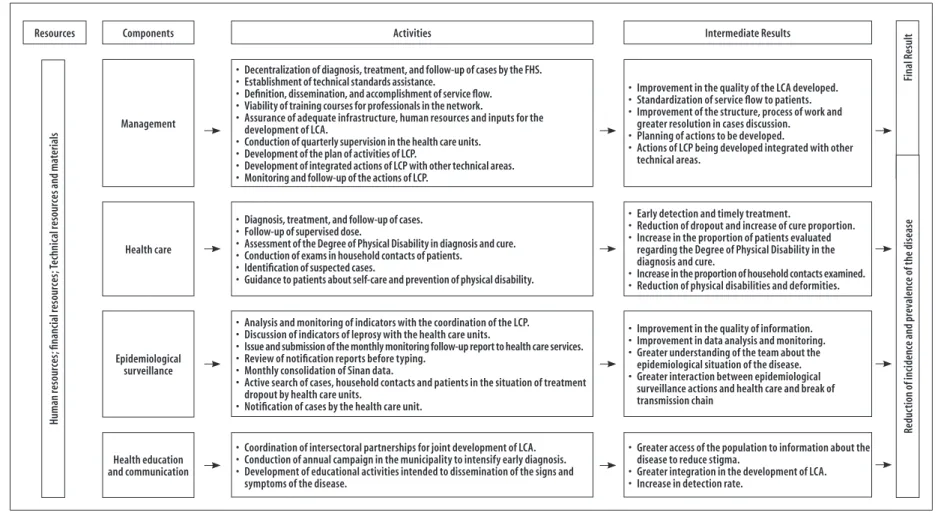
Step 1 – Construction of the Logical Model of MLPC
The Logical Model of MLPC intends to clarify
the complex relationship between the structure,
the process and the result and allows verifying the
difference between planned intervention of LCA
and empirical reality. The program was structured
according to strategic areas (components) of the
National Program: health care; epidemiological
surveillance; management; and health education
and communication. These strategic areas were
developed by the teams from Family Health Care, at the
management level of the Municipal Health Department
of Camaragibe. The following documents from the
Ministry of Health were used for its elaboration:
Regulations and Ordinances (Ordinance No. 3,125,
dated October 7
th, 2010, which approves the guidance
for surveillance, health care and control of leprosy;
and Ordinance No. 594, dated October 29
th, 2010,
which classifies the comprehensive care for leprosy
into levels I, II and III, in accordance with the
infrastructure, competencies, equipment and core
team); Technical Guides (Guide to Leprosy Control,
2002; Booklets for Primary Health Care Surveillance
– Leprosy, 2.ed., 2008); and Management Report
of the General-Coordination of the National Leprosy
Control Program, 2011.
12The need to use institutional
documents from the Ministry of Health owes to the fact
that these municipal programs adopt the guidelines
and defined activities, recommended and validated in
national scope, and their execution is the responsibility
of municipalities. Figure 1 presents the Logical Model
of MLPC, listing the activities and results expected to
each of the four components aforementioned.
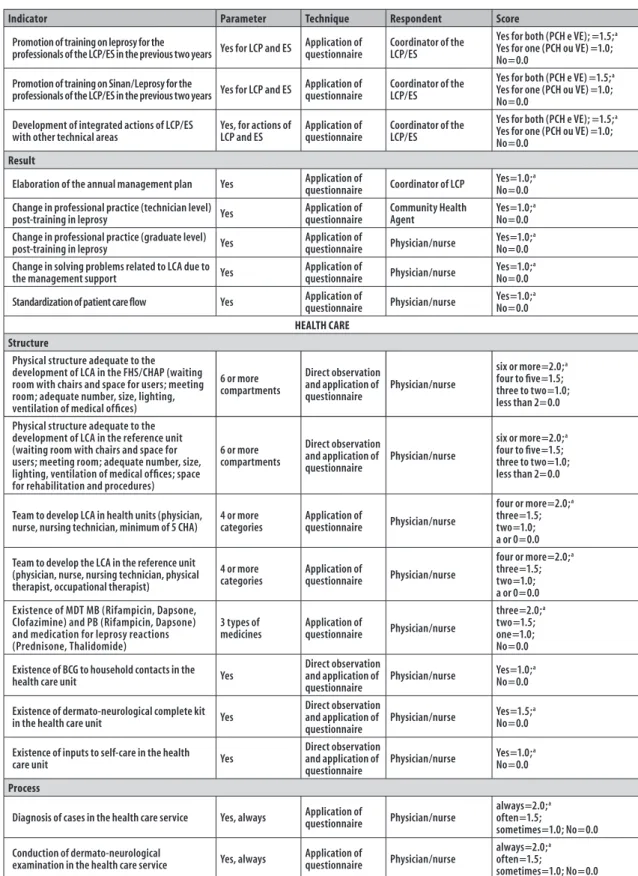
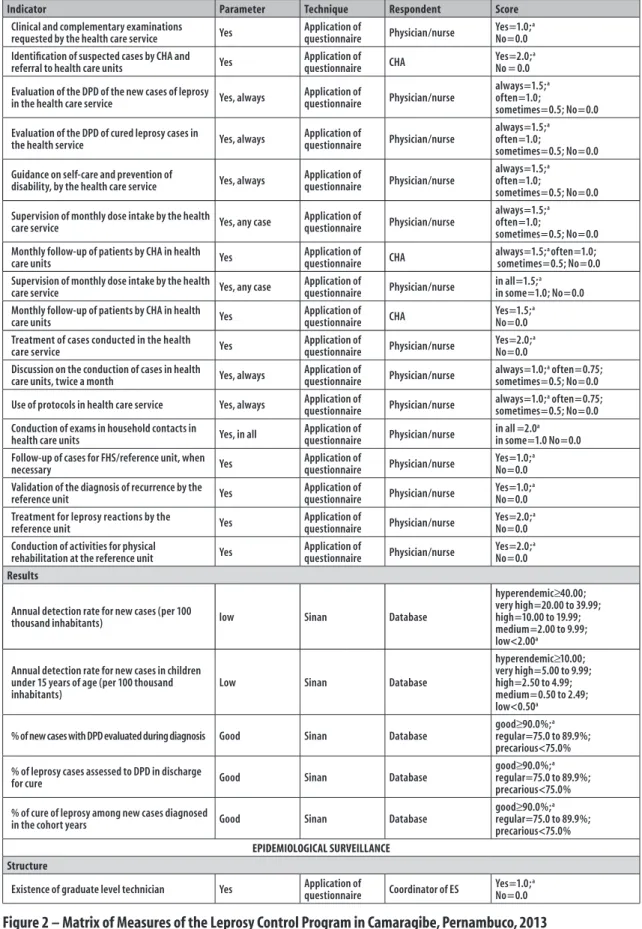
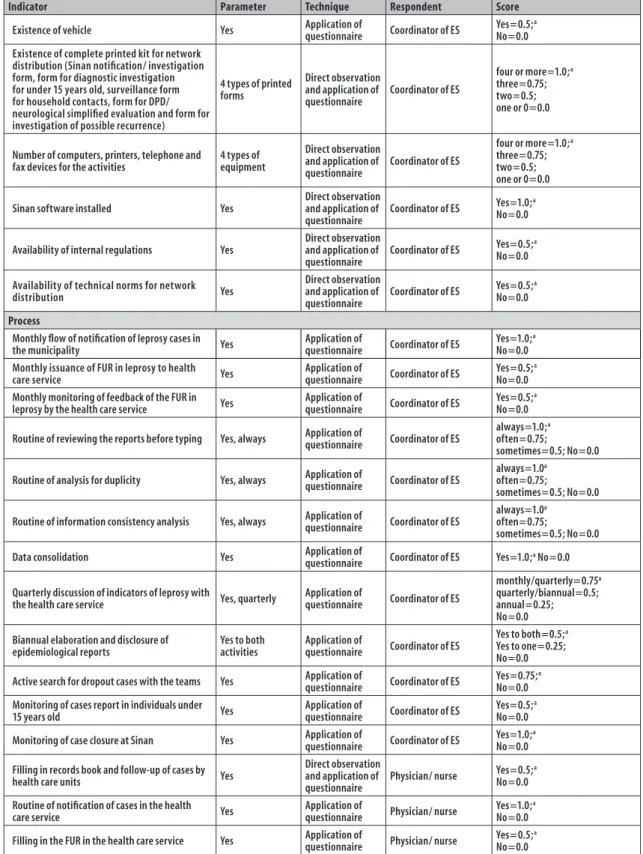
Step 2 – Development of the measure and judgment matrix
The Logical Model subsidized the development of
the assessment questions that composed the measure
and judgment matrix. Figure 2 presents, for each of the
four components of MLPC, (i) indicators of structure,
process and result dimension, (ii) parameters adopted
for judgment and (iii) sources of data specified per
indicator. The parameters were defined according to
institutional documents or found in literature and, in
case they were inexistent, referred by the researchers.
The valuation of each selected indicator considered its
degree of relevance on a scale from zero to 2, based
on a previous study.
8Data collection
The indicators listed in the matrix were composed
of (i) primary data, through non-participant direct
observation, based on a script, and (ii) application
of a questionnaire to professionals responsible for
the program coordination (1), epidemiological
surveillance (1) and health care – physicians, nurses
and community health agents (CHA) (78), totalizing
80 professionals surveyed. The professionals with less
than six months of work in the Family Health team
and those working in units with no report of cases
were excluded from the study. The data collection
was performed from July to September 2013. The
secondary data were extracted from the database of
the Information System for Notifiable Diseases (Sinan)
in leprosy, in August 2013.
Step 3 – Classification of degree of implementation
To calculate the degree of implementation, data
from the normative assessment on structure and
process indicators of each component were used.
To calculate the degree of implementation of MLPC,
maximum expected scores were referred to each of the
components, taking into consideration their relevance
in the reconstruction of the object study: management
(30); health care (40); epidemiological surveillance
(20); and health education and communication (10).
Initially, we determined the values observed (
Σ
of indicators scores) and calculated the degree of
implementation, in percentage (
Σ
observed/
Σ
of
maximum expected value x 100), for each component.
The total degree of implementation was based on the
sum of the listed indicators. The value obtained was
compared with the maximum expected value of each
component, obtaining the proportion to be classified
as follows: program ‘implemented' (90.0 to 100.0%),
‘partially implemented' (70.0 to 89.9%), ‘incipient'
(50.0 to 69.9%) and ‘not implemented' (<50.0%).
The ranking, rated by us, had higher level of demand
than the traditionally used, due to the strictness of the
epidemiological indicators and period of continuous
activity of the program evaluated.
Step 4 – Analysis of results (effects) and influence of
degree of implementation on the observed effects
The analysis of effects was performed taking into
consideration the indicators contained in the matrix
of measures of the Leprosy Control Program for
the period 2010-2012, last years with information
available on Sinan database. All indicators are
represented in Figure 2, including the result, and
the respective framework for judgment. After the
definition of the degree of implementation of each
component and the set of MLPC, these degrees were
compared to the result indicators, confronting them
with the developed model, overlapping each other to
identify the aspects that strengthened or undermined
the achievement of results.
Ethical aspects
The study project was approved by the Committee of
Ethics in Research in Human Beings of the Institute of
Comprehensive Medicine Professor Fernando Figueira
– Report No. 352,513/2013; Certificate of Ethical
Assessment Consideration No. 13430313.3.0000.5201
– on 31
stJuly, 2013.
Results
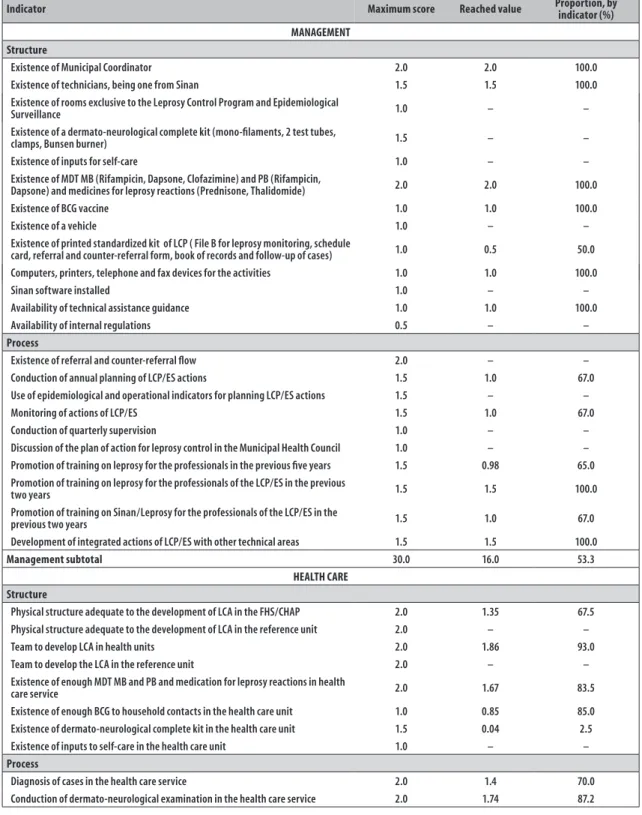
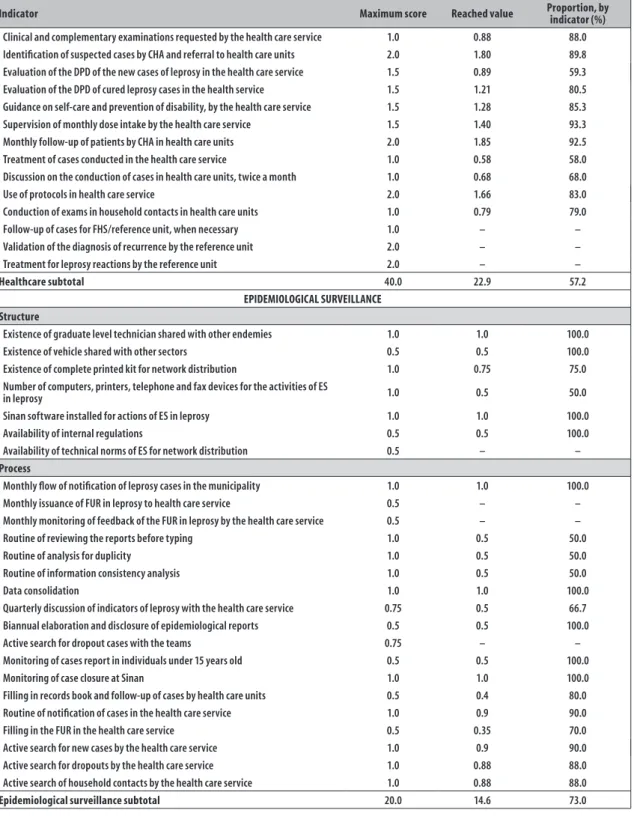
Figure 3 details the set of indicators of structure and
process used to assess the degree of implementation of
the Municipal Leprosy Control Program of Camaragibe,
the maximum values expected and reached for each
component of MLPC, based on the definition of the
degree of implementation of the intervention.
Figure 4 shows a summary of expected and
reached values for each component and level
of implementation of MLPC. The total level of
implementation of MLPC of Camaragibe was classified
as ‘incipient' (58.3%). The degree of implementation
by component ranged from ‘not implemented'
(health education and communication, 48.0%) to
‘incipient' (management, 53.3%; health assistance,
57.2%) and ‘partially implemented' (epidemiological
surveillance, 73.0%).
Figure 5 presents the results of MLPC by component.
The indicators related to management showed to
be regular (changes in professional practices of
technicians and higher education levels after training,
respectively, 83.0% and 88.0%) or precarious (annual
plan, 50.0%; uniformity of assistance flow, 15.0%; and
problems resolution, 44.0%).
The annual detection rate of new cases in 2010 and
2011 was very high (respectively, 33.2 and 22.6/100
thousand inhabitants); and in 2012, high (19.7/100
thousand inhabitants). The same rate in individuals
under 15 years old, in all three years, remained very
high: from 2010 to 2011, it remained in 9.0/100
thousand inhabitants; and decreased in 2012 to 5.9/100
thousand inhabitants. The proportion of new cases of
leprosy with a degree of physical disability assessed
by diagnosis varied from 82.8% to 91.0%; the ratio
of cure of new cases diagnosed in the years assessed
varied between 24.0 and 73.0%. The proportion of
dropout cases remained precarious in 2010 (33%),
in 2011 (69.5%) and 2012 (34.1%). As for the quality
of information, the consistency varied from 81.0 to
91.0%; and the absence of duplicates remained at
100.0% in all three years. For timely closure of cases,
it varied from 70.3 to 78.4% (Figure 5).
The result indicators related to health education
and communication were classified as precarious
(promotion of social mobilization activity, 50.0%;
and behavior of users after participation in activities
of prevention, 59.0%) (Figure 5).
Discussion
The analysis of the Municipal Leprosy Control
Program has exposed operational, technical and
administrative obstacles, as already demonstrated
in previous studies,
6,7characterizing its degree of
implementation in Camaragibe as ‘incipient’. After
nearly four decades after the recommendation of
multidrug therapy by WHO, almost three after its
formalization in Brazil,
13and nearly two decades since
Epidemiol. Serv. Saude, Brasília, 26(4), Oct-Dec 2017
Monique Feitosa de Souza et al.
precariousness of epidemiological surveillance actions
and educational activities; and little joint efforts with
social and institutional agents.
The methodological approach used – a single
case study – is described as having high potential of
internal validity, by analyzing in depth a phenomenon,
allowing the program’s functioning to be described
and explained broadly, without sticking to specific
issues about the object of evaluation.
9The quality of
theoretical articulation of the model relates to the
internal validity of the study.
10The construct of the
Leprosy Control Program is well established, based
on biomedical research and interventions applied in
large scale.
The limitations of this research, inherent to
single-case studies, relate to the excess of indicators in
relation to the observation scores. Similarly, in this type
of study we question the external validity, although what
is sought is not the statistical generalization, but the
analytical, based on the Logical Model of the program,
that is, the extrapolation of the adopted model and not
the empirical results.
10The inadequacy of the program's management in
the municipal scope relates, among other aspects,
to the insufficiency of monitoring process and
epidemiological and operational indicators, of
systematic evaluation of LCA and teams' supervision,
besides the lack of annual planning of actions and
dialogue with social control institutions. Similar
findings to those highlighted were evidenced in
evaluations of the Leprosy Control Program and the
performance of Primary Health Care.
14-16Also, the weak management preparation, associated
with the vertical municipal management and the lack of
service integration, influence the program's condition,
which becomes improvised, with low resolution of
municipal services, as observed in another context.
17In order to minimize such difficulties, it is suggested
an accurate definition of attributions, improvement of
communication between the several departments and
sharing of responsibilities.
18Despite the low investment of management in
the promotion of leprosy training among the health
professionals, it was observed a change in their
practices. Also, during the assessment of the role of
training in the quality of LCA, it was found that the
positive differential was the teaching/learning process
and the commitment of professionals.
19In a study
conducted in Recife, in 2013, the training courses
were analyzed from the professionals' perspectives,
and it was revealed a need to negotiate the content and
methodology from the problematization of the work,
aiming at a better performance.
20In spite of that, there
are no guarantees of a proactive professional profile
and transformation of the health care model.
21The influence of the implementation degree of the
effects observed, by component, was convergent and
divergent between some indicators, especially among
the unsatisfactory: (i) low proportion of contacts
examined, (ii) treatment dropout, (iii) limited
standardization of patient care flow, and (iv) inadequate
resolution of issues with management support. A
previous study carried out in the same municipality
almost a decade before (2004), showed divergences
between the degree of implementation of strategic
areas of Primary Health Care and the operational
epidemiological indicators of the program,
22similar
to what was observed on the National Program.
7The rates of general detection and in individuals
under 15 years of age showed very high endemicity,
although the diagnostic activities were adequate,
pointing out not only the increase of coverage of the
health care system and diagnostic speed, but also – and
mainly – expansion of the disease, reflecting a higher
incidence of new cases.
23,24However, the high indicator
in individuals under 15 years shows a persistence of
transmission and precocity of exposure to active sites,
suggesting a deficiency in surveillance and disease
control.
24Most part of structure indicators of MLPC
were deficient, which is a bottleneck and compromises
the quality of assistance. Furthermore, when there is
suspicion of the case, the referral to another service
is frequent, which hampers early diagnosis and timely
treatment. Reports about the lack of physicians in
Primary Health Care, low professional commitment,
deficient technical and scientific quality and inadequate
performance are re-incident, overwhelming nurses, in
addition to the transfer of responsibilities and blurring
of roles.
25,26There are frequent reports about users in treatment
or discharged from MLPC, who have not been evaluated
for their degree of physical disability, perhaps due
to the unfamiliarity, for many professionals, of the
classification technique and its importance as a strategy
to prevent disabilities.
27The analysis of degree of
showed to be incipient. However, the indicators related
to the level of physical disability in diagnosis ranged
from regular to good during the three years studied,
probably because some patients were evaluated
according to State references, leaving the primary care
in charge of notifying and starting treatment.
There was good evaluation regarding the active
search for household contacts and dropout patients.
Nonetheless, these procedures were not enough to
ensure the high proportion of contacts examined and
reverse the abandonment of treatment among newly
diagnosed cases. The examination of contacts is essential
to early discover new cases, guide about the signs of
the disease and break of the chain of transmission.
24Similarly, other authors observed that a reduced number
of contacts have received such measure, whilst the intake
of medication for several months and the appearance of
leprosy reactions are possible explanations to dropouts
or irregularity in treatment.
28In spite of the highlighted results, it is important
to consider the quality of information of Sinan related
to the consistency and existence of duplicity, because
it could compromise the analysis of indicators.
14The
precarious conduction of these procedures by the
municipality was not detected in the indicators due to
the implementation, by the State Health Department,
of emergency actions aiming to improve the quality of
information from the public Sinan.
As the reference unit was not working the users
were referred to other specialized services, located in
other municipalities, adding barriers to access, such
as cost and difficulties to schedule medical visits.
28Finally, the promotion actions, such as health education
and communication, are effective strategies for a good
performance of programs related to neglected diseases,
though they are demoted, according to findings of
this study. When these actions take place, they are
predominantly vertical and unilateral, emphasizing
campaigns and production of educational material
29in detriment to social and pedagogical practices
developed by the team in partnership with social and
institutional agents.
21,28This practice must be focused
on community participation, allied to experience with
the disease and its’ inclusion in the planning, execution
and evaluation of actions. Thus, it is possible to favor
changes in behavior, individual and collective health
promotion and improve the community quality of life.
30In 2013, the Camaragibe MLPC presented an
incipient degree of implementation in the municipality,
with repercussions on the results achieved and here
analyzed. The activities of health education and
communication, as well as the program’s management
and health assistance, are more problematic, whereas
the epidemiological surveillance is better structured.
For the effective control of leprosy, it is necessary to
overcome such difficulties, with greater mobilization of
resources and enough investments to qualify municipal
health care network, the reorganization of services and
strengthening of the health information system.
Authors’ contribution
Epidemiol.
S
erv.
Sau
de
, B
rasília,
26(4),
O
ct-D
ec 2017
Monique F
eit
osa de S
ouza et al.
Resources Components Activities
Management
Health care
Epidemiological surveillance
Health education and communication
•Decentralization of diagnosis, treatment, and follow-up of cases by the FHS.
•Establishment of technical standards assistance.
•Definition, dissemination, and accomplishment of service flow.
•Viability of training courses for professionals in the network.
•Assurance of adequate infrastructure, human resources and inputs for the
development of LCA.
•Conduction of quarterly supervision in the health care units.
•Development of the plan of activities of LCP.
•Development of integrated actions of LCP with other technical areas.
•Monitoring and follow-up of the actions of LCP.
•Diagnosis, treatment, and follow-up of cases.
•Follow-up of supervised dose.
•Assessment of the Degree of Physical Disability in diagnosis and cure.
•Conduction of exams in household contacts of patients.
•Identification of suspected cases.
•Guidance to patients about self-care and prevention of physical disability.
•Analysis and monitoring of indicators with the coordination of the LCP.
•Discussion of indicators of leprosy with the health care units.
•Issue and submission of the monthly monitoring follow-up report to health care services.
•Review of notification reports before typing.
•Monthly consolidation of Sinan data.
•Active search of cases, household contacts and patients in the situation of treatment
dropout by health care units.
•Notification of cases by the health care unit.
•Coordination of intersectoral partnerships for joint development of LCA.
•Conduction of annual campaign in the municipality to intensify early diagnosis.
•Development of educational activities intended to dissemination of the signs and
symptoms of the disease.
Intermediate Results
•Improvement in the quality of the LCA developed.
•Standardization of service flow to patients.
•Improvement of the structure, process of work and
greater resolution in cases discussion.
•Planning of actions to be developed.
•Actions of LCP being developed integrated with other
technical areas.
•Early detection and timely treatment.
•Reduction of dropout and increase of cure proportion.
•Increase in the proportion of patients evaluated
regarding the Degree of Physical Disability in the diagnosis and cure.
•Increase in the proportion of household contacts examined.
•Reduction of physical disabilities and deformities.
•Improvement in the quality of information.
•Improvement in data analysis and monitoring.
•Greater understanding of the team about the
epidemiological situation of the disease.
•Greater interaction between epidemiological
surveillance actions and health care and break of transmission chain
•Greater access of the population to information about the
disease to reduce stigma.
•Greater integration in the development of LCA.
•Increase in detection rate.
H
um
an
reso
ur
ces
; fi
na
nc
ia
l reso
ur
ces
; T
ec
hn
ic
al
reso
ur
ces
a
nd
m
at
er
ia
ls
Fin
al
R
es
ult
Re
du
ct
ion
o
f in
ci
den
ce
a
nd
p
re
va
len
ce
o
f t
he
di
se
as
e
Indicator Parameter Technique Respondent Score MANAGEMENT
Structure
Existence of Municipal Coordinator Yes Application of questionnaire Coordinator of LCP Yes=2.0; a No=0.0
Existence of technicians, being one from Sinan Yes Application of questionnaire Coordinator of LCP Yes=1.0;No=0.0a
Existence of rooms exclusive to the Leprosy Control Program and Epidemiological Surveillance
Yes, for the existence of both rooms (for the LCP and ES)
Direct observation and application of questionnaire
Coordinator of the LCP/ES
Yes for both =1.0;a Yes for one =0.5; No=0.0
Existence of a dermato-neurological complete kit (mono-filaments, 2 test tubes, clamps, Bunsen burner)
Yes
Direct observation and application of questionnaire
Coordinator of LCP Yes=1.5;No=0.0a
Existence of inputs for self-care Yes
Direct observation and application of questionnaire
Coordinator of LCP Yes=1.0; a No=0.0
Existence of MDT MB (Rifampicin, Dapsone, Clofazimine) and PB (Rifampicin, Dapsone) and medicines for leprosy reactions (Prednisone, Thalidomide)
3 types of medicines
Application of
questionnaire Coordinator of LCP
Three = 2.0;a Two = 1.5; One = 1.0; None = 0.0
Existence of BCG vaccine Yes Application of questionnaire Coordinator of LCP Yes=1.0; a No=0.0
Existence of a vehicle Yes Application of questionnaire Coordinator of LCP Yes=1.0;No=0.0a
Existence of printed standardized kit of LCP ( File B for leprosy monitoring, schedule card, referral and counter-referral form, book of records and follow-up of cases)
4 types of printed materials
Direct observation and application of questionnaire
Coordinator of LCP
Four =1.0;a Three=0.75; Two=0.5; One=0.25; None=0.0
Computers, printers, telephone and fax devices for the activities
4 types of equipment
Direct observation and application of questionnaire
Coordinator of LCP
Four = 1.0;a Three = 0.75; Two = 0.5; One = 0.25; None = 0.0
Sinan software installed Yes
Direct observation and application of questionnaire
Coordinator of LCP Yes=1.0; a No=0.0
Availability of technical assistance guidance Yes
Direct observation and application of questionnaire
Coordinator of LCP Yes=1.0;No=0.0a
Availability of internal regulations Yes
Direct observation and application of questionnaire
Coordinator of LCP Yes=0.5; a No=0.0
Process
Existence of referral and counter-referral flow Yes Application of questionnaire Coordinator of LCP Yes=2.0; a No=0.0
Conduction of annual planning of LCP/ES actions Yes for actions for LCP and ES Application of questionnaire Coordinator of the LCP/ES
Yes to two (PCH e VE) =1.5;a Yes to one (PCH ou VE) =1.0; No=0.0
Use of epidemiological and operational indicators for planning LCP/ES actions
Yes for actions for LCP and ES
Application of questionnaire
Coordinator of the LCP/ES
Yes for both (PCH e VE) =1.5;a Yes for one (PCH ou VE) =1.0; No=0.0
Monitoring of actions of LCP/ES Yes for actions for LCP and ES Application of questionnaire Coordinator of the LCP/ES
Yes for both (PCH e VE) =1.5;a Yes for one (PCH ou VE) =1.0; No=0.0
Conduction of quarterly supervision Yes, quarterly Application of questionnaire Coordinator of LCP
Quarterly=1.0;a Semi-annual=0.75; Annual =0.5; No=0.0 Discussion of the plan of action for leprosy
control in the Municipal Health Council Yes
Application of
questionnaire Coordinator of LCP
Yes=1.0;a No=0.0 Promotion of training on leprosy for the
professionals in the previous five years Yes
Application of questionnaire
Coordinator of the LCP and physician/nurse
Yes=1.5;a No=0.0
Figure 2 – Matrix of Measures of the Leprosy Control Program in Camaragibe, Pernambuco, 2013
Epidemiol. Serv. Saude, Brasília, 26(4), Oct-Dec 2017
Monique Feitosa de Souza et al.
Indicator Parameter Technique Respondent Score
Promotion of training on leprosy for the
professionals of the LCP/ES in the previous two years Yes for LCP and ES
Application of questionnaire
Coordinator of the LCP/ES
Yes for both (PCH e VE); =1.5;a Yes for one (PCH ou VE) =1.0; No=0.0
Promotion of training on Sinan/Leprosy for the
professionals of the LCP/ES in the previous two years Yes for LCP and ES
Application of questionnaire
Coordinator of the LCP/ES
Yes for both (PCH e VE) =1.5;a Yes for one (PCH ou VE) =1.0; No=0.0
Development of integrated actions of LCP/ES with other technical areas
Yes, for actions of LCP and ES
Application of questionnaire
Coordinator of the LCP/ES
Yes for both (PCH e VE); =1.5;a Yes for one (PCH ou VE) =1.0; No=0.0
Result
Elaboration of the annual management plan Yes Application of questionnaire Coordinator of LCP Yes=1.0; a No=0.0 Change in professional practice (technician level)
post-training in leprosy Yes
Application of questionnaire Community Health Agent Yes=1.0;a No=0.0 Change in professional practice (graduate level)
post-training in leprosy Yes
Application of
questionnaire Physician/nurse
Yes=1.0;a No=0.0 Change in solving problems related to LCA due to
the management support Yes
Application of
questionnaire Physician/nurse
Yes=1.0;a No=0.0
Standardization of patient care flow Yes Application of questionnaire Physician/nurse Yes=1.0; a No=0.0 HEALTH CARE
Structure
Physical structure adequate to the development of LCA in the FHS/CHAP (waiting room with chairs and space for users; meeting room; adequate number, size, lighting, ventilation of medical offices)
6 or more compartments
Direct observation and application of questionnaire
Physician/nurse
six or more=2.0;a four to five=1.5; three to two=1.0; less than 2=0.0
Physical structure adequate to the development of LCA in the reference unit (waiting room with chairs and space for users; meeting room; adequate number, size, lighting, ventilation of medical offices; space for rehabilitation and procedures)
6 or more compartments
Direct observation and application of questionnaire
Physician/nurse
six or more=2.0;a four to five=1.5; three to two=1.0; less than 2=0.0
Team to develop LCA in health units (physician, nurse, nursing technician, minimum of 5 CHA)
4 or more categories
Application of
questionnaire Physician/nurse
four or more=2.0;a three=1.5; two=1.0; a or 0=0.0
Team to develop the LCA in the reference unit (physician, nurse, nursing technician, physical therapist, occupational therapist)
4 or more categories
Application of
questionnaire Physician/nurse
four or more=2.0;a three=1.5; two=1.0; a or 0=0.0 Existence of MDT MB (Rifampicin, Dapsone,
Clofazimine) and PB (Rifampicin, Dapsone) and medication for leprosy reactions (Prednisone, Thalidomide)
3 types of medicines Application of questionnaire Physician/nurse three=2.0;a two=1.5; one=1.0; No=0.0
Existence of BCG to household contacts in the
health care unit Yes
Direct observation and application of questionnaire
Physician/nurse Yes=1.0; a No=0.0
Existence of dermato-neurological complete kit
in the health care unit Yes
Direct observation and application of questionnaire
Physician/nurse Yes=1.5;No=0.0a
Existence of inputs to self-care in the health
care unit Yes
Direct observation and application of questionnaire
Physician/nurse Yes=1.0; a No=0.0
Process
Diagnosis of cases in the health care service Yes, always Application of questionnaire Physician/nurse
always=2.0;a often=1.5;
sometimes=1.0; No=0.0
Conduction of dermato-neurological
examination in the health care service Yes, always
Application of
questionnaire Physician/nurse
always=2.0;a often=1.5;
sometimes=1.0; No=0.0
Figure 2 – Matrix of Measures of the Leprosy Control Program in Camaragibe, Pernambuco, 2013
Indicator Parameter Technique Respondent Score Clinical and complementary examinations
requested by the health care service Yes
Application of
questionnaire Physician/nurse
Yes=1.0;a No=0.0 Identification of suspected cases by CHA and
referral to health care units Yes
Application of questionnaire CHA
Yes=2.0;a No = 0.0
Evaluation of the DPD of the new cases of leprosy
in the health care service Yes, always
Application of
questionnaire Physician/nurse
always=1.5;a often=1.0;
sometimes=0.5; No=0.0
Evaluation of the DPD of cured leprosy cases in
the health service Yes, always
Application of
questionnaire Physician/nurse
always=1.5;a often=1.0;
sometimes=0.5; No=0.0
Guidance on self-care and prevention of
disability, by the health care service Yes, always
Application of
questionnaire Physician/nurse
always=1.5;a often=1.0;
sometimes=0.5; No=0.0
Supervision of monthly dose intake by the health
care service Yes, any case
Application of
questionnaire Physician/nurse
always=1.5;a often=1.0;
sometimes=0.5; No=0.0 Monthly follow-up of patients by CHA in health
care units Yes
Application of questionnaire CHA
always=1.5;a often=1.0; sometimes=0.5; No=0.0 Supervision of monthly dose intake by the health
care service Yes, any case
Application of
questionnaire Physician/nurse
in all=1.5;a in some=1.0; No=0.0 Monthly follow-up of patients by CHA in health
care units Yes
Application of questionnaire CHA
Yes=1.5;a No=0.0 Treatment of cases conducted in the health
care service Yes
Application of
questionnaire Physician/nurse
Yes=2.0;a No=0.0 Discussion on the conduction of cases in health
care units, twice a month Yes, always
Application of
questionnaire Physician/nurse
always=1.0;a often=0.75; sometimes=0.5; No=0.0
Use of protocols in health care service Yes, always Application of questionnaire Physician/nurse always=1.0;sometimes=0.5; No=0.0a often=0.75;
Conduction of exams in household contacts in
health care units Yes, in all
Application of
questionnaire Physician/nurse
in all =2.0a in some=1.0 No=0.0 Follow-up of cases for FHS/reference unit, when
necessary Yes
Application of
questionnaire Physician/nurse
Yes=1.0;a No=0.0 Validation of the diagnosis of recurrence by the
reference unit Yes
Application of
questionnaire Physician/nurse
Yes=1.0;a No=0.0 Treatment for leprosy reactions by the
reference unit Yes
Application of
questionnaire Physician/nurse
Yes=2.0;a No=0.0 Conduction of activities for physical
rehabilitation at the reference unit Yes
Application of
questionnaire Physician/nurse
Yes=2.0;a No=0.0 Results
Annual detection rate for new cases (per 100
thousand inhabitants) low Sinan Database
hyperendemic≥40.00; very high=20.00 to 39.99; high=10.00 to 19.99; medium=2.00 to 9.99; low<2.00a
Annual detection rate for new cases in children under 15 years of age (per 100 thousand inhabitants)
Low Sinan Database
hyperendemic≥10.00; very high=5.00 to 9.99; high=2.50 to 4.99; medium=0.50 to 2.49; low<0.50a
% of new cases with DPD evaluated during diagnosis Good Sinan Database
good≥90.0%;a regular=75.0 to 89.9%; precarious<75.0%
% of leprosy cases assessed to DPD in discharge
for cure Good Sinan Database
good≥90.0%;a regular=75.0 to 89.9%; precarious<75.0%
% of cure of leprosy among new cases diagnosed
in the cohort years Good Sinan Database
good≥90.0%;a regular=75.0 to 89.9%; precarious<75.0% EPIDEMIOLOGICAL SURVEILLANCE
Structure
Existence of graduate level technician Yes Application of questionnaire Coordinator of ES Yes=1.0;No=0.0a
Figure 2 – Matrix of Measures of the Leprosy Control Program in Camaragibe, Pernambuco, 2013
Epidemiol. Serv. Saude, Brasília, 26(4), Oct-Dec 2017
Indicator Parameter Technique Respondent Score
Existence of vehicle Yes Application of questionnaire Coordinator of ES Yes=0.5; a No=0.0 Existence of complete printed kit for network
distribution (Sinan notification/ investigation form, form for diagnostic investigation for under 15 years old, surveillance form for household contacts, form for DPD/ neurological simplified evaluation and form for investigation of possible recurrence)
4 types of printed forms
Direct observation and application of questionnaire
Coordinator of ES
four or more=1.0;a three=0.75; two=0.5; one or 0=0.0
Number of computers, printers, telephone and fax devices for the activities
4 types of equipment
Direct observation and application of questionnaire
Coordinator of ES
four or more=1.0;a three=0.75; two=0.5; one or 0=0.0
Sinan software installed Yes
Direct observation and application of questionnaire
Coordinator of ES Yes=1.0;No=0.0a
Availability of internal regulations Yes
Direct observation and application of questionnaire
Coordinator of ES Yes=0.5; a No=0.0
Availability of technical norms for network
distribution Yes
Direct observation and application of questionnaire
Coordinator of ES Yes=0.5;No=0.0 a
Process
Monthly flow of notification of leprosy cases in
the municipality Yes
Application of
questionnaire Coordinator of ES
Yes=1.0;a No=0.0 Monthly issuance of FUR in leprosy to health
care service Yes
Application of
questionnaire Coordinator of ES
Yes=0.5;a No=0.0 Monthly monitoring of feedback of the FUR in
leprosy by the health care service Yes
Application of
questionnaire Coordinator of ES
Yes=0.5;a No=0.0
Routine of reviewing the reports before typing Yes, always Application of questionnaire Coordinator of ES
always=1.0;a often=0.75; sometimes=0.5; No=0.0
Routine of analysis for duplicity Yes, always Application of questionnaire Coordinator of ES
always=1.0a often=0.75; sometimes=0.5; No=0.0
Routine of information consistency analysis Yes, always Application of questionnaire Coordinator of ES
always=1.0a often=0.75; sometimes=0.5; No=0.0
Data consolidation Yes Application of questionnaire Coordinator of ES Yes=1.0;a No=0.0
Quarterly discussion of indicators of leprosy with
the health care service Yes, quarterly
Application of
questionnaire Coordinator of ES
monthly/quarterly=0.75a quarterly/biannual=0.5; annual=0.25; No=0.0
Biannual elaboration and disclosure of epidemiological reports
Yes to both activities
Application of
questionnaire Coordinator of ES
Yes to both=0.5;a Yes to one=0.25; No=0.0
Active search for dropout cases with the teams Yes Application of questionnaire Coordinator of ES Yes=0.75; a No=0.0 Monitoring of cases report in individuals under
15 years old Yes
Application of
questionnaire Coordinator of ES
Yes=0.5;a No=0.0
Monitoring of case closure at Sinan Yes Application of questionnaire Coordinator of ES Yes=1.0; a No=0.0
Filling in records book and follow-up of cases by
health care units Yes
Direct observation and application of questionnaire
Physician/ nurse Yes=0.5;No=0.0 a
Routine of notification of cases in the health
care service Yes
Application of
questionnaire Physician/ nurse
Yes=1.0;a No=0.0
Filling in the FUR in the health care service Yes Application of questionnaire Physician/ nurse Yes=0.5;No=0.0 a
Figure 2 – Matrix of Measures of the Leprosy Control Program in Camaragibe, Pernambuco, 2013
Continue on next page
Indicator Parameter Technique Respondent Score
Active search for new cases by the health care service Yes, always Application of questionnaire Physician/nurse and CHA
always=1.0;a often=0.75; sometimes=0.5; No=0.0
Active search for dropouts by the health care service Yes, always Application of questionnaire Physician/nurse and CHA
always=1.0;a often=0.75; sometimes=0.5; No=0.0
Active search of household contacts by the
health care service Yes, always
Application of questionnaire
Physician/nurse and CHA
always=1.0;a often=0.75; sometimes=0.5; No=0.0 Results
% of contacts examined among new cases
diagnosed during the year Good Sinan Database
good≥75.0%;a regular=50.0 to 74.9%; precarious<50.0%
% of leprosy cases who abandoned treatment
among new cases Good Sinan Database
good<10.0%;a regular=10.0 to 24.9%; precarious≥25.0%
Quality of information – Consistency Good Sinan Database
good≥90.0%;a regular=70.0 to 89.9%; precarious<70.0%
Quality of information – Absence of duplicates Good Sinan Database
good≥90.0%;a regular=70.0 to 89.9%; precarious<70.0%
Timely closure of cases Good Sinan Database
good≥90.0%;a regular=70.0 to 89.9%; precarious<70.0% HEALTH EDUCATION AND COMMUNICATION
Structure
Existence of room for educational activities Yes
Direct observation and application of questionnaire
Physician/nurse Yes=1.0; a No=0.0
Availability of audiovisual resources for activities Yes
Direct observation and application of questionnaire
Physician/nurse Yes=1.0; a No=0.0
Availability of resources for the development of educational activities in the health care service Yes
Direct observation and application of questionnaire
Physician/nurse Yes=1.0No=0.0a;
Process
Joint partnership with the several social agents
and institutions Yes, always
Application of questionnaire
Physician/nurse and coordinator of LCP
always=2.0;a often=1.5;
sometimes=1.0; No=0.0
Promotion of biannual actions by the LCP/ES with the health care service
Yes, for the promotion of actions by LCP and ES
Application of questionnaire
Coordinator of the LCP/ES
Yes for both (PCH e VE) =2.0;a Yes for one (PCH ou VE)=1.0; No=0.0
Organization of municipal campaign to increase
early diagnosis Yes
Application of
questionnaire Coordinator of LCP
Yes=1.0;a No=0.0
Monthly development of educational activities in
the health care service Yes, monthly
Application of
questionnaire Physician/nurse
monthly=2.0a
bi-monthly/ quarterly=1.5; biannual/annual=1.0; No=0.0 Results
Opinion of physicians and nurses about the behavioral changes of users after participation in educational activities
Yes Application of questionnaire Physician/nurse Yes=1.0; a No=0.0
Promotion of social mobilization activities Yes Application of questionnaire Coordinator of the LCP/ES Yes=0.5;No=0.0 a
a) Maximum value expected.
Acronyms: LCP, Leprosy Control Program; Sinan, Information System for Notifiable Diseases; ES, epidemiological surveillance; MDT, multidrug therapy; MC, multibacillary; PB, paucibacillary; BCG, Bacillus Calmette-Guérin; LCA, leprosy control actions; FHS, Family Health Strategy; CHAP, Community Health Agents Program; CHA, community health agent; DPD, degree of physical disability; and FUR, follow-up report.
(based on Leal et al.8).
Epidemiol. Serv. Saude, Brasília, 26(4), Oct-Dec 2017
Indicator Maximum score Reached value Proportion, by indicator (%)
MANAGEMENT Structure
Existence of Municipal Coordinator 2.0 2.0 100.0
Existence of technicians, being one from Sinan 1.5 1.5 100.0
Existence of rooms exclusive to the Leprosy Control Program and Epidemiological
Surveillance 1.0 – –
Existence of a dermato-neurological complete kit (mono-filaments, 2 test tubes,
clamps, Bunsen burner) 1.5 – –
Existence of inputs for self-care 1.0 – –
Existence of MDT MB (Rifampicin, Dapsone, Clofazimine) and PB (Rifampicin,
Dapsone) and medicines for leprosy reactions (Prednisone, Thalidomide) 2.0 2.0 100.0
Existence of BCG vaccine 1.0 1.0 100.0
Existence of a vehicle 1.0 – –
Existence of printed standardized kit of LCP ( File B for leprosy monitoring, schedule
card, referral and counter-referral form, book of records and follow-up of cases) 1.0 0.5 50.0 Computers, printers, telephone and fax devices for the activities 1.0 1.0 100.0
Sinan software installed 1.0 – –
Availability of technical assistance guidance 1.0 1.0 100.0
Availability of internal regulations 0.5 – –
Process
Existence of referral and counter-referral flow 2.0 – –
Conduction of annual planning of LCP/ES actions 1.5 1.0 67.0
Use of epidemiological and operational indicators for planning LCP/ES actions 1.5 – –
Monitoring of actions of LCP/ES 1.5 1.0 67.0
Conduction of quarterly supervision 1.0 – –
Discussion of the plan of action for leprosy control in the Municipal Health Council 1.0 – – Promotion of training on leprosy for the professionals in the previous five years 1.5 0.98 65.0 Promotion of training on leprosy for the professionals of the LCP/ES in the previous
two years 1.5 1.5 100.0
Promotion of training on Sinan/Leprosy for the professionals of the LCP/ES in the
previous two years 1.5 1.0 67.0
Development of integrated actions of LCP/ES with other technical areas 1.5 1.5 100.0
Management subtotal 30.0 16.0 53.3
HEALTH CARE Structure
Physical structure adequate to the development of LCA in the FHS/CHAP 2.0 1.35 67.5 Physical structure adequate to the development of LCA in the reference unit 2.0 – –
Team to develop LCA in health units 2.0 1.86 93.0
Team to develop the LCA in the reference unit 2.0 – –
Existence of enough MDT MB and PB and medication for leprosy reactions in health
care service 2.0 1.67 83.5
Existence of enough BCG to household contacts in the health care unit 1.0 0.85 85.0 Existence of dermato-neurological complete kit in the health care unit 1.5 0.04 2.5
Existence of inputs to self-care in the health care unit 1.0 – –
Process
Diagnosis of cases in the health care service 2.0 1.4 70.0
Conduction of dermato-neurological examination in the health care service 2.0 1.74 87.2
Figure 3 – Score of indicators used in the assessment of the degree of implementation of the Leprosy Control
Program, according to the Logical Model component, in Camaragibe, Pernambuco, 2013
Continue on next page
Indicator Maximum score Reached value Proportion, by indicator (%)
Clinical and complementary examinations requested by the health care service 1.0 0.88 88.0 Identification of suspected cases by CHA and referral to health care units 2.0 1.80 89.8 Evaluation of the DPD of the new cases of leprosy in the health care service 1.5 0.89 59.3 Evaluation of the DPD of cured leprosy cases in the health service 1.5 1.21 80.5 Guidance on self-care and prevention of disability, by the health care service 1.5 1.28 85.3
Supervision of monthly dose intake by the health care service 1.5 1.40 93.3
Monthly follow-up of patients by CHA in health care units 2.0 1.85 92.5
Treatment of cases conducted in the health care service 1.0 0.58 58.0
Discussion on the conduction of cases in health care units, twice a month 1.0 0.68 68.0
Use of protocols in health care service 2.0 1.66 83.0
Conduction of exams in household contacts in health care units 1.0 0.79 79.0
Follow-up of cases for FHS/reference unit, when necessary 1.0 – –
Validation of the diagnosis of recurrence by the reference unit 2.0 – –
Treatment for leprosy reactions by the reference unit 2.0 – –
Healthcare subtotal 40.0 22.9 57.2
EPIDEMIOLOGICAL SURVEILLANCE Structure
Existence of graduate level technician shared with other endemies 1.0 1.0 100.0
Existence of vehicle shared with other sectors 0.5 0.5 100.0
Existence of complete printed kit for network distribution 1.0 0.75 75.0
Number of computers, printers, telephone and fax devices for the activities of ES
in leprosy 1.0 0.5 50.0
Sinan software installed for actions of ES in leprosy 1.0 1.0 100.0
Availability of internal regulations 0.5 0.5 100.0
Availability of technical norms of ES for network distribution 0.5 – –
Process
Monthly flow of notification of leprosy cases in the municipality 1.0 1.0 100.0
Monthly issuance of FUR in leprosy to health care service 0.5 – –
Monthly monitoring of feedback of the FUR in leprosy by the health care service 0.5 – –
Routine of reviewing the reports before typing 1.0 0.5 50.0
Routine of analysis for duplicity 1.0 0.5 50.0
Routine of information consistency analysis 1.0 0.5 50.0
Data consolidation 1.0 1.0 100.0
Quarterly discussion of indicators of leprosy with the health care service 0.75 0.5 66.7
Biannual elaboration and disclosure of epidemiological reports 0.5 0.5 100.0
Active search for dropout cases with the teams 0.75 – –
Monitoring of cases report in individuals under 15 years old 0.5 0.5 100.0
Monitoring of case closure at Sinan 1.0 1.0 100.0
Filling in records book and follow-up of cases by health care units 0.5 0.4 80.0
Routine of notification of cases in the health care service 1.0 0.9 90.0
Filling in the FUR in the health care service 0.5 0.35 70.0
Active search for new cases by the health care service 1.0 0.9 90.0
Active search for dropouts by the health care service 1.0 0.88 88.0
Active search of household contacts by the health care service 1.0 0.88 88.0
Epidemiological surveillance subtotal 20.0 14.6 73.0
Figure 3 – Score of indicators used in the assessment of the degree of implementation of the Leprosy Control
Program, according to the Logical Model component, in Camaragibe, Pernambuco, 2013
Epidemiol. Serv. Saude, Brasília, 26(4), Oct-Dec 2017
Indicator Maximum score Reached value Proportion, by indicator (%)
HEALTH EDUCATION AND COMMUNICATION Structure
Existence of room for educational activities in the health care service 1.0 0.41 41.0 Availability of audiovisual resources for educational activities 1.0 0.05 5.0 Availability of resources for the development of educational activities in the health
care service 1.0 0.29 29.0
Process
Joint partnership with the several social agents and institutions 2.0 1.07 53.0 Promotion of biannual actions by the LCP/ES with the health care service 2.0 1.0 50.0
Organization of municipal campaign to increase early diagnosis 1.0 1.0 100.0
Monthly development of educational activities in the health care service 2.0 0.98 49.0
Subtotal da educação em saúde e comunicação 10.0 4.8 48.0
Acronyms: LCP, Leprosy Control Program; Sinan, Information System for Notiafible Diseases; ES, epidemiological surveillance; MDT, multidrug therapy-; MC, multibacillary; PB, paucibacillary; BCG, Bacillus Calmette-Guérin; LCA, leprosy control actions; FHS, Family Health Strategy; CHAP, Community Health Agents Program; CHA, community health agent; DPD, degree of physical disability; and FUR, follow-up report.
Figure 3 – Score of indicators used in the assessment of the degree of implementation of the Leprosy Control
Program, according to the Logical Model component, in Camaragibe, Pernambuco, 2013
Components Maximum value expected Reached value Degree of Implementation (%)
Management 30.0 16.0 53.3
Health care 40.0 22.9 57.2
Epidemiological Surveillance 20.0 14.6 73.0
Health Education and Communication 10.0 4.8 48.0
Degree of Implementation TOTAL 100.0 58.3 58.3
Degree of Implementation
Implemented 100 to 90%
Partially implemented 89 to 70%
Incipient 69 to 50%
Not implemented <50%
Figure 4 – Degree of implementation of the Leprosy Control Program, Camaragibe, Pernambuco, 2013
Indicators Parameters Sinan indicators Score achieved (%)
2010 2011 2012
MANAGEMENT
Annual management plan developed and implemented
Good: ≥90,0% Regular: 70,0 to 89,9% Precarious: <70,0%
– – – 50.0
Change in professional practices (graduate level)
post-training in leprosy – – – 88.0
Change in professional practices (technician
level) post-training in leprosy – – – 83.0
Change in addressing the obstacles about LCA by
the support of management – – – 44.0
Standardization of patient care flow – – – 15.0
HEALTH CARE
Annual detection rate of new cases (per 100 thousand inhabitants)
Hyperendemic: ≥40,00/100 mil hab. Very high: 20,00 to 39,99/100 mil hab. High: 10,00 to 19,99/100 mil hab. Medium: 2,00 to 9,99 /100 mil hab. Low: <2,00 /100 mil hab.
33.2 22.6 19.7 –
Figure 5 – Results of the Leprosy Control Program, Camaragibe, Pernambuco, 2013
Continue on next page