Fisioter Mov. 2016 July/Sept.;29(3):533-42 Fisioter. Mov., Curitiba, v. , n. , p. - , Jul./Set.
Licenciado sob uma Licença Creative Commons DO): http://dx.doi.org. . / - . . .AO
[T]
Association between family poverty and the neuropsychomotor
development of children in the administrative districts of Belém
[)]
Associação entre a pobreza familiar e o desenvolvimento
neuropsicomotor de crianças nos distritos administrativos de Belém
[A]
Elson Ferreira Costa, Lilia Iêda Chaves Cavalcante, Mariane Lopes da Silva, Talitha Buenaño França Guerreiro*
Universidade Federal do Pará UFPA , Belém, PA, Brazil
[R]Abstract
Introduction: Childhood development represents a sequence of changes in behavior and underlying pro-cesses, in luenced by biological and environmental factors. Screening and monitoring of neurodevelopment show effective procedures for early identi ication of different disorders of childhood development. Objective: To analyze the neurodevelopment, using the Denver Developmental Screening Test )), of children enrolled in preschools of Administrative Districts in Belém and to map the districts and the percentage of development evaluated as normal and suspected delay. Methods: This was a cross-sectional and exploratory descriptive study. A questionnaire was administered to parents to collect the personal, contextual and family data and an instrument to measure the level of family poverty. Results: Of the children assessed, . % showed a sus-pected delay in neuropsychomotor developmental and . % in language. The family poverty level variable showed a statistically signi icant association with the overall level of development p = . and of language p = . . Conclusion: )t is hoped that this study will contribute to generate an impact in improving the eco-logical conditions of children and their families, reducing the risks to which they are exposed.
Keywords: Child. Childhood Development. Poverty.
Resumo
Introdução: O desenvolvimento infantil é uma sequência de mudanças no comportamento e processos subja-centes, infl uenciado por fatores biológicos e ambientais. A triagem desenvolvimento têm se mostrado um pro-cedimento efi ciente para identifi car precocemente desvios desenvolvimentais. Objetivo: Analisar o perfi l do neu-rodesenvolvimento, segundo o Teste de Triagem do Desenvolvimento Denver II, de crianças de pré-escolas dos Distritos Administrativos de Belém e mapear os distritos e os percentuais de desenvolvimento avaliado como “normal” e “suspeita de atraso”. Métodos: Estudo transversal e de caráter descritivo exploratório. Foi aplicado com os pais das crianças um questionário para coletar os dados pessoais, contextuais e familiares, e instrumento para medição do nível de pobreza familiar. Resultados: Das 319 crianças avaliadas, a prevalência de suspeita de atraso no desenvolvimento chegou a 77,7% e da área da linguagem foi de 59,2%. A variável denominada Nível de Pobreza Familiar apresentou associação estatisticamente signifi cativa com o nível de desenvolvimento global (p = 0,011) e da linguagem (p = 0,003). Conclusão: Espera-se que esta pesquisa possa contribuir para gerar repercussões sobre a melhoria das condições de saúde das crianças e suas famílias, reduzindo os fatores de riscos aos quais elas estão expostas.
Palavras-chave: Criança. Desenvolvimento Infantil. Pobreza.
Introduction
)n recent decades studies have aimed to investi-gate the impact of multiple risk factors on childhood development, with poverty being among the most discussed and investigated , , . The indings suggest that the delay in neuropsychomotor devel-opment NPMD occurs with greater frequency and severity when children live in extreme poverty and for a longer period of life .
The irst experiences of children exposed to the deleterious effects of poverty can affect the overall health, not only in childhood but also in adulthood . Thus, growing up in impoverished environments can trigger serious implications in the different di-mensions of development , , , such as in cogni-tion, motor skills, social interaction and language.
There is evidence that poor children are more exposed to biological and genetic risk factors, such as nutritional disorders , , infant mortality, pre-maturity and low birth weight , neurological, psy-cho-emotional and behavioral changes , family factors, such as an unsafe and non-stimulating envi-ronment, dysfunctional family, low socioeconomic status , , , poor access to health and educa-tion, and community factors that in luence both the environment of the child and that of his/her family , . A possible explanation for this is that the poorer the child is, the fewer opportunities there are to sat-isfy the basic childhood necessities.
Thus, the study of poverty and its implications for human development is a complex task. There are contradictions in the very concept of this term, as well as in the different methods for its measurement , , . For a long time poverty was considered to be a condition de ined by income below a pre-established level . This variable continues to be a widely used indicator. (owever, in recent years, poverty has been seen as a multidimensional phe-nomenon, with a more dynamic and structural con-cept . Thus, poverty involves not only economic aspects, but also other dimensions, such as political, social, cultural, quality of life and well-being .
As a result, poverty must be analyzed from the reality of each country, considering its historical, cul-tural and contextual characteristics , . )n Brazil, the disparate socioeconomic inequality present in the society causes the levels of poverty and the number of children developing in this critical condition to vary according to regions. The North and Northeast of Brazil, for example, stand out as having the high-est incidence of poverty and a higher rate of children aged under six years living in this situation , . Speci ically, the state capitals Belém, Fortaleza, Recife and Salvador have the highest rates of poor people and poor children.
535 below the national average . The Metropolitan
Area of Belém MAB can be characterized as exten-sively precarious, with acute shortages of urban infra-structure and services, organized around delimited and spatially compact centers . These aspects are associated with the high rates of poverty and socio-economic conditions of the inhabitants .
Another aspect highlighted in the current litera-ture on poverty measurement is that many research-es consider poor people to be grouped in a broad socioeconomic category, not taking into account the different levels of poverty and the potential concen-tration of risk factors associated with each of them ,
, . )n addition, it is assumed that urban poverty in particular affects the ecology of the development of the child, including its extrafamilial dimension kin-dergartens, schools, neighborhood , and therefore its measurement has been a concern for researchers from different areas , , .
)n ecological terms, urban poverty assumes the contours of the context in which the phenomenon is manifested , assuming signi icant variations from one neighborhood or area to another. Therefore, to measure it and verify its various levels of manifestation can help comprehend the degree of effect that this phe-nomenon has on childhood development in a particular city or district. The importance should be highlighted of evaluating NPMD and verifying how much it is as-sociated with descriptive variables of the poverty level of a given population, in a speci ic context , .
From this perspective, Sigolo and Aiello em-phasize the importance of using instruments that can evaluate NPMD and identify suspected delays in populations, especially when considering the signi i-cant number of children in early childhood exposed to risk factors for development . )n addition to encompassing the broader aspects of neurodevel-opment, Bricker, Squires and Clifford reported that evaluative tools must have an appropriate re-lationship between brevity rapid application and precision satisfactory psychometric properties as a characteristic. Many of these instruments have emerged in the last twenty years, with the Denver Developmental Screening Test )) – Denver )) standing out among them.
)t should be noted that the Denver )) is a screening test and is not presented as a de initive predictor in-strument for adaptive or intellectual abilities, therefore, evaluators should take care not to use it to create labels or diagnoses. To be valid, the test should be applied in
a standardized manner and with the exact materials . )t is considered that the Denver )) is designed to re lect the development from a vast expanse of hetero-geneous skills. Thus, the application allows the identi i-cation, from the performance of children in the tasks, of whether they act according to their age or not.
Accordingly, the need to study the effects of pov-erty on neurodevelopment from an ecological dimen-sion can be perceived, especially with epidemiologi-cal studies or large samples and using methods of evaluation through tests or scales, such as the Denver Developmental Screening Test )). The aim of this study was to analyze the neurodevelopmental
pro-ile, according to the Denver )), of children enrolled in preschools of Administrative Districts in Belém and to map the districts and the percentage of development evaluated as normal and suspected delay.
Methods
The study included children of both genders, with . % being male and . % female. The children attended the Early Childhood Education Units ECEUs located in the administrative districts of Belém, in the period from August to December , and their ages ranged from to months. Children that presented disturbances that could affect the ex-pression of speech, sensory, auditory and/or visual dis-orders, central nervous system impairment sequelae or any other type of pathology were excluded.
For the sample size calculation, the sampling by conglomerate process was used. The margin of error of the sample size calculation was % and the
con-idence level %. The ECEUs involved in the study were distributed according to the total number in each district, and according to the number of children in the age group studied. Thus, the study included ECEUs that were selected from a universe of , distributed throughout the city.
Regarding the interpretation of the test, the in-dividual items were analyzed irst and the entire test analyzed last. The individual items are inter-preted as passed , failed , no opportunity and
refusal . The inal interpretation of the test pres-ents the indicators: a Normal: when there is no de-lay or, at most, one care/caution in one area; b Questionable: when there are two or more caution and/or one delay in at least one area, which indi-cates that the child has suspected developmental alteration; c Abnormal: when the child evaluated has two or more delays , which represents that the child shows strong signs of possible developmental alteration; d Not testable: if refusal is marked in one or more items that should already be part of the repertoire of the child. The child whose score is interpreted as questionable, abnormal or not test-able in the irst test should be reassessed before resorting to other diagnostic evaluations .
The validity of the Denver )) is established by the reliability with which the ages corresponding to %, %, % and % crossed for each item and subgroup were determined . Thus, each item is considered normal when the child passes or fails within the to % correct responses range for the reference population; caution when the child fails in the adequate performance of the item within the range to % of the reference popula-tion; and delay when the child fails in the adequate performance of the item when the line touches or exceeds the range in which there is % correct responses in the reference population. According to the test, there can be three outcomes: abnor-mal, questionable or normal. (owever, in this study the group with suspected developmental delays including children with questionable and abnor-mal was considered, to facilitate the achievement of inferential statistical analysis and comparison with studies present in the national and interna-tional literature.
The household poverty level was measured by means of an instrument designed for poor urban populations , translated and adapted in Brazil by )ssler and Giugliani . This instrument allows the analysis of a range of elements that are descrip-tors of the socioeconomic conditions of poor urban populations. )t aims to generate a measure capable of measuring the variability of poverty, which is not limited to the consideration of the family in-come. )t consists of items that involve in their
composition variables that are recognized in the literature as factors that in luence childhood de-velopment: . Number of people that eat and sleep in the house; . Abandonment of father/mother; . Education of the parents the highest is considered when there is a difference ; . Work of the parents; . Relationship with the home; . Type of house; . Number of people sleeping in the house versus sleeping places; . Water supply; . Disposal of ex-creta; . Garbage collection; . Electricity supply;
. Separate kitchen; . (ousehold appliances. The score for each item is given on a scale of zero to four, with the minimum points possible being seven and maximum . The sum obtained in each of these items gives the level of urban poverty of the family. For statistical purposes, the division into quartiles of the study population is recommended, according to the score obtained in the classi ication of their level of poverty. Each quartile equals % of the data distribution.
)nitially, authorization was requested for the study from the Municipal Education Department. After the release of this document, the study was forwarded and approved by the (uman Research Ethics Committee of the Tropical Medicine Center NMT/UFPA , under authorization No. . / . The procedures used ful illed the criteria of (uman Research Ethics, according to Resolution No. / of the National (ealth Council, in force at the time, however, in line with Resolution No. / . )n addition authorization was requested from those responsible through an )nformed Consent )C form. Next a pilot project was performed with ive applications of each instru-ment. This allowed the reproduction of the condi-tions of the study and training of the research team, which was composed of three Master’s students of the Graduate Program in Behavioral Theory and Research PPGTPC , and seven undergraduate stu-dents. When this step was completed, the period of the actual data collection began.
537 years age group . % , with or more years of study . % , and performed some kind of regu-lar work . % . Among the fathers, men aged years or more . % predominated, with to years of education . % , performing informal work . % . A marked presence of parents with low education was found, characterized by non-completion of elementary education, with some being illiterate.
Regarding the data related to the level of poverty among the participating families, were classi ied within extreme poverty % , families in the lower low % , and families in the upper low % levels. The calculated mean was points
SD = . and the mode was points. Figure
shows the distribution of the poverty level score of the study population. )n it the th percentile irst quartile - Q and the th percentile second quartile - Q are marked. The minimum score was points and maximum points.
Figure 1 - Distribution of the Poverty Level Score of the Families, Belém - PA.
By Administrative District
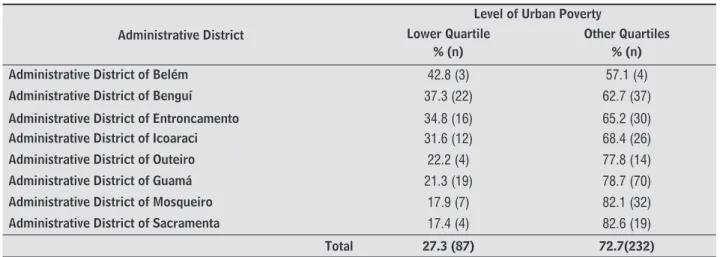
)n the analysis of family poverty level by admin-istrative district of the city, the results show that the percentages of the poorest families participating in this study were higher in the DABEL and DABEN districts . % and . % . Table shows the data representation.
To verify the association between the outcome, whether normal or suspected delay in language and the independent variables, the chi-square test was used, considering a signi icance level of %
p-value < . .
To present the data obtained through the Denver )) by AD, a map was designed that could represent the neuropsychomotor pro ile of children evalu-ated by means of an image. This methodological decision follows a current trend among researchers from different areas of knowledge, particularly in public health. )n this way, its evolution and grada-tions can be represented through geoprocessing of complex social processes data. This means generat-ing geographic information systems capable of con-tributing to the production of maps, using speci ic tools. These are produced from the data collection, analysis, interpretation and representation of the information, being supported by the assumptions of cartography, and processed with resources now available through the computer .
Results
The prevalence of participants with suspected NPMD delay was approximately . %, with . % abnormal and . % questionable. With regard to the domains of development, the application of the Denver )) revealed that the majority of the children were in the normal category in three of the four domains of development evaluated. The area of lan-guage was the only one with a signi icant number of suspected delays . % .
Regarding the socio-economic and environmen-tal data, the study population belonged to house-holds with monthly incomes of one to three mini-mum wages . % , with fathers being primarily responsible for the income . % . )n addition, over half of them received some social bene its . % , mainly inancial assistance, such as the Bolsa Família Program. Most families lived in their own . % brick built homes . % with three or more rooms . % , with two to ive residents . % , the presence of running water . % , regular garbage collection . % , own internal bathroom . % and possessed basic household goods, such as refrigerator, television and stove.
Table 1 - Absolute and Relative Frequencies of the Poverty Level by Administrative District
Administrative District
Level of Urban Poverty Lower Quartile
% (n)
Other Quartiles
% (n)
Administrative District of Belém 42.8 (3) 57.1 (4)
Administrative District of Benguí 37.3 (22) 62.7 (37)
Administrative District of Entroncamento 34.8 (16) 65.2 (30)
Administrative District of Icoaraci 31.6 (12) 68.4 (26)
Administrative District of Outeiro 22.2 (4) 77.8 (14)
Administrative District of Guamá 21.3 (19) 78.7 (70)
Administrative District of Mosqueiro 17.9 (7) 82.1 (32)
Administrative District of Sacramenta 17.4 (4) 82.6 (19)
Total 27.3 (87) 72.7(232)
Regarding the Denver )) score, it was veri ied that there was high prevalence of children with suspected delays in NPMD in all the Administrative Districts of Belém. The results show that although there is no sta-tistically signi icant difference between the variables,
the children from the poorer families tended to have a higher risk of potential delay in NPMD. The dis-tricts with the highest percentages were DABEL and DABEN % and . % . The other districts also presented high percentages, as shown in Table .
Table 2 - Distribution of the Results of the Denver II by
Administrative District Normal
% (n)
Suspected Delay
% (n)
Administrative District of Belém 0 (0) 100 (7)
Administrative District of 16.7 (3) 83.3 (15)
Administrative District of
Entroncamento 19.6 (9) 80.4 (37)
Administrative District of Icoaraci 21.1 (8) 78.9 (30)
Administrative District of Guamá 21.4 (19) 78.6 (70)
Administrative District of Mosqueiro 25.6 (10) 74.4 (29)
Administrative District of Sacramenta 26.1 (6) 73.9 (17)
Administrative District of Benguí 27.1(16) 72.9 (43)
Total 22.3 (71) 77.7 (248)
The results obtained with the Denver )) can also be seen from Figure . The image provides a map with the territorial representation of the neighborhoods that make up the city of Belém, distributed in eight administrative districts. The different colors indicate the percentages of children whose NPMD was
classi-ied as suspected delay, with the color intensity being directly proportional to the percentage of children with this outcome.
539
Discussion
The indings of this study suggest that children in the to months age group from the lowest poverty level present greater suspected delay in their neuro-psychomotor development. These data lead to a strong explanatory hypothesis that the situation of poverty presented by a portion of the families may have con-tributed to the children obtaining the result classi ied as suspected delay, especially in the language area.
The results of this study are consistent with previ-ous research using the Denver )) , , , , , . These studies show an association between predictors of poverty or socioeconomic status of the family and the acquisition of neurodevelopmental milestones, espe-cially language. )n addition, they highlight the in luence of social and environmental aspects related to the fun-damental stimuli for linguistic patterns to improve, as well as the interaction of the caregivers with the child.
The poverty level of the family can cause or worsen serious health problems, including those related to NPMD delays, due to less stimulation and increased ex-posure to risk factors . )n contrast, there are publica-tions that demonstrate that the development of children belonging to a social class with fewer socioeconomic resources is favored by protective factors, such as the strong and positive in luence of child rearing practices that encourage stable and affectionate relationships of the child with his/her caregiver, such as breastfeeding and physical contact between mother and baby.
Regarding the Administrative Districts, it was estab-lished that all were shown to be related to each other, in ecological terms, that is, there were no statistically signi icant differences between the poverty level of the family and the AD. This could be explained by the fact that poverty is present in different regions of the city of Belém , being a characteristic common to the majority of the families in the various ADs. )n other words, the city does not have de ined areas that can be classi ied exclusively as af luent or impoverished, with it being possible to observe that families from different social classes live close together. Thus, the ecological context in which children are inserted is characterized by lack of resources and by chronic and troubling social indicators, which does not always include the basic necessities for healthy development in early childhood.
These indings con irm national reports that indi-cate that the town of Belém has an high poverty rate in relation to the other metropolitan regions of Brazil. (alf of the population living of this metropolis live The strati ication of the population by level of
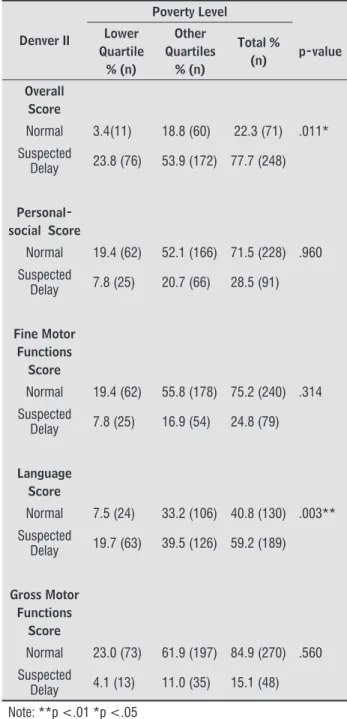
poverty showed that children from the poorest families may be at higher risk of having their psychomotor development threatened, i.e., the poverty level exerted a greater effect on the overall result of the Denver )) X2
= . ; df = ; p = . and on the area of language X2 = . ; df = ; p = . , as shown in Table .
Table 3 - Poverty Level Score in relation to the Overall Score of the Denver II
Denver II
Poverty Level
Lower Quartile
% (n)
Other Quartiles
% (n)
Total %
(n) p-value
Overall Score
Normal 3.4(11) 18.8 (60) 22.3 (71) .011*
Suspected
Delay 23.8 (76) 53.9 (172) 77.7 (248)
Personal-social Score
Normal 19.4 (62) 52.1 (166) 71.5 (228) .960
Suspected
Delay 7.8 (25) 20.7 (66) 28.5 (91)
Fine Motor Functions
Score
Normal 19.4 (62) 55.8 (178) 75.2 (240) .314
Suspected
Delay 7.8 (25) 16.9 (54) 24.8 (79)
Language Score
Normal 7.5 (24) 33.2 (106) 40.8 (130) .003**
Suspected
Delay 19.7 (63) 39.5 (126) 59.2 (189)
Gross Motor Functions
Score
Normal 23.0 (73) 61.9 (197) 84.9 (270) .560
Suspected
Delay 4.1 (13) 11.0 (35) 15.1 (48)
the other districts was high. Among the alternative ex-planations for this inding the general condition of the families residing in the DABEN district is highlighted. Despite the characteristics of this district revealing a predominance of inappropriate environmental con-ditions for the ecology of development , two of ECEUs surveyed were located around delimited cen-ters with availability of infrastructure and services and close to the af luent residential areas. )n addition, the socioeconomic variables of the investigated families were better, compared to the parents of the other ADs.
Another interpretation of this outcome refers to the contribution and cooperation perceived between the teachers and the coordination in two of the DABEN district units. These professionals, even faced with precarious physical conditions, proved to be com-mitted to ensuring quality education and care for the students . One of ECEUs was nearly closed down, however, because of the mobilization of these employ-ees, was relocated to a temporary site in order to keep it functioning.
)n the other ADs, the frequency of suspected delays in NPMD ranged from . % to . %, showing that unfavorable ecological conditions for development are found in all the areas of Belém. (owever, there was no statistically signi icant difference among the admin-istrative districts regarding the number of children identi ied with suspected developmental delay. )t is considered that this result occurred due to little varia-tion among the districts with regard to the outcomes obtained through the Denver )). )n summary, this re-sults of this study corroborate previous study indings that show evidence that biological and environmental factors related to poverty interactively and cumula-tively in luence childhood development , , , .
Although the developmental contexts are often analyzed individually, the fact that environments and individuals not only interact, but also in luence each other, is considered the basic premise of ecological theory. )t should be comprehended that poverty is not a unidirectional model, in which only one variable, such as the socioeconomic status of the family, can affect childhood development, especially language. Thus, it should be analyzed multi-dimensionally, con-sidering that families are affected not only by schools, communities and neighborhoods, but the parents and children also in luence the environments in which they participate , , . Regarding the study en-vironment, some units presented satisfactory condi-tion for healthy development. (owever, there was a in poor communities . Nationally, nearly % of
the population living in slums is concentrated in the metropolitan areas of São Paulo, Rio de Janeiro, Belém, Salvador and Recife . (owever, the percentage of residents in these conditions in the MAB is higher than that of the other capitals , .
With regard to the scores obtained through the Denver )) by AD, it was found that the district that presented the highest percentage of suspected delay was the DABEL district and the lower percentage was the DABEN district, contrary to that indicated in the literature , , , . The DABEL district, located in the central region of Belém, encompasses neigh-borhoods with better infrastructure, with the high-est construction standards and greater availability of services, commerce and public facilities and presents a higher index of general well-being . (owever, it is assumed that this concentration of bene its was not suf icient with regards to the performance of the NPMD and language of the children, because it was the AD that had the highest prevalence of cases of sus-pected delay. There are some explanatory hypotheses to comprehend this result, such as the small sample size of participants in this area n = , due to there being a single ECEU in the district, with only one class of students in the age group studied. Another explana-tion is the fact that people with better socioeconomic conditions, as is the case of those that reside in the DABEL district, usually use day-care or preschools services of the private network. Furthermore, some of the children evaluated did not live in that district.
These indings contradict the hypothesis that, being linked to the municipal area that has the greater con-centration of bene its, the children evaluated would present better performance in the Denver )) than the participants from the other ADs. As shown, this was not the result recorded. )n the DABEL district, as well as in other districts, the socioeconomic conditions of the families studied were precarious. Although it cov-ers a region with economic and urban centrality, this district, as well as others, presents problematic re-gions with irregular occupations, with low-lying areas, where families live in socially unsatisfactory housing conditions, with the ECEU being located on the bank of a drainage channel.
541
References
. Evans GW, Li D, Whipple SS. Cumulative risk and child development. Psychol Bull. ; : - . . Fotso JC, Madise N, Baschieri A, Cleland J, Zulu E, Mutua
MK, et al. Child growth in urban deprived settings: Does household poverty status matter? At which stage of child development? (ealth Place. ; : - . . Roelen K, Gassmann F, Neubourg C. Child poverty
in Vietnam – Providing insights using a country-speci ic and multidimensional model. Soc )ndic Res.
; : - .
. Wehby GL, McCarthy AM. Economic gradients in early child neurodevelopment: A multi-country study. Soc Sci Med. ; : - .
. Walker SP, Wachs TD, Gardner JM, Lozoff B, Wasserman GA, Pollit TE, et al. Child Development: risk factors for adverse outcomes in developing countries. Lancet.
; : - .
. Alkire S, Foster J. Counting and multidimensional pov-erty measurement. J Public Econ. ; : - . . (uston AC, Bentley AC. (uman development in societal
context. Annu Rev Clin Psychol. ; : - . . )ssler RMS, Giugliani ERJ. )denti icação de grupos mais
vulneráveis à desnutrição infantil pela medição do nível de pobreza. J Pediatr. ; : - . Portuguese. . (alpern R, Barros AJD, Matijasevich A, Santos )S,
Vic-tora CG, Barros FC. Developmental status at age months according to birth weight and family income: a comparison of two Brazilian birth cohorts. Cad Saude Publica. ; : - .
. Dearing E. Psychological Costs of Growing Up Poor. Ann N Y Acad Sci. ; : - .
. Brito CML, Vieira GO, Costa COM, Oliveira NF. De-senvolvimento neuropsicomotor: o teste de Denver na triagem dos atrasos cognitivos e neuromotores de pré-escolares. Cad Saude Publica. ; :
-. Portuguese-.
. Chiu S(, DiMarco MA. A Pilot Study Comparing Two Developmental Screening Tools for Use With (omeless Children. J Pediatr (ealth Care. ; : - . . Yazbek MC. Pobreza no Brasil contemporâneo e formas
de seu enfrentamento. Serv Soc Soc. ; : -. Portuguese-.
predominance of precarious places, regarding both the infrastructure and the pedagogic resources. The low number of ECEUs and places is also worrying, consid-ering the large amount of children not in preschools and the large number of them awaiting new places.
Through the evaluation of the results it could be seen that the children presented a high prevalence of suspected delay in NPMD and language. (owever, it should be noted that the Denver )) is a test for screen-ing and not for the diagnosis of developmental ab-normalities, requiring those participants whose result were suspect to be reassessed. As an epidemiologi-cal research instrument, the Denver )) proved to be suitable for the early detection of any deviation in the development and insightful for longitudinal monitor-ing of the child, havmonitor-ing its practicality of application as an advantage. The instrument used to classify the poverty level of urban populations was also found to be adequate for identifying the children and families with higher risk, through population strata.
Childhood neuropsychomotor development is a dynamic process, as are the risk factors that in luence it, especially urban poverty. Thus, the results classi ied as suspected delay in NPMD and its association with the poverty level present complexity. These variables are interrelated and can have a cumulative and inter-generational effect. The indings of this study reinforce the multifactorial nature of childhood development and indicate the importance of continuous monitoring, especially in the underprivileged populations of Belém.
Conclusion
. Frankenburg WK, Dodds J, Archer P, Shapiro (, Bresn-ick B. The Denver )): a major revision and restandard-ization of the Denver Developmental Screening Test. Pediatrics. ; : - .
. Alvarez ML, Muzzo S, )vanovic D. Escala para medición del nível socioeconómico, en el área de la salud. Rev Med Chil. ; : - . Spanish.
. Archela RS, Théry (. Orientação metodológica para construção e leitura de mapas temáticos. Con ins.
; : - . Portuguese.
. Ozkan M, Senel S, Arslan EA, Karacan CD. The so-cioeconomic and biological risk factors for devel-opmental delay in early childhood. Eur J Pediatr.
; : - .
. Pilz EML, Schermann LB. Determinantes biológicos e ambientais no desenvolvimento neuropsicomotor em uma amostra de crianças de Canoas/RS. Cienc Saude Colet. ; : - . Portuguese.
. Veleda AA, Soares MCF, Cézar-Vaz MR. Fatores asso-ciados ao atraso no desenvolvimento em crianças, Rio Grande, Rio Grande do Sul, Brasil. Rev Gaucha Enferm.
; : - . Portuguese.
. Costa MA, Tsukumo )TL. anos de Regiões Metro-politanas no Brasil. Brasília: )PEA; . Portuguese. . Maria-Mengel MRS, Linhares MBM. Fatores de risco
para problemas de desenvolvimento infantil. Rev Lat Am Enfermagem. ; : - . Portuguese. . Bronfenbrenner U. Bioecologia do desenvolvimento
humano: tornando os seres humanos mais humanos. Porto Alegre Brazil : Artmed; . Portuguese. . Ramos DD, Salomão NMR. )nteração
educadora-cri-ança em creches públicas: estilos linguísticos. Psicol Estud. ; : - . Portuguese.
Received in / /
Recebido em 16/10/2014
Approved in / /
Aprovado em 19/10/2015
. )BGE - )nstituto Brasileiro de Geogra ia e Estatísti-ca. Censo demográ ico . Rio de Janeiro: )BGE;
. Portuguese.
. )PEA - )nstituto de Pesquisa Econômica Aplicada. Duas décadas de desigualdade e pobreza no Brasil medidas pela Pnad/)BGE. Comunicados do )PEA. [cited Aug ]. Available from: http://tinyurl.com/ jmajojz. Portuguese.
. Celentano D, Santos D, Veríssimo A. A Amazônia e os objetivos do milênio. Belém Brazil : )mazon;
. Portuguese.
. Ponto JPX, Lima JJF, Cardoso, ACD, Rodrigues RM. Análise do )BEU Local – Região Metropolitana de Belém-PA. Observatório das Metrópoles [cited Aug ]. Available from: http://tinyurl.com/ jb ws. Portuguese.
. Paiva GS, Lima ACVMS, Lima MC, Eickmann S(. The effect of poverty on developmental screening scores among infants. Sao Paulo Med J. ; : - . . Guerreiro TBF. Desenvolvimento neuropsicomotor
de crianças de Belém: associação com características pessoais e variáveis do seu ambiente ecológico. [master’s thesis]. Belém Brazil : Universidade Federal do Pará; . Portuguese.
. Tudge JR(. Children s development under conditions of poverty: A cultural ecological analysis. )n: Bastos A, Rabinovich EP Orgs. . Living in poverty: Develop-mental poetics of cultural realities. Charlotte NC : )nformation Age Pub; . p. - .
. Soares AMC. Cidade Revelada: pobreza urbana em Salvador-BA. Geogra ias. ; : - . Portuguese. . Sigolo ARL, Aiello ALR. Análise de instrumentos
para triagem do desenvolvimento infantil. Paideia Ribeirão Preto . ; : - . Portuguese. . United Nations Children's Fund. The State of the
World’s Children )n Numbers: Every Child Counts. Nova York: UN)CEF; .
. Bricker D, Squires J, Clifford J. Developmental screening measures: Stretching the use of the ASQ for other assessment purposes. )nfants Young Child.
; : - .
. Souza SC, Leone C, Takano OK, Moratelli (B. Desen-volvimento de pré-escolares na educação infantil em Cuiabá, Mato Grosso, Brasil. Cad Saude Publica.