Licenciado sob uma Licença Creative Commons DO): http://dx.doi.org. . / - . . .AO
[T]
Effect of a physical therapy protocol on the health related
quality of life of patients with temporomandibular disorder
[)]
Efeitos da i sioterapia na qualidade de vida de
pacientes com disfunção temporomandibular
[A]
Maíra de Oliveira Viana[a,b], Natália Bitar da Cunha Olegario[b],
Mariana de Oliveira Viana[c], Guilherme Pinheiro Ferreira da Silva[b], Jair Licio Ferreira Santos[a], Sarah Tarcisia Rebelo Ferreira de Carvalho[d]*
[a] Universidade de São Paulo, Faculdade de Medicina de Ribeirão Preto FMRP , Ribeirão Preto, SP, Brazil [b] Universidade de Fortaleza UN)FOR , Fortaleza, CE, Brazil
[c] Universidade Federal do Ceará UFC , Fortaleza, CE, Brazil [d] Universidade Ceuma UN)CEUMA , São Luís, MA, Brazil
[R]
Abstract
Introduction: Temporomandibular disorders TMD comprise a group of diseases that affect not only the
temporomandibular joint, but also different areas extrinsic to the joints. Quality of life has been the subject of numerous studies in the (ealth area, especially aimed at people with chronic diseases, such as TMD. Objective:
To evaluate effects of a physical therapy protocol on the quality of life of patients with temporomandibular di-sorder. Methods: Blinded, prospective, clinical trial, with patients of both genders, aged between and
years with TMD diagnosis attended in the clinic of Ribeirão Preto School of Dentistry. The patients were
*MOV: MS, e-mail: [email protected] NBCO: MS, e-mail: [email protected]
MOV: MS, Doctoral Student, e-mail: [email protected]
GPFS: MS, Doctoral Student, e-mail: guilhermepinheiro @hotmail.com JLFS: PhD, e-mail: [email protected]
divided into two groups, with one group, in addition to dental treatment, receiving a physical therapy protocol and the other group dental treatment only, for weeks. The measurement of quality of life was obtained throu-gh the generic SF- questionnaire, at the beginning and end of the proposed protocol. Results: The patients
to whom the physical therapy protocol was applied associated with dental care presented increased scores in all the domains of the questionnaire. )n the group that received only dental treatment, improvements were only found in the domain related to pain. Conclusion: The application of a physical therapy protocol was able
to improve the quality of life of patients with temporomandibular disorder.
Keywords: Quality of Life. Physical Therapy Modalities. Temporomandibular Joint Disorders.
Resumo
Introdução: A disfunção temporomandibular (DTM) compõem um conjunto de doenças que afetam não so-mente a articulação Temporomandibular, mas também diferentes áreas extrínsecas às articulações. A quali-dade de vida tem sido motivo de inúmeros estudos na área da saúde, especialmente voltados para pessoas com doenças crônicas, como a DTM. Objetivo: Avaliar efeitos de um protocolo ϔisioterapêutico na qualidade de vida de pacientes com disfunção temporomandibular. Métodos: Estudo do tipo ensaio clínico, cego e prospectivo, com 60 pacientes de ambos os sexos, com idade variando entre 18 a 70 anos com diagnóstico de DTM atendi-dos na clínica da Faculdade de Odontologia de Ribeirão Preto. Os pacientes foram dividiatendi-dos em dois grupos, em um grupo, além do acompanhamento odontológico, foi aplicado um protocolo ϔisioterapêutico e no outro grupo foi realizado apenas o acompanhamento odontológico, durante 5 semanas. A mensuração da quali-dade de vida foi obtida pelo questionário genérico SF-36, no início e ϔinal do protocolo proposto. Resultados: Nos pacientes em que foi aplicado o protocolo ϔisioterapêutico associado ao acompanhamento odontológico apresentaram escores mais elevados em todos os domínios do questionário. No grupo que recebeu apenas acompanhamento odontológico, veriϔicou-se melhora apenas no domínio relacionado a dor. Conclusão: A apli-cação de um protocolo ϔisioterapêutico foi capaz de melhorar a qualidade de vida de pacientes com disfunção temporomandibular.
Palavras-chave: Qualidade de vida. Modalidades de Fisioterapia. Transtornos da Articulação Temporomandibular.
Introduction
)n recent years temporomandibular disorders TMD have become a widely known and discussed concept, mainly among health professionals, includ-ing physicians, dentists, speech therapists, psycholo-gists and physical therapists .
Temporomandibular disorders, also known as craniomandibular disorders, comprise a group of diseases that affect not only the temporomandibular joint TMJ , but also different areas extrinsic to the joints . Their etiology is multifactorial and related to emotional stress, to occlusal interferences, to tooth loss or bad position of the teeth, to postural changes, to disorder of the masticatory and adjacent muscles, to the extrinsic and intrinsic changes of the structural components of the TMJ or even to a combination all these factors , , .
Among the various manifestations, the following can be cited as the classic symptoms of TMD: noises in the jaw joint crackles or clicks ; mandibular hy-pomobility, headache, pain in the TMJ, earache and/ or tinnitus, asymmetries, irregularities, limitations and/or deviations in movements of the jaw, sleep disorders and change in head position , , , , .
The authors of the American Academy of Craniomandibular Disorders AACD con irm that physical therapy helps with the relief of musculo-skeletal pain and the restoration of normal function through changing the sensory input and reducing in lammation, decreasing, coordinating and strength-ening the muscular activity, and promoting repair and
regeneration of the tissues .
document the use of speci ic questionnaires or mul-tidimensional tools for this purpose .
Quality of life is a broad, subjective, productive and polysemic concept which has been the subject of numerous studies in the (ealth area, especially directed towards people with chronic diseases, such as TMD. )t is de ined by the individual as an internal experience of satisfaction and well-being in their
liv-ing process , .
Given the complexity of the symptoms and their consequences, studies indicate that TMJ disorders require broad multidisciplinary care, with physical therapy having a vital role in the rehabilitation of these patients, since it provides pain relief, rehabili-tates the neuromuscular system and restores the mandibular rest position and muscle coordination,
therefore improving quality of life , , .
)n this context, the aim of this study was to evalu-ate the effect of a physical therapy protocol on the QoL of patients with TMD.
Methods
A blinded, prospective, clinical trial was conduct-ed, in the Odontology service of the Ribeirão Preto School of Dentistry — Universidade de São Paulo
FORP-USP , from May to September .
This study followed the ethical and legal principles, in accordance with the recommendations of Resolution
No. / of the CNS, which sets out the principles
for human research , and was approved by the
Research Ethics Committee of the University of São
Paulo under authorization number . . .
All the patients agreed to participate in the study by signing the informed consent form.
The sample consisted of patients with clini-cal diagnosis of TMD of muscular and/or joint ori-gin, of both genders, aged - years registered in the Odontology service of FORP-USP. The patients were diagnosed and referred by surgical dentists of the Occlusion, Temporomandibular Disorder and Orofacial Pain Clinic as patients with special needs: multidisciplinary approach.
The exclusion criterion used were patients un-dergoing other treatments in the previous month, patients with a history of traumatic injury or surgical treatment in the orofacial region or carriers of sys-temic, degenerative and/or neoplastic diseases. All the patients needed to have time available to attend
the ten physical therapy sessions and the necessary dental consultations.
The study participants were divided into two groups, the experimental group: composed of pa-tients with TMD that received dental treatment and
physical therapy n = ; and the control group:
TMD patients who received dental treatment but no
receive physical therapy n = . The allocation of
participants was made by convenience.
An instrument to assess quality of life, validat-ed for the Brazilian population, the SF- Mvalidat-edical Outcome Study-MOS Short Form (ealth Survey was applied before and ive weeks after the protocol used in this study. When the patient did not present conditions to complete the instrument, in the case of illiteracy, change in cognition or low educational level, the instrument was applied by the researcher, without inducing any responses.
The SF- is a generic instrument composed of questions and divided into eight domains: functional capacity, limitations due to physical aspects, pain, general health status, vitality, social aspects, emo-tional aspects, and mental health, with these dimen-sions representing basic human values relevant to the assessment of the quality of life of the general popu-lation. The scores of the quality of life dimensions, classi ied in this instrument, range from zero,
poor-est health status, to , best possible health status.
The dental treatment consisted of weekly consul-tations in which, according to the clinical condition of the patient, occlusal adjustments and preparation of myorelaxing plates were performed.
The physical therapy treatment protocol received by the experimental group was performed twice week-ly for a total of ten sessions, with an average duration of minutes each. The protocol employed was initi-ated with the application of the Bioset brand ultra-sound in each temporomandibular joint separately, using continuous handling parameters, frequency of
M(z, intensity of . W/cm², for minutes . Next,
joint mobilization; pompage preparatory maneuvers in the cervical spine for the purpose of lengthening the anterior and posterior muscles of the cervical spine; and active kinesiotherapy for the movements of the
TMJ and cervical spine were performed .
The Joint mobilization was carried out based on the
description of Schmitt and Gerrits , , through
the other ingers are held under the chin, in order to perform traction movements down and forward and condylar translation backward and forward .
After the data collection, the results were present-ed as the mpresent-edians, since the measure was a score
The age group most affected by TMD was that of to years in the experimental group, repre-senting . %, and that of to years in control group, with . %.
Table 1 - Distribution of the individuals with Temporomandibular Disorders, according to gender and age group in the
group that received physical therapy and dental treatment, Ribeirão Preto - SP, 2008
Group Age
(years)
Gender
Total
Female Male
n % n % n %
18 to 24 3 13.64 1 12.50 4 13.33
25 to 34 4 18.18 1 12.50 5 16.67
Experimental 35 to 44 5 22.73 1 12.50 6 20.00
45 to 54 2 9.09 2 25.00 4 13.33
55 and + 8 36.36 3 37.50 11 16.67
Total 22 100.00 8 100.00 30 100.00
Table 2 - Distribution of the individuals with Temporomandibular Disorders, according to gender and age group in the
group that received dental treatment only, Ribeirão Preto - SP, 2008
Group Age
(years)
Gender
Total
Female Male
n % n % n %
18 to 24 10 37.04 0 0.00 10 33.33
25 to 34 8 29.63 1 33.33 9 30.00
Control 35 to 44 1 3.70 0 0.00 1 3.33
45 to 54 7 25.93 1 33.33 8 26.67
55 and + 1 3.70 1 33.33 2 6.67
Total 27 100.00 3 100.00 30 100.00
type. The comparisons of the SF- scores in each group wereperformed through non-parametric
sta-tistics, using the Wilcoxon test , with the
prob-ability of the occurrence of type error ixed at %, using the statistical program Stata version . .
The median values of the SF- scores in each domain, in both groups, at the beginning and end of the treatment are presented in Table .
Table 3 - Median scores of the SF-36 in each domain in both groups, Ribeirão Preto-SP, 2008
Domains
Median score
Experimental Control
Beginning End Beginning End
Functional Capacity 62.5 87.5 85.0 87.5
Physical Aspects 12.5 100 50.0 25.0
Pain 41.0 62.0 56.0 62.0
General Health Status 56.0 72.0 68.5 67.0
Vitality 45.0 60.0 50.0 52.5
Social Aspects 50.0 75.0 62.5 68.7
Emotional Aspects 33.1 66.6 33.3 33.3
The Functional Capacity FC domain evaluates the presence of physical limitations and how they affect the physical capacity of the individual. From the median value, it was observed that the experimental group increased from . % to . %, while the con-trol group increased from % to . %.
The Physical Aspects PA domain, which evalu-ates limitations in the form and amount of work, in-creased in the experimental group from . % to
%, while the control group presented a reduction from % to %.
The domain related to pain is responsible for evaluating its intensity and how it affects activities of daily living. An increase was observed in both groups in this domain, with the experimental group increasing from % to % and the control group
% to %.
The General (ealth Status G(S domain evaluates the perceptions of the individual regarding his/her health, with an increase observed in the experimental group from % to % and a decrease in the control group from . % to %.
Vitality V)T is evaluated from the level of en-ergy and fatigue of each individual. An increase in
the experimental group was observed from % to % and in the control group from % to . %.
The Social Aspects SA domain evaluates the participation of the individual in social groups and whether this is compromised by any health problems, with the experimental group presenting an improve-ment from % to % in this domain and the control group from . % to . %.
The Emotional Aspects EA domain evaluates limitations in the form and amount of work and how this affects the activities of daily living of the patient. Based on the table, it can be observed that the ex-perimental group presented an improvement from
. % to . %, while the control group remained at the same value of . % before and after treatment. The inal domain of Mental (ealth M( is evaluat-ed through the presence of distress and psychological well-being, with the experimental group presenting positive data, increasing from % to %, while the control group remained at the same value of %.
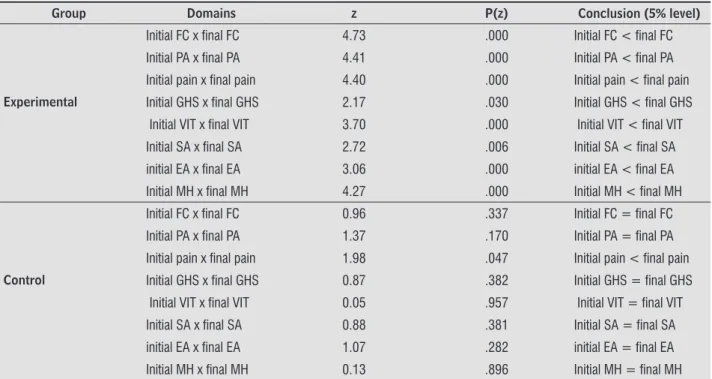
Table presents the comparisons between the two measurements in each domain of the SF- , in the two groups, through the Wilcoxon test.
Table 4 - Comparison between the two measurements in each domain of the SF-36, in the two groups, through the Wilcoxon
test, Ribeirão Preto-SP, 2008
Group Domains z P(z) Conclusion (5% level)
Initial FC x fi nal FC 4.73 .000 Initial FC < fi nal FC
Initial PA x fi nal PA 4.41 .000 Initial PA < fi nal PA
Initial pain x fi nal pain 4.40 .000 Initial pain < fi nal pain
Experimental Initial GHS x fi nal GHS 2.17 .030 Initial GHS < fi nal GHS
Initial VIT x fi nal VIT 3.70 .000 Initial VIT < fi nal VIT
Initial SA x fi nal SA 2.72 .006 Initial SA < fi nal SA
initial EA x fi nal EA 3.06 .000 initial EA < fi nal EA
Initial MH x fi nal MH 4.27 .000 Initial MH < fi nal MH
Initial FC x fi nal FC 0.96 .337 Initial FC = fi nal FC
Initial PA x fi nal PA 1.37 .170 Initial PA = fi nal PA
Initial pain x fi nal pain 1.98 .047 Initial pain < fi nal pain
Control Initial GHS x fi nal GHS 0.87 .382 Initial GHS = fi nal GHS
Initial VIT x fi nal VIT 0.05 .957 Initial VIT = fi nal VIT
Initial SA x fi nal SA 0.88 .381 Initial SA = fi nal SA
initial EA x fi nal EA 1.07 .282 initial EA = fi nal EA
Initial MH x fi nal MH 0.13 .896 Initial MH = fi nal MH
Through this table, it can be concluded that there were statistically signi icant differences in all areas
for the experimental group p < . , however, the
in control group the only statistically signi icant
dif-ference was in the pain domain p = . Table .
Discussion
According to Oliveira the causes of TMD are
variable and dependent on the age of the popula-tion, suggesting that between and years of age they are due to myogenic factors and when the age is over years this factor is found to be related to arthrogenic factors.
Over % of healthy individuals have at least one TMD sign, however, only - % of them seek treat-ment, with this disorder more prevalent in women aged to years, a fact that is similar to the results found in this study .
When comparing the results between the groups, improved scores in the SF- questionnaire can be observed in the group that received physical therapy
experimental group .
)n this study the SF- was shown to be a tool of simple application that was easy to understand by the volunteers, minimizing the in luence of the examiner on the patients and consequently on their responses.
Patients with TMD usually present some limita-tions in their daily activities, which are largely re-sponsible for the decrease in QoL of these individuals
, .
The evaluation of quality of life, initially, was to complement analyzes of survival, adding to the other clinical parameters. Currently, this evaluation has expanded its scope by integrating analyzes of cost-effectiveness. Quality of life is an expression rooted in professional practice and increasingly present in specialized publications. This term has been used in articles that apply validated questionnaires or not for its measurement, or in articles that simply discuss the impact of a particular procedure or intervention
, .
A retrospective study by Matta and (onorato , in which the physical therapy intervention in TMD patients treated at a public health service in Campinas-SP was evaluated, showed that the inter-disciplinary approach is a necessity, and that physical therapy, when carried out comprehensively, without being restricted to the isolated use of therapeutic modalities, can signi icantly help in controlling the
symptoms manifested by the TMD, thus promoting a better quality of life for these individuals.
A study by Oliveira et al. , observing the impact of pain in subjects with TMD, through the McGill pain questionnaire Br-MPQ , in which subjects diag-nosed with TMD received physical therapy, concluded that the pain in TMD presented a negative impact on the QoL of the individuals and that the questionnaire was effective, although not speci ic. This procedure was similar to that of the present study, in which a
non-speci ic questionnaire SF- was also used for
the evaluation of quality of life and was shown to be capable of being sensitive to changes promoted by the performance of a physical therapy protocol.
Various studies have shown the bene icial effects of myofascial therapy for improving the pain
con-dition of TMD patients . Regarding the use of
therapeutic ultrasound, it was found that this can be safely used on the TMJ, without risk of overheating
or damage to the teeth or their illings .
According to Feine et al. it is necessary to
offer patients treatment capable of reducing their limitations, as well as the discomfort caused by pain, aiming to improve their quality of life. )n this con-text, physical therapy can be an effective resource in cases of TMD, especially for those in which the pain
persists .
The literature focuses on the ef icacy of the asso-ciation of therapeutic exercises and electrotherapy in the treatment of myogenic TMD, resulting in the normalization of the range of mandibular motion, elimination of pain and in lammation, and elimina-tion of the restricelimina-tions to the mandibular funcelimina-tion
.
)t is considered that the evaluation of quality of life to measure the effectiveness of a physical therapy protocol is necessary to enable the professional to monitor the belief of the patient in the therapeutic planning, considering the patient as an integral be-ing. Thus, the analysis of the quality of life becomes central to adaptations of the therapeutic strategy adopted in accordance with the requirements of the
patient .
This study presents limitations related to the control of the presence of other comorbidities that could affect the quality of life of these subjects and the disparity in the age groups of the groups studied.
Despite the positive results found in the litera-ture, a limiting factor in the analysis of the majority of studies on manual therapy is the frequent absence of an explicit description of the focus techniques, taking into account that the terms manual therapy, mobilization and manipulation are generic and can include many forms of passive movement, which could constitute a methodological weaknesses in the present study.
Few studies on TMD evaluate the quality of life, which could demonstrate the ef icacy of physical ther-apy in chronic conditions. Filling this gap is neces-sary for the development of therapeutic, educational, promotion and prevention programs directed toward behavioral changes consistent with the concept of integral health.
Therefore, conducting further research with a larger number of subjects evaluated through the same instruments is suggested in order to con irm the results presented.
Conclusion
From the results obtained, it was concluded that the application of a physical therapy protocol was able to improve the quality of life of patients with TMD.
References
. Rizzatti BCM, Arana ARS, Cunha Jr AC, Morais ABA, Gil )A. Avaliação diária da dor na desordem temporomandibular: caso clínico. Rev ABO Nac.
; : - . Portuguese.
. Pinto MVM, Silva ALS, Barbosa LG, Santos AG, Felício Jr J, Maria J, et al. Estudo do impacto psi-cossocial causado pela dor, em portadores de disfunção temporomandibular. Fisioter Bras.
; : - . Portuguese.
. Oliveira AS, Bermudez CC, Souza RA, Freitas CMS, Castro CES, Bérzin F. Avaliação multidimensional da dor em portadores de desordem temporo-mandibular utilizando uma versão brasileira do Questionário McGill de Dor. Rev Bras Fisioter.
; : - . Portuguese.
. Pedroni CR, Oliveira AS, Guaratini M). Prevalence study of signs and symptoms of temporoman-dibular disorders in university students. J Oral
Rehabil. ; : - .
. Ritzel C(, Diefenthaeler F, Rodrigues AM, Gui-marães ACS, Vaz MA. Temporomandibular joint dysfunction and trapezius muscle fatigability.
Rev Bras Fisioter. ; : - .
. Piozzi R, Lopes FC. Desordens temporomandibu-lares: aspectos clínicos e guia para a Odontologia
e Fisioterapia. JBA. ; : - . Portuguese.
. Sera im F, Teodoroski RCC. Laser arseneto de gálio Ga-As no tratamento das algias provoca-das pela disfunções temporomandibular: estudo
piloto. Fisioter Bras. ; : - . Portuguese.
. Biasotto-Gonzalez DA. Abordagem interdisci-plinar das disfunções temporomandibulares.
São Paulo: Manole; . Portuguese.
. Kato MT, Kogawa EM, Santos CN, Conti PCR. TENS and low-level laser therapy in the management of temporomandibular disorders. J Appl Oral Sci.
; : - .
. Fricton JR, Dubner R. Dor Orofacial e Desordens Temporomandibulares. São Paulo: Santos
Edi-tora; . Portuguese.
. Mynaio MCS, (artz ZMA, Buss, PM. Qualidade de Vida e saúde: um debate necessário. Cienc Saude
Colet. ; : - .
. Santos SR, Santos )BC, Fernandes MG, (en-riques MERM. Qualidade de Vida do )doso na comunidade: aplicação da escala de Flanagan.
Rev Lat Am Enfermagem. ; :
-. Portuguese-.
. Tedeschi-Marzola F, Pasqual-Marques A, Marzola C. Contribuição da Fisioterapia para a Odontolo-gia nas Disfunções da Articulação
Temporoman-dibular. Rev Odonto Cienc. ; :
. Guimarães GV, D'Avila V, Bocchi EA, Carvalho VO. Norepinephrine remains increased in the six-minute walking test after heart transplantation.
Clinics Sao Paulo . ; : - .
. Steiner ML, Fernandes CE, Strufaldi R, Azevedo L(, Stephan C, Pompei LM, et al. Accuracy study on Osteorisk : a new osteoporosis screening clinical tool for women over years old. Sao
Paulo Med J. ; : - .
. Matta MAP, (onorato DC. Uma abordagem i-sioterapêutica nas desordens temporomandib-ulares: estudo retrospectivo. Rev. Fisioter. Univ.
Sao Paulo. ; : - . Portuguese.
. Felício CM, Melchior MO, Ferreira CL, Silva MA. Otologic symptoms of temporomandibular disorders and effect of orofacia myofunctional
therapy. Cranio. ; : - .
. Feine JS, Widmer CG, Lund JP. Physical therapy: a critique. Oral Surg Oral Med Oral Pathol Oral
Radiol Endod. ; : - .
. Michelotti A, De Wijer A, Steenks M, Farella M. (ome-exercise regimes for the management of non-especi ic temporomandibular
disor-ders. J Oral Rehabil. ; : - .
. Borges MC, Borges CS, Silva AGJ, Castellano LRC, Cardoso FAG. Avaliação da qualidade de vida e do tratamento isioterapêutico em pa-cientes com cervicalgia crônica. Fisioter Mov.
; : - .
Received in / /
Recebido em 08/06/2014
Approved in / /
Aprovado em 16/10/2015
. Resolução CNS/MS nº , de de outubro de
. Aprova diretrizes e normas regulamenta-doras de pesquisa envolvendo seres humanos.
Diário O icial da União: Brasília. ; :
-; Seção . Portuguese.
. Ciconelli RM, Ferraz MB, Santos W. Tradução para a língua portuguesa e validação do ques-tionário genérico de avaliação de qualidade de
vida SF- . Rev Bras Reumatol. ; :
-. Portuguese-.
. Salome W, Gann N, Jones D. (eating effects of ultrasound applied to extracted molar. )s it safe to apply ultrasound to the temporomandibular
joint? Physiotherapy. ; : - .
. McNeely ML, Armijo OS, Magee DJ. A systematic review of the effectiveness of physical therapy interventions for temporomandibular disorders.
Phys Ther. ; : - .
. . La Touche R, Fernández-de-las-Peñas C,
Fernández-Carnero J, Escalante K, AnguloDíaz-Parreño S, Paris-Alemany A, et al. The effects of manual therapy and exercises directed at the cer-vical spine on pain sensitivity in patients with myofascial temporomandibular disorders. J Oral
Rehabil. ; : - .
. Steenks MA, Wijer A. Disfunções da Articulação Temporomandibular do ponto de vista da Fisiote-rapia e da Odontologia: Diagnóstico e
Tratamen-to. São Paulo: Santos Editora; . Portuguese.
. Siegel S, Castellan Jr NJ. Estatística Não-Paramé-trica para Ciências do Comportamento. Porto
Alegre Brazil : Arfmed; . Portuguese.
. Oliveira AS, Bermudez CC, Souza RA, Souza CMF, Dias EM, Castro SCE, et al. )mpacto da dor na vida de portadores de disfunção
temporomandibu-lar. J Appl Oral Sci. ; : - .
. . Seidl EM, Zannon F, Costa CML. Quality of
life and health: conceptual and methodological