Licenciado sob uma Licença Creative Commons DO): http://dx.doi.org. . / - . . .AO
[T]
Functional disability for mobility in adults:
a population-based study
[)]
Incapacidade funcional para mobilidade em
adultos: estudo de base populacional
[A]
Cristhiane Yumi Yonamine, Tiemi Matsuo, Regina Kazue Tanno de Souza, Mathias Roberto Loch, Marcos Aparecido Sarria Cabrera*
Universidade Estadual de Londrina UEL , Londrina, Paraná, Brazil
[R]
Abstract
Introduction: Functional disability is an important health indicator associated with worse quality of life. Objective: To estimate the prevalence of functional disability for mobility and to identify factors associated
with dif iculty going up and down stairs in adults aged years or over. Methods: Cross-sectional,
popu-lation-based study, with residents of the Municipality of Cambé, PR, interviewed in . The dependent variable was the dif iculty of going up and down stairs. Analysis of associated factors was performed using Poisson regression for each subgroup - years and years or older . Results: )n total, % of the
subjects presented some kind of dif iculty going up stairs p < . . )n both subgroups, a signi icantly higher prevalence in women, among those inactive during leisure time and those with a history of cerebrovascular disease was observed. )n the subgroup aged to years, age - years, hypertension, diabetes and falls in the previous months were also associated with the outcome. Conclusion: The results suggest the
450
need to expand the actions of health promotion, prevention and control of chronic conditions, especially among middle-aged people.
Keywords: Activities of Daily Living. Mobility Limitation. Cross-Sectional Studies.
Resumo
Introdução: A incapacidade funcional é importante indicador de saúde, associada a pior qualidade de vida. Objetivo: Estimar a prevalência de incapacidade funcional para mobilidade e identiϔicar os fatores associados à diϔiculdade de subir e descer escadas em adultos de 40 anos ou mais. Metódos: Estudo transversal, de base popula-cional, com residentes no Município de Cambé-PR, entrevistados em 2011. A variável dependente foi a diϔiculdade de subir e descer escadas. A análise de fatores associados foi realizada por meio da regressão de Poisson, para cada subgrupo etário (40 a 59 anos e 60 anos ou mais). Resultados: No total, 24% referiram alguma diϔiculdade para subir e descer escadas (p < 0,01). Em ambos os subgrupos, observaram-se prevalências signiϔicativamente mais elevadas em mulheres, entre os inativos no lazer e naqueles com histórico de doença cerebrovascular. No subgrupo com idade entre 40 e 59 anos, associaram-se também ao desfecho a faixa etária de 50 a 59 anos, a hipertensão arte-rial, o diabetes e queda nos últimos 12 meses. Conclusão: Os resultados apontam a necessidade de ampliar as ações de promoção da saúde e de prevenção e controle das condições crônicas, principalmente entre não idosos.
Palavras-chave: Idoso. Densidade Óssea. Osteoporose. Acidentes por Quedas. Programas de Rastreamento.
Introduction
Functional disability is the dif iculty or need for help in performing basic daily activities necessary for independent living in the community . Despite the increased frequency of functional disability in people of advanced age, the reported dif iculties are not only relat-ed to age , since functional disability is characterizrelat-ed as being a multifactorial process . Sociodemographic, behavioral and environmental factors and those related to social support are among the factors related to dis-ability that can speed up or slow down the process . The most commonly used measures to evaluate functional capacity are basic activities of daily living ADL , instrumental activities of daily living )ADL , and mobility. Some authors have shown that restric-tions in mobility are predictive of functional disability and therefore can be considered as an early sign of functional decline , , , .
This functional deterioration process often begins as early as the fourth decade of life , however, stud-ies on functional capacity are carried out
predomi-nantly with older adults , , , , , .
Therefore, this study aimed to evaluate the level of mobility as an early indicator of disability, as well as the factors associated with these dif iculties in middle-aged and older adults living in a medium-sized municipality of southern Brazil.
Methods
Cross-sectional, population-based study, the data
of which came from the project “Cardiovascular
Diseases in the State of Paraná: risk proϔile, mortal-ity, medication therapy and complications” VigiCardio
Project , conducted with adults aged years or over, living in the urban area of the municipality of
Cambé, Paraná, between February and June .
As the Census data had not been made
avail-able at the time of planning of the study, data from
the Population Count was considered to
cal-culate the sample size, which showed a population
of , people, of which . % were aged or
over . The value of the prevalence of the outcome
was unknown, therefore, to calculate the sample size a prevalence of % was used, with a % margin of error and % con idence interval, resulting in a
sample of subjects. Foreseeing possible losses
and refusals, this number was increased by %,
ini-tially totaling subjects to be interviewed.
)BGE, mentioned above, with reference date of April
, . For each sector a quota of individuals
to be interviewed was de ined, for each gender and ive-year age group, according to the proportion ob-served in the population of the municipality. After these procedures and eventual rounding up, the total
number of subjects to be interviewed was .
The sampling was carried out in three stages, with the strati ication of population by census sec-tors being the irst stage. The number of individuals to be interviewed in each census sector was de ined considering the proportional share, i.e., for census sectors with larger representativity in the population a greater number of people were selected, and for the smaller census sectors fewer people were selected. )n the second stage, in each census sector, the house-holds were selected through systematic sampling. The blocks of each census tract were listed and the starting point of the route was de ined through a draw. After determining the block corresponding to the initial point, the corner of the block was drawn in which the route would begin in a counterclockwise direction. Thus, a contiguous route was randomly selected. The irst home was established by draw, and from that home, the next to be selected was the third, i.e., for every two households one was selected, to en-sure the representativity of each sector and prevent concentration of respondents in certain streets or blocks. )n the third stage, in the household selected, eligible individuals were identi ied according to gen-der and age group ive-year intervals . )n situations where more than one resident met the conditions a draw was held for the participant selection. Further details regarding the sampling process are described
by Souza et al. .
Functional disability for mobility was investigated through the dif iculty to perform four activities get-ting up from the bed to an armchair or a chair, sitget-ting and lying down; walking around the house; walking out of the house; and going up and down stairs . The instrument used to evaluate these activities was the Functional Autonomy Measurement System
SMAF .
Because disability be considered a de icit, the SMAF scores are negatively oriented, and each func-tion can be graded from autonomy to - total help or dependence . Thus, the subjects were classi ied into three categories: no disability score , mild disability scores - . , - and - . and moderate/ severe disability scores - and - .
To verify the association between the variables dif iculty going up and down stairs was de ined as the indicator of functional disability for mobility, considered to be a reliable predictor in identifying a transition group pre-clinical disability that may be more vulnerable to changes in the health status than
those who do not present dif iculties .
The independent variables were divided into two groups: demographic and socioeconomic character-istics gender, age, marital status, race/color, years of schooling, paid work and economic classi ication,
the latter according to the Associação Brasileira de
Empresas de Pesquisa - ABEP and health-related
conditions and behaviors physical activity during leisure time, self-reported hypertension, diabetes - DM, cerebrovascular disease - CVD, musculoskeletal disorders, falls in the last months and nutritional status . All the information was collected through the reports of the participants or their responsible caregivers, through home interviews using a struc-tured form, except for the nutritional status which was calculated by measuring the body mass index BM) , in which the World (ealth Organization
clas-si ication was adopted.
The information was double entered into a da-tabase of the Epi )nfo version . . program. )n the descriptive analysis, the distribution of frequency and association measures was carried out using Fisher’s exact test or the chi-square test. The prevalence of the outcome mild and moderate/severe disability for go-ing up and down stairs were compared to those who did not present any dif iculty reference category , according to the characteristics selected.
The crude and adjusted analyzes of the data were based on the prevalence ratio, using Poisson regres-sion with robust variance, for each variable with the outcome with or without functional disability . The variables with p <. entered the multiple factor anal-ysis, being considered statistically signi icant vari-ables when p <. in the adjusted analysis, through the backward method. Analyses were performed using the Statistical Package for the Social Sciences
SPSS version . .
This project was approved by the (uman Research Ethics Committee of the State University
of Londrina CAAE No. . . . - and the
452
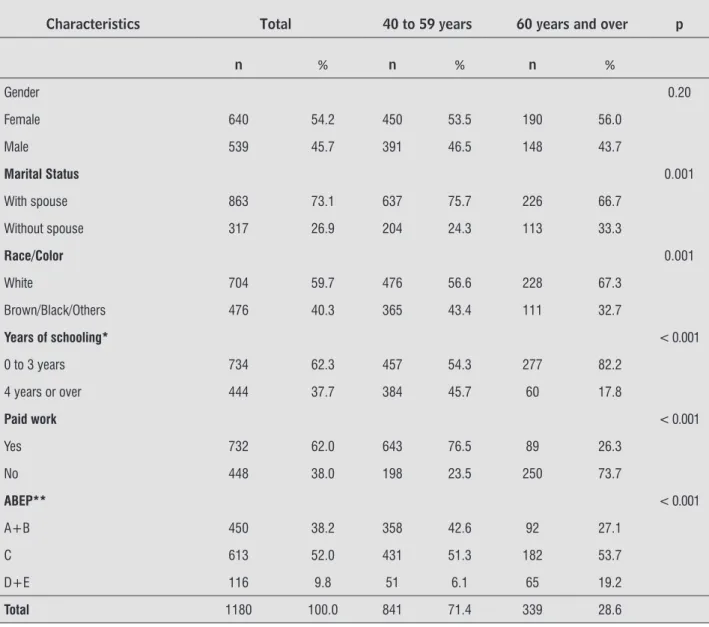
the characteristics mentioned according to gender, there were higher proportions of men living with a partner, with paid work, living with others and with higher educational and economic levels Table .
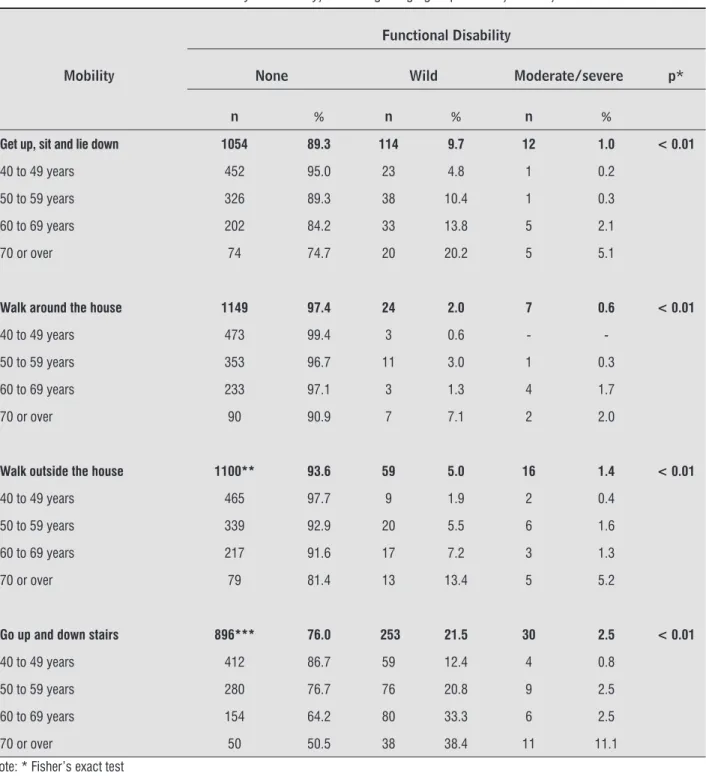
Among the mobility criteria evaluated get up, sit and lie down; walk around the house, walk outside the house, and go up and down stairs , there was a higher prevalence of mild and moderate or severe disability in the older age groups. The most prevalent disability mild and moderate/severe was the dif iculty of going
up and down stairs % , which gradually increased
as age increased, . %, . %, . % and . % for those aged to years, to years, to years and and over. respectively Table .
Results
Of the total eligible subjects, . %
were interviewed. There were losses . % ,
due to refusals and not contacted after at least three attempts at alternative times and dates.
Considering the sample investigated, the age of the subjects varied from to years, with a mean age of . SD = . . The majority of the subjects
were female . % , aged between and years
. % , living with spouse . % , with less than
eight years of education . % , performing paid
work % , living with others . % and
belong-ing to economic class C or lower . % . Comparing
Table 1 - Distribution of the population studied, according to demographic and socioeconomic characteristics. Cambé, 2011
Characteristics Total 40 to 59 years 60 years and over p
n % n % n %
Gender 0.20
Female 640 54.2 450 53.5 190 56.0
Male 539 45.7 391 46.5 148 43.7
Marital Status 0.001
With spouse 863 73.1 637 75.7 226 66.7
Without spouse 317 26.9 204 24.3 113 33.3
Race/Color 0.001
White 704 59.7 476 56.6 228 67.3
Brown/Black/Others 476 40.3 365 43.4 111 32.7
Years of schooling* < 0.001
0 to 3 years 734 62.3 457 54.3 277 82.2
4 years or over 444 37.7 384 45.7 60 17.8
Paid work < 0.001
Yes 732 62.0 643 76.5 89 26.3
No 448 38.0 198 23.5 250 73.7
ABEP** < 0.001
A+B 450 38.2 358 42.6 92 27.1
C 613 52.0 431 51.3 182 53.7
D+E 116 9.8 51 6.1 65 19.2
Total 1180 100.0 841 71.4 339 28.6
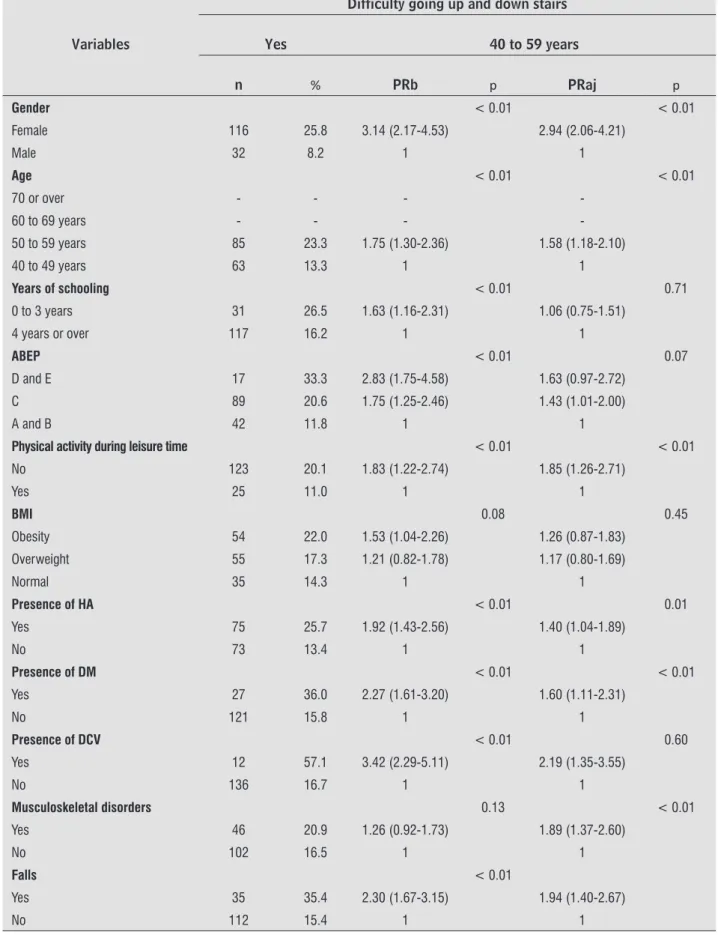
disease, obesity and in those that had fallen in the previous months. After adjustment, the factors that remained associated with the outcome in mid-dle-aged adults were: being female, age group - years, not performing physical activity during leisure time, having hypertension, DM, CVD and a history of falls in the previous months Table .
Among those aged to years, in the crude analysis, a higher prevalence was observed in dif i-culty going up and down stairs among women, aged
to years, in subjects with lower educational and economic levels, in those that did not practice any physical activity during leisure time, in those with a history of hypertension, diabetes, cerebrovascular
Table 2 - Prevalence of functional disability for mobility, according to age group. Cambé, Paraná, 2011
Mobility
Functional Disability
None Wild Moderate/severe p*
n % n % n %
Get up, sit and lie down 1054 89.3 114 9.7 12 1.0 < 0.01
40 to 49 years 452 95.0 23 4.8 1 0.2
50 to 59 years 326 89.3 38 10.4 1 0.3
60 to 69 years 202 84.2 33 13.8 5 2.1
70 or over 74 74.7 20 20.2 5 5.1
Walk around the house 1149 97.4 24 2.0 7 0.6 < 0.01
40 to 49 years 473 99.4 3 0.6 -
-50 to 59 years 353 96.7 11 3.0 1 0.3
60 to 69 years 233 97.1 3 1.3 4 1.7
70 or over 90 90.9 7 7.1 2 2.0
Walk outside the house 1100** 93.6 59 5.0 16 1.4 < 0.01
40 to 49 years 465 97.7 9 1.9 2 0.4
50 to 59 years 339 92.9 20 5.5 6 1.6
60 to 69 years 217 91.6 17 7.2 3 1.3
70 or over 79 81.4 13 13.4 5 5.2
Go up and down stairs 896*** 76.0 253 21.5 30 2.5 < 0.01
40 to 49 years 412 86.7 59 12.4 4 0.8
50 to 59 years 280 76.7 76 20.8 9 2.5
60 to 69 years 154 64.2 80 33.3 6 2.5
70 or over 50 50.5 38 38.4 11 11.1
454
Table 3 - Factors associated with difficulty going up and down stairs in the analysis (crude and adjusted) by Poisson regression in adults aged 40 to 59 years. Cambé, Paraná, 2011
Variables
Difficulty going up and down stairs
Yes 40 to 59 years
n % PRb p PRaj p
Gender < 0.01 < 0.01
Female 116 25.8 3.14 (2.17-4.53) 2.94 (2.06-4.21)
Male 32 8.2 1 1
Age < 0.01 < 0.01
70 or over - - -
-60 to 69 years - - -
-50 to 59 years 85 23.3 1.75 (1.30-2.36) 1.58 (1.18-2.10)
40 to 49 years 63 13.3 1 1
Years of schooling < 0.01 0.71
0 to 3 years 31 26.5 1.63 (1.16-2.31) 1.06 (0.75-1.51)
4 years or over 117 16.2 1 1
ABEP < 0.01 0.07
D and E 17 33.3 2.83 (1.75-4.58) 1.63 (0.97-2.72)
C 89 20.6 1.75 (1.25-2.46) 1.43 (1.01-2.00)
A and B 42 11.8 1 1
Physical activity during leisure time < 0.01 < 0.01
No 123 20.1 1.83 (1.22-2.74) 1.85 (1.26-2.71)
Yes 25 11.0 1 1
BMI 0.08 0.45
Obesity 54 22.0 1.53 (1.04-2.26) 1.26 (0.87-1.83)
Overweight 55 17.3 1.21 (0.82-1.78) 1.17 (0.80-1.69)
Normal 35 14.3 1 1
Presence of HA < 0.01 0.01
Yes 75 25.7 1.92 (1.43-2.56) 1.40 (1.04-1.89)
No 73 13.4 1 1
Presence of DM < 0.01 < 0.01
Yes 27 36.0 2.27 (1.61-3.20) 1.60 (1.11-2.31)
No 121 15.8 1 1
Presence of DCV < 0.01 0.60
Yes 12 57.1 3.42 (2.29-5.11) 2.19 (1.35-3.55)
No 136 16.7 1 1
Musculoskeletal disorders 0.13 < 0.01
Yes 46 20.9 1.26 (0.92-1.73) 1.89 (1.37-2.60)
No 102 16.5 1 1
Falls < 0.01
Yes 35 35.4 2.30 (1.67-3.15) 1.94 (1.40-2.67)
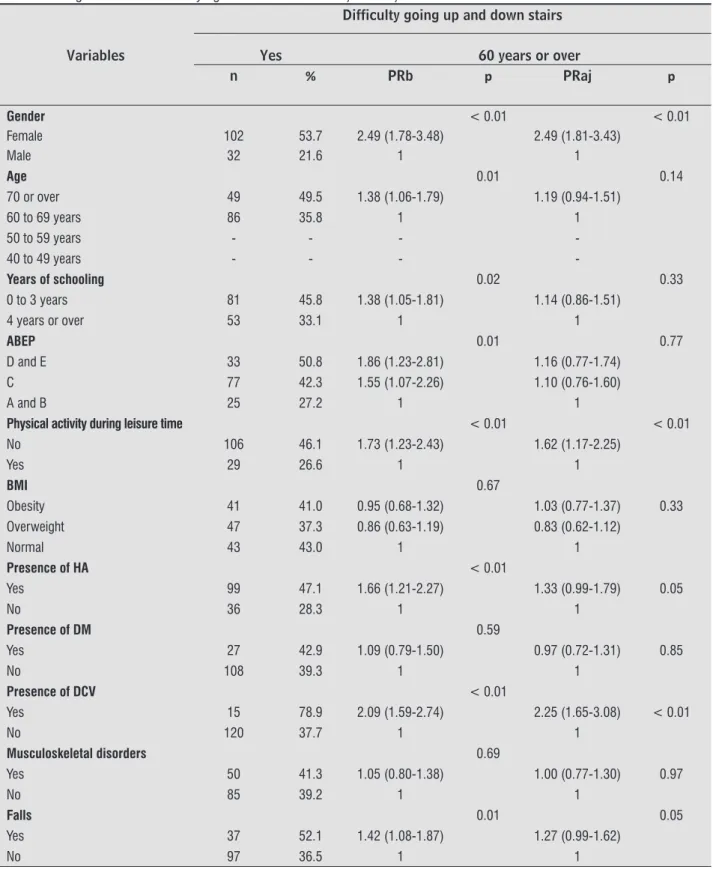
Among the people aged or over, in the crude anal-ysis, a higher prevalence was observed in females, in the age group years and over, with lower educational and economic levels, physically inactive during leisure time, with hypertension, cerebrovascular disease and
Table 4 - Factors associated with difficulty going up and down stairs in the analysis (crude and adjusted) by Poisson regression in the elderly aged 60 or more. Cambé, Paraná, 2011
Variables
Difficulty going up and down stairs
Yes 60 years or over
n % PRb p PRaj p
Gender < 0.01 < 0.01
Female 102 53.7 2.49 (1.78-3.48) 2.49 (1.81-3.43)
Male 32 21.6 1 1
Age 0.01 0.14
70 or over 49 49.5 1.38 (1.06-1.79) 1.19 (0.94-1.51)
60 to 69 years 86 35.8 1 1
50 to 59 years - - -
-40 to 49 years - - -
-Years of schooling 0.02 0.33
0 to 3 years 81 45.8 1.38 (1.05-1.81) 1.14 (0.86-1.51)
4 years or over 53 33.1 1 1
ABEP 0.01 0.77
D and E 33 50.8 1.86 (1.23-2.81) 1.16 (0.77-1.74)
C 77 42.3 1.55 (1.07-2.26) 1.10 (0.76-1.60)
A and B 25 27.2 1 1
Physical activity during leisure time < 0.01 < 0.01
No 106 46.1 1.73 (1.23-2.43) 1.62 (1.17-2.25)
Yes 29 26.6 1 1
BMI 0.67
Obesity 41 41.0 0.95 (0.68-1.32) 1.03 (0.77-1.37) 0.33 Overweight 47 37.3 0.86 (0.63-1.19) 0.83 (0.62-1.12)
Normal 43 43.0 1 1
Presence of HA < 0.01
Yes 99 47.1 1.66 (1.21-2.27) 1.33 (0.99-1.79) 0.05
No 36 28.3 1 1
Presence of DM 0.59
Yes 27 42.9 1.09 (0.79-1.50) 0.97 (0.72-1.31) 0.85
No 108 39.3 1 1
Presence of DCV < 0.01
Yes 15 78.9 2.09 (1.59-2.74) 2.25 (1.65-3.08) < 0.01
No 120 37.7 1 1
Musculoskeletal disorders 0.69
Yes 50 41.3 1.05 (0.80-1.38) 1.00 (0.77-1.30) 0.97
No 85 39.2 1 1
Falls 0.01 0.05
Yes 37 52.1 1.42 (1.08-1.87) 1.27 (0.99-1.62)
No 97 36.5 1 1
456
The report of cerebrovascular disease was the second best predictor of disability analyzed in both age groups in this study. This inding, concurrent with
other studies , , , is of importance when
considering that, even though it is one of the leading health problems in Latin America and the Caribbean , having an impact on the physical and psycho-logical well-being of the people affected and their
family members , the majority of the cases could
be prevented with proper control of its risk factors. The report of hypertension, DM and history of falls in the previous months remained associ-ated with the dif iculty of going up and down stairs only for individuals of to years in this study. (ypertension has a high prevalence and low rates of control and is considered one of the major modi iable risk factors for cardiovascular disease in Brazil V)
Brazilian Guidelines on (ypertension . Failure
to control and treat this disease allow the installation of other diseases, such as coronary artery disease, acute myocardial infarction and diabetes, which have a strong negative impact on the physical function of
individuals with hypertension .
The presence of DM also appears as worrying aspect. One study of individuals aged years and over in the United States noted that % of women and % of men with diabetes reported an inability
to walk ¼ mile, climb stairs or clean the house .
)n addition, DM, due to being associated with micro-vascular and macromicro-vascular complications, such as peripheral neuropathy, which is related to low levels
of physical performance and pain, greatly affects
the quality of life of patients . According to Wray
et al. , DM was shown to be a signi icant predictor
of disability, not only in the older adults, but also in middle-aged people.
Diabetes and sarcopenia have been reported as risk factors for the development and/or progression of physical disability among individuals. According
to Anton et al. , diabetes seems to accelerate the
progression of sarcopenia due to metabolic dysregu-lation, contributing to the progressive loss of strength and muscle mass.
)n the present study the association observed be-tween falls and dif iculty going up and down stairs is
consistent with the results of other studies , ,
, . According to Melzer, Gardener and Guralnik
, the limitation in the mobility in individuals due to pain in the lower limbs hip, knee and foot or spine, is a signi icant inding for the identi ication
Discussion
The prevalence of mild or moderate/severe func-tional disability in the four mobility indicators evalu-ated ranged from . % for dif iculty walking around the house to % for dif iculty going up and down stairs . (owever, one of the most important results observed was that these disabilities, although progres-sively increasing with advancing chronological age, af-fecting a signi icant proportion of people from years of age. )n addition, when considering the dif iculty go-ing up and down stairs outcome, the fact that this does not remain associated with the age group variable in people aged years or over after the adjusted analy-sis reinforces the idea that aging does not necessar-ily lead to an accumulation of disabilities. Therefore,
this re lects, as with other chronic diseases , the
intensity and duration of exposure to other risk factors such as comorbidities, which can lead to dysfunctions.
The prevalence of dif iculty going up and down
stairs found in this study % was higher than
that found in other studies, in which the prevalence ranged from % to %. (owever, it is dif icult to draw comparisons, since most of these studies ex-amined other age groups and used different methods
, , , .
The association between dif iculty going up stairs and being female is consistent with other national and
international studies , , , , . The higher
prevalence among women can be attributed, in part, to the greater ability of women to report their health
conditions than men . (owever, this may also be
due to gender differences in body composition and physical itness, in which women, due to their greater proportion of body fat, lower proportion of lean body mass and lower aerobic capacity than men, tend to present lower performance of physically demanding
activities, especially involving the lower limbs .
The study reinforces the idea that moderate and high levels of physical activity appear to reduce the risk
of disability or functional limitations , especially
considering the association between the non-perfor-mance of physical activity during leisure time and func-tional disability. Even though this inding is subject to reverse causality, since the interviewees could not be active during leisure time precisely because of their low functional capacity, studies have indicated regular physical activity as a desirable behavior for health that can contribute to the maintenance and improvement
and can be detected in a preclinical stage, the perfor-mance of physical activities that preserve muscle mass and the effective control of chronic conditions should be encouraged. These actions should be integrated into the priority agenda of the healthcare services, especial-ly those directed toward primary healthcare and the inclusion of economically disadvantaged populations.
Acknowledgements
The authors thank CAPES PROAP, Equipment grant and Master’s scholarship and of the Municipal (ealth Secretariat of Cambé.
References
. Alves LC, Leite )C, Machado CJ. Conceituando e men-surando a incapacidade funcional da população idosa: uma revisão de literatura. Cien Saude Colet.
; : - .
. )ezzoni L), McCarthy EP, Davis RB, Siebens (. Mobility dif iculties are not only a problem of old age. J Gen )ntern Med. ; : - .
. Lollar DJ, Crews JE. Rede ining the role of pub-lic health in disability. Annu Rev Pubpub-lic (ealth.
; : - .
. Verbrugge LM, Jette AM. The Disablement Process. Soc Sci Med. ; : - .
. Guralnik JM, Fried LP, Salive ME. Disability as a public health outcome in the aging population. Annu Rev Public (ealth. ; : - .
. Fried LP, Guralnik JM. Disability in older adults: evi-dence regarding signi icance, etiology, and risk. J Am Geriatr Soc. ; : - .
. Avlund K, Pedersen AN, Schroll M. Functional decline from age to : in luence of preceding changes in tiredness in daily activities. Psychosom Med.
; : - .
. Chen (, Wang C, Lee M, Tang P, Chu Y, Suen M. A hier-archical categorisation of tasks in mobility disability. Disabil Rehabil. ; : - .
. Gretebeck RJ, Ferraro KF, Black DR, (olland K, Gretebeck KA. Longitudinal change in physical activity and dis-ability in adults. Am J (ealth Behav. ; : - .
of measures that require prevention, treatment and rehabilitation. Accordingly, to preserve bone and muscle mass and to reduce excess fat and levels of physical inactivity are important strategies for the maintenance of physical performance and for the
reduction of functional disability in individuals .
(owever, these results and the others should be ana-lyzed with caution, since the main limitation of the pres-ent study is its cross-sectional design, in which there is no possibility to infer causality between functional disability and the independent variables. Furthermore, the self-reported data may have increased the sensitiv-ity of the measurements. (owever, according to Fried et
al. , this measure is considered a reliable indicator
for the risk of disability, as it allows for assistance or for the caregivers to answer the questions of the form. )t should be noted that in this study only . % of the interviews were not answered by the selected subject. Another relevant aspect to be considered is the dif iculty in establishing a comparison between the results of this study and those of other studies, due to variations in the measures, scales, dimensions and classi ications and the lack of standardization in the evaluation of the functional disability. Furthermore, the majority of the studies restrict their analysis to older adults, unlike this study that included people from the age of years.
)t is therefore likely that the variables that re-mained signi icant in the adjusted analysis are related to functional decline and the various factors that re-mained associated con irm the multifactorial nature of the analyzed outcome and reiterate the importance of the challenge to the Brazilian health system with the expansion of strategies for coping with diseases and non-communicable injuries, as proposed by the
Ministry of (ealth . Although this study
458
. Dhingra R, Vasan RS. Age as a risk factor. Med Clin N Am. ; : - .
. Melzer D, Gardener E, Guralnik JM. Mobility disability in the middle-aged: cross-sectional associations in the English Longitudinal Study of Ageing. Age Ageing.
; : - .
. Gardener EA, (uppert FA, Guralnik JM, Melzer D. Mid-dle-aged and mobility-limited: prevalence of disability and symptom attributions in a national survey. J Gen )ntern Med. ; : - .
. Valentine RJ, Misic MM, Rosengren KS, Woods JA, Evans EM. Sex impacts the relation between body composition and physical function in older adults. Menopause. ; : - .
. Paterson D(, Warburton DER. Physical activity and functional limitations in older adults: a systematic re-view related to Canada's Physical Activity Guidelines. )nt J Behav Nutr Phys Act. ; : - .
. Mendes EV. O cuidado das condições crônicas na at-enção primária à saúde: o imperativo da consolidação da estratégia da saúde da família. Brasília Brazil : Organização Pan-Americana da Saúde; . p. . Lang )A, Guralnik JM, Melzer D. Physical activity in
middle-aged adults reduces risks of functional impair-ment independent of its effect on weight. J Am Geriatr
Soc. ; : - .
. Teasel R. Stroke recovery and rehabilitation. Stroke. ; : - .
. Giacomin KC, Peixoto SV, Uchoa E, Lima-Costa MF. Estudo de base populacional dos fatores associados à incapacidade funcional entre idosos na Região Met-ropolitana de Belo (orizonte, Minas Gerais, Brasil. Cad Saude Publica. ; : - .
. Nunes MCR, Ribeiro RCL, Rosado LEFPL, Franceschini SC. )n luência das características sociodemográ icas e epidemiológicas na capacidade funcional de idosos residentes em Ubá, Minas Gerais. Rev Bras Fisioter.
; : - .
. Lavados PM, (ennis AJM, Fernandes JG, Medina MT, Legetic B, (oppe A, et al. Stroke epidemiology, preven-tion, and management strategies at a regional level: Latin America and the Caribbean. Lancet Neurol.
; : - . . Leveille SG, Penninx BWJ(, Melzer D, )zmirlian G,
Gu-ralnik JM. Sex differences in the prevalence of mobil-ity disabilmobil-ity in old age: the dynamics of incidence, recovery, and mortality. J Geront B Psychol Sci Soc Sci. ; :S -S .
. Fried LP, Bandeen-Roche K, Chaves P(M, Johnson BA. Preclinical Mobility Disability Predicts )ncident Mobility Disability in Older Women. J Gerontol A Biol Sci Med Sci. ; :M -M .
. Gill TM, Allore (G, (ardy SE, Guo Z. The dynamic nature of mobility disability in older persons. J Am Geriatr Soc. ; : - .
. Parahyba M), Simões CCS. A prevalência de incapaci-dade funcional em idosos no Brasil. Cien Saude Colet.
; : - .
. Parahyba M), Veras R. Diferenciais sociodemográ icos no declínio funcional em mobilidade ísica entre os ido-sos no Brasil. Cien Saude Colet. ; : - . . Alves LC, Leite )C, Machado CJ. Fatores associados à
incapacidade funcional dos idosos no Brasil: análise multinível. Rev Saude Publica. ; : - . . Departamento de )nformática do SUS. )nformações de
Saúde. Estatísticas Vitais. Mortalidade Geral - Paraná. . Óbitos por residência segundo capítulo da C)D-. [cited ]. Available from: http://tabnet.data-sus.gov.br/cgi/tabcgi.exe?sim/cnv/obtpr.def . Souza RKT, Bortoletto MSS, Loch MR, González AD,
Matsuo T, Cabrera MAS, et al. Prevalência de fatores de risco cardiovascular em pessoas com anos ou mais de idade, da cidade de Cambé, Estado do Paraná, Brasil : estudo de base populacional. Epidemiol Serv Saude. ; : - .
. Desrosiers J, Bravo G, (ébert R, Dubuc N. Reliability of the revised functional autonomy measurement sys-tem smaf for epidemiological research. Age Ageing.
; : - .
. Piirtola M, Löppönen M, Vahlberg T, )soaho R, Kivelä L, Räihä ). Fractures as an independent predictor of functional decline in older people: a population-based study with an -year follow-up. Gerontology.
; : - .
. Shin (, Panton LB, Dutton GR, )lich JZ. Relation-ship of physical performance with body composi-tion and body mineral density in individuals over
years of age: a systematic review. J Aging Res.
; : .
. Ministério da Saúde. Secretaria de Vigilância em Saúde. Departamento de Analise de Situação de Saúde. Plano de ações estratégicas para o enfrentamento das doenças crônicas não transmissíveis DCNT no Brasil - . Brasília: Ministério da Saúde; . p.
Received in / / Recebido em / /
Approved in / / Aprovado em / /
. Shah MV. Rehabilitation of the older adult with stroke. Clin Geriatr Med. ; : - .
. V) Diretrizes Brasileiras de (ipertensão. Rev Bras (ipertens. ; : - .
. Suciu L, Cristescu C, Tomescu M, Balaş M, Mureşan R, Vlaia V, et al. The impact of hypertension and associ-ated comorbidities on quality of life assessment ques-tionnaire SF- V . Farmacia. ; : - . . Gregg EW, Beckles GL, Williamson DF, Leveille SG,
Langlois JA, Engelgau MM, et al. Diabetes and physi-cal disability among older U.S. adults. Diabetes Care.
; : - .
. Tuttle LJ. Skeletal muscle impairments in people with diabetes and peripheral neuropathy [dissertation]. Saint Louis MO : Washington University in St. Louis;
. p. English.
. Davies M, Brophy S, Williams R, Taylor A. The preva-lence, severity, and impact of painful diabetic periph-eral neuropathy in type diabetes. Diabetes Care.
; : - .
. Wray LA, Ofstedal MB, Langa KM, Blaum CS. The effect of diabetes on disability in middle-aged and older adults. J Gerontol A Biol Sci Med Sci.
; : - .
. Anton SD, Karabetian C, Naugle K, Buford TW. Obesity and diabetes as accelerators of functional decline: Can lifestyle interventions maintain func-tional status in high risk older adults? Exp Gerontol.
; : – .
. van Dijk GM, Dekker J, Venhoof C, van den Ende C(M. Course of functional status and pain in osteoarthritis of the hip or knee: a systematic review of the litera-ture. Arthritis Rheum. ; : - .
. (ébert R, Brayne C, Spiegelhalter D. Factors associ-ated with functional decline and improvement in a very elderly community-dwelling population. Am J Epidemiol. ; : - .