Carnivores of Syria
Marco Masseti
Department of Evolutionistic Biology “Leo Pardi” of the University of Florence, Italy
Corresponding author: Marco Masseti (marco.masseti@unii .it)
Academic editors: E. Neubert, Z. Amr | Received 14 April 2009 | Accepted 29 July 2009 | Published 28 December 2009
Citation: Masseti, M (2009) Carnivores of Syria. In: Neubert E, Amr Z, Taiti S, Gümüs B (Eds) Animal Biodiversity in the Middle East. Proceedings of the First Middle Eastern Biodiversity Congress, Aqaba, Jordan, 20–23 October 2008. ZooKeys 31: 229–252. doi: 10.3897/zookeys.31.170
Abstract
h e aim of this research is to outline the local occurrence and recent distribution of carnivores in Syria (Syrian Arab Republic) in order to of er a starting point for future studies. h e species of large dimensions, such as the Asiatic lion, the Caspian tiger, the Asiatic cheetah, and the Syrian brown bear, became extinct in historical times, the last leopard being reputed to have been killed in 1963 on the Alauwit Mountains (Al Nusyriain Mountains). h e checklist of the extant Syrian carnivores amounts to 15 species, which are essentially referable to 4 canids, 5 mustelids, 4 felids – the sand cat having been reported only recently for the i rst time – one hyaenid, and one herpestid. h e occurrence of the Blandford fox has yet to be con-i rmed. h con-is paper con-is almost entcon-irely the result of a sercon-ies of con-i eld surveys carrcon-ied out by the author macon-inly between 1989 and 1995, integrated by data from several subsequent reports and sightings by other authors.
Keywords
Carnivores, Syria, Near East.
Introduction
h e geographical position of Syria (Syrian Arab Republic), in the land-bridge between Eurasia and Africa, displays a remarkable variation of bioclimatic and biogeographical conditions throughout its territories, allowing the coexistence of zoological elements of the Mediterranean and Boreal regions with Irano-Turanian and Saharo-Sindian taxa
(cf. Atallah 1977, 1978; Masseti 2004; Serra et al. 2005). Within the mammalian taxonomic group, this appears particularly evident for the carnivores, with several taxa
of which having been reported from the Syrian territory over recent decades. However, with the exception of a very few species, possibly including the red fox, Vulpes vulpes
www.pensoftonline.net/zookeys
Copyright Marco Masseti. This is an open access article distributed under the terms of the Creative Commons Attribution License, which permits unrestricted use, distribution, and reproduction in any medium, provided the original author and source are credited.
(Linnaeus, 1758), the majority of the surviving carnivores now appear to be in popula-tions of low viability.
Unfortunately, large carnivores, such as the Asiatic lion, Panthera leo persica (Mey-er, 1826), the Caspian tig(Mey-er, Panthera tigris virgata (Illiger, 1815), the Asiatic cheetah,
Acinonyx jubatus venaticus (Grii th, 1921), and the Syrian brown bear, Ursus arctos
syriacus Hemprich & Ehrenberg, 1828, became extinct in historical times. According
to Mouterde (1966), the lion was recorded along the Euphrates only up to the 12th century. h e last known reports of cheetahs in the region are from the south-eastern desert during the years 1956–1957 (Masseti 1990). h e last surviving individual may have been killed at the end of the 1950s in an area in the south between the Jordanian and Iraqi borders (AbuZinada et al. 2001). h ere is some archaeological evidence for the occurrence of tigers in the Amuq valley (Ellerman and Morrison-Scott 1951; Val-lino and Guazzo Albergoni 1978). Although previously located within Syria, boundary changes made during World War II now place the plain within Turkish Hatay (Yener and Wilkinson 2007). Here, tigers were reported up to the 1970s (Baytop 1974; Kock 1990). According to Kumerloeve (1956), Baytop (1973, 1974), and Corbet (1978), isolated populations of the species probably survived up to this time in the south-ern Caucasus and Eastsouth-ern Asia Minor. h e westsouth-ernmost occurrence of this species is undoubtedly related to the heartland of the tiger in Transcaucasia (cf. Heptner and Sludskij 1980) and northern Iran (Misonne 1959; Lay 1967), since tigers appeared regularly at Tbilisi up to 1922, and in the upper Aras (Araxes) Valley (Mazak 1979). It is believed that brown bears inhabited Galilee only up to the end of the 19th century
(Mendelsshon and Yom-Tov 1999), whereas they have been reported as still surviving (Simon 1969) in the mountains of Kurdistan, in northern and eastern Iraq and pos-sibly also in northern Syria (Cowan 1972). Talbot (1960), for example, coni rmed the existence of brown bears on the slopes of the Alawit Mountains (Al Nusyriain Moun-tains), north of Lattakia, in the 1960s (Harrison 1968; Harrison and Bates 1991). h e oi cial version is that the last Syrian bear was recorded in 1927, along the Nahal Al-Kabir, in the vicinity of Lattakia.
h ere are instead a larger number of studies on the carnivores of geographical regions adjacent to Syria, such as southern Turkey (Baytop 1973, 1974; Huş 1974; Borner 1977; Kasparek 1986, 1988; Ulrich and Rif el 1993; Özkurt et al. 1998; Öz-kurt et al. 1999; Masseti 2000a; Can 2004; Can and Togan 2004; Kasparek et al. 2004; h ol-Schmitz 2004; Giannartos et al. 2006, and others). Over the last twenty years there have been various studies on the local carnivores of Jordan which, from a biogeographical point of view, can be regarded as an extension of the Syrian desert. We should mention, inter alia, the works of Masseti (1990), Masseti and Covarelli (1991), Qumsiyeh et al. (1993), Bunaian et al. (1998), Rifai et al. (1999), Reuter et al. (2000), Abu Baker and Amr (2002), Bunaian et al. (2002), Abu Baker et al. (2003), Abu Baker et al. (2004), and Qarqaz et al. (2004). Israeli production on the subject is notably vast, I shall restrict myself to mentioning the important review that appears in Mendelsshon and Yom-Tov (1999). Iraq boasts a decidedly smaller number of specialist studies, in practise restricted to Hatt (1959), Mahdi and Georg (1969), and Kock (1990). Finally, there are also very few publications on the mammals of Lebanon, and almost all date to before the 1990s. Among which I should mention Lewis et al. (1968), and Serhal (1985). h e results of a recent study on the distribution of the striped hyaena in Lebanon were published by Abi-Said and Marrouche (2007).
Materials and methods
h is study is almost entirely the result of a series of i eld surveys carried out by the au-thorin the territories of the Syrian Arab Republic, mainly between the years 1989 and 1995, integrated by data from several subsequent reports and sightings by other authors, such as Peshev and Al-Hossein (1989), Kock et al. (1994), and Uhrin et al. (2000), or referring to original data communicated me by Petr Benda on the results of a biological expedition organised inter alia by the National Museum (Natural History) of Prague in 1998. h e present research is based on personal observations, as well as on contacts with local institutions and individuals such as hunters and taxidermists. To avoid repetition, I do not indicate on the distribution maps data published prior to 1989.
In the course of this study the collections of the following museums were also examined: PAM Palmyra Archaeological Museum, Tadmor (=Palmyra), Syria
AFRI Arab Institute of Forestry & Range, Lattakia, Syria
IBM Idlib Museum, northwestern Syria (about 60 km south-west of Aleppo) JNHM Jordan Natural History Museum, Yarmouk University, Irbid, Jordan BMNH Natural History Museum, London
ZFMK Museum Alexander König, Bonn,
h e examination of one such collection at Basamfasal, a suburb of Deir ez-Zor, was particularly important. h is collection was gathered from the late 1980s on, and consisted of stuf ed animals that were shot in the environs of the town, along the Euphrates valley and in the Eastern Syrian steppe (Masseti 2001). h ey were dis-played in the house of Mr. Zuheir Karkutli, also known as Abu Rabic, “father of the
spring”, after the name of his son, Rabic (= “spring”). Comprising hundreds of
speci-mens, dominated by birds (71 species) but also featuring a fair number of mammals (27 species) and a few reptiles (4 species), the Basamfasal collection was representative of the wildlife repertoire of the part of northern Syrian Mesopotamia known as the “Djazireh”, between the valley of the Euphrates and the Khabur river. h e collection was destroyed in 1994, for reasons which are not altogether clear. h e stuf ed speci-mens may possibly have been destroyed as a result of conservation problems. Some of the living animals were, instead, transferred to the small zoological garden in the urban settlement of Douma, at the north-eastern corner of the oasis of Damascus, also called Ghouta (cf. Bianquis 1989).
h e aim of this work is to outline a mapping of the present occurrence of wild carnivores in Syria in order to of er a starting point for future studies.
Annotated checklist
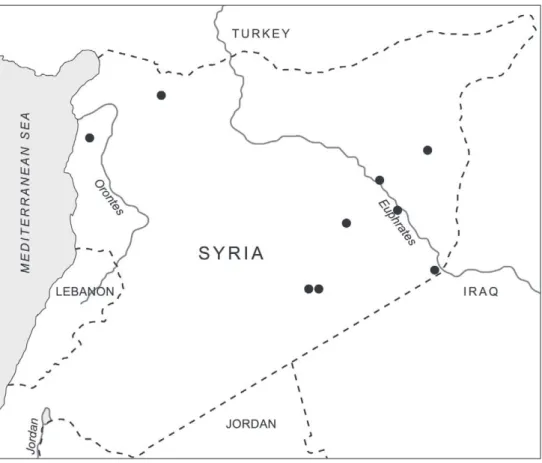
Golden jackal, Canis aureus Linnaeus, 1758 Fig. 1
h is is the only species of jackal distributed outside Africa, in the Near East and Mid-dle East (Ellermann and Morrison-Scott 1951; Kumerloeve 1967; Hosey 1982; Fran-cis 2008), and in south-western Europe as far as north-eastern Italy (Lapini and Perco 1988a and 1988b; Lapini et al. 1993). Golden jackals are regarded as fairly common in many areas of the western Near East where they are often persecuted as pests (Frank-enberg 1991; Mendelssohn and Yom-Tov 1999).
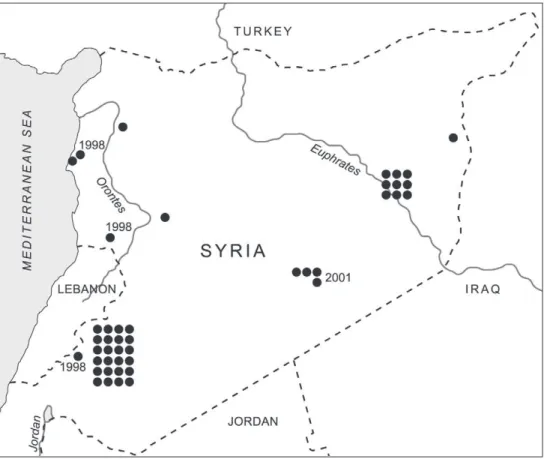
Wolf, Canis lupus Linnaeus, 1758 Fig. 2
h is is the last carnivore of large dimensions still dispersed in the region, albeit seri-ously threatened with extinction (cf. Shalmon 2004). In the course of this study two stuf ed specimens were observed in the collection of the Palmyra Archaeological Mu-seum; according to the manager of the museum, Ali Tahr (pers. comm. 1994), they were captured in the vicinity between 1970 and 1975. h e adult stuf ed specimen in theBasamfasal collection was hunted in the area of Jabal Bishri, between Raqqa and Deir-ez-Zor (cf. Masseti 2001); it appeared not to be pure-blooded but more likely the result of a wolf-dog crossing. According to F. Al-Yassine (1994, pers. comm.), wolves were present but rare in the mountains of Shoëh and north of Ifreen, whereas Abu Ma-zen (1994, pers. comm.) claimed they were also present in the Alawit Mountains (Bab Janné). In April 1994, three live individuals were observed in the zoological garden at Douma, originating respectively from Jabal Deir ez-Zor, Mayadin and Abu Kamal. At that time, the species appeared to be still dispersed in eastern Syria.
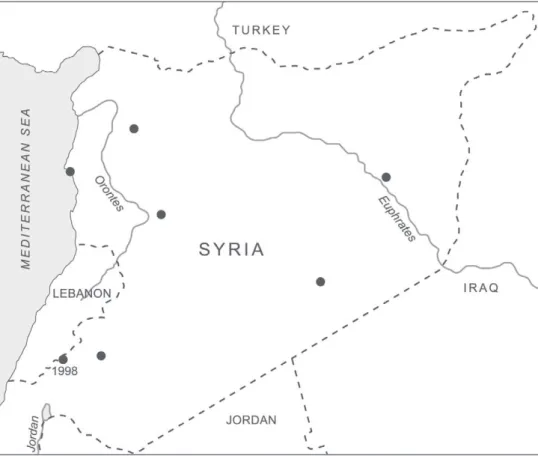
Red fox, Vulpes vulpes (Linnaeus, 1758) Fig. 3
reported one specimen of this species from Tall ash-Shaikh Hamad, along the river Khabur (north-eastern Syria). In June 1998, two individuals were observed respec-tively in Burqash, and 5 km NE of Slonfeh; a freshly shot specimen was found 5 km W of Ash’meiseh on 1 July 1998 (Pert Benda 2009: pers. comm.)
At Al talila reserve, about 25 km SE of Tadmor (= Palmyra), exploiting a
combina-tion of systematic and opportunistic sampling approaches, the red fox was detected and readily identii ed at night using optical instruments and camera traps in the period between May 2000 and December 2001 (Serra et al. 2007).
Ruppell’s sand fox, Vulpes rueppellii (Schinz, 1825) Fig. 4
along the course of the Euphrates (Benda 2009: in litteris). Subsequently, the oc-currence of the species was coni rmed by a camera trapping campaign carried out in the protected desert area of Al talila, during the period May 2000 – December 2001 (Serra et al. 2007).
Weasel, Mustela nivalis (Schinz, 1825) Fig. 4
In the Levant the distribution of this mustelid is restricted to the northern areas of the region, including Lebanon (Serhal 1985; Harrison and Bates 1991) and north-ern Syria (Masseti 1995). In Palestine, for example, the species does not exist at present (Dayan and Tchernov 1988; Dayan 1989). It has not been reported from the northern Arabian peninsula since the Early Bronze Age (Boessneck 1977; Dayan and Tchernov 1988). In the course of this research it was possible to examine only one stuf ed specimen on display in the Idlib museum. h us, this site can be regarded as one of the southernmost stations of the weasel in the south-western Near East.
Beyond this Levantine distribution gap in the southern Levant, the species occurs again in Egypt, along the Nile delta and valley, with a population characterised by large body size and regarded as almost completely commensal with man (Osborn and Helmy 1980).
Marbled polecat, Vormela peregusna (Gueldenstaedt, 1770) Fig. 5
Peshev and Al-Hossein (1989) reported two males of this species, captured in the De-raa district. In the course of the present study, between 1989 and 1995, two stuf ed specimens were observed respectively in the Palmyra Archaeological Museum, and in the Idlib museum, and another two in the house of the taxidermist Mohammed Al Salie in the village of Salamieh, captured in the vicinity; three live individuals were kept at Basamfasal. Rifai et al. (1999) noted that the population of marbled polecats had increased and become noticeable in north-western Jordan, even along the border with Syria.
Beech marten or stone marten, Martes foina (Erxleben, 1777) Fig. 6
In the western Near East, the range of the stone marten comprises the whole of Anatolia and the Levant, although not further south than the latitude of the Dead Sea (Harrison and Bates 1991; Mendelssohn and Yom Tov 1999). It is predominantly dispersed in the Levantine mountainous part of the Mediterranean region, with some penetration of semi-desert areas. h e clif s, trees and dense vegetation of the oasis, such as the oasis of Damascus (Ghouta), also appear to represent suitable habitats for the species. In the course of this research, in 1992, only two stuf ed specimens were observed, on sale in the airport of Damascus and probably captured in the Ghouta. Both of them were char-acterised by a white throat patch divided by a median blackish-brown band, as in the Syrian subspecies Martes foina syriaca Nerhring, 1902, dispersed in south-western Asia (cf. Harrison 1968). Analogous phenotype pattern are also characteristic of the Cretan marten, M. foina bunites (Bate 1906) (cf. Niethammer and Niethammer 1967; Ragni et al. 1999), and of several populations of the Eastern Aegean islands (cf. Masseti 2002).
European badger, Meles meles (Linnaeus, 1758) Fig. 7
A record of this species is available in Kock and Kinzelbach (1982) from 20 km south of Tartus. Between 1989 and 1994, several stuf ed specimens were observed in the Palmyra Archaeological Museum, the Idlib museum, the collection of the Department of Animal Production of the University of Lattakia, at Basamfasal, and in the house of the taxidermist Mohammed Al Salie at Salamieh. All these badgers were captured in the vicinity of the aforementioned sites; one live individual, characterised by a very light coat colour, was examined in the zoological garden of Douma (Damascus area). In June 1998, two live individuals and several burrowing sites were observed in Bur-qash (Pert Benda 2009: pers. comm.).
As noted by Abu Baker and Amr (2002) for Jordan, the relative scarcity of the spe-cies in Syria might be explained by the geographical position of both countries at the edge of its distribution range.
Otter, Lutra lutra (Linnaeus, 1758) Fig. 8
Two stuf ed specimens (one adult and one subadult), captured in the surroundings, were examined in the Basamfasal collection (cf. Masseti 2001, 2004). According to Abu Rabieh (1994, pers. comm.), there were numerous specimens in the Euphrates from Deir ez-Zor up to Abu Kamal (at the Iraqi border), Al Mayaddin and Doura Europos, but not in the north-westernmost area of Raqqa. Kock et al. (1994) re-ported the occurrence of this species from the Khabur valley, in north-eastern Syria. Additional data on the distribution of the species in eastern Syria were collected during a biological expedition organised inter alia by the National Museum (Natu-ral History) of Prague in the period 11 June–7 July 1998. h e occurrence of otters was coni rmed from an island in the Euphrates at Doura Europos, from the site of Halabiyyeh and from Tell Sheikh, along the river Khabur, all sites in the district of Deir-ez-Zor (Uhrin et al. 2000). Data collected between 1989 and 1998 appear to indicate that a considerable population of otters is still present in this portion of eastern Syria, comprised between the Euphrates, its tributary the Khabur and the border with Iraq.
h e carnivore is reported from the West Bank and northern Lebanon, and recent evidence is in favour of its presence in the western Bekaa valley and in the river Litani (Mounir R. Abi-Said 2008: pers. comm.). In neighbouring Israel otters are present in aquatic habitats and i shponds in the Hula Valley, in the northern Jordan River catchments and the Harod Valley (Dolev et al. 2006; Ben Ari et al. 2008); Guter et al. 2005; Guter et al. 2008). A single record from the Zvulun Val-ley and Carmel coastal area in 2000 suggests the existence of a remnant population along the coast, which may have become extinct (Dolev et al. 2006). New i nd-ings have indicated previously undocumented otter activity in the Golan Heights (Dolev et al. 2006).
Egyptian mongoose or ichneumon, Herpestes ichneumon (Linnaeus, 1758) Fig. 8
Striped hyena, Hyaena hyaena (Linnaeus, 1758) Fig. 9
Two stuf ed adult specimens were examined in the collections of the Palmyra Archaeologi-cal Museum, Tadmor (PAM), which according to Ali Tahr (pers. comm. 1994) were cap-tured in the surrounding area between 1970 and 1975; another one, again killed in the re-gion of Palmyra, was present in the collection of the Forest and Range Institute of Lattakia; two other stuf ed adult specimens were in the Basamfasal collection, both captured in the environs of Deir-ex-Zor (cf. Masseti 2001). In 1994, a live adult individual, captured in the region of Deir ez-Zor, was housed in the zoological garden of Douma, near Damascus.
Local people claim that there are very few hyenas in the Alawit Mountains (Abu Mazen, Bab Janné, pers. comm. 1994). It seems possible that, as in Lebanon (Abi-Said and Marrouche 2007; Abi-Said et al. 2008),the species may even occasionally frequent urban areas.
Wildcat, Felis silvestris Schreber, 1775 Fig. 10
In the course of this research it was possible to examine one adult stuf ed specimen in the collections of the Palmyra Archaeological Museum (PAM), another in the house of the taxidermist Mohammed Al Salie in the village of Salamieh (which had been cap-tured in the vicinity), and another which was on sale in a shop at Damascus airport, very likely captured in the surroundings in 1992. h e occurrence of the wild cat in the protected desert area of Al talila, Tadmor (= Palmyra) was coni rmed in 2001 by the results of a camera trapping campaign carried out by Serra et al. (2007).
Jungle cat, Felis chaus Gueldenstaedt, 1776 Fig. 11
Euphrates river (cf. Masseti 2001 and 2004).Another stuffed female, captured in 1988 at Damyeh Bridge, in Jordan, not far from the Syrian border (East Bank of the Jordan river, S. Wadi Zerka), was examined in the Natural History Museum of the Yarmouk University, at Irbid (see also Kock et al. 1993; Abu Baker et al. 2003).
According to the hunters of Deir-ez-Zor, the jungle cat is a species still quite widely dispersed along the riverine thickets of the middle Euphrates and the Khabur, where it is locally referred to as el qut el barry (= “wild cat”) and sometimes even nimr
al Furat (= “leopard of the Euphrates”). As in this case, vernacular names used by
locals and hunters may often lead to misunderstanding,and information acquired purely through interviews must be treated with great caution. h ere can, however, be no risk of such misunderstanding in the present work since it is based exclusively on tangible evidence.
with the exception, perhaps, of the excessively populated Al Ghab plain – could still be favourable to its survival.
Sand cat, Felis margarita Loche, 1858 Fig. 11
h e occurrence of this species was unknown in Syria up to 2001, when it was reported for the i rst time during the camera trapping campaign carried out in the protected area of Al talila, Tadmor (= Palmyra) by Serra et al. (2007).
Caracal, Caracal caracal (Schreber, 1776) Fig. 12
In the course of this research it was possible to examine only one stuf ed specimen, still conserved in the collection of the Palmyra Archaeological Museum (PAM). According to Ali Tahr (pers. comm. 1994) it was captured locally between 1970 and 1980.
Leopard, Parthera pardus (Linnaeus, 1758) Fig. 12
As regards this felid, I was able to examine only the skin of an adult male killed at Nabi Yunes, Slonfeh, north-western Syria, in 1959 (ZFMK n. 64.1171, see Lehmann 1965), and to collect direct information about the disappearance of the last individuals from the same region. In the territories of northern Syria where the species was last reported, the Asia Minor leopard, P. pardus tulliana Valenciennes, 1856, is documented but it cannot be ruled out that the Arabian leopard, P. pardus nimr Hemprich & Ehrtenberg, 1833, may also have occurred in the desert regions of southern Syria. In the Levant, felids of the latter subspecies are still dispersed along the shores of the Dead Sea, and in the Negev desert (Mendelssohn 1989; Masseti 2000a; Shalmon 2004).
h e last Syrian leopard is reputed to have been killed in 1963, in the vicinity of the village of Bab Jannè (= “the gate of paradise”), Slonfeh, on the Alawit Mountains, about 20 km from the Turkish border (Masseti 2000a). According to Ahmad Hamud of the Arab Forest and Range Institute of Lattakia(AFRI) (1994, pers. comm.), this specimen was killed by a forest guard of the Kharafan family in the forest of Cilician i r, Abies cilicica (Ant. et Klotsch.) Carr. It is perhaps interesting to recall that the same
area is also the last Syrian stronghold of the Kurdish roe deer, Capreolus capreolus coxi
(Cheesman and Hinton 1923) (Masseti 2000b and 2004).
Remarks
In the course of this research it was possible to gather information on the current dif-fusion of 15 species of carnivore ranging in size from the wolf to the weasel, and not including the leopard.
It was, not possible to ascertain the occurrence of the Blandford fox, Vulpes cana
Blandford, 1877, in Syria. h e species was i rst recorded from the western Near East by Ilani (1983), and there is no previous information from this area. Today the western limit of its distribution is found in the southern Levant (Ginsberg and Macdonald 1990), where it inhabits the clif s of the desert region from Aqaba up to the southern Jordan valley (Abu Baker et al. 2004; Shalmon 2004). However, as in the recent case of the sand cat in the Tadmor desert, it cannot be ruled out that further studies might document the presence of Vulpes cana in some of the rocky regions of Syria.
Nor was it possible to obtain any information about the ratel or honey badger,
Mellivora capensis (Schreber, 1776), and we should recall that Kumerloeve (1975) too
was unable to coni rm the occurrence of this species from the Syrian territories. h is is not to say, however, that the species is to be considered as completely absent from the country, otherwise it would be impossible to explain its fairly well-documented occurrence in neighbouring Jordan (see Amr, 2000), and Israel (see Shalmon, 2004). In this case too, it cannot be ruled out that the absence of specii c sightings/reports for Syria could plausibly be attributed to the absence of targeted studies. Nor should we overlook the fact that in the entire Near East this speciesis frequently persecuted, being poisoned and hunted by bee farmers because it of the damage it causes to bee-hives (Shalmon, 2004). Nor was any information obtained about the occurrence of the smooth-coated Indian otter, Lutrograle perspicillata (Geof roy, 1826) along the Syrian course of the Euphrates. In any case, however, the Near Eastern range of this Middle and Far Eastern species has been indicated as limited to southern Mesopotamia (Harri-son 1968; Harri(Harri-son and Bates 1991; Wozencraft 2005; Karami et al. 2008). h e ques-tion of the possible presence of representatives of the Lynx genus in modern-day Syria remains open (see Aymerich 1991). One specimen characterised by the “pardina” phe-notype was reported by Oriani (2000) from Tadmor (= Palmyra), who stated that: “In
Syria the species was not recorded prior to this work”.Local hunters at Deir-ez-Zorrefer
to the occurrence of felids of this type on Jebel Ablasis and Jebel Abdul-Aziz, between the Balik and Khabur, rivers in the northern Djazireh, not far from the southern Turk-ish border. h e same hunters declare that the main dif erence between this carnivore and the jungle cat consists in the fact that the former is maculated, with black spots. But other spotted felids did also occur in the past in this geographical area.
by species that are fully adapted to living in areas inl uenced by man. Jackals, foxes, wild and jungle cats, mongooses and several mustelids are carnivores that humans have accepted as neighbours, while also being those that are most adept at avoiding contact with man (cf. Osborn and Helmy 1980; Ragni et al. 1999, Masseti 1995, 2002a). h ese carnivores are principally represented by generalist species which can thrive in a wide variety of environmental conditions and can exploit a range of dif erent resources h us, they are able to vary their diets according to local and seasonal food availability. Frequently, for example, in the Mediterranean region the stone marten can be found behaving as a full commensal of man in urban areas (cf. Masseti 2002b) and it is also well known that weasels in the Nile delta are almost completely commensal with man (see Osborn and Helmy 1980).
Acknowledgements
In the course of this project I have been fortunate to have the help of many friends and colleagues. I should like to express special thanks to Mounir R. Abi-Said, American Uni-versity of Beirut; F. Al-Yassine, Dép. de la Production Animale, Faculté d’Agronomie, Université d’Alep; Eliezer Frankenberg, Israel Nature and Parks Authority, Jerusalem; A. Hamud, Forest and Range Institute of Latakia; Amir Ibrahim Department of Ani-mal Production, Faculty of Agriculture of the Tishreen University of Lattakia; Abu Mazen, Bab Janné; Zuheir Karkutli “Abu Rabieh”, Basamfasal (Deir ez-Zor); Gianluca Serra, IUCN Bald Ibis project; Ali h ar, Palmyra Archaeological Museum, Tadmor; and S. Zahoueh, Faculté d’Agronomie, Université d’Alep.
I should like to express my special appreciation and gratitude to Zuhair S. Amr, Department of Biology of the Jordan University of Science and Technology (Irbid) for the enjoyable and stimulating discussions on the carnivores of Jordan and the Near East, and to Petr Benda, National Museum (Natural History) of Prague, for having put at my disposal the information on the carnivores he gathered in the course of a scientii c expedition carried out in Syria in 1998.
References
Abi-Said MR, Marrouche D (2007) Distribution of the Striped Hyaena (Hyaena hyaena syriaca
Matius, 1882) (Carnivora: Hyaenidae) in urban and rural areas of Lebanon. Zoology in the Middle East, 42: 3–14.
Abi-Said MR, Abi-Said DM, Sadek R (2008) Distribution of the striped hyaena, Hyaena
Abu Baker M, Amr Z (2002) Status of the Eurasian Badger, Meles meles, in Jordan (Carnivora: Mustelidae). Zoology in the Middle East, 27: 13–20.
Abu Baker M, Nassar K, Rifai L, Qarqaz M, Al-Melhim W, Amar Z (2003) On the current
status and distribution of the Jungle Cat, Felis chaus, in Jordan (Mammalia: Carnivora).
Zoology in the Middle East, 30: 5–10.
Abu Baker MA, Al Omari K, Qarqaz M, Khaled Y, Yousef M, Amr ZS (2004) On the current
status and distribution of Blanford’fox, Vulpes cana Blanford, 1877, in Jordan (Mammalia:
Carnivora: Canidae). Turkish Journal of Zoology, 28: 1–6.
Abu Zinada AH, Robinson ER, Nader AI, Al Wetaid YI (Eds) (2001) First Saudi Arabian Na-tional Report on the Convention on Biological Diversity. h e NaNa-tional Commission for Wildlife Conservation and Development, Ryad: 131 pp.
Amr ZS (2000) Jordan Country Study on Biological Diversity. Mammals of Jordan. United Nations Environment Programme/National Library, Amman: 100 pp.
Atallah SI (1977) Mammals of the Eastern Mediterranean Region: their Ecology, Systematics and Zoogeographical Relationships. Säugetierkundliche Mitteilungen, 25: 241–360. Atallah SI (1978) Mammals of the Eastern Mediterranean Region: their Ecology, Systematics
and Zoogeographical Relationships. Part 2. Säugetierkundliche Mitteilungen, 26: 1–50.
Aymerich M (1991) Situación del lince boreal en Europa. Quercus, 61: 13–16.
Baytop T (1973) Neue Beobachtung über die Verbreitung des kleinasiatischen Leoparden (Pan-thera pardus tulliana) in der Türkei. Bonner zoologische Beiträge., 24: 183–184.
Baytop T (1974) La présence du vrai tigre, Panthera tigris (Linné 1758) en Turquie.
Säugetie-rkundliche Mitteilungen., 22 (3): 254–256.
Ben Ari Y, Nrakiss T, Kronfeld-Schor N, Bar-Gal GK, Saltz D, Dolev A (2008) h e Eurasian
otter (Lutra lutra) in the Southern Levant. In: Programme and abstracts of the First
In-ternational Congress “Documenting, Analysing and Managing Biodiversity in the Mid-dle East” (Aqaba, 20–23 October 2008). Senckenberg Forschungsinstitut und Museum/ University of Jordan/Marine Science Station Aqaba. Jordan University Press, Amman: 52. Bianquis A-M (1989) La réforme agraire dans la Ghouta de Damas. Institut Français de Damas,
Damascus: 152 pp.
Boessneck J (1977) Funde von Mausswicscl, Mustela riivalis Linne, 1766, auf dern Tell Hesbon,
Jordanien. Saugetierkundliche Mitteilungen., 25: 44–48.
Borner M (1977) Leopards in Western Turkey. Oryx, July 1977: 26–30.
Bunaian F, Mashaqbeh A, Yuosef M, Budairi A, Amr Z (1998) A new record of the Sand Cat, Felis margarita Loche, 1858, from Jordan. Zoology in the Middle East, 16: 5–7.
Bunaian F, Hatough A, Ababaneh D, Mashaqbeh S, Yuosef M, Amr Z (2002) h e Carnivores of the Northeastern Badia, Jordan. Turkish Journal of Zoology, 25: 19–25.
Can ÖE (2004) Status, Conservation and management of Large Carnivores in Turkey. Conven-tion on the ConservaConven-tion of European Wildlife and Natural Habitats. Council of Europe, Strasbourg. T-PVS/Inf (2004) 8: 1–28.
Can ÖE, Togan İ (2004) Status and management of brown bears in Turkey. Ursus, 15: 48–53. Carruthers D (1909) Big Game of Syria, Palestine and Sinai. Field, London, 114: 1135. Corbet GB (1978) h e mammals of the Palaearctic Region: a taxonomic review. British
CowanIM (1972) h e status and conservation of bears (Ursidae) of the world-1970. Proceed-ings International Conference on Bear Research and Management, 2:343–367.
Dayan T (1989) h e succession and the community structure of the Carnivores of the Middle East in space and time. h esis submitted for the degree PhD. Te1 Aviv University, Febru-ary 1989.
Dayan T, Tchernov E (1988) On the i rst occurrence of the common weasel (Mustelu nivalis)
in the fossil record of Israel. Mammalia, 52: 165–168.
Dolev A, Guter A, Saltz D, Kronfeld-Schor N (2006) Israel’s otter (Lutra lutra) population,
status and future conservation. In: Conroy JWH, Yoxon G, Gutleb AC, Ruiz-Olmo J (Eds): h e return of the otter in Europe - where and how? Sabhal Mor Ostaig, Isle of Skye (30 June–5 July 2003). International Otter Survival Fund, Broadford, Isle of Skye (Scotland): 1–7.
Ellerman JR, Morrison-Scott TCS (1951) Checklist of Palaearctic and Indian mammals 1758 to 1946. British Museum (Natural History), London: 810 pp.
Francis CM (2008) Mammals of South-East Asia. New Holland Publishers, London: 392 pp.
Frankenberg E (1991) Jackal (Canis aureus) census in the Judean lowland. Israel Journal of
Zoology, 37: 173.
Gasperetti J, Harrison DL, Büttiker W (1985) h e Carnivora of Arabia. Fauna of Saudi Arabia, 7: 397–461.
Giannatos G, Albayrak T, Erdogan A (2006) Status of the Caracal in Protected Areas in
South-western Turkey. CAT News, 45: 23–24.
Ginsberg JR, Macdonald DW (1990) Foxes, wolves, jackals and dogs: an action plan for the conservation of Canids. IUCN. Gland (Switzerland): 116 pp.
Guter A,Dolev A,Saltz D, Kronfeld-Schor N (2005) Temporal and spatial inl uences on road
mortality in otters: conservation implications. Israel Journal of Zoology, 51: 199–207. Guter A, Dolev A, Saltz D, Kronfeld-Schor N (2008) Using videotaping to validate the use of
spraints as an index of Eurasian otter (Lutra lutra) activity. Ecological Indicators, 8: 462–465.
Harrison DL (1968) h e mammals of Arabia. Vol. II. Carnivora – Artiodactyla – Hyracoidea. Ernest Benn Ltd, London: 380 pp.
Harrison DL, Bates PJJ (1991) h e Mammals of Arabia. Harrison Zoological Museum, Seven-oaks (England): 354 pp.
Hatt RT (1959) h e Mammals of Iraq. Miscellaneous Publ. Mus . Zool. Univ. Mich., No 106: 1–113.
Hepter VG, Sludskii AA (1980) Die Säugetiere der Sowjetunion, III: Raubtiere (Feloidea). Jena: 607 pp.
Hosey GR (1982) h e Bosporous Land-Bridge and Mammal Distribution in Asia Minor and the Balkans. Säugetierkundliche Mittelungen, 30: 53–62.
Huş S (1974) Av hayvanlari ve avcilik. Orman Fakültesi, Istambul Universitesi, Istambul: 406 pp.
Ilani G (1983) Blanfords fox, Vulpes cana Blanford, 1877, a new specie sto Israel. Israel Journal
of Zoology, 32: 150.
Kasparek M (1986)On a historical occurrence of the lion, Panthera leo, in Turkey. Zoology in the Middle East, 1: 9–10.
Kasparek M (1988)On the occurrence of the Weasel, Mustela nivalis, in Turkey. Zoology in
the Middle East, 2: 8–11.
Kasparek M, Kasparek A, Gözcelioğlu B, Çolak E, Yiğit N (2004)On the status and distribution
of the Striped Hyaena, Hyaena hyaena, in Turkey. Zoology in the Middle East, 33: 93–108.
Kock D (1990)Historical record of a tiger, Panthera tigris (Linnaeus, 1758), in Iraq. Zoology
in the Middle East, 4: 11–15.
Kock D, Kinzelbach R (1982) Der Dachs, Meles meles (Linnaeus, 1758), in NW-Syrien.
Zeitschrift für Säugetierk., 47: 316–317.
Kock D, Krupp F, Schneider W (1994)Einige Säugetiere aus dem Nahr al-Khabur-Gebiet,
NE-Syrien. Säugetierkundliche Mitteilungen, 35 (4): 177–183.
Kock D, Shai e DM, Amr ZS (1993)h e Jungle Cat, Felis chaus Güldenstaedt, 1776, in Jordan.
Zeitschrift für Säugetierkunde, 58: 313–315.
Kumerloeve H (1956)Zur Verbreitung des Leoparden (Panthera pardus L.) in Anatolien. Zool.
Garten N.F., 22: 154–162.
Kumerloeve H (1967)Die Säugetiere (Mammalia) der Türkei. Veröf . Zool. Staatssammlg.
München, 18: 69–158.
Kumerloeve H (1975)Die Säugetiere (Mammalia) Syriens und des Libanon. Veröf . Zool.
Staatssamml. München, 18: 159–225.
Lapini L (2003)Canis aureus (Linnaeus, 1758). Distribuzione geograi ca.In: Boitani L., Lovari
S. and Vigna Taglianti A. (a cura di): Fauna d’Italia. Mammalia III. Carnivora - Ungulata. Edizioni Calderini de Il Sole 24 Ore Ed agricole S.r.l., Bologna: 52–54.
Lapini L, Perco F (1988a)Lo sciacallo dorato (Canis aureus L., 1758), specie nuova per la fauna
italiana (Mammalia, Carnivora, Canidae). Gortiana – Atti del Museo Friulano di Storia Naturale, 10: 213–227.
Lapini L, Perco F (1988b)Primi dati sullosciacallo dorato (Canis aureus L., 1758) in Italia
(Mammalia, Carnivora, Canidae). Suppl. Ric. Biol. Selvaggina, 14: 627–628.
Lapini L, Perco F, Benussi E (1993)Nuovi dati sullosciacallo dorato (Canis aureus L., 1758)
in Italia (Mammalia, Carnivora, Canidae). Gortiana – Atti del Museo Friulano di Storia Naturale, 14: 233–240.
LayDM (1967)A study of the mammals of Iran, resulting from the Street expedition of 1962–
1963. Fieldiana (Zool.), 54: 1–282.
Lehmann E von (1965)Über die Säugetiere im Waldgebiet NW-Syriens. Sitzungsberichte der
Gesellschaft Naturforschender Freunde zu Berlin (N.F.), 5 (1): 22–38.
Lehmann E von (1966)Taxonomische Bemerkungen zur Säugerausbeute der Kumerloeveschen
Oriententreisen 1953–1965. Zoologische Beiträge, 12 (2) : 251–317.
Lewis RI, Lewis JH, Atallah SI (1968)A Review of Lebanese Mammals. Carnivora, Pinnipedia,
Hyracoiea and Artiodactyla. Journal of Zoology, 154: 517–531.
Mahdi N, Georg PV (1969)A systematic list of the vertebrates of Iraq. University of Bagdad.
Iraq Natural History Museum Publication, 26: 1–104.
Masseti M (1990)Fauna of Southern Jordan: notes on 22 endangered or extinct mammal and
Masseti M (1995)Quaternary biogeography of the Mustelidae family on the Mediterranean islands. Hystrix, (N.S.) 7 (1–2): 17–34.
Masseti M (2000a)Wild cats (Mammalia, Carnivora) of Anatolia. With some observations on
the former and present occurrence of leopards in south-eastern Turkey and on the Greek island of Samos. Biogeographia: 20: 607–618.
Masseti M (2000b)Note on a Near-Eastern relic population of roe deer, Capreolus capreolus (L.,
1758) (Mammalia, Artodactyla). Biogeographia, 20: 619–623.
Masseti M (2001)A lost collection of bird and mammals from Northern Syria (1989–1994).
13th International Conference of the Society for the History of Natural History “Lost, stolen and strayed. h e fate of missing natural history collections”. 10–11 Maggio 2001. Naturalis, h e National Museum of Natural History, Leiden (Olanda). Abstract book: 22.
Masseti M (2002a)Uomini e (non solo) topi. Gli animali domestici e la fauna antropocora.
Firenze University Press/Università di Firenze, Firenze: 337 pp.
Masseti M (2002b)h e non-l ying terrestrial mammals of the Dodecanese islands. In: Masseti
M. (Ed): Island of deer. Natural history of the fallow deer of Rhodes and of the vertebrates of the Dodecanese (Greece). Environment Organisation of the City of Rhodes, Rhodes: 89–98. Masseti M (2004) Artiodactyls of Syria. Zoology in the Middle East, 33: 139–148.
Masseti M, Covarelli A (1991)Presence and distribution of Hyaena hyaena L., 1758, in Jordan,
with particular reference to its occurrence in the southern desert. Studi per l’Ecologia del Quaternario, 13: 163–170.
Mazak V (1979)Der Tiger, Panthera tigris. Neue Brehm-Bücherei, Wittenberg-Lutherstadt,
356: 1–228,
Mendelssohn H (1989)Felids in Israel. Cat News, 10: 2–4.
Mendelssohn H, Yom Tov Y (1999) Mammalia of Israel. Fauna Palaestina. h e Israel Academy of Sciences and Humanities, Jerusalem: 440 pp.
Misonne X (1957)Mammiferes de la Turquie sud-orientale et du nord de la Syrie. Mammalia,
21: 53–67.
Misonne X (1959)Analyse zoogéographique des mammifères de l’Iran. Mémoires de l’Institut
royale des Sciences naturelles de Belgique, (2) 59: 1–157.
Mouterde P (1966)Nouvelle l ore du Liban et de la Syria. Editions de l’imprimerie catholique
Beyrouth - Lyban T I, II, III.
Niethammer G, Niethammer J (1967)Zur Variabilität der Kehldzeichnung beim Steinmarder,
Martes foina (Erxleben, 1777). Z. Säugetierk., 32: 185–187.
Oriani A (2000)Le linci del Caucaso e dell’Asia Occidentale. Atti Soc. it. Sci. nat. Museo civ.
Stor. nat. Milano, 141/2000 (I): 51–64.
Osborn DJ, Helmy I (1980)h e contemporary land mammals of Egypt (including Sinai).
Feldiana Zoology, 5: 1–579.
Özkurt Ş, Sözen M, Yiğit N, Çolak E (1998)Notes on Distributional Records and Some
Cha-racteristics of Five Carnivore Species (Mammalia: Carnivora) in Turkey. Turkish Journal of Zoology, 22: 285–288.
Özkurt Ş, Sözen M, Yiğit N, Çolak E (1999)A Study on Vormela peregusna Guldenstaedt,
Peshev DT, Al-Hossein K (1989)Karyology and biochemical characteristic of the pole cat (Vormela peregusna syriaca Pocock) (Carnivora: Mustelidae) from Syria. Acta Zoologica Bulgarica, 38: 54–57.
Qarqaz MA, Abu Baker MA, Amr ZS (2004)Status and ecology of the Striped Hyaena, Hyaena
hyaena, in Jordan. Zoology in the Middle East, 33:87–92.
Qumsiyeh MB, Amr ZS, Shafei D (1993)h e status and conservation of carnivores in Jordan.
Mammalia, 57 (1): 55–62.
Ragni B, Masseti M, Roussos T, Belardinelli A, Cicconi P (1999) h e carnivores of the island of Crete, Greece). Contributions to the Zoogeography and Ecology of the Eastern Mediter-ranean Region, 1: 117–123.
Reuter C, Rifai L, Qarcaz M, Abu Baker M, Amr Z (2000)Results of an initial i led survey for
otters (Lutra lutra) in Jordan. IUCN Otter Specialist Group Bulletin, 17 (2): 75–79.
Rifai L, Al-Shafee DM, Al-Melhim WN, Amr ZS (1999)Status of the Marbled Polecat,
Vorme-la peregusna (Güldenstaedt, 1770), in Jordan. Zoology in the Middle East, 17: 5–8.
Serhal A (1985)Wild mammals of Lebanon. Rihani House Est, Beirut: 148 pp.
Serra G, Williamson D, Batello C (2003)From indif erence to awareness. Encountering
biodi-versity in the semi-arid rangelends of the Syrian Arab Republic. FAO Inter-Departmental Working Group on Biological Diversity for Food and Agriculture, Rome: 47 pp.
Serra G, Scheisch Abdallah M, Al Qaim G (2007)Occurrence of Ruppell’s Fox, Vulpes
ruep-pelli, and Sand Cat, Felis margarita,in Syria. Zoology in the Middle East, 42: 99–101.
Serra G, Al Qaim G, Abdallah M, Kanani A, Assaed A (2005)A long-term bird survey of
cen-tral Syrian desert (2000–2003). Part 2. Sandgrouse, 27 (2): 104–125.
Shalmon B (2004)Mammals. In: Dolev A, Perevolotsky A (Eds): h e Red Book of the
Verte-brates in Israel. h e Israel Nature and Parks Authority and the Society for the Protection of Nature in Israel, Jerusalem: 211–289.
Simon N (1966) Red Data Book. Vol. 1. Mammalia: a compilation. IUCN, Morges, Switzer-land: 526 pp.
Talbot LMA (1960)A look at threatened species. A report on some animals of the Middle East
and southern Asia which are threatened with extermination. Oryx, 5: 153.
h ol-Schmitz H (2004)Status of the Eurasian Otter, Lutra lutra, in Turkey, and experiences
with establishing a National Otter Data Base. Zoology in the Middle East, 33: 109–118.
Uhrin M, Benda P, Andreas M (2000)Správa o výskyte vydry riečnej (Lutra lutra) v Sýrii
(Re-port on the occurrence of the Eurasian otter, Lutra lutra, in Syria). Vydra, 9–10: 53–54.
Ulrich B, Rif el M (1993)New evidence for the occurrence of the Anatolian leopard Panthera
par-dus tulliana (Valenciennes, 1956) in Western Turkey. Zoology in the Middle East, 8: 5–14.
Vallino FO, Guazzo Albergoni F (1978)Dalla foresta al deserto. Degradazione millenaria di un
paesaggio mediterraneo. Sugar Co Edizioni, Milano: 228 pp.:
Wozencraft W (2005)Order Carnivora. In: Wilson DE, Reeder DM (Eds) Mammal Species of
the World. A Taxonomic and Geographic Reference. h ird Edition. Volume 1. h e John Hopkins University Press, Baltimore: 532–628.
Yener KA, Wilkinson TJ (2007)h e Amuq Valley Project. 1995–96 Annual Report. h e