INTRODUCTION
Some of the advantages of upright plant architec-ture in common bean cultivars are greater tolerance to lodg-ing, reduced harvest losses, reduced susceptibility to dis-eases such as white mold, and facilitation of culture man-agement and mechanized harvest. Beans from the culti-vars now available with good plant architecture have a low market value. For this reason, breeding programs have em-phasized the combination of ideal plant architecture with other desirable agronomical traits in the same cultivar. However, the insufficiency of information on genetic con-trol of bean architecture and traits related to architecture impedes progress toward an ideal cultivar.
The definition of bean architecture is based on morphological traits, but there is no consensus as to which traits should be given priority in its determination. Acquaah et al. (1991) recommended the use of plant height, hypo-cotyl diameter, ramification angle and pod distribution in the middle section of the plant, while Brothers and Kelly (1993) used ramification angle, hypocotyl diameter and plant height. A scale of grades considering the plant as a whole has also been developed (Collicchio et al., 1997).
There has been some work done to clarify genetic control of traits that influence bean plant architecture (Davis and Frazier, 1966; Santos and Vencovsky, 1986; Singh, 1991). However, they only studied individual traits associated with plant architecture. We decided to study the genetic control of bean architecture and associated multiple morphological traits.
MATERIAL AND METHODS
Segregating populations were compared from 1995 to 1997 at the campus of the Federal University of Lavras (UFLA). Data were gathered at the experimental farm of the ‘Fundação de Apoio a Pesquisa’ (FAEPE), both in Lavras, MG, Brazil (21º12’ south, 45º00’ west and 910 m altitude) and at the research station of the ‘Empresa de Pesquisa Agropecuária de Minas Gerais’ (EPAMIG) in Patos de Minas, Brazil (18º35’ south, 46º31’ west, 856 m altitude).
Four parents with different agronomical traits were used to obtain the segregating populations (Table I). Experiments were carried out evaluating individual plants and families. The experiments evaluating individual plants were sown in July of 1996. In the first experiment, the F1,F2, F3, F2BC1, F2BC2 generations and the parents of the Carioca MG x H-4 cross were evaluated in Patos de Minas. In the second experiment (Carioca x FT-Tarumã cross) the same generations, except F2, were studied in Lavras. In both experiments a random complete block design was used, with three replications. Ninety plants were evaluated from each parental and F1 generation and 270 plants from the F2, F3, F2BC1 and F2BC2 generations. The following traits were evaluated: degree of branch-ing, with plants containing up to three basal ramifica-tions classified as little ramified and those with more than three basal ramifications as very ramified; length from the 4th to 7th internode; 5th internode diameter; height of insertion of the first pod, which was measured from the soil level to the apex of the lowest pod; and degree of erect-ness on a scale of 1 to 9. Value 1 corresponded to the most erect plant and value 9 to the most prostrate. Mean and variance components were estimated (Mather and Jinks, 1984; Ramalho et al., 1993), and narrow sense heritability
GENETIC CONTROL OF PLANT ARCHITECTURE IN THE COMMON
BEAN (Phaseolus vulgaris L.)
Flavia França Teixeira1, Magno Antonio Patto Ramalho1 and Ângela de Fátima Barbosa Abreu2
A
BSTRACTMore erect plant architecture has been a goal in the development of bean cultivars. Aiming to obtain more information about genetic control of traits related to plant architecture, this work was carried out between August 1995 and July 1997 in the southern and Alto São Francisco regions, in the State of Minas Gerais, Brazil. Initially, analyses were performed with individual plants of parents and different segregant generations from the crosses Carioca-MG x H-4 and Carioca x FT-Tarumã. In these experiments, besides degree of erectness, other traits were evaluated: ramification degree, internode length, internode diam-eter and height of insertion of the first pod. Mean and variance components and heritability at an individual level were esti-mated. Later, families derived from F2 or F3 plants of the same crosses were evaluated for degree of erectness. Genetic and phenotypic variance between family averages, heritabilities using variance components, and realized heritability were esti-mated. Of the morphological traits, internode length varied the most. There was a predominance of additive effect in the control of this trait. Evaluating plant architecture with individual plants for degree of erectness was not efficient. However, when families were used, genetic parameter estimates confirmed the possibility of successful selection, especially if evalu-ated for a few generations and/or environments, despite the strong environmental influence on trait expression.
1Departamento de Biologia, Universidade Federal de Lavras, Caixa Postal
37, 37200-000 Lavras, MG, Brasil.
2Embrapa/EPAMIG, Caixa Postal 176, 37200-000 Lavras, MG, Brasil. Send
was estimated from the variance components, based on an individual level.
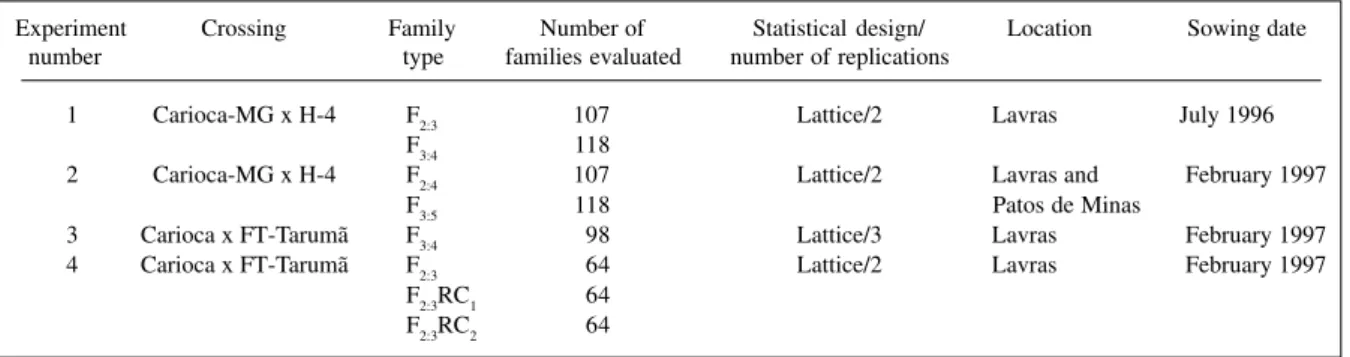
Four experiments on plant architecture were car-ried out using bean families (Table II). Genetic variance in each generation and broad sense heritability of the fami-lies were estimated based on the expected mean squares. The realized heritability from evaluating the same fami-lies in more than one generation and/or location was esti-mated using the procedure presented by Fehr (1987).
RESULTS
Mean and variance component estimates were de-termined for individuals (Table III). The genetic model of averages was sufficient to explain observed variations for most traits, since r2 was higher than 0.50. In the Carioca-MG x H-4 cross, the additive component estimate (a) dif-fered significantly from zero for the traits ramification degree, length from the 4th to 7th internode and degree of erectness. This indicates a predominantly additive effect for these traits. The additive x additive interaction compo-nent for ramification degree, in addition to the additive component was also significantly different from zero. Additive genetic variance estimates were significantly dif-ferent from zero for the traits length from the 4th to 7th internode, 5th internode diameter and plant architecture grade. Heritability estimates were low and had associated errors superior to the estimates.
In the Carioca-MG x FT-Tarumã cross, an addi-tive effect was observed for the traits length from the 4th to 7th internode, 5th internode diameter, plant architec-ture grade and height of insertion of the first pod. The 5th internode diameter, besides the additive effect, presented dominance effects and a dominant x dominant interaction. In this cross, additive variance was present for length from the 4th to 7th internode, 5th internode diameter and height of insertion of the first pod. Dominance variance was also observed for ramification degree and degree of erectness. Also in this case, the length from the 4th to 7th internode was highly heritable, while for the traits 5th internode di-ameter and height of insertion of the first pod, heritability estimates were of small magnitude and associated with elevated errors.
In all experiments involving families, heritability estimates were high, above 29%, and associated with rela-tively small errors (Table IV). Heritability estimates were expressed with higher confidence when the same genera-tion was evaluated at more than one locagenera-tion, especially when compared to the estimates in the individual plant evaluations. There was also variability in the amplitude of degree of erectness obtained in the segregant families (Table IV).
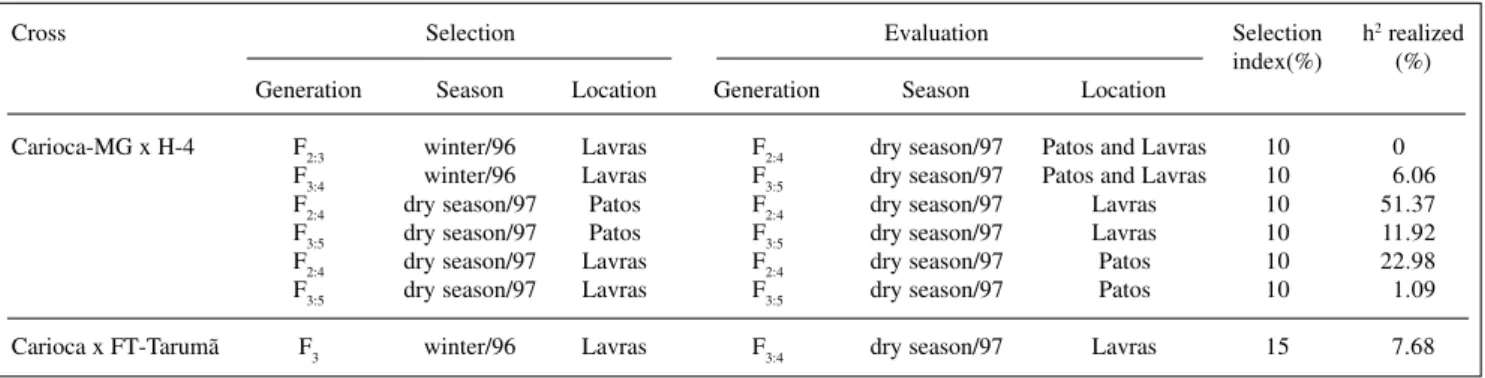
In the Carioca-MG x H-4 cross in Lavras, selec-tion in F2:3 during the winter of 1996 and evaluation in F2:4 during the dry season presented null heritability (Table V). However, in the F3:4 generation under the same conditions, heritability was significantly different from zero, although of small magnitude (6.06%). On the other hand, during the dry season of 1997, when considering selection in F2:4 in Patos de Minas and evaluation in F2:4 in Lavras, the re-alized heritability was high. High values for the rere-alized heritability were also obtained during the dry season of 1997, when selecting in F2:4 in Lavras and evaluating F2:4 in Patos de Minas. When considering the F3:5 generation selected in Patos de Minas and evaluated in Lavras, both during the dry season of 1997, an 11.9% realized herita-bility was obtained. However, when the situation was in-verted, in other words, with selection in Lavras and evalu-ation in Patos de Minas, the realized heritability was only 1.1%. In the Carioca x FT-Tarumã crossing, during the Table I - Bean lines used and their relevant traits.
Lines Traits
Growth habit1 Bean type
Carioca-MG II small and beige with brown stripe Carioca III small and beige with brown stripe H-4 III small and beige with brown stripe FT-Tarumã II small and black
1II: plant with indeterminate habit, upright; III: plant with indeterminate
habit, weak-stemmed, non-climber or semi-climbing.
Table II - Description of the experiments in which bean families were evaluated.
Experiment Crossing Family Number of Statistical design/ Location Sowing date number type families evaluated number of replications
1 Carioca-MG x H-4 F2:3 107 Lattice/2 Lavras July 1996
F3:4 118
2 Carioca-MG x H-4 F2:4 107 Lattice/2 Lavras and February 1997
F3:5 118 Patos de Minas
3 Carioca x FT-Tarumã F3:4 98 Lattice/3 Lavras February 1997
4 Carioca x FT-Tarumã F2:3 64 Lattice/2 Lavras February 1997
F2:3RC1 64
Continued on next page Table III - Estimates of mean and variance components for some traits related to bean plant architecture
obtained from the Carioca-MG x H-4 and Carioca x FT-Tarumã crosses.
Trait Crosses
Carioca-MG x H4 Carioca x FT-Tarumã
Ramification degree Mean components
m =-0.273** (0.028)1 m =--0.346** (0.031)
a = -0.168** (0.021) a =--0.071 (0.041) d = -0.150 (0.059) a x a = -0.085 (0.065) a x a = -0.124* (0.042)
R2 = -0.97 R2 = -0.68
Variance components
σ2 = 00.232 (0.171; 0.331)2 σ2 = 0.193 (0.158; 0.241) σ2 = 00.008 (-0.002; -8.227) σ2 = 0.026 (0.008; 0.355)
R2 = 01.00 R2 = 1.00
Length from the 4th to 7th internode Mean components
m = 10.l550** (0.258) m = 10.449** (0.219) a =01.175** (0.384) a =01.044* (0.360) a x a =01.384 (0.656)
R2 =00.86 R2=00.60
Variance components
σ2= 3.371 (2.726; 5.366) σ2= 5.859 (4.749; 7.412) σ2= 0.089 (0.018; 90.751) σ2= 3.210 (2.553; 4.159) σ2= 1.936 (0.621; 26.912)
h2= 0.0096 (0.1560) h2= 0.4735 (0.3347)
R2= 0.11 R2= 1.00
5th internode diameter Mean components
m =-4.375* (0.056) m =-4.901** (0.017) a = -0.094 (0.080) a = -0.386** (0.013) a x a = -0.001 (0.122) d =-1.574** (0.095) d x d = -1.399** (0.085) R2 = -0.34 R2 =-1.00
Variance components
σ2= 0.536 (0.396; 0.765) σ2= 1.030 (0.846; 1.282) σ2= 0.090 (0.029; 1.251) σ2= 0.096 (0.037; 0.574)
h2= 0.1142 (0.1941) h2= 0.1334 (0.3923)
R2= 0.91 R2= 1.00
Degree of erectness Mean components
m =-3.913* (0.561) m = 3.647** (0.173) a = -0.746 (0.138) a = 1.243** (0.265) d =-6.168 (2.116)
a x a =-1.396 (0.587) d x d = -4.176 (1.636)
R2 =-0.97 R2 = 0.88
Variance components
σ2= 2.651 (1.964; 3.775) σ2= 3.217 (2.631; 4.025) σ2= 0.425 (0.115; 16.797) σ2= 0.079 (0.016; 80.544)
h2= 0.1201 (0.2065)
R2= 0.97 R2= 0.99
E
A D
^
^ ^
-E
^
E
^
E
^
A
^
A
^
D
^
r
^
r
^
E
^
A
^ E
^
A
^
r
^
r
^
E
^
A
^
r
^
E
^
D
Table III continued
Trait Crosses
Carioca-MG x H4 Carioca x FT-Tarumã
Height of insertion of the first pod Mean components
m =-2.685** (0.394) m = -5.881** (0.093) d =-5.787 (2.145) a = -0.880* (0.107) d x d = -3.565 (2.095) d = -0.319 (0.276) R2 =-0.80 R2= -0.94
Variance components
σ2 = 5.606 (4.086; 8.170) σ2= 15.10 (12.820; 19.424) σ2 = 5.539 (4.156; 7.753) σ2= 01.363 (0.489; 11.252)
h2= 00.1176 (0.3818)
R2= 0.91 R2= 01.00
1Standard error of the estimate; 2Low and high limits of the estimate; *Significant at the 5% level; **Significant
at the 1% level.
E
^
E
^
D
^
A
^
r
^
Table IV - Average values of degree of erectness, their amplitudes, genetic variances and heritabilities, estimated for the bean families evaluated in the experiments.
Generation Degree of erectness1 Amplitude σ2 h2
Carioca-MG (P1) 5.0
H-4 (P2) 5.8
Between F3 families of F2(F2:3) plants 5.0 2.2-8.8 0.642 0.3914 ± 0.1030 Between F4 families of F3(F3:4) plants 5.5 2.8-8.2 0.423 0.2981 ± 0.1151
Carioca-MG (P1) 3.2
H-4 (P2) 4.3
Between F4 families of F2(F2:4) plants 3.6 2.2-6.8 0.197 0.6006 ± 0.0769
Between F5 families of F3(F3:5) plants 3.5 2.2-6.2 0.132 0.4407 ± 0.1034
Carioca (P1) 8.5
FT-Tarumã (P2) 3.5
Between F3 families of F2(F2:3) plants 5.8 2.8-8.8 1.136 0.5159 ± 0.0998
Between F3 families of F2RC1(F2:3BC1) plants 6.7 3.2-9.2 0.939 0.4683 ± 0.1095
Between F3 families of F2RC2(F2:3BC2) plants 5.0 2.2-8.2 0.904 0.4588 ± 0.1152
Carioca (P1) 7.4
FT-Tarumã (P2) 4.3
Between F4 families of F3(F3:4) plants 5.7 2.2-7.8 0.333 0.3528 ± 0.1153
1Scale of 1 to 9: value 1 corresponded to the most erect plant and value 9 to the most prostrate.
G a
^ ^
winter of 1996 in Lavras, selection of F3 plants and evalu-ation of F3:4 families presented realized heritability of 7.7%.
DISCUSSION
In order to obtain erect bean plants, some prob-lems need to be solved. First, the trait or traits that are associated with erect plants need to be identified. Adams (1973) listed a series of traits that determine an erect plant. He stated that the cultivar with an ideal plant architecture is the one having strong, thick stems, so that water
was predominant for internode length, indicating the pos-sibility of successful selection. Similar results were ob-tained by Santos and Vencovsky (1986), who used a dial-lel scheme to evaluate segregant populations. However, heritability estimated by those authors was higher (69.0%). Another problem is the visual evaluation of plant architecture and subsequent classification on a scale of grades. This is particularly difficult when evaluation at an individual level is tried. The procedure is more coherent when considering families and using more than one evalu-ator. Marques Junior et al. (1997) used several important bean traits, including plant architecture, in order to deter-mine the efficiency of visual evaluation of traits through a scale of values. This evaluation system had good preci-sion, indicating the efficiency of this procedure, which is frequently adopted by plant breeders. They also commented that when using a grading scale of smaller breadth, that is, 1 to 5 instead of 1 to 9, the values given to the same treat-ment by different evaluators coincide more.
Degree of erectness in individual plants was evalu-ated in previously harvested dry plants which, without any doubt, masked manifestation of the trait. There was little variation and estimated heritabilities were of small mag-nitude. In addition, they were associated with high error estimates. It can be concluded that evaluation of this trait should not be performed at an individual level. When a scale of degree of erectness was used to evaluate segre-gating families, experimental precision was low (variation coefficient on average, 21%).
The main problem in breeding programs for plant architecture is the effect of the environment. With high humidity, temperatures and/or organic material, the plant presents greater vegetative development, even causing lines that were erect under other conditions to become pros-trate. The opposite was observed when these factors were not present, making good discrimination of lines impos-sible. Collicchio (1995) found a deterioration in degree of erectness when plants were sown in October and Novem-ber, when higher temperatures and rain fall are registered. FT-Tarumã parents had the most consistent erect plant architecture possible, that is, they maintained the desired phenotype for the trait under all the conditions
tested. On the other hand, Carioca-MG, chosen not only for its plant architecture but mainly for bean type, proved to be unstable and, in some environments, its degree of erectness did not differ as much as desired from the other parent. Therefore, plant and/or family segregation was smaller, which reduced the amplitude of variation of the trait and the genetic variance estimate. Use of the FT-Tarumã cultivar as a parent in programs aiming to obtain erect plant architecture, in principle, is a good strategy for the reasons already given. It is worth adding that if the ob-jective is to obtain an erect cultivar with grains of the Ca-rioca type, the plant breeder could have serious difficulties since grain color is controlled by many genes, probably an even greater number than that involved in plant architec-ture (Leakey, 1988). Thus, the plant breeder should try to choose a strategy that makes the process more efficient.
Under high heat and humidity conditions, plant development is improved. Non-erect plants become pros-trate and fall over neighboring ones, making even the researcher’s passage between the plots difficult during evaluations. The solution would be to use larger plots with borders. However, when more than 100 families are evalu-ated, as was the case in this experiment, area can be a limi-tation and the use of larger plots with borders becomes impossible. The quantity of seeds necessary for each fam-ily, especially in the first generations, can also limit the use of larger plots.
This can explain the poor agreement observed be-tween heritability estimates based on variance components and realized heritability. The latter, in some cases, was null. It was especially common when realized heritability was estimated from the average performance of the families evaluated in different generations (F2:3 and F2:4). It is evi-dent that heritability is largely influenced by the geno-type x environment interaction. When evaluations were performed in the same generation but at other locations, there was little interaction, and heritability was relatively high. Heritability was greatest when the Patos de Minas evaluation, in which genetic variation was greater, was used as a reference.
These results emphasize that plant architecture is highly influenced by the environment. Thus, breeding pro-Table V - Estimates of realized heritabilities between bean families for the plant architecture value.
Cross Selection Evaluation Selection h2 realized
index(%) (%) Generation Season Location Generation Season Location
Carioca-MG x H-4 F2:3 winter/96 Lavras F2:4 dry season/97 Patos and Lavras 10 0 F3:4 winter/96 Lavras F3:5 dry season/97 Patos and Lavras 10 6.06
F2:4 dry season/97 Patos F2:4 dry season/97 Lavras 10 51.37
F3:5 dry season/97 Patos F3:5 dry season/97 Lavras 10 11.92 F2:4 dry season/97 Lavras F2:4 dry season/97 Patos 10 22.98
F3:5 dry season/97 Lavras F3:5 dry season/97 Patos 10 1.09
grams that use the bulk method with families derived from F2 plants should select families based on the average of three or more evaluations, performed not only during the rainy season harvest, as suggested by Collicchio (1995), but also during other seasons. This author recommended that plants be evaluated in environmental conditions unfa-vorable to plant architecture. Cultivars that remain erect under adverse conditions would also remain erect under conditions that promote plant architecture improvement. Another fact considered important by Collicchio (1995) for plant architecture selection during the rainy season was that an erect plant architecture becomes more important since it is likely that harvest coincides with rainy periods. An erect plant architecture reduces pod contact with the soil, such that harvest losses are smaller.
ACKNOWLEDGMENTS
Research was supported by FAPEMIG, Minas Gerais, Brazil.
RESUMO
O porte mais ereto das plantas tem sido uma das exi-gências nas novas cultivares de feijão de feijoeiro. Visando obter maiores informações sobre o controle genético de caracteres relacionados ao porte das plantas, foi realizado esse trabalho no período de agosto de 1995 a julho de 1997 nas regiões sul e Alto São Francisco em Minas Gerais. Inicialmente procedeu-se às análises de plantas individuais dos genitores e de diferentes gerações segregantes dos cruzamentos Carioca-MG x H-4 e Ca-rioca-MG x FT-Tarumã. Nesses experimentos, além da nota de porte, foram avaliados os caracteres grau de ramificação, com-primento de entre-nós, diâmetro de entre-nós e altura de inserção da primeira vagem. Foram estimados os componentes de média e de variância e a herdabilidade ao nível de indivíduos. Pos-teriormente foram avaliadas famílias derivadas de plantas F2 ou F3 dos mesmos cruzamentos considerando a nota de porte. Foi estimada a variância genética e fenotípica entre médias das famílias, as herdabilidades utilizando os componentes de variância e a herdabilidade realizada. Constatou-se que entre os caracteres morfológicos associados ao porte do feijoeiro o comprimento dos entre-nós foi o que mostrou maior variação, havendo predominância do efeito aditivo no controle do caráter. A avaliação do porte por meio de notas utilizando plantas
indi-viduais revelou ser de baixa eficiência. Contudo, quando se uti-lizaram famílias, apesar da acentuada influência do ambiente na expressão do caráter, as estimativas dos parâmetros genéticos evidenciaram a possibilidade de sucesso com a seleção, espe-cialmente se esta for realizada após a avaliação em algumas gera-ções e/ou ambientes.
REFERENCES
Acquaah, G., Adams, M.W. and Kelly, J.D. (1991). Identification of ef-fective indication of erect plant arquitecture in dry bean ideotype.
Crop Sci. 31: 261-264.
Adams, M.W. (1973). Plant architecture and physiological efficiency in the field bean. In: Potentials of Field Beans and Other Legumes in Latin America. CIAT, Cali, pp. 266-278.
Brothers, M.E. and Kelly, J.D. (1993). Interrelationship of plant architec-ture and yield components in pinto bean ideotype. Crop Sci. 33: 1234-1238.
Collicchio, E. (1995).Associação entre o porte da planta do feijoeiro e o tamanho de grãos. Master’s thesis, Universidade Federal de Lavras, Lavras.
Collicchio, E., Ramalho, M.A.P. and Abreu, A. de F.B. (1997). Associação entre o porte da planta do feijoeiro e o tamanho dos grãos. Pesqui. Agropecu. Bras. 32: 297-304.
Davis, D.W. and Frazier, W.A. (1966). Inheritance of some growth habit components in certain types of bush lines of Phaseolus vulgaris L.
Proc. Am. Soc. Hortic. Sci.88: 384-392.
Fehr, W.R. (1987). Principles of Cultivar Development: Theory and Tech-nique. MacMillan, New York.
Kornegay, J., White, J.W. and Cruz, O.O. de la (1992). Growth habit and gene pool effects on inheritance of yield in common bean. Euphytica 62: 171-180.
Leakey, C.L.A. (1988). Genotypic and phenotypic markers in common bean. In: Genetics Resources of Phaseolus Beans (Gepts, P., ed.). Kluwer Academics Publishers, Wageningen, pp. 245-327.
Marques Junior, O.G., Ramalho, M.A.P., Ferreira, D.F. and Santos, J.B. dos (1997). Viabilidade do emprego de notas na avaliação de alguns caracteres do feijoeiro (Phaseolus vulgaris L.). Rev. Ceres 44: 411-420.
Mather, K. and Jinks, J.L. (1984). Introdução à Genética. Sociedade Brasileira de Genética, Ribeirão Preto.
Ramalho, M.A.P., Santos, J.B. dos and Zimmermann, M.J. de O. (1993).
Genética Quantitativa Aplicada em Plantas Autógamas: Aplicações ao Melhoramento do Feijoeiro. Editora da Universidade Federal de Goiânia, Goiânia.
Santos, J.B. dos and Vencovsky, R. (1986). Controle genético de alguns componentes do porte da planta em feijoeiro. Pesqui. Agropecu. Bras.
21: 957-963.
Singh, S.P. (1991). Bean genetics. In: Common Beans - Research for Crop Improvement (Schoonhoven, A.V. and Voysest, O., eds.). CIAT, Cali, pp. 55-118.