http://www.uem.br/acta ISSN printed: 1679-9275 ISSN on-line: 1807-8621
Doi: 10.4025/actasciagron.v38i4.30652
Acta Scientiarum. Agronomy Maringá, v. 38, n. 4, p. 439-446, Oct.-Dec., 2016
Genetic parameters of iron and zinc concentrations in Andean
common bean seeds
Allan Emanoel Mezzomo Zemolin, Nerinéia Dalfollo Ribeiro*, Cleiton Renato Casagrande,
Maykon Júnior da Silva and Fernanda Daltrozo Arns
Departamento de Fitotecnia, Centro de Ciências Rurais, Universidade Federal de Santa Maria, Avenida Roraima, 1000, 97105-900, Santa Maria, Rio Grande do Sul, Brazil. *Author for correspondence. E-mail: [email protected]
ABSTRACT. Thegenetic parameter estimates of the iron and zinc concentrations in Andean common bean seeds were obtained using the IAC Boreal × Light Red Kidney and Ouro Branco × Light Red Kidney crosses. The parents and the F1, F1 reciprocal, F2, F2 reciprocal, and backcross BC11 and BC12 generations
were evaluated in a field experiment that was carried out in the state of Rio Grande do Sul, Brazil. The iron concentration in Andean common bean seeds ranged from 24.70 to 102.40 mg kg-1 dry matter (DM), the
zinc concentration ranged from 10.73 to 37.50 mg kg-1 DM, and no significant maternal effect was
observed. The narrow-sense heritability ranged from low (h2n= 19.04%) to high (h2n= 63.60%) for the
concentrations of iron and zinc, respectively. Hybrid vigor and transgressive segregation were observed for the iron and zinc concentrations in Andean common bean seeds. In the hybrid combination IAC Boreal × Light Red Kidney, it was possible to select recombinants for the iron and zinc biofortification program. From the tested hybrid combinations, recombinants with low iron and zinc concentrations in seeds could be selected to use when the diet needs to be restricted in those minerals.
Keywords: gain with selection, heritability, heterosis, inheritance pattern, maternal effect, Phaseolus vulgaris.
Parâmetros genéticos da concentração de ferro e de zinco em sementes de feijão Andino
RESUMO. Estimativas de parâmetros genéticos para a concentração de ferro e zinco em sementes de feijão Andino foram obtidas usando os cruzamentos IAC Boreal × Light Red Kidney e Ouro Branco × Light Red Kidney. Os parentais e as gerações F1, F1 recíproco, F2, F2 recíproco e retrocruzamentos RC11 e RC12
foram avaliados em experimento de campo conduzido em Santa Maria, Estado do Rio Grande do Sul, Brasil. A concentração de ferro nas sementes de feijão Andino variou de 24,70 a 102,40 mg kg-1 de matéria
seca – MS e a de zinco, de 10,73 a 37,50 mg kg-1 de MS, sem que expressão de efeito materno tem sido
observada. A herdabilidade em sentido restrito foi de baixa (h2r= 19,04%) a alta (h2r= 63,60%) magnitude
para a concentração de ferro e de zinco, respectivamente. Vigor híbrido e segregação transgressiva foram observados para a concentração de ferro e de zinco em sementes de feijão Andino. Na combinação híbrida IAC Boreal × Ligh Red Kidney é possível selecionar recombinantes para o programa de biofortificação de ferro e zinco. A partir das combinações híbridas testadas podem ser selecionados recombinantes com baixa concentração de ferro e de zinco nas sementes para atender os casos de necessidade de restrição desses minerais na alimentação.
Palavras-chave: ganho com a seleção, herdabilidade, heterose, padrão de herança, efeito materno, Phaseolus vulgaris.
Introduction
Beans are significant protein sources and are used daily in human diets in several countries of East Africa and Latin America, representing 65% of the total protein that is consumed and 32% of the total energy (Blair, González, Kimani, & Butare, 2010a). Beans are also important sources of minerals, especially iron, with concentrations ranging from 8.90 to 161.50 mg kg-1 dry matter
(DM), and zinc, with concentrations ranging from 19.00 to 65.50 mg kg-1 DM (Talukder et al., 2010;
Tryphone & Nchimbi-Msolla, 2010; Silva, Abreu,
Ramalho, & Maia, 2012a), in common bean cultivars. In addition, common bean grains do not require polishing or any other prior mechanical processing and thus can be considered a whole food. Therefore, beans can potentially be used in mineral biofortification programs.
Acta Scientiarum. Agronomy Maringá, v. 38, n. 4, p. 439-446, Oct.-Dec., 2016
cause symptoms such as anemia, decreased work capacity, decreased birth weight, immune system changes, dermatitis, diarrhea and others, as described by Gibson (2012) and Abbaspour, Hurrel, and Kelishadi (2014). Therefore, increased iron and zinc concentrations have received significant attention from common bean breeding programs. However, seeds with low concentrations of these minerals are desired by some patients. Patients with a diagnosis of hereditary hemochromatosis are recommended to avoid iron-rich food (Cançado & Chiattone, 2010) due to their increased intestinal absorption of iron, which can lead to iron overload, increasing their risk of fibrosis, functional failure, sclerosis, diabetes and cardiomyopathies (Cançado & Chiattone, 2010; Pietrangelo, 2010). Excess zinc in the human body alters the HDL levels, the immune function and the iron concentration in the body (Guerrero-Romero & Rodríguez-Morán, 2005). Therefore, the selection of common bean cultivars with low iron and zinc concentrations is important for cases in which the diet requires the restriction of these minerals.
To develop common bean cultivars with iron and zinc concentrations in seeds that meet the specific dietary needs of bean consumers, it is necessary to study the genetic parameters of these minerals. The expression of a maternal effect of iron and zinc concentrations in common bean seeds depends on the evaluated gene pool and the tested hybrid combination (Jost, Ribeiro, Cerutti, Poersch, & Maziero, 2009; Rosa et al., 2010; Silva, Abreu, & Ramalho, 2013; Mukamuhirwa, Tusiime, & Mukankusi, 2015; Possobom, Ribeiro, Domingues, & Casagrande, 2015). Similarly, there is a wide range of variation for narrow-sense heritability and predicted gain with selection estimates for iron and zinc concentrations in Middle American and Andean common bean seeds (Cichy, Forster, Grafton, & Hosfield, 2005; Jost et al., 2009; Rosa et al., 2010; Mukamuhirwa et al., 2015; Possobom et al., 2015).
Genetic parameter estimates refer strictly to the analyzed populations, the environmental conditions and the estimation method (Ramalho et al., 2012). For the seed coat combinations of dark red with cream-colored stripes × light red and white × light red, genetic parameter estimates for the iron and zinc concentrations in Andean common bean seeds were not found in the literature. The selection of low iron and zinc concentrations in common bean seeds, aiming to serve a market niche of individuals presenting health problems due to the high
ingestion of these minerals, is unprecedented. Thus, the objectives of this study were to obtain genetic parameter estimates for the iron and zinc concentrations in Andean common bean seeds and to select recombinants for mineral biofortification programs, as well as for cases in which diets with restricted iron and zinc are required.
Material and methods
Obtaining segregating generations
The generations that were assessed were obtained from controlled crosses between the Andean common bean cultivars IAC Boreal × Light Red Kidney and Ouro Branco × Light Red Kidney. The parents were selected based on the seed coat colour: IAC Boreal is dark red with cream-colored stripes, Light Red Kidney is light red, and Ouro Branco is white; and due to the contrasting iron and zinc concentrations in the seeds (Ribeiro et al., 2014a).
Crossing blocks were installed in a greenhouse at the Plant Science Department of the Santa Maria Federal University (UFSM), Santa Maria, in the State of Rio Grande do Sul, Brazil (29º42´S lat, 53º49´W long, and 95 m asl). The plants were cultivated in 5 L plastic pots that were filled with a mixture of a typical alitic Argisol Hapludalf, Macplant commercial substrate, carbonized rice husk, and ashes at a volumetric ratio of 3:1:1:1. In each pot, there were two bean plants.
During the summer-fall season of 2013, F1 (♀ P1
× ♂ P2) and F1 reciprocal (♀ P2 × ♂ P1) seeds were
obtained for both hybrid combinations using the interlacing method with previous floral bud emasculation. The hybrids and parents were sown in the winter-spring season of 2013 to obtain F2
(natural selfing of F1 plants), F2 reciprocal (natural
selfing of F1 reciprocal plants), and backcross BC11
(♀ F1 × ♂ P1) and BC12 (♀ F1 × ♂ P2) seeds. The
pods were harvested individually at maturity (R9),
and the seeds were oven dried (65 to 70 ºC) to 13% average humidity.
Generations evaluated
The seeds from the F1, F1 reciprocal, F2, F2
reciprocal, BC11 and BC12 generations that were
obtained for each hybrid combination and from the parents (IAC Boreal, Light Red Kidney and Ouro Branco) were evaluated in an experiment that was performed in a field at the Plant Science Department of UFSM. The soil was classified as typical alitic Argisol, Hapludalf and presented the following chemical composition: pH (H2O): 6.50;
Acta Scientiarum. Agronomy Maringá, v. 38, n. 4, p. 439-446, Oct.-Dec., 2016
dm-3; K: 116.00 mg dm-3; Ca+2: 8.70 cmolc dm-3;
Mg+2: 4.50 cmolc dm-3; H++Al3+: 1.70 cmolc dm-3;
Fe: 2267.40 mg dm-3; Zn: 0.50 mg dm-3; and Cu:
0.90 mg dm-3. The soil was prepared conventionally
and fertilized according to the interpretation of soil analysis results. The fertilizers applied were 275 kg ha-1 of the 5-20-20 formula (urea: 45% nitrogen;
superphosphate: 18% P2O5; and potassium chloride:
60% K2O) at furrow sowing and 67 kg ha-1 urea
(45% N) at the growth stage of the first trifoliate leaf (V3). Micronutrients were not added to the soil or to the leaves.
The experiment was carried out in two blocks in 1.00-m-long rows that were spaced 0.5 m apart. Sowing was conducted on 17 February 2014, and the number of rows varied with seed availability. In block 1, the generations that were obtained from the cross IAC Boreal × Light Red Kidney were evaluated in different numbers of rows: seven rows for F1 and F1 reciprocal, four rows for BC11 and
BC12, 14 rows for F2 and F2 reciprocal, and seven
rows for each parent (IAC Boreal, Light Red Kidney and Ouro Branco). In block 2, the generations that were obtained from the cross Ouro Branco × Light Red Kidney were evaluated, with seven rows for F1
and F1 reciprocal, five rows for BC11 and BC12, 15
rows for F2 and F2 reciprocal, and seven rows for
each parent. The sowing density was 15 seeds m-1
for the parents; 10 seeds m-1 for F
1, F1 reciprocal and
backcross; and 8 seeds m-1 for F
2 and F2 reciprocal.
Weed control was carried out by hoeing, and insects were eliminated by applying EngeoTM Pleno
(Thiamethoxam + Lambda-cyhalothrin) insecticide at a dose of 125 mL ha-1. Disease control was not
carried out. The plants were harvested individually and manually at maturity (R9). The pods were removed manually to avoid contaminating the seeds with metals.
The seeds of each plant were oven dried at 65 to 70ºC until reaching 13% average humidity. A random sample of 5 g of seeds was ground in an electrical grinder to produce particles smaller than 1 mm and was not sieved. Part of the raw bean flour that was obtained (0.5 g) was used for the nitric-perchloric digestion process, as described by Ribeiro, Jost, Maziero, Storck, and Rosa (2014b). The iron and zinc concentrations in the seeds were measured in a flame atomic absorption spectrophotometer at wavelengths of 248.30 and 213.90 nm, respectively.
Genetic parameter estimates
The bilateral t test was used to compare the means between the P1 × P2, P1 × F1, P2 × F1
reciprocal, F1 × F1 reciprocal and F2 × F2 reciprocal
contrasts to investigate the maternal effects on the iron and zinc concentrations in common bean seeds for each hybrid combination. The data of the iron and zinc concentrations in F2 plants were submitted
to Shapiro-Wilk testing at the 5% significance level to verify the normality. The number of classes used in the frequency distribution was calculated using the expression √ , where n is the number of observations.
The genetic parameters were estimated from the variances of the parents (P1 and P2) and the F1, F2,
BC11 and BC12 generations. Heritability was
estimated in a broad sense (ℎ = σσ ) and a narrow
sense (ℎ = σσ ) according to the backcross method, in which genotypic variance: σ2
g = σ2P - σ2E;
phenotypic variance: σ2
P = σ2F2; additive variance: σ2
A = 2σ2F2 – (σ2BC11 + σ2BC12); and environmental
variance in F2: σ2E = (0.5 σ2F1 + 0.25 σ2P1 + 0.25 σ2
P2). Heterosis in the F1 generation was quantified
by traditional heterosis ( % = 100) and heterobeltiosis ( % = 100), where =
, and is the better parent.
The prediction of gains with selection was carried out considering a selection of 10% of the F2
plants with higher iron and zinc concentrations in their seeds for each hybrid combination. The expected gain with selection was estimated using the expression ∆ = ℎ and ∆ % = ∆ , where = selection differential, as calculated by the difference between the selected F2 plant means
and the general mean of the F2 plants. Statistical
analyses were carried out using the Office Excel and Action spreadsheet and GENES program (Cruz, 2013).
Results and discussion
Genetic variability and maternal effect
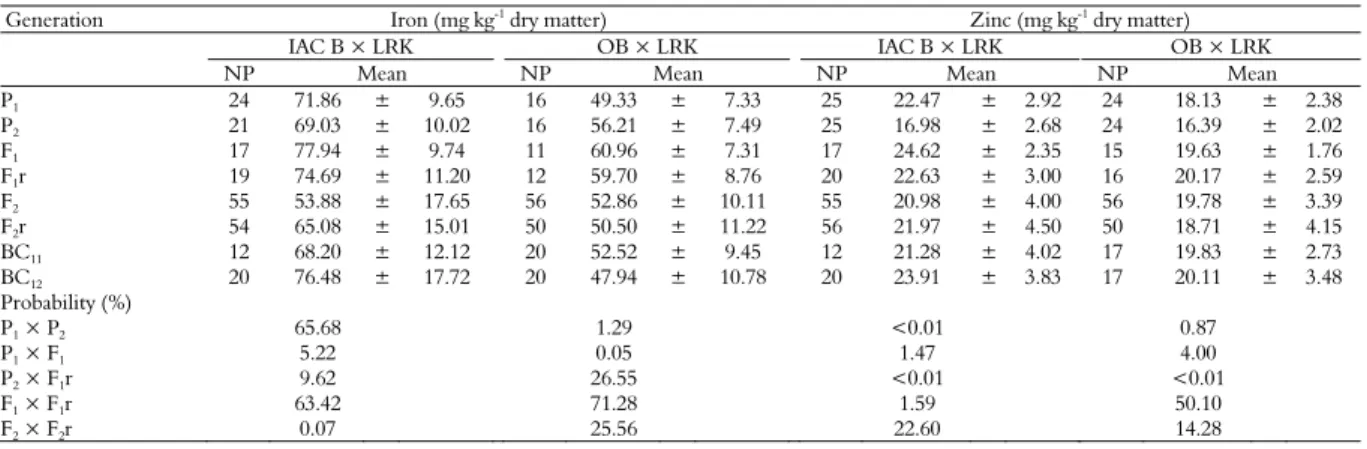
In the hybrid combinations of IAC Boreal × Light Red Kidney and Ouro Branco × Light Red Kidney, only contrast between the parents for the zinc concentrations in their seeds was significant (Table 1). For the iron concentration in seeds, the P1 × P2
Acta Scientiarum. Agronomy Maringá, v. 38, n. 4, p. 439-446, Oct.-Dec., 2016
concentrations of common bean seeds (Moraghan, Padilha, Etchevers, Grafton, & Acosta-Gallegos, 2002; Silva, Abreu, Ramalho, & Corrêa, 2012b; Petry, Boy, Wirth, & Hurrell, 2015; Possobom et al., 2015).
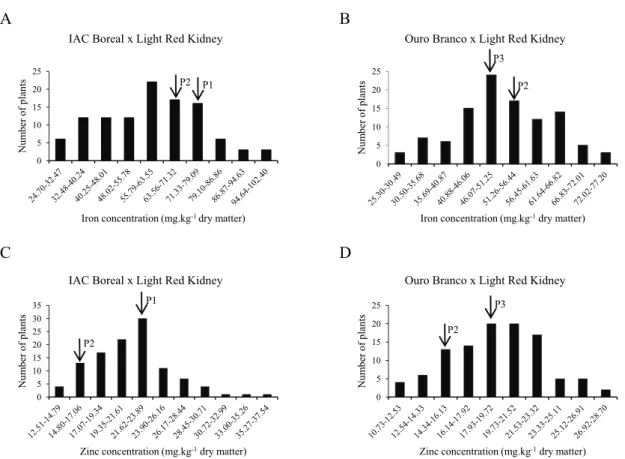
Because the parents that were used in the controlled crosses were contrasting regarding the zinc concentration in their seeds, it was possible to obtain recombinants with genetic variability, with zinc concentrations ranging from 10.73 to 37.50 mg kg-1
DM (Figure 1C and D). However, for iron, the range observed in the F2 generation was greater, from 24.70
to 102.40 mg kg-1 DM (Figure 1A and B). Therefore,
even when using convergent crosses for the iron concentration, a wide segregation was observed for this mineral in the F2 generation, comparable to that
observed previously by Jost et al. (2009) in segregants obtained from crosses between the common bean cultivars Diamante Negro and IAPAR 44, which did not present significant differences in the iron concentrations in the seeds. From the hybrid combinations that were tested in the present study, the genetic variability for the iron and zinc concentrations in Andean common bean seeds was obtained, enabling the selection of recombinants in early generations.
The F1 × F1 reciprocal contrast was not
significant for the iron and zinc concentrations in Andean common bean seeds in the crosses between IAC Boreal × Light Red Kidney and Ouro Branco × Light Red Kidney (Table 1). This result indicates the absence of a maternal effect and that the seeds of the F1 generation represent fertilization between the
parents in both hybrid combinations. Our results agree with those of Possobom et al. (2015) and Rosa et al. (2010), who reported non-significant maternal effects for iron and zinc concentrations, respectively, in hybrid seeds of common bean.
The expression of maternal effect for the iron and zinc concentrations in common bean seeds seems to be related to the distribution of these minerals in the fractions of the seed. Iron and zinc
are minerals that, depending on the cultivar, can be concentrated in higher quantities in the seed coat or embryo in common bean seeds and can even occur in similar proportions in the seed fractions (Moraghan et al., 2002; Ribeiro et al., 2012; Possobom et al., 2015). Possobom et al. (2015) observed that the parents CNFP 10104 and CHC 01-175 accumulated from 54.61 to 67.92% of the total iron in the seed coat of common bean seeds and observed a significant maternal effect of this mineral in the hybrids. In the other evaluated hybrid combination (Cal 96 × Hooter), the authors did not find any maternal effect expression, which was verified by the greater accumulation of iron, from 69.40 to 73.44%, in the seed embryo. Therefore, the selection of superior common bean recombinants for iron concentration should begin in seeds of the F3 generation if iron accumulates more in the seed
coat or in seeds of the F2 generation if iron is more
concentrated in the seed embryo (Jost et al., 2009; Possobom et al., 2015).
The locations of iron and zinc in the different fractions of common bean seeds will directly affect the bioavailability of these minerals because common bean seed embryos contain significant amounts of phytates, which inhibit iron and zinc absorption by the human body (Ariza-Nieto, Blair, Welch, & Glahn, 2007). Thus, as the results of this study suggest, if the accumulation of iron and zinc is higher in the embryos of common bean seeds, it is expected that these minerals will be less bioavailable. However, Ramírez-Cárdenas, Leonel, Costa, and Reis (2010) observed that the grains of cooked beans from the Ouro Branco cultivar presented high zinc and phytate concentrations and a greater zinc bioavailability among other evaluated cultivars. Therefore, it is possible to select common bean cultivars with high micromineral and phytate concentrations without compromising the bioavailability of these minerals.
Table 1. Number of plants (NP); mean values of the iron and zinc concentrations in common bean seeds; respective standard deviation obtained in parents (P1 and P2) and in the F1, F1 reciprocal (F1r), F2, F2 reciprocal (F2r) and backcross (BC11 and BC12) generations in the crosses IAC Boreal
(IAC B, P1) × Light Red Kidney (LRK, P2) and Ouro Branco (OB, P1) × Light Red Kidney (LRK, P2); and the probability as determined by the t
test (p value) for the contrasts P1 × P2; P1 × F1; P2 × F1 reciprocal; F1 × F1 reciprocal; and F2 × F2 reciprocal.
Generation Iron (mg kg-1
dry matter) Zinc (mg kg-1
dry matter)
IAC B × LRK OB × LRK IAC B × LRK OB × LRK
NP Mean NP Mean NP Mean NP Mean
P1 24 71.86 ± 9.65 16 49.33 ± 7.33 25 22.47 ± 2.92 24 18.13 ± 2.38
P2 21 69.03 ± 10.02 16 56.21 ± 7.49 25 16.98 ± 2.68 24 16.39 ± 2.02
F1 17 77.94 ± 9.74 11 60.96 ± 7.31 17 24.62 ± 2.35 15 19.63 ± 1.76
F1r 19 74.69 ± 11.20 12 59.70 ± 8.76 20 22.63 ± 3.00 16 20.17 ± 2.59
F2 55 53.88 ± 17.65 56 52.86 ± 10.11 55 20.98 ± 4.00 56 19.78 ± 3.39
F2r 54 65.08 ± 15.01 50 50.50 ± 11.22 56 21.97 ± 4.50 50 18.71 ± 4.15
BC11 12 68.20 ± 12.12 20 52.52 ± 9.45 12 21.28 ± 4.02 17 19.83 ± 2.73
BC12 20 76.48 ± 17.72 20 47.94 ± 10.78 20 23.91 ± 3.83 17 20.11 ± 3.48
Probability (%)
P1 × P2 65.68 1.29 <0.01 0.87
P1 × F1 5.22 0.05 1.47 4.00
P2 × F1r 9.62 26.55 <0.01 <0.01
F1 × F1r 63.42 71.28 1.59 50.10
Acta Scientiarum. Agronomy Maringá, v. 38, n. 4, p. 439-446, Oct.-Dec., 2016
A B
C D
Figure 1. Frequency distribution of the F2 plants that were obtained from the cross IAC Boreal × Light Red Kidney for iron (A) and zinc
(C) concentrations and cross Ouro Branco × Light Red Kidney for iron (B) and zinc (D) concentrations in common bean seeds during the dry season of 2014.
** The arrows indicate the mean values that were obtained from the parents: P1 = IAC Boreal, P2 = Light Red Kidney, and P3 = Ouro Branco.
Inheritance pattern, heritability and heterosis
The iron and zinc concentrations in Andean common bean seeds of the F2 generation presented a
continuous, nearly normal distribution, indicating quantitative inheritance (Figure 1A, B, C and D). A continuous distribution of the iron and zinc concentrations in common bean seeds was previously described in early (Possobom et al., 2015) and advanced (Blair, Astudilo, Grusak, Graham, & Beebe, 2009; Cichy, Caldas, Snapp, & Blair, 2009; Blair et al., 2010b; Ribeiro et al., 2014b; Teixeira, Lima, Abreu, & Ramalho, 2015) generations in recombinants that were obtained from the crosses Andean × Andean, Andean × Middle American and Middle American × Middle American. These results affirm that the iron and zinc concentrations in common bean present quantitative inheritance in populations of low and high homozygosity, regardless of the gene pool, and that they oppose the initial hypothesis of Cichy et al. (2005) regarding the monogenic control of the zinc concentration in common bean seeds.
The iron concentration in Andean common bean seeds presented broad-sense heritability estimates of intermediate (h2b= 52.36%; Ouro Branco × Light
Red Kidney) to high (h2b= 67.83%; IAC Boreal ×
Light Red Kidney) magnitude (Table 2), indicating that the genotypic variance was greater than the phenotype variance. These values are comparable to the broad-sense
heritability estimates of iron concentrations in Andean common bean seeds (Possobom et al., 2015) and Middle American common bean seeds (Jost et al., 2009; Teixeira et al., 2015). The narrow-sense heritability estimates varied from 19.04 to 45.29% in the crosses of Ouro Branco × Light Red Kidney and IAC Boreal × Light Red Kidney, respectively, suggesting difficulties in the fixation of this character with the advance of generations. Narrow-sense heritability estimates of similar magnitude were observed previously by Ribeiro et al. (2014b) and Possobom et al. (2015) for the iron concentrations in common bean seeds; however, these estimates were inferior to those obtained by Jost et al. (2009). This result is supported by the fact that heritability estimates refer strictly to the populations assessed, the environmental conditions and the estimation method and are not constant or fixed values (Ramalho et al., 2012).
P2 P1
0 5 10 15 20 25
N
u
m
b
er of
plants
Iron concentration (mg.kg-1 dry matter)
IAC Boreal x Light Red Kidney
P3
P2
0 5 10 15 20 25
N
u
m
b
er of
plants
Iron concentration (mg.kg-1dry matter)
Ouro Branco x Light Red Kidney
P2
P1
0 5 10 15 20 25 30 35
N
u
m
b
er of
plants
Zinc concentration (mg.kg-1dry matter)
IAC Boreal x Light Red Kidney
P2 P3
0 5 10 15 20 25
N
u
m
b
er of
plants
Zinc concentration (mg.kg-1dry matter)
Acta Scientiarum. Agronomy Maringá, v. 38, n. 4, p. 439-446, Oct.-Dec., 2016 Table 2. Genetic parameter estimates and prediction of gains with selection for the iron and zinc concentrations in common bean seeds that were obtained from the crosses IAC Boreal (IACB) × Light Red Kidney (LRK) and Ouro Branco (OB) × Light Red Kidney (LRK) during the dry season of 2014.
Genetic parameters Iron (mg kg
-1 DM) Zinc (mg kg-1 DM)
IACB × LRK OB × LRK IACB × LRK OB × LRK
P1 variance 93.08 53.75 8.54 5.67
P2 variance 100.39 56.10 7.20 4.08
F1 variance 94.95 53.41 5.50 3.09
Phenotypic variance (σ2
P) 297.92 113.69 18.25 14.35
Environment variance (σ2
E) 95.85 54.16 6.68 3.99
Genotypic variance (σ2
G) 202.07 59.52 11.56 10.36
Additive variance (σ2
A) 134.93 21.64 5.66 9.12
Broad-sense heritability (h2
b) 67.83 52.36 63.36 72.22
Narrow-sense heritability (h2
n) 45.29 19.04 31.04 63.60
Traditional heterosis (H%) 10.63 15.54 24.84 13.75
Heterobeltiosis (HT%) 8.46 8.46 9.59 8.28
Minimum value in parents 52.20 36.80 12.10 12.99
Maximum value in parents 94.90 65.70 27.30 22.68
Minimum value in F2 24.70 25.30 12.50 10.73
Maximum value in F2 102.40 77.20 37.50 28.71
Original mean in F2 59.43 51.75 21.48 19.27
Selection for high values
Mean of selected plants 91.49 69.90 30.09 26.16
Selection differential (DS) 32.06 18.15 8.61 6.88
Gain with selection (∆G) 14.52 3.45 2.67 4.38
Gain with selection (∆G%) 24.43 6.68 12.44 22.72
Predicted mean after the first selection cycle 73.95 55.20 24.15 23.65 Selection for low values
Mean of selected plants 30.72 32.21 15.11 12.54
Selection differential (DS) -28.71 -19.54 -6.37 -6.73
Gain with selection (∆G) -13.00 -3.72 -1.98 -4.28
Gain with selection (∆G%) -21.88 -7.19 -9.21 -22.22
Predicted mean after the first selection cycle 46.43 48.03 19.50 14.99
The broad-sense heritability of the zinc concentrations of Andean common bean seeds had a high magnitude (h2b= 63.36 to 72.22%), and the
narrow-sense heritability had an intermediate (h2n=
31.04%; IAC Boreal × Light Red Kidney) to high (h2n= 63.60%; Ouro Branco × Light Red Kidney)
magnitude. The variation range that was obtained for the broad-sense and narrow-sense heritability estimates of zinc concentrations was similar to that found for Middle American common bean seeds by Rosa et al. (2010) and was inferior to the estimates reported by Cichy et al. (2005). In this study, a high narrow-sense heritability was observed for the zinc concentration in the cross Ouro Branco × Light Red Kidney, indicating the predominance of additive variance. In this case, the fixation of favorable alleles can be verified in the next generation (Borém & Miranda, 2007), favoring the selection of the recombinants obtained from this hybrid combination.
The values of traditional heterosis and heterobeltiosis varied from 8.28 to 24.84%, indicating that it was possible to obtain common bean hybrids with iron and zinc concentrations in seeds superior to the average and maximum iron and zinc concentrations of the parent seeds (Table 2). The existence of hybrid vigor was previously described for the iron and zinc concentrations in common bean seeds (Jost et al., 2009; Rosa et al.,
2010; Silva et al., 2013). The development of common bean hybrid cultivars is not usual due to the low efficiency that is obtained in controlled crosses, the non-existence of a male sterility mechanism and the low use of seeds for cropping. Therefore, segregating generations will lead to homozygosis, and it is expected that heterosis will be reduced by half in each self-fertilized generation.
Selection for high iron and zinc concentrations in seeds
In the tested hybrid combinations, transgressive segregation was observed for the iron and zinc concentrations in the seeds (Figure 1, Table 2). Recombinants with higher and lower iron and zinc concentrations in seeds than in the parents were obtained from both hybrid combinations, similar to the results reported for other bi-parental crosses that have been carried out in common bean (Jost et al., 2009; Rosa et al., 2010; Silva et al., 2013; Ribeiro et al., 2014b; Mukamuhirwa et al., 2015; Possobom et al., 2015).
In the cross IAC Boreal × Light Red Kidney, three F2 plants were obtained with an iron
concentration in seeds greater than 95 mg kg-1 DM
Acta Scientiarum. Agronomy Maringá, v. 38, n. 4, p. 439-446, Oct.-Dec., 2016
estimates (h2b= 67.83%) and predicted gain with
selection (∆G%= 24.43%) and due to the intermediate narrow-sense heritability (h2n=
45.29%). The development of common bean cultivars that are biofortified for iron meets the demand for foods that can be used to fight against anemia. Iron deficiency also affects cognitive development, immunity and work capacity (Abbaspour et al., 2014).
We obtained three recombinants with a zinc concentrations in seeds greater than 31 mg kg-1 DM,
which is considered high according to the stratification presented by Cichy et al. (2005) and Tryphone and Nchimbi-Msolla (2010), in the cross IAC Boreal × Light Red Kidney. The selection and advance of these populations will result in the development of common bean cultivars that are biofortified for zinc, which can contribute to immune system improvement, dermatitis treatment, bone maturation and taste sensitivity, which are all affected by zinc deficiency in the body (Gibson, 2012).
Selection for low iron and zinc concentrations in seeds
Recombinants with an iron concentration lower than 42 mg kg-1 DM were obtained in both hybrid
combinations (Table 2). This value characterizes low iron for common bean lines according to the classification presented by Tryphone and Nchimbi-Msolla (2010). However, the selection of recombinants with a low iron concentration in seeds is more promising in the cross IAC Boreal × Light Red Kidney due to the lowest value of predicted gain with selection (∆G%= -21.88%).
The selection of common bean lines with a low iron concentration in seeds is important for the diet of patients with hereditary hemochromatosis. These patients have an increased intestinal absorption of iron, which can lead to iron overload, causing cellular and tissue injury, fibrosis, functional failure, sclerosis, diabetes and cardiomyopathies (Cançado & Chiattone, 2010; Pietrangelo, 2010). Therefore, these patients are recommended to avoid eating iron-rich food (Cançado & Chiattone, 2010).
In the cross Ouro Branco × Light Red Kidney, 104 F2 plants were obtained with a zinc
concentration in seeds of less than 26 mg kg-1 DM
(Figure 1D), which is considered low for common bean inbred lines (Tryphone and Nchimbi-Msolla, 2010). In this cross, we also observed a higher predicted gain with selection for a low zinc concentration (∆G%= -22.22%). The development of common bean cultivars with a low zinc concentration serves a market niche for individuals
seeking to normalize their levels of HDL in the blood or for individuals with altered immune function and iron concentration due to zinc toxicity (Guerrero-Romero & Rodriguez-Morán, 2005).
Conclusion
In Andean common bean seeds in the F2
generation, the iron concentration ranges from 24.70 to 102.40 mg kg-1 dry matter (DM), the zinc
concentration ranges from 10.73 to 37.50 mg kg-1
DM, and no maternal effect was observed.
Narrow-sense heritability estimates is from low (h2n= 19.04%) to high (h2n= 63.60%) magnitude
for the iron and zinc concentrations.
There is a hybrid vigor for the iron and zinc concentrations in seeds of Andean common bean and transgressive segregation was observed.
Recombinants with low and high iron and zinc concentrations in seeds can be selected from the hybrid combinations assessed.
Acknowledgements
The authors would like to thank the National Council of Technological and Scientific Development (CNPq) for the financial aid and scholarships granted. To the Coordination for the Improvement of Higher Education Personnel (Capes) for the scholarship granted.
References
Abbaspour, N., Hurrell R., & Kelishadi R. (2014). Review on iron and its importance for human health. Journal of
Research in Medical Sciences, 19(2), 164-174.
Ariza-Nieto, M., Blair, M. W., Welch, R. M., & Glahn, P. (2007). Screening of iron biovailability patterns in eight bean (Phaseolus vulgaris L.) genotypes using the caco-2 cell in vitro model. Journal of Agricultural and
Food Chemistry, 55(19), 7950-7956. doi: 10.
1021/jf070023y
Blair, M. W., Astudilo, C., Grusak, M. A., Graham, R., & Beebe, S. E. (2009). Inheritance of seed iron and zinc concentrations in common bean (Phaseolus vulgaris L.).
Molecular Breeding, 23(2), 197-207. doi: 10.1007/
s11032-008-9225-z
Blair, M. W., González, L. F., Kimani, P. M., & Butare, L. (2010a). Genetic diversity, inter-gene pool introgression and nutritional quality of common beans
(Phaseolus vulgaris L.) from Central Africa. Theoretical
and Applied Genetics, 121(2), 237-248. doi: 10.1007/
s00122-010-1305-x
Blair, M. W., Medina, J. I., Astudilo, C., Rengifo, J., Beebe, S. E., Machado, G., & Graham, R. (2010b). QTL for seed iron and zinc concentration and content in a Mesoamerican common bean (Phaseolus vulgaris
Acta Scientiarum. Agronomy Maringá, v. 38, n. 4, p. 439-446, Oct.-Dec., 2016
Borém, A., & Miranda, G. V. (2007). Melhoramento de
plantas (4a ed.). Viçosa, MG: UFV.
Cançado, R. D., & Chiattone, C. S. (2010). Visão atual da hemocromatose hereditária. Revista Brasileira de
Hematologia e Hemoterapia, 32(6), 469-475. doi: 10.1590
/S1516-84842010000600011
Cichy, K. A., Forster, S., Grafton, K. F., & Hosfield, G. L. (2005). Inheritance of seed zinc accumulation in navy
bean. Crop Science, 45(1), 864-870. doi:
10.2135/cropsci2004.0104
Cichy, K. A., Caldas, G. V., Snapp, S. S., & Blair, M. W. (2009). QTL analysis of seed iron, zinc, and phosphorus levels in an Andean bean population. Crop Science, 49(5), 1742-1750. doi: 10.2135/cropsci2008. 10.0605
Cruz, C. D. (2013). Genes - a software package for analysis in experimental statistics and quantitative genetics. Acta Scientiarum Agronomy, 35(3), 271-276. doi: 10.4025/actasciagron.v35i3.21251
Gibson, R. (2012). Zinc deficiency and human health: etiology, health consequences, and future solutions. Plant
and Soil, 361(1), 291-299. doi: 10.1007/s11104-012-1209-4
Guerrero-Romero, F., & Rodríguez-Morán, M., (2005). Complementary therapies for diabets: the case for chromium, magnesium, and antioxidants. Archives of
Medical Research, 36(3), 250-257. doi: 10.1016/j.arcmed.
2005.01.004
Jost, E., Ribeiro, N. D., Cerutti, T., Poersch, N. L., & Maziero, S. M. (2009). Potencial de aumento do teor de ferro em grãos de feijão por melhoramento genético.
Bragantia, 68(1), 35-42. doi: 10.1590/50006-8705
Moraghan, J. T., Padilla, J., Etchevers, J. D., Grafton, K., & Acosta-Gallegos, J. A. (2002). Iron accumulation in seed of common bean. Plant and Soil, 246(2), 175-183. doi: 10.1023/A:1020616026728
Mukamuhirwa, F., Tusiime, G., & Mukankusi, M. C. (2015). Inheritance of high iron and zinc concentration in selected bean varieties. Euphytica,
205(2), 369-380. doi: 10. 1007/s10681-015-1385-4 Petry, N., Boy, E., Wirth, J. P., & Hurrell, R. F. (2015).
The potential of the common bean (Phaseolus vulgaris) as a vehicle for iron biofortification. Nutrients, 7(2), 1144-1173. doi: 10.3390/nu7021144
Pietrangelo, A. (2010). Hereditary hemochromatosis: pathogenesis, diagnosis and treatment. Gastroenterology,
139(2), 393-408. doi: 10.1053/j.gastro.2010.06.013 Possobom, M. T. D. F., Ribeiro, N. D., Domingues, L. da S.,
& Casagrande, C. R. (2015). Genetic control of iron concentration in Mesoamerican and Andean common bean seeds. Pesquisa Agropecuária Brasileira, 50(5), 383-391. doi: 10.1590/S0100-204X201500050 0005
Ramalho, M. A. P., dos Santos, J. B., Pinto, C. A. B. P., Souza E. A., Gonçalves, F. M. A., & Souza, J. C. (2012). Genética
na agropecuária (5a ed.). Lavras, MG: UFLA.
Ramírez-Cárdenas, L., Leonel, A. J., Costa, N. M. B., & Reis, F. P. (2010). Zinc biovailability in different beans as affected by cultivar type and cooking conditions.
Food Research International, 43(2), 573-581. doi: 10.
1016/j.foodres.2009.07.023
Ribeiro, N. D., Maziero, S. M., Prigol, M., Nogueira, C. W., Rosa, D. P., & Possobom, M. T. D. F. (2012). Mineral concentrations in the embryo and seed coat of common bean cultivars. Journal of Food Composition and
Analysis, 26(1-2), 89-95. doi: 10.1016/j.jfca.2012.03.003
Ribeiro, N. D., Domingues, L. da S., Zemolin, A. E. M., & Possobom, M. T. D. F. (2013). Selection of common bean lines with high agronomic performance and high calcium and iron concentrations. Pesquisa
Agropecuária Brasileira, 48(10), 1368-1375. doi: 10.1590/
S0100-204X2013001000008
Ribeiro, N. D., Rodrigues, J. A., Prigol, M., Nogueira, C. W., Storck, L., & Gruhn, E. M. (2014a). Evaluation of special grains bean lines for grain yield, cooking time and mineral concentrations. Crop Breeding and Applied Biotechnology,
14(1), 15-22. doi: 10.1590/S1984-70332014000100003 Ribeiro, N. D., Jost, E., Maziero, S. M., Storck, L., &
Rosa, D. P. (2014b). Selection of common bean lines with high grain yield and high calcium and iron concentrations. Revista Ceres, 61(1), 77-83. doi: 10.15 90/S0034-737X2014000100010
Rosa, S. S., Ribeiro, N. D., Jost, E., Reiniger, L. R. S., Rosa, D. P., Cerutti, T., & Possobom, M. T. D. F. (2010). Potential for increasing the zinc content in common bean using genetic improvement. Euphytica,
175(2), 207-213. doi: 10.1007/s10681-010-0163-6 Silva, C. A., Abreu, A. F. B., Ramalho, M. A. P., & Maia, L. G.
S. (2012a). Chemical composition as related to seed color of common bean. Crop Breeding and Applied Biotechnology,
12(2), 132-137. doi: 10.1590/S1984-70332012000200006 Silva, C. A., Abreu, A. F. B., Ramalho, M. A. P., & Corrêa,
A. D. (2012b). Interaction genotype by season and its influence on the identification of beans with high content of zinc and iron. Bragantia, 71(3), 336-341. doi: 10.1590 /S0006-87052012005000037
Silva, C. A., Abreu, A. F. B., & Ramalho, M. A. P. (2013). Genetic control of zinc and iron concentration in common bean seeds. African Journal of Agricultural
Research, 8(11), 1001-1008. doi: 10.5897/AJAR12.2172
Teixeira, R. K. S., Lima, D. C., Abreu, A. F. B., & Ramalho, M. A. P. (2015). Implications of early selection for grain colour on iron and zinc content and productivity of common bean. Plant Breeding, 134(2), 193-196. doi: 10. 1111/pbr.12241
Talukder, Z. I., Anderson, E., Miklas, P. N., Blair, M. W., Osorno, J., Dilawari, M., & Hossain, K. G. (2010). Genetic diversity and selection of genotypes to enhance Zn and Fe content in common bean. Canadian Journal of Plant Science,
90(1), 49-60. doi: 10. 4141/CJPS09096
Tryphone, G. M., & Nchimbi-Msolla, S. (2010). Diversity of common bean (Phaseolus vulgaris L.) genotypes in iron and zinc contents under screenhouse conditions.
Journal of Agricultural Research, 5(8), 738-747. doi: 10.
5897/AJAR10.304
Received on January 20, 2016. Accepted on April 18, 2016.