R
EPTILESPECIESCOMPOSITIONINTHEM
IDDLEG
URGUÉIAANDCOMPARISONWITH INVENTORIESINTHEEASTERNP
ARNAÍBAR
IVERB
ASIN, S
TATEOFP
IAUÍ, B
RAZILC
LÁUDIAR
ENATAM
ADELLA-A
URICCHIO¹
P
AULOA
URICCHIO²
E
NIOS
ARAIVAS
OARES³
ABSTRACT
The reptile diversity of the Middle Gurguéia River Basin in southern Piauí, Brazil, is little known. The rapid expansion of agriculture in the region is converting the Cerrado and Caat-inga into large farming areas, which threatens biodiversity and hastens its loss. In this study, 68 specimens of reptiles from a university collection were examined, comprising 29 species: ten liz-ards, one amphisbaenian, 15 snakes, two turtles and one crocodilian. They were collected from five locations in the Middle Gurguéia Basin, a region not previously evaluated for reptiles. The most abundant species is a member of Tropidurus. Comparison with eight other areas in the eastern Parnaíba Basin indicated that the diversity of reptiles in the Middle Gurguéia is similar to that in other Caatinga-Cerrado ecotone areas. The reptile assemblage in the eastern Parnaíba Basin comprises 100 species of reptiles: 39 lizards, five amphisbaenians, 50 snakes, four chelonians and two crocodilians. This study expanded the known distributions of some reptiles and recorded the first occurrence of Helicops leopardinus (Schlegel, 1837) for Piauí. A cluster analysis showed that the reptile composition concords with the habitat where species were found, i.e. Cerrado, Caatinga or ecotone. Studies that associate habitat structure with each species are essential to propose efficient strategies for reptile management and conservation for the entire Parnaíba River Basin, mostly in areas that are not yet protected.
Key-Words: Reptilia; Helicops; Ecotone; Cerrado; Caatinga.
INTRODUCTION
Although knowledge of the biodiversity of the Cerrado, Caatinga and ecotone areas has increased, the fauna of these vegetation complexes is still little
known and many areas have never been inventoried (Rodrigues, 2005a). Reptilia is a well-understood group, but in the five largest Brazilian collections, reptiles from many key areas and ecosystems are not represented (Rodrigues, 2005b). Except for the
well-www.mz.usp.br/publicacoes www.revistas.usp.br/paz
ISSN impresso: 0031-1049 ISSNon-line:1807-0205
Museu de Zoologia da Universidade de São Paulo
http://dx.doi.org/10.11606/0031-1049.2017.57.28
1. Universidade Federal do Ceará (UFC), Centro de Ciências, Departamento de Biologia, Programa de Pós-Graduação em Ecologia e Recursos Naturais. Rua Campus do Pici, Bloco 906, Pici, CEP 60440-554, Fortaleza, CE, Brasil. ORCID: 0000-0003-3015-496X. E-mail: [email protected]
2. Universidade Federal do Piauí (UFPI), Centro de Ciências da Natureza (CCN), Departamento de Biologia. Campus Universitário Ministro Petrônio Portella. Avenida Universitária, Ininga, CEP 64049-550, Teresina, PI, Brasil. ORCID: 0000-0002-7578-1097. E-mail: [email protected]
known Crocodilia, the number of Brazilian reptile species is still underestimated, due to insufficient in-ventories and the small number of taxonomists (Ro-drigues, 2005b).
According to Costa & Bérnils (2015), 773 rep-tile species can be found in Brazil: six crocodilians, 36 chelonians, 73 amphisbaenians, 266 lizards and 392 snakes. The 185 species known from the Cerrado in-clude five crocodilians, ten turtles, 33 amphisbaenians (20 endemic), 76 lizards (32 endemic) and 158 snakes (51 endemic) (Colli et al., 2002). Records from the Caatinga show 47 lizards, ten amphisbaenians, 112 snakes (Guedes et al., 2014), four chelonians and three crocodilians, totaling 176 species (Rodrigues, 2005b).
In the eastern Parnaíba Basin, State of Piauí, some areas have been inventoried: Parque Nacional Serra da Capivara (Cavalcante et al., 2014), Estação Ecológica Uruçuí-Una (Dal Vechio et al., 2013), Parque Nacional Serra das Confusões (Dal Vechio
et al., 2016), Parque Nacional Sete Cidades (Rocha & Prudente, 2010), and sites in the municipalities of Va-lença (Vanzolini, 1976), Castelo do Piauí (Rodrigues & Prudente, 2011), Picos (Benício et al., 2015a), Bar-ras (Benício et al., 2015b) and Batalha (Silva et al.,
2015).
Southern Piauí State is among the Brazilian re-gions most coveted by agribusiness (Reydon & Mon-teiro, 2006) Here we provide a list of reptiles for the Middle Gurguéia region (MG) and a cluster analysis of the reptile species composition within the MG, comparing with eight previous inventories in the east-ern Parnaíba River Basin in the state.
MATERIAL AND METHODS
Study site
The collection studied includes reptiles from five municipalities in the Middle Gurguéia region (MG), southwestern Piauí: Alvorada do Gurguéia (AG) 08°27’03.6”S, 43°52’05.05”W; Cristino Cas-tro (CC) 08°47’36.0”S, 44°12’26.2”W; Palmeira do Piauí (PP) 08°43’32.7”S, 44°14’04.5”W; Redenção do Gurguéia (RG) 09°28’24.8”S, 44°36’2.30”W, and Bom Jesus (BJ) 09°05’18.6”S, 44°19’41.4”W. Fig-ure 1 shows these areas in the Gurguéia River Basin and eight other areas previously inventoried in the Parnaíba River Basin, used here for comparison: the municipalities of Batalha (BT; Silva et al., 2015), Bar-ras (BR; Benício et al., 2015b), Castelo do Piauí (CP; Rodrigues & Prudente, 2011), Picos (PC; Benício
et al., 2015a), and the conservation units Parque Na-cional Sete Cidades (7C; Rocha & Prudente, 2010), Parque Nacional Serra da Capivara (CA; Cavalcante
et al., 2014), Estação Ecológica de Uruçuí-Una (UU; Dal Vechio et al., 2013), and Parque Nacional Serra das Confusões (CO; Dal Vechio et al., 2016). Notes on the geographic distribution of reptiles of the Par-naíba River Basin are provided in the discussion. Au-thors of species are listed only in the tables.
Data collection
The data from the Gurguéia River Basin are based on a reptile collection formerly housed in the Laboratório de Zoologia, Universidade Federal do Piauí (UFPI), Campus Professora Cinobelina Elvas (CPCE), Bom Jesus, Piauí. Labels found with the specimens indicate that they were fixed in 10% for-malin, preserved in 70% ethanol, and collected by active searching from 2010 to 2012. No collecting effort was available. The nomenclature follows recent taxonomic literature (Zaher et al., 2009; Wüster & Bérnils, 2011; Harvey et al., 2012; Dal Vechio et al.,
2016). Following this study, all specimens were de-posited in the Laboratório Especial de Coleções Zoológicas (LECZ), Instituto Butantan, São Paulo, Brazil (Appendix 1). The conservation status of the species was obtained from the report of the Conven-tion on InternaConven-tional Trade in Endangered Species of Wild Fauna and Flora (CITES, 2016).
Data analysis
RESULTS
Reptiles in the Middle Gurguéia
We analyzed a total of 69 specimens: 33 lizards; five amphisbaenians; 28 snakes; two chelonians, Me-soclemmys tuberculata and Phrynops geoffroanus: and one crocodilian, Paleosuchus palpebrosus. The lizards belong to eight families (nine genera, ten species) and the snakes to four families (15 genera, 15 species). A species of Amphisbaenidae was also represented. Tables 1 and 2 list the reptile species, their families, and the number of specimens recorded from each location. Four species are listed as vulnerable in
Ap-pendix 2 of CITES (2016): Iguana iguana, Salvator merianae, Boa constrictor and P. palpebrosus.
Among the lizards collected in MG, the most abundant was Tropidurus hispidus (11 specimens), re-corded in BJ, CC and PP, followed by Tropidurus se-mitaeniatus (seven specimens), recorded in MG, CO, CA and UU. These two species likely also occur in the other areas, because both are widespread in northeast-ern Brazil (Passos et al., 2016).
The municipalities of Bom Jesus (BJ) and Cristino Castro (CC) had three species in common,
Amphisbaena vermicularis, Hemidactylus mabouia
and T. hispidus; only T. hispidus occurred in both Cristino Castro (CC) and Palmeira do Piauí (PP).
TABLE 1: Species of reptiles and number of individuals recorded in each study area of the Middle Gurguéia River Basin. Municipalities: AG: Alvorada do Gurguéia, BJ: Bom Jesus, CC: Cristino Castro, PP: Palmeira do Piauí, RG: Redenção do Gurguéia. MG* refers to samples with no specific point of collection, but certainly within the MG region. T = Total number of specimens.
AG BJ CC PP RG MG* T
REPTILIA
AMPHISBAENIDAE
Amphisbaena vermicularis Wagler, 1824 3 2 5
GEKKONIDAE
Hemidactylus mabouia (Moreau de Jonnès, 1818) 1 1 2
IGUANIDAE
Iguana iguana (Linnaeus, 1758) 1 1
POLYCHROTIDAE
Polychrus acutirostris Spix, 1825 1 1
TEIIDAE
Ameiva ameiva (Linnaeus, 1758) 3 3
Salvator merianae (Duméril & Bibron, 1839) 1 1
TROPIDURIDAE
Tropidurus hispidus (Spix, 1825) 1 1 9 11
Tropidurus semitaeniatus (Spix, 1825) 7 7
SCINCIDAE
Mabuya heathi (Schmidt & Inger, 1951) 2 2
PHYLLODACTYLIDAE
Gymnodactylus geckoides Spix, 1825 1 1
GYMNOPHTHALMIDAE
Micrablepharus maximiliani (Reinhardt & Lütken, 1862) 4 4
BOIIDAE
Boa constrictor Linnaeus, 1758 1 1
Epicrates assisi Machado, 1945 1 1 2
COLUBRIDAE
Chironius flavolineatus (Boettger, 1885) 1 1
Helicops leopardinus (Schlegel, 1837) 1 1
Oxybelis aeneus (Wagler, 1824) 1 1
Spilotes pullatus (Linnaeus, 1758) 1 1
DIPSADIDAE
Apostolepis cearensis Gomes, 1915 1 1
Erythrolampus poecilogyrus (Wied, 1825) 2 2
Leptodeira annulata (Linnaeus, 1758) 1 1
Oxyrhopus trigeminus Duméril, Bibron & Duméril, 1854 4 2 6
Philodryas nattereri Steindachner, 1870 1 3 2 6
Phimophis iglesiasi (Gomes, 1915) 1 1
Psomophis joberti (Sauvage, 1884) 1 1
Xenodon merremii (Wagler, 1824) 2 2
VIPERIDAE
Crotalus durissus Linnaeus, 1758 1 1
CHELIDAE
Mesoclemmys tuberculata (Luederwaldt, 1926) 1 1
Phrynops geoffroanus (Schweigger, 1812) 1 1
ALLIGATORIDAE
Paleosuchus palpebrosus (Cuvier, 1807) 1 1
TABLE 2: Diversity of nine areas in the Parnaíba River Basin: MG: Middle Gurguéia (this study); CP: Castelo do Piauí; PC: Picos; CO: Parque Nacional Serra das Confusões; CA: Parque Nacional Serra da Capivara; UU: Estação Ecológica do Uruçuí-Una; 7C: Parque Nacional Sete Cidades; BR: Barras and BT: Batalha municipalities. Asterisks indicate number of animals collected not provided. CP and 7C did not inventory lizards. Symbols refer to individuals found only in: ∆: Cerrado, □: Caatinga and ◊: Cerrado-Caatinga ecotone.
MG CP PC CO CA UU 7C BR BT
REPTILIA DACTYLOIDAE
Norops brasiliensis Vanzolini & Williams, 1970 ∆ 2
Norops meridionalis (Boettger, 1885) ∆ 15
GEKKONIDAE
Hemydactylus agrius Vanzolini, 1978 ◊ *
Hemydactylus brasilianus (Amaral, 1935) 16 28 15
Hemidactylus mabuia (Moreau de Jonnès, 1818) 2 * 3 * *
Lygodactylus klugei (Smith, Martin & Swain, 1977) * 14
GYMNOPHTALMIDAE
Calyptommatus confusionibus Rodrigues, Zaher & Curcio, 2001 □ 14
Colobosauroides cearensis Cunha, Lima-Verde & Lima 1991 ◊ *
Colobosaura modesta (Reinhardt & Lütken, 1862) 45 7 44
Micrablepharus maximiliani (Reinhardt & Lütken, 1862) 4 32 100 85 *
Procellosaurinus erythrocercus Rodrigues, 1991 □ 16 92
Vanzosaura rubricauda (Boulenger, 1902) ◊ *
HOPLOCERCIDAE
Hoplocercus spinosus Fitzinger, 1843 18 13
IGUANIDAE
Iguana iguana (Linnaeus, 1758) 1 * 2 1 7 * *
LEIOSAURIDAE
Enyalius bibronii Boulenger, 1885 □ 18 6
SCINCIDAE
Copeoglossum nigropunctatum (Spix, 1825) 6 10
Mabuya frenata (Cope, 1862) □ 10
Mabuya heathi (Schmidt & Inger, 1951) 2 * 11 * *
Mabuya nigropunctata (Spix, 1825) □ 17
PHYLLODACTYLIDAE
Gymnodactylus geckoides Spix, 1825 ◊ 1 *
Phyllopezus pollicaris (Spix, 1825) * 12 33 25 *
POLYCHROTIDAE
Polychrus acutirostris Spix, 1825 1 * 4 *
SPHAERODACTYLIDAE
Coleodactylus brachystoma (Amaral, 1935) 1 19
Gonatodes humeralis (Guichenot, 1855) ◊ * *
TEIIDAE
Ameiva ameiva (Linnaeus, 1758) 3 * 29 16 109 * *
Ameivula ocellifera (Spix, 1825) * *
Ameivula confusioniba (Arias, De Carvalho, Rodrigues & Zaher, 2011) □ *
Ameivula cf. mumbuca Colli et al., 2003 ∆ 162
Ameivula sp. □ *
Glaucomastix venetacauda (Arias, De Carvalho, Rodrigues & Zaher, 2011) * 23 56
Kentropyx calcarata Spix, 1825 ∆ 5
Salvator merianae (Duméril & Bibron, 1839) 1 * 2 1 1 * *
Tupinambis quadrilineatus Manzani & Abe, 1997 ∆ 12
Tupinambis teguixin (Linnaeus, 1758) ◊ *
TROPIDURIDAE
Stenocercus squarrosus Nogueira & Rodrigues, 2006 □ 13 5
Tropidurus helenae (Manzani & Abe, 1990) □ 61
MG CP PC CO CA UU 7C BR BT
Tropidurus oreadicus Rodrigues, 1987 ∆ 301
Tropidurus semitaeniatus (Spix, 1825) 7 32 52 45 *
AMPHISBAENIDAE
Amphisbaena alba Linnaeus, 1758 ∆ 8
Amphisbaena frontalis Vanzolini, 1991 □ 5
Amphisbaena miringoera Vanzolini, 1971 1 5
Amphisbaena polystega (Duméril, 1851) 1 14
Amphisbaena vermicularis Wagler, 1824 5 * 2 17 *
TYPHLOPIDAE
Trilepida cf. fuliginosa □ 5
Typhlopsbron gersmianus Vanzolini, 1972 ∆ 5
LEPTOTYPHLOPIDAE
Tricheilostoma brasiliensis (Laurent, 1949) ∆ 4
BOIDAE
Boa constrictor Linnaeus, 1758 1 1 * 6 3
Corallus hortulanus (Linnaeus, 1758) 3 2 6
Epicrates assisi Machado, 1945 2 2 1 3 1 *
Eunectes murinus (Linnaeus, 1758) 4 1 *
COLUBRIDAE
Chironius exoletus (Linnaeus, 1758) ∆ 1
Chironius flavolineatus (Boettger, 1885) 1 14
Drymarcon corais (Boie, 1827) 3 3
Drymoluber brazili (Gomes, 1918) □ 2
Helicops leopardinus (Schlegel, 1837) ◊ 1
Leptophis ahaetulla (Linnaeus, 1758) 1 2 3
Mastigodryas bifossatus (Raddi, 1820) 1 6
Mastigodryas boddaerti (Sentzen, 1796) 2 1
Oxybelis aeneus (Wagler, 1824) 1 * 1 2 2
Spilotes pullatus (Linnaeus, 1758) 1 1 3 1 6 4 *
Tantilla melanocephala (Linnaeus, 1758) 2 5 2
DIPSADIDAE
Apostolepis cearensis Gomes, 1915 1 4 10 11 1
Apostolepis polylepis Amaral, 1921 ∆ 1
Boiruna sp. ∆ 2
Erythrolampus poecilogyrus (Wied-Neuwied, 1825) 2 9 * 62 2
Erythrolamprus miliaris (Linnaeus, 1758) □ 1
Erythrolamprus reginae (Linnaeus, 1758) ∆ 17
Erythrolamprus taeniogaster (Jan, 1863) ∆ 3
Erythrolampus viridis (Günther, 1862) 8 * 1 4 *
Helicops angulatus (Linnaeus, 1758) ∆ 7
Hydrops triangularis (Wagler, 1824) ∆ 8
Leptodeira annulata (Linnaeus, 1758) ◊ 1 3 3 *
Lygophis paucidens Hoge, 1953 2 2
Oxyrhopus trigeminus A.M.C. Duméril, Bibron & A.H.A. Duméril, 1854 6 7 * 3 2 20 9 *
Oxyrhopus rhombifer A.M.C. Duméril, Bibron & A.H.A. Duméril, 1854 ∆ 14
Philodryas nattereri Steindachner, 1870 6 10 * 1 4 30 1 *
Phylodryas cf. aestiva Duméril, Bibron & A.H.A. Duméril, 1854 ◊ *
Phylodryas olfersii (Lichtenstein, 1823) 1 1 17 1 * *
Phylodryas joberti (Sauvage, 1884) ◊ * *
Phimophis iglesiasi (Gomes, 1915) 1 5 1 4
Pseudoboa nigra (Duméril, Bibron & A.H.A. Duméril, 1854) 2 * 5 1 2 6 *
Psomophis joberti (Sauvage, 1884) 1 1 15 2 *
Rodriguesophis iglesiasi (Gomes, 1915) 1 4
For snakes, Philodryas nattereri was present in AG, BJ and PP, and Oxyrhopus trigeminus in BJ and PP. All other snakes each appeared at only one site. The most abundant family was Dipsadidae, with eight species.
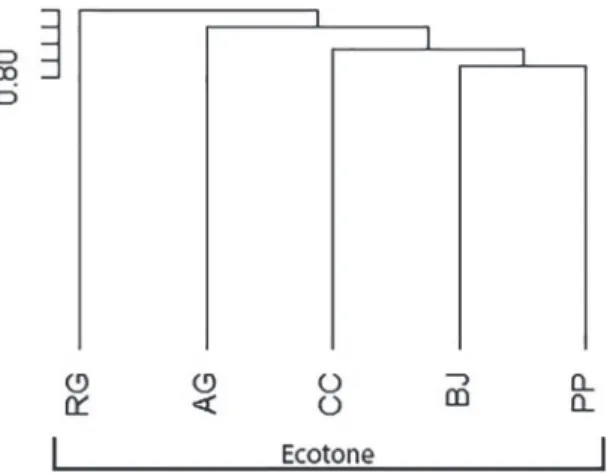
The dendrogram for all reptile species of the MG region showed BJ and PP as the most similar, while RG differed most from the other localities (Fig. 2).
Similarity between reptiles in MG and other areas in the eastern Parnaíba River Basin
We compared the results for MG with eight previously studied areas in the eastern Parnaíba River Basin (CP, PC, CO, CA, UU, 7C, BR and BT). The richness of reptiles from all studies comprised 100 species: 39 lizards, five amphisbaenians, 50 snakes, four turtles and two crocodilians (Table 2).
Of the nine inventories carried out in the eastern Parnaíba River Basin (PRB), the most specimens and highest richness were found in the Estação Ecológi-ca de Uruçuí-Una (Dal Vechio et al., 2013) and the Parque Nacional Serra das Confusões (Dal Vechio
et al., 2016), respectively (Table 2).
Helicops leopardinus (Schlegel, 1837) was found only in MG. From the label, this specimen was found in a small stream near the municipality of Bom Jesus, Piauí (see Appendix 1).
The species found in more than seven locali-ties were Iguana iguana, Ameiva ameiva, Salvator merianae, Epicrates assisi, Spilotes pullatus, Oxyrhopus trigeminus, Philodryas nattereri, and Pseudoboa nigra
(Table 2).
The largest number of reptile species shared by two sites was between CO and UU with 27 species, followed by CO and CA with 23 species. The small-est number of shared species was between 7C and BT, with one species only. The dendrogram for lizards in-dicated two groups: (1) MG, PC, BT, BR and (2) CA, CO and UU (Fig. 3).
The most common snakes recorded were B. con-strictor (except in CO, CA, BR, and BT), Epicrates assisi (except in PC, CA and BT), Spilotes pullatus
(except in PC and BT), Apostolepsis cearensis (except in PC, CA, BR and BT), Xenodon merremii (except in CP, PC, BR and BT), Oryrhopus trigeminus, Philo-dryas nattereri (except in BT), P. olfersi (except in MG, CP and PC), Pseudoboa nigra (except in MG and BT), and Crotalus durissus (except in PC, CA, BR and BT).
The dendrogram for snakes showed similar compositions between (1) MG, CP, 7C and UU; (2) BT and CO; and (3) CA and BR; while PC was less similar, forming a separate cluster (Fig. 4).
The dendrogram resulting from a comparison of all sites and all species showed two groups: (1) MG, BT, BR and PC, and (2) CA, CO and UU (Fig. 5). Areas CP and 7C (only snakes) were not included in
MG CP PC CO CA UU 7C BR BT
Taeniophallus occipitalis (Jan, 1863) 3 1
Thamnodynastes sp. 8 6 17
Xenodon merremii (Wagler, 1824) 2 1 1 110 6
Xenodon nattereri (Steindachner, 1867) 5 1 1
ELAPIDAE
Micrurus ibiboboca (Merrem, 1820) 1 * 7 9
VIPERIDAE
Bothrops lutzi (Miranda-Ribeiro, 1915) 3 2 2
Bothrops moojeni Hoge, 1966 ∆ 104 *?
Bothropoides erythromelas Amaral, 1923 *
Crotalus durissus (Linnaeus, 1758) 1 1 1 15 5
CHELIDAE
Mesoclemmys perplexa Bour & Zaher, 2005 □ 3
Mesoclemmys tuberculata (Luederwaldt, 1926) 1 6 1 *
Phrynops cf. tuberosus (Peters, 1870) ∆ 4
Phrynops geoffroanus (Schweigger, 1812) ◊ 1 * * *
ALLIGATORIDAE
Caiman crocodilus (Linnaeus, 1758) ∆ 3
Paleosuchus palpebrosus (Cuvier, 1807) ◊ 1 * *
Total Specimens 69 74 * 460 602 1,471 70 * *
this analysis. However, even if these areas were in-cluded, the result would show no bias, resulting in the same topology as Fig. 5, only CP and 7C grouping with UU.
Surprisingly, all dendrograms for the Parnaíba River Basin (Figs. 3-5), including MG, demonstrated a close relationship of the reptile fauna with the en-vironments where they were found: Cerrado (UU), Caatinga (CA and CO) and Cerrado-Caatinga eco-tone (PC, BR, MG, BT, 7C, CP). This result was also confirmed by the species that were found exclusively in areas of Cerrado (19 species), Caatinga (14) and Cerrado-Caatinga ecotone (12), as apparent from the symbols in Table 2.
DISCUSSION
The reptile assemblage in the Middle Gurguéia
Although this study was based on a collection of reptiles that lacks information about the collection effort, we consider that no data should be discarded or neglected. This assertion is supported by the find-ing of a specimen of Helicops leopardinus, the first re-cord of this species for Piauí. Helicops is a genus of semi-aquatic and very specialized snakes (Cisneros-Heredia, 2006), so we suggest that more-thorough collections should be carried out in the Parnaíba River Basin, especially near water bodies.
FIGURE 3: Dendrogram for similarity of lizard species composition in the Middle Gurguéia (MG) with previously studied areas in Piauí. The rule bar shows the Jaccard coefficient. BR: Barras, BT: Batal-ha, MG: Middle Gurguéia, PC: Picos, UU: Estação Ecológica do Uruçuí-Una, CA: Parque Nacional Serra da Capivara, CO: Parque Nacional Serra das Confusões. Castelo do Piauí (CP) and Parque Nacional Sete cidades (7C) were not included in this analysis.
FIGURE 2: Dendrogram for similarity of reptile species composi-tions in five areas in the Middle Gurguéia (MG), southern Piauí. The rule bar shows the Jaccard coefficient. RG: Redenção do Gur-guéia, AG: Alvorada do GurGur-guéia, CC: Cristino Castro, BJ: Bom Jesus, PP: Palmeira do Piauí.
FIGURE 5: Dendrogram for similarity of all reptile species compo-sitions in the Middle Gurguéia (MG) and other previously studied areas in Piauí. The rule bar shows the Jaccard coefficient. PC: Picos, BR: Barras, BT: Batalha, UU: Estação Ecológica do Uruçuí-Una, CA: Parque Nacional Serra da Capivara, CO: Parque Nacional Serra das Confusões. Castelo do Piauí (CP) and Sete Cidades (7C) were not included in this analysis.
The list of reptile species found in MG indicates an affinity with the Cerrado-Caatinga ecotone (e.g., Gymnodactylus geckoides; Hemidactylus agrius; Vanzo-saura rubricauda) in concordance with results from other studies (Colli et al., 2002; Rodrigues, 2003; Sawaya et al., 2008), although some species (e.g., Boa constrictor, Spilotes pullatus, Philodryas nattereri, Iguana iguana, Ameiva ameiva and Salvator merianae)
were found in areas outside these habitats (Henderson
et al., 1995; Bérnils et al., 2001; Cicchi et al., 2007; Vaz-Silva et al., 2007). In addition, the fauna of MG was similar only to the inventories carried out in Picos (Benício et al., 2015a), Barras (Benício et al., 2015b) and Batalha (Silva et al., 2015), all areas of Cerrado-Caatinga ecotone (Figs. 3-5), reinforcing the evidence that the composition of the fauna in MG is not associ-ated with the Cerrado or Caatinga biomes separately.
Comparison between species composition in Middle Gurguéia with inventoried areas
of eastern Parnaíba River Basin (PRB)
The finding of the largest number of individu-als and the highest reptile richness in the inventories conducted in the Parque Nacional Serra da Capivara (CA) and Parque Nacional Serra das Confusões (CO) may result from a higher collection effort in these studies compared to surveys in other localities in the PRB (Rocha & Prudente, 2010; Rodrigues & Pru-dente, 2011; Cavalcante et al., 2014; Benício et al.,
2015a, b; Silva et al., 2015). The CO inventory dis-covered and described five new species (see Table 2), which was attributed to the collection effort (Dal Ve-chio et al., 2016).
The dendrograms of similarity among the nine study areas of the PRB, including MG (Figs. 3-5), showed that the species composition is correlated with the Cerrado, Caatinga or ecotone areas (transi-tions between these biomes). Species found predomi-nantly in one of these environments may have a nar-rower niche compared to species found at virtually all sites in the PRB. This argument is supported by stud-ies that demonstrate the association of reptile specstud-ies with the structure of the environment (Garden et al.,
2007; Stumpel & Werf, 2012). Pelegrin et al. (2017) described differences in microhabitat preferences in the Caatinga among Tropidurus hispidus, T. helenae
and T. semitaeniatus, three sympatric species found in the Parque Nacional Serra da Capivara. Drymoluber brazili, Micrablepharus maximiliani and Tupinambis quadrilineatus, which were also found in other areas of Piauí, were recorded in areas with a predominance
of Caatinga, Cerrado-Caatinga ecotone and Cerrado vegetation, respectively (Moura et al., 2010; Freitas
et al., 2012; Silva et al., 2013).
Further studies of the degree of interaction of reptile species within the vegetation composition and physical structure in the Cerrado, Caatinga and/or ecotone areas should be conducted to confirm the species-environment association, in order to explain the reptile diversity and composition in the PRB. Un-derstanding the distribution, composition and deter-mining factors for the presence of each reptile species in each environment is fundamentally important for species conservation and management, especially for species that are considered vulnerable, as observed in this study.
CONCLUSIONS
Our examination of this collection revealed a new record for the state of Piauí, the snake Helicops leopardinus (Schlegel, 1837). The cluster analysis showed that the reptile fauna in the eastern Parnaíba River Basin is closely identified with Cerrado, Caat-inga or ecotonal areas individually.
Because of the rapid landscape transformation in northeastern Brazil, changing Cerrado and Caat-inga vegetation complexes (including ecotonal areas) into agricultural areas, it is imperative to understand the diversity of species and their environmental rela-tionships in order to inform the development of con-servation strategies, especially in unprotected areas such as the Middle Gurguéia.
RESUMO
Colli, G.R.; Bastos, R.P. & Araújo, A.B. 2002. The character and dynamics of the Cerrado Reptiles. In: Oliveira, P.S. & Marques, R.J. (Eds.). The Cerrados of Brazil. Ecology and natural history of a neotropical savanna. New York,Columbia University Press,
Costa, H. & Bérnils, R.S. 2015. Répteis brasileiros: Lista de espé-cies. Herpetologia Brasileira, 4:75-93.
Dal Vechio, F.; Recoder, R.; Rodrigues, M.T. & Zaher, H. 2013. The reptiles of the Estação Ecológica de Uruçuí-Una, State of Piauí, Brazil. Papéis Avulsos de Zoologia, 53:225-243. Dal Vechio, F.; Teixeira Jr., M.; Recoder, R.S.; Rodrigues,
M.T. & Zaher, H. 2016. The herpetofauna of Parque Nacio-nal da Serra das Confusões, state of Piauí, Brazil, with a regio-nal species list from an ecotoregio-nal area of Cerrado and Caatinga. Biota Neotropica, 16:1-19.
Freitas, M.A.; França, D.P.F. & Veríssimo, D. 2012. Distribution extension of Drymoluber brazili (Gomes, 1918) (Serpentes: Colubridae) for the state of Piauí, Brazil. Check List, 8(1):168-169.
Garden, J.G.; McAlpine, C.A.; Possingham, H.P. & Jones, D.N. 2007. Habitat structure is more important than vegetation composition for local‐level management of native terrestrial reptile and small mammal species living in urban remnants: A case study from Brisbane, Australia. Austral Ecology, 32(6):669-685.
Guedes, T.B.; Nogueira, C. & Marques, O.A.V. 2014. Diversity, natural history, and geographic distribution of snakes in the Caatinga, Northeastern Brazil. Zootaxa, 3863:1-93.
Harvey, M.B.; Ugueto, G.N. & Gutberlet Jr., R.L. 2012. Review of Teiid morphology with a revised taxonomy and phylogeny of the Teiidae (Lepidosauria: Squamata). Zootaxa, 3459:1-156.
Henderson, R.W.; Micucci, T.W.P.; Puorto, G. & Bourgeois, R.W. 1995. Ecological correlates and patterns in the distribution of Neotropical Boines (Serpentes: Boidae): A preliminary assessment. Herpetological Natural History, 3:15-27.
Magurran, A.E. 2013. Measuring biological diversity. Wiley-Blackwell, New York.
Moura, M.; Dayrell, J.S. & San-Pedro, V.A. 2010. Reptilia, Gymnophtalmidae, Micrablepharus maximiliani (Reinhardt and Lutken, 1861): Distribution extension, new state record and geographic distribution map. Check List, 6(3):419-426. Oksanen, J.; Blanchet, F.G.; Kindt, R.; Legendre, P.; Minchin,
P.R.; O’Hara, R.B.; Simpson, G.L.; Solymos, P.; Stevens, M.H.M. & Wagner, H. 2016. Package ‘vegan’: Community Ecology Package. Available at: http://cran.r-project.org/web/ packages/vegan/index.html. Accessed on: 03/05/2016. Passos, D.C.; Mesquita, P.C.M.D. & Borges-Nojosa, D.M.
2016. Diversity and seasonal dynamic of a lizard assemblage in a Neotropical semiarid habitat. Studies on Neotropical Fauna and Environment, 51(1):19-28.
Pelegrin, N.; Mesquita, D.O.; Albinati, P.; Caldas, F.L.S.; de Queiroga Cavalcanti, L.B.; Costa, T.B.; Falico, D.A.; Galdino, J.Y.; Tucker, D.B. & Garda, A.A. 2017. Extreme specialization to rocky habitats in Tropidurus lizards from Brazil: Trade‐offs between a fitted ecomorph and autoecology in a harsh environment. Austral Ecology, 12486:1-13. R Core Team. 2014. R: A language and environment for statistical
computing. R Foundation for Statistical Computing, Vienna, Austria. Available at: www.R-project.org. Accessed on: 10/01/2015.
Reydon, B.P. & Monteiro, M.S.L. 2006. A ocupação do Cerrado piauiense: Um processo de valorização fundiária. In: Reydon, B.P. & Cornélio, A. (Eds.). Mercados de Terras no Brasil – Es-trutura e Dinâmica. Brasília, Ministério do Desenvolvimento Agrário.
compreende 100 espécies de répteis: 39 lagartos, cinco anfisbenas, 50 serpentes, quatro tartarugas e dois croco-dilianos. Além disso, este estudo expande a distribuição para os répteis e registra pela primeira vez a ocorrência da serpente Helicops leopardinus (Schlegel, 1837) para o Piauí. A análise de agrupamento mostrou que os répteis possuem identidade com o ambiente em que foram en-contrados: Cerrado, Caatinga ou área de ecótono. Desta forma, estudos que associem a estrutura de hábitat com cada espécie são necessários para propor estratégias efi-cientes de manejo e conservação de répteis para toda a bacia do rio Parnaíba, principalmente em áreas ainda não protegidas.
Palavras-Chave: Reptilia; Helicops; Ecótono; Cerra-do; Caatinga.
ACKNOWLEDGEMENTS
We are grateful to Valdir J. Germano for the taxonomic identifications, and Dr. Francisco Franco for accepting specimens to be deposited in the Labo-ratório Especial de Coleções Zoológicas (LECZ), In-stituto Butantan. We also thank Brisa G. Costa for help in laboratory work, and Mr. Luis Casado Filho for his comments and language corrections. Janet W. Reid edited the English text.
REFERENCES
Benício, R.A.; Lima, D.C. & Fonseca, M.G. 2015a. Species richness of reptiles in a Caatinga area in northeastern Brazil. Gaia Scientia, 9(1):89-94.
Benício, R.A.; de Mesquita, P.C.M.D.; Cavalcante, V.H.G.L. & Fonseca, M.G. 2015b. Répteis de uma região de ecó-tono no estado do Piauí, Nordeste do Brasil. Gaia Scientia, 9(1):95-100.
Bérnils, R.S.; Batista, M.A. & Bertelli, P.W. 2001. Cobras e la-gartos do Vale: levantamento das espécies de Squamata (Repti-lia, Lepidosauria) da Bacia do Rio Itajai, Santa Catarina, Brasil. Revista de Estudos Ambientais, Blumenau, 3:69-79.
Cavalcante, L.B.Q.; Costa, T.B.; Colli, G.R.; Costa, G.C.; França, F.G.R.; Mesquita, D.O.; Palmeira, C.N.S.; Pe-legrin, N.; Soares, A.H.B.; Tucker, D.B. & Garda, A.A. 2014. Reptiles of protected areas in the Caatinga II: Serra da Capivara National Park, Piauí, Brazil. Check List, 10:18-27. Cicchi, P.J.P.; Sena, M.A.; Peccinini-Seale, D.M. & Duarte,
M.R. 2007. Snakes from coastal islands of state of São Paulo, southeastern Brazil. Biota Neotropica, 7(2):227-240. Cisneros-Heredia, D.F. 2006. Reptilia, Colubridae, Helicops
angulatus and Helicops leopardinus: Distribution extension, new country record. Check List, 2(1):36-37.
Rocha, W.A. & Prudente, A.L.C. 2010. The snake assemblage of Parque Nacional de Sete Cidades, State of Piauí, Brazil. South American Journal of Herpetology, 5:132-142.
Rodrigues, F.S. & Prudente, A.L.C. 2011. The snake assemblage (Squamata: Serpentes) of a Cerrado-Caatinga transition area in Castelo do Piauí, state of Piauí, Brazil. Zoologia, 28:440-448. Rodrigues, M.T. 2003. Herpetofauna da Caatinga. In: Leal, I.R.;
Tabarelli, M. & Silva, J.M.C. (Eds.). Ecologia e Conservação da Caatinga. Recife, Universidade Federal de Pernambuco. p. 181-236.
Rodrigues, M.T. 2005a. A biodiversidade dos cerrados: conheci-mento atual e perspectivas, com uma hipótese sobre o papel das matas galerias na troca faunística durante ciclos climáticos. In: Scariot, A.; Sousa-Silva, J.C. & Felfili, J.M. (Eds.). Cerrado: Ecologia, Biodiversidade e Conservação. Brasília, Ministério do Meio Ambiente. p. 235-246.
Rodrigues, M.T. 2005b. Conservação dos répteis brasileiros: os desafios de um país megadiverso. Megadiversidade, 1:87-94. Sawaya, R.J.; Marques, O.A.V. & Martins, M. 2008. Composition
and natural history of a Cerrado snake assemblage at Itirapina, São Paulo state, southeastern Brazil. Biota Neotropica, 8:127-149.
Silva, M.B.; Carvalho, L.S. & Rodrigues, V. 2015. Reptiles in an ecotonal area in northern state of Piauí, Brazil. Boletim do Museu de Biologia Mello Leitão, 37:437-455.
Silva, M.B.; Lima-Filho, G.R.; Cronemberger, A.A.; Carva-lho, L.S; Manzani, P.R. & Vieira, J.B. 2013. Description of the hemipenial morphology of Tupinambis quadrilineatus Manzani and Abe, 1997 (Squamata, Teiidae) and new records from Piauí, Brazil. Zookeys, 361:61-72.
Stumpel, A.H. & Werf, D.C. 2012. Reptile habitat preference in heathland: implications for heathland management. The Herpetological Journal, 22(3):179-182.
Vanzolini, P.E. 1976. On the lizards of a Cerrado-Caatinga contact: evolutionary and zoogeographical implications (Sauria). Papéis Avulsos de Zoologia, 29:111-119.
Vaz-Silva, W.; Guedes, A.G.; Azevedo-Silva, P.L.; Gontijo, F.F.; Barbosa, R.S.; Aloísio, G.R. & Oliveira, F.C.G. 2007. Herpetofauna, Espora Hydroeletric Power Plant, State of Goiás, Brazil. Check List, 3:338-345.
Wüster, W. & Bérnils, R.S. 2011. On the generic classification of the rattlesnakes, with special reference to Neotropical Crotalus durissus complex (Squamata: Viperidae). Zoologia, 28(4):417-419.
Zaher, H.; Grazziotin, F.G.; Cadle, J.E.; Murphy, R.W.; Moura-Leite, J.C.D.; & Bonatto, S.L. 2009. Molecular phylogeny of advanced snakes (Serpentes, Caenophidia) with an emphasis on South American Xenodontines: a revised classification and descriptions of new taxa. Papéis Avulsos de Zoologia, São Paulo, 49(11):115-153.
Aceito em: 17/07/2017 Publicado em: 15/09/2017 Editor Responsável: Marcelo Duarte
Publicado com o apoio financeiro do Programa de
Apoio às Publicações
Científicas Periódicas da USP
Produzido e diagramado na Seção de Publicações do
Museu de Zoologia da
Universidade de São Paulo
Os periódicos Papéis
A
vulsos de Zoologia
e
Arquivos de Zoologia estão licenciados sob uma Licença CC-BY
APPENDIX 1
List of the specimens used in this study, followed by the collection site and collection number, housed at the Instituto Butantan, IBSP: Instituto Butantan São Paulo; CRIB: Collection of Reptiles of Instituto Butantan.
Ameiva ameiva (Linnaeus, 1758), Palmeira do Piauí, PI, IBSP.CRIB.0380;
Amphisbaena vermicularis Wagler, 1824, Bom Jesus, PI, IBSP.CRIB.0403; IBSP.CRIB.0404; IBSP.CRIB.0405; IBSP.CRIB.0406; Cristino Castro, PI, IBSP.CRIB.0402;
Apostolepis cearensis Gomes, 1915, Redenção do Gurguéia, PI, IBSP-80.942;
Boa constrictor Linnaeus, 1758, Bom Jesus (Colégio Agrícola UFPI), PI, IBSP-81.301;
Chironius flavolineatus (Boettger, 1885), Palmeira do Piauí, PI, IBSP-80.935;
Crotalus durissus Linnaeus, 1758, PI, IBSP-81.316;
Epicrates assisi Machado, 1945, Bom Jesus, PI, IBSP-81.304; Canto do Buriti (6 km ao sul da cidade, BR135, km 170), PI, IBSP-81.317; Palmeira do Piauí, PI, IBSP-80.933;
Erythrolamprus poecilogyrus (Wied, 1825), Bom Jesus, PI, IBSP-81.302; IBSP-81.303;
Gymnodactylus geckoides Spix, 1825, Bom Jesus, PI, IBSP.CRIB.0394;
Helicops leopardinus (Schlegel, 1837), Bom Jesus, PI, IBSP-80.937;
Hemidactylu smabuia (Moreau de Jonnès, 1818), Bom Jesus, PI, IBSP.CRIB.0395; IBSP.CRIB.0396; Cristino Castro, PI;
Iguana iguana (Linnaeus, 1758), Bom Jesus, PI, IBSP.CRIB.0391;
Leptodeira annulata (Linnaeus, 1758), Redenção do Gurguéia, PI, IBSP-80.943;
Mabuya heathi (Schmidt & Inger, 1951), Palmeira do Piauí, PI, IBSP.CRIB.0393; IBSP.CRIB.0397;
Mesoclemmys tuberculata (Luederwaldt, 1926), Bom Jesus, PI, IBSP.CRIB.0334;
Micrablepharus maximiliani (Reinhardt & Lütken, 1862), Cristino Castro, PI, IBSP.CRIB.0398; IBSP. CRIB.0399; IBSP.CRIB.0400; IBSP.CRIB.0401;
Oxybelis aeneus (Wagler, 1824), Palmeira do Piauí, PI, IBSP-80.936;
Oxyrhopus trigeminus Duméril, Bibron & Duméril, 1854, Bom Jesus, PI, IBSP-80.938; IBSP-80.939; IBSP-80.840; Palmeira do Piauí, PI, IBSP-81.310; IBSP-81.311;
Philodryas nattereri Steindachner, 1870, Alvorada do Gurguéia, PI, IBSP-81.313; Bom Jesus (UFPI), PI, IBSP-81.307; IBSP-81.308; IBSP-81.309; Palmeira do Piauí, PI, IBSP-81.312; IBSP-80.934;
Phrynops geoffroanus (Schweigger, 1812), Bom Jesus, PI, IBSP.CRIB.0335;
Psomophis joberti (Sauvage, 1884), Bom Jesus, PI, IBSP-80.941;
Spilotes pullatus (Linnaeus, 1758), BR135, Km 367, PI, Monte Alegre do Piauí, IBSP-81.314;
Tropidurus hispidus (Spix, 1825), Bom Jesus, PI, IBSP.CRIB.0392; Cristino Castro, PI, IBSP.CRIB.0390; Pal-meira do Piauí, PI, IBSP.CRIB.0381; IBSP.CRIB.0382; IBSP.CRIB.0383; IBSP.CRIB.0384; IBSP.CRIB.0385; IBSP.CRIB.0386; IBSP.CRIB.0387; IBSP.CRIB.0388; IBSP.CRIB.0389;
Tropidurus semitaeniatus (Spix, 1825), Palmeira do Piauí, PI, IBSP.CRIB.0373; IBSP.CRIB.0374; IBSP. CRIB.0375; IBSP.CRIB.0376; IBSP.CRIB.0377; IBSP.CRIB.0378; IBSP.CRIB.0379;