doi: 10.1590/S1984-46702011000400005
The high diversity of reptiles in Brazil is associated with the presence of different biomes, resulting in a gradient of re-gions with open and xeric formations (such as the Caatinga) to regions with extremely humid forest formations (like the Amazon Forest) (RODRIGUES 2003, 2005). Despite the great di-versity of snakes (371 species) recorded for Brazil (BÉRNILS 2010), information on distribution and natural history in this group is still unsatisfactory, especially for the Cerrado and Caatinga, biomes with the lowest known diversity (SAZIMA & HADDAD 1992, RODRIGUES 2005, SAWAYA et al. 2008).
The main landscapes in the state of Piauí, northeastern Brazil, are associated with Cerrado sensu lato (30.0% of the total area of the state; CEPRO 1992, CASTROet al. 1998, FARIAS & CASTRO 2004) and Caatinga (28.4%), as well as transitional ar-eas or ecotones between these two biomes (CASTROet al. 1998, CASTRO 2003). Few herpetological studies have been conducted in the state in localities of Caatinga (VANZOLINIet al. 1980, ARAUJO
et al. 1998), Cerrado (COIMBRA FILHO & MAIA 1979), or in transi-tional areas between these two biomes (VANZOLINIet al. 1980, ROCHA & SANTOS 2004, ROCHA & PRUDENTE 2010). Herpetological studies in these and in other localities in northeastern Brazil are mostly restricted to species lists, descriptions of new taxa, and basic information on their biology, with scant
informa-tion on factors structuring assemblages, as well as on their struc-ture.
Nevertheless, recently ROCHA & PRUDENTE (2010) presented data on the composition and aspects of the natural history of the snake assemblage in a transition area between Cerrado and Caatinga in the state of Piauí.
Herein we present the results of an inventory of a snake assemblage from the Municipality of Castelo do Piauí, another transitional area between Cerrado and Caatinga in the state of Piauí. We provide information on composition, estimates of species richness and abundance, and a comparison with snake assemblages from others localities localized on open areas al-ready studied in Brazil.
MATERIAL AND METHODS
The study area of about 3,000 ha belongs to ECB Rochas Ornamentais do Brasil and is located in the Municipality of Castelo do Piauí, northeast of the state of Piauí, Brazil (05°19’20"S, 41°33’09"W, Fig. 1). The vegetation is typical of a transition area between the Caatinga and Cerrado, with a pre-dominance of a low altitude Cerrado Rupestre (rocky grasslands) (CASTRO & COSTA 2007, FARIAS & CASTRO 2004). The average
an-The snake assemblage (Squamata: Serpentes) of a Cerrado-Caatinga
transition area in Castelo do Piauí, state of Piauí, Brazil
Francílio da Silva Rodrigues
1,2& Ana Lúcia da Costa Prudente
11 Laboratório de Herpetologia, Coordenação de Zoologia, Museu Paraense Emílio Goeldi. Avenida Perimetral 1901, Terra
Firme, Caixa Postal 399, 66017-970 Belém, PA, Brazil.
2 Corresponding Author: E-mail: [email protected]
ABSTRACT. This study records and analyzes the diversity and structure of a snake assemblage in a transition area be-tween Cerrado and Caatinga, in the municipality of Castelo do Piauí, state of Piauí, comparing the distribution and similarity of the species composition with other open localities already studied in Brazil. We used three complementary sampling methods: time constrained search (TCS), pitfall traps with drift fences (PFT), and incidental encounters (IE). During the TCS and PFT, 912 hours/observer and 6,468 days/trap were used, respectively. We estimated 23 species of snakes for the locality, although only 19 species were recorded. Philodryas nattereri Steindachner, 1870 (n = 10), Liophis poecilogyrus (Schlegel, 1837) (n = 9), Liophisviridis Günther, 1862 (n = 8) and Thamnodynastes sp. (n = 8) were the most abundant species. Terrestrial, cryptozoic, and diurnal snakes predominated in the assemblage (Boidae = 2 species, Dipsadidae = 12, Colubridae = 2, Elapidae = 1, Viperidae = 2). The results indicate that the fauna of the locality is similar with that of other open formations, especially the Caatinga, corroborating previous floristic studies. Comparisons be-tween snake assemblages analyzed by different authors suggest structural differences bebe-tween the assemblages of the Cerrado and the Caatinga, contradicting the hypothesis of mixed composition of fauna in these biomes.
nual temperature is 33.6°C (with a minimum of 21.8°C in Feb-ruary and a maximum of 35.0°C, in October) and the climate is considered dry sub-humid, with annual rainfall of 1,199.3 mm (THORNTHWAITE & MATHER 1955, CASTRO & COSTA 2007).
Fieldwork was conducted in three physiognomically dis-tinct areas, with the following characteristics: Area 1 – low al-titude Cerrado Rupestre (rocky grasslands), characterized by superficially rocky soil, with rocky outcrops and with poorly developed plants dispersed between rocky outcrops and be-tween trenches (CASTRO & COSTA 2007) (Figs 2 and 3); Area 2 – Campo Cerrado (open Cerrado), characterized by a predomi-nantly herbaceous-shrub component (rather than a shrub-ar-boreal) and fields that remain flooded during the rainy season (Figs 4 and 5); and Area 3 – secondary forest of typicalCerrado, composed of mainly shrubs and small trees, with a predomi-nance of secondary vegetation and absence of herbaceous
com-ponents. In this last area, pioneer species such as Mimosa sp. and other Mimosaceae have replaced the native vegetation, resulting in transitional and altered vegetation (Figs 6 and 7). From October 2005 to July 2006, four expeditions in three physiognomically distinct areas were made, using three comple-mentary data collection methods: a) time constrained search (TCS) (MARTINS & OLIVEIRA 1999, MARTINS 2001); 2) pitfall traps with drift fences (PFT) (modified from FITCH 1987, CECHIN & MARTINS 2000, ENGE 2001); and 3) incidental encounters (IE) (SAWAYAet al. 2008).
Seven sets of traps were installed in each of the three ar-eas. Each set contained four 60 L buckets, arranged in a “Y” configuration, 10 m apart from one another and connected by 100 cm high fences, totaling 84 buckets and 630 m of drift-fences. In each of the three areas, the traps remained open dur-ing 77 days, spread over four expeditions, two in the dry season and two in the rainy season. This effort resulted in 2,156 days/ trap in each area, totalizing 6,468 days/trap performed.
Time constrained search (TCS) consisted of walking slowly along pre-existing tracks within the areas, searching actively (vi-sually) in burrows, termite nests, shrubs, grasses tussocks, etc. This procedure was performed for 38 days in each of the three areas. The search lasted four hours per day (two hours in the morning and two hours at night), and was carried out by two observers. Thus, each area had the same sampling effort of 304 hours/observer, totaling 912 hours/observer for the three areas. We considered an encounter incidental (IE) when snakes were found alive or dead in the study area and surrounding region during other activities in which the collection time was not being computed, as well as instances when snakes were found and collected by workers and local residents.
The specimens collected were deposited in the Herpeto-logical Collection of the Museu Paraense Emílio Goeldi (MPEG), Municipality of Belém, state of Pará, Brazil (Appendix).
For the species accumulation curves, rarefaction methods and richness estimates, we used the program “EstimateS” ver-sion 7.5 (COLWELL 2005a) from the samples obtained by the meth-ods TCS and PFT. For TCS, a sample corresponded to 8 man-hours (114 samples) and for PFT it corresponded to a collection day for seven sets of traps per area (231 samples). To estimate rich-ness we used the first order Jackknife estimator (Jack 1) (COLWELL & CODDINGTON 1994, COLWELL 2005b). For the construction of the accumulation curve and estimation of species richness, the num-ber of species was associated with the numnum-ber of individuals, using the obtained samples. We performed a hierarchical rela-tionship between relative abundance and dominance ratios be-tween species. For classification of the macrohabitats and daily activity we used the categories proposed by CADLE & GREENE (1993), with modifications by STRÜSSMANN (2000).
To evaluate the similarity between the composition of the snake assemblage of Castelo do Piauí and those of other open and transitional areas of Brazil, we used data from 10 localities (Fig. 1), divided into three groups as follows: Cerrado-Caatinga Figure 1. Cerrado, Caatinga and Cerrado-Caatinga transition
Figures 2-7. Sampling areas. Area 1: low altitude Cerrado Rupestre, (2) detail of the vegetation and (3) detail of the stony soil typical of the area; Area 2: open Cerrado, (4) detail of the vegetation and (5) detail of the soil; Area 3: secondary forest of typical Cerrado, (6) detail of the vegetation and soil during the rainy season, and (7) detail of the vegetation and soil during the dry season.
transition: 1) Castelo do Piauí (Castelo), state of Piauí; 2) José de Freitas (JFreitas), state of Piauí (ROCHA & SANTOS 2004); 3) Parque Nacional de Sete Cidades (PNSC), state of Piauí (ROCHA & PRUDENTE 2010); Cerrado: 4) Parque Nacional das Emas (Emas), state of Goiás (VALDUJOet al. 2009); 5) Manso hydroelectric powerplant (Manso), state of Mato Grosso (STRÜSSMANN 2000); 6) Estação
Ecológica de Itirapina (Itirapina), state of São Paulo (SAWAYA et al.
2008); 7) Urbano Santos (USantos), state of Maranhão (J. D. Lima, pess. com.); Caatinga: 8) Exu (Exu), state of Pernambuco (VITT & VANGILDER 1983); 9) Dunas de São Francisco (Dunas SF), state of Bahia (RODRIGUES 1996); 10) Chapada do Apodi (Apodi), Ceará and Rio Grande do Norte states (LIMA-VERDE 1976); and 11) Parque
2 3
4 5
Nacional Serra da Capivara (Capivara), state of Piauí (ARAUJOet
al. 1998). Only localities with minimum sampling efforts of at least 80 collection days and/or 200 field hours in total of TCS were used for this comparison.
We performed a Principal Coordinates Analysis (PCoA) for the species recorded in these localities (PIELOU 1969, MANLY 1994, KOVACH 1999), and a cluster analysis using the weighted pair-group method of arithmetic averages (WPGMA, indicated for samples of groups with different richness or differences in sampling, according to KOVACH 1999). Both analyses were run by using Gower’s general similarity coefficient (SNEATH & SOKAL 1983, KOVACH 1999). Analyses were performed using the pro-gram MVSP 3.1 (KOVACH 1999). The distribution map was pro-duced by using ArcView GIS version 3.3.
RESULTS
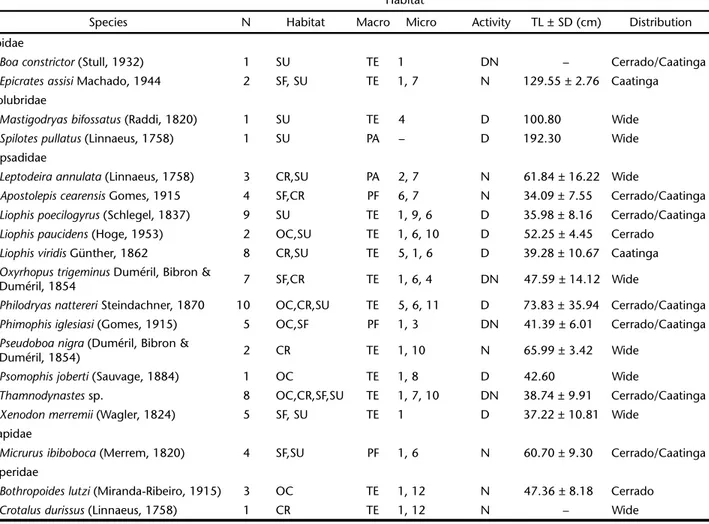
We recorded 77 specimens of snakes belonging to 19 spe-cies, 17 genera and five families (Tab. I). Philodryasnattereri
Steindachner, 1870 (n = 10; 13.0%), Liophispoecilogyrus (Schlegel, 1837) (n = 9; 11.7%), Liophisviridis Günther, 1862 (n = 8; 10.4%), and Thamnodynastes sp. (= Thamnodynastes sp. nov. 2 sensu FRANCO & FERREIRA 2002) (n = 8, 10.4%) were the most abundant species (Fig. 8), considering the three methods used.
Considering only the quantifiable capture methods (TCS and PFT), we recorded 14 species (TCS = 12 species, 912 hours/ observer; PFT = 7 species, 6,468 days/trap), the most abundant of which were Thamnodynastes sp. (n = 7; 18.0%), P. nattereri (n = 5; 15.0%) and Phimophis iglesiasi (Gomes, 1915) (n = 5; 15.0%).
Table I. Ecological attributes of the snake community in the locality of Castelo do Piauí, state of Piauí, Brazil. Subtitles: Habitat (phytophysiognomies): (CR) low altitude Cerrado Rupestre, (OC) open Cerrado, (SF) secondary forest of typical Cerrado, (SU) Surroundings of study area. Macrohabitat: (PF) primary or exclusively fossorial, (PA) primary or exclusively arboreal; CT = criptozoic and terrestrial. Microhabitat: (1) on the ground, (2) in the tree canopy, (3) buried in the ground, (4) over rocks, (5) under rocks, (6) under leaf litter, (7) over leaf litter, (8) on trunks in the understory, (9) on fallen logs, (10) in hollow trunks, (11) inside a termite hill, (12) over a termite hill. Activity: (D) diurnal, (N) nocturnal, (DN) diurnal/nocturnal, (TL) mean total length, (SD) standard deviation, (–) no records.
Habitat
Species N Habitat Macro Micro Activity TL ± SD (cm) Distribution
Boidae
Boaconstrictor (Stull, 1932) 1 SU TE 1 DN – Cerrado/Caatinga
Epicratesassisi Machado, 1944 2 SF, SU TE 1, 7 N 129.55 ± 2.76 Caatinga
Colubridae
Mastigodryasbifossatus (Raddi, 1820) 1 SU TE 4 D 100.80 Wide
Spilotespullatus (Linnaeus, 1758) 1 SU PA – D 192.30 Wide
Dipsadidae
Leptodeiraannulata (Linnaeus, 1758) 3 CR,SU PA 2, 7 N 61.84 ± 16.22 Wide
Apostolepiscearensis Gomes, 1915 4 SF,CR PF 6, 7 N 34.09 ± 7.55 Cerrado/Caatinga
Liophispoecilogyrus (Schlegel, 1837) 9 SU TE 1, 9, 6 D 35.98 ± 8.16 Cerrado/Caatinga
Liophispaucidens (Hoge, 1953) 2 OC,SU TE 1, 6, 10 D 52.25 ± 4.45 Cerrado
Liophisviridis Günther, 1862 8 CR,SU TE 5, 1, 6 D 39.28 ± 10.67 Caatinga
Oxyrhopustrigeminus Duméril, Bibron &
Duméril, 1854 7 SF,CR TE 1, 6, 4 DN 47.59 ± 14.12 Wide
Philodryasnattereri Steindachner, 1870 10 OC,CR,SU TE 5, 6, 11 D 73.83 ± 35.94 Cerrado/Caatinga
Phimophisiglesiasi (Gomes, 1915) 5 OC,SF PF 1, 3 DN 41.39 ± 6.01 Cerrado/Caatinga
Pseudoboanigra (Duméril, Bibron &
Duméril, 1854) 2 CR TE 1, 10 N 65.99 ± 3.42 Wide
Psomophisjoberti (Sauvage, 1884) 1 OC TE 1, 8 D 42.60 Wide
Thamnodynastes sp. 8 OC,CR,SF,SU TE 1, 7, 10 DN 38.74 ± 9.91 Cerrado/Caatinga
Xenodonmerremii (Wagler, 1824) 5 SF, SU TE 1 D 37.22 ± 10.81 Wide
Elapidae
Micrurusibiboboca (Merrem, 1820) 4 SF,SU PF 1, 6 N 60.70 ± 9.30 Cerrado/Caatinga
Viperidae
Bothropoideslutzi (Miranda-Ribeiro, 1915) 3 OC TE 1, 12 N 47.36 ± 8.18 Cerrado
Thirteen species were recorded using IE (five species were uniquely recorded by this method), of which L. poecilogyrus
(n = 9; 23.0%), L. viridis (n = 6; 15.0%) and P. nattereri (n = 5; 13.0%) were the most frequent. The species accumulation and rarefaction curves did not reach an asymptote, suggesting that at least 23 species occur in the locality (Jack 1: 19.95 + 2.41) (Fig. 9).
Most species in this assemblage had diurnal habits (8 species; 42.1%). They were followed by nocturnal species (7 species, 36.8%), and by species with both diurnal and noctur-nal activities (4 species, 21.1%) (Tab. I). Regarding the use of the substrate, snakes with terrestrial and cryptozoic habits pre-dominated in the assemblage (14 species, 73.7%), followed by fossorial (3 species, 15.8%) and arboreal (2 species, 10.5%) spe-cies (Tab. I). Most terrestrial spespe-cies have diurnal or diurnal/ nocturnal habits. Exclusively nocturnal species were recorded in a wide variety of substrates (Tab. I).
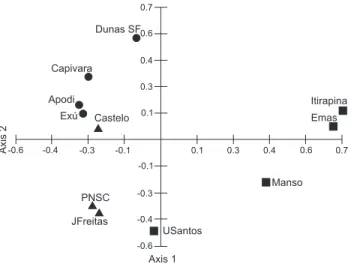
The first two axes of the Principal Coordinates Analysis (PCoA) together explained 36.6% of the data variance (Axis 1: eigen value = 1.573 and 21.9% of the variance; axis 2: eigen value = 1.05 and 14.6% of the variance). Axis 1 ordered the assemblages into two main groups: group 1 formed by assem-blages from the Caatinga (Exú, Apodi, Capivara and Dunas SF), ecotones (Castelo, JFreitas and PNSC), and northeastern Cerrado
(USantos); group 2 was formed by assemblages from Midwest-ern (Manso) and MidwestMidwest-ern Cerrado (Emas and Itirapina) (Fig. 10). Axis 2 of the PCoA ordered the assemblages into two other groups: group 1 was formed by the assemblages from the Cerrado (Manso and USantos) and from two transition areas (PNSC and J Freitas); group 2 was composed by the assemblages from other open formations of Northeastern Brazil, including Castelo (Fig. 10).
Figure 8. Relative abundance of snake species recorded at Castelo do Piauí (Piauí, Brazil) by using the methods of time constrained search (solid black), pitfall traps (gray), and incidental encounters (blank). (PHLna) Philodryas nattereri, (LIOpo) Liophispoecilogyrus, (LIOvi) Liophis viridis, (THMsp) Thamnodynastes sp., (OXRtr)
Oxyrhopus trigeminus, (PHMig) Phimophis iglesiasi, (XENme)
Xenodonmerremii, (APOce) Apostolepiscearensis, (MCRib) Micru-rus ibiboboca, (BOTlu) Bothropoides lutzi, (LEPan) Leptodeira annulata, (EPIce) Epicratesassisi, (LIOpa) Liophispaucidens, (PSBni)
Pseudoboanigra, (BOAco) Boa constrictor, (CROdu) Crotalus durissus, (MASbi) Mastigodryasbifossatus, (PSOjo) Psomophisjoberti, (SPLpu)
Spilotespullatus.
Figure 9. Species accumulation curve, richness estimates and per-formance of two different methods employed to sample snakes at Castelo do Piauí. Samples were generated after 100 random-izations. (TCS) Time constrained search (1 sample = 8 man-hours); (PFT) pitfall traps (1 sample = 28 days/trap). Jack 1 = 1st order
Jackknife richness estimator; OBS = observed richness.
Axis 1 USantos JFreitas PNSC Manso Emas Itirapina Dunas SF Capivara Apodi Exú Castelo Axis 2
0.1 0.3 0.4 0.6 0.7 -0.6 -0.4 -0.3 -0.1
0.7 0.6 0.4 0.3 0.1 -0.1 -0.3 -0.4 -0.6
Figure 10. Ordination diagram of the Principal Coordinates Analy-sis (PCoA) resulting from the species composition of thirteen lo-calities. Axis 1: eigenvalue = 1.57 and 21.9% variance, axis 2: eigen-value = 1.05 and 14.6% variance. Legends: Cerrado (squares), transition area (triangles) and Caatinga localities (circles).
24 22 20 18 16 14 12 10 8 6 4 2 0
0 20 40 60 80 100 120 Samples
140 160 180 200 220 240
Number of species TCS PFT OBS JACK 1 11 10 9 8 7 6 5 4 3 2 1 0 Number of individuals Species
PHLna LIOpo LIOvi THMsp OXRtr PHMig XENme APOce MRCib BOTlu LEPan EPIce LIOpa PSBni BOAco
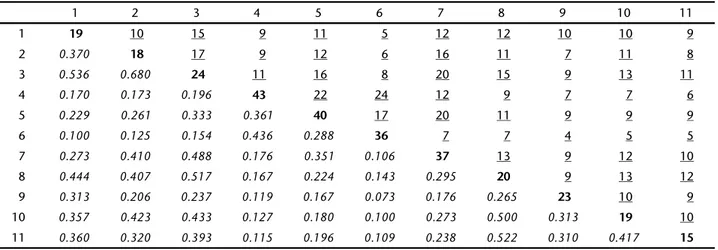
Similarly to the PCoA results, the cluster analysis showed two groups according to vegetation characteristics. The group 1 was formed by the Cerrado assemblages (Manso, Emas and Itirapina) and the northeastern Cerrado (USantos). The group 2 was formed by the Dunas SF and a subgroup composed by assemblages from the Caatinga (Capivara, Exu and Apodi), and Cerrado-Caatinga transition areas (PNSC, Castelo and JFreitas) (Fig. 11). PNSC (53.6%) and J Freitas (37.0%) are the most simi-lar assemblages to Castelo (Tab. II).
DISCUSSION
The low diversity of snakes observed in the assemblages studied in Castelo and in other two Cerrado-Caatinga transi-tion localities (PNSC, JFreitas) is probably a pattern of the tran-sitional formations, since localities with a predominance of open vegetation types tend to have relatively lower diversity when compared to forested formations (VANZOLINI 1974, 1976, VITT & VANGILDER 1983, SILVA & SITES 1995, STRÜSSMANN 2000, BERNARDE & ABE 2006, SAWAYAet al. 2008). Additional studies are necessary to elucidate this hypothesis.
The combination of different capture methods is the best way to sample an area since it makes it possible to access the faunas from distinct habitats (GREENBERG et al. 1994, SAWAYAet al. 2008, RIBEIRO-JÚNIORet al. 2008). Nevertheless, in spite of the fact that three capture methods were employed in our study area, both rarefaction and species accumulation curves did not stabilize, indicating the possibility of additional records for Castelo do Piauí in further studies.
The snake assemblage from Castelo is characterized by the prevalent abundance of specimens of Dipsadidae (repre-senting 83.1% of the total number of records) and by the low abundance of Boidae, Colubridae, Elapidae and Viperidae speci-mens. The predominance of terrestrial, diurnal snakes was also observed in other communities from open areas or ecotones, such as PNSC (ROCHA & PRUDENTE 2010), Exu (VITT & VANGILDER 1983), Capivara (ARAÚJOet al. 1998) and JFreitas (ROCHA & SANTOS 2004). Although not tested, the few records of arboreal snakes are tentatively attributed to the low height and density of the vegetation, and the absence of aquatic species in the studied area can be attributed to the lack of water bodies.
Figure 11. Dendrogram of the cluster analysis between eleven lo-calities resulting from the snake species composition of lolo-calities from transition localities (Castelo, JFreitas e PNSC), Cerrado (Emas, Manso, Itirapina e USantos) and Caatinga localities (Exu, Dunas SF, Apodi e Capivara).
Table II. Similarity matrix with similarity indexes between pairs of assemblages (italics), number of shared species (underline), and species richness (bold) in each assemblage. Subtitles: Cerrado-Caatinga transition: (1) Castelo do Piauí, state of Piauí, (2) José de Freitas, state of Piauí, (3) Parque Nacional de Sete Cidades (PNSC), state of Piauí. Cerrado: (4) Parque Nacional das Emas, state of Goiás, (5) Manso hydroelectric powerplant, state of Mato Grosso, (6) Itirapina, state of São Paulo, (7) Urbano Santos, state of Maranhão. Caatinga, (8) Exu, state of Pernambuco, (9) Dunas de São Francisco, state of Bahia, (10) Chapada do Apodi, Ceará and Rio Grande do Norte states, (11) Parque Nacional Serra da Capivara, state of Piauí.
1 2 3 4 5 6 7 8 9 10 11
1 19 10 15 9 11 5 12 12 10 10 9
2 0.370 18 17 9 12 6 16 11 7 11 8
3 0.536 0.680 24 11 16 8 20 15 9 13 11
4 0.170 0.173 0.196 43 22 24 12 9 7 7 6
5 0.229 0.261 0.333 0.361 40 17 20 11 9 9 9
6 0.100 0.125 0.154 0.436 0.288 36 7 7 4 5 5
7 0.273 0.410 0.488 0.176 0.351 0.106 37 13 9 12 10
8 0.444 0.407 0.517 0.167 0.224 0.143 0.295 20 9 13 12
9 0.313 0.206 0.237 0.119 0.167 0.073 0.176 0.265 23 10 9
10 0.357 0.423 0.433 0.127 0.180 0.100 0.273 0.500 0.313 19 10
11 0.360 0.320 0.393 0.115 0.196 0.109 0.238 0.522 0.310 0.417 15
Itirapina
Emas
Manso
USantos
DunasSF
Castelo
JFreitas
PNSC
Apodi
Capivara
Exú
0.04 0.20 0.36 0.52 0.68 0.84 1.00
Eight of the 19 species (42.1%) recorded for the locality present wide geographic distributions, occurring in different biomes (such as the Cerrado, Caatinga, Pantanal, Amazon and Atlantic forests), while other seven species (36.8%) occur exclu-sively in Cerrado and Caatinga. Additionally, two species are found exclusively in the Caatinga – Epicrates assisi Machado, 1944 and
L. viridis, and two in the Cerrado – Liophis paucidens (Hoge, 1953) and Bothropoides lutzi (Miranda-Ribeiro, 1915). Although B. lutzi
can occur at the limits of the Caatinga, the species is considered typical of the Cerrado, according to CAMPBELL & LAMAR (2004). The presence of shared species with Cerrado and Caatinga, associated with the occurrence of transitional vegetation species (CASTRO & COSTA 2007), indicate that the locality of Castelo do Piauí repre-sents an ecotonal area, influenced by both types of biomes.
The similarity between assemblages from the Cerrado-Caatinga transition localities (Castelo, JFreitas and PNSC), the northeastern Cerrado (USantos), and the Caatinga (Apodi, Exu and Capivara) indicate that the geographical proximity of adja-cent biomes have an influence on the composition of the fauna from Castelo. This fact can be corroborated by the presence of species in common with Cerrado and Caatinga assemblages, besides the presence of species with wide geographic distribu-tion. However, species richness, faunal composition, and num-ber of shared species in the above mentioned localities, as well as the formation of two distinct groups observed in our analysis – Cerrado and Caatinga – provide evidence that they have their own faunal identities, as previously argued by authors such as COLLIet al. (2002), RODRIGUES (2003), and SAWAYA et al. (2008).
ACKNOWLEDGMENTS
We thank the Post-Graduate Program in Zoology MPEG/ UFA, the ECB Rochas Ornamentais do Brasil Ltda and the Programa de Pesquisas Ecológicas de Longa Duração (PELD) for logistical support. The Coordenação de Aperfeiçoamento de Pessoal de Nível Superior (fellowship to F.S. Rodrigues), and Conselho Nacional de Desenvolvimento Científico e Tecnoló-gico (fellowship to A.L.C. Prudente, Process PQ 307999/2008-4) for financial support. The Instituto Brasileiro do Meio Ambiente e dos Recursos Naturais Renováveis (IBAMA) for the collection permit (Process 02020.001736/2003). We thank to Marcos P.D. Santos and Antônio A.J.F. de Castro for logistics and structure used during the PELD; to Gleomar F. Maschio and Joxleide M. da C. Pires for reviewing earlier versions of the manuscript and for information about the flora in the region; to Daniel P. Coutinho, Yuri Cláudio, Karla C. Bezerra, Francisco M. Oliveira Neto, Francisco H.R. Leite, Marcelo de S. e Silva, Francisco L.A. Silva and Fábio de M. Lopes for assistance in the field. We thank A. Baldisseri for improving the English writing.
LITERATURE CITED
ARAUJO, A.J.G.; A.M. PESSIS; C. GUÉRIN; C.M.M. DIAS; C. ALVES; E.S. LA SILVA; F. OLMOS; F. PARENTI; G. D. FELICE; J. PELLERIN; L. EMPERAIRE;
M. CHAME; M.C.S. MENESES LAGE; M. FAUNE; N. GUIDON; R.P. MEDEIROS & P.R.G. SIMÕES. 1998. Parque Nacional Serra da
Capivara. Piauí, Brasil. São Raimundo Nonato, Fundham, Alínea Publicações, 94p.
BÉRNILS, R. S. 2010. Brazilian reptiles – List of species. Socie-dade Brasileira de Herpetologia. Available online at http:// www.sbherpetologia.org.br [Acessed: 19.VII.2010]. BERNARDE, P.S. & A.S. ABE. 2006. A snake community at Espigão
do Oeste, Rondônia, Southweastern Amazon, Brazil. South American Journal of Herpetology 1 (2): 102-113. CADLE, J.E. & H.W. GREENE. 1993. Phylogenetic patterns, biogeography,
and ecological structure of neotropical snake assemblages, p. 281-293. In: R.E. RICKLEFS & D. SCHLUTER (Eds). Species diversity in ecological communities. Historical and geographical perspectives. Chicago, University of Chicago Press, 414p. CASTRO, A.A.J.F. 2003. Survey of the Vegetation in the State of
Piauí, p. 117-123. In: T.L. GAISER; M. KROL; H. FRISCHKORN & J.C. ARAUJO (Eds). Global Change and Regional Impacts: Water Availability and Vulnerability of Ecosystems and Society in Semiarid Northeast of Brazil. Berlin, 444p. CASTRO, A A.J.F. & J.M. COSTA. 2007. Flora e Melissofauna
Asso-ciada de um Cerrado Rupestre da Região Setentrional do Piauí, p. 271-298. In: Programa Regional de Pós-Graduação em Desenvolvimento e Meio Ambiente (Org.). Cerrado Piauiense: Uma Visão Multidisciplinar. Teresina, Editora da Universidade Federal do Piauí, 300p.
CASTRO, A.A.J.F.; F.R. MARTINS & A.G. FERNANDES. 1998. The wood flora of cerrado vegetation in the state of Piauí, northeastern Brazil. Edinburgh Journal of Botany 55 (3): 455-472. CAMPBELL, J.A. & W.W. LAMAR. 2004. The Venomous reptiles of
the western hemisphere. Comstock Publishing Associates, vol. 1, 422p.
CECHIN, S.Z. & M. MARTINS. 2000. Eficiência de armadilhas de queda (Pitfall-traps) em amostragens de anfíbios e répteis no Brasil. Revista Brasileira de Zoologia 17: 729-749. CEPRO. 1992. Perfil dos municípios piauienses. Teresina,
Fundação Centro de Pesquisas Econômicas e Sociais, Secre-taria de Planejamento, 420p.
COIMBRA FILHO, A.F. & A.A. MAIA. 1979. Preliminares acerca da situação da fauna no Parque Nacional de Sete Cidades, Es-tado do Piauí (Relatório). Boletim Informativo da Funda-ção Brasileira para ConservaFunda-ção da Natureza 14: 42-61. COLLI, G.R.; R.P. BASTOS & A.F.B. ARAUJO. 2002. The character and
dynamics of the Cerrado herpetofauna, p. 223-241. In: P.S. OLIVEIRA & R.J. MARQUIS (Eds). The Cerrados of Brazil:
Ecology and Natural History of a Neotropical Savanna.
New York, Columbia University Press, 424p.
COLWELL, R.K. & J.A. CODDINGTON. 1994. Estimating terrestrial biodiversity through extrapolation. Philosophical Trans-actions of the Royal Society, Series B, 345: 101-118. COLWELL, R.K. 2005a. EstimateS: Statistical estimation of
species richness and shared species from samples. Sinauer Associates, Sunderland, Massachusetts, version 10.5. COLWELL, R.K. 2005b. User’s guide to EstimateS5 statistical.
samples. Version 10.5.0. Available online at: http:// viceroy.eeb.uconn.edu/estimates [Acessed: 13.X.2005]. ENGE, K.M. 2001. The Pitfall of Pitfall Traps. Journal of
herpetology 35 (3): 467-478.
FARIAS, R.R.S. & A.A.J.F. CASTRO. 2004. Fitossociologia em tre-chos da vegetação do Complexo de Campo Maior, Campo Maior, PI, Brasil. Acta Botanica Brasilica 18 (4): 949-963. FRANCO, F.L. & T.G. FERREIRA. 2002. Descrição de uma nova
espé-cie de Thamnodynastes Wagler, 1830 (Serpentes, Colubridae) do nordeste brasileiro, com comentários sobre o gênero.
Phyllomedusa 1 (2): 57-74.
FITCH, H.S. 1987. Collecting and life-history techniques, p. 143-182. In: R.A. SEIGEL; J.T. COLLINS & S.S. NOVAK (Eds). Snakes.
Ecology and Evolutionary Biology. New York,
Mcgraw-Hill, 529p.
GREENBERG, C.H.; D.G. NEARY & L.D. HARRIS. 1994. A comparison of herpetofaunal sampling effectiveness of pitfall, single-ended, and double-ended funnel traps used with drift fences.
Journal of Herpetology 28: 319-324.
KOVACH, W.L. 1999. MVSP – A Multi-Variate Statistical Package
for Windows, ver. 3.1. Penthraeth, Kovach Computing
Services.
LIMA-VERDE, J.S. 1976. Fisioecologia e etologia de algumas espé-cies de serpentes da Chapada do Apodi, Estados do Ceará e Rio Grande do Norte (Brasil). Caatinga 1 (1): 21-56. MANLY, B.F.J. 1994. Multivariate Statistical Methods. A primer.
London, Chapman & Hall, 215p.
MARTINS, M. & M.E. OLIVEIRA. 1999. Natural History of Snakes in Forests of the Manaus region, Central Amazonia, Brazil.
Herpetological Natural History 6: 78-150.
MARTINS, M. 2001. Ecologia dos Cerrados de Itirapina. Available at: http://eco.ib.usp.br/labvert/SiteItirapina/ iti.htm. [Acessed: 13/VII/2005].
PIELOU, E.C. 1969. An introduction to mathematical ecology. New York, Wiley Interscience, 286p.
RIBEIRO-JÚNIOR, M.A.; T.A. GARDNER & T.C.S. ÁVILA-PIRES. 2008. Evaluating the Effectiveness of Herpetofaunal Sampling Techniques across a Gradient of Habitat Change in a Tropi-cal Forest Landscape. Journal of Herpetology 42 (4): 733-749.
ROCHA, W.A. & M.P.D. SANTOS. 2004. Análise Ecológica da Ofidiofauna da Área do Nazareth Eco Resort, município de José de Freitas, Piauí. Publicações Avulsas em Ciências Ambientais 11: 1-12.
ROCHA, W.A. & A.L.C. PRUDENTE. 2010. The snake assemblage of Parque Nacional de Sete Cidades, State of Piauí, Brazil. South American Journal of Herpetology 5 (2): 132-142.
RODRIGUES, M.T. 1996. Lizards, Snakes and Amphisbaenians from Quarternary Sand Dunes of the Middle São Francisco, Bahia, Brazil. Journal of Herpetology 30 (4): 513-523.
RODRIGUES, M.T. 2003. Herpetofauna da caatinga, p. 181-236.
In: I.R. LEAL; M. TABARELLI & J.M.C. SILVA (Eds). Ecologia e
Conservação da Caatinga. Recife, Universidade Federal de Pernambuco, 624p.
RODRIGUES, M.T. 2005. The Conservation of Brazilian Reptiles: Challenges for a Megadiverse Country. Conservation Biology 19 (3): 659-664.
SAWAYA, R.J.; O.A.V. MARQUES & M. MARTINS. 2008. Composition and natural history of a Cerrado snake assemblage at Itirapina, São Paulo state, southeastern Brazil. Biota Neotropica 8 (2): 127-149.
SAZIMA, I. & C.F.B. HADDAD. 1992. Répteis da Serra do Japi: notas sobre história natural, p. 212-236. In: L.P.C. MORELLATO (Ed.).
História natural da Serra do Japi: ecologia e preservação de uma área florestal no sudeste do Brasil. (São Paulo, Editora da Unicamp, FAPESP, 321p.
SNEATH, D.H. & R.R. SOKAL. 1973. Numerical Taxonomy. San Francisco, W.H. Freeman & Co., 573p.
SILVA JR, N.J.S. & J.W. SITES JR. 1995. Patterns of Diversity of Neotropical Squamate Reptile Species with Emphasis on the Brazilian Amazon and Conservastion Potencial of Indigenous Reserves. Conservation Biology 9 (4): 873-901.
STRÜSSMANN, C. 2000. Herpetofauna, p. 153-189. In: Fauna
sil-vestre na região do Rio Manso – MT. Brasília, Ministério do Meio Ambiente, IBAMA, Centrais Elétricas do Norte do Brasil, 267p.
THORNTHWAITE, C.W. & J.R. MATHER. 1995. The water balance. Centerton, Laboratory of Climatology, 104p.
VALDUJO, P.H.; C.C. NOGUEIRA; L. BAUMGARTEN; F.H.G. RODRIGUES; R.A. BRANDÃO; A. ETEROVIC; M.B. RAMOS-NETO & O.A.V. MAR -QUES. 2009. Squamate Reptiles from Parque Nacional das Emas and surroundings, Cerrado of Central Brazil. Check List 5 (3): 405 417.
VANZOLINI, P.E. 1974. Ecological and geographical distribution of lizards in Pernambuco, northeastern Brazil (Sauria). São Paulo. Papéis Avulsos de Zoologia 28: 61-90.
VANZOLINI, P.E. 1976. On the lizard of cerrado-caatinga contact: evolutionary and zoogeographical implications (Sauria). São Paulo. Papéis Avulsos de Zoologia 29 (16): 111-119. VANZOLINI, P.E.; M.M. RAMOS-COSTA & L.J. VITT. 1980. Répteis das
Caatingas. Rio de Janeiro, Academia Brasileira de Ciências, 161p.
VITT, L.J. & L.D. VANGILDER. 1983. Ecology of a snake community in northeastern Brazil. Amphibia-Reptilia 4: 273-296.
Appendix. Specimens examined (MPEG: Museu Paraense Emílio Goeldi).
BRASIL, Piauí: Castelo do Piauí: Apostolepis cearensis – MPEG 22760, MPEG 22762, MPEG 22810, MPEG 22814; Boa constrictor – CASTH 801 (not catalogued); Bothropoideslutzi – MPEG 22752, MPEG 22753, MPEG 22801; Epicrates assisi – MPEG 22750, MPEG 22768;
Leptodeira annulata – MPEG 22746, MPEG 22751, MPEG 22781; Liophis paucidens – MPEG 22791, MPEG 22802; Liophis poecilogyrus – MPEG 22786, MPEG 22787, MPEG 22790, MPEG 22804, MPEG 22806, MPEG 22807, MPEG 22809, MPEG 22811, MPEG 22817;
Liophis viridis – MPEG 22745, MPEG 22749, MPEG 22756, MPEG 22770, MPEG 22775, MPEG 22783, MPEG 22805, MPEG 22812;
Mastigodryas bifossatus – MPEG 22788; Micrurus ibiboboca – MPEG 22772, MPEG 22789, MPEG 22793, MPEG 22803; Oxyrhopus trigeminus – MPEG 22765, MPEG 22767, MPEG 22769, MPEG 22777, MPEG 22796, MPEG 22815, MPEG 22816; Philodryas nattereri